NAME:- T.ARUNA
REG.NO:- U14BR001
BHARATH UNIVERSITY
DEPT OF GENETIC ENGINEERING
TECHNICAL SEMINOR
Such manipulations of DNA are
conducted by a toolkit of enzymes:
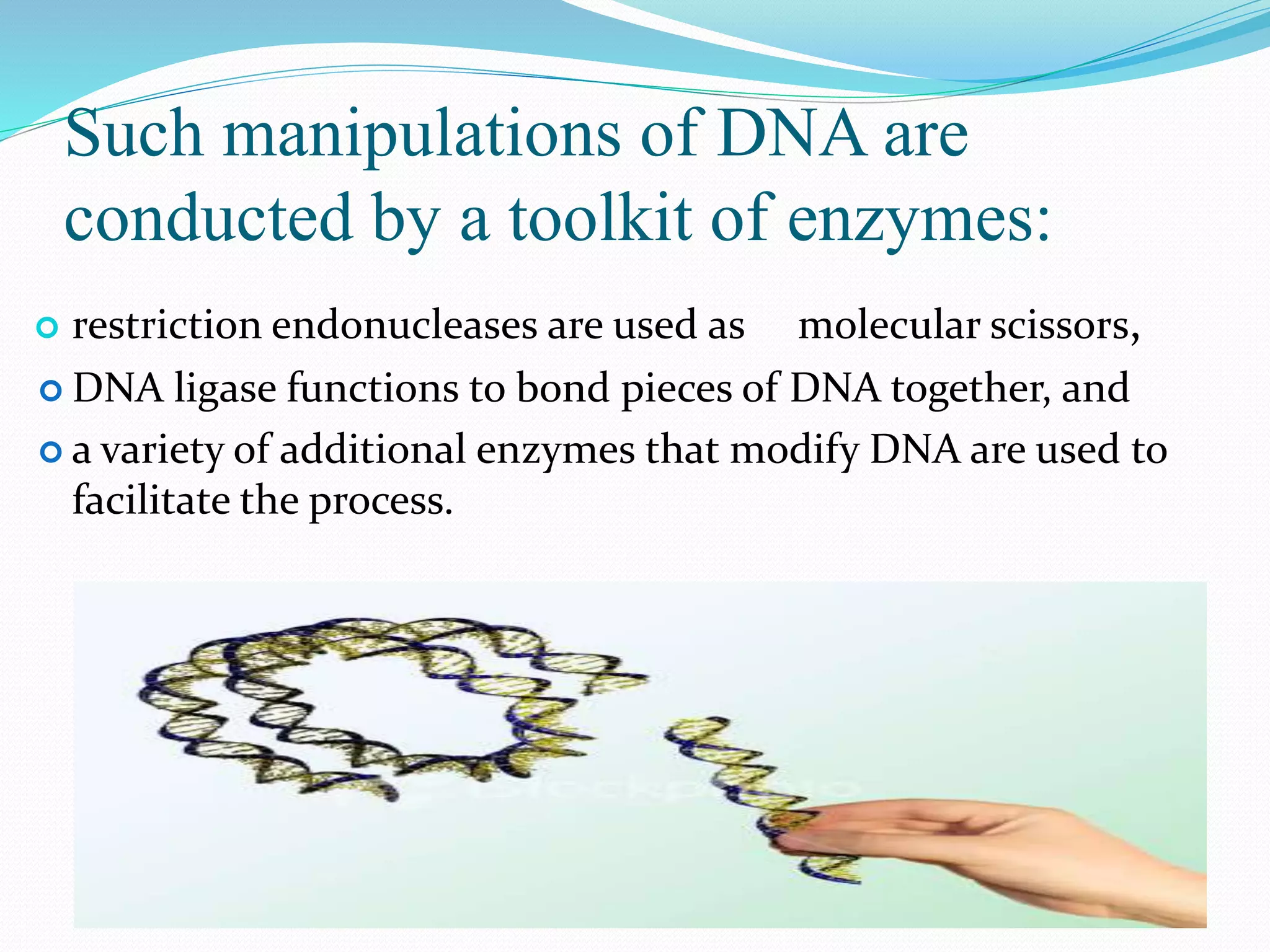
 restriction endonucleases are used as molecular scissors,
 DNA ligase functions to bond pieces of DNA together, and
 a variety of additional enzymes that modify DNA are used to
facilitate the process.
DNA modifying enzymes
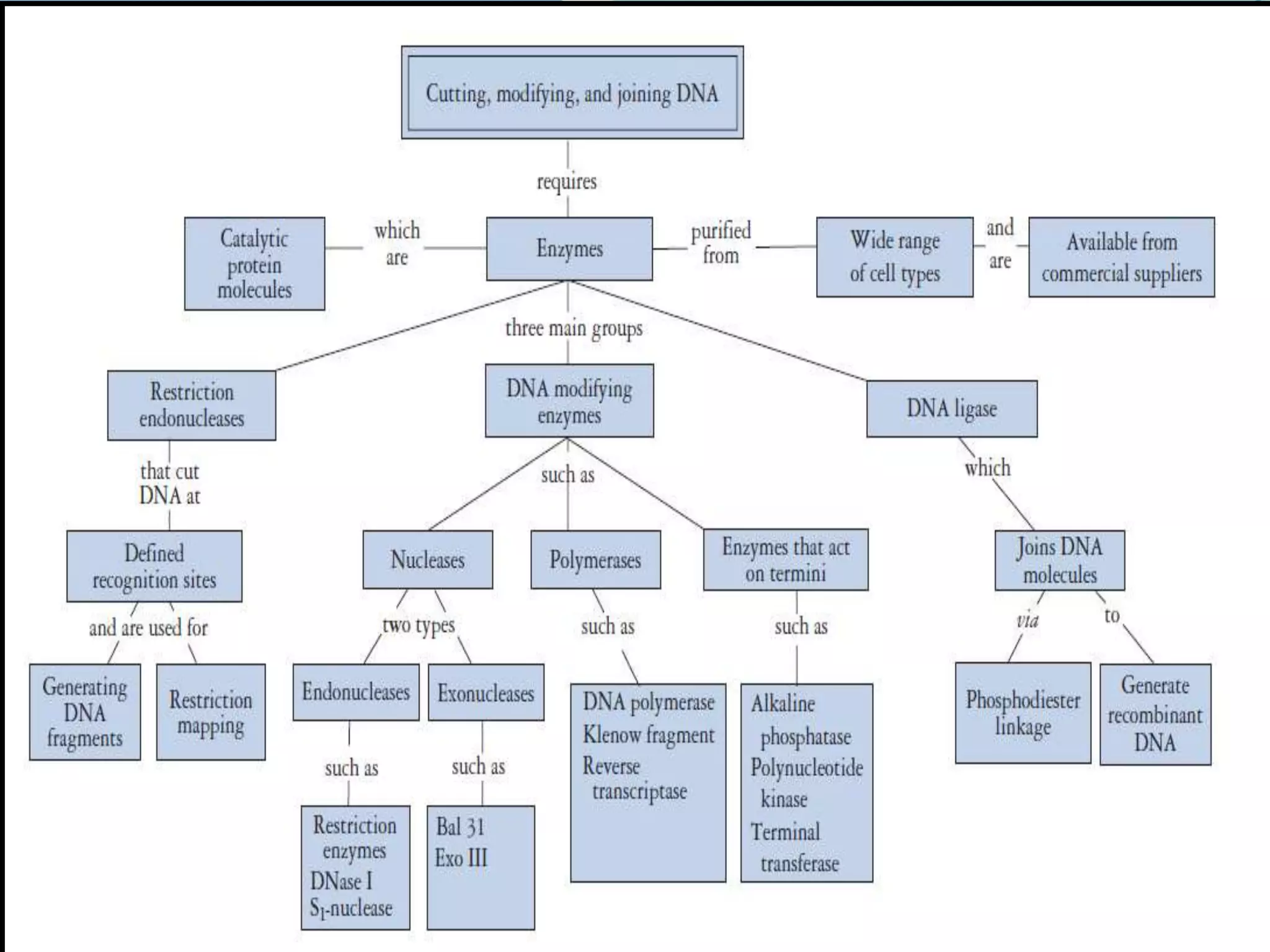
 Restriction enzymes and DNA ligases represent the
cutting and joining functions in DNA manipulation.
 All other enzymes involved in genetic engineering fall
under the broad category of enzymes known as DNA
modifying enzymes.
 These enzymes are involved in the degradation,
synthesis and alteration of the nucleic acids.
Nucleases
 Nuclease enzymes degrade nucleic acids by breaking
the phosphodiester bond that holds the nucleotides
together.
 Restriction enzymes are good examples of
endonucleases, which cut within a DNA strand.
 A second group of nucleases, which degrade DNA
from the termini of the molecule, are known as
exonucleases.
Nucleases and its action
Polymerases
 Polymerase enzymes synthesise copies of nucleic acid
molecules and are used in many genetic engineering
procedures.
 When describing a polymerase enzyme, the terms ‘DNA-
dependent’ or ‘RNA-dependent’ may be used to indicate
the type of nucleic acid template that the enzyme uses.
 Thus, a
 DNA-dependent DNA polymerase copies DNA into DNA,
 an RNA-dependent DNA polymerase copies RNA into DNA,
and
 a DNA-dependent RNA polymerase transcribes DNA into
RNA.
DNA Polymerases
Mesophilic and thermophilic DNA
polymerases for different polymerization
reactions, DNA end blunting and
amplification, labeling and others.
 DNA Polymerase, Large Fragment
 DNA Polymerase I
 T4 DNA Polymerase
 T7 DNA Polymerase
 Terminal Transferase (TdT)
DNA Polymerase, Large Fragment
•DNA Polymerase, Large Fragment, is a portion of
DNA polymerase of Bacillus smithii, which catalyzes
5'=>3' synthesis of DNA and lacks 5'→3' and 3'→5'
exonuclease activities.
Highlights
 Thermophilic DNA polymerase with strong strand
displacement activity
DNA Polymerase I
 DNA Polymerase I, a template-dependent DNA
polymerase, catalyzes 5'→3' synthesis of DNA.
 The enzyme also exhibits 3'→5' exonuclease
(proofreading) activity, 5'→3' exonuclease activity, and
ribonuclease H activity.
Highlights
Incorporates modified nucleotides
Active in multiple buffers, including restriction
enzyme, PCR, and RT buffers
Applications
 DNA labeling
 Second-strand synthesis of cDNA in
conjunction with RNaseH
T4 DNA Polymerase
 T4 DNA Polymerase, a template-dependent DNA
polymerase, catalyzes 5'-3' synthesis from primed
single-stranded DNA.
 The enzyme has a 3'-5' exonuclease activity, but lacks
5'-3' exonuclease activity.
T7 DNA Polymerase
 T7 DNA Polymerase, a template dependent DNA
polymerase.
 It catalyzes DNA synthesis in the 5'=>3' direction.
 It is a highly processive DNA polymerase allowing
continuous synthesis of long stretches of DNA.
Applications
 Purification of covalently closed circular DNA by
removal of residual genomic DNA
 Primer extension reactions on long templates
 DNA 3'-end labeling
 Strand extensions in site-directed mutagenesis
Terminal Transferase (TdT)
 Protruding, recessed or blunt ended double or single
stranded DNA molecules serve as a substrate for TdT.
 TdT is isolated and purified from an E. coli strain
carrying the cloned terminal transferase gene from calf
thymus.
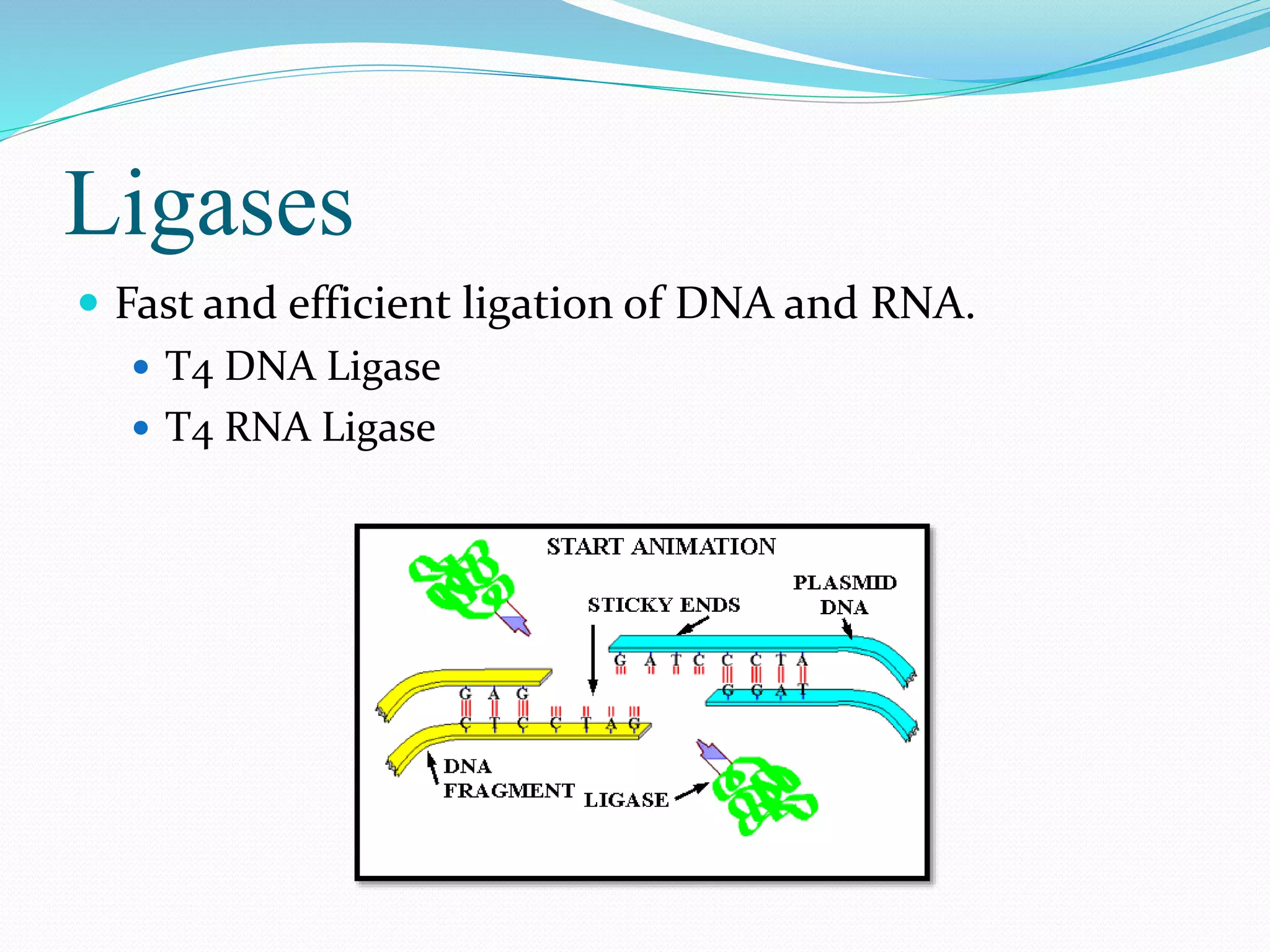
DNA ligase
 DNA ligase is an important cellular enzyme, as its
function is to repair broken phosphodiester bonds that
may occur at random or as a consequence of DNA
replication or recombination.
 It can therefore be thought of as molecular glue, which
is used to stick pieces of DNA together.
Ligases
 Fast and efficient ligation of DNA and RNA.
 T4 DNA Ligase
 T4 RNA Ligase
T4 DNA Ligase
 The enzyme repairs single-strand nicks in duplex
DNA, RNA, or DNA/RNA hybrids.
 It also joins DNA fragments with either cohesive or
blunt termini, but has no activity on single-stranded
nucleic acids.
 The T4 DNA Ligase requires ATP as a cofactor.
Applications
 Cloning of restriction enzyme generated DNA
fragments
 Cloning of PCR products
 Joining of double-stranded oligonucleotide
linkers or adaptors to DNA
 Site-directed mutagenesis
T4 RNA Ligase
 T4 RNA Ligase catalyzes the ATP-dependent intra-
and intermolecular formation of phosphodiester
bonds between 5'-phosphate and 3'-hydroxyl termini
of oligonucleotides, single-stranded RNA and DNA.
Applications
 Joining RNA to RNA
 Specific modifications of tRNAs
 Site-specific generation of composite primers for PCR
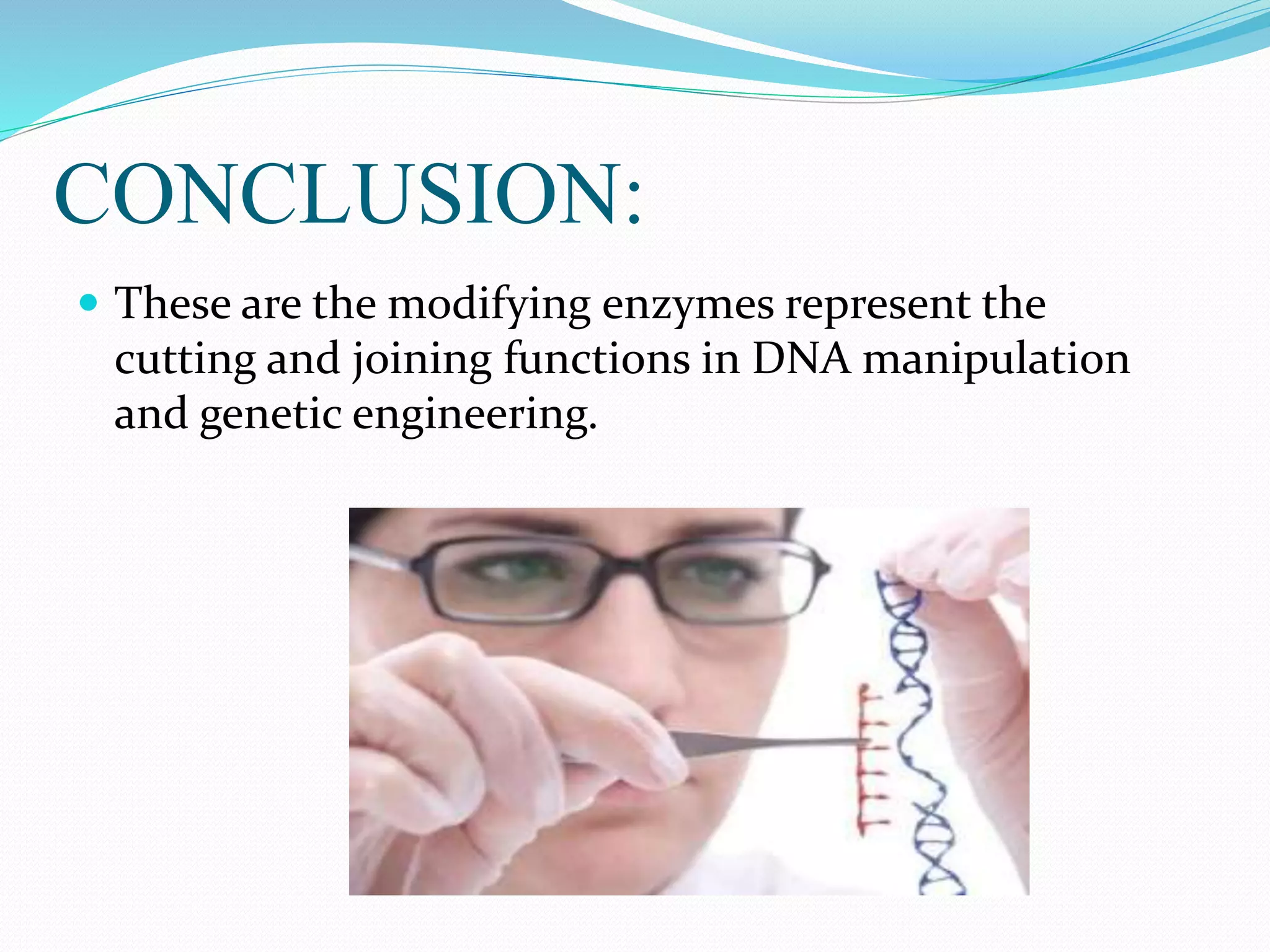
CONCLUSION:
 These are the modifying enzymes represent the
cutting and joining functions in DNA manipulation
and genetic engineering.
REFERENCES
MODIFYING ENZYMES

MODIFYING ENZYMES

  • 1.
    NAME:- T.ARUNA REG.NO:- U14BR001 BHARATHUNIVERSITY DEPT OF GENETIC ENGINEERING TECHNICAL SEMINOR
  • 2.
    Such manipulations ofDNA are conducted by a toolkit of enzymes:  restriction endonucleases are used as molecular scissors,  DNA ligase functions to bond pieces of DNA together, and  a variety of additional enzymes that modify DNA are used to facilitate the process.
  • 3.
    DNA modifying enzymes Restriction enzymes and DNA ligases represent the cutting and joining functions in DNA manipulation.  All other enzymes involved in genetic engineering fall under the broad category of enzymes known as DNA modifying enzymes.  These enzymes are involved in the degradation, synthesis and alteration of the nucleic acids.
  • 6.
    Nucleases  Nuclease enzymesdegrade nucleic acids by breaking the phosphodiester bond that holds the nucleotides together.  Restriction enzymes are good examples of endonucleases, which cut within a DNA strand.  A second group of nucleases, which degrade DNA from the termini of the molecule, are known as exonucleases.
  • 7.
  • 8.
    Polymerases  Polymerase enzymessynthesise copies of nucleic acid molecules and are used in many genetic engineering procedures.  When describing a polymerase enzyme, the terms ‘DNA- dependent’ or ‘RNA-dependent’ may be used to indicate the type of nucleic acid template that the enzyme uses.  Thus, a  DNA-dependent DNA polymerase copies DNA into DNA,  an RNA-dependent DNA polymerase copies RNA into DNA, and  a DNA-dependent RNA polymerase transcribes DNA into RNA.
  • 9.
    DNA Polymerases Mesophilic andthermophilic DNA polymerases for different polymerization reactions, DNA end blunting and amplification, labeling and others.  DNA Polymerase, Large Fragment  DNA Polymerase I  T4 DNA Polymerase  T7 DNA Polymerase  Terminal Transferase (TdT)
  • 10.
    DNA Polymerase, LargeFragment •DNA Polymerase, Large Fragment, is a portion of DNA polymerase of Bacillus smithii, which catalyzes 5'=>3' synthesis of DNA and lacks 5'→3' and 3'→5' exonuclease activities. Highlights  Thermophilic DNA polymerase with strong strand displacement activity
  • 11.
    DNA Polymerase I DNA Polymerase I, a template-dependent DNA polymerase, catalyzes 5'→3' synthesis of DNA.  The enzyme also exhibits 3'→5' exonuclease (proofreading) activity, 5'→3' exonuclease activity, and ribonuclease H activity.
  • 12.
    Highlights Incorporates modified nucleotides Activein multiple buffers, including restriction enzyme, PCR, and RT buffers Applications  DNA labeling  Second-strand synthesis of cDNA in conjunction with RNaseH
  • 13.
    T4 DNA Polymerase T4 DNA Polymerase, a template-dependent DNA polymerase, catalyzes 5'-3' synthesis from primed single-stranded DNA.  The enzyme has a 3'-5' exonuclease activity, but lacks 5'-3' exonuclease activity.
  • 14.
    T7 DNA Polymerase T7 DNA Polymerase, a template dependent DNA polymerase.  It catalyzes DNA synthesis in the 5'=>3' direction.  It is a highly processive DNA polymerase allowing continuous synthesis of long stretches of DNA.
  • 15.
    Applications  Purification ofcovalently closed circular DNA by removal of residual genomic DNA  Primer extension reactions on long templates  DNA 3'-end labeling  Strand extensions in site-directed mutagenesis
  • 16.
    Terminal Transferase (TdT) Protruding, recessed or blunt ended double or single stranded DNA molecules serve as a substrate for TdT.  TdT is isolated and purified from an E. coli strain carrying the cloned terminal transferase gene from calf thymus.
  • 17.
    DNA ligase  DNAligase is an important cellular enzyme, as its function is to repair broken phosphodiester bonds that may occur at random or as a consequence of DNA replication or recombination.  It can therefore be thought of as molecular glue, which is used to stick pieces of DNA together.
  • 18.
    Ligases  Fast andefficient ligation of DNA and RNA.  T4 DNA Ligase  T4 RNA Ligase
  • 19.
    T4 DNA Ligase The enzyme repairs single-strand nicks in duplex DNA, RNA, or DNA/RNA hybrids.  It also joins DNA fragments with either cohesive or blunt termini, but has no activity on single-stranded nucleic acids.  The T4 DNA Ligase requires ATP as a cofactor.
  • 20.
    Applications  Cloning ofrestriction enzyme generated DNA fragments  Cloning of PCR products  Joining of double-stranded oligonucleotide linkers or adaptors to DNA  Site-directed mutagenesis
  • 21.
    T4 RNA Ligase T4 RNA Ligase catalyzes the ATP-dependent intra- and intermolecular formation of phosphodiester bonds between 5'-phosphate and 3'-hydroxyl termini of oligonucleotides, single-stranded RNA and DNA. Applications  Joining RNA to RNA  Specific modifications of tRNAs  Site-specific generation of composite primers for PCR
  • 22.
    CONCLUSION:  These arethe modifying enzymes represent the cutting and joining functions in DNA manipulation and genetic engineering.
  • 23.

Editor's Notes

  • #10 A mesophile is an organism that grows best in moderate temperature, neither too hot nor too cold, typically between 20 and 45 °C (68 and 113 °F).[1] The term is mainly applied tomicroorganisms. A thermophile is an organism — a type of extremophile — that thrives at relatively high temperatures, between 45 and 122 °C (113 and 252 °F).