Fluorescence in situ
Hybridization
PRESENTED BY : SHREYA LODH
UNDER THE GUIDANCE OF: DR.T.R.SHARMA
DR.R.K.CHAHOTA
INTRODUCTIONINTRODUCTION
 FISH is a cytogenetic technique that uses
fluorescent probes that bind to only those parts
of the chormosomes with a high degree of
sequences complementarity.
 Fluorescent probe-DNA complex can be studied
under fluroscent microscope.
 Developed by the biomedical researchers in
early’ 1980s.
Characteristics of FISH
FISH - a process which vividly paints
chromosomes or portions of chromosomes
with fluorescent molecules.
identifies the presence and location of a
region of DNA or RNA within morphologically
preserved chromosome preparations, fixed
cells or tissue sections
(FISH) contd.
Identifies chromosomal abnormalities
Aids in gene mapping, toxicological
studies, analysis of chromosome
structural aberrations, and ploidy
determination
Centromere regions stained brighter -
means they are rich in A-T bonds
Advantage of (FISH)
less labor-intensive method for
confirming the presence of a
DNA segment within an entire
genome than other
conventional methods like
Southern blotting
FISH: Limitations
Probe design requires knowledge of
specific chromosomal abnormalities to be
studied
Cutoff signals may be different among
laboratories
Processing errors, imperfect hybridization,
non-specific binding, photobleaching,
interobserver variability, and false positive
and negative results are possible
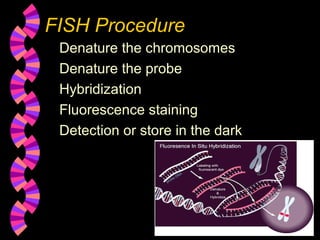
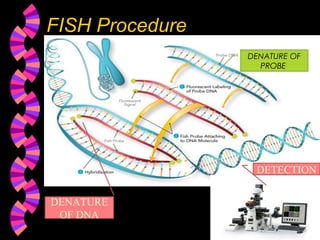
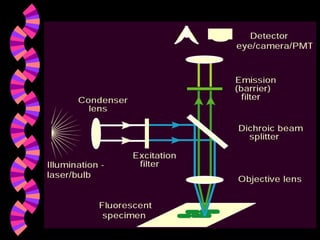
FISH Procedure
Denature the chromosomes
Denature the probe
Hybridization
Fluorescence staining
Detection or store in the dark
Probes
 Complementary sequences of target
nucleic acids
 Designed against the sequence of interest.
 Probes are tagged with fluorescent dyes
like biotin, fluorescein, Digoxigenin
 Size ranges from 20-40 bp to 1000bp.
 Stellaris(R) RNA FISH probes.
FISH Procedure
DETECTION
DENATURE OF
PROBE
DENATURE
OF DNA
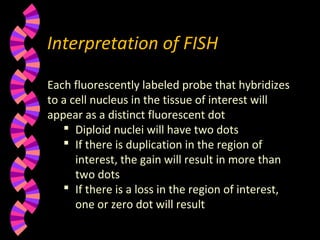
Interpretation of FISH
Each fluorescently labeled probe that hybridizes
to a cell nucleus in the tissue of interest will
appear as a distinct fluorescent dot
 Diploid nuclei will have two dots
 If there is duplication in the region of
interest, the gain will result in more than
two dots
 If there is a loss in the region of interest,
one or zero dot will result
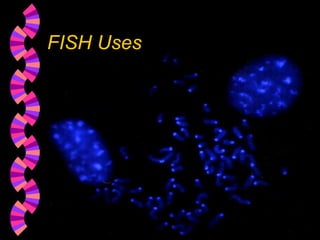
FISH Uses
APPLICATIONS
Also used in germ cell or prenatal diagnosis of
conditions such as aneuploidies.
Use to detect and localize the presence and absence of
the specific DNA sequences on chormosomes.
FISH often used for finding specific features in DNA
for use in genetic counselling, medicine, and species
identification.
FISH can also be used to detect and localize specific
RNA target (mRNA, IncRNA, miRNA) in cells.
Diseases that are diagnosed using FISH include
Angelman syndrome, 22q13 deletion syndrome,, acute
lymphoblastic leukemia, Cri-du-chat, and Down
syndrome.
FISH can also be used to compare the genomes of two
biological species, to deduce evolutionary relationships.
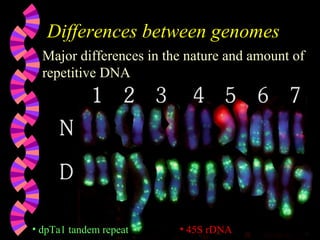
Differences between genomesDifferences between genomes
Major differences in the nature and amount of
repetitive DNA
• dpTa1 tandem repeat • 45S rDNA
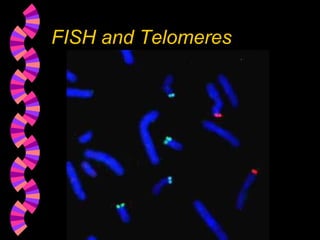
FISH and Telomeres
Telomeric probes define the terminal
boundaries of chromosomes (5’ and 3’ ends)
Used in research of chromosomal
rearrangements and deletions related to cell
aging or other genetic abnormalities
Special telomeric probes specific to individual
chromosomes have been designed
Probe is based on the TTAGGG repeat
present on all human telomeres
FISH and Telomeres
FISH in Physical Mapping
A physical map is primarily based on the locations of
landmarks along a DNA molecule and units of distance are
expressed in base pairs.
Low Resolution Physical Mapping
 Cytogenetic map
 In situ hybridization
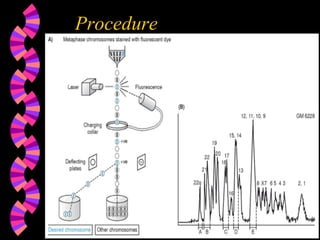
Procedure
THANK YOU …..

Fish

  • 1.
    Fluorescence in situ Hybridization PRESENTEDBY : SHREYA LODH UNDER THE GUIDANCE OF: DR.T.R.SHARMA DR.R.K.CHAHOTA
  • 2.
    INTRODUCTIONINTRODUCTION  FISH isa cytogenetic technique that uses fluorescent probes that bind to only those parts of the chormosomes with a high degree of sequences complementarity.  Fluorescent probe-DNA complex can be studied under fluroscent microscope.  Developed by the biomedical researchers in early’ 1980s.
  • 3.
    Characteristics of FISH FISH- a process which vividly paints chromosomes or portions of chromosomes with fluorescent molecules. identifies the presence and location of a region of DNA or RNA within morphologically preserved chromosome preparations, fixed cells or tissue sections
  • 4.
    (FISH) contd. Identifies chromosomalabnormalities Aids in gene mapping, toxicological studies, analysis of chromosome structural aberrations, and ploidy determination Centromere regions stained brighter - means they are rich in A-T bonds
  • 5.
    Advantage of (FISH) lesslabor-intensive method for confirming the presence of a DNA segment within an entire genome than other conventional methods like Southern blotting
  • 6.
    FISH: Limitations Probe designrequires knowledge of specific chromosomal abnormalities to be studied Cutoff signals may be different among laboratories Processing errors, imperfect hybridization, non-specific binding, photobleaching, interobserver variability, and false positive and negative results are possible
  • 7.
    FISH Procedure Denature thechromosomes Denature the probe Hybridization Fluorescence staining Detection or store in the dark
  • 8.
    Probes  Complementary sequencesof target nucleic acids  Designed against the sequence of interest.  Probes are tagged with fluorescent dyes like biotin, fluorescein, Digoxigenin  Size ranges from 20-40 bp to 1000bp.  Stellaris(R) RNA FISH probes.
  • 9.
  • 10.
    Interpretation of FISH Eachfluorescently labeled probe that hybridizes to a cell nucleus in the tissue of interest will appear as a distinct fluorescent dot  Diploid nuclei will have two dots  If there is duplication in the region of interest, the gain will result in more than two dots  If there is a loss in the region of interest, one or zero dot will result
  • 11.
  • 12.
    APPLICATIONS Also used ingerm cell or prenatal diagnosis of conditions such as aneuploidies. Use to detect and localize the presence and absence of the specific DNA sequences on chormosomes. FISH often used for finding specific features in DNA for use in genetic counselling, medicine, and species identification. FISH can also be used to detect and localize specific RNA target (mRNA, IncRNA, miRNA) in cells. Diseases that are diagnosed using FISH include Angelman syndrome, 22q13 deletion syndrome,, acute lymphoblastic leukemia, Cri-du-chat, and Down syndrome. FISH can also be used to compare the genomes of two biological species, to deduce evolutionary relationships.
  • 13.
    Differences between genomesDifferencesbetween genomes Major differences in the nature and amount of repetitive DNA • dpTa1 tandem repeat • 45S rDNA
  • 14.
    FISH and Telomeres Telomericprobes define the terminal boundaries of chromosomes (5’ and 3’ ends) Used in research of chromosomal rearrangements and deletions related to cell aging or other genetic abnormalities Special telomeric probes specific to individual chromosomes have been designed Probe is based on the TTAGGG repeat present on all human telomeres
  • 15.
  • 16.
    FISH in PhysicalMapping A physical map is primarily based on the locations of landmarks along a DNA molecule and units of distance are expressed in base pairs. Low Resolution Physical Mapping  Cytogenetic map  In situ hybridization
  • 17.
  • 20.