Operating a Fire Extinguisher
Types of Fire ExtinguishersTypes of Fire Extinguishers
Different types of fire extinguishers are designed
to fight different classes of fire.
The 3 most common types of fire extinguishers
are:
1.Water (APW)
2.Carbon Dioxide (CO2)
3.Dry Chemical (ABC, BC, DC)
11.. Water (APW) Fire Extinguishers
Types of Fire ExtinguishersTypes of Fire Extinguishers
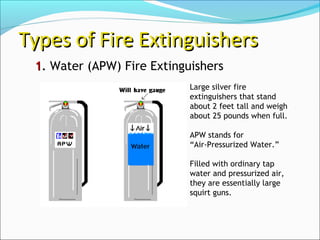
Large silver fire
extinguishers that stand
about 2 feet tall and weigh
about 25 pounds when full.
APW stands for
“Air-Pressurized Water.”
Filled with ordinary tap
water and pressurized air,
they are essentially large
squirt guns.
11.. Water (APW) Fire Extinguishers
Types of Fire ExtinguishersTypes of Fire Extinguishers
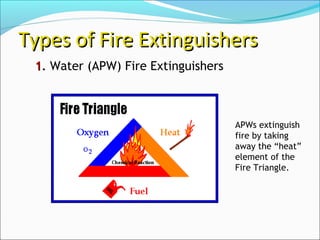
APWs extinguish
fire by taking
away the “heat”
element of the
Fire Triangle.
1.1. Water (APW) Fire Extinguishers
Types of Fire ExtinguishersTypes of Fire Extinguishers
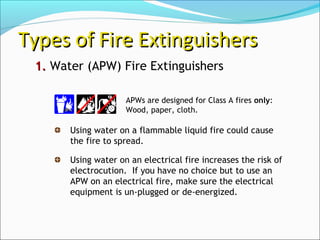
APWs are designed for Class A fires only:
Wood, paper, cloth.
Using water on a flammable liquid fire could cause
the fire to spread.
Using water on an electrical fire increases the risk of
electrocution. If you have no choice but to use an
APW on an electrical fire, make sure the electrical
equipment is un-plugged or de-energized.
11.. Water (APW) Fire Extinguishers
Types of Fire ExtinguishersTypes of Fire Extinguishers
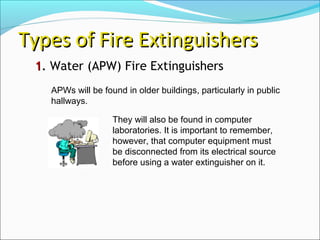
APWs will be found in older buildings, particularly in public
hallways.
They will also be found in computer
laboratories. It is important to remember,
however, that computer equipment must
be disconnected from its electrical source
before using a water extinguisher on it.
22.. Carbon Dioxide Fire Extinguishers
Types of Fire ExtinguishersTypes of Fire Extinguishers
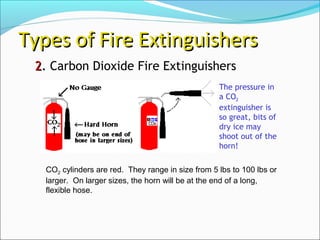
CO2 cylinders are red. They range in size from 5 lbs to 100 lbs or
larger. On larger sizes, the horn will be at the end of a long,
flexible hose.
The pressure in
a CO2
extinguisher is
so great, bits of
dry ice may
shoot out of the
horn!
2.2. Carbon Dioxide Fire Extinguishers
Types of Fire ExtinguishersTypes of Fire Extinguishers
CO2s will frequently be found in laboratories, mechanical
rooms, kitchens, and flammable liquid storage areas.
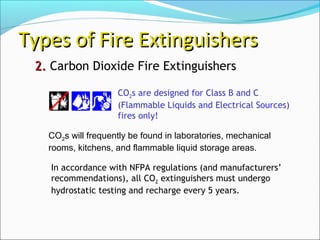
CO2s are designed for Class B and C
(Flammable Liquids and Electrical Sources)
fires only!
In accordance with NFPA regulations (and manufacturers’
recommendations), all CO2 extinguishers must undergo
hydrostatic testing and recharge every 5 years.
22.. Carbon Dioxide Fire Extinguishers
Types of Fire ExtinguishersTypes of Fire Extinguishers
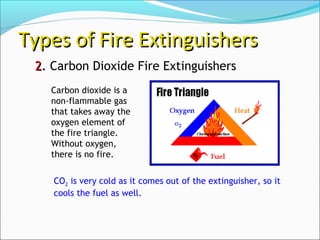
CO2 is very cold as it comes out of the extinguisher, so it
cools the fuel as well.
Carbon dioxide is a
non-flammable gas
that takes away the
oxygen element of
the fire triangle.
Without oxygen,
there is no fire.
22.. Carbon Dioxide Fire Extinguishers
Types of Fire ExtinguishersTypes of Fire Extinguishers
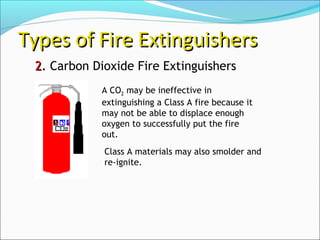
Class A materials may also smolder and
re-ignite.
A CO2 may be ineffective in
extinguishing a Class A fire because it
may not be able to displace enough
oxygen to successfully put the fire
out.
33.. Dry Chemical (ABC) Fire Extinguishers
Types of Fire ExtinguishersTypes of Fire Extinguishers
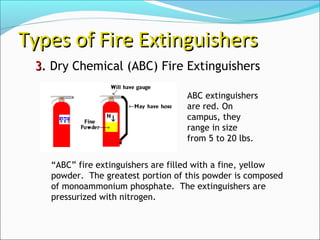
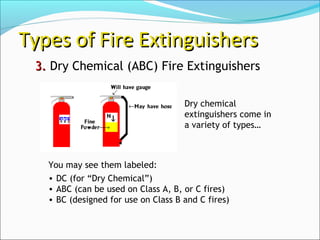
“ABC” fire extinguishers are filled with a fine, yellow
powder. The greatest portion of this powder is composed
of monoammonium phosphate. The extinguishers are
pressurized with nitrogen.
ABC extinguishers
are red. On
campus, they
range in size
from 5 to 20 lbs.
3.3. Dry Chemical (ABC) Fire Extinguishers
Types of Fire ExtinguishersTypes of Fire Extinguishers
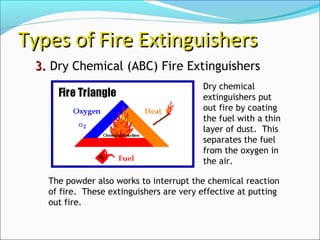
The powder also works to interrupt the chemical reaction
of fire. These extinguishers are very effective at putting
out fire.
Dry chemical
extinguishers put
out fire by coating
the fuel with a thin
layer of dust. This
separates the fuel
from the oxygen in
the air.
3.3. Dry Chemical (ABC) Fire Extinguishers
Types of Fire ExtinguishersTypes of Fire Extinguishers
You may see them labeled:
• DC (for “Dry Chemical”)
• ABC (can be used on Class A, B, or C fires)
• BC (designed for use on Class B and C fires)
Dry chemical
extinguishers come in
a variety of types…
3.3. Dry Chemical (ABC) Fire Extinguishers
Types of Fire ExtinguishersTypes of Fire Extinguishers
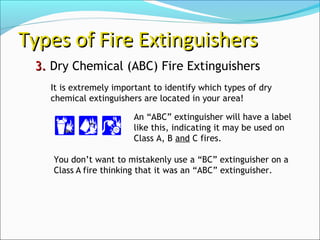
An “ABC” extinguisher will have a label
like this, indicating it may be used on
Class A, B and C fires.
It is extremely important to identify which types of dry
chemical extinguishers are located in your area!
You don’t want to mistakenly use a “BC” extinguisher on a
Class A fire thinking that it was an “ABC” extinguisher.
3.3. Dry Chemical (ABC) Fire Extinguishers
Types of Fire ExtinguishersTypes of Fire Extinguishers
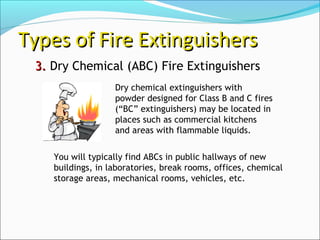
Dry chemical extinguishers with
powder designed for Class B and C fires
(“BC” extinguishers) may be located in
places such as commercial kitchens
and areas with flammable liquids.
You will typically find ABCs in public hallways of new
buildings, in laboratories, break rooms, offices, chemical
storage areas, mechanical rooms, vehicles, etc.
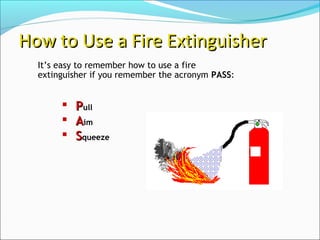
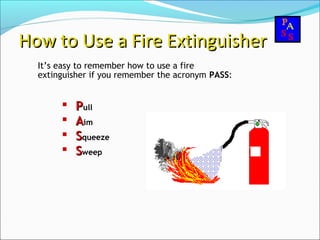
It’s easy to remember how to use a fire
extinguisher if you remember the acronym PASS:
How to Use a Fire ExtinguisherHow to Use a Fire Extinguisher
 PPull
 AAim
 SSqueeze
It’s easy to remember how to use a fire
extinguisher if you remember the acronym PASS:
How to Use a Fire ExtinguisherHow to Use a Fire Extinguisher
 PPull
 AAim
 SSqueeze
 SSweep
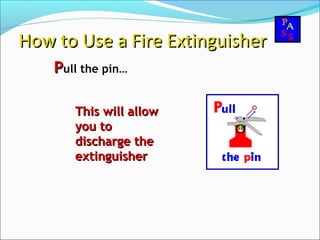
PPull the pin…
How to Use a Fire ExtinguisherHow to Use a Fire Extinguisher
This will allowThis will allow
you toyou to
discharge thedischarge the
extinguisherextinguisher
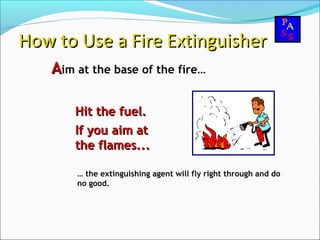
AAim at the base of the fire…
How to Use a Fire ExtinguisherHow to Use a Fire Extinguisher
Hit the fuel.Hit the fuel.
If you aim atIf you aim at
the flames...the flames...
… the extinguishing agent will fly right through and do
no good.
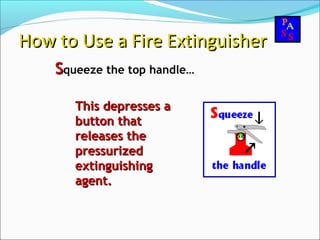
SSqueeze the top handle…
How to Use a Fire ExtinguisherHow to Use a Fire Extinguisher
This depresses aThis depresses a
button thatbutton that
releases thereleases the
pressurizedpressurized
extinguishingextinguishing
agent.agent.
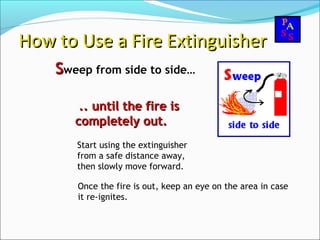
SSweep from side to side…
How to Use a Fire ExtinguisherHow to Use a Fire Extinguisher
.. until the fire is.. until the fire is
completely out.completely out.
Start using the extinguisher
from a safe distance away,
then slowly move forward.
Once the fire is out, keep an eye on the area in case
it re-ignites.

Fire extinguisher

  • 1.
    Operating a FireExtinguisher
  • 2.
    Types of FireExtinguishersTypes of Fire Extinguishers Different types of fire extinguishers are designed to fight different classes of fire. The 3 most common types of fire extinguishers are: 1.Water (APW) 2.Carbon Dioxide (CO2) 3.Dry Chemical (ABC, BC, DC)
  • 3.
    11.. Water (APW)Fire Extinguishers Types of Fire ExtinguishersTypes of Fire Extinguishers Large silver fire extinguishers that stand about 2 feet tall and weigh about 25 pounds when full. APW stands for “Air-Pressurized Water.” Filled with ordinary tap water and pressurized air, they are essentially large squirt guns.
  • 4.
    11.. Water (APW)Fire Extinguishers Types of Fire ExtinguishersTypes of Fire Extinguishers APWs extinguish fire by taking away the “heat” element of the Fire Triangle.
  • 5.
    1.1. Water (APW)Fire Extinguishers Types of Fire ExtinguishersTypes of Fire Extinguishers APWs are designed for Class A fires only: Wood, paper, cloth. Using water on a flammable liquid fire could cause the fire to spread. Using water on an electrical fire increases the risk of electrocution. If you have no choice but to use an APW on an electrical fire, make sure the electrical equipment is un-plugged or de-energized.
  • 6.
    11.. Water (APW)Fire Extinguishers Types of Fire ExtinguishersTypes of Fire Extinguishers APWs will be found in older buildings, particularly in public hallways. They will also be found in computer laboratories. It is important to remember, however, that computer equipment must be disconnected from its electrical source before using a water extinguisher on it.
  • 7.
    22.. Carbon DioxideFire Extinguishers Types of Fire ExtinguishersTypes of Fire Extinguishers CO2 cylinders are red. They range in size from 5 lbs to 100 lbs or larger. On larger sizes, the horn will be at the end of a long, flexible hose. The pressure in a CO2 extinguisher is so great, bits of dry ice may shoot out of the horn!
  • 8.
    2.2. Carbon DioxideFire Extinguishers Types of Fire ExtinguishersTypes of Fire Extinguishers CO2s will frequently be found in laboratories, mechanical rooms, kitchens, and flammable liquid storage areas. CO2s are designed for Class B and C (Flammable Liquids and Electrical Sources) fires only! In accordance with NFPA regulations (and manufacturers’ recommendations), all CO2 extinguishers must undergo hydrostatic testing and recharge every 5 years.
  • 9.
    22.. Carbon DioxideFire Extinguishers Types of Fire ExtinguishersTypes of Fire Extinguishers CO2 is very cold as it comes out of the extinguisher, so it cools the fuel as well. Carbon dioxide is a non-flammable gas that takes away the oxygen element of the fire triangle. Without oxygen, there is no fire.
  • 10.
    22.. Carbon DioxideFire Extinguishers Types of Fire ExtinguishersTypes of Fire Extinguishers Class A materials may also smolder and re-ignite. A CO2 may be ineffective in extinguishing a Class A fire because it may not be able to displace enough oxygen to successfully put the fire out.
  • 11.
    33.. Dry Chemical(ABC) Fire Extinguishers Types of Fire ExtinguishersTypes of Fire Extinguishers “ABC” fire extinguishers are filled with a fine, yellow powder. The greatest portion of this powder is composed of monoammonium phosphate. The extinguishers are pressurized with nitrogen. ABC extinguishers are red. On campus, they range in size from 5 to 20 lbs.
  • 12.
    3.3. Dry Chemical(ABC) Fire Extinguishers Types of Fire ExtinguishersTypes of Fire Extinguishers The powder also works to interrupt the chemical reaction of fire. These extinguishers are very effective at putting out fire. Dry chemical extinguishers put out fire by coating the fuel with a thin layer of dust. This separates the fuel from the oxygen in the air.
  • 13.
    3.3. Dry Chemical(ABC) Fire Extinguishers Types of Fire ExtinguishersTypes of Fire Extinguishers You may see them labeled: • DC (for “Dry Chemical”) • ABC (can be used on Class A, B, or C fires) • BC (designed for use on Class B and C fires) Dry chemical extinguishers come in a variety of types…
  • 14.
    3.3. Dry Chemical(ABC) Fire Extinguishers Types of Fire ExtinguishersTypes of Fire Extinguishers An “ABC” extinguisher will have a label like this, indicating it may be used on Class A, B and C fires. It is extremely important to identify which types of dry chemical extinguishers are located in your area! You don’t want to mistakenly use a “BC” extinguisher on a Class A fire thinking that it was an “ABC” extinguisher.
  • 15.
    3.3. Dry Chemical(ABC) Fire Extinguishers Types of Fire ExtinguishersTypes of Fire Extinguishers Dry chemical extinguishers with powder designed for Class B and C fires (“BC” extinguishers) may be located in places such as commercial kitchens and areas with flammable liquids. You will typically find ABCs in public hallways of new buildings, in laboratories, break rooms, offices, chemical storage areas, mechanical rooms, vehicles, etc.
  • 16.
    It’s easy toremember how to use a fire extinguisher if you remember the acronym PASS: How to Use a Fire ExtinguisherHow to Use a Fire Extinguisher  PPull  AAim  SSqueeze
  • 17.
    It’s easy toremember how to use a fire extinguisher if you remember the acronym PASS: How to Use a Fire ExtinguisherHow to Use a Fire Extinguisher  PPull  AAim  SSqueeze  SSweep
  • 18.
    PPull the pin… Howto Use a Fire ExtinguisherHow to Use a Fire Extinguisher This will allowThis will allow you toyou to discharge thedischarge the extinguisherextinguisher
  • 19.
    AAim at thebase of the fire… How to Use a Fire ExtinguisherHow to Use a Fire Extinguisher Hit the fuel.Hit the fuel. If you aim atIf you aim at the flames...the flames... … the extinguishing agent will fly right through and do no good.
  • 20.
    SSqueeze the tophandle… How to Use a Fire ExtinguisherHow to Use a Fire Extinguisher This depresses aThis depresses a button thatbutton that releases thereleases the pressurizedpressurized extinguishingextinguishing agent.agent.
  • 21.
    SSweep from sideto side… How to Use a Fire ExtinguisherHow to Use a Fire Extinguisher .. until the fire is.. until the fire is completely out.completely out. Start using the extinguisher from a safe distance away, then slowly move forward. Once the fire is out, keep an eye on the area in case it re-ignites.