•   Goals of a Fire Prevention Program
•   Fire Prevention Strategy
•   Housekeeping Issues
•   Flammable and Combustible Liquids
•   Electrical Fire Hazards
•   Compartmentalization
• Life Safety
   – The primary goal of fire safety efforts is to protect
     building occupants from injury and to prevent loss of
     life.
• Property Protection
   – The secondary goal of fire safety is to prevent property
     damage.
• Protection of Operations
   – By preventing fires and limiting damage we can assure
     that work operations will continue.
The Strategy of Preventing a Fire
• A fire must have three things to ignite and maintain
  combustion:
   – Fuel
   – Heat
   – Oxygen
• The basic strategy of fire prevention is to control or isolate
  sources of fuel and heat in order to prevent combustion.
  If all three are not present in sufficient quantities a
   fire will not ignite or a fire will not be able to
   sustain combustion
• Good housekeeping habits are an important part of a safe
  workplace.
• Why is good housekeeping important?
   –   To reduce amounts of flammable and combustible materials.
   –   To reduce ignition hazards.
   –   To ensure safe emergency evacuation of occupants.
   –   To allow for quick emergency response.
General Housekeeping
               Guidelines
• Work areas, aisles, walkways, stairways, and equipment
  should be kept clear of loose materials, trash, scraps, etc.
• Never block aisles, fire exits, emergency equipment, or
  alarm pull stations with equipment or materials.
• Avoid build up of combustible trash and waste such as
  paper, wood, cardboard, etc.
• Keep use and storage of flammables and combustibles to a
  minimum.
• Clean up all spills such as grease, oil, or water
  immediately. A delay could result in accidents.
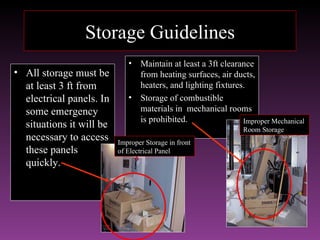
Storage Guidelines
                             •   Maintain at least a 3ft clearance
• All storage must be            from heating surfaces, air ducts,
  at least 3 ft from             heaters, and lighting fixtures.
  electrical panels. In      •   Storage of combustible
  some emergency                 materials in mechanical rooms
                                 is prohibited.                Improper Mechanical
  situations it will be                                        Room Storage
  necessary to access     Improper Storage in front
  these panels            of Electrical Panel
  quickly.
• Flammable and combustible liquids are potential
  fuel sources for fires and are present in almost
  every workplace.
• It is actually the vapor created by flammable and
  combustible liquids that ignites and burns.
• It is important to understand what materials in
  your work area are flammable and combustible so
  that you may properly store and isolate them from
  ignition sources.
How do I tell what’s flammable?
• NFPA classification system
    – The NFPA diamond is an easy way to determine the safety risks
       associated with hazardous materials. To determine a materials
 For example, An NFPA diamond on a of the diamond. A number in
       flammability refer to the red section
 can of gasoline would have a 3 flammability rating of the material.
       this section will indicate the in the
 red section indicating that gasoline
•could ignite at normal working system is used to
   The following numbering
   indicate flammability
 temperatures.
            0- will not burn
            1- must be preheated to burn
            2-ignites when moderately heated
            3-ignites at normal temperature
            4-extremely flammable
                                                  NFPA Diamond
Fire Safety-Electrical Issues
                 Electrical
• Electrical hazards are the cause of numerous workplace
  fires each year. Faulty electrical equipment or misuse of
  equipment produces heat and sparks that serve as ignition
  sources in the presence of flammable and combustible
  materials.
• Examples of common ignition hazards:
   – overloading circuits
   – use of unapproved electrical devices
   – damaged or worn wiring
Electrical Fire Safety

• Extension cords
  – Extension cords are only approved for temporary use.
    They may only be used for a period of three days or
    less. Instead of using extension cords contact FP&M to
    install permanent wiring.
  – When using extension cords check for defaults such as
    frays, brittleness, or broken wires.
  – Never place extension cords in high traffic areas where
    they can be damaged by being stepped on or run over
    by equipment.
Electrical Fire Safety
• Multi-plug strips
   – Should only be used for office equipment such as
     computers, printers, and fax machines.
   – Other common items such as microwaves, refrigerators,
     and copy machines must be plugged directly into wall
     outlets. This is a requirement of the State Fire Marshal.
   – Multi-plug strips should have a fuse or circuit breaker
     and be UL approved.
Compartmentalization
• Buildings are designed to prevent fire, heat, and smoke
  from spreading beyond locations of origination. Building
  elements such as fire walls, fire dampers, and fire doors,
  are designed to seal off one location from the next. This
  system is called compartmentalization.
• Compartmentalization increases the safety of evacuating
  building occupants because smoke and fire are not able to
  escape into exit passageways.
• Containment of fire and smoke reduces property damage
  and prevents small fires from growing into large fires.
• In order for compartmentalization efforts to be effective
  fire barriers must be maintained.
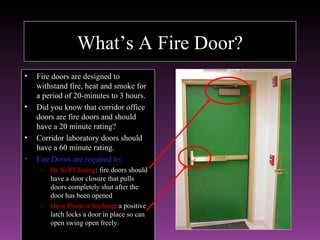
What’s A Fire Door?
•   Fire doors are designed to
    withstand fire, heat and smoke for
    a period of 20-minutes to 3 hours.
•   Did you know that corridor office
    doors are fire doors and should
    have a 20 minute rating?
•   Corridor laboratory doors should
    have a 60 minute rating.
•   Fire Doors are required to:
     – Be Self Closing: fire doors should
       have a door closure that pulls
       doors completely shut after the
       door has been opened
     – Have Positive latching: a positive
       latch locks a door in place so can
       open swing open freely.
Fire prevention.ppt

Fire prevention.ppt

  • 2.
    Goals of a Fire Prevention Program • Fire Prevention Strategy • Housekeeping Issues • Flammable and Combustible Liquids • Electrical Fire Hazards • Compartmentalization
  • 3.
    • Life Safety – The primary goal of fire safety efforts is to protect building occupants from injury and to prevent loss of life. • Property Protection – The secondary goal of fire safety is to prevent property damage. • Protection of Operations – By preventing fires and limiting damage we can assure that work operations will continue.
  • 4.
    The Strategy ofPreventing a Fire • A fire must have three things to ignite and maintain combustion: – Fuel – Heat – Oxygen • The basic strategy of fire prevention is to control or isolate sources of fuel and heat in order to prevent combustion. If all three are not present in sufficient quantities a fire will not ignite or a fire will not be able to sustain combustion
  • 5.
    • Good housekeepinghabits are an important part of a safe workplace. • Why is good housekeeping important? – To reduce amounts of flammable and combustible materials. – To reduce ignition hazards. – To ensure safe emergency evacuation of occupants. – To allow for quick emergency response.
  • 6.
    General Housekeeping Guidelines • Work areas, aisles, walkways, stairways, and equipment should be kept clear of loose materials, trash, scraps, etc. • Never block aisles, fire exits, emergency equipment, or alarm pull stations with equipment or materials. • Avoid build up of combustible trash and waste such as paper, wood, cardboard, etc. • Keep use and storage of flammables and combustibles to a minimum. • Clean up all spills such as grease, oil, or water immediately. A delay could result in accidents.
  • 7.
    Storage Guidelines • Maintain at least a 3ft clearance • All storage must be from heating surfaces, air ducts, at least 3 ft from heaters, and lighting fixtures. electrical panels. In • Storage of combustible some emergency materials in mechanical rooms is prohibited. Improper Mechanical situations it will be Room Storage necessary to access Improper Storage in front these panels of Electrical Panel quickly.
  • 8.
    • Flammable andcombustible liquids are potential fuel sources for fires and are present in almost every workplace. • It is actually the vapor created by flammable and combustible liquids that ignites and burns. • It is important to understand what materials in your work area are flammable and combustible so that you may properly store and isolate them from ignition sources.
  • 9.
    How do Itell what’s flammable? • NFPA classification system – The NFPA diamond is an easy way to determine the safety risks associated with hazardous materials. To determine a materials For example, An NFPA diamond on a of the diamond. A number in flammability refer to the red section can of gasoline would have a 3 flammability rating of the material. this section will indicate the in the red section indicating that gasoline •could ignite at normal working system is used to The following numbering indicate flammability temperatures. 0- will not burn 1- must be preheated to burn 2-ignites when moderately heated 3-ignites at normal temperature 4-extremely flammable NFPA Diamond
  • 10.
    Fire Safety-Electrical Issues Electrical • Electrical hazards are the cause of numerous workplace fires each year. Faulty electrical equipment or misuse of equipment produces heat and sparks that serve as ignition sources in the presence of flammable and combustible materials. • Examples of common ignition hazards: – overloading circuits – use of unapproved electrical devices – damaged or worn wiring
  • 11.
    Electrical Fire Safety •Extension cords – Extension cords are only approved for temporary use. They may only be used for a period of three days or less. Instead of using extension cords contact FP&M to install permanent wiring. – When using extension cords check for defaults such as frays, brittleness, or broken wires. – Never place extension cords in high traffic areas where they can be damaged by being stepped on or run over by equipment.
  • 12.
    Electrical Fire Safety •Multi-plug strips – Should only be used for office equipment such as computers, printers, and fax machines. – Other common items such as microwaves, refrigerators, and copy machines must be plugged directly into wall outlets. This is a requirement of the State Fire Marshal. – Multi-plug strips should have a fuse or circuit breaker and be UL approved.
  • 13.
    Compartmentalization • Buildings aredesigned to prevent fire, heat, and smoke from spreading beyond locations of origination. Building elements such as fire walls, fire dampers, and fire doors, are designed to seal off one location from the next. This system is called compartmentalization. • Compartmentalization increases the safety of evacuating building occupants because smoke and fire are not able to escape into exit passageways. • Containment of fire and smoke reduces property damage and prevents small fires from growing into large fires. • In order for compartmentalization efforts to be effective fire barriers must be maintained.
  • 14.
    What’s A FireDoor? • Fire doors are designed to withstand fire, heat and smoke for a period of 20-minutes to 3 hours. • Did you know that corridor office doors are fire doors and should have a 20 minute rating? • Corridor laboratory doors should have a 60 minute rating. • Fire Doors are required to: – Be Self Closing: fire doors should have a door closure that pulls doors completely shut after the door has been opened – Have Positive latching: a positive latch locks a door in place so can open swing open freely.