Fire Safety Training
What you will learn What is Fire Classes of Fire -  What to do in Case of  Fire Types of Extinguishers How to Use an Extinguisher Methods of Extinguishing First Responder Emergency Response team Development
Fire is man’s best friend   & worst enemy
It is a source of heat and light  It illuminates our homes,  drives our automobiles,  flies our aircraft, etc.
Fire when out of control   has no friends   no moral values   respects no barriers & recognizes no boundaries
Definition of Fire Exothermic chemical reaction followed by the evolution of heat and light
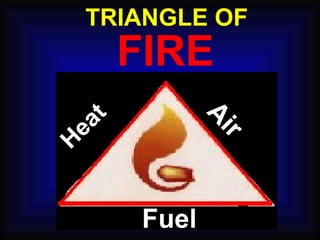
Heat Fuel Air TRIANGLE OF FIRE
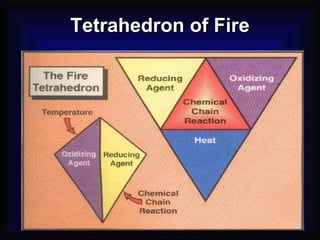
Tetrahedron of Fire
Petrol Kerosene Fire & its speed
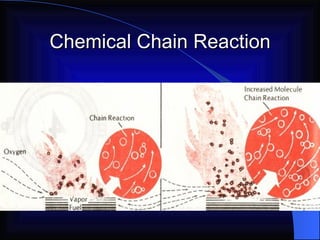
Chemical Chain Reaction
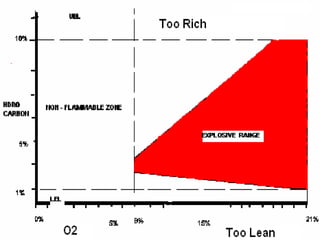
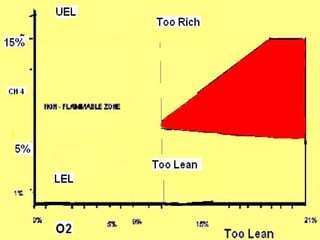
Basic Definitions Flammable Limit   of a material is a  % by volume mixture of its vapours with air within which it will burn (explode)
 
 
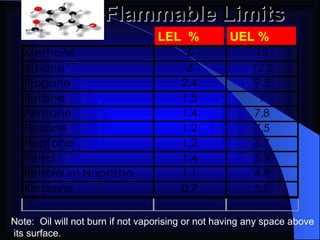
Flammable Limits Note:  Oil will not burn if not vaporising or not having any space above  its surface. LEL  %   UEL %
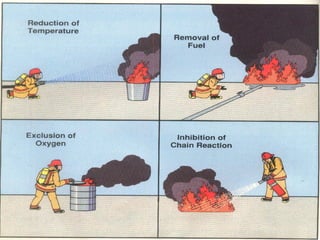
PRINCIPLES  OF  EXTINCTION
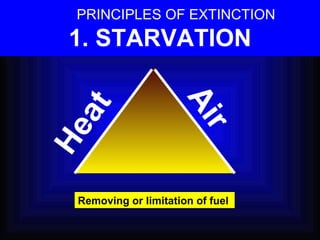
PRINCIPLES OF EXTINCTION 1. STARVATION Heat Air Removing or limitation of fuel
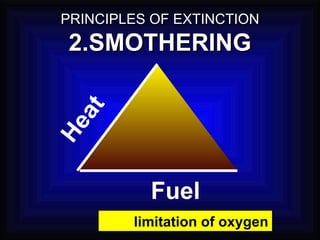
Heat Fuel PRINCIPLES OF EXTINCTION 2.SMOTHERING limitation of oxygen
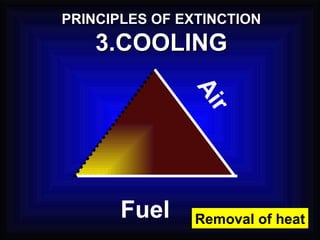
Air Fuel PRINCIPLES OF EXTINCTION 3.COOLING Removal of heat
 
 
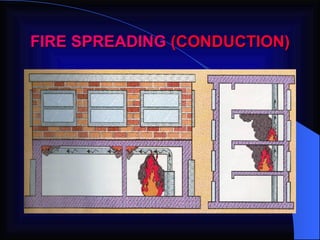
FIRE SPREADING  (CONDUCTION)
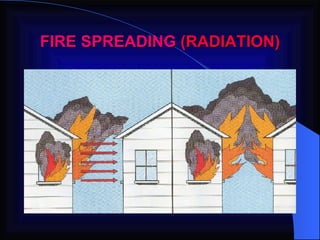
FIRE SPREADING  (RADIATION)
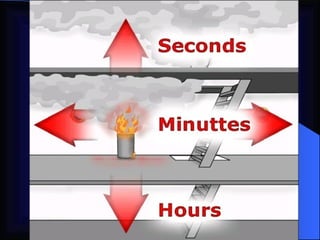
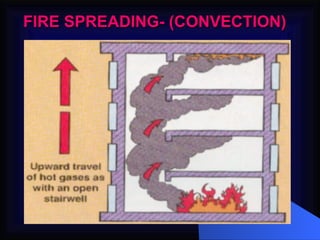
FIRE SPREADING- (CONVECTION)
Classifications  of  Fire
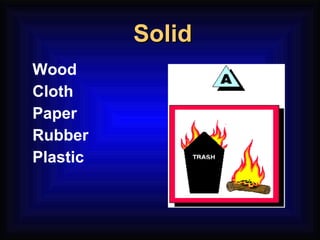
Solid Wood Cloth Paper Rubber Plastic
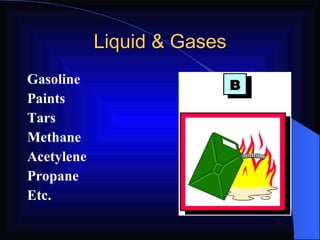
Liquid & Gases Gasoline Paints Tars Methane Acetylene Propane Etc.
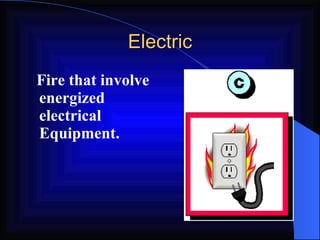
Electric Fire that involve energized electrical Equipment.
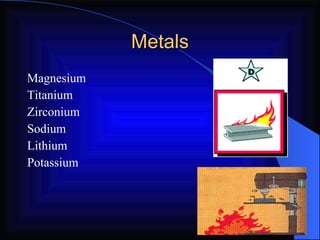
Metals Magnesium Titanium Zirconium Sodium Lithium Potassium
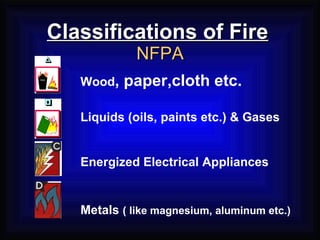
Classifications of Fire   NFPA Wood , paper,cloth etc.   Liquids (oils, paints etc.) & Gases   Energized Electrical Appliances Metals  ( like magnesium, aluminum etc.)
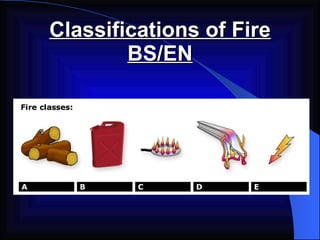
Classifications of Fire BS/EN
Common Causes of Fire Physical Cause Chemical Cause Biological Cause Radiological Cause
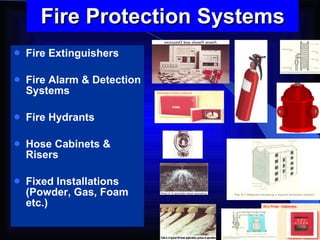
Fire Protection Systems Fire Extinguishers Fire Alarm & Detection Systems Fire Hydrants Hose Cabinets & Risers Fixed Installations (Powder, Gas, Foam etc.)
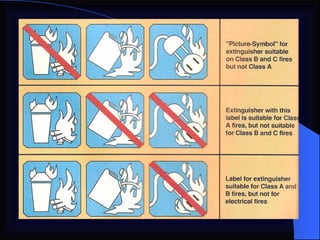
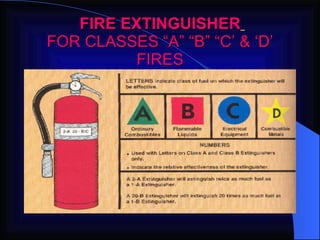
Types of Extinguishers Type of fire extinguishers are classified by the type of fires on which they may be used
 
FIRE EXTINGUISHER   FOR CLASSES “A” “B” “C’ & ‘D’ FIRES
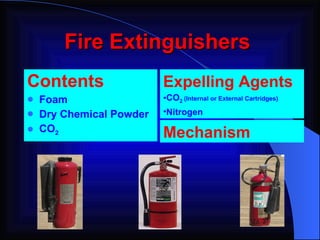
Fire Extinguishers   Contents Foam Dry Chemical Powder CO 2 Expelling Agents CO 2   (Internal or External Cartridges) Nitrogen Mechanism
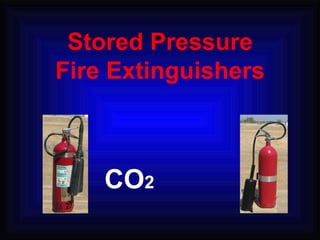
Stored Pressure Fire Extinguishers CO 2
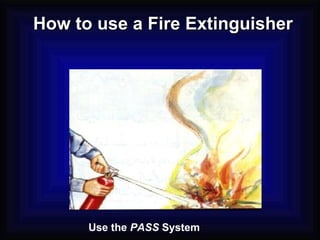
How to use a Fire Extinguisher Use the  PASS  System
PASS Pull Aim Squeeze Sweep
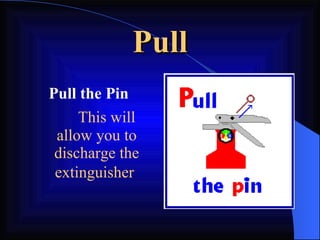
Pull Pull the Pin  This will allow you to discharge the extinguisher
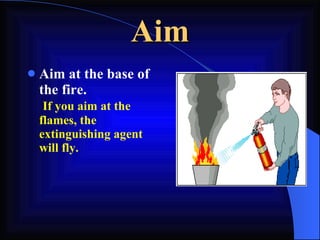
Aim Aim at the base of  the fire.    If you aim at the  flames, the extinguishing agent will fly.
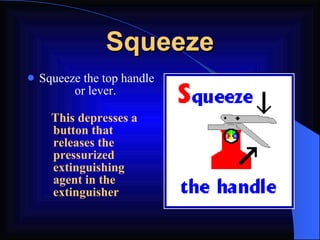
Squeeze Squeeze the top handle or lever.   This depresses a button that releases the pressurized extinguishing agent in the extinguisher
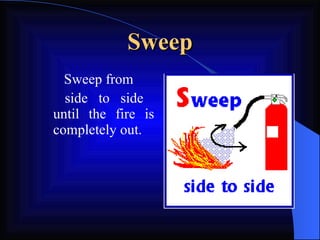
Sweep Sweep from side to side  until the fire is completely out.
Fire Routine What to do in case of a  Fire ?
1 Raise fire alarm  or  shout fire fire What to do in case of a fire?
Telephone City Fire Brigade  16 2 What to do in case of a fire? 1.  Raise Fire Alarm or Shout Fire Fire
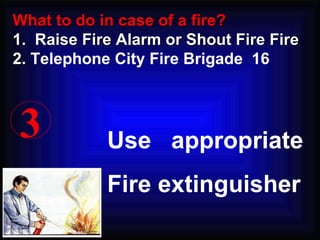
3 Use  appropriate Fire extinguisher What to do in case of a fire? 1.  Raise Fire Alarm or Shout Fire Fire 2.  Telephone City Fire Brigade  16
What to do in case of a fire? 1.  Raise Fire Alarm or Shout Fire Fire 2.  Telephone City Fire Brigade  16 3.  Use appropriate Fire Extinguishers 4 Shut / switch off necessary Valves / Switches
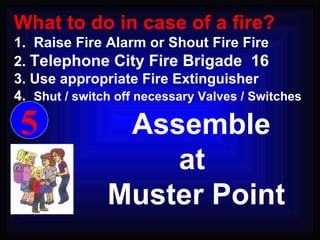
Assemble  at Muster Point 5 What to do in case of a fire? 1.  Raise Fire Alarm or Shout Fire Fire 2.  Telephone City Fire Brigade  16 3. Use appropriate Fire Extinguisher 4.  Shut / switch off necessary Valves / Switches
1.  Raise Fire Alarm or shout fire fire  2.  Telephone City Fire Brigade  16 3.Use appropriate Fire Extinguisher if Safe 4. Shut / Switch off  (necessary valves / switches) 5. Assemble at Muster Point What to do in case of a fire?
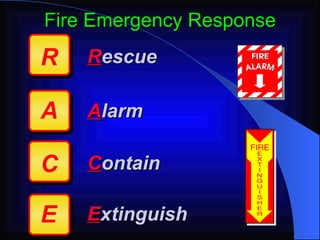
Fire Emergency Response R escue A larm C ontain E xtinguish R A C E
Fire Fighting Hints Always “Size Up” the fire Select the proper Extinguishing Agent
Work on side of fire where it is  extending Do not use Fire Extinguisher/ Water until fire is seen Fire Fighting Hints
Attack the fire until it “Dies – Out”.  Hit it again if it rekindles Fire Fighting Hints
Do not hit hot glass with water unless you want to break it Use all available means for personal protection Check carefully all possible avenues of fire travel Fire Fighting Hints
If you have to force open a door, smash a panel near the lock, so you may be able to get a hand to unlock the door from inside Don’t enter a burning building or room without Extinguishing media or Proper cover Fire Fighting Hints
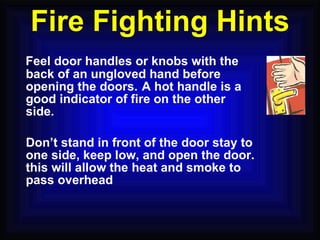
Feel door handles or knobs with the back of an ungloved hand before opening the doors.  A hot handle is a good indicator of fire on the other side.  Don’t stand in front of the door stay to one side, keep low, and open the door. this will allow the heat and smoke to pass overhead Fire Fighting Hints
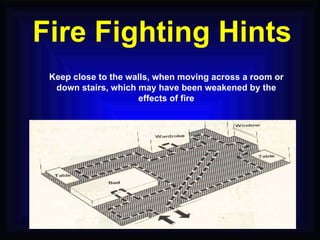
Keep close to the walls, when moving across a room or down stairs, which may have been weakened by the effects of fire Fire Fighting Hints
When having to crawl down stairs; come  backwards, with feet first Fire Fighting Hints
If a burning room gets too hot for you,  shut the door as you retreat; it restricts the air supply Fire Fighting Hints
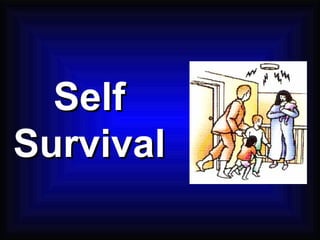
Self Survival
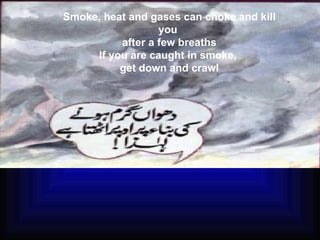
Smoke, heat and gases can choke and kill you  after a few breaths If you are caught in smoke,  get down and crawl
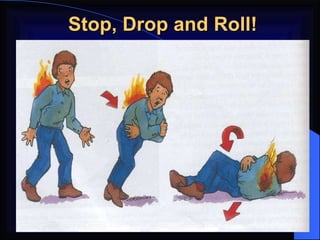
Stop, Drop and Roll!
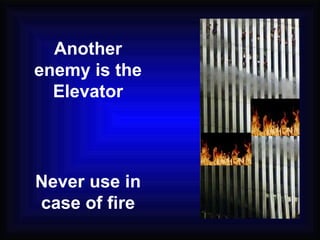
Another enemy is the Elevator Never use in case of fire
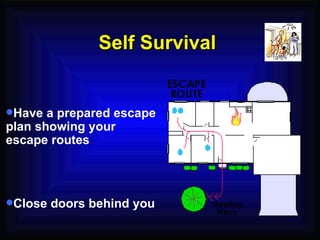
Have a prepared escape plan showing your escape routes  Close doors behind you Self Survival
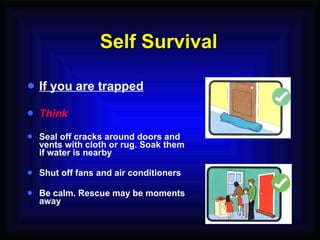
Self Survival If you are trapped Think Seal off cracks around doors and vents with cloth or rug. Soak them if water is nearby Shut off fans and air conditioners Be calm. Rescue may be moments away
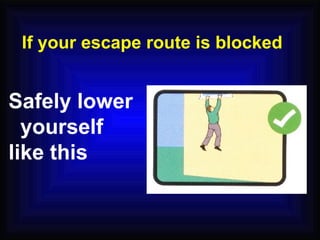
Safely lower  yourself like this If your escape route is blocked
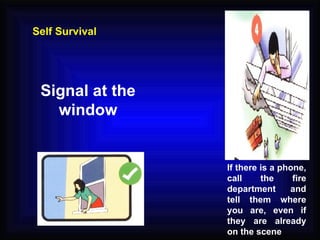
Signal at the window Self Survival If there is a phone, call the fire department and tell them where you are, even if they are already on the scene
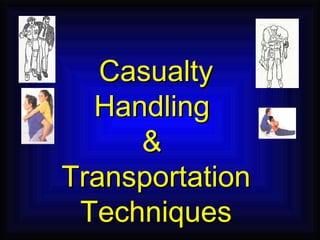
Casualty Handling  &  Transportation Techniques
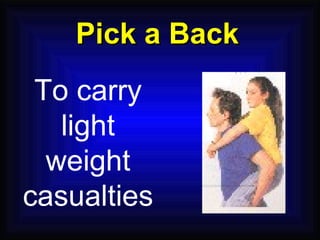
Pick a Back To carry light weight casualties
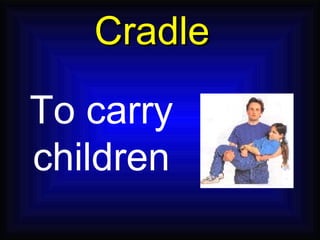
Cradle To carry children
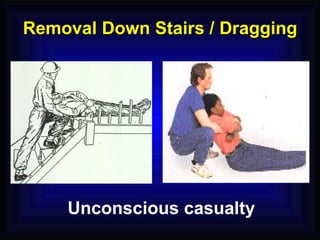
Removal Down Stairs / Dragging Unconscious casualty
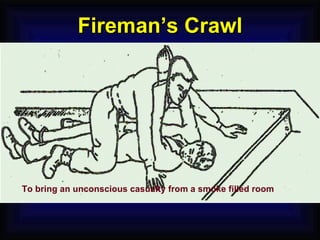
Fireman’s Crawl To bring an unconscious casualty from a smoke filled room
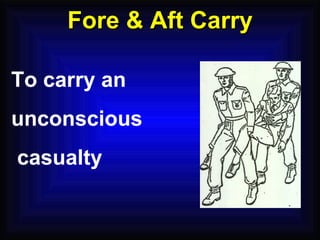
Fore & Aft Carry To carry an  unconscious casualty
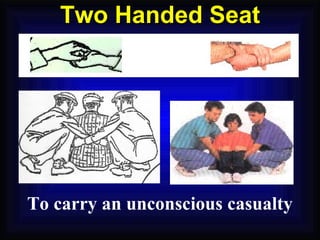
Two Handed Seat To carry an unconscious casualty
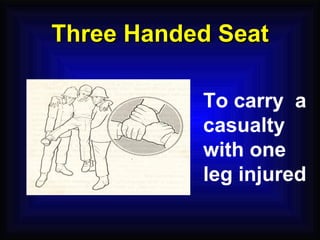
Three Handed Seat To carry  a casualty with one leg injured
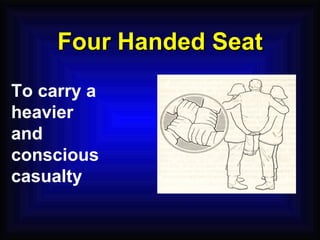
Four Handed Seat To carry a heavier and conscious casualty
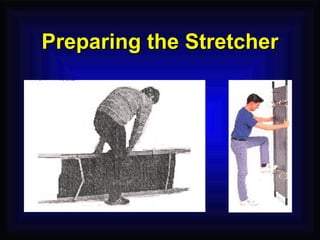
Preparing the Stretcher
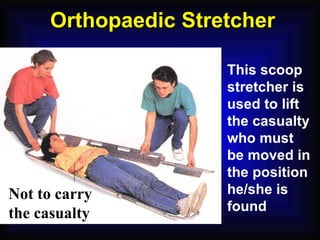
Orthopaedic Stretcher This scoop stretcher is used to lift the casualty who must be moved in the position he/she is found Not to carry the casualty
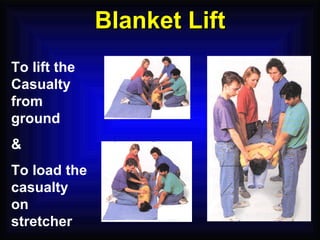
Blanket Lift To lift the Casualty from ground & To load the casualty on stretcher
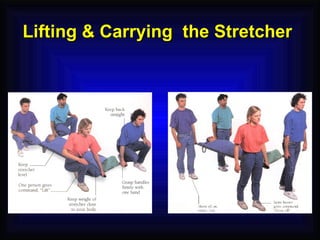
Lifting & Carrying  the Stretcher
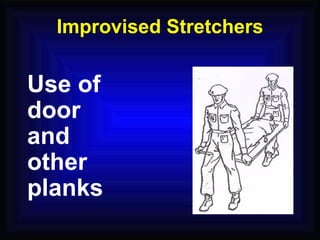
Improvised Stretchers Use of door and other planks
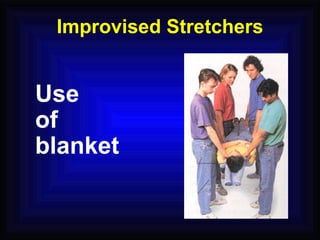
Improvised Stretchers Use  of blanket


Fire Risk Screening
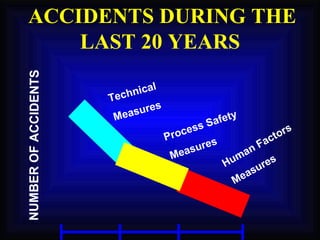
ACCIDENTS DURING THE LAST 20 YEARS NUMBER OF ACCIDENTS Technical  Measures Process Safety  Measures Human Factors Measures
 
Electrical Safety
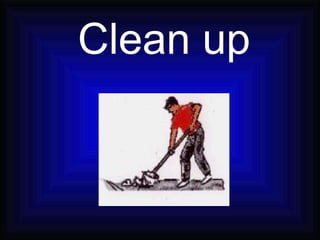
Clean up
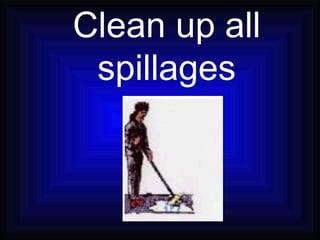
Clean up all spillages
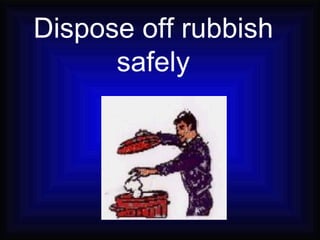
Dispose off rubbish safely
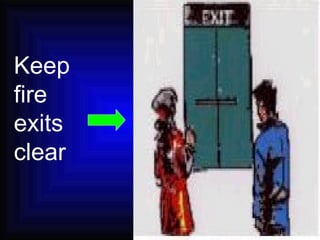
Keep fire exits clear
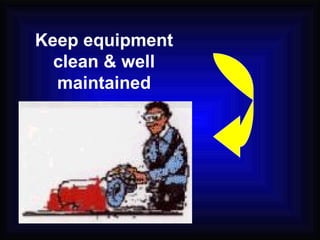
Keep equipment clean & well maintained
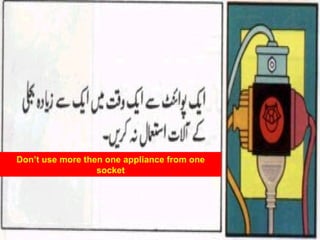
Don’t use more then one appliance from one socket
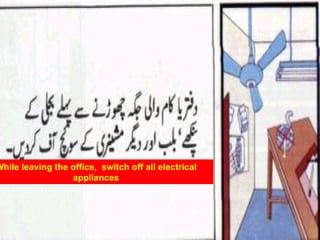
While leaving the office,  switch off all electrical appliances
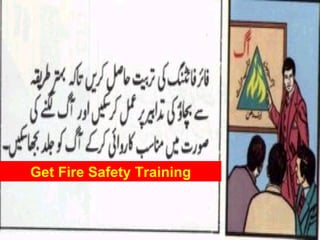
Get Fire Safety Training
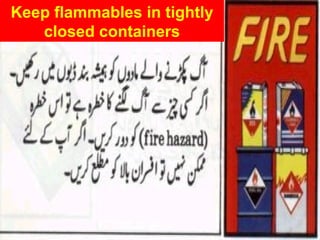
Keep flammables in tightly closed containers
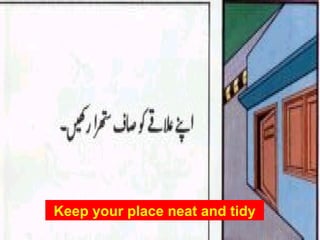
Keep your place neat and tidy
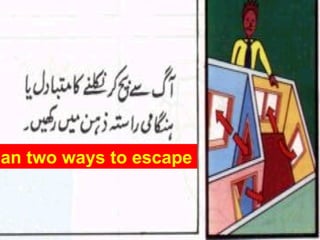
Plan two ways to escape
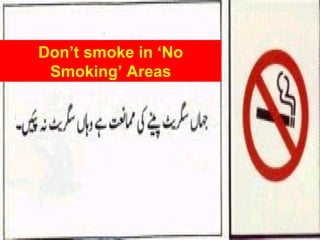
Don’t smoke in ‘No Smoking’ Areas
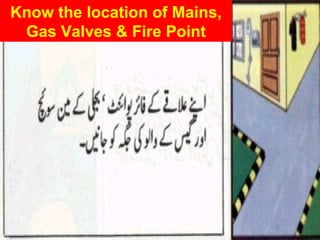
Know the location of Mains, Gas Valves & Fire Point
Follow the  Checklist Before any Hot Work
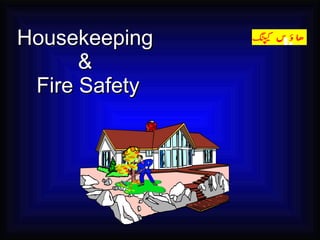
Housekeeping  &  Fire Safety
 
 
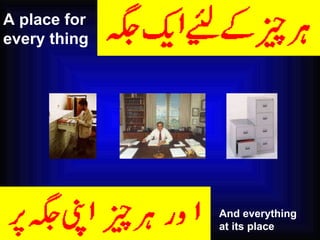
A place for every thing   And everything  at its place
 
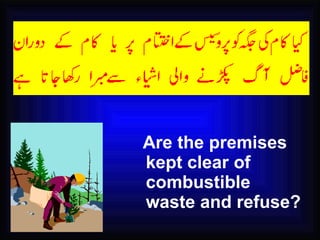
Are the premises kept clear of combustible  waste and refuse?
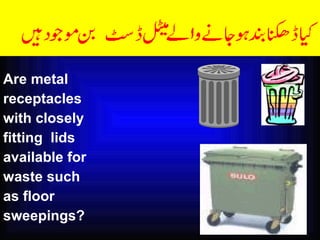
Are metal  receptacles with closely  fitting  lids  available for  waste such  as floor  sweepings?
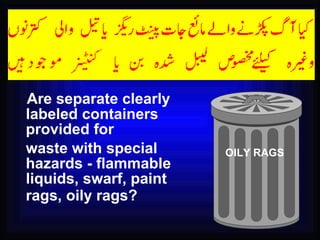
Are separate clearly labeled containers provided for  waste with special hazards - flammable liquids, swarf, paint rags, oily rags?   OILY RAGS
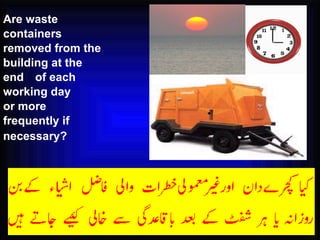
Are waste containers removed from the building at the  end  of each working day  or more frequently if necessary?
Is waste put out in a  safe place awaiting  disposal?
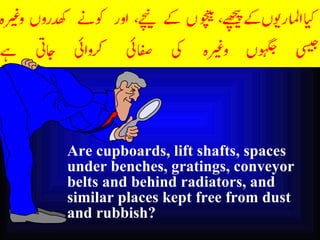
Are cupboards, lift shafts, spaces  under benches, gratings, conveyor  belts and behind radiators, and  similar places kept free from dust  and rubbish?
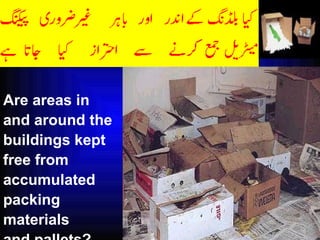
Are areas in and around the buildings kept free from accumulated packing  materials  and pallets?
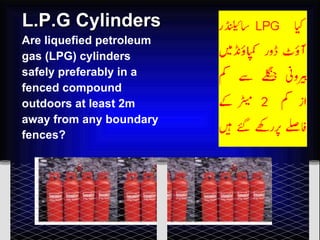
L.P.G Cylinders Are liquefied petroleum gas (LPG) cylinders  safely preferably in a fenced compound outdoors at least 2m away from any boundary fences?
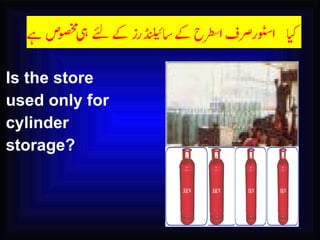
Is the store used only for cylinder storage?
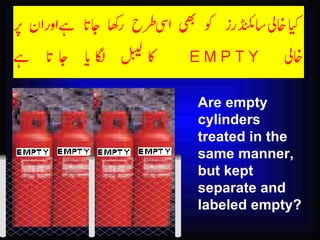
Are empty cylinders treated in the same manner, but kept separate and labeled empty?
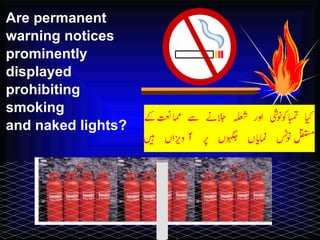
Are permanent  warning notices prominently displayed  prohibiting smoking  and naked lights?
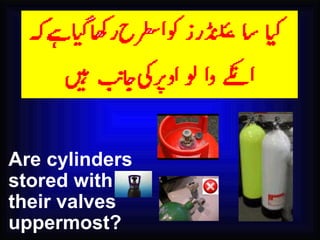
Are cylinders stored with their valves uppermost?
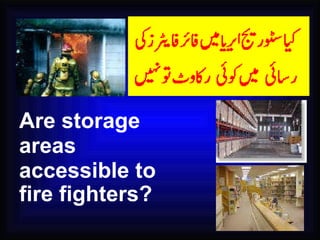
Are storage areas accessible to  fire fighters?
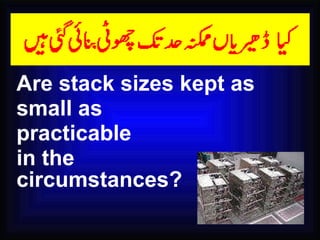
Are stack sizes kept as small as practicable in the  circumstances?
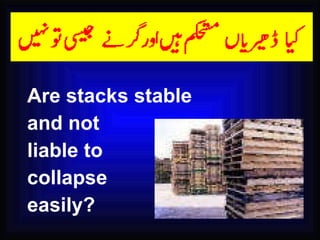
Are stacks stable and not liable to collapse easily?
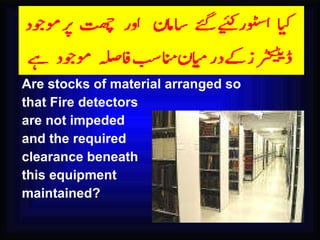
Are stocks of material arranged so that Fire detectors  are not impeded  and the required  clearance beneath  this equipment maintained?
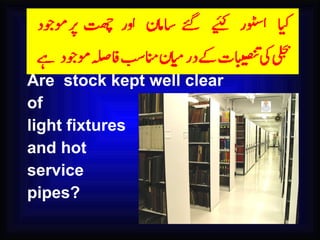
Are  stock kept well clear of  light fixtures  and hot  service  pipes?
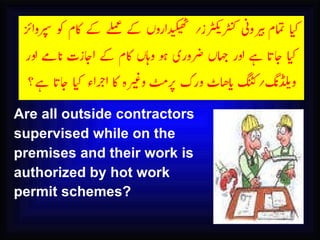
Are all outside contractors supervised while on the premises and their work is authorized by hot work permit schemes?
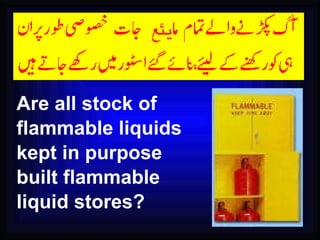
Are all stock of flammable liquids kept in purpose built flammable liquid stores?
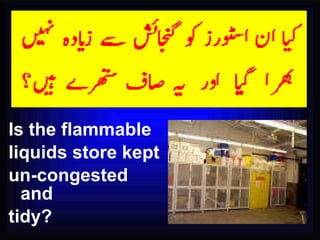
Is the flammable liquids store kept un-congested and tidy?
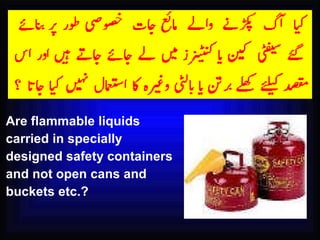
Are flammable liquids carried in specially designed safety containers and not open cans and buckets etc.?
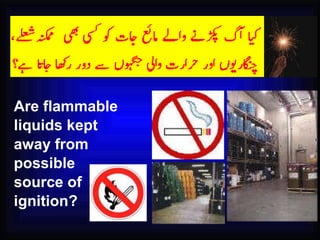
Are flammable liquids kept  away from possible source of ignition?
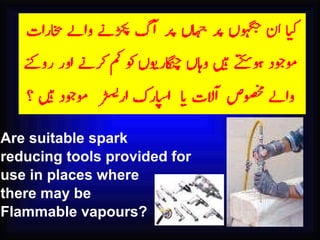
Are suitable spark reducing tools provided for use in places where  there may be  Flammable vapours?
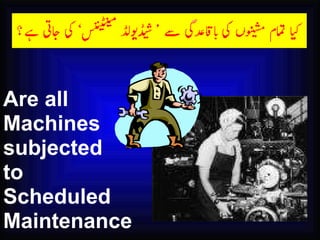
Are all Machines subjected  to  Scheduled Maintenance
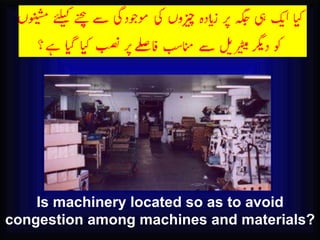
Is machinery located so as to avoid congestion among machines and materials?
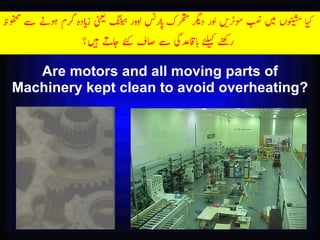
Are motors and all moving parts of Machinery kept clean to avoid overheating?
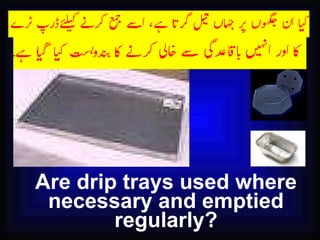
Are drip trays used where necessary and emptied regularly?
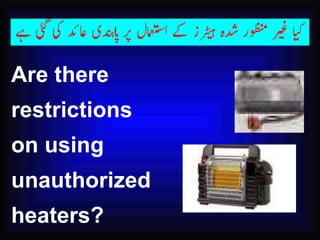
Are there restrictions on using unauthorized heaters?
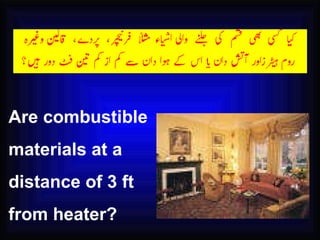
Are combustible materials at a distance of 3 ft from heater?
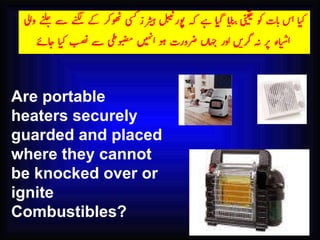
Are portable heaters securely guarded and placed where they cannot be knocked over or ignite Combustibles?
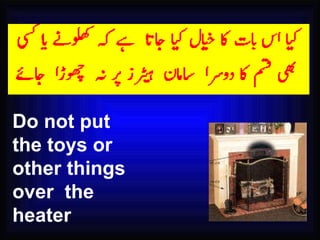
Do not put the toys or other things over  the heater
Is smoking prohibited in all areas where it is particularly, dangerous such as: *Production areas, workshops and other places where materials and waste produced is readily combustible? * Store rooms and warehouse? *Packing and unpacking areas? *Loading and unloading areas? *Infrequently visited areas?
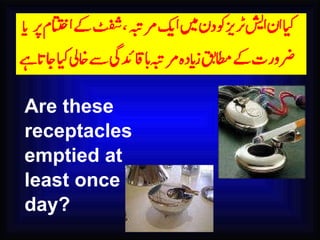
Are these receptacles emptied at least once a day?
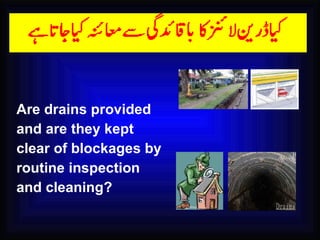
Are drains provided and are they kept clear of blockages by  routine inspection and cleaning?
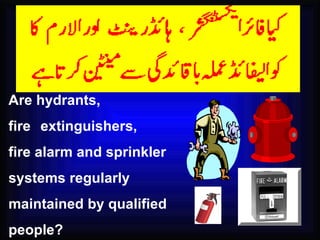
Are hydrants,  fire  extinguishers,  fire alarm and sprinkler systems regularly maintained by qualified people?
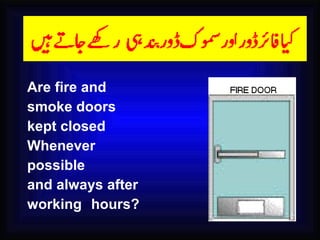
Are fire and smoke doors  kept closed Whenever possible and always after working  hours?
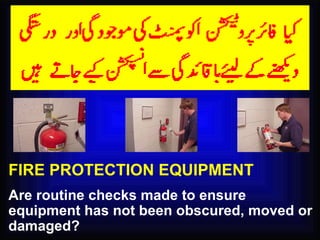
FIRE PROTECTION EQUIPMENT Are routine checks made to ensure equipment has not been obscured, moved or damaged?
Join hands to save our people and property from the ferocity of ruthless fires

Fire Fighting Theory

  • 1.
  • 2.
  • 3.
    What you willlearn What is Fire Classes of Fire - What to do in Case of Fire Types of Extinguishers How to Use an Extinguisher Methods of Extinguishing First Responder Emergency Response team Development
  • 4.
    Fire is man’sbest friend & worst enemy
  • 5.
    It is asource of heat and light It illuminates our homes, drives our automobiles, flies our aircraft, etc.
  • 6.
    Fire when outof control has no friends no moral values respects no barriers & recognizes no boundaries
  • 7.
    Definition of FireExothermic chemical reaction followed by the evolution of heat and light
  • 8.
    Heat Fuel AirTRIANGLE OF FIRE
  • 9.
  • 10.
  • 11.
  • 12.
    Basic Definitions FlammableLimit of a material is a % by volume mixture of its vapours with air within which it will burn (explode)
  • 13.
  • 14.
  • 15.
    Flammable Limits Note: Oil will not burn if not vaporising or not having any space above its surface. LEL % UEL %
  • 16.
    PRINCIPLES OF EXTINCTION
  • 17.
    PRINCIPLES OF EXTINCTION1. STARVATION Heat Air Removing or limitation of fuel
  • 18.
    Heat Fuel PRINCIPLESOF EXTINCTION 2.SMOTHERING limitation of oxygen
  • 19.
    Air Fuel PRINCIPLESOF EXTINCTION 3.COOLING Removal of heat
  • 20.
  • 21.
  • 22.
    FIRE SPREADING (CONDUCTION)
  • 23.
    FIRE SPREADING (RADIATION)
  • 24.
  • 25.
  • 26.
    Solid Wood ClothPaper Rubber Plastic
  • 27.
    Liquid & GasesGasoline Paints Tars Methane Acetylene Propane Etc.
  • 28.
    Electric Fire thatinvolve energized electrical Equipment.
  • 29.
    Metals Magnesium TitaniumZirconium Sodium Lithium Potassium
  • 30.
    Classifications of Fire NFPA Wood , paper,cloth etc. Liquids (oils, paints etc.) & Gases Energized Electrical Appliances Metals ( like magnesium, aluminum etc.)
  • 31.
  • 32.
    Common Causes ofFire Physical Cause Chemical Cause Biological Cause Radiological Cause
  • 33.
    Fire Protection SystemsFire Extinguishers Fire Alarm & Detection Systems Fire Hydrants Hose Cabinets & Risers Fixed Installations (Powder, Gas, Foam etc.)
  • 34.
    Types of ExtinguishersType of fire extinguishers are classified by the type of fires on which they may be used
  • 35.
  • 36.
    FIRE EXTINGUISHER FOR CLASSES “A” “B” “C’ & ‘D’ FIRES
  • 37.
    Fire Extinguishers Contents Foam Dry Chemical Powder CO 2 Expelling Agents CO 2 (Internal or External Cartridges) Nitrogen Mechanism
  • 38.
    Stored Pressure FireExtinguishers CO 2
  • 39.
    How to usea Fire Extinguisher Use the PASS System
  • 40.
    PASS Pull AimSqueeze Sweep
  • 41.
    Pull Pull thePin This will allow you to discharge the extinguisher
  • 42.
    Aim Aim atthe base of the fire. If you aim at the flames, the extinguishing agent will fly.
  • 43.
    Squeeze Squeeze thetop handle or lever. This depresses a button that releases the pressurized extinguishing agent in the extinguisher
  • 44.
    Sweep Sweep fromside to side until the fire is completely out.
  • 45.
    Fire Routine Whatto do in case of a Fire ?
  • 46.
    1 Raise firealarm or shout fire fire What to do in case of a fire?
  • 47.
    Telephone City FireBrigade 16 2 What to do in case of a fire? 1. Raise Fire Alarm or Shout Fire Fire
  • 48.
    3 Use appropriate Fire extinguisher What to do in case of a fire? 1. Raise Fire Alarm or Shout Fire Fire 2. Telephone City Fire Brigade 16
  • 49.
    What to doin case of a fire? 1. Raise Fire Alarm or Shout Fire Fire 2. Telephone City Fire Brigade 16 3. Use appropriate Fire Extinguishers 4 Shut / switch off necessary Valves / Switches
  • 50.
    Assemble atMuster Point 5 What to do in case of a fire? 1. Raise Fire Alarm or Shout Fire Fire 2. Telephone City Fire Brigade 16 3. Use appropriate Fire Extinguisher 4. Shut / switch off necessary Valves / Switches
  • 51.
    1. RaiseFire Alarm or shout fire fire 2. Telephone City Fire Brigade 16 3.Use appropriate Fire Extinguisher if Safe 4. Shut / Switch off (necessary valves / switches) 5. Assemble at Muster Point What to do in case of a fire?
  • 52.
    Fire Emergency ResponseR escue A larm C ontain E xtinguish R A C E
  • 53.
    Fire Fighting HintsAlways “Size Up” the fire Select the proper Extinguishing Agent
  • 54.
    Work on sideof fire where it is extending Do not use Fire Extinguisher/ Water until fire is seen Fire Fighting Hints
  • 55.
    Attack the fireuntil it “Dies – Out”. Hit it again if it rekindles Fire Fighting Hints
  • 56.
    Do not hithot glass with water unless you want to break it Use all available means for personal protection Check carefully all possible avenues of fire travel Fire Fighting Hints
  • 57.
    If you haveto force open a door, smash a panel near the lock, so you may be able to get a hand to unlock the door from inside Don’t enter a burning building or room without Extinguishing media or Proper cover Fire Fighting Hints
  • 58.
    Feel door handlesor knobs with the back of an ungloved hand before opening the doors. A hot handle is a good indicator of fire on the other side. Don’t stand in front of the door stay to one side, keep low, and open the door. this will allow the heat and smoke to pass overhead Fire Fighting Hints
  • 59.
    Keep close tothe walls, when moving across a room or down stairs, which may have been weakened by the effects of fire Fire Fighting Hints
  • 60.
    When having tocrawl down stairs; come backwards, with feet first Fire Fighting Hints
  • 61.
    If a burningroom gets too hot for you, shut the door as you retreat; it restricts the air supply Fire Fighting Hints
  • 62.
  • 63.
    Smoke, heat andgases can choke and kill you after a few breaths If you are caught in smoke, get down and crawl
  • 64.
  • 65.
    Another enemy isthe Elevator Never use in case of fire
  • 66.
    Have a preparedescape plan showing your escape routes Close doors behind you Self Survival
  • 67.
    Self Survival Ifyou are trapped Think Seal off cracks around doors and vents with cloth or rug. Soak them if water is nearby Shut off fans and air conditioners Be calm. Rescue may be moments away
  • 68.
    Safely lower yourself like this If your escape route is blocked
  • 69.
    Signal at thewindow Self Survival If there is a phone, call the fire department and tell them where you are, even if they are already on the scene
  • 70.
    Casualty Handling & Transportation Techniques
  • 71.
    Pick a BackTo carry light weight casualties
  • 72.
  • 73.
    Removal Down Stairs/ Dragging Unconscious casualty
  • 74.
    Fireman’s Crawl Tobring an unconscious casualty from a smoke filled room
  • 75.
    Fore & AftCarry To carry an unconscious casualty
  • 76.
    Two Handed SeatTo carry an unconscious casualty
  • 77.
    Three Handed SeatTo carry a casualty with one leg injured
  • 78.
    Four Handed SeatTo carry a heavier and conscious casualty
  • 79.
  • 80.
    Orthopaedic Stretcher Thisscoop stretcher is used to lift the casualty who must be moved in the position he/she is found Not to carry the casualty
  • 81.
    Blanket Lift Tolift the Casualty from ground & To load the casualty on stretcher
  • 82.
    Lifting & Carrying the Stretcher
  • 83.
    Improvised Stretchers Useof door and other planks
  • 84.
  • 85.
  • 86.
  • 87.
  • 88.
  • 89.
    ACCIDENTS DURING THELAST 20 YEARS NUMBER OF ACCIDENTS Technical Measures Process Safety Measures Human Factors Measures
  • 90.
  • 91.
  • 92.
  • 93.
    Clean up allspillages
  • 94.
  • 95.
  • 96.
    Keep equipment clean& well maintained
  • 97.
    Don’t use morethen one appliance from one socket
  • 98.
    While leaving theoffice, switch off all electrical appliances
  • 99.
  • 100.
    Keep flammables intightly closed containers
  • 101.
    Keep your placeneat and tidy
  • 102.
    Plan two waysto escape
  • 103.
    Don’t smoke in‘No Smoking’ Areas
  • 104.
    Know the locationof Mains, Gas Valves & Fire Point
  • 105.
    Follow the Checklist Before any Hot Work
  • 106.
    Housekeeping & Fire Safety
  • 107.
  • 108.
  • 109.
    A place forevery thing And everything at its place
  • 110.
  • 111.
    Are the premiseskept clear of combustible waste and refuse?
  • 112.
    Are metal receptacles with closely fitting lids available for waste such as floor sweepings?
  • 113.
    Are separate clearlylabeled containers provided for waste with special hazards - flammable liquids, swarf, paint rags, oily rags? OILY RAGS
  • 114.
    Are waste containersremoved from the building at the end of each working day or more frequently if necessary?
  • 115.
    Is waste putout in a safe place awaiting disposal?
  • 116.
    Are cupboards, liftshafts, spaces under benches, gratings, conveyor belts and behind radiators, and similar places kept free from dust and rubbish?
  • 117.
    Are areas inand around the buildings kept free from accumulated packing materials and pallets?
  • 118.
    L.P.G Cylinders Areliquefied petroleum gas (LPG) cylinders safely preferably in a fenced compound outdoors at least 2m away from any boundary fences?
  • 119.
    Is the storeused only for cylinder storage?
  • 120.
    Are empty cylinderstreated in the same manner, but kept separate and labeled empty?
  • 121.
    Are permanent warning notices prominently displayed prohibiting smoking and naked lights?
  • 122.
    Are cylinders storedwith their valves uppermost?
  • 123.
    Are storage areasaccessible to fire fighters?
  • 124.
    Are stack sizeskept as small as practicable in the circumstances?
  • 125.
    Are stacks stableand not liable to collapse easily?
  • 126.
    Are stocks ofmaterial arranged so that Fire detectors are not impeded and the required clearance beneath this equipment maintained?
  • 127.
    Are stockkept well clear of light fixtures and hot service pipes?
  • 128.
    Are all outsidecontractors supervised while on the premises and their work is authorized by hot work permit schemes?
  • 129.
    Are all stockof flammable liquids kept in purpose built flammable liquid stores?
  • 130.
    Is the flammableliquids store kept un-congested and tidy?
  • 131.
    Are flammable liquidscarried in specially designed safety containers and not open cans and buckets etc.?
  • 132.
    Are flammable liquidskept away from possible source of ignition?
  • 133.
    Are suitable sparkreducing tools provided for use in places where there may be Flammable vapours?
  • 134.
    Are all Machinessubjected to Scheduled Maintenance
  • 135.
    Is machinery locatedso as to avoid congestion among machines and materials?
  • 136.
    Are motors andall moving parts of Machinery kept clean to avoid overheating?
  • 137.
    Are drip traysused where necessary and emptied regularly?
  • 138.
    Are there restrictionson using unauthorized heaters?
  • 139.
    Are combustible materialsat a distance of 3 ft from heater?
  • 140.
    Are portable heaterssecurely guarded and placed where they cannot be knocked over or ignite Combustibles?
  • 141.
    Do not putthe toys or other things over the heater
  • 142.
    Is smoking prohibitedin all areas where it is particularly, dangerous such as: *Production areas, workshops and other places where materials and waste produced is readily combustible? * Store rooms and warehouse? *Packing and unpacking areas? *Loading and unloading areas? *Infrequently visited areas?
  • 143.
    Are these receptaclesemptied at least once a day?
  • 144.
    Are drains providedand are they kept clear of blockages by routine inspection and cleaning?
  • 145.
    Are hydrants, fire extinguishers, fire alarm and sprinkler systems regularly maintained by qualified people?
  • 146.
    Are fire andsmoke doors kept closed Whenever possible and always after working hours?
  • 147.
    FIRE PROTECTION EQUIPMENTAre routine checks made to ensure equipment has not been obscured, moved or damaged?
  • 148.
    Join hands tosave our people and property from the ferocity of ruthless fires

Editor's Notes

  • #53 ASK “WHAT DO I DO IF I SEE A FIRE?” R ESCUE VICTIMS. A LARM ACTIVATION TO SUMMON HELP. C ONTAIN FIRE TO PREVENT SPREAD--CLOSE DOORS, WINDOWS, SHUT OFF EXHAUST, ETC. E XTINGUISH THE FLAMES--PUT THE FIRE OUT.