Fire Safety Training
By:
Ahmed Moftah
Training Overview
What is Fire?
Classes of Fire
3 A’s
Types of Fire Extinguishers
Use of a Fire Extinguisher
Summary
What is Fire?
Fire is a self-sustaining, chemical chain reaction with
varying degrees of light and heat.
Fire is made up of four components
• Fuel
• Oxygen
• Heat
• Chemical Chain Reaction
Fire Tetrahedron
By removing one of these
four components the fire
will go out.
Fire extinguishers are
designed to do just that.
Classes Of Fire
Fires are classified according to the type of fuel
that is burning.
If you use the wrong type of fire extinguisher on the
wrong class of fire, you might make matters worse.
Its very important to understand the four different
fire (fuel) classifications…
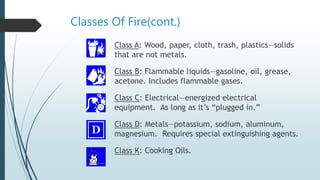
Classes Of Fire(cont.)
Class A: Wood, paper, cloth, trash, plastics—solids
that are not metals.
Class B: Flammable liquids—gasoline, oil, grease,
acetone. Includes flammable gases.
Class C: Electrical—energized electrical
equipment. As long as it’s “plugged in.”
Class D: Metals—potassium, sodium, aluminum,
magnesium. Requires special extinguishing agents.
Class K: Cooking Oils.
If You Discover a Fire Follow The 3 A’s
Activate
Assist
Attempt
The 3 A’s (cont.)
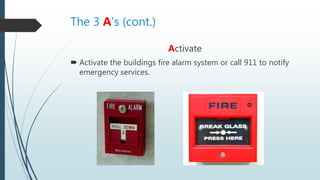
Activate
 Activate the buildings fire alarm system or call 911 to notify
emergency services.
The 3 A’s (cont.)
Assist
 Assist those who are in immediate danger or who are
incapacitated. Do this without risk to yourself!
The 3 A’s (cont.)
Attempt
Before going on with this step make sure of the
following:
The Fire isn’t too large to control.
Having the right type & size of extinguisher.
Always have an exit to your back in case you need to
escape.
 Never attempt to fight a fire if there is a heavy smoke
condition.
Types of Fire Extinguishers
Different types of fire extinguishers are designed to
fight different classes of fire; here are some of the
commonly used extinguishers:
• Dry Chemical
• Carbon Dioxide
• Foam
• Dry Powder
• Wet Chemical
Types of Fire Extinguishers (cont.)
Dry Chemical
• Dry Chemical is the most widely used type
of fire extinguisher and is also recognized as a
multi-purpose ABC fire extinguisher.
• They contain an extinguishing agent and use a
compressed, non-flammable gas as a propellant.
• The agent works by interrupting the chemical
chain reaction. Also, on a class A fire it creates a
barrier between the fuel and the oxygen.
Carbon Dioxide
• Works by separating oxygen and heat.
• Most effective on Class B and C (liquids and
electrical) fires.
• Since the gas disperses quickly, these
extinguishers are only effective from 3 to 8 feet.
• Since the fire could re-ignite, continue to apply
the agent even after the fire appears to be out.
Types of Fire Extinguishers (cont.)
Foam
• Foam fire extinguishers work by covering a
burning flammable liquid with a blanket of foam,
cutting off the fire’s air supply and preventing the
release of flammable vapors.
• Suitable for Class A & B fires.
Types of Fire Extinguishers (cont.)
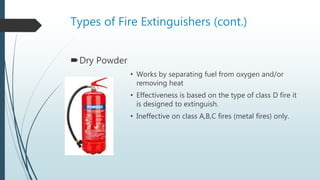
Dry Powder
• Works by separating fuel from oxygen and/or
removing heat
• Effectiveness is based on the type of class D fire it
is designed to extinguish.
• Ineffective on class A,B,C fires (metal fires) only.
Types of Fire Extinguishers (cont.)
Wet Chemical
• Designed for restaurant type kitchens.
• Works by forming a soapy foam blanket over the
burning material and cooling it below it’s ignition
temperature.
Types of Fire Extinguishers (cont.)
Use of A Fire Extinguisher
Use the acronym PASS to remember how to use a fire
extinguisher.
• P – Pull
• A – Aim
• S – Squeeze
• S – Sweep
Use of A Fire Extinguisher (cont.)
S – Sweep
S – Squeeze
A – Aim
P – Pull
Summary
Remember the following
• Actions to take when a fire is discovered….The Three A’s
(Activate, Assist, Attempt)
• When & what extinguisher to use?
• How to use a fire extinguisher…. P.A.S.S. (Pull, Aim,
Squeeze, Sweep)

Fire Safety Training Presentation

  • 1.
  • 2.
    Training Overview What isFire? Classes of Fire 3 A’s Types of Fire Extinguishers Use of a Fire Extinguisher Summary
  • 3.
    What is Fire? Fireis a self-sustaining, chemical chain reaction with varying degrees of light and heat. Fire is made up of four components • Fuel • Oxygen • Heat • Chemical Chain Reaction
  • 4.
    Fire Tetrahedron By removingone of these four components the fire will go out. Fire extinguishers are designed to do just that.
  • 5.
    Classes Of Fire Firesare classified according to the type of fuel that is burning. If you use the wrong type of fire extinguisher on the wrong class of fire, you might make matters worse. Its very important to understand the four different fire (fuel) classifications…
  • 6.
    Classes Of Fire(cont.) ClassA: Wood, paper, cloth, trash, plastics—solids that are not metals. Class B: Flammable liquids—gasoline, oil, grease, acetone. Includes flammable gases. Class C: Electrical—energized electrical equipment. As long as it’s “plugged in.” Class D: Metals—potassium, sodium, aluminum, magnesium. Requires special extinguishing agents. Class K: Cooking Oils.
  • 7.
    If You Discovera Fire Follow The 3 A’s Activate Assist Attempt
  • 8.
    The 3 A’s(cont.) Activate  Activate the buildings fire alarm system or call 911 to notify emergency services.
  • 9.
    The 3 A’s(cont.) Assist  Assist those who are in immediate danger or who are incapacitated. Do this without risk to yourself!
  • 10.
    The 3 A’s(cont.) Attempt Before going on with this step make sure of the following: The Fire isn’t too large to control. Having the right type & size of extinguisher. Always have an exit to your back in case you need to escape.  Never attempt to fight a fire if there is a heavy smoke condition.
  • 11.
    Types of FireExtinguishers Different types of fire extinguishers are designed to fight different classes of fire; here are some of the commonly used extinguishers: • Dry Chemical • Carbon Dioxide • Foam • Dry Powder • Wet Chemical
  • 12.
    Types of FireExtinguishers (cont.) Dry Chemical • Dry Chemical is the most widely used type of fire extinguisher and is also recognized as a multi-purpose ABC fire extinguisher. • They contain an extinguishing agent and use a compressed, non-flammable gas as a propellant. • The agent works by interrupting the chemical chain reaction. Also, on a class A fire it creates a barrier between the fuel and the oxygen.
  • 13.
    Carbon Dioxide • Worksby separating oxygen and heat. • Most effective on Class B and C (liquids and electrical) fires. • Since the gas disperses quickly, these extinguishers are only effective from 3 to 8 feet. • Since the fire could re-ignite, continue to apply the agent even after the fire appears to be out. Types of Fire Extinguishers (cont.)
  • 14.
    Types of FireExtinguishers (cont.) Foam • Foam fire extinguishers work by covering a burning flammable liquid with a blanket of foam, cutting off the fire’s air supply and preventing the release of flammable vapors. • Suitable for Class A & B fires.
  • 15.
    Types of FireExtinguishers (cont.) Dry Powder • Works by separating fuel from oxygen and/or removing heat • Effectiveness is based on the type of class D fire it is designed to extinguish. • Ineffective on class A,B,C fires (metal fires) only.
  • 16.
    Types of FireExtinguishers (cont.) Wet Chemical • Designed for restaurant type kitchens. • Works by forming a soapy foam blanket over the burning material and cooling it below it’s ignition temperature.
  • 17.
    Types of FireExtinguishers (cont.)
  • 18.
    Use of AFire Extinguisher Use the acronym PASS to remember how to use a fire extinguisher. • P – Pull • A – Aim • S – Squeeze • S – Sweep
  • 19.
    Use of AFire Extinguisher (cont.) S – Sweep S – Squeeze A – Aim P – Pull
  • 20.
    Summary Remember the following •Actions to take when a fire is discovered….The Three A’s (Activate, Assist, Attempt) • When & what extinguisher to use? • How to use a fire extinguisher…. P.A.S.S. (Pull, Aim, Squeeze, Sweep)