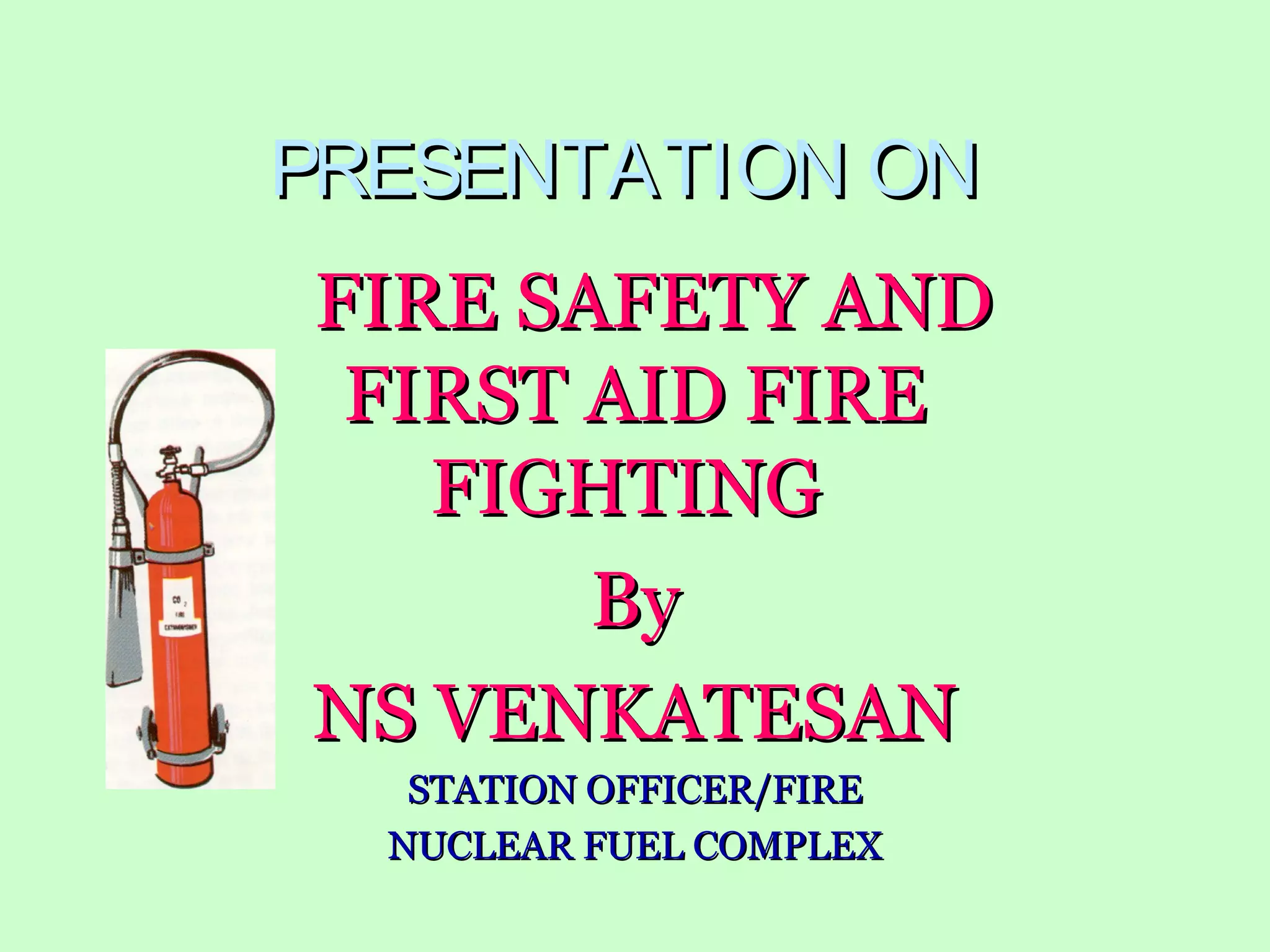
WHAT EVER BURNS NEVER
RETURNS
FIRE IS A GOOD SERVANT
BUT A BAD MASTER.
PRESENTATION ONPRESENTATION ON
FIRE SAFETY ANDFIRE SAFETY AND
FIRST AID FIREFIRST AID FIRE
FIGHTINGFIGHTING
ByBy
NS VENKATESANNS VENKATESAN
STATION OFFICER/FIRESTATION OFFICER/FIRE
NUCLEAR FUEL COMPLEXNUCLEAR FUEL COMPLEX
Fire SafetyFire Safety
Fire PreventionFire Prevention
Fire ProtectionFire Protection
FIRE PREVENTIONFIRE PREVENTION
 PREVENTION IS BETTER THAN CUREPREVENTION IS BETTER THAN CURE
 PREVENT FIRE AND AVERTPREVENT FIRE AND AVERT
DESTRUCTIONSDESTRUCTIONS
 ELIMINATION OF CAUSES OFELIMINATION OF CAUSES OF
COMBUSTION IS NOTHING BUT FIRECOMBUSTION IS NOTHING BUT FIRE
PREVENTIONPREVENTION
FIRE PREVENTION
 TO PREVENT OCCURRENCE OF
ACCIDENTAL FIRE
 DEVISES/EQUIPMENT/INSPECTION
/ACT/METHOD APPLIED TO PREVENT
ACCIDENTAL OCCURRENCE OF FIRE
AND TO ADOPT MEASURES TO PREVENT
ITS DEVASTATING FORM
FIRE PREVENTIONFIRE PREVENTION
Thethreeelementsof fireprevention are:-Thethreeelementsof fireprevention are:-
*Codes and Code enforcement*Codes and Code enforcement
*Fire prevention inspections*Fire prevention inspections
*Fire prevention education*Fire prevention education
CODESCODES
 National Building Code 1983 (Rev.2005)National Building Code 1983 (Rev.2005)
 Factories Act 1948Factories Act 1948
 Indian Standard SpecificationsIndian Standard Specifications
 NFPANFPA
 Petroleum ActPetroleum Act
 OISDOISD
 AERB Standards for DAE EstablishmentsAERB Standards for DAE Establishments
FIRE INSPECTIONSFIRE INSPECTIONS
Joint Inspection Team Consists of:-Joint Inspection Team Consists of:-
Fire Officer,Fire Officer,
Safety officer,Safety officer,
Production,Production,
Electrical,Electrical,
Mechanical,Mechanical,
Civil,Civil,
Chemical andChemical and
Medical OfficerMedical Officer
WHAT TO INSPECT?WHAT TO INSPECT?
 MaterialsMaterials which constitute to fuel and whichwhich constitute to fuel and which
are too close toare too close to
 SourceSource of accidentalof accidental ignitionignition andand
 Lack of suitableLack of suitable means to fightmeans to fight a firea fire plusplus
 Obstructions to theObstructions to the means of escapemeans of escape
FIRE PROTECTIONFIRE PROTECTION
 When fire prevention fails, fire starts thus the needWhen fire prevention fails, fire starts thus the need
for fire protection arises.for fire protection arises.
 Philosophy of fire protection isPhilosophy of fire protection is
To Save & ProtectTo Save & Protect
- Human Lives- Human Lives
- Machine- Machine
- Materials- Materials andand
-- EnvironmentEnvironment
FIRE PROTECTION SYSTEMSFIRE PROTECTION SYSTEMS
 ACTIVEACTIVE
-- Fire water systemFire water system
networkingnetworking
- Water deluge system- Water deluge system
-Automatic sprinkler-Automatic sprinkler
systemsystem
-Fire water hose reel-Fire water hose reel
-Foam system-Foam system
-DCP system-DCP system
-CO2 Total flooding-CO2 Total flooding
systemsystem
- Fire extinguishers- Fire extinguishers
-Fire blankets etc.,-Fire blankets etc.,
 PASSIVEPASSIVE
--Fire wallsFire walls
-Thermal insulation-Thermal insulation
-Fire detection system-Fire detection system
-Gas detection system-Gas detection system
-Flame arrester-Flame arrester
IntroductionIntroduction
PURPOSE OF THE DISCUSSION IS TO MAKEPURPOSE OF THE DISCUSSION IS TO MAKE
THE PARTICIPANTS UNDERSTAND:THE PARTICIPANTS UNDERSTAND:
THE BASIC PHENOMENA HOW DOESTHE BASIC PHENOMENA HOW DOES
A FIRE OCCURA FIRE OCCUR
 AND HOW A FIRE CAN BEAND HOW A FIRE CAN BE
EXTINGUISHEDEXTINGUISHED
WHAT IS FIRE ?WHAT IS FIRE ?
1.1. Fire is the rapid oxidation of a substance with theFire is the rapid oxidation of a substance with the
evolution of heat and light in varying degree ofevolution of heat and light in varying degree of
intensities.intensities.
2.2. FIRE IS A CHEMICAL REACTION ACCOMPANIEDFIRE IS A CHEMICAL REACTION ACCOMPANIED
WITH THE EVOLUTION OF HEAT, LIGHT, SMOKEWITH THE EVOLUTION OF HEAT, LIGHT, SMOKE
ETC. FOR WHICH 3 BASIC ELEMENTS AREETC. FOR WHICH 3 BASIC ELEMENTS ARE
NECESSARY IN CORRECT PROPORTIONNECESSARY IN CORRECT PROPORTION
HEAT /HEAT /
FUELFUEL++AIR/OXYGENAIR/OXYGEN++------------------------------------
IGNITIONIGNITION
TEMP.TEMP.
08/02/1308/02/13 1515
What actually burns in a fireWhat actually burns in a fire
Often a misconception is fire burns the actual chair orOften a misconception is fire burns the actual chair or
piece of wood. It is the gasses given off by an objectpiece of wood. It is the gasses given off by an object
that burns. Heat causes objects to give off thesethat burns. Heat causes objects to give off these
flammable gasses.flammable gasses.
When the gasses reach their ignition temperature youWhen the gasses reach their ignition temperature you
see the light given off during the oxidation known assee the light given off during the oxidation known as
fire. Fire itself generates more heat to the object andfire. Fire itself generates more heat to the object and
thus an endless cycle begins until all of the gassesthus an endless cycle begins until all of the gasses
have been exhausted from an object. Then thehave been exhausted from an object. Then the
remaining particles or ash are what is left.remaining particles or ash are what is left.
Fire - Rapid Oxidation which emits
Heat and Light
Factors required for fire to startFactors required for fire to start
HeatHeat
FuelFuel
OxygenOxygen
Chain reaction of free radicalsChain reaction of free radicals
As three lines are to be connected to formAs three lines are to be connected to form
a triangle, the heat, fuel and oxygen are toa triangle, the heat, fuel and oxygen are to
be connected to cause a fire.be connected to cause a fire.
Heat
OxygenFuel
We call this a
Heat
OxygenFuel
The Fire TriangleThe Fire Triangle
1.1. EnoughEnough OXYGENOXYGEN to sustain combustionto sustain combustion
2.2. EnoughEnough HEATHEAT to reach ignition temperatureto reach ignition temperature
3.3. SomeSome FUELFUEL or combustible materialor combustible material
Together, they produce theTogether, they produce the CHEMICALCHEMICAL
REACTIONREACTION that is firethat is fire
Three things must be present at the same time to
produce fire:
Take away any of these things andTake away any of these things and
the fire will bethe fire will be extinguishedextinguished
The Fire TetrahedronThe Fire Tetrahedron
 Fire is a chemical reaction involving rapid oxidation of aFire is a chemical reaction involving rapid oxidation of a
combustible material.combustible material.
 To start and continue fire needs: fuel, heat, oxygen and theTo start and continue fire needs: fuel, heat, oxygen and the
chemical reaction they create.chemical reaction they create.
 Remove any of these elements and the fire is extinguished.Remove any of these elements and the fire is extinguished.
FIRE TETRAHEDRONFIRE TETRAHEDRON
FUEL
HEAT
OXYGEN
CHAIN
REACTION
FIRE EXTINGUISHMENTFIRE EXTINGUISHMENT
The acts of fire extinguishment are a combinationThe acts of fire extinguishment are a combination
of physical skill, mental acumen, technicalof physical skill, mental acumen, technical
knowledge and professionally trained manpower.knowledge and professionally trained manpower.
All of the methods we use to control andAll of the methods we use to control and
extinguish fires are based on the fire tetrahedron.extinguish fires are based on the fire tetrahedron.
We focus on removing one or more of theWe focus on removing one or more of the
elements that allow the fire to Extinguish.elements that allow the fire to Extinguish.
Fires will continue to burn untilFires will continue to burn until
 Fuel is removedFuel is removed
 Oxygen % is lowered belowOxygen % is lowered below
11%.11%.
 Heat is removedHeat is removed
 Flames are inhibitedFlames are inhibited
Chemically.Chemically.
PRINCIPLES OF FIRE EXTINCTIONPRINCIPLES OF FIRE EXTINCTION
 CoolingCooling
 Starvation/ isolationStarvation/ isolation
 Limiting 0xygen in a fire/ SmotheringLimiting 0xygen in a fire/ Smothering
 Interruption of chain reactionInterruption of chain reaction
Remove the HEAT
sources, and there is
nothing hot to start
the fire
COOLING
If we remove HEAT side of the triangle, the fire cannot sustain
COOLINGCOOLING
Remove the FUEL
sources, and there
is nothing to burn.
STARVATION
If we remove fuel side of the triangle, the fire cannot sustain
STARVATIONSTARVATION
R
E
M
O
V
A
L
O
F
F
U
L
E
Remove the
OXYGEN and there
is nothing to feed the
fire.
SMOOTHERING
If we remove oxygen side of the triangle, the fire cannot sustain
SMOTHERINGSMOTHERING
Removal of heat.
(Best cooling media is water)
Reducing % of oxygen.
Cutting off the supply of
oxygen. (Blanketing, Use foam)
Removal of fuel or removal of
combustible material
FIRE TRIANGLE
FIRE
OXYGEN
FUEL
HEAT
FIRE TRIANGLE
OXYGEN
FUEL
HEAT
FIRE
FIRE TRIANGLE
OXYGEN
FUEL
HEAT
FIRE
FIRE TRIANGLE
OXYGEN
FUEL
HEAT
FIRE
INHIBITION OF CHEMICAL CHAIN REACTION
FIRE
OXYGEN
FUEL
HEAT
Inhibition of chemical chain reaction
CLASSIFICATION OF FIRESCLASSIFICATION OF FIRES
 Depending upon the material involved inDepending upon the material involved in
the combustion, fire are classified asthe combustion, fire are classified as
 Class AClass A
 Class BClass B
 Class CClass C
 Class DClass D
Classes of FireClasses of Fire
Class of
fire
Description
Class A
Class B
Class C
Class D
Fire involving ordinary combustible
materials like wood,paper,textiles etc.,
Fire involving flammable liquids like
oils,solvents,petroleum
products,varnishes,paints,etc.,
Fire involving gaseous combustible
Ex.LPG,Hydrogen etc.,
ELECTRICAL FIRESELECTRICAL FIRES
 Do not constitute a separate classDo not constitute a separate class
 Any fire involving or stated by electricalAny fire involving or stated by electrical
equipment must in fact be a fire of class A,B,Cequipment must in fact be a fire of class A,B,C
or D.or D.
 Cut off electricity and extinguish the fireCut off electricity and extinguish the fire
..
FIRE FIGHTING MEDIASFIRE FIGHTING MEDIAS
WaterWater
FoamFoam
Carbon-di-oxideCarbon-di-oxide
Dry Chemical PowderDry Chemical Powder
Vaporizing liquidsVaporizing liquids
WaterWater
 Highly efficient, cheapest and readilyHighly efficient, cheapest and readily
available mediaavailable media
 Highest latent heat of vaporizationHighest latent heat of vaporization
 Cooling agentCooling agent
 Also useful for production of foamAlso useful for production of foam
 Application in the form of either solid streamApplication in the form of either solid stream
of jet or fine sprayof jet or fine spray
WATER AND ITS QUALITIESWATER AND ITS QUALITIES
Water extinguishes fire by the followingWater extinguishes fire by the following
methods:methods:
a) Cooling- one gallon absorbs 9000 BTUa) Cooling- one gallon absorbs 9000 BTU
heatheat
b) Smothering(Displacement of air byb) Smothering(Displacement of air by
generating steam)generating steam)
c) Emulsificationc) Emulsification
d) Dilutiond) Dilution
FOAMFOAM
 Most popular extinguishing media for oilMost popular extinguishing media for oil
fires by smothering/blanketingfires by smothering/blanketing
 Foam is lighter than the flammable liquidsFoam is lighter than the flammable liquids
 Forms an air excluding,cooling,continuousForms an air excluding,cooling,continuous
layer of vapour sealing that halts orlayer of vapour sealing that halts or
prevents combustionprevents combustion
FOAM &WATER RATIOFOAM &WATER RATIO
 Ratio between water and foam concentrateRatio between water and foam concentrate
is very important for best resultsis very important for best results
 Too thick concentrate will not flow freely andToo thick concentrate will not flow freely and
too thin will not stick for proper sealingtoo thin will not stick for proper sealing
permitting RE-IGNITIONpermitting RE-IGNITION
 Generally 3% to 6% volume by foam beingGenerally 3% to 6% volume by foam being
used for fire fighting purposes.used for fire fighting purposes.
TYPES OF FOAMTYPES OF FOAM
 PROTEIN FOAMPROTEIN FOAM
 AQUEOUS FILM FORMING FOAMAQUEOUS FILM FORMING FOAM
VAPOURISING LIQUIDSVAPOURISING LIQUIDS
 Popularly known as Halons , proved to bePopularly known as Halons , proved to be
the most effective fire fighting media in thethe most effective fire fighting media in the
worldworld
 They cutoff the flame by breaking chemicalThey cutoff the flame by breaking chemical
chain reactionchain reaction
 Anti environmental effects makes it obsoleteAnti environmental effects makes it obsolete
graduallygradually
HALONSHALONS
The most common substances used are:-The most common substances used are:-
Halon 1211 (Bromochloro difloro methane)Halon 1211 (Bromochloro difloro methane)
CFCF22ClBrClBr
Halon 1301(Bromo trifloro methaneHalon 1301(Bromo trifloro methane
CFCF33BrBr
EXTINGUISHIN MECHANISMEXTINGUISHIN MECHANISM
BY VAPOURISING LIQUIDSBY VAPOURISING LIQUIDS
 While all the halogens in the Halon,While all the halogens in the Halon,
Bromine is much more effectiveBromine is much more effective
Under fire conditions it releases a Br AtomUnder fire conditions it releases a Br Atom
CFCF33Br---Br--->CF°>CF°33 + Br°+ Br°
The Br atom reacts with hydrocarbonThe Br atom reacts with hydrocarbon
molecule to form HBrmolecule to form HBr
R-H + Br°-- R° + HBrR-H + Br°-- R° + HBr
Contd.,Contd.,
 The HBr then reacts with active H or OHThe HBr then reacts with active H or OH
radicals releasing again BR.radicals releasing again BR.
OHOH° + HBr – H° + HBr – H22O + Br°O + Br°
Chemical chain inhibition thus continues.Chemical chain inhibition thus continues.
CARBON-DI OXIDECARBON-DI OXIDE
 COCO22 Prevents combustion by displacing thePrevents combustion by displacing the
oxygen in the air surrounding the fireoxygen in the air surrounding the fire
 It is also a non conductor of electricityIt is also a non conductor of electricity
 It does not leave any residue thereby notIt does not leave any residue thereby not
causing damages due to fire fighting mediacausing damages due to fire fighting media..
DRY CHEMICAL POWDERDRY CHEMICAL POWDER
Extinguishing mechanism involved in DCP isExtinguishing mechanism involved in DCP is
as follows:as follows:
1. De-composing and releasing CO1. De-composing and releasing CO22
2. Smothering2. Smothering
3. Cutting chemical chain reaction3. Cutting chemical chain reaction
4. Heat absorption by powder4. Heat absorption by powder
Common DCP typesCommon DCP types
 Sodium bi-carbonateSodium bi-carbonate
 Potassium bi-carbonate(purple K)Potassium bi-carbonate(purple K)
 Potassium Chlorade(Super K)Potassium Chlorade(Super K)
 Urea Potassium bi-carbonate(Monnex)Urea Potassium bi-carbonate(Monnex)
 Mono Ammonium PhosphateMono Ammonium Phosphate
Special DCP for Class D FireSpecial DCP for Class D Fire
Ternary Eutectic Chlorides (TEC)Ternary Eutectic Chlorides (TEC) powderpowder
is a special powder, which is very effectiveis a special powder, which is very effective
on metal fires. The following compositionon metal fires. The following composition
has been found very effective on metal fires.has been found very effective on metal fires.
Constituents of TECConstituents of TEC
 NaCl 20% w/wNaCl 20% w/w
 KCl 29% w/wKCl 29% w/w
 BaClBaCl22 51% w/w51% w/w
 This powder when applied on metal firesThis powder when applied on metal fires
melts at the temperature of burning metals,melts at the temperature of burning metals,
covers the burning surface, forms a crustcovers the burning surface, forms a crust
over it, excludes oxygen, thereby stopsover it, excludes oxygen, thereby stops
combustion and stops cooling.combustion and stops cooling.
Other medias…Other medias…
SandSand
Where other smothering agents are not readilyWhere other smothering agents are not readily
available,sand can also be used.It also prevents spreadingavailable,sand can also be used.It also prevents spreading
of burning materials.of burning materials.
BlanketingBlanketing
Another method by which fire may be extinguishedAnother method by which fire may be extinguished
especially on persons whose clothing is on fire is byespecially on persons whose clothing is on fire is by
blanketing. Coat,woolen,asbestos blankets,etc.,are someblanketing. Coat,woolen,asbestos blankets,etc.,are some
tools for easy blanketingtools for easy blanketing
Beating OutBeating Out
Small fires in materials such as grass etc., can beSmall fires in materials such as grass etc., can be
extinguished by beating out.extinguished by beating out.
First Aid Fire FightingFirst Aid Fire Fighting
AppliancesAppliances
 The portable fire fighting equipment shall beThe portable fire fighting equipment shall be
designed to control/extinguish fire at theirdesigned to control/extinguish fire at their
incipient stages itself.incipient stages itself.
 They are the first line defense and shall beThey are the first line defense and shall be
named as first aid fire fighting equipmentnamed as first aid fire fighting equipment
 Effective and suitable selection of applianceEffective and suitable selection of appliance
is an important factoris an important factor
PORTABLE FIRE EXTINGUISHERSPORTABLE FIRE EXTINGUISHERS
““HEALTHY PORTABLE FIREHEALTHY PORTABLE FIRE
EXTINGUISHERS AREEXTINGUISHERS ARE
VITAL TOOL TO PROTECTVITAL TOOL TO PROTECT
LIFE AND PROPERTY”LIFE AND PROPERTY”
PORTABLE FIRE EXTINGUISHERSPORTABLE FIRE EXTINGUISHERS
CONTROL THE FIRE AT ITS INCIPIENTCONTROL THE FIRE AT ITS INCIPIENT
STAGESTAGE
FIRST AID FIRE FIGHTINGFIRST AID FIRE FIGHTING
EQUIPMENTEQUIPMENT
FIRST LINE OF DEFENSEFIRST LINE OF DEFENSE
TYPES & CAPACITIESTYPES & CAPACITIES
 WATER TYPEWATER TYPE - 09 LITRS- 09 LITRS
(Stored Pressure & Gas Cartridge)(Stored Pressure & Gas Cartridge)
 FOAM TYPE-FOAM TYPE- 09, 50 Ltr09, 50 Ltr
(Stored Pressure & Gas Cartridge)(Stored Pressure & Gas Cartridge)
 Mechanical &Mechanical & ChemicalChemical
 DRY CHEMICAL POWDER TYPE-DRY CHEMICAL POWDER TYPE-
02, 05,1002, 05,10,, 25, 50 Kg25, 50 Kg
- (Stored Pressure & Gas Cartridge)(Stored Pressure & Gas Cartridge)
 CARBON DIOXIDECARBON DIOXIDE TYPETYPE --
- 4.5, 6.8, 22.5 Kg- 4.5, 6.8, 22.5 Kg
SCALE OF DEPLOYMENTSCALE OF DEPLOYMENT
Class
of
Fire
Nature
of
Occup-
ancy
Number, Capacity &
Type of Fire Extinguisher
Floor
Area
(M2
)
Min. No. of
Ext. required /
Compartment
or part thereof
Travel
Distance
(M)
A LH
OH
HH
SH
• 1 x 9 ltrs water type
• 2 x 9 ltrs water type
• As per OH +
• 1 x 50Kg DCP extinguisher
• 1 x 4.5 kg CO2
extinguisher
600
600
-
100
100
2
4
-
-
02
25
25
-
-
10
B LH
OH
HH
• 1 x 9 ltrs foam extinguisher
• 2x9 ltrs foam or1x5 kg DCP
• As per OH +
• 1 x 50 Kg DCP extinguisher
• 1 x 150 Kg extinguisher
600
600
100
300
2
4
-
-
25
15
-
-
C LH
OH
HH
•1 x 2 kg DCP or 2 Kg CO2
•1 x 10 kg DCP or 6.8 kg CO2
20
100
100
-
1
2
15
15
10
D HH • 1 x 10 kg Special DCP 100 2 10
DISCHARGE PERFORMANCEDISCHARGE PERFORMANCE
OF EXTINGUISHERSOF EXTINGUISHERS
WATER TYPEWATER TYPE - 9 Ltrs – 70 sec. - 6 M – 95%- 9 Ltrs – 70 sec. - 6 M – 95%
FOAM TYPEFOAM TYPE - 9 Ltrs – 45 sec. - 6 M – 95%- 9 Ltrs – 45 sec. - 6 M – 95%
DCP TYPEDCP TYPE - 10KG – 20 sec. - 6 M – 85%- 10KG – 20 sec. - 6 M – 85%
CO2 TYPECO2 TYPE -- 6.8 KG - 30 sec.6.8 KG - 30 sec.
Low range -1.5 to 2 MLow range -1.5 to 2 M - 75%- 75%
HYDRAULIC PRESSURE TESTINGHYDRAULIC PRESSURE TESTING
TYPE OF
EXTINGUISHER
TEST
INTERVAL
YEARS
PRESSURE
Kg/cm2
PRESSURE
MAINTAINED
FOR
Water
(Gas Cartridge)
3 17.5 2.5 min
Water stored
Pressure
2 25 2.5 min
DCP 3 25 2.5 min
Mechanical
Foam
3 17.5 2.5 min
CO2
Each
refilling
236 2.5 min
SUITABLILITY OF FIRESUITABLILITY OF FIRE
EXTINGUISHERSEXTINGUISHERS
 ..CLASS OF FIRE DISCRIPTION MEDIUM EXTINGUISHING
A ORINARY COMBUTIBLE
MATERIALS WOOD,
FABRIC ETC.,
WATER
B FLAMMABLELIQUIDS,
PETROL,DIESEL ET
Foam,CO2,DCP,Halon
C Flammable Gases CO2,DCP
D Flammable metals Special DCP,
Electrical
Fires
Electrical equipments Halon,CO2 when
elec.equipment is de-
energised
Carbon Dioxide ExtinguisherCarbon Dioxide Extinguisher
Dry Chemical Powder ExtinguisherDry Chemical Powder Extinguisher
METHOD OF OPERATIONMETHOD OF OPERATION
 REMOVEREMOVE THE SAFETY CLIPTHE SAFETY CLIP
 DEPRESS THE PLUNGERDEPRESS THE PLUNGER
 WITHDRAW THE NOZZLE FROM RUBBER CAPWITHDRAW THE NOZZLE FROM RUBBER CAP
AND PRESS THE SQUEEZE GRIPAND PRESS THE SQUEEZE GRIP
 DIRECT THE DCP TO THE BASE OF FLAME SDIRECT THE DCP TO THE BASE OF FLAME S
WITH A FAST SWEEPING ACTIONWITH A FAST SWEEPING ACTION
OPERATION MATHOD OF WATEROPERATION MATHOD OF WATER
TYPE EXTINGUISHERTYPE EXTINGUISHER
COMMON MISTAKES WHILECOMMON MISTAKES WHILE
OPERATING THE EXTINGUISHEROPERATING THE EXTINGUISHER
CARE & MAINTENANCECARE & MAINTENANCE
 LOCATION (MEANS OF ESCAPE)LOCATION (MEANS OF ESCAPE)
 BLOCKAGE OF EXTINGUISHER.BLOCKAGE OF EXTINGUISHER.
 CHECK THE PRESSURE LEVEL.CHECK THE PRESSURE LEVEL.
 NO SIGN OF LEAKAGE.NO SIGN OF LEAKAGE.
 WEIGHT OF EXTINGUISHER.WEIGHT OF EXTINGUISHER.
 WEIGHT OF CARTRIDGE.WEIGHT OF CARTRIDGE.
 CHECKING OF EXTINGUISHING AGENTS.CHECKING OF EXTINGUISHING AGENTS.
COMMON CAUSES OF FIRE
01. ELECTRICAL FAULTS
02. SMOKING/NEGLIGENT THROWING OF NACKED LIGHT
03. HOT JOBS WELDING/CUTTING OPERATIONS.
04. FRICTION HEAT/SPARK
05. MACHINARY FALURE.
06. BATTARY CHARGING
07. STEAM LOCOMOTIVES.
08. SPRAY PAINTING.
09. DUST EXPLOSION.
10. SPONTANEOUS COMBNUSTION.
MINIMUMINFORMATIONMINIMUMINFORMATION
ABOUT WORK PLACEABOUT WORK PLACE
 Each employee should be aware of the followingEach employee should be aware of the following
minimum information about the work place :minimum information about the work place :
 Threat oriented operations/machineries at hisThreat oriented operations/machineries at his
workplaceworkplace
 The emergency switchesThe emergency switches
 Location of FAFF Appliances nearbyLocation of FAFF Appliances nearby
 Location of Manual call Points,Telephone and theLocation of Manual call Points,Telephone and the
knowledge of fire station telephone numberknowledge of fire station telephone number
Contd…Contd…
 Location of power mainsLocation of power mains
 Nearest hydrant pointNearest hydrant point
 Static water tank or OH tank or any other source ofStatic water tank or OH tank or any other source of
supply of watersupply of water
 Location of POL pointsLocation of POL points
 Location of main exit and alternative exit routeLocation of main exit and alternative exit route
SUMMARYSUMMARY
In summary let’s define fire safety services as allIn summary let’s define fire safety services as all
measures taken to:-measures taken to:-
Eliminate fire causesEliminate fire causes
Provide safe guards against inherent hazards thatProvide safe guards against inherent hazards that
can not be eliminatedcan not be eliminated
Minimising the possibilities of small fires becomingMinimising the possibilities of small fires becoming
largerlarger
Minimising fire consequences(death,loss ofMinimising fire consequences(death,loss of
property and serious injuries)property and serious injuries)
Accomplish the above objectives at reasonableAccomplish the above objectives at reasonable
causecause
LET’S MARCH TOGETHERLET’S MARCH TOGETHER
TOWARDSTOWARDS
FIRE SAFEFIRE SAFE
ENVIRONMENT ATENVIRONMENT AT
WORK PLACEWORK PLACE
THANK YOUTHANK YOU

Fire safety an introduction

  • 1.
    WHAT EVER BURNSNEVER RETURNS FIRE IS A GOOD SERVANT BUT A BAD MASTER.
  • 2.
    PRESENTATION ONPRESENTATION ON FIRESAFETY ANDFIRE SAFETY AND FIRST AID FIREFIRST AID FIRE FIGHTINGFIGHTING ByBy NS VENKATESANNS VENKATESAN STATION OFFICER/FIRESTATION OFFICER/FIRE NUCLEAR FUEL COMPLEXNUCLEAR FUEL COMPLEX
  • 3.
    Fire SafetyFire Safety FirePreventionFire Prevention Fire ProtectionFire Protection
  • 4.
    FIRE PREVENTIONFIRE PREVENTION PREVENTION IS BETTER THAN CUREPREVENTION IS BETTER THAN CURE  PREVENT FIRE AND AVERTPREVENT FIRE AND AVERT DESTRUCTIONSDESTRUCTIONS  ELIMINATION OF CAUSES OFELIMINATION OF CAUSES OF COMBUSTION IS NOTHING BUT FIRECOMBUSTION IS NOTHING BUT FIRE PREVENTIONPREVENTION
  • 5.
    FIRE PREVENTION  TOPREVENT OCCURRENCE OF ACCIDENTAL FIRE  DEVISES/EQUIPMENT/INSPECTION /ACT/METHOD APPLIED TO PREVENT ACCIDENTAL OCCURRENCE OF FIRE AND TO ADOPT MEASURES TO PREVENT ITS DEVASTATING FORM
  • 6.
    FIRE PREVENTIONFIRE PREVENTION Thethreeelementsoffireprevention are:-Thethreeelementsof fireprevention are:- *Codes and Code enforcement*Codes and Code enforcement *Fire prevention inspections*Fire prevention inspections *Fire prevention education*Fire prevention education
  • 7.
    CODESCODES  National BuildingCode 1983 (Rev.2005)National Building Code 1983 (Rev.2005)  Factories Act 1948Factories Act 1948  Indian Standard SpecificationsIndian Standard Specifications  NFPANFPA  Petroleum ActPetroleum Act  OISDOISD  AERB Standards for DAE EstablishmentsAERB Standards for DAE Establishments
  • 8.
    FIRE INSPECTIONSFIRE INSPECTIONS JointInspection Team Consists of:-Joint Inspection Team Consists of:- Fire Officer,Fire Officer, Safety officer,Safety officer, Production,Production, Electrical,Electrical, Mechanical,Mechanical, Civil,Civil, Chemical andChemical and Medical OfficerMedical Officer
  • 9.
    WHAT TO INSPECT?WHATTO INSPECT?  MaterialsMaterials which constitute to fuel and whichwhich constitute to fuel and which are too close toare too close to  SourceSource of accidentalof accidental ignitionignition andand  Lack of suitableLack of suitable means to fightmeans to fight a firea fire plusplus  Obstructions to theObstructions to the means of escapemeans of escape
  • 10.
    FIRE PROTECTIONFIRE PROTECTION When fire prevention fails, fire starts thus the needWhen fire prevention fails, fire starts thus the need for fire protection arises.for fire protection arises.  Philosophy of fire protection isPhilosophy of fire protection is To Save & ProtectTo Save & Protect - Human Lives- Human Lives - Machine- Machine - Materials- Materials andand -- EnvironmentEnvironment
  • 11.
    FIRE PROTECTION SYSTEMSFIREPROTECTION SYSTEMS  ACTIVEACTIVE -- Fire water systemFire water system networkingnetworking - Water deluge system- Water deluge system -Automatic sprinkler-Automatic sprinkler systemsystem -Fire water hose reel-Fire water hose reel -Foam system-Foam system -DCP system-DCP system -CO2 Total flooding-CO2 Total flooding systemsystem - Fire extinguishers- Fire extinguishers -Fire blankets etc.,-Fire blankets etc.,  PASSIVEPASSIVE --Fire wallsFire walls -Thermal insulation-Thermal insulation -Fire detection system-Fire detection system -Gas detection system-Gas detection system -Flame arrester-Flame arrester
  • 13.
    IntroductionIntroduction PURPOSE OF THEDISCUSSION IS TO MAKEPURPOSE OF THE DISCUSSION IS TO MAKE THE PARTICIPANTS UNDERSTAND:THE PARTICIPANTS UNDERSTAND: THE BASIC PHENOMENA HOW DOESTHE BASIC PHENOMENA HOW DOES A FIRE OCCURA FIRE OCCUR  AND HOW A FIRE CAN BEAND HOW A FIRE CAN BE EXTINGUISHEDEXTINGUISHED
  • 14.
    WHAT IS FIRE?WHAT IS FIRE ? 1.1. Fire is the rapid oxidation of a substance with theFire is the rapid oxidation of a substance with the evolution of heat and light in varying degree ofevolution of heat and light in varying degree of intensities.intensities. 2.2. FIRE IS A CHEMICAL REACTION ACCOMPANIEDFIRE IS A CHEMICAL REACTION ACCOMPANIED WITH THE EVOLUTION OF HEAT, LIGHT, SMOKEWITH THE EVOLUTION OF HEAT, LIGHT, SMOKE ETC. FOR WHICH 3 BASIC ELEMENTS AREETC. FOR WHICH 3 BASIC ELEMENTS ARE NECESSARY IN CORRECT PROPORTIONNECESSARY IN CORRECT PROPORTION HEAT /HEAT / FUELFUEL++AIR/OXYGENAIR/OXYGEN++------------------------------------ IGNITIONIGNITION TEMP.TEMP.
  • 15.
    08/02/1308/02/13 1515 What actuallyburns in a fireWhat actually burns in a fire Often a misconception is fire burns the actual chair orOften a misconception is fire burns the actual chair or piece of wood. It is the gasses given off by an objectpiece of wood. It is the gasses given off by an object that burns. Heat causes objects to give off thesethat burns. Heat causes objects to give off these flammable gasses.flammable gasses. When the gasses reach their ignition temperature youWhen the gasses reach their ignition temperature you see the light given off during the oxidation known assee the light given off during the oxidation known as fire. Fire itself generates more heat to the object andfire. Fire itself generates more heat to the object and thus an endless cycle begins until all of the gassesthus an endless cycle begins until all of the gasses have been exhausted from an object. Then thehave been exhausted from an object. Then the remaining particles or ash are what is left.remaining particles or ash are what is left.
  • 16.
    Fire - RapidOxidation which emits Heat and Light Factors required for fire to startFactors required for fire to start HeatHeat FuelFuel OxygenOxygen Chain reaction of free radicalsChain reaction of free radicals
  • 17.
    As three linesare to be connected to formAs three lines are to be connected to form a triangle, the heat, fuel and oxygen are toa triangle, the heat, fuel and oxygen are to be connected to cause a fire.be connected to cause a fire. Heat OxygenFuel
  • 18.
    We call thisa Heat OxygenFuel
  • 19.
    The Fire TriangleTheFire Triangle 1.1. EnoughEnough OXYGENOXYGEN to sustain combustionto sustain combustion 2.2. EnoughEnough HEATHEAT to reach ignition temperatureto reach ignition temperature 3.3. SomeSome FUELFUEL or combustible materialor combustible material Together, they produce theTogether, they produce the CHEMICALCHEMICAL REACTIONREACTION that is firethat is fire Three things must be present at the same time to produce fire: Take away any of these things andTake away any of these things and the fire will bethe fire will be extinguishedextinguished
  • 20.
    The Fire TetrahedronTheFire Tetrahedron  Fire is a chemical reaction involving rapid oxidation of aFire is a chemical reaction involving rapid oxidation of a combustible material.combustible material.  To start and continue fire needs: fuel, heat, oxygen and theTo start and continue fire needs: fuel, heat, oxygen and the chemical reaction they create.chemical reaction they create.  Remove any of these elements and the fire is extinguished.Remove any of these elements and the fire is extinguished.
  • 21.
  • 22.
    FIRE EXTINGUISHMENTFIRE EXTINGUISHMENT Theacts of fire extinguishment are a combinationThe acts of fire extinguishment are a combination of physical skill, mental acumen, technicalof physical skill, mental acumen, technical knowledge and professionally trained manpower.knowledge and professionally trained manpower. All of the methods we use to control andAll of the methods we use to control and extinguish fires are based on the fire tetrahedron.extinguish fires are based on the fire tetrahedron. We focus on removing one or more of theWe focus on removing one or more of the elements that allow the fire to Extinguish.elements that allow the fire to Extinguish.
  • 23.
    Fires will continueto burn untilFires will continue to burn until  Fuel is removedFuel is removed  Oxygen % is lowered belowOxygen % is lowered below 11%.11%.  Heat is removedHeat is removed  Flames are inhibitedFlames are inhibited Chemically.Chemically.
  • 24.
    PRINCIPLES OF FIREEXTINCTIONPRINCIPLES OF FIRE EXTINCTION  CoolingCooling  Starvation/ isolationStarvation/ isolation  Limiting 0xygen in a fire/ SmotheringLimiting 0xygen in a fire/ Smothering  Interruption of chain reactionInterruption of chain reaction
  • 25.
    Remove the HEAT sources,and there is nothing hot to start the fire COOLING If we remove HEAT side of the triangle, the fire cannot sustain
  • 26.
  • 27.
    Remove the FUEL sources,and there is nothing to burn. STARVATION If we remove fuel side of the triangle, the fire cannot sustain
  • 28.
  • 29.
    Remove the OXYGEN andthere is nothing to feed the fire. SMOOTHERING If we remove oxygen side of the triangle, the fire cannot sustain
  • 30.
  • 31.
  • 32.
    Removal of heat. (Bestcooling media is water) Reducing % of oxygen. Cutting off the supply of oxygen. (Blanketing, Use foam) Removal of fuel or removal of combustible material
  • 33.
  • 34.
  • 35.
  • 36.
  • 37.
    INHIBITION OF CHEMICALCHAIN REACTION FIRE OXYGEN FUEL HEAT Inhibition of chemical chain reaction
  • 38.
    CLASSIFICATION OF FIRESCLASSIFICATIONOF FIRES  Depending upon the material involved inDepending upon the material involved in the combustion, fire are classified asthe combustion, fire are classified as  Class AClass A  Class BClass B  Class CClass C  Class DClass D
  • 39.
    Classes of FireClassesof Fire Class of fire Description Class A Class B Class C Class D Fire involving ordinary combustible materials like wood,paper,textiles etc., Fire involving flammable liquids like oils,solvents,petroleum products,varnishes,paints,etc., Fire involving gaseous combustible Ex.LPG,Hydrogen etc.,
  • 40.
    ELECTRICAL FIRESELECTRICAL FIRES Do not constitute a separate classDo not constitute a separate class  Any fire involving or stated by electricalAny fire involving or stated by electrical equipment must in fact be a fire of class A,B,Cequipment must in fact be a fire of class A,B,C or D.or D.  Cut off electricity and extinguish the fireCut off electricity and extinguish the fire ..
  • 41.
    FIRE FIGHTING MEDIASFIREFIGHTING MEDIAS WaterWater FoamFoam Carbon-di-oxideCarbon-di-oxide Dry Chemical PowderDry Chemical Powder Vaporizing liquidsVaporizing liquids
  • 42.
    WaterWater  Highly efficient,cheapest and readilyHighly efficient, cheapest and readily available mediaavailable media  Highest latent heat of vaporizationHighest latent heat of vaporization  Cooling agentCooling agent  Also useful for production of foamAlso useful for production of foam  Application in the form of either solid streamApplication in the form of either solid stream of jet or fine sprayof jet or fine spray
  • 43.
    WATER AND ITSQUALITIESWATER AND ITS QUALITIES Water extinguishes fire by the followingWater extinguishes fire by the following methods:methods: a) Cooling- one gallon absorbs 9000 BTUa) Cooling- one gallon absorbs 9000 BTU heatheat b) Smothering(Displacement of air byb) Smothering(Displacement of air by generating steam)generating steam) c) Emulsificationc) Emulsification d) Dilutiond) Dilution
  • 44.
    FOAMFOAM  Most popularextinguishing media for oilMost popular extinguishing media for oil fires by smothering/blanketingfires by smothering/blanketing  Foam is lighter than the flammable liquidsFoam is lighter than the flammable liquids  Forms an air excluding,cooling,continuousForms an air excluding,cooling,continuous layer of vapour sealing that halts orlayer of vapour sealing that halts or prevents combustionprevents combustion
  • 45.
    FOAM &WATER RATIOFOAM&WATER RATIO  Ratio between water and foam concentrateRatio between water and foam concentrate is very important for best resultsis very important for best results  Too thick concentrate will not flow freely andToo thick concentrate will not flow freely and too thin will not stick for proper sealingtoo thin will not stick for proper sealing permitting RE-IGNITIONpermitting RE-IGNITION  Generally 3% to 6% volume by foam beingGenerally 3% to 6% volume by foam being used for fire fighting purposes.used for fire fighting purposes.
  • 46.
    TYPES OF FOAMTYPESOF FOAM  PROTEIN FOAMPROTEIN FOAM  AQUEOUS FILM FORMING FOAMAQUEOUS FILM FORMING FOAM
  • 47.
    VAPOURISING LIQUIDSVAPOURISING LIQUIDS Popularly known as Halons , proved to bePopularly known as Halons , proved to be the most effective fire fighting media in thethe most effective fire fighting media in the worldworld  They cutoff the flame by breaking chemicalThey cutoff the flame by breaking chemical chain reactionchain reaction  Anti environmental effects makes it obsoleteAnti environmental effects makes it obsolete graduallygradually
  • 48.
    HALONSHALONS The most commonsubstances used are:-The most common substances used are:- Halon 1211 (Bromochloro difloro methane)Halon 1211 (Bromochloro difloro methane) CFCF22ClBrClBr Halon 1301(Bromo trifloro methaneHalon 1301(Bromo trifloro methane CFCF33BrBr
  • 49.
    EXTINGUISHIN MECHANISMEXTINGUISHIN MECHANISM BYVAPOURISING LIQUIDSBY VAPOURISING LIQUIDS  While all the halogens in the Halon,While all the halogens in the Halon, Bromine is much more effectiveBromine is much more effective Under fire conditions it releases a Br AtomUnder fire conditions it releases a Br Atom CFCF33Br---Br--->CF°>CF°33 + Br°+ Br° The Br atom reacts with hydrocarbonThe Br atom reacts with hydrocarbon molecule to form HBrmolecule to form HBr R-H + Br°-- R° + HBrR-H + Br°-- R° + HBr
  • 50.
    Contd.,Contd.,  The HBrthen reacts with active H or OHThe HBr then reacts with active H or OH radicals releasing again BR.radicals releasing again BR. OHOH° + HBr – H° + HBr – H22O + Br°O + Br° Chemical chain inhibition thus continues.Chemical chain inhibition thus continues.
  • 51.
    CARBON-DI OXIDECARBON-DI OXIDE COCO22 Prevents combustion by displacing thePrevents combustion by displacing the oxygen in the air surrounding the fireoxygen in the air surrounding the fire  It is also a non conductor of electricityIt is also a non conductor of electricity  It does not leave any residue thereby notIt does not leave any residue thereby not causing damages due to fire fighting mediacausing damages due to fire fighting media..
  • 52.
    DRY CHEMICAL POWDERDRYCHEMICAL POWDER Extinguishing mechanism involved in DCP isExtinguishing mechanism involved in DCP is as follows:as follows: 1. De-composing and releasing CO1. De-composing and releasing CO22 2. Smothering2. Smothering 3. Cutting chemical chain reaction3. Cutting chemical chain reaction 4. Heat absorption by powder4. Heat absorption by powder
  • 53.
    Common DCP typesCommonDCP types  Sodium bi-carbonateSodium bi-carbonate  Potassium bi-carbonate(purple K)Potassium bi-carbonate(purple K)  Potassium Chlorade(Super K)Potassium Chlorade(Super K)  Urea Potassium bi-carbonate(Monnex)Urea Potassium bi-carbonate(Monnex)  Mono Ammonium PhosphateMono Ammonium Phosphate
  • 54.
    Special DCP forClass D FireSpecial DCP for Class D Fire Ternary Eutectic Chlorides (TEC)Ternary Eutectic Chlorides (TEC) powderpowder is a special powder, which is very effectiveis a special powder, which is very effective on metal fires. The following compositionon metal fires. The following composition has been found very effective on metal fires.has been found very effective on metal fires.
  • 55.
    Constituents of TECConstituentsof TEC  NaCl 20% w/wNaCl 20% w/w  KCl 29% w/wKCl 29% w/w  BaClBaCl22 51% w/w51% w/w  This powder when applied on metal firesThis powder when applied on metal fires melts at the temperature of burning metals,melts at the temperature of burning metals, covers the burning surface, forms a crustcovers the burning surface, forms a crust over it, excludes oxygen, thereby stopsover it, excludes oxygen, thereby stops combustion and stops cooling.combustion and stops cooling.
  • 56.
    Other medias…Other medias… SandSand Whereother smothering agents are not readilyWhere other smothering agents are not readily available,sand can also be used.It also prevents spreadingavailable,sand can also be used.It also prevents spreading of burning materials.of burning materials. BlanketingBlanketing Another method by which fire may be extinguishedAnother method by which fire may be extinguished especially on persons whose clothing is on fire is byespecially on persons whose clothing is on fire is by blanketing. Coat,woolen,asbestos blankets,etc.,are someblanketing. Coat,woolen,asbestos blankets,etc.,are some tools for easy blanketingtools for easy blanketing Beating OutBeating Out Small fires in materials such as grass etc., can beSmall fires in materials such as grass etc., can be extinguished by beating out.extinguished by beating out.
  • 57.
    First Aid FireFightingFirst Aid Fire Fighting AppliancesAppliances  The portable fire fighting equipment shall beThe portable fire fighting equipment shall be designed to control/extinguish fire at theirdesigned to control/extinguish fire at their incipient stages itself.incipient stages itself.  They are the first line defense and shall beThey are the first line defense and shall be named as first aid fire fighting equipmentnamed as first aid fire fighting equipment  Effective and suitable selection of applianceEffective and suitable selection of appliance is an important factoris an important factor
  • 58.
    PORTABLE FIRE EXTINGUISHERSPORTABLEFIRE EXTINGUISHERS ““HEALTHY PORTABLE FIREHEALTHY PORTABLE FIRE EXTINGUISHERS AREEXTINGUISHERS ARE VITAL TOOL TO PROTECTVITAL TOOL TO PROTECT LIFE AND PROPERTY”LIFE AND PROPERTY”
  • 59.
    PORTABLE FIRE EXTINGUISHERSPORTABLEFIRE EXTINGUISHERS CONTROL THE FIRE AT ITS INCIPIENTCONTROL THE FIRE AT ITS INCIPIENT STAGESTAGE FIRST AID FIRE FIGHTINGFIRST AID FIRE FIGHTING EQUIPMENTEQUIPMENT FIRST LINE OF DEFENSEFIRST LINE OF DEFENSE
  • 60.
    TYPES & CAPACITIESTYPES& CAPACITIES  WATER TYPEWATER TYPE - 09 LITRS- 09 LITRS (Stored Pressure & Gas Cartridge)(Stored Pressure & Gas Cartridge)  FOAM TYPE-FOAM TYPE- 09, 50 Ltr09, 50 Ltr (Stored Pressure & Gas Cartridge)(Stored Pressure & Gas Cartridge)  Mechanical &Mechanical & ChemicalChemical  DRY CHEMICAL POWDER TYPE-DRY CHEMICAL POWDER TYPE- 02, 05,1002, 05,10,, 25, 50 Kg25, 50 Kg - (Stored Pressure & Gas Cartridge)(Stored Pressure & Gas Cartridge)  CARBON DIOXIDECARBON DIOXIDE TYPETYPE -- - 4.5, 6.8, 22.5 Kg- 4.5, 6.8, 22.5 Kg
  • 61.
    SCALE OF DEPLOYMENTSCALEOF DEPLOYMENT Class of Fire Nature of Occup- ancy Number, Capacity & Type of Fire Extinguisher Floor Area (M2 ) Min. No. of Ext. required / Compartment or part thereof Travel Distance (M) A LH OH HH SH • 1 x 9 ltrs water type • 2 x 9 ltrs water type • As per OH + • 1 x 50Kg DCP extinguisher • 1 x 4.5 kg CO2 extinguisher 600 600 - 100 100 2 4 - - 02 25 25 - - 10 B LH OH HH • 1 x 9 ltrs foam extinguisher • 2x9 ltrs foam or1x5 kg DCP • As per OH + • 1 x 50 Kg DCP extinguisher • 1 x 150 Kg extinguisher 600 600 100 300 2 4 - - 25 15 - - C LH OH HH •1 x 2 kg DCP or 2 Kg CO2 •1 x 10 kg DCP or 6.8 kg CO2 •1 x 10 kg DCP or 6.8 kg CO2 20 100 100 - 1 2 15 15 10 D HH • 1 x 10 kg Special DCP 100 2 10
  • 62.
    DISCHARGE PERFORMANCEDISCHARGE PERFORMANCE OFEXTINGUISHERSOF EXTINGUISHERS WATER TYPEWATER TYPE - 9 Ltrs – 70 sec. - 6 M – 95%- 9 Ltrs – 70 sec. - 6 M – 95% FOAM TYPEFOAM TYPE - 9 Ltrs – 45 sec. - 6 M – 95%- 9 Ltrs – 45 sec. - 6 M – 95% DCP TYPEDCP TYPE - 10KG – 20 sec. - 6 M – 85%- 10KG – 20 sec. - 6 M – 85% CO2 TYPECO2 TYPE -- 6.8 KG - 30 sec.6.8 KG - 30 sec. Low range -1.5 to 2 MLow range -1.5 to 2 M - 75%- 75%
  • 63.
    HYDRAULIC PRESSURE TESTINGHYDRAULICPRESSURE TESTING TYPE OF EXTINGUISHER TEST INTERVAL YEARS PRESSURE Kg/cm2 PRESSURE MAINTAINED FOR Water (Gas Cartridge) 3 17.5 2.5 min Water stored Pressure 2 25 2.5 min DCP 3 25 2.5 min Mechanical Foam 3 17.5 2.5 min CO2 Each refilling 236 2.5 min
  • 64.
    SUITABLILITY OF FIRESUITABLILITYOF FIRE EXTINGUISHERSEXTINGUISHERS  ..CLASS OF FIRE DISCRIPTION MEDIUM EXTINGUISHING A ORINARY COMBUTIBLE MATERIALS WOOD, FABRIC ETC., WATER B FLAMMABLELIQUIDS, PETROL,DIESEL ET Foam,CO2,DCP,Halon C Flammable Gases CO2,DCP D Flammable metals Special DCP, Electrical Fires Electrical equipments Halon,CO2 when elec.equipment is de- energised
  • 65.
  • 66.
    Dry Chemical PowderExtinguisherDry Chemical Powder Extinguisher
  • 67.
    METHOD OF OPERATIONMETHODOF OPERATION  REMOVEREMOVE THE SAFETY CLIPTHE SAFETY CLIP  DEPRESS THE PLUNGERDEPRESS THE PLUNGER  WITHDRAW THE NOZZLE FROM RUBBER CAPWITHDRAW THE NOZZLE FROM RUBBER CAP AND PRESS THE SQUEEZE GRIPAND PRESS THE SQUEEZE GRIP  DIRECT THE DCP TO THE BASE OF FLAME SDIRECT THE DCP TO THE BASE OF FLAME S WITH A FAST SWEEPING ACTIONWITH A FAST SWEEPING ACTION
  • 68.
    OPERATION MATHOD OFWATEROPERATION MATHOD OF WATER TYPE EXTINGUISHERTYPE EXTINGUISHER
  • 69.
    COMMON MISTAKES WHILECOMMONMISTAKES WHILE OPERATING THE EXTINGUISHEROPERATING THE EXTINGUISHER
  • 70.
    CARE & MAINTENANCECARE& MAINTENANCE  LOCATION (MEANS OF ESCAPE)LOCATION (MEANS OF ESCAPE)  BLOCKAGE OF EXTINGUISHER.BLOCKAGE OF EXTINGUISHER.  CHECK THE PRESSURE LEVEL.CHECK THE PRESSURE LEVEL.  NO SIGN OF LEAKAGE.NO SIGN OF LEAKAGE.  WEIGHT OF EXTINGUISHER.WEIGHT OF EXTINGUISHER.  WEIGHT OF CARTRIDGE.WEIGHT OF CARTRIDGE.  CHECKING OF EXTINGUISHING AGENTS.CHECKING OF EXTINGUISHING AGENTS.
  • 71.
    COMMON CAUSES OFFIRE 01. ELECTRICAL FAULTS 02. SMOKING/NEGLIGENT THROWING OF NACKED LIGHT 03. HOT JOBS WELDING/CUTTING OPERATIONS. 04. FRICTION HEAT/SPARK 05. MACHINARY FALURE. 06. BATTARY CHARGING 07. STEAM LOCOMOTIVES. 08. SPRAY PAINTING. 09. DUST EXPLOSION. 10. SPONTANEOUS COMBNUSTION.
  • 72.
    MINIMUMINFORMATIONMINIMUMINFORMATION ABOUT WORK PLACEABOUTWORK PLACE  Each employee should be aware of the followingEach employee should be aware of the following minimum information about the work place :minimum information about the work place :  Threat oriented operations/machineries at hisThreat oriented operations/machineries at his workplaceworkplace  The emergency switchesThe emergency switches  Location of FAFF Appliances nearbyLocation of FAFF Appliances nearby  Location of Manual call Points,Telephone and theLocation of Manual call Points,Telephone and the knowledge of fire station telephone numberknowledge of fire station telephone number
  • 73.
    Contd…Contd…  Location ofpower mainsLocation of power mains  Nearest hydrant pointNearest hydrant point  Static water tank or OH tank or any other source ofStatic water tank or OH tank or any other source of supply of watersupply of water  Location of POL pointsLocation of POL points  Location of main exit and alternative exit routeLocation of main exit and alternative exit route
  • 74.
    SUMMARYSUMMARY In summary let’sdefine fire safety services as allIn summary let’s define fire safety services as all measures taken to:-measures taken to:- Eliminate fire causesEliminate fire causes Provide safe guards against inherent hazards thatProvide safe guards against inherent hazards that can not be eliminatedcan not be eliminated Minimising the possibilities of small fires becomingMinimising the possibilities of small fires becoming largerlarger Minimising fire consequences(death,loss ofMinimising fire consequences(death,loss of property and serious injuries)property and serious injuries) Accomplish the above objectives at reasonableAccomplish the above objectives at reasonable causecause
  • 75.
    LET’S MARCH TOGETHERLET’SMARCH TOGETHER TOWARDSTOWARDS FIRE SAFEFIRE SAFE ENVIRONMENT ATENVIRONMENT AT WORK PLACEWORK PLACE
  • 76.

Editor's Notes

  • #22 ASK “WHAT FOUR INGREDIENTS ARE NEEDED TO CREATE A FIRE?” AND SHOW SLIDE. EXPLAIN HOW IT SHOWS “FIRE TETRAHEDRON”--FOUR-SIDED FIGURE SHOWING RELATIONSHIP BETWEEN COMPONENTS OF COMBUSTION PROCESS (UPDATE FROM OLD “FIRE TRIANGLE”--ADDS CHEMICAL CHAIN REACTION AS FOURTH ELEMENT). EXPLAIN THAT EACH COMPONENT IS EQUALLY IMPORTANT. ASK “HOW DO YOU PUT OUT A FIRE?” (REMOVE ONE OR MORE OF THE ABOVE ELEMENTS). EXPLAIN HOW EXTINGUISHERS WE USE ARE ALL DESIGNED TO DO THIS.