Processing of Cereals
A.Poshadri
M.Tech (Food Tech.)
Assistant Professor
Department of Food Technology
Prof. Jayashankar Telangana State Agriculture University
Email: poshadri_fst@yahoo.co.in
Cell No: +919492828965
Introduction
Cereals are staple foods, and are
important sources of nutrients in both
developed and developing countries
Wheat, rice, and corn are the major
important grains in the human diet.
The minor grains include oats, barley, rye,
triticale, sorghum and millets
Cereals grains are rich sources of fibre,
vitamins, minerals, and photochemicals
• After harvest, correct storage of the grain is
important to prevent mould spoilage, pest
infestation and grain germination
• Dehusking (Dehulling) and Milling are the
main processing techniques associated with
cereals
Cereals and Millets
– Sorghum
– Maize
– Foxtail Millet
– Pearl Millet
– Finger Millet
– Kodo Millet
– Little Millet
– Proso Millet
– Barnyard Millet
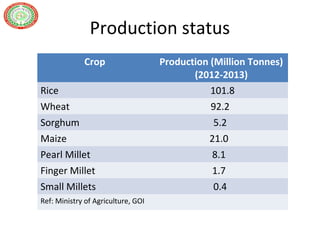
Production status
Crop Production (Million Tonnes)
(2012-2013)
Rice 101.8
Wheat 92.2
Sorghum 5.2
Maize 21.0
Pearl Millet 8.1
Finger Millet 1.7
Small Millets 0.4
Ref: Ministry of Agriculture, GOI
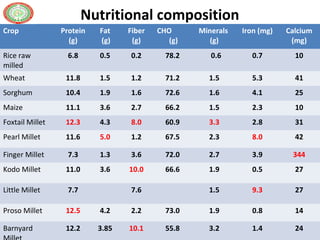
Nutritional composition
Crop Protein
(g)
Fat
(g)
Fiber
(g)
CHO
(g)
Minerals
(g)
Iron (mg) Calcium
(mg)
Rice raw
milled
6.8 0.5 0.2 78.2 0.6 0.7 10
Wheat 11.8 1.5 1.2 71.2 1.5 5.3 41
Sorghum 10.4 1.9 1.6 72.6 1.6 4.1 25
Maize 11.1 3.6 2.7 66.2 1.5 2.3 10
Foxtail Millet 12.3 4.3 8.0 60.9 3.3 2.8 31
Pearl Millet 11.6 5.0 1.2 67.5 2.3 8.0 42
Finger Millet 7.3 1.3 3.6 72.0 2.7 3.9 344
Kodo Millet 11.0 3.6 10.0 66.6 1.9 0.5 27
Little Millet 7.7 7.6 1.5 9.3 27
Proso Millet 12.5 4.2 2.2 73.0 1.9 0.8 14
Barnyard 12.2 3.85 10.1 55.8 3.2 1.4 24
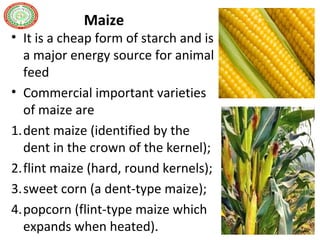
Maize
• It is a cheap form of starch and is
a major energy source for animal
feed
• Commercial important varieties
of maize are
1.dent maize (identified by the
dent in the crown of the kernel);
2.flint maize (hard, round kernels);
3.sweet corn (a dent-type maize);
4.popcorn (flint-type maize which
expands when heated).
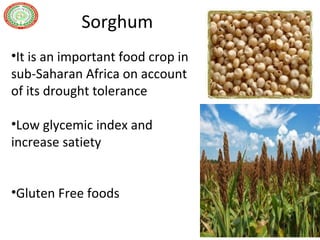
Sorghum
•It is an important food crop in
sub-Saharan Africa on account
of its drought tolerance
•Low glycemic index and
increase satiety
•Gluten Free foods
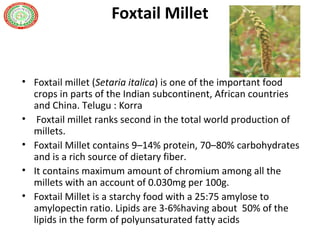
Foxtail Millet
• Foxtail millet (Setaria italica) is one of the important food
crops in parts of the Indian subcontinent, African countries
and China. Telugu : Korra
• Foxtail millet ranks second in the total world production of
millets.
• Foxtail Millet contains 9–14% protein, 70–80% carbohydrates
and is a rich source of dietary fiber.
• It contains maximum amount of chromium among all the
millets with an account of 0.030mg per 100g.
• Foxtail Millet is a starchy food with a 25:75 amylose to
amylopectin ratio. Lipids are 3-6%having about 50% of the
lipids in the form of polyunsaturated fatty acids
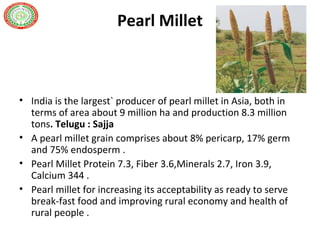
Pearl Millet
• India is the largest` producer of pearl millet in Asia, both in
terms of area about 9 million ha and production 8.3 million
tons. Telugu : Sajja
• A pearl millet grain comprises about 8% pericarp, 17% germ
and 75% endosperm .
• Pearl Millet Protein 7.3, Fiber 3.6,Minerals 2.7, Iron 3.9,
Calcium 344 .
• Pearl millet for increasing its acceptability as ready to serve
break-fast food and improving rural economy and health of
rural people .
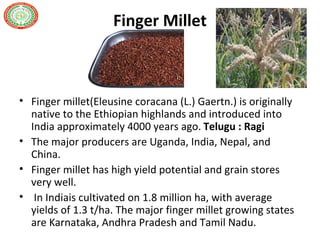
Finger Millet
• Finger millet(Eleusine coracana (L.) Gaertn.) is originally
native to the Ethiopian highlands and introduced into
India approximately 4000 years ago. Telugu : Ragi
• The major producers are Uganda, India, Nepal, and
China.
• Finger millet has high yield potential and grain stores
very well.
• In Indiais cultivated on 1.8 million ha, with average
yields of 1.3 t/ha. The major finger millet growing states
are Karnataka, Andhra Pradesh and Tamil Nadu.
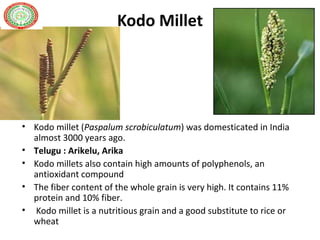
Kodo Millet
• Kodo millet (Paspalum scrobiculatum) was domesticated in India
almost 3000 years ago.
• Telugu : Arikelu, Arika
• Kodo millets also contain high amounts of polyphenols, an
antioxidant compound
• The fiber content of the whole grain is very high. It contains 11%
protein and 10% fiber.
• Kodo millet is a nutritious grain and a good substitute to rice or
wheat
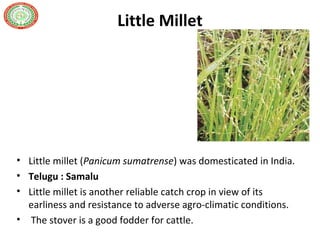
Little Millet
• Little millet (Panicum sumatrense) was domesticated in India.
• Telugu : Samalu
• Little millet is another reliable catch crop in view of its
earliness and resistance to adverse agro-climatic conditions.
• The stover is a good fodder for cattle.
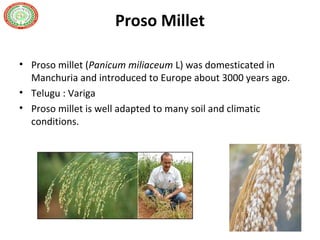
Proso Millet
• Proso millet (Panicum miliaceum L) was domesticated in
Manchuria and introduced to Europe about 3000 years ago.
• Telugu : Variga
• Proso millet is well adapted to many soil and climatic
conditions.
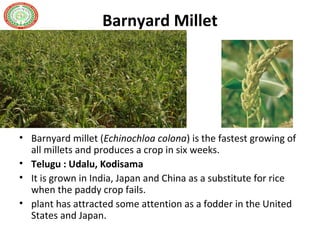
Barnyard Millet
• Barnyard millet (Echinochloa colona) is the fastest growing of
all millets and produces a crop in six weeks.
• Telugu : Udalu, Kodisama
• It is grown in India, Japan and China as a substitute for rice
when the paddy crop fails.
• plant has attracted some attention as a fodder in the United
States and Japan.
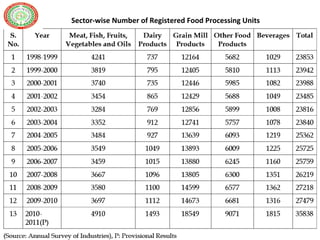
Sector-wise Number of Registered Food Processing Units
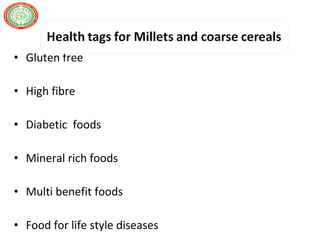
• Gluten free
• High fibre
• Diabetic foods
• Mineral rich foods
• Multi benefit foods
• Food for life style diseases
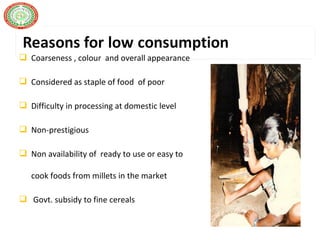
 Coarseness , colour and overall appearance
 Considered as staple of food of poor
 Difficulty in processing at domestic level
 Non-prestigious
 Non availability of ready to use or easy to
cook foods from millets in the market
 Govt. subsidy to fine cereals
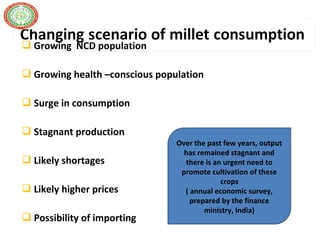
 Growing NCD population
 Growing health –conscious population
 Surge in consumption
 Stagnant production
 Likely shortages
 Likely higher prices
 Possibility of importing
Over the past few years, output
has remained stagnant and
there is an urgent need to
promote cultivation of these
crops
( annual economic survey,
prepared by the finance
ministry, India)
• Dehulling technology is available for various
capacity dehulling fabrication of machine is
possible
• Whole grain flour
• Dehulled grain flour
• Coarse rawa
• Semolina
• Fermented flour and rawa
• Germinated rawa and flour
• Autoclaved rawa and flour for RS3 enhancement
• Composite flours
Value-Added Supply Chain
• Excellent food products can be and are made from millets.
The value-added supply chain includes
• Seed supplier (seed production) - quality and purity
• Grain producer
• Harvesting
• Storage
• Handling and transportation
• Processing into products
• Marketing
Milling
• The millet was decorticated in pilot-scale rice milling
machinery with suitable adaptations.
• Husking was done in a centrifugal sheller.
• The husked material was debranned in a horizontal emery
cone according.
• The husk and the bran fractions together (seed coat material)
formed 26% of the millet
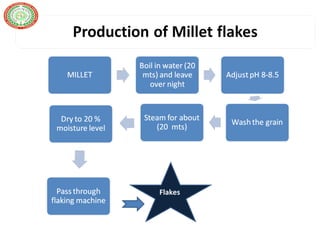
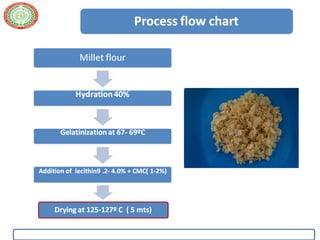
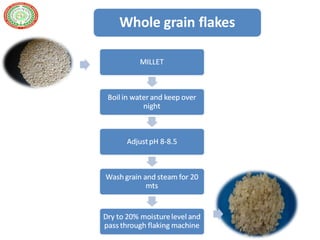
 The process involves grain hydration followed by steaming and
pressing of the grains.
 The grain is soaked to its equilibrium moisture content and is
steamed or roasted to gelatinize the starch and dried to 18%
moisture , conditioned decorticated and then flaked by passing
through an edge runner.
 Thick flakes can be deep fried or dry roasted and this can be used for
uppitu after boiling and seasoning.
 These can be coated with any desired additives for value addition
 Since wet cooking slows down the digestion this feature can be
exploited for preparation diabetic foods at industrial scale
Flakes
Ref: Dept of food science technology, Kasetsart University, Thailand
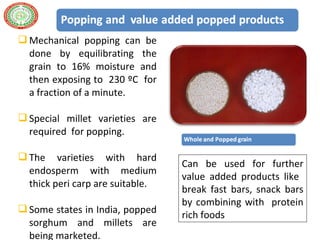
Mechanical popping can be
done by equilibrating the
grain to 16% moisture and
then exposing to 230 ºC for
a fraction of a minute.
Special millet varieties are
required for popping.
The varieties with hard
endosperm with medium
thick peri carp are suitable.
Some states in India, popped
sorghum and millets are
being marketed.
Can be used for further
value added products like
break fast bars, snack bars
by combining with protein
rich foods
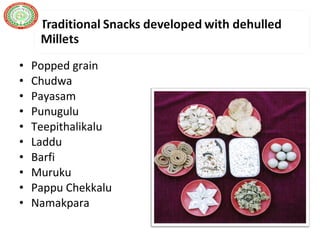
• Popped grain
• Chudwa
• Payasam
• Punugulu
• Teepithalikalu
• Laddu
• Barfi
• Muruku
• Pappu Chekkalu
• Namakpara
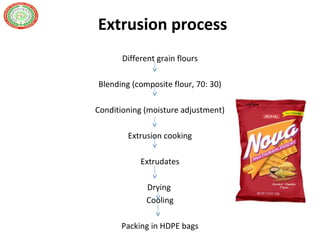
Extrusion process
Different grain flours
Blending (composite flour, 70: 30)
Conditioning (moisture adjustment)
Extrusion cooking
Extrudates
Drying
Cooling
Packing in HDPE bags
Cereal and Millets based products
• Crispies
• Cookies
• Cake
• Idly mix
• Dosa mix
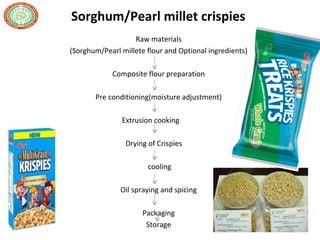
Sorghum/Pearl millet crispies
Raw materials
(Sorghum/Pearl millete flour and Optional ingredients)
Composite flour preparation
Pre conditioning(moisture adjustment)
Extrusion cooking
Drying of Crispies
cooling
Oil spraying and spicing
Packaging
Storage
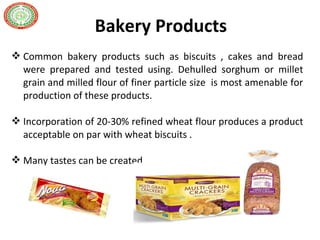
 Common bakery products such as biscuits , cakes and bread
were prepared and tested using. Dehulled sorghum or millet
grain and milled flour of finer particle size is most amenable for
production of these products.
 Incorporation of 20-30% refined wheat flour produces a product
acceptable on par with wheat biscuits .
 Many tastes can be created
Coconut
Bakery Products
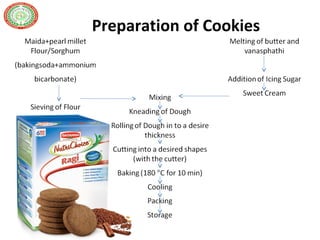
Preparation of Cookies
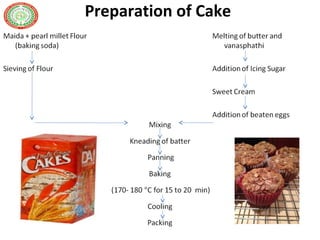
Preparation of Cake
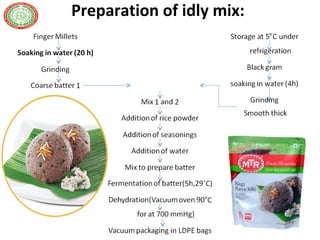
Preparation of idly mix:
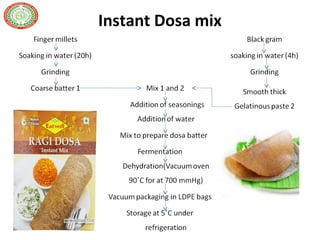
Instant Dosa mix
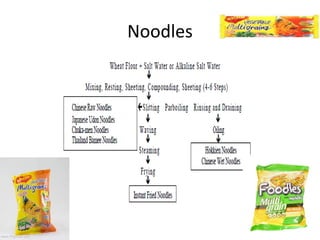
Noodles
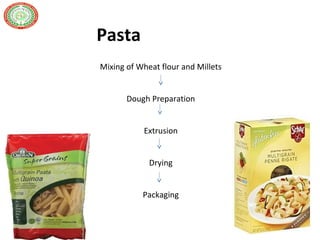
Pasta
Mixing of Wheat flour and Millets
Dough Preparation
Extrusion
Drying
Packaging
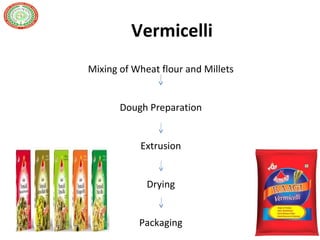
Vermicelli
Mixing of Wheat flour and Millets
Dough Preparation
Extrusion
Drying
Packaging
Flavorings
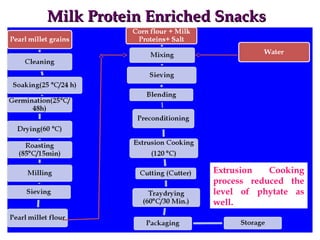
Milk Protein Enriched SnacksMilk Protein Enriched Snacks
Extrusion Cooking
process reduced the
level of phytate as
well.
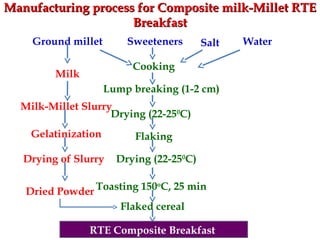
Manufacturing process for Composite milk-Millet RTEManufacturing process for Composite milk-Millet RTE
BreakfastBreakfast
Ground millet Sweeteners Salt
Cooking
Water
Drying (22-250
C)
Flaked cereal
Toasting 150o
C, 25 min
Lump breaking (1-2 cm)
Flaking
Drying (22-250
C)
Dried Powder
Milk
Milk-Millet Slurry
Gelatinization
Drying of Slurry
RTE Composite Breakfast
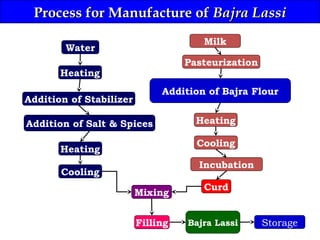
Process for Manufacture ofProcess for Manufacture of Bajra LassiBajra Lassi
Water
Heating
Addition of Stabilizer
Addition of Salt & Spices
Heating
Cooling
Milk
Pasteurization
Addition of Bajra Flour
Heating
Cooling
Incubation
Curd
Mixing
Filling Bajra Lassi Storage
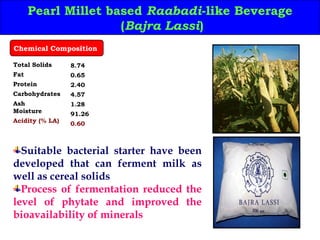
Pearl Millet based Raabadi-like Beverage
(Bajra Lassi)
Total Solids
Fat
Protein
Carbohydrates
Ash
Moisture
Acidity (% LA)
8.74
0.65
2.40
4.57
1.28
91.26
0.60
Chemical Composition
Suitable bacterial starter have been
developed that can ferment milk as
well as cereal solids
Process of fermentation reduced the
level of phytate and improved the
bioavailability of minerals
Conclusion
• World over increasing number of NCD is leading
to Commercialization of millet products is the
need of the hour
• Ready-to- eat food industry should come
forward to provide a healthy food to the
mankind keeping in view the changing
demography
• Public private partnership helps for better
commercialization
• Farmer encouragement
Better Millet Thank you for Your
Kind Attention

Cereals & Millet Processing

  • 1.
    Processing of Cereals A.Poshadri M.Tech(Food Tech.) Assistant Professor Department of Food Technology Prof. Jayashankar Telangana State Agriculture University Email: poshadri_fst@yahoo.co.in Cell No: +919492828965
  • 2.
    Introduction Cereals are staplefoods, and are important sources of nutrients in both developed and developing countries Wheat, rice, and corn are the major important grains in the human diet. The minor grains include oats, barley, rye, triticale, sorghum and millets Cereals grains are rich sources of fibre, vitamins, minerals, and photochemicals
  • 3.
    • After harvest,correct storage of the grain is important to prevent mould spoilage, pest infestation and grain germination • Dehusking (Dehulling) and Milling are the main processing techniques associated with cereals
  • 4.
    Cereals and Millets –Sorghum – Maize – Foxtail Millet – Pearl Millet – Finger Millet – Kodo Millet – Little Millet – Proso Millet – Barnyard Millet
  • 5.
    Production status Crop Production(Million Tonnes) (2012-2013) Rice 101.8 Wheat 92.2 Sorghum 5.2 Maize 21.0 Pearl Millet 8.1 Finger Millet 1.7 Small Millets 0.4 Ref: Ministry of Agriculture, GOI
  • 6.
    Nutritional composition Crop Protein (g) Fat (g) Fiber (g) CHO (g) Minerals (g) Iron(mg) Calcium (mg) Rice raw milled 6.8 0.5 0.2 78.2 0.6 0.7 10 Wheat 11.8 1.5 1.2 71.2 1.5 5.3 41 Sorghum 10.4 1.9 1.6 72.6 1.6 4.1 25 Maize 11.1 3.6 2.7 66.2 1.5 2.3 10 Foxtail Millet 12.3 4.3 8.0 60.9 3.3 2.8 31 Pearl Millet 11.6 5.0 1.2 67.5 2.3 8.0 42 Finger Millet 7.3 1.3 3.6 72.0 2.7 3.9 344 Kodo Millet 11.0 3.6 10.0 66.6 1.9 0.5 27 Little Millet 7.7 7.6 1.5 9.3 27 Proso Millet 12.5 4.2 2.2 73.0 1.9 0.8 14 Barnyard 12.2 3.85 10.1 55.8 3.2 1.4 24
  • 7.
    Maize • It isa cheap form of starch and is a major energy source for animal feed • Commercial important varieties of maize are 1.dent maize (identified by the dent in the crown of the kernel); 2.flint maize (hard, round kernels); 3.sweet corn (a dent-type maize); 4.popcorn (flint-type maize which expands when heated).
  • 8.
    Sorghum •It is animportant food crop in sub-Saharan Africa on account of its drought tolerance •Low glycemic index and increase satiety •Gluten Free foods
  • 9.
    Foxtail Millet • Foxtailmillet (Setaria italica) is one of the important food crops in parts of the Indian subcontinent, African countries and China. Telugu : Korra • Foxtail millet ranks second in the total world production of millets. • Foxtail Millet contains 9–14% protein, 70–80% carbohydrates and is a rich source of dietary fiber. • It contains maximum amount of chromium among all the millets with an account of 0.030mg per 100g. • Foxtail Millet is a starchy food with a 25:75 amylose to amylopectin ratio. Lipids are 3-6%having about 50% of the lipids in the form of polyunsaturated fatty acids
  • 10.
    Pearl Millet • Indiais the largest` producer of pearl millet in Asia, both in terms of area about 9 million ha and production 8.3 million tons. Telugu : Sajja • A pearl millet grain comprises about 8% pericarp, 17% germ and 75% endosperm . • Pearl Millet Protein 7.3, Fiber 3.6,Minerals 2.7, Iron 3.9, Calcium 344 . • Pearl millet for increasing its acceptability as ready to serve break-fast food and improving rural economy and health of rural people .
  • 11.
    Finger Millet • Fingermillet(Eleusine coracana (L.) Gaertn.) is originally native to the Ethiopian highlands and introduced into India approximately 4000 years ago. Telugu : Ragi • The major producers are Uganda, India, Nepal, and China. • Finger millet has high yield potential and grain stores very well. • In Indiais cultivated on 1.8 million ha, with average yields of 1.3 t/ha. The major finger millet growing states are Karnataka, Andhra Pradesh and Tamil Nadu.
  • 12.
    Kodo Millet • Kodomillet (Paspalum scrobiculatum) was domesticated in India almost 3000 years ago. • Telugu : Arikelu, Arika • Kodo millets also contain high amounts of polyphenols, an antioxidant compound • The fiber content of the whole grain is very high. It contains 11% protein and 10% fiber. • Kodo millet is a nutritious grain and a good substitute to rice or wheat
  • 13.
    Little Millet • Littlemillet (Panicum sumatrense) was domesticated in India. • Telugu : Samalu • Little millet is another reliable catch crop in view of its earliness and resistance to adverse agro-climatic conditions. • The stover is a good fodder for cattle.
  • 14.
    Proso Millet • Prosomillet (Panicum miliaceum L) was domesticated in Manchuria and introduced to Europe about 3000 years ago. • Telugu : Variga • Proso millet is well adapted to many soil and climatic conditions.
  • 15.
    Barnyard Millet • Barnyardmillet (Echinochloa colona) is the fastest growing of all millets and produces a crop in six weeks. • Telugu : Udalu, Kodisama • It is grown in India, Japan and China as a substitute for rice when the paddy crop fails. • plant has attracted some attention as a fodder in the United States and Japan.
  • 16.
    Sector-wise Number ofRegistered Food Processing Units
  • 17.
    • Gluten free •High fibre • Diabetic foods • Mineral rich foods • Multi benefit foods • Food for life style diseases
  • 18.
     Coarseness ,colour and overall appearance  Considered as staple of food of poor  Difficulty in processing at domestic level  Non-prestigious  Non availability of ready to use or easy to cook foods from millets in the market  Govt. subsidy to fine cereals
  • 19.
     Growing NCDpopulation  Growing health –conscious population  Surge in consumption  Stagnant production  Likely shortages  Likely higher prices  Possibility of importing Over the past few years, output has remained stagnant and there is an urgent need to promote cultivation of these crops ( annual economic survey, prepared by the finance ministry, India)
  • 20.
    • Dehulling technologyis available for various capacity dehulling fabrication of machine is possible • Whole grain flour • Dehulled grain flour • Coarse rawa • Semolina
  • 21.
    • Fermented flourand rawa • Germinated rawa and flour • Autoclaved rawa and flour for RS3 enhancement • Composite flours
  • 22.
    Value-Added Supply Chain •Excellent food products can be and are made from millets. The value-added supply chain includes • Seed supplier (seed production) - quality and purity • Grain producer • Harvesting • Storage • Handling and transportation • Processing into products • Marketing
  • 23.
    Milling • The milletwas decorticated in pilot-scale rice milling machinery with suitable adaptations. • Husking was done in a centrifugal sheller. • The husked material was debranned in a horizontal emery cone according. • The husk and the bran fractions together (seed coat material) formed 26% of the millet
  • 24.
     The processinvolves grain hydration followed by steaming and pressing of the grains.  The grain is soaked to its equilibrium moisture content and is steamed or roasted to gelatinize the starch and dried to 18% moisture , conditioned decorticated and then flaked by passing through an edge runner.  Thick flakes can be deep fried or dry roasted and this can be used for uppitu after boiling and seasoning.  These can be coated with any desired additives for value addition  Since wet cooking slows down the digestion this feature can be exploited for preparation diabetic foods at industrial scale
  • 25.
  • 26.
    Ref: Dept offood science technology, Kasetsart University, Thailand
  • 28.
    Mechanical popping canbe done by equilibrating the grain to 16% moisture and then exposing to 230 ºC for a fraction of a minute. Special millet varieties are required for popping. The varieties with hard endosperm with medium thick peri carp are suitable. Some states in India, popped sorghum and millets are being marketed. Can be used for further value added products like break fast bars, snack bars by combining with protein rich foods
  • 29.
    • Popped grain •Chudwa • Payasam • Punugulu • Teepithalikalu • Laddu • Barfi • Muruku • Pappu Chekkalu • Namakpara
  • 30.
    Extrusion process Different grainflours Blending (composite flour, 70: 30) Conditioning (moisture adjustment) Extrusion cooking Extrudates Drying Cooling Packing in HDPE bags
  • 31.
    Cereal and Milletsbased products • Crispies • Cookies • Cake • Idly mix • Dosa mix
  • 32.
    Sorghum/Pearl millet crispies Rawmaterials (Sorghum/Pearl millete flour and Optional ingredients) Composite flour preparation Pre conditioning(moisture adjustment) Extrusion cooking Drying of Crispies cooling Oil spraying and spicing Packaging Storage
  • 33.
     Common bakeryproducts such as biscuits , cakes and bread were prepared and tested using. Dehulled sorghum or millet grain and milled flour of finer particle size is most amenable for production of these products.  Incorporation of 20-30% refined wheat flour produces a product acceptable on par with wheat biscuits .  Many tastes can be created Coconut Bakery Products
  • 34.
  • 35.
  • 36.
  • 37.
  • 38.
  • 39.
    Pasta Mixing of Wheatflour and Millets Dough Preparation Extrusion Drying Packaging
  • 40.
    Vermicelli Mixing of Wheatflour and Millets Dough Preparation Extrusion Drying Packaging
  • 41.
  • 42.
    Milk Protein EnrichedSnacksMilk Protein Enriched Snacks Extrusion Cooking process reduced the level of phytate as well.
  • 43.
    Manufacturing process forComposite milk-Millet RTEManufacturing process for Composite milk-Millet RTE BreakfastBreakfast Ground millet Sweeteners Salt Cooking Water Drying (22-250 C) Flaked cereal Toasting 150o C, 25 min Lump breaking (1-2 cm) Flaking Drying (22-250 C) Dried Powder Milk Milk-Millet Slurry Gelatinization Drying of Slurry RTE Composite Breakfast
  • 44.
    Process for ManufactureofProcess for Manufacture of Bajra LassiBajra Lassi Water Heating Addition of Stabilizer Addition of Salt & Spices Heating Cooling Milk Pasteurization Addition of Bajra Flour Heating Cooling Incubation Curd Mixing Filling Bajra Lassi Storage
  • 45.
    Pearl Millet basedRaabadi-like Beverage (Bajra Lassi) Total Solids Fat Protein Carbohydrates Ash Moisture Acidity (% LA) 8.74 0.65 2.40 4.57 1.28 91.26 0.60 Chemical Composition Suitable bacterial starter have been developed that can ferment milk as well as cereal solids Process of fermentation reduced the level of phytate and improved the bioavailability of minerals
  • 46.
    Conclusion • World overincreasing number of NCD is leading to Commercialization of millet products is the need of the hour • Ready-to- eat food industry should come forward to provide a healthy food to the mankind keeping in view the changing demography • Public private partnership helps for better commercialization • Farmer encouragement
  • 47.
    Better Millet Thankyou for Your Kind Attention