
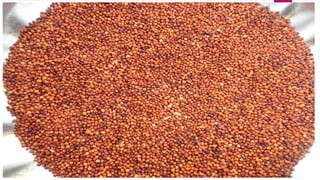
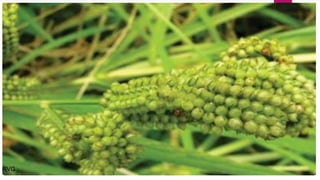


32.రాగి ( Ragi )
(FINGERMILLET)
Scientific name: Eleusine coracana
Family: Poaceae
RVG
RVG
 In fact, it is the main cereal crop for monsoon season in some hilly areas.
 It is predominantly grown as a dry land crop in Karnataka, Andhra Pradesh,
and Tamil Nadu.
 Finger millet contributes nearly 40% of total small millet produce of India,
occupying nearly 3.2 million ha.
 Ragi is relished mostly by the rural population of southern India for the
nutritious meal it provides.
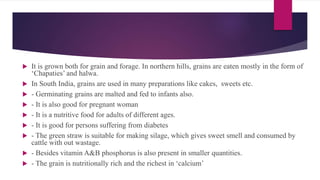
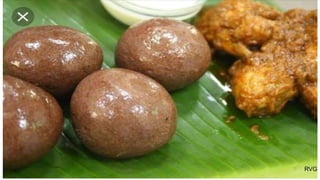
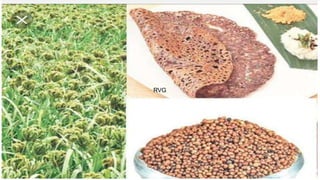
 It is grown both for grain and forage. In northern hills, grains are eaten mostly in the form of
‘Chapaties’ and halwa.
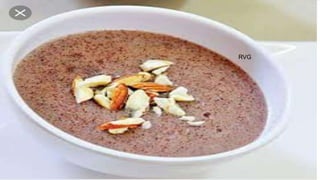
 In South India, grains are used in many preparations like cakes, sweets etc.
 - Germinating grains are malted and fed to infants also.
 - It is also good for pregnant woman
 - It is a nutritive food for adults of different ages.
 - It is good for persons suffering from diabetes
 - The green straw is suitable for making silage, which gives sweet smell and consumed by
cattle with out wastage.
 - Besides vitamin A&B phosphorus is also present in smaller quantities.
 - The grain is nutritionally rich and the richest in ‘calcium’
RVG
RVG
RVG
Proteins - 9.2%
Fat - 1.29%
Carbohydrates - 76.32%
Minerals - 2.24%
Ash - 3.90%
Calcium - 0.33%
NUTRITIONAL STATUS
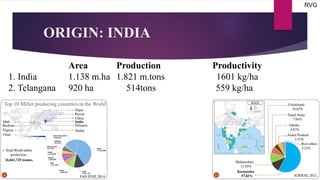
ORIGIN: INDIA
Area Production Productivity
1. India 1.138 m.ha 1.821 m.tons 1601 kg/ha
2. Telangana 920 ha 514tons 559 kg/ha
RVG
ADAPTATION:
 It is a crop of tropical and subtropical climate and can be grown
successfully from sea level to an altitude of 2100 mts on hill slopes
as well as in plains.
 It is a hardy crop.
 It is grown in areas having annual average rainfall between 500
to 1000 mm. In regions of higher rainfall it can be raised on well
drained soils as a transplanted crop.
 It can be grown under rainfed as well as irrigated conditions.
33. Ragi
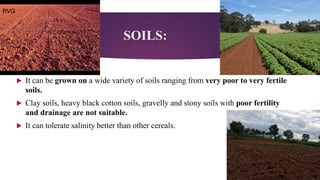
SOILS:
 It can be grown on a wide variety of soils ranging from very poor to very fertile
soils.
 Clay soils, heavy black cotton soils, gravelly and stony soils with poor fertility
and drainage are not suitable.
 It can tolerate salinity better than other cereals.
RVG
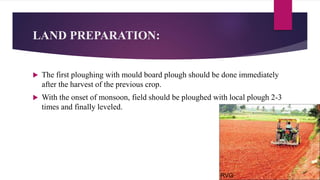
LAND PREPARATION:
 The first ploughing with mould board plough should be done immediately
after the harvest of the previous crop.
 With the onset of monsoon, field should be ploughed with local plough 2-3
times and finally leveled.
RVG
SEASON: Finger millet is not a season bound crop. So, it can be grown through
out the year, if water is available,
 The main seasons are
 1. Punasa Ragi (or) Burada Chodi:
 Finger millet is grown in wetlands, prior to planting of rice in slushy conditions by taking advantage of monsoon
rains in Srikakulam and Visakhapatnam Dist. Short duration varieties (AKP -2) are preferred for this season.
Twenty five percent Ragi in above districts is under this season (May-Aug).
 2. Main Season (or) Pedda Panta:
 The main area under Ragi crop during this season (Aug-Nov) accounts for 50% area of Srikakulam and
Visakhapatnam. Suitable varieties are AKP -7 and Kalyani (WR – 652)
 3. Pyru season:
 Remaining 25% of area is under pyru season. (Nov/Dec – Feb/ March). As the crop is grown under assured
irrigated conditions, the yields are high.VZM-2 is recommended.
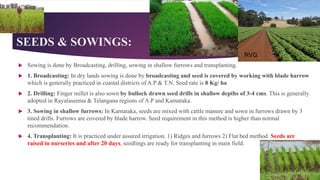
SEEDS & SOWINGS:
 Sowing is done by Broadcasting, drilling, sowing in shallow furrows and transplanting.
 1. Broadcasting: In dry lands sowing is done by broadcasting and seed is covered by working with blade harrow
which is generally practiced in coastal districts of A.P & T.N. Seed rate is 8 Kg/ ha
 2. Drilling: Finger millet is also sown by bullock drawn seed drills in shallow depths of 3-4 cms. This is generally
adopted in Rayalaseema & Telangana regions of A.P and Karnataka.
 3. Sowing in shallow furrows: In Karnataka, seeds are mixed with cattle manure and sown in furrows drawn by 3
tined drills. Furrows are covered by blade harrow. Seed requirement in this method is higher than normal
recommendation.
 4. Transplanting: It is practiced under assured irrigation. 1) Ridges and furrows 2) Flat bed method. Seeds are
raised in nurseries and after 20 days, seedlings are ready for transplanting in main field.
RVG
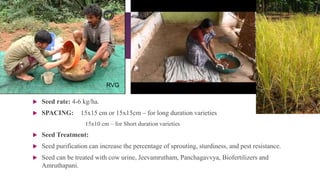
 Seed rate: 4-6 kg/ha.
 SPACING: 15x15 cm or 15x15cm – for long duration varieties
15x10 cm – for Short duration varieties
 Seed Treatment:
 Seed purification can increase the percentage of sprouting, sturdiness, and pest resistance.
 Seed can be treated with cow urine, Jeevamrutham, Panchagavvya, Biofertilizers and
Amruthapani.
RVG
MANURES & FERTILIZERS:
 For Nursery: FYM : 10t/ha Incorporation before sowing
40-40-40 kg N, P2O5 and K2O/ha
 For main field: FYM: 10t/ha – Before sowing
60-30-30 kg N, P2O5 and K2O/ha
 N is applied in 2 Splits
 1. At the time of transplanting – ½ dose of N along with full dose of P and K.
 2. Remaining dose of N at 30 DAS.
Fertilizer in organic farming depends on the following factors:
 On nutrients such as those in the soil.
 On the nutrients from the rain.
 On top of the soil fertilizer.
 Above ground microorganisms (nitrogen fixing bacteria, phosphorus, solubilizer bacteria, potash
solubilizer).
 Depends on the nutrients sprayed on the crops.
 10 tonnes of cattle manure per acre in the last Tillage.
 Spray the liquid Jeevamrutham once every 15 days.
 Spray 3% Panchagavvya at the time of Crop Season twice or thrice.
 Apply 200 kg of Ghaanajeevamrutham per acre twice or thrice.
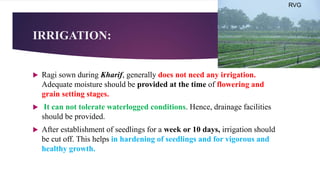
IRRIGATION:
 Ragi sown during Kharif, generally does not need any irrigation.
Adequate moisture should be provided at the time of flowering and
grain setting stages.
 It can not tolerate waterlogged conditions. Hence, drainage facilities
should be provided.
 After establishment of seedlings for a week or 10 days, irrigation should
be cut off. This helps in hardening of seedlings and for vigorous and
healthy growth.
RVG
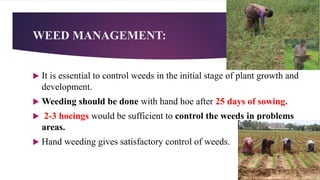
WEED MANAGEMENT:
 It is essential to control weeds in the initial stage of plant growth and
development.
 Weeding should be done with hand hoe after 25 days of sowing.
 2-3 hoeings would be sufficient to control the weeds in problems
areas.
 Hand weeding gives satisfactory control of weeds.
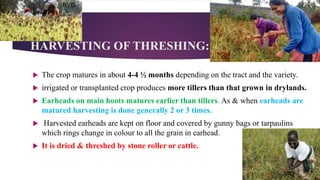
HARVESTING OF THRESHING:
 The crop matures in about 4-4 ½ months depending on the tract and the variety.
 irrigated or transplanted crop produces more tillers than that grown in drylands.
 Earheads on main hoots matures earlier than tillers. As & when earheads are
matured harvesting is done generally 2 or 3 times.
 Harvested earheads are kept on floor and covered by gunny bags or tarpaulins
which rings change in colour to all the grain in earhead.
 It is dried & threshed by stone roller or cattle.
RVG
YIELD ATTRIBUTES:
 Number of plants per unit area
 Number of tillers per unit area
 Number productive tillers per unit area
 Number of fingers per earhead
 Number of filled grains per earhead
 Test weight
YIELD
 Rainfed: 7- 8 q/ha - grain
11-18 q/ha – fodder
 Irrigated: 30-35 q/ha - grain
35-50 q/ha – fodder,
Varieties:
 Kalyani – Released in 1971 from ARS, Pelumallaplle
 Sarada - Relesed in 1972 in 1971 RARS, Anakapalli.
 Godavari - Released in 1974 - ARS, Peddapuram
 Simhadri - Released in 1981 – ARS Vijayanagaram
 Ratnagiri - Released in 1985 – ARS, Peddapuram
 Hamsa, co-9 – White grained var. with protein (12%) others (7.9%) The other varieties are AKP-2, Suraj,
Padmavathi, VZM-1, Sapthagiri, Maruthi, Gauthami, Bharathi, Champavathi etc.
Cropping System
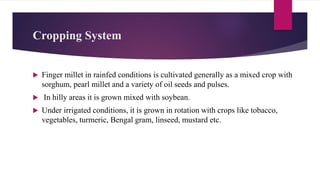
 Finger millet in rainfed conditions is cultivated generally as a mixed crop with
sorghum, pearl millet and a variety of oil seeds and pulses.
 In hilly areas it is grown mixed with soybean.
 Under irrigated conditions, it is grown in rotation with crops like tobacco,
vegetables, turmeric, Bengal gram, linseed, mustard etc.
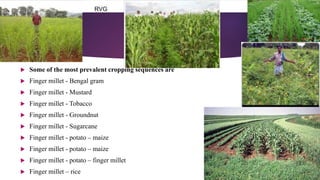
 Some of the most prevalent cropping sequences are
 Finger millet - Bengal gram
 Finger millet - Mustard
 Finger millet - Tobacco
 Finger millet - Groundnut
 Finger millet - Sugarcane
 Finger millet - potato – maize
 Finger millet - potato – finger millet
 Finger millet – rice
RVG
Thank you
RVG

Ragi / fingermillet

  • 1.
    32.రాగి ( Ragi) (FINGERMILLET) Scientific name: Eleusine coracana Family: Poaceae RVG
  • 3.
  • 4.
     In fact,it is the main cereal crop for monsoon season in some hilly areas.  It is predominantly grown as a dry land crop in Karnataka, Andhra Pradesh, and Tamil Nadu.  Finger millet contributes nearly 40% of total small millet produce of India, occupying nearly 3.2 million ha.  Ragi is relished mostly by the rural population of southern India for the nutritious meal it provides.
  • 5.
     It isgrown both for grain and forage. In northern hills, grains are eaten mostly in the form of ‘Chapaties’ and halwa.  In South India, grains are used in many preparations like cakes, sweets etc.  - Germinating grains are malted and fed to infants also.  - It is also good for pregnant woman  - It is a nutritive food for adults of different ages.  - It is good for persons suffering from diabetes  - The green straw is suitable for making silage, which gives sweet smell and consumed by cattle with out wastage.  - Besides vitamin A&B phosphorus is also present in smaller quantities.  - The grain is nutritionally rich and the richest in ‘calcium’
  • 6.
  • 7.
  • 8.
  • 9.
    Proteins - 9.2% Fat- 1.29% Carbohydrates - 76.32% Minerals - 2.24% Ash - 3.90% Calcium - 0.33% NUTRITIONAL STATUS
  • 10.
    ORIGIN: INDIA Area ProductionProductivity 1. India 1.138 m.ha 1.821 m.tons 1601 kg/ha 2. Telangana 920 ha 514tons 559 kg/ha RVG
  • 11.
    ADAPTATION:  It isa crop of tropical and subtropical climate and can be grown successfully from sea level to an altitude of 2100 mts on hill slopes as well as in plains.  It is a hardy crop.  It is grown in areas having annual average rainfall between 500 to 1000 mm. In regions of higher rainfall it can be raised on well drained soils as a transplanted crop.  It can be grown under rainfed as well as irrigated conditions.
  • 12.
  • 13.
    SOILS:  It canbe grown on a wide variety of soils ranging from very poor to very fertile soils.  Clay soils, heavy black cotton soils, gravelly and stony soils with poor fertility and drainage are not suitable.  It can tolerate salinity better than other cereals. RVG
  • 14.
    LAND PREPARATION:  Thefirst ploughing with mould board plough should be done immediately after the harvest of the previous crop.  With the onset of monsoon, field should be ploughed with local plough 2-3 times and finally leveled. RVG
  • 15.
    SEASON: Finger milletis not a season bound crop. So, it can be grown through out the year, if water is available,  The main seasons are  1. Punasa Ragi (or) Burada Chodi:  Finger millet is grown in wetlands, prior to planting of rice in slushy conditions by taking advantage of monsoon rains in Srikakulam and Visakhapatnam Dist. Short duration varieties (AKP -2) are preferred for this season. Twenty five percent Ragi in above districts is under this season (May-Aug).  2. Main Season (or) Pedda Panta:  The main area under Ragi crop during this season (Aug-Nov) accounts for 50% area of Srikakulam and Visakhapatnam. Suitable varieties are AKP -7 and Kalyani (WR – 652)  3. Pyru season:  Remaining 25% of area is under pyru season. (Nov/Dec – Feb/ March). As the crop is grown under assured irrigated conditions, the yields are high.VZM-2 is recommended.
  • 16.
    SEEDS & SOWINGS: Sowing is done by Broadcasting, drilling, sowing in shallow furrows and transplanting.  1. Broadcasting: In dry lands sowing is done by broadcasting and seed is covered by working with blade harrow which is generally practiced in coastal districts of A.P & T.N. Seed rate is 8 Kg/ ha  2. Drilling: Finger millet is also sown by bullock drawn seed drills in shallow depths of 3-4 cms. This is generally adopted in Rayalaseema & Telangana regions of A.P and Karnataka.  3. Sowing in shallow furrows: In Karnataka, seeds are mixed with cattle manure and sown in furrows drawn by 3 tined drills. Furrows are covered by blade harrow. Seed requirement in this method is higher than normal recommendation.  4. Transplanting: It is practiced under assured irrigation. 1) Ridges and furrows 2) Flat bed method. Seeds are raised in nurseries and after 20 days, seedlings are ready for transplanting in main field. RVG
  • 17.
     Seed rate:4-6 kg/ha.  SPACING: 15x15 cm or 15x15cm – for long duration varieties 15x10 cm – for Short duration varieties  Seed Treatment:  Seed purification can increase the percentage of sprouting, sturdiness, and pest resistance.  Seed can be treated with cow urine, Jeevamrutham, Panchagavvya, Biofertilizers and Amruthapani. RVG
  • 18.
    MANURES & FERTILIZERS: For Nursery: FYM : 10t/ha Incorporation before sowing 40-40-40 kg N, P2O5 and K2O/ha  For main field: FYM: 10t/ha – Before sowing 60-30-30 kg N, P2O5 and K2O/ha  N is applied in 2 Splits  1. At the time of transplanting – ½ dose of N along with full dose of P and K.  2. Remaining dose of N at 30 DAS.
  • 19.
    Fertilizer in organicfarming depends on the following factors:  On nutrients such as those in the soil.  On the nutrients from the rain.  On top of the soil fertilizer.  Above ground microorganisms (nitrogen fixing bacteria, phosphorus, solubilizer bacteria, potash solubilizer).  Depends on the nutrients sprayed on the crops.  10 tonnes of cattle manure per acre in the last Tillage.  Spray the liquid Jeevamrutham once every 15 days.  Spray 3% Panchagavvya at the time of Crop Season twice or thrice.  Apply 200 kg of Ghaanajeevamrutham per acre twice or thrice.
  • 20.
    IRRIGATION:  Ragi sownduring Kharif, generally does not need any irrigation. Adequate moisture should be provided at the time of flowering and grain setting stages.  It can not tolerate waterlogged conditions. Hence, drainage facilities should be provided.  After establishment of seedlings for a week or 10 days, irrigation should be cut off. This helps in hardening of seedlings and for vigorous and healthy growth. RVG
  • 21.
    WEED MANAGEMENT:  Itis essential to control weeds in the initial stage of plant growth and development.  Weeding should be done with hand hoe after 25 days of sowing.  2-3 hoeings would be sufficient to control the weeds in problems areas.  Hand weeding gives satisfactory control of weeds.
  • 22.
    HARVESTING OF THRESHING: The crop matures in about 4-4 ½ months depending on the tract and the variety.  irrigated or transplanted crop produces more tillers than that grown in drylands.  Earheads on main hoots matures earlier than tillers. As & when earheads are matured harvesting is done generally 2 or 3 times.  Harvested earheads are kept on floor and covered by gunny bags or tarpaulins which rings change in colour to all the grain in earhead.  It is dried & threshed by stone roller or cattle. RVG
  • 23.
    YIELD ATTRIBUTES:  Numberof plants per unit area  Number of tillers per unit area  Number productive tillers per unit area  Number of fingers per earhead  Number of filled grains per earhead  Test weight
  • 24.
    YIELD  Rainfed: 7-8 q/ha - grain 11-18 q/ha – fodder  Irrigated: 30-35 q/ha - grain 35-50 q/ha – fodder,
  • 25.
    Varieties:  Kalyani –Released in 1971 from ARS, Pelumallaplle  Sarada - Relesed in 1972 in 1971 RARS, Anakapalli.  Godavari - Released in 1974 - ARS, Peddapuram  Simhadri - Released in 1981 – ARS Vijayanagaram  Ratnagiri - Released in 1985 – ARS, Peddapuram  Hamsa, co-9 – White grained var. with protein (12%) others (7.9%) The other varieties are AKP-2, Suraj, Padmavathi, VZM-1, Sapthagiri, Maruthi, Gauthami, Bharathi, Champavathi etc.
  • 26.
    Cropping System  Fingermillet in rainfed conditions is cultivated generally as a mixed crop with sorghum, pearl millet and a variety of oil seeds and pulses.  In hilly areas it is grown mixed with soybean.  Under irrigated conditions, it is grown in rotation with crops like tobacco, vegetables, turmeric, Bengal gram, linseed, mustard etc.
  • 27.
     Some ofthe most prevalent cropping sequences are  Finger millet - Bengal gram  Finger millet - Mustard  Finger millet - Tobacco  Finger millet - Groundnut  Finger millet - Sugarcane  Finger millet - potato – maize  Finger millet - potato – maize  Finger millet - potato – finger millet  Finger millet – rice RVG
  • 28.