
K R C COLLEGE OF HORTICULTURE,ARABHAVI
Seed Treatment
Basavaraj Panjagal
Ph.D Research Scholar
1
Basavaraj Panjagal
Seed treatment refers to the application of fungicide , insecticide
or both to the seeds to disinfect (deep seated ) and disinfest
( over seed coat ) them from seed borne or soil borne pathogenic
organisms and storage insects.
Benefits of seed treatment
1.Prevention of spread of plant diseases
2.Protects seed from seed rot and seedling blights
3. Provides protection from storage insects and pests.
4. Improves germination
2
Basavaraj Panjagal
Dates back to 17th century when salt water wasaccidently
discovered to control bunt and stinking smut of wheat seed.
In 1755, M.D Tillet, a french botonist recommented the use of
lime as a chemical treatment for wheat seed
Some 50 years later ,Prevost a Swiss botanist ,discovered the
use of copper fungicides as seed treatment.
New concepts of treating seeds with Organomercurials like
Ceresan and Semesan were introduced in 1920.
3
Basavaraj Panjagal
Types of Seed treatments
1.Physical treatment:
a) Hot water treatment
b) Hot air
c) scarification
d) anaerobic
e) solar treatment
2.Chemical seed treatments:
3. Biological seed treatments: Bio agents, plant extracts, red earth..
Methods of seed treatments
1. Manual methods
2. Mechanical method of seed treatment
4
Basavaraj Panjagal
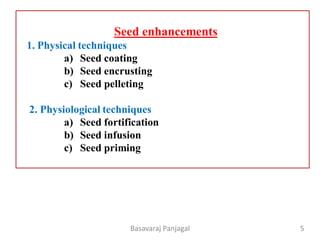
Seed enhancements
1. Physical techniques
a) Seed coating
b) Seed encrusting
c) Seed pelleting
2. Physiological techniques
a) Seed fortification
b) Seed infusion
c) Seed priming
5
Basavaraj Panjagal
Seed Quality Enhancement
Definition
Post harvest treatment that improve
germination or seedling growth or facilitate the
delivery of seeds and other materials required at
the time of sowing
6
Basavaraj Panjagal
Role of improved seed
•
•
•
•
It serves as a carrier of new technologies
It serves a basic tools for secured food
supply crop yields
It serves as mean of security in less
favorable production area
It act as medium for rehabitation of
agriculture in case of natural disaster
7
Basavaraj Panjagal
Where & when it is needed?
• Problematic seed
• High value of seed
• Specific planting technique
• Biotic stresses
• Direct seeding
• Adverse climatic conditions
8
Basavaraj Panjagal
History
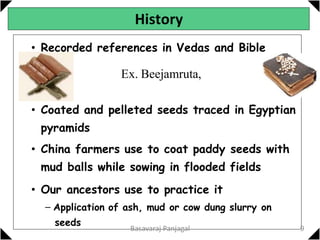
• Recorded references in Vedas and Bible
Ex. Beejamruta,
• Coated and pelleted seeds traced in Egyptian
pyramids
• China farmers use to coat paddy seeds with
mud balls while sowing in flooded fields
• Our ancestors use to practice it
– Application of ash, mud or cow dung slurry on
seeds
9
Basavaraj Panjagal
Seed Quality Enhancement
Techniques
1. Seed hydration technology (pre
hydration, priming)
2. Seed coating (pelleting, film coating)
3. Integrated seed enhancement
10
Basavaraj Panjagal
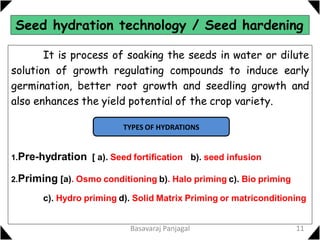
Seed hydration technology / Seed hardening
1.Pre-hydration [ a). Seed fortification b). seed infusion
2.Priming [a). Osmo conditioning b). Halo priming c). Bio priming
c). Hydro priming d). Solid Matrix Priming or matriconditioning
It is process of soaking the seeds in water or dilute
solution of growth regulating compounds to induce early
germination, better root growth and seedling growth and
also enhances the yield potential of the crop variety.
TYPES OF HYDRATIONS
11
Basavaraj Panjagal
12
Basavaraj Panjagal
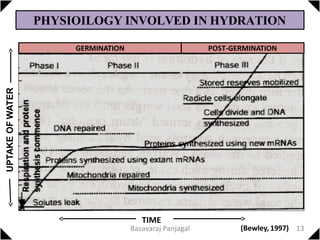
PHYSIOILOGY INVOLVED IN HYDRATION
GERMINATION POST-GERMINATION
UPTAKE
OF
WATER
TIME
(Bewley, 1997) 13
Basavaraj Panjagal
Seed fortification
It is pre hydration technique were seeds are soaked either in
water or dilute solution of bioactive chemicals such as micro
nutrients, growth regulators, vitamins and seed protectants.
Seed infusion
It is a method of impregnation of seeds with bioactive
chemicals through organic solvents instead of water this
technique of infusion which helps to avoid the damage
caused to the seed due to soaking in water. hence this
method is highly suitable to the seeds that suffer from
soaking or seed coat injury.
14
Basavaraj Panjagal
Advantages of Pre hydration
 Faster water Imbibition
 Imbibition causes swelling of seeds
 Pre hydration promotes early germination and good
crop stand.
Disadvantages of Pre-hydration
Toxicity of chemicals
Limited O2 supply to seed
Disadvantage in handling large quantity of seed
15
Basavaraj Panjagal
Seed Priming
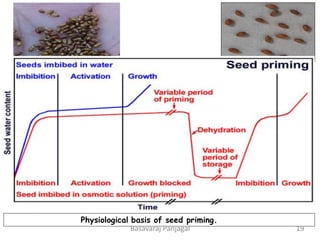
 It is a presowing treatment in which seeds are
soaked in osmotic solution that allows the seeds
to imbibe water and go through the first stages
of germination but does not permit radicle
protrusion through the seed coat
 It is based on the principle of controlled
Imbibition, to a level that a permits pre
germination metabolism to proceed, but prevents
actual emergence of radicle
16
Basavaraj Panjagal
Hydro priming (drum priming)
It is achieved by continuous or successive addition of
limited amount of water to the seeds is the cheap and
useful technique that is practiced by incubating seeds for a
limited time in warm water.
Halo priming-
the use of salts of chlorides,
Halo priming involves
sulphates, nitrates etc.
Osmopriming (Osmoconditioning)
It is the standard priming technique. Seeds are incubated in
well aerated solutions with a low water potential, and later
washed and dried.
17
Basavaraj Panjagal
Matric priming (Solid matrix conditioning)
It is the incubation of seeds in a solid, insoluble matrix with
a limited amount of water. This method confers a slow
imbibition.
matric carriers are- (Calcinatedclay, Vermiculite ,Peat Moss ,Sand, Micro-Cel )
Bio-priming (Seed conditioning)
It is a process of biological seed treatment that refers to
combination of seed hydration (physiological aspect of
disease control) and inoculation (biological aspect of disease
control) of seed with beneficial organism to protect seed
with the help of beneficial fungi and bacteria.
18
Basavaraj Panjagal
Physiological basis of seed priming.
19
Basavaraj Panjagal
• Osmotic potential of solution.
• Priming temperature and light
• Duration of priming
• O2 availability
• Drying method
20
Basavaraj Panjagal
Advantages of Priming
Controlled water Imbibition
Imbibition injury prevented
Salt priming supply seeds with nitrogen and
other nutrients for protein synthesis
Disadvantages of Priming
Toxicity of chemicals
Limited O2 supply to seed
Disadvantage in handling large quantity of seed
21
Basavaraj Panjagal
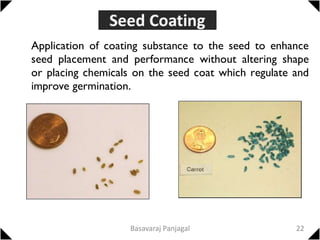
Application of coating substance to the seed to enhance
seed placement and performance without altering shape
or placing chemicals on the seed coat which regulate and
improve germination.
22
Basavaraj Panjagal
23
Basavaraj Panjagal
SEED COATINGS
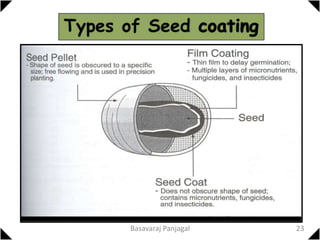
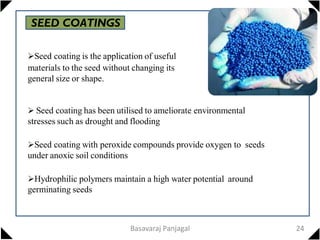
Seed coating is the application of useful
materials to the seed without changing its
general size or shape.
 Seed coating has been utilised to ameliorate environmental
stresses such as drought and flooding
Seed coating with peroxide compounds provide oxygen to seeds
under anoxic soil conditions
Hydrophilic polymers maintain a high water potential around
germinating seeds
24
Basavaraj Panjagal
FILM COATINGS
It is a sophisticated process of applying precise amount of
active ingredients in form of thin film along with the
liquid material directly on to the seed surface without
obscuring its shape.
25
Basavaraj Panjagal
Advantages of seed coating
 Enables accurate and even dose of chemicals and reduces
chemical wastage
 Improve the appearance and dust free handling
 To apply fungicides, insecticides, micronutrients directly to
seed.
 Allow easy flow of seed in automatic seeding
 Act as a temperature switch and water intake regulator
Disadvantages of coating
Coated seeds fetch high cost, than the bare seeds
Improper coating and improper dilution of coating
material may deteriote the whole seed lot
26
Basavaraj Panjagal
Seed Pelleting
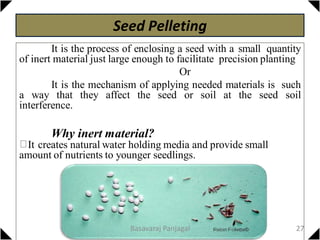
It is the process of enclosing a seed with a small quantity
of inert material just large enough to facilitate precision planting
Or
It is the mechanism of applying needed materials is such
a way that they affect the seed or soil at the seed soil
interference.
Why inert material?
It creates natural water holding media and provide small
amount of nutrients to younger seedlings.
27
Basavaraj Panjagal
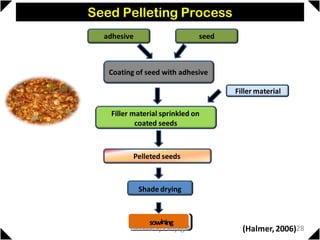
Seed Pelleting Process
adhesive seed
Coating of seed with adhesive
Filler material
Filler material sprinkled on
coated seeds
Pelleted seeds
Shade drying
sowining
(Halmer,2006)28
Basavaraj Panjagal
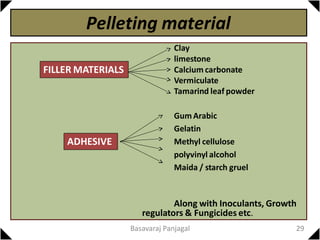
Pelleting material
Clay
limestone
Calcium carbonate
Vermiculate
Tamarind leaf powder
GumArabic
Gelatin
Methyl cellulose
polyvinyl alcohol
Maida / starch gruel
ADHESIVE
FILLER MATERIALS
Along with Inoculants, Growth
regulators & Fungicides etc.
29
Basavaraj Panjagal
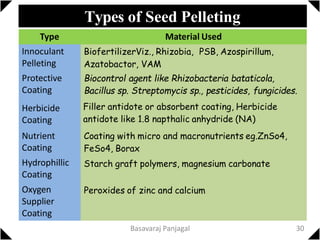
Types of Seed Pelleting
Type Material Used
Innoculant
Pelleting
Protective
Coating
BiofertilizerViz., Rhizobia, PSB, Azospirillum,
Azatobactor, VAM
Biocontrol agent like Rhizobacteria bataticola,
Bacillus sp. Streptomycis sp., pesticides, fungicides.
Filler antidote or absorbent coating, Herbicide
antidote like 1.8 napthalic anhydride (NA)
Coating with micro and macronutrients eg.ZnSo4,
FeSo4, Borax
Starch graft polymers, magnesium carbonate
Herbicide
Coating
Nutrient
Coating
Hydrophillic
Coating
Oxygen
Supplier
Coating
Peroxides of zinc and calcium
30
Basavaraj Panjagal
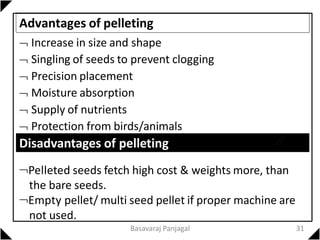
Advantages of pelleting
 Increase in size and shape
 Singling of seeds to prevent clogging
 Precision placement
 Moisture absorption
 Supply of nutrients
 Protection from birds/animals
Disadvantages of pelleting
Pelleted seeds fetch high cost & weights more, than
the bare seeds.
Empty pellet/ multi seed pellet if proper machine are
not used.
31
Basavaraj Panjagal
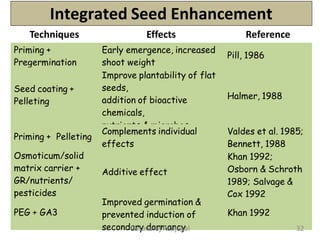
Integrated Seed Enhancement
Techniques Effects Reference
Priming +
Pregermination
Pill, 1986
Seed coating +
Pelleting
nutrients & microbes
Halmer, 1988
Early emergence, increased
shoot weight
Improve plantability of flat
seeds,
addition of bioactive
chemicals,
Complements individual
effects
Additive effect
Priming + Pelleting
Osmoticum/solid
matrix carrier +
GR/nutrients/
pesticides
PEG + GA3
Improved germination &
prevented induction of
secondary dormancy
Valdes et al. 1985;
Bennett, 1988
Khan 1992;
Osborn & Schroth
1989; Salvage &
Cox 1992
Khan 1992
32
Basavaraj Panjagal
Recent approaches:
o Ultrasonic seed priming and mode of action
o Electromagnetic seed therapies
o Laser irradiations
o Seed polymers and nano particles
o Poly electrolytes
o Endophytes
33
Basavaraj Panjagal
Advantages of Seed Quality Enhancement Technology




Reduced seed rate
Early emergence and reduced time of emergence under
stress conditions
Supply of growth regulators/nutrients/beneficial microbes
Better nursery management
 weeds in competition for


Helps seedling to dominate
nutrition
Field stand and uniformity
Minimum exposure to toxicant
 conventionally transplanted vegetable

Direct seeding of
seeds.
High turnover
34
Basavaraj Panjagal
Conclusion
Seed enhancements have a wide range of commercial applications
from improved crop stands through better germination rates and
seedling vigour effective in crop stress management, and improved
crop yields together with efficient use of resources such as fertilizers,
water and seeds. Sustainable crop production requires the adoption of
low-cost and environment friendly seed enhancement techniques.
35
Basavaraj Panjagal
36
Basavaraj Panjagal

Seed treatment

  • 1.
    K R CCOLLEGE OF HORTICULTURE,ARABHAVI Seed Treatment Basavaraj Panjagal Ph.D Research Scholar 1 Basavaraj Panjagal
  • 2.
    Seed treatment refersto the application of fungicide , insecticide or both to the seeds to disinfect (deep seated ) and disinfest ( over seed coat ) them from seed borne or soil borne pathogenic organisms and storage insects. Benefits of seed treatment 1.Prevention of spread of plant diseases 2.Protects seed from seed rot and seedling blights 3. Provides protection from storage insects and pests. 4. Improves germination 2 Basavaraj Panjagal
  • 3.
    Dates back to17th century when salt water wasaccidently discovered to control bunt and stinking smut of wheat seed. In 1755, M.D Tillet, a french botonist recommented the use of lime as a chemical treatment for wheat seed Some 50 years later ,Prevost a Swiss botanist ,discovered the use of copper fungicides as seed treatment. New concepts of treating seeds with Organomercurials like Ceresan and Semesan were introduced in 1920. 3 Basavaraj Panjagal
  • 4.
    Types of Seedtreatments 1.Physical treatment: a) Hot water treatment b) Hot air c) scarification d) anaerobic e) solar treatment 2.Chemical seed treatments: 3. Biological seed treatments: Bio agents, plant extracts, red earth.. Methods of seed treatments 1. Manual methods 2. Mechanical method of seed treatment 4 Basavaraj Panjagal
  • 5.
    Seed enhancements 1. Physicaltechniques a) Seed coating b) Seed encrusting c) Seed pelleting 2. Physiological techniques a) Seed fortification b) Seed infusion c) Seed priming 5 Basavaraj Panjagal
  • 6.
    Seed Quality Enhancement Definition Postharvest treatment that improve germination or seedling growth or facilitate the delivery of seeds and other materials required at the time of sowing 6 Basavaraj Panjagal
  • 7.
    Role of improvedseed • • • • It serves as a carrier of new technologies It serves a basic tools for secured food supply crop yields It serves as mean of security in less favorable production area It act as medium for rehabitation of agriculture in case of natural disaster 7 Basavaraj Panjagal
  • 8.
    Where & whenit is needed? • Problematic seed • High value of seed • Specific planting technique • Biotic stresses • Direct seeding • Adverse climatic conditions 8 Basavaraj Panjagal
  • 9.
    History • Recorded referencesin Vedas and Bible Ex. Beejamruta, • Coated and pelleted seeds traced in Egyptian pyramids • China farmers use to coat paddy seeds with mud balls while sowing in flooded fields • Our ancestors use to practice it – Application of ash, mud or cow dung slurry on seeds 9 Basavaraj Panjagal
  • 10.
    Seed Quality Enhancement Techniques 1.Seed hydration technology (pre hydration, priming) 2. Seed coating (pelleting, film coating) 3. Integrated seed enhancement 10 Basavaraj Panjagal
  • 11.
    Seed hydration technology/ Seed hardening 1.Pre-hydration [ a). Seed fortification b). seed infusion 2.Priming [a). Osmo conditioning b). Halo priming c). Bio priming c). Hydro priming d). Solid Matrix Priming or matriconditioning It is process of soaking the seeds in water or dilute solution of growth regulating compounds to induce early germination, better root growth and seedling growth and also enhances the yield potential of the crop variety. TYPES OF HYDRATIONS 11 Basavaraj Panjagal
  • 12.
  • 13.
    PHYSIOILOGY INVOLVED INHYDRATION GERMINATION POST-GERMINATION UPTAKE OF WATER TIME (Bewley, 1997) 13 Basavaraj Panjagal
  • 14.
    Seed fortification It ispre hydration technique were seeds are soaked either in water or dilute solution of bioactive chemicals such as micro nutrients, growth regulators, vitamins and seed protectants. Seed infusion It is a method of impregnation of seeds with bioactive chemicals through organic solvents instead of water this technique of infusion which helps to avoid the damage caused to the seed due to soaking in water. hence this method is highly suitable to the seeds that suffer from soaking or seed coat injury. 14 Basavaraj Panjagal
  • 15.
    Advantages of Prehydration  Faster water Imbibition  Imbibition causes swelling of seeds  Pre hydration promotes early germination and good crop stand. Disadvantages of Pre-hydration Toxicity of chemicals Limited O2 supply to seed Disadvantage in handling large quantity of seed 15 Basavaraj Panjagal
  • 16.
    Seed Priming  Itis a presowing treatment in which seeds are soaked in osmotic solution that allows the seeds to imbibe water and go through the first stages of germination but does not permit radicle protrusion through the seed coat  It is based on the principle of controlled Imbibition, to a level that a permits pre germination metabolism to proceed, but prevents actual emergence of radicle 16 Basavaraj Panjagal
  • 17.
    Hydro priming (drumpriming) It is achieved by continuous or successive addition of limited amount of water to the seeds is the cheap and useful technique that is practiced by incubating seeds for a limited time in warm water. Halo priming- the use of salts of chlorides, Halo priming involves sulphates, nitrates etc. Osmopriming (Osmoconditioning) It is the standard priming technique. Seeds are incubated in well aerated solutions with a low water potential, and later washed and dried. 17 Basavaraj Panjagal
  • 18.
    Matric priming (Solidmatrix conditioning) It is the incubation of seeds in a solid, insoluble matrix with a limited amount of water. This method confers a slow imbibition. matric carriers are- (Calcinatedclay, Vermiculite ,Peat Moss ,Sand, Micro-Cel ) Bio-priming (Seed conditioning) It is a process of biological seed treatment that refers to combination of seed hydration (physiological aspect of disease control) and inoculation (biological aspect of disease control) of seed with beneficial organism to protect seed with the help of beneficial fungi and bacteria. 18 Basavaraj Panjagal
  • 19.
    Physiological basis ofseed priming. 19 Basavaraj Panjagal
  • 20.
    • Osmotic potentialof solution. • Priming temperature and light • Duration of priming • O2 availability • Drying method 20 Basavaraj Panjagal
  • 21.
    Advantages of Priming Controlledwater Imbibition Imbibition injury prevented Salt priming supply seeds with nitrogen and other nutrients for protein synthesis Disadvantages of Priming Toxicity of chemicals Limited O2 supply to seed Disadvantage in handling large quantity of seed 21 Basavaraj Panjagal
  • 22.
    Application of coatingsubstance to the seed to enhance seed placement and performance without altering shape or placing chemicals on the seed coat which regulate and improve germination. 22 Basavaraj Panjagal
  • 23.
  • 24.
    SEED COATINGS Seed coatingis the application of useful materials to the seed without changing its general size or shape.  Seed coating has been utilised to ameliorate environmental stresses such as drought and flooding Seed coating with peroxide compounds provide oxygen to seeds under anoxic soil conditions Hydrophilic polymers maintain a high water potential around germinating seeds 24 Basavaraj Panjagal
  • 25.
    FILM COATINGS It isa sophisticated process of applying precise amount of active ingredients in form of thin film along with the liquid material directly on to the seed surface without obscuring its shape. 25 Basavaraj Panjagal
  • 26.
    Advantages of seedcoating  Enables accurate and even dose of chemicals and reduces chemical wastage  Improve the appearance and dust free handling  To apply fungicides, insecticides, micronutrients directly to seed.  Allow easy flow of seed in automatic seeding  Act as a temperature switch and water intake regulator Disadvantages of coating Coated seeds fetch high cost, than the bare seeds Improper coating and improper dilution of coating material may deteriote the whole seed lot 26 Basavaraj Panjagal
  • 27.
    Seed Pelleting It isthe process of enclosing a seed with a small quantity of inert material just large enough to facilitate precision planting Or It is the mechanism of applying needed materials is such a way that they affect the seed or soil at the seed soil interference. Why inert material? It creates natural water holding media and provide small amount of nutrients to younger seedlings. 27 Basavaraj Panjagal
  • 28.
    Seed Pelleting Process adhesiveseed Coating of seed with adhesive Filler material Filler material sprinkled on coated seeds Pelleted seeds Shade drying sowining (Halmer,2006)28 Basavaraj Panjagal
  • 29.
    Pelleting material Clay limestone Calcium carbonate Vermiculate Tamarindleaf powder GumArabic Gelatin Methyl cellulose polyvinyl alcohol Maida / starch gruel ADHESIVE FILLER MATERIALS Along with Inoculants, Growth regulators & Fungicides etc. 29 Basavaraj Panjagal
  • 30.
    Types of SeedPelleting Type Material Used Innoculant Pelleting Protective Coating BiofertilizerViz., Rhizobia, PSB, Azospirillum, Azatobactor, VAM Biocontrol agent like Rhizobacteria bataticola, Bacillus sp. Streptomycis sp., pesticides, fungicides. Filler antidote or absorbent coating, Herbicide antidote like 1.8 napthalic anhydride (NA) Coating with micro and macronutrients eg.ZnSo4, FeSo4, Borax Starch graft polymers, magnesium carbonate Herbicide Coating Nutrient Coating Hydrophillic Coating Oxygen Supplier Coating Peroxides of zinc and calcium 30 Basavaraj Panjagal
  • 31.
    Advantages of pelleting Increase in size and shape  Singling of seeds to prevent clogging  Precision placement  Moisture absorption  Supply of nutrients  Protection from birds/animals Disadvantages of pelleting Pelleted seeds fetch high cost & weights more, than the bare seeds. Empty pellet/ multi seed pellet if proper machine are not used. 31 Basavaraj Panjagal
  • 32.
    Integrated Seed Enhancement TechniquesEffects Reference Priming + Pregermination Pill, 1986 Seed coating + Pelleting nutrients & microbes Halmer, 1988 Early emergence, increased shoot weight Improve plantability of flat seeds, addition of bioactive chemicals, Complements individual effects Additive effect Priming + Pelleting Osmoticum/solid matrix carrier + GR/nutrients/ pesticides PEG + GA3 Improved germination & prevented induction of secondary dormancy Valdes et al. 1985; Bennett, 1988 Khan 1992; Osborn & Schroth 1989; Salvage & Cox 1992 Khan 1992 32 Basavaraj Panjagal
  • 33.
    Recent approaches: o Ultrasonicseed priming and mode of action o Electromagnetic seed therapies o Laser irradiations o Seed polymers and nano particles o Poly electrolytes o Endophytes 33 Basavaraj Panjagal
  • 34.
    Advantages of SeedQuality Enhancement Technology     Reduced seed rate Early emergence and reduced time of emergence under stress conditions Supply of growth regulators/nutrients/beneficial microbes Better nursery management  weeds in competition for   Helps seedling to dominate nutrition Field stand and uniformity Minimum exposure to toxicant  conventionally transplanted vegetable  Direct seeding of seeds. High turnover 34 Basavaraj Panjagal
  • 35.
    Conclusion Seed enhancements havea wide range of commercial applications from improved crop stands through better germination rates and seedling vigour effective in crop stress management, and improved crop yields together with efficient use of resources such as fertilizers, water and seeds. Sustainable crop production requires the adoption of low-cost and environment friendly seed enhancement techniques. 35 Basavaraj Panjagal
  • 36.