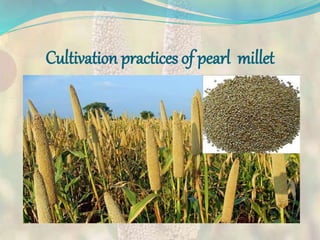
Cultivation practices of pearl millet
OVER VIEW:- Botanical description
 Economic Importance
 Area Production and Productivity
 Varieties
 Climatic Requirement
 Soil Type and Field Preparation
 Sowing Time
 Method of Sowing
 Seed Rate and Spacing
 Seed Treatment
 Nutrient Management
 Water Management
 Weed Management
 Intercultural Operation
 Cropping Systems
 Yield attributes
 Harvesting and Threshing
 Yield
 Contingency planning
Botany of the crop
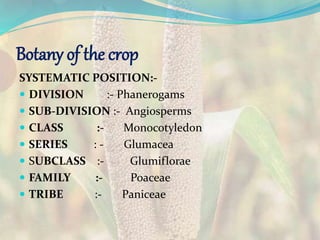
SYSTEMATIC POSITION:-
 DIVISION :- Phanerogams
 SUB-DIVISION :- Angiosperms
 CLASS :- Monocotyledon
 SERIES : - Glumacea
 SUBCLASS :- Glumiflorae
 FAMILY :- Poaceae
 TRIBE :- Paniceae
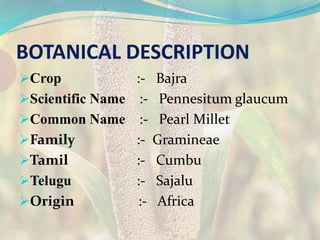
BOTANICAL DESCRIPTION
Crop :- Bajra
Scientific Name :- Pennesitum glaucum
Common Name :- Pearl Millet
Family :- Gramineae
Tamil :- Cumbu
Telugu :- Sajalu
Origin :- Africa
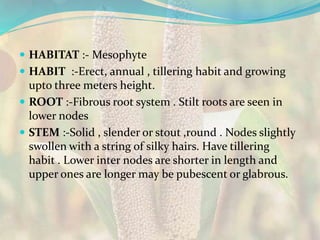
 HABITAT :- Mesophyte
 HABIT :-Erect, annual , tillering habit and growing
upto three meters height.
 ROOT :-Fibrous root system . Stilt roots are seen in
lower nodes
 STEM :-Solid , slender or stout ,round . Nodes slightly
swollen with a string of silky hairs. Have tillering
habit . Lower inter nodes are shorter in length and
upper ones are longer may be pubescent or glabrous.
Economic Importance:-
 Pearl millet is a stable food crop of about 100 million
peoples in rural areas of India and sub saharan
Africa.
 Roti or Chapathi,which are unleaved flat breads
prepared using pearlmillet flour or common in Asia.
 Porridges and cooked Grains are also used.
 In Northern India it is prepared in during winter
while wheat becomes common in summer diet.
 It is also used for fried preparations,foods such as
fermented products and beer.
Varieties of Pancakes are prepared using pearlmillet
flour in Africa and Pearlmillet beer is used throughout
Africa.
Fura or cheese is the traditional African snacks
prepared using steamed pearlmillet flour and cream.
It is used as fodder in Africa and Asia.
Oxalic is very high.So it is not relished by cattle.
In central America it is mainly cultivated for forage
purpose.It is also grown as pasture grass
It is rich in:
*Protein-12.6% *Fibre-1.2%
*Fat-5% *Carbohydrate-60-70%
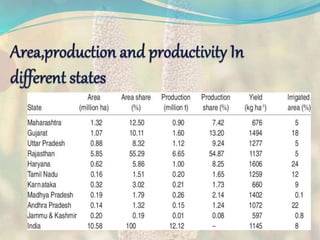
It is largely grown in India.
The important pearlmillet producing countries are
India,Africa,Pakisthan,China,Sudan and Egypt.
In India,it is cultivated in an area of 10 m.ha,with
production 7.9 million tones,and productivity of 791
kg/ha.
Area under cultivation is high in Rajasthan,followed by
Maharashtra,Gujarat and Uttar Pradesh.
In Tamilnadu,it is cultivated in an area of 2.31 ha.,with
production of2.51.tonnes and productivity of 1226kg/ha.
NilgriThe production is more in Rajasthan,followed by
Maharastra,Gujarat,Tamilnadu ana Uttarpradesh.
In tamilnadu it is grown in all the districts except
Kanchipuram,Tiruvallur and nilgris .
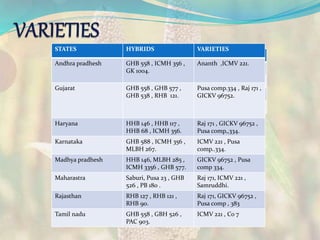
STATES HYBRIDS VARIETIES
Andhra pradhesh GHB 558 , ICMH 356 ,
GK 1004.
Ananth ,ICMV 221.
Gujarat GHB 558 , GHB 577 ,
GHB 538 , RHB 121.
Pusa comp.334 , Raj 171 ,
GICKV 96752.
Haryana HHB 146 , HHB 117 ,
HHB 68 , ICMH 356.
Raj 171 , GICKV 96752 ,
Pusa comp,,334.
Karnataka GHB 588 , ICMH 356 ,
MLBH 267.
ICMV 221 , Pusa
comp..334.
Madhya pradhesh HHB 146, MLBH 285 ,
ICMH 3356 , GHB 577.
GICKV 96752 , Pusa
comp 334.
Maharastra Saburi, Pusa 23 , GHB
526 , PB 180 .
Raj 171, ICMV 221 ,
Samruddhi.
Rajasthan RHB 127 , RHB 121 ,
RHB 90.
Raj 171, GICKV 96752 ,
Pusa comp , 383
Tamil nadu GHB 558 , GBH 526 ,
PAC 903.
ICMV 221 , Co 7
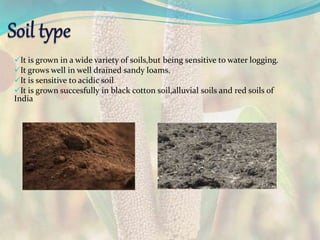
It is grown in a wide variety of soils,but being sensitive to water logging.
It grows well in well drained sandy loams.
It is sensitive to acidic soil
It is grown succesfully in black cotton soil,alluvial soils and red soils of
India
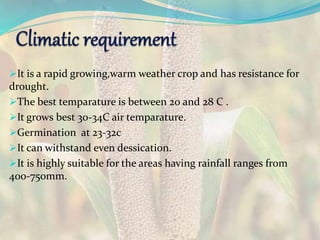
It is a rapid growing,warm weather crop and has resistance for
drought.
The best temparature is between 20 and 28 C .
It grows best 30-34C air temparature.
Germination at 23-32c
It can withstand even dessication.
It is highly suitable for the areas having rainfall ranges from
400-750mm.
Even 150mm of rainfall is sufficient.
Rainfall during vegetataive phase is favourable while at
flowering is not conductive as it washes of pollen and
there is a poor seed setting.
The crop grows better in light showers followed by
bright sunshine hours .
Usually bajra is grown, where it is not possible o grow
sorghum because of high temparature and low rainfall.
It is grown as kharif crop in Northern India, while in
Tamil nadu,Karnataka and Punjab,it is grown under
irrigated condition during summer
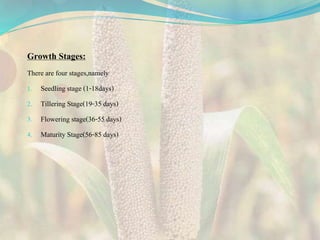
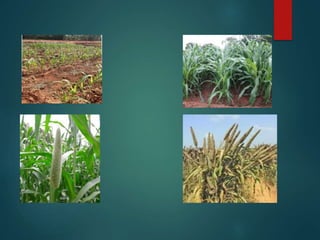
Growth Stages:
There are four stages,namely
1. Seedling stage (1-18days)
2. Tillering Stage(19-35 days)
3. Flowering stage(36-55days)
4. Maturity Stage(56-85 days)
In India it is grown in three seasons viz.,
* Kharif –june-october [rainfed]
*Winter-november-february [rainfed]
*Summer -march-june
During summer ,it is grown in Tamil Nadu,Karnataka,Punjab, and
Gujarat as an irrigated crop.
Sowing of kharif pearl millet should be done with oneset of
moonsoon i.e first fortnight of july in north and central parts of the
country.
Summer pearl millet should be sown last week of january to 1st week
of february to obtain higher production of summer pearl.
First fortnight of october is appropriate time for rabi season in
Tamilnadu
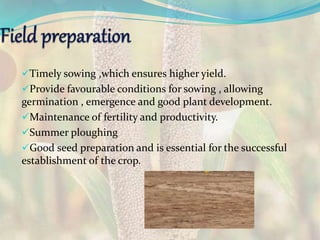
Timely sowing ,which ensures higher yield.
Provide favourable conditions for sowing , allowing
germination , emergence and good plant development.
Maintenance of fertility and productivity.
Summer ploughing
Good seed preparation and is essential for the successful
establishment of the crop.
Loosening the soil.
Deep ploughing with iron plough and
country plough is to be done twice to bring
the tilth
If there is hard pan ,chisel ploughing is done
Apply about 12.5tonnes/ha of farmyard
manure or compost during last ploughing .
Application of azospirillum to the soil should
be done@ 10 packets [2kg].
Levelling the soil.
Seed treatment with bio pesticides [Tricoderma harzianum @
4kg] or thiram 75% dust @3g kg seed will help against soilborne
diseases.
Seed treatment with 300-mesh sulphur powder @4g kg seeds
controls the smut disease.
For removing ergot affected seeds, they are soaked in 10% salt
solution.[1 kg of NaCl in 10lit of water].
Seeds are treated with Azospirillum [600] and
phosphobacterium to enhance the availability of nitrogen and
phosphorous.0.
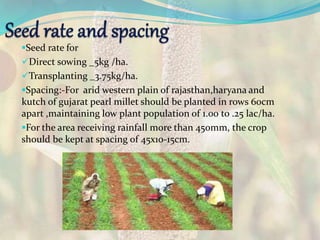
Seed rate for
Direct sowing _5kg /ha.
Transplanting _3.75kg/ha.
Spacing:-For arid western plain of rajasthan,haryana and
kutch of gujarat pearl millet should be planted in rows 60cm
apart ,maintaining low plant population of 1.00 to .25 lac/ha.
For the area receiving rainfall more than 450mm, the crop
should be kept at spacing of 45x10-15cm.
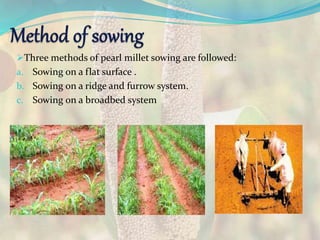
Three methods of pearl millet sowing are followed:
a. Sowing on a flat surface .
b. Sowing on a ridge and furrow system.
c. Sowing on a broadbed system
Nursey preparation:nursery required is 7.5 cents [300 sq.m] for
one ha.
The land is ploughed in such a way to bringfine tilth
Application of 750kg of farmyard manure or compost is done
and incorporated.
Raised beds of 3.0 x 1.5m with 30cm channel are formed.
Small rills not deeper than 1cm on the raised bed are opened.
About 3.75kg of seeds is sown in 7.5 cents at 0.5kg/cent and
500kg of FYM or compost is used for sprinkling for covering the
seeds.
LAND SHAPING:for irrigated crop [transpanting],either
ridges and furrows at 45cm apart or beds of convinient size
depanding upon the water availability are formed. For rainfed
crop,Flat sowing is followed.for rainfed crop Pora method of
sowing is better than kera method.
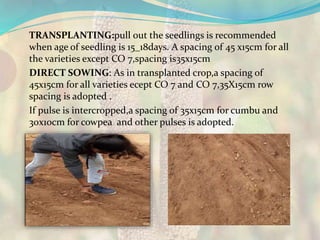
TRANSPLANTING:pull out the seedlings is recommended
when age of seedling is 15_18days. A spacing of 45 x15cm for all
the varieties except CO 7,spacing is35x15cm
DIRECT SOWING: As in transplanted crop,a spacing of
45x15cm for all varieties ecept CO 7 and CO 7,35X15cm row
spacing is adopted .
If pulse is intercropped,a spacing of 35x15cm for cumbu and
30x10cm for cowpea and other pulses is adopted.
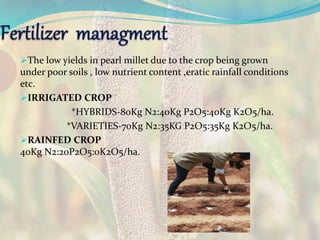
The low yields in pearl millet due to the crop being grown
under poor soils , low nutrient content ,eratic rainfall conditions
etc.
IRRIGATED CROP
*HYBRIDS-80Kg N2:40Kg P2O5:40Kg K2O5/ha.
*VARIETIES-70Kg N2:35KG P2O5:35Kg K2O5/ha.
RAINFED CROP
40Kg N2:20P2O5:0K2O5/ha.
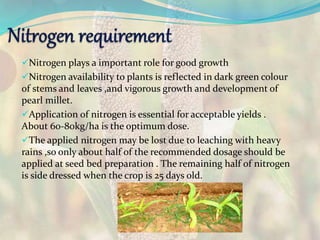
Nitrogen plays a important role for good growth
Nitrogen availability to plants is reflected in dark green colour
of stems and leaves ,and vigorous growth and development of
pearl millet.
Application of nitrogen is essential for acceptable yields .
About 60-80kg/ha is the optimum dose.
The applied nitrogen may be lost due to leaching with heavy
rains ,so only about half of the recommended dosage should be
applied at seed bed preparation . The remaining half of nitrogen
is side dressed when the crop is 25 days old.
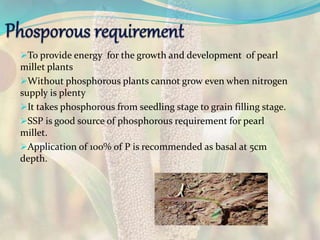
To provide energy for the growth and development of pearl
millet plants
Without phosphorous plants cannot grow even when nitrogen
supply is plenty
It takes phosphorous from seedling stage to grain filling stage.
SSP is good source of phosphorous requirement for pearl
millet.
Application of 100% of P is recommended as basal at 5cm
depth.
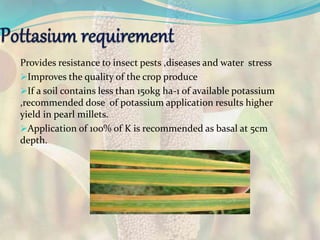
Provides resistance to insect pests ,diseases and water stress
Improves the quality of the crop produce
If a soil contains less than 150kg ha-1 of available potassium
,recommended dose of potassium application results higher
yield in pearl millets.
Application of 100% of K is recommended as basal at 5cm
depth.
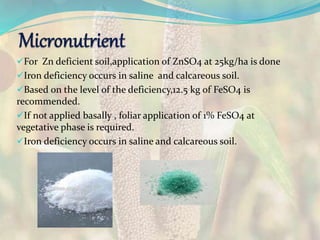
For Zn deficient soil,application of ZnSO4 at 25kg/ha is done
Iron deficiency occurs in saline and calcareous soil.
Based on the level of the deficiency,12.5 kg of FeSO4 is
recommended.
If not applied basally , foliar application of 1% FeSO4 at
vegetative phase is required.
Iron deficiency occurs in saline and calcareous soil.
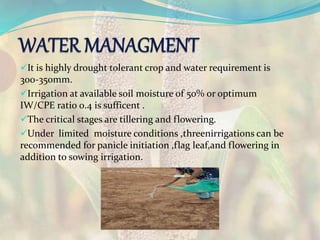
It is highly drought tolerant crop and water requirement is
300-350mm.
Irrigation at available soil moisture of 50% or optimum
IW/CPE ratio 0.4 is sufficent .
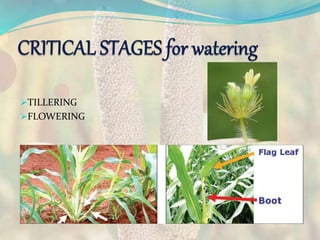
The critical stages are tillering and flowering.
Under limited moisture conditions ,threenirrigations can be
recommended for panicle initiation ,flag leaf,and flowering in
addition to sowing irrigation.
Normally 5 irrigations are recommended for the stages viz,
Tillering,panicle initiation,flag leaf,flowering ,dough stages in
addition to sowing.
Summer irrigated pearl millet require six irrrigations for the
high yields at given stages,
 * transplanting
* 1week after transplanting
*3 week after transpanting
* Panicle initiation
* Flowering
* Grain development
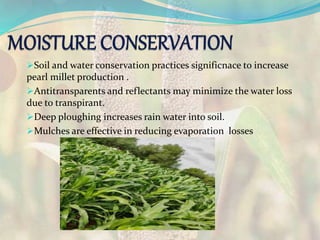
Soil and water conservation practices significnace to increase
pearl millet production .
Antitransparents and reflectants may minimize the water loss
due to transpirant.
Deep ploughing increases rain water into soil.
Mulches are effective in reducing evaporation losses
TILLERING
FLOWERING
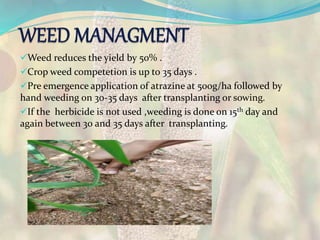
Weed reduces the yield by 50% .
Crop weed competetion is up to 35 days .
Pre emergence application of atrazine at 500g/ha followed by
hand weeding on 30-35 days after transplanting or sowing.
If the herbicide is not used ,weeding is done on 15th day and
again between 30 and 35 days after transplanting.
For direct sown crop ,hoeing and weeding may be done on
20-25 days after sowing
Atrazine should not be used for intercropping systems.
PRE-EMERGENCE APPLICATION:
Is applied after sowing but before emergence of seedling.
-Atrazine [0.5-1.0]
-Pendimethalin[1.0-1.5]
POST EMERGENCE APPLICATION:
*In case of severe infestations
* low rates of 2,4-D[0.5-1.0kg/ha] may be applied when
the plants are about 10 to 30cm tall.
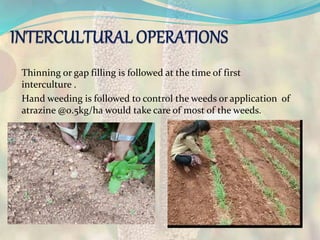
Thinning or gap filling is followed at the time of first
interculture .
Hand weeding is followed to control the weeds or application of
atrazine @0.5kg/ha would take care of most of the weeds.
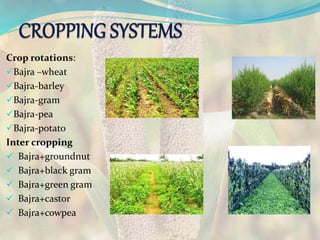
Crop rotations:
Bajra –wheat
Bajra-barley
Bajra-gram
Bajra-pea
Bajra-potato
Inter cropping
 Bajra+groundnut
 Bajra+black gram
 Bajra+green gram
 Bajra+castor
 Bajra+cowpea
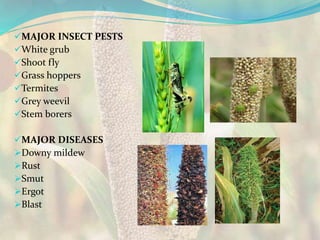
MAJOR INSECT PESTS
White grub
Shoot fly
Grass hoppers
Termites
Grey weevil
Stem borers
MAJOR DISEASES
Downy mildew
Rust
Smut
Ergot
Blast
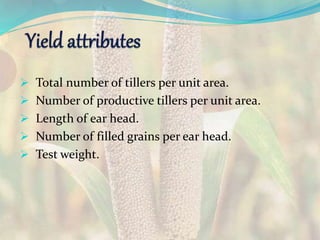
 Total number of tillers per unit area.
 Number of productive tillers per unit area.
 Length of ear head.
 Number of filled grains per ear head.
 Test weight.
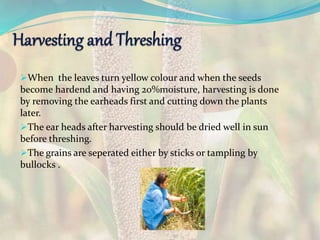
When the leaves turn yellow colour and when the seeds
become hardend and having 20%moisture, harvesting is done
by removing the earheads first and cutting down the plants
later.
The ear heads after harvesting should be dried well in sun
before threshing.
The grains are seperated either by sticks or tampling by
bullocks .
If mechanically thresher is available ,thresh it or spread it and drag a
stoneroller over it
The threshed grain is cleaned and dried in the sun to bring the
moisture to 12-14% for safe storage
For long term storage [more than 6months] , grain moisture content
should be less than 12%.
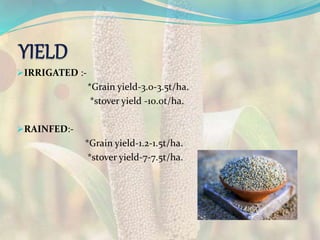
IRRIGATED :-
*Grain yield-3.0-3.5t/ha.
*stover yield -10.0t/ha.
RAINFED:-
*Grain yield-1.2-1.5t/ha.
*stover yield-7-7.5t/ha.
To conserve in situ rainwater , deep plough the field during
summer on heavy soils of Maharastra ,Tamilnadu,
Andhrapradhesh,Karnataka and Rajasthan.
Adopt suitable intercropping system early maturing
hybrids/composites of pearl millet in between under late onset
of moonsoon.
Keep the crop free by timely weeding
If dry spell occurs immediately after sowing ,replant pearl
millet in between the existing rows.
Under excess rain fall during vegetative phase ,additional dose
of 20kg N/ha should be applied.
THANK YOU
M. Lavanya – 111718012057 .
R.Samyuktha - 111718012100
.
A . Sanjana - 111718012103.
Bajra ppt

Bajra ppt

  • 1.
  • 2.
    OVER VIEW:- Botanicaldescription  Economic Importance  Area Production and Productivity  Varieties  Climatic Requirement  Soil Type and Field Preparation  Sowing Time  Method of Sowing  Seed Rate and Spacing  Seed Treatment  Nutrient Management  Water Management  Weed Management  Intercultural Operation  Cropping Systems  Yield attributes  Harvesting and Threshing  Yield  Contingency planning
  • 3.
    Botany of thecrop SYSTEMATIC POSITION:-  DIVISION :- Phanerogams  SUB-DIVISION :- Angiosperms  CLASS :- Monocotyledon  SERIES : - Glumacea  SUBCLASS :- Glumiflorae  FAMILY :- Poaceae  TRIBE :- Paniceae
  • 4.
    BOTANICAL DESCRIPTION Crop :-Bajra Scientific Name :- Pennesitum glaucum Common Name :- Pearl Millet Family :- Gramineae Tamil :- Cumbu Telugu :- Sajalu Origin :- Africa
  • 5.
     HABITAT :-Mesophyte  HABIT :-Erect, annual , tillering habit and growing upto three meters height.  ROOT :-Fibrous root system . Stilt roots are seen in lower nodes  STEM :-Solid , slender or stout ,round . Nodes slightly swollen with a string of silky hairs. Have tillering habit . Lower inter nodes are shorter in length and upper ones are longer may be pubescent or glabrous.
  • 6.
    Economic Importance:-  Pearlmillet is a stable food crop of about 100 million peoples in rural areas of India and sub saharan Africa.  Roti or Chapathi,which are unleaved flat breads prepared using pearlmillet flour or common in Asia.  Porridges and cooked Grains are also used.  In Northern India it is prepared in during winter while wheat becomes common in summer diet.  It is also used for fried preparations,foods such as fermented products and beer.
  • 7.
    Varieties of Pancakesare prepared using pearlmillet flour in Africa and Pearlmillet beer is used throughout Africa. Fura or cheese is the traditional African snacks prepared using steamed pearlmillet flour and cream. It is used as fodder in Africa and Asia. Oxalic is very high.So it is not relished by cattle. In central America it is mainly cultivated for forage purpose.It is also grown as pasture grass It is rich in: *Protein-12.6% *Fibre-1.2% *Fat-5% *Carbohydrate-60-70%
  • 8.
    It is largelygrown in India. The important pearlmillet producing countries are India,Africa,Pakisthan,China,Sudan and Egypt. In India,it is cultivated in an area of 10 m.ha,with production 7.9 million tones,and productivity of 791 kg/ha. Area under cultivation is high in Rajasthan,followed by Maharashtra,Gujarat and Uttar Pradesh.
  • 9.
    In Tamilnadu,it iscultivated in an area of 2.31 ha.,with production of2.51.tonnes and productivity of 1226kg/ha. NilgriThe production is more in Rajasthan,followed by Maharastra,Gujarat,Tamilnadu ana Uttarpradesh. In tamilnadu it is grown in all the districts except Kanchipuram,Tiruvallur and nilgris .
  • 11.
    STATES HYBRIDS VARIETIES Andhrapradhesh GHB 558 , ICMH 356 , GK 1004. Ananth ,ICMV 221. Gujarat GHB 558 , GHB 577 , GHB 538 , RHB 121. Pusa comp.334 , Raj 171 , GICKV 96752. Haryana HHB 146 , HHB 117 , HHB 68 , ICMH 356. Raj 171 , GICKV 96752 , Pusa comp,,334. Karnataka GHB 588 , ICMH 356 , MLBH 267. ICMV 221 , Pusa comp..334. Madhya pradhesh HHB 146, MLBH 285 , ICMH 3356 , GHB 577. GICKV 96752 , Pusa comp 334. Maharastra Saburi, Pusa 23 , GHB 526 , PB 180 . Raj 171, ICMV 221 , Samruddhi. Rajasthan RHB 127 , RHB 121 , RHB 90. Raj 171, GICKV 96752 , Pusa comp , 383 Tamil nadu GHB 558 , GBH 526 , PAC 903. ICMV 221 , Co 7
  • 12.
    It is grownin a wide variety of soils,but being sensitive to water logging. It grows well in well drained sandy loams. It is sensitive to acidic soil It is grown succesfully in black cotton soil,alluvial soils and red soils of India
  • 13.
    It is arapid growing,warm weather crop and has resistance for drought. The best temparature is between 20 and 28 C . It grows best 30-34C air temparature. Germination at 23-32c It can withstand even dessication. It is highly suitable for the areas having rainfall ranges from 400-750mm.
  • 14.
    Even 150mm ofrainfall is sufficient. Rainfall during vegetataive phase is favourable while at flowering is not conductive as it washes of pollen and there is a poor seed setting. The crop grows better in light showers followed by bright sunshine hours . Usually bajra is grown, where it is not possible o grow sorghum because of high temparature and low rainfall. It is grown as kharif crop in Northern India, while in Tamil nadu,Karnataka and Punjab,it is grown under irrigated condition during summer
  • 15.
    Growth Stages: There arefour stages,namely 1. Seedling stage (1-18days) 2. Tillering Stage(19-35 days) 3. Flowering stage(36-55days) 4. Maturity Stage(56-85 days)
  • 17.
    In India itis grown in three seasons viz., * Kharif –june-october [rainfed] *Winter-november-february [rainfed] *Summer -march-june During summer ,it is grown in Tamil Nadu,Karnataka,Punjab, and Gujarat as an irrigated crop. Sowing of kharif pearl millet should be done with oneset of moonsoon i.e first fortnight of july in north and central parts of the country. Summer pearl millet should be sown last week of january to 1st week of february to obtain higher production of summer pearl. First fortnight of october is appropriate time for rabi season in Tamilnadu
  • 18.
    Timely sowing ,whichensures higher yield. Provide favourable conditions for sowing , allowing germination , emergence and good plant development. Maintenance of fertility and productivity. Summer ploughing Good seed preparation and is essential for the successful establishment of the crop.
  • 19.
    Loosening the soil. Deepploughing with iron plough and country plough is to be done twice to bring the tilth If there is hard pan ,chisel ploughing is done Apply about 12.5tonnes/ha of farmyard manure or compost during last ploughing . Application of azospirillum to the soil should be done@ 10 packets [2kg]. Levelling the soil.
  • 20.
    Seed treatment withbio pesticides [Tricoderma harzianum @ 4kg] or thiram 75% dust @3g kg seed will help against soilborne diseases. Seed treatment with 300-mesh sulphur powder @4g kg seeds controls the smut disease. For removing ergot affected seeds, they are soaked in 10% salt solution.[1 kg of NaCl in 10lit of water]. Seeds are treated with Azospirillum [600] and phosphobacterium to enhance the availability of nitrogen and phosphorous.0.
  • 21.
    Seed rate for Directsowing _5kg /ha. Transplanting _3.75kg/ha. Spacing:-For arid western plain of rajasthan,haryana and kutch of gujarat pearl millet should be planted in rows 60cm apart ,maintaining low plant population of 1.00 to .25 lac/ha. For the area receiving rainfall more than 450mm, the crop should be kept at spacing of 45x10-15cm.
  • 22.
    Three methods ofpearl millet sowing are followed: a. Sowing on a flat surface . b. Sowing on a ridge and furrow system. c. Sowing on a broadbed system
  • 23.
    Nursey preparation:nursery requiredis 7.5 cents [300 sq.m] for one ha. The land is ploughed in such a way to bringfine tilth Application of 750kg of farmyard manure or compost is done and incorporated. Raised beds of 3.0 x 1.5m with 30cm channel are formed. Small rills not deeper than 1cm on the raised bed are opened. About 3.75kg of seeds is sown in 7.5 cents at 0.5kg/cent and 500kg of FYM or compost is used for sprinkling for covering the seeds. LAND SHAPING:for irrigated crop [transpanting],either ridges and furrows at 45cm apart or beds of convinient size depanding upon the water availability are formed. For rainfed crop,Flat sowing is followed.for rainfed crop Pora method of sowing is better than kera method.
  • 24.
    TRANSPLANTING:pull out theseedlings is recommended when age of seedling is 15_18days. A spacing of 45 x15cm for all the varieties except CO 7,spacing is35x15cm DIRECT SOWING: As in transplanted crop,a spacing of 45x15cm for all varieties ecept CO 7 and CO 7,35X15cm row spacing is adopted . If pulse is intercropped,a spacing of 35x15cm for cumbu and 30x10cm for cowpea and other pulses is adopted.
  • 25.
    The low yieldsin pearl millet due to the crop being grown under poor soils , low nutrient content ,eratic rainfall conditions etc. IRRIGATED CROP *HYBRIDS-80Kg N2:40Kg P2O5:40Kg K2O5/ha. *VARIETIES-70Kg N2:35KG P2O5:35Kg K2O5/ha. RAINFED CROP 40Kg N2:20P2O5:0K2O5/ha.
  • 26.
    Nitrogen plays aimportant role for good growth Nitrogen availability to plants is reflected in dark green colour of stems and leaves ,and vigorous growth and development of pearl millet. Application of nitrogen is essential for acceptable yields . About 60-80kg/ha is the optimum dose. The applied nitrogen may be lost due to leaching with heavy rains ,so only about half of the recommended dosage should be applied at seed bed preparation . The remaining half of nitrogen is side dressed when the crop is 25 days old.
  • 27.
    To provide energyfor the growth and development of pearl millet plants Without phosphorous plants cannot grow even when nitrogen supply is plenty It takes phosphorous from seedling stage to grain filling stage. SSP is good source of phosphorous requirement for pearl millet. Application of 100% of P is recommended as basal at 5cm depth.
  • 28.
    Provides resistance toinsect pests ,diseases and water stress Improves the quality of the crop produce If a soil contains less than 150kg ha-1 of available potassium ,recommended dose of potassium application results higher yield in pearl millets. Application of 100% of K is recommended as basal at 5cm depth.
  • 29.
    For Zn deficientsoil,application of ZnSO4 at 25kg/ha is done Iron deficiency occurs in saline and calcareous soil. Based on the level of the deficiency,12.5 kg of FeSO4 is recommended. If not applied basally , foliar application of 1% FeSO4 at vegetative phase is required. Iron deficiency occurs in saline and calcareous soil.
  • 30.
    It is highlydrought tolerant crop and water requirement is 300-350mm. Irrigation at available soil moisture of 50% or optimum IW/CPE ratio 0.4 is sufficent . The critical stages are tillering and flowering. Under limited moisture conditions ,threenirrigations can be recommended for panicle initiation ,flag leaf,and flowering in addition to sowing irrigation.
  • 31.
    Normally 5 irrigationsare recommended for the stages viz, Tillering,panicle initiation,flag leaf,flowering ,dough stages in addition to sowing. Summer irrigated pearl millet require six irrrigations for the high yields at given stages,  * transplanting * 1week after transplanting *3 week after transpanting * Panicle initiation * Flowering * Grain development
  • 32.
    Soil and waterconservation practices significnace to increase pearl millet production . Antitransparents and reflectants may minimize the water loss due to transpirant. Deep ploughing increases rain water into soil. Mulches are effective in reducing evaporation losses
  • 33.
  • 34.
    Weed reduces theyield by 50% . Crop weed competetion is up to 35 days . Pre emergence application of atrazine at 500g/ha followed by hand weeding on 30-35 days after transplanting or sowing. If the herbicide is not used ,weeding is done on 15th day and again between 30 and 35 days after transplanting.
  • 35.
    For direct sowncrop ,hoeing and weeding may be done on 20-25 days after sowing Atrazine should not be used for intercropping systems. PRE-EMERGENCE APPLICATION: Is applied after sowing but before emergence of seedling. -Atrazine [0.5-1.0] -Pendimethalin[1.0-1.5] POST EMERGENCE APPLICATION: *In case of severe infestations * low rates of 2,4-D[0.5-1.0kg/ha] may be applied when the plants are about 10 to 30cm tall.
  • 36.
    Thinning or gapfilling is followed at the time of first interculture . Hand weeding is followed to control the weeds or application of atrazine @0.5kg/ha would take care of most of the weeds.
  • 38.
    Crop rotations: Bajra –wheat Bajra-barley Bajra-gram Bajra-pea Bajra-potato Intercropping  Bajra+groundnut  Bajra+black gram  Bajra+green gram  Bajra+castor  Bajra+cowpea
  • 39.
    MAJOR INSECT PESTS Whitegrub Shoot fly Grass hoppers Termites Grey weevil Stem borers MAJOR DISEASES Downy mildew Rust Smut Ergot Blast
  • 40.
     Total numberof tillers per unit area.  Number of productive tillers per unit area.  Length of ear head.  Number of filled grains per ear head.  Test weight.
  • 41.
    When the leavesturn yellow colour and when the seeds become hardend and having 20%moisture, harvesting is done by removing the earheads first and cutting down the plants later. The ear heads after harvesting should be dried well in sun before threshing. The grains are seperated either by sticks or tampling by bullocks .
  • 42.
    If mechanically thresheris available ,thresh it or spread it and drag a stoneroller over it The threshed grain is cleaned and dried in the sun to bring the moisture to 12-14% for safe storage For long term storage [more than 6months] , grain moisture content should be less than 12%.
  • 43.
    IRRIGATED :- *Grain yield-3.0-3.5t/ha. *stoveryield -10.0t/ha. RAINFED:- *Grain yield-1.2-1.5t/ha. *stover yield-7-7.5t/ha.
  • 44.
    To conserve insitu rainwater , deep plough the field during summer on heavy soils of Maharastra ,Tamilnadu, Andhrapradhesh,Karnataka and Rajasthan. Adopt suitable intercropping system early maturing hybrids/composites of pearl millet in between under late onset of moonsoon. Keep the crop free by timely weeding If dry spell occurs immediately after sowing ,replant pearl millet in between the existing rows. Under excess rain fall during vegetative phase ,additional dose of 20kg N/ha should be applied.
  • 45.
    THANK YOU M. Lavanya– 111718012057 . R.Samyuktha - 111718012100 . A . Sanjana - 111718012103.