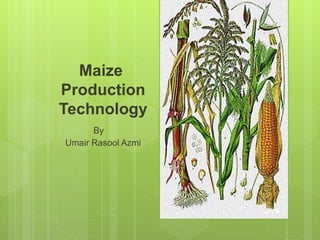
Maize
Production
Technology
By
Umair Rasool Azmi
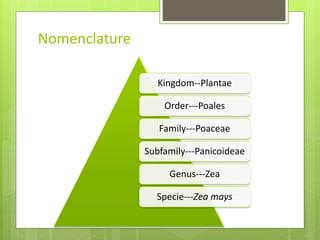
Nomenclature
Kingdom--Plantae
Order---Poales
Family---Poaceae
Subfamily---Panicoideae
Genus---Zea
Specie---Zea mays
Origin & History
 Corn plant is indigenous to America and principle food
grain of native Americans
 It was domesticated 8000 years ago
 For western civilization, the story of corn began in 1492
when Columbus's men discovered this new grain in Cuba.
 Archeological evidence of corn's early presence in the
western hemisphere was identified from corn pollen grain
considered to be 80,000 years old obtained from drill cores
200 feet below Mexico City
Introduction
 Highest yielding cereal crop in the world
 3rd most grown crop in world
 3rd largest grown cereal crop in Pakistan
 4th largest crop grown crop in Pakistan
 Rich source of starch, vitamins, proteins and
minerals
Introduction Continue……………
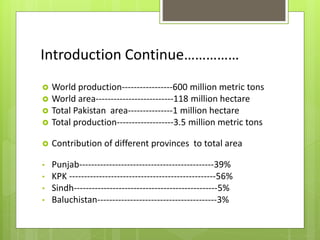
 World production-----------------600 million metric tons
 World area--------------------------118 million hectare
 Total Pakistan area---------------1 million hectare
 Total production-------------------3.5 million metric tons
 Contribution of different provinces to total area
• Punjab---------------------------------------------39%
• KPK -------------------------------------------------56%
• Sindh------------------------------------------------5%
• Baluchistan----------------------------------------3%
Introduction Continue……………
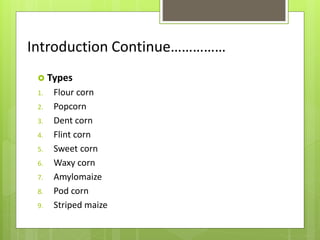
 Types
1. Flour corn
2. Popcorn
3. Dent corn
4. Flint corn
5. Sweet corn
6. Waxy corn
7. Amylomaize
8. Pod corn
9. Striped maize
Uses
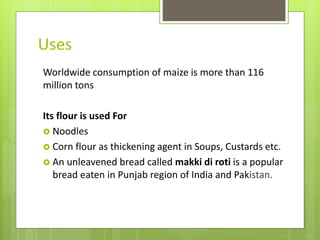
Worldwide consumption of maize is more than 116
million tons
Its flour is used For
 Noodles
 Corn flour as thickening agent in Soups, Custards etc.
 An unleavened bread called makki di roti is a popular
bread eaten in Punjab region of India and Pakistan.
Uses Continue……..
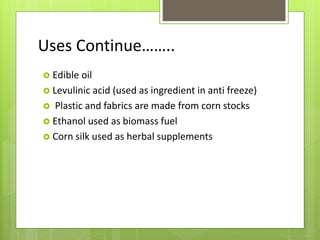
 Edible oil
 Levulinic acid (used as ingredient in anti freeze)
 Plastic and fabrics are made from corn stocks
 Ethanol used as biomass fuel
 Corn silk used as herbal supplements
Production Technology
Soil and climate
 Maize is adapted to wild variety of soil and
climate
 Well drain heavy soils with high organic matter
content and good water holding capacity.
 Soil pH 6.5—7.5 & Temp. should be 12⁰C.
 The optimum temperature for maize growth and
development is 18 to 32 °C.
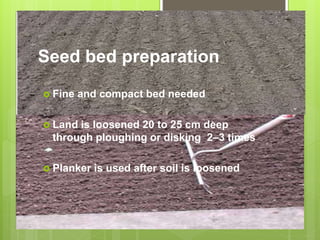
Seed bed preparation
 Fine and compact bed needed
 Land is loosened 20 to 25 cm deep
through ploughing or disking 2–3 times
 Planker is used after soil is loosened
Sowing time
 Autumn Maize
 First weak of February up to first week of March
 Spring Maize
 Last week of July to mid of august
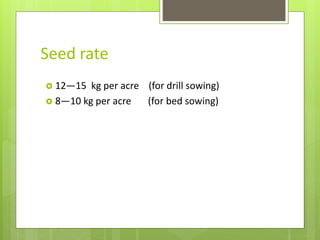
Seed rate
 12—15 kg per acre (for drill sowing)
 8—10 kg per acre (for bed sowing)
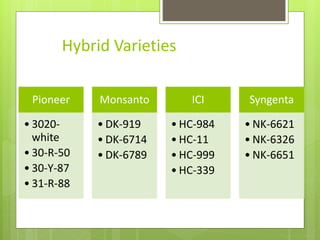
Hybrid Varieties
Pioneer
• 3020-
white
• 30-R-50
• 30-Y-87
• 31-R-88
Monsanto
• DK-919
• DK-6714
• DK-6789
ICI
• HC-984
• HC-11
• HC-999
• HC-339
Syngenta
• NK-6621
• NK-6326
• NK-6651
Sowing methods
 Ridge sowing
 75 cm apart ridges are made with ridger
 Choka method or manual sowing is practiced
 Flat sowing
 Automatic tractor drawn drill or hand drill with 75 cm distance
between rows is used.
 Plant to plant distance 20—25 cm
 Thinning is done after 10—15 days of emergence
 Plant population should be 70,000—75,000 per hectare
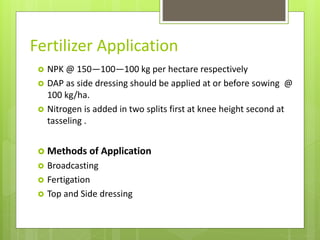
Fertilizer Application
 NPK @ 150—100—100 kg per hectare respectively
 DAP as side dressing should be applied at or before sowing @
100 kg/ha.
 Nitrogen is added in two splits first at knee height second at
tasseling .
 Methods of Application
 Broadcasting
 Fertigation
 Top and Side dressing
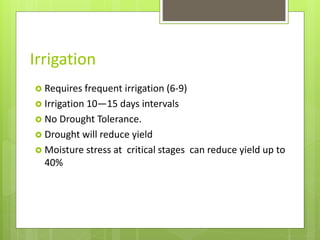
Irrigation
 Requires frequent irrigation (6-9)
 Irrigation 10—15 days intervals
 No Drought Tolerance.
 Drought will reduce yield
 Moisture stress at critical stages can reduce yield up to
40%
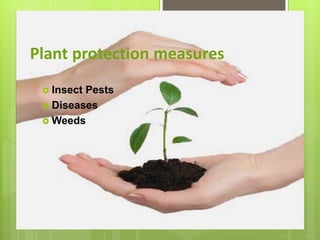
Plant protection measures
 Insect Pests
 Diseases
 Weeds
Plant Protection Measures
Insect Pests
 Maize crop faces serious threat after emergence
 Shoot fly
 Maize stem borer
 Solution
 Furadon powder should be dropped into shoots @ 20
kg/hectare
Plant Protection Measures
 Diseases
 Maize dwarf mosaic virus
 Stalk rot/ Ear rot
 Corn rust
 Cultivate Resistant Varieties
Plant protection measures
Weeds
 Weeds Reduce yield 29—43%
 Common weeds are
 Deela
 Itsit
 Jangli chulai
 Tandla
 Jangli swank
 Jangli haloon
Weeds Continue……
 Weeding at interval of 2 months until the harvesting
time is due.
 Timely weeding + Removal of Dead Leaves
 Grazing or burning
Harvesting & Storage
 Traditionally, when red maize cobs have dried down and it is
time for harvest, the cobs are handpicked, hand shelled and
dried in the sun. This is very labor intensive, which has a
significant impact on the gross margin for maize.
 Combined Harvester is used when moisture levels drop
below 18% to 24% and then dried to below 14% for delivery
or storage.
H&S Continue…….
 Store at moisture content 15%
 Temperature for storage 20—25 c°
 Humidity 30—50 %
Yield
 Hybrid Varieties has potential 125—130 munds/Acre

Maize production technology

  • 1.
  • 2.
  • 3.
    Origin & History Corn plant is indigenous to America and principle food grain of native Americans  It was domesticated 8000 years ago  For western civilization, the story of corn began in 1492 when Columbus's men discovered this new grain in Cuba.  Archeological evidence of corn's early presence in the western hemisphere was identified from corn pollen grain considered to be 80,000 years old obtained from drill cores 200 feet below Mexico City
  • 4.
    Introduction  Highest yieldingcereal crop in the world  3rd most grown crop in world  3rd largest grown cereal crop in Pakistan  4th largest crop grown crop in Pakistan  Rich source of starch, vitamins, proteins and minerals
  • 5.
    Introduction Continue……………  Worldproduction-----------------600 million metric tons  World area--------------------------118 million hectare  Total Pakistan area---------------1 million hectare  Total production-------------------3.5 million metric tons  Contribution of different provinces to total area • Punjab---------------------------------------------39% • KPK -------------------------------------------------56% • Sindh------------------------------------------------5% • Baluchistan----------------------------------------3%
  • 6.
    Introduction Continue……………  Types 1.Flour corn 2. Popcorn 3. Dent corn 4. Flint corn 5. Sweet corn 6. Waxy corn 7. Amylomaize 8. Pod corn 9. Striped maize
  • 7.
    Uses Worldwide consumption ofmaize is more than 116 million tons Its flour is used For  Noodles  Corn flour as thickening agent in Soups, Custards etc.  An unleavened bread called makki di roti is a popular bread eaten in Punjab region of India and Pakistan.
  • 8.
    Uses Continue……..  Edibleoil  Levulinic acid (used as ingredient in anti freeze)  Plastic and fabrics are made from corn stocks  Ethanol used as biomass fuel  Corn silk used as herbal supplements
  • 9.
  • 10.
    Soil and climate Maize is adapted to wild variety of soil and climate  Well drain heavy soils with high organic matter content and good water holding capacity.  Soil pH 6.5—7.5 & Temp. should be 12⁰C.  The optimum temperature for maize growth and development is 18 to 32 °C.
  • 11.
    Seed bed preparation Fine and compact bed needed  Land is loosened 20 to 25 cm deep through ploughing or disking 2–3 times  Planker is used after soil is loosened
  • 12.
    Sowing time  AutumnMaize  First weak of February up to first week of March  Spring Maize  Last week of July to mid of august
  • 13.
    Seed rate  12—15kg per acre (for drill sowing)  8—10 kg per acre (for bed sowing)
  • 14.
    Hybrid Varieties Pioneer • 3020- white •30-R-50 • 30-Y-87 • 31-R-88 Monsanto • DK-919 • DK-6714 • DK-6789 ICI • HC-984 • HC-11 • HC-999 • HC-339 Syngenta • NK-6621 • NK-6326 • NK-6651
  • 15.
    Sowing methods  Ridgesowing  75 cm apart ridges are made with ridger  Choka method or manual sowing is practiced  Flat sowing  Automatic tractor drawn drill or hand drill with 75 cm distance between rows is used.  Plant to plant distance 20—25 cm  Thinning is done after 10—15 days of emergence  Plant population should be 70,000—75,000 per hectare
  • 16.
    Fertilizer Application  NPK@ 150—100—100 kg per hectare respectively  DAP as side dressing should be applied at or before sowing @ 100 kg/ha.  Nitrogen is added in two splits first at knee height second at tasseling .  Methods of Application  Broadcasting  Fertigation  Top and Side dressing
  • 17.
    Irrigation  Requires frequentirrigation (6-9)  Irrigation 10—15 days intervals  No Drought Tolerance.  Drought will reduce yield  Moisture stress at critical stages can reduce yield up to 40%
  • 18.
    Plant protection measures Insect Pests  Diseases  Weeds
  • 19.
    Plant Protection Measures InsectPests  Maize crop faces serious threat after emergence  Shoot fly  Maize stem borer  Solution  Furadon powder should be dropped into shoots @ 20 kg/hectare
  • 20.
    Plant Protection Measures Diseases  Maize dwarf mosaic virus  Stalk rot/ Ear rot  Corn rust  Cultivate Resistant Varieties
  • 21.
    Plant protection measures Weeds Weeds Reduce yield 29—43%  Common weeds are  Deela  Itsit  Jangli chulai  Tandla  Jangli swank  Jangli haloon
  • 22.
    Weeds Continue……  Weedingat interval of 2 months until the harvesting time is due.  Timely weeding + Removal of Dead Leaves  Grazing or burning
  • 23.
    Harvesting & Storage Traditionally, when red maize cobs have dried down and it is time for harvest, the cobs are handpicked, hand shelled and dried in the sun. This is very labor intensive, which has a significant impact on the gross margin for maize.  Combined Harvester is used when moisture levels drop below 18% to 24% and then dried to below 14% for delivery or storage.
  • 24.
    H&S Continue…….  Storeat moisture content 15%  Temperature for storage 20—25 c°  Humidity 30—50 %
  • 25.
    Yield  Hybrid Varietieshas potential 125—130 munds/Acre