Vigna mungo, also known as black gram or urdbean, is an important pulse crop grown in India. It is rich in protein and helps restore soil fertility through nitrogen fixation. The main producing states are Maharashtra, Andhra Pradesh, Madhya Pradesh, and Uttar Pradesh. Black gram grows best in temperatures between 25-35°C and prefers loam or clay soils with good drainage. It is usually sown between June-July during the kharif season or February-March in summer. Proper weed management and irrigation are important. Hand picking is done when pods are dried to avoid shattering. Black gram is a nutritious crop that provides around 10-12 quintals
Introduction
Botanical Name: Vignamungo
Family: Leguminoseae.
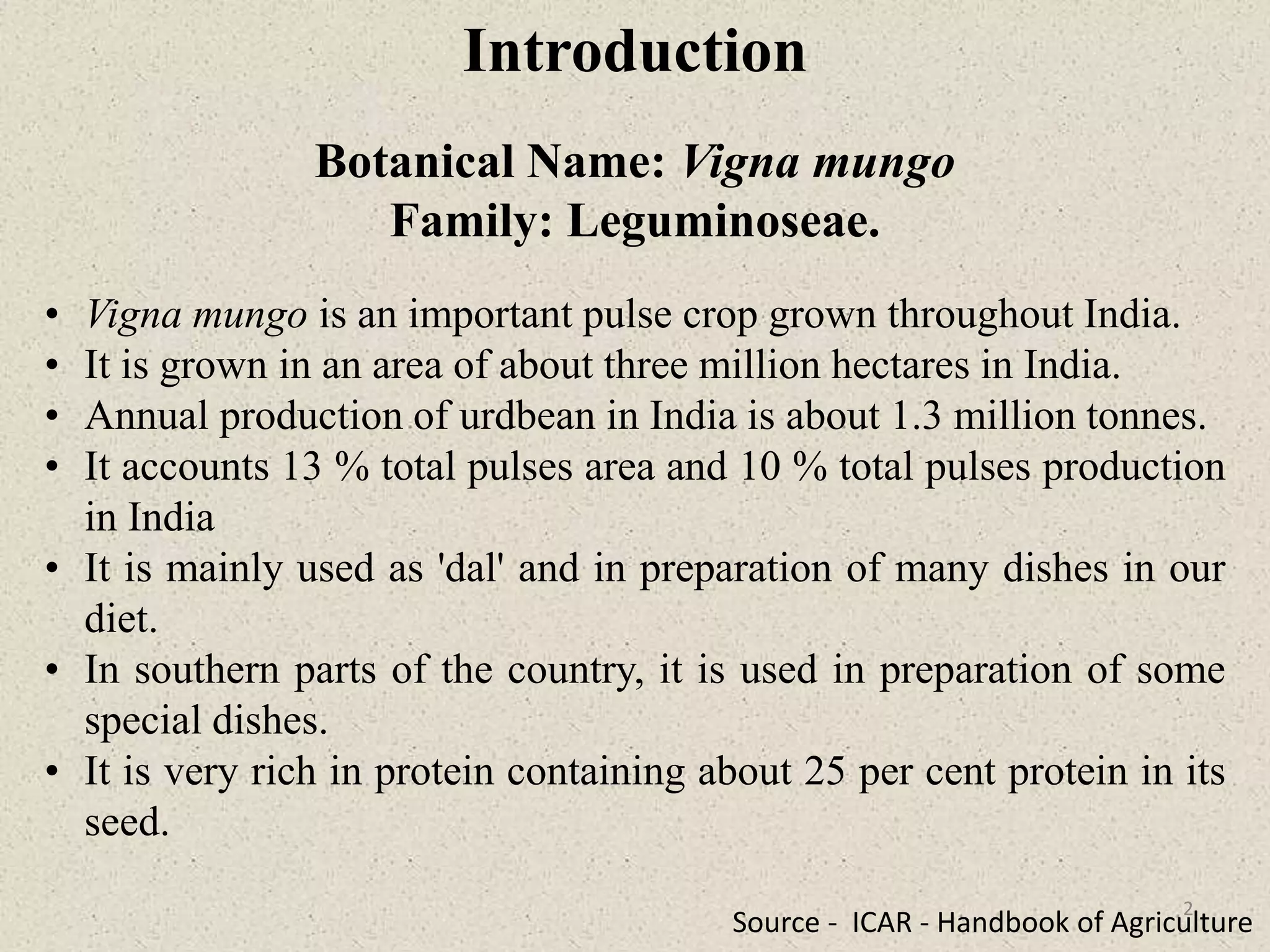
• Vigna mungo is an important pulse crop grown throughout India.
• It is grown in an area of about three million hectares in India.
• Annual production of urdbean in India is about 1.3 million tonnes.
• It accounts 13 % total pulses area and 10 % total pulses production
in India
• It is mainly used as 'dal' and in preparation of many dishes in our
diet.
• In southern parts of the country, it is used in preparation of some
special dishes.
• It is very rich in protein containing about 25 per cent protein in its
seed.
Source - ICAR - Handbook of Agriculture
2
3.
• It alsoacts as cover crop and its deep root system protects the
soil from erosion.
• Besides, this green fodder of urdbean is very nutritive and is
specially useful for milch cattle.
• Urdbean being leguminous has the capacity to fix atmospheric
nitrogen and thus helps in restoring the soil fertility.
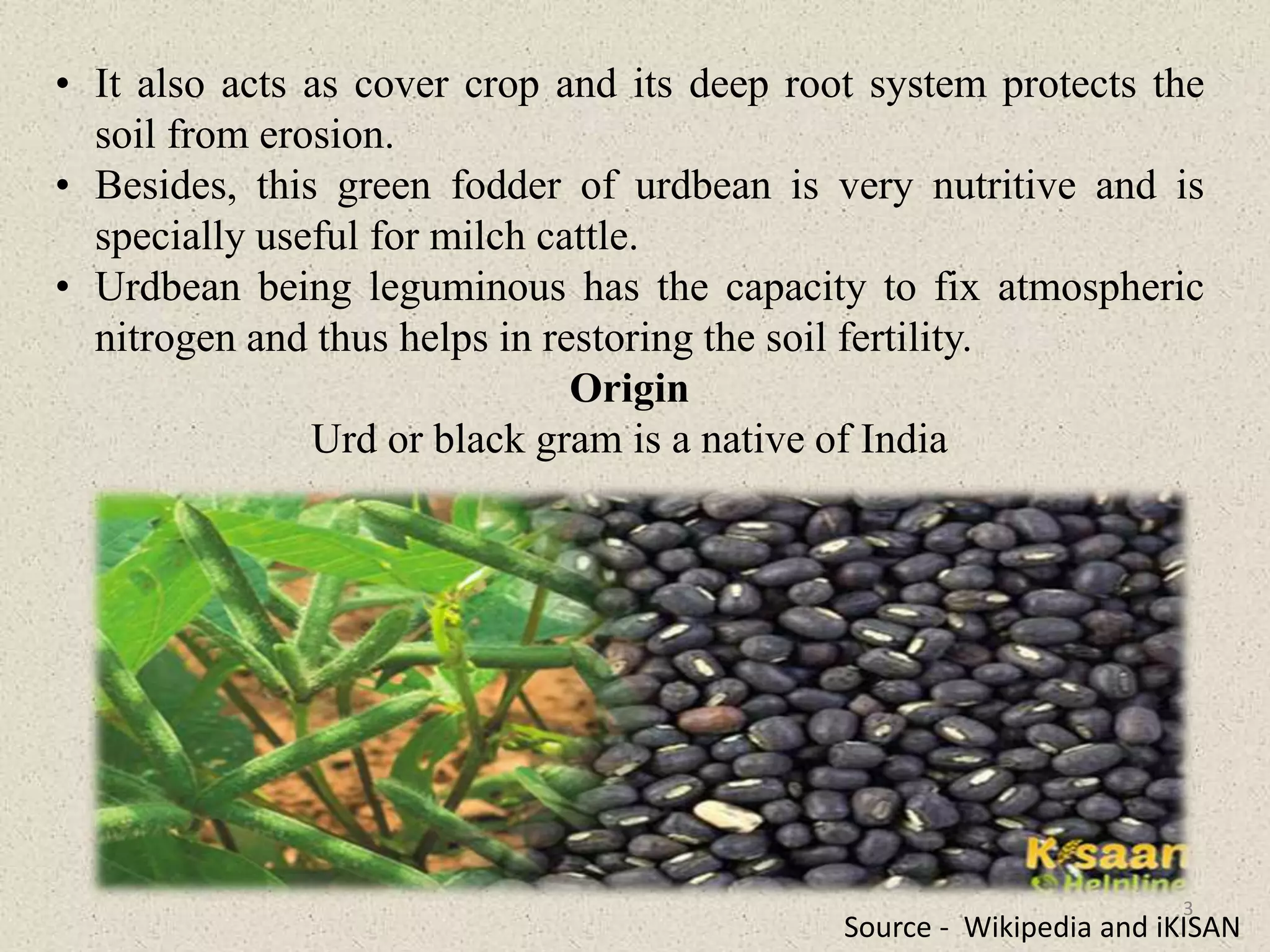
Origin
Urd or black gram is a native of India
Source - Wikipedia and iKISAN
3
4.
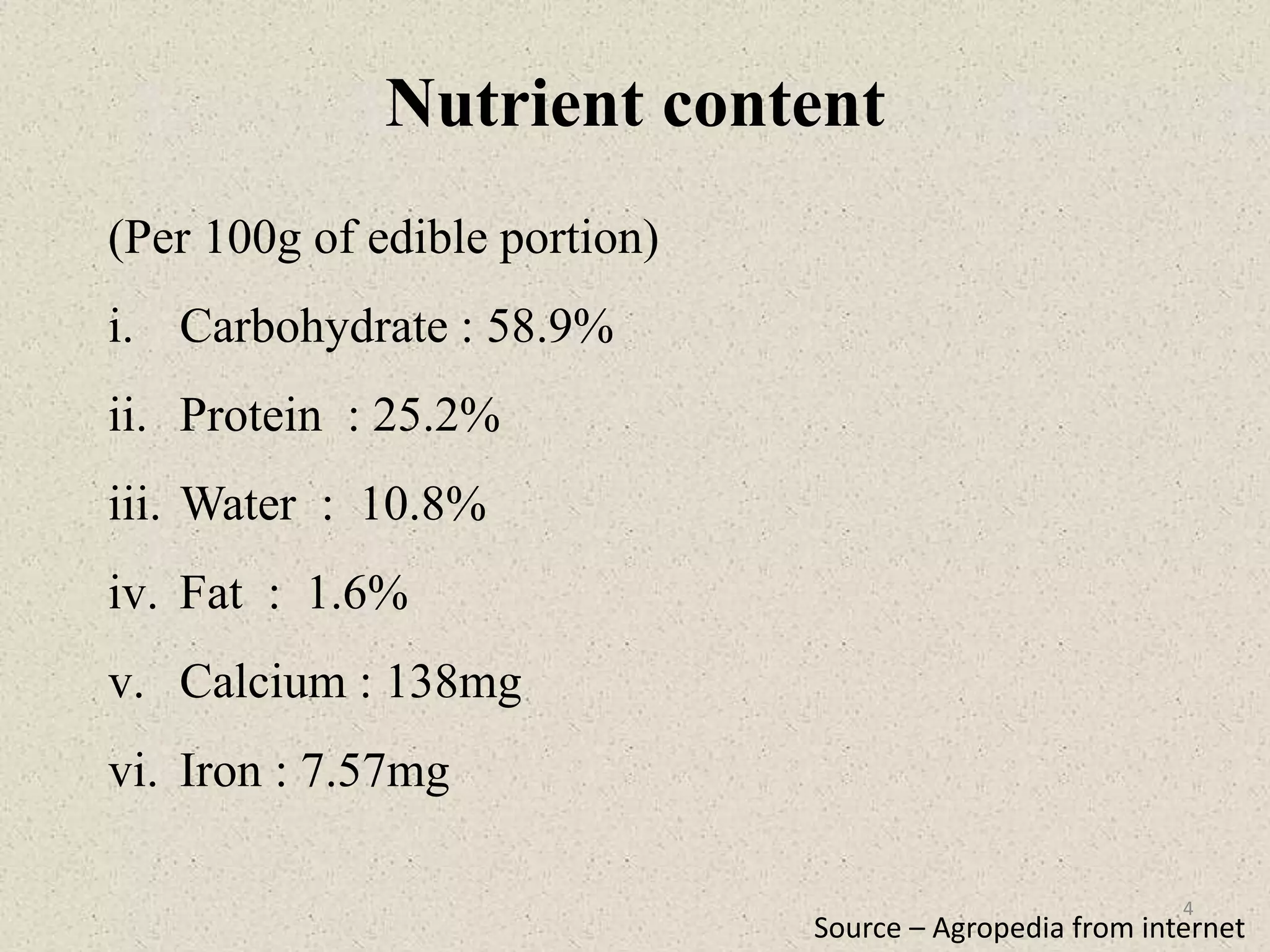
(Per 100g ofedible portion)
i. Carbohydrate : 58.9%
ii. Protein : 25.2%
iii. Water : 10.8%
iv. Fat : 1.6%
v. Calcium : 138mg
vi. Iron : 7.57mg
Nutrient content
Source – Agropedia from internet
4
5.
Area, production andproductivity of Urdbean in India
Area (3 million ha)
Maharashtra (18.55%), Andhra Pradesh (16.23%), Madhya Pradesh
(18.55%), Uttar Pradesh (12.61%), Tamil Nadu (11.00), Rajasthan (4.68),
Orissa (4.84%) and Karnataka (4.06)
Production (1.3 million tonnes)
Maharashtra(23.36%), Andhra Pradesh (18.50%), Uttar Pradesh (12.29%),
Madhya Pradesh (11.86%), Tamil Nadu (8.64%), Karnataka (4.57%),
Rajasthan (4.29%) and Orissa (3.00%)
Productivity (kg ha-1)
Andhra Pradesh (1447.62), Gujarat (976.74), Karnataka (937.19),
Maharashtra (872.14), Uttar Pradesh (748.51) and Madhya Pradesh (711.93)
Source – Directorate of Economics and Statistics ,Ministry of Agriculture (GOI) - 2011
5
6.
Climate
• It isgenerally grown in kharif and summer season.
• It grows best in hot and humid condition with ideal
temperature range between 25°C to 35°C.
• It can be grown successfully from sea level up to an
elevation of 1800 meters.
• Heavy rains during flowering are harmful.
• It is best suited to areas having an annual rainfall of 60
to 75 cm.
Source – IndiaAgroNet.Com
7.
Soil
• Black gramdoes well on heavier soils such as black
cotton soils which retain moisture better.
• It can be grown all types of soils ranging from sandy
loam to heavy clay, except the alkaline and saline
soils.
• Loam or slightly heavy soils with neutral pH are best
suited for urdbean.
• Soil should be will drained and having good water
holding capacity.
• Waterlogged, saline and alkaline soil should be
avoided.
Source – IndiaAgroNet.Com
7
8.
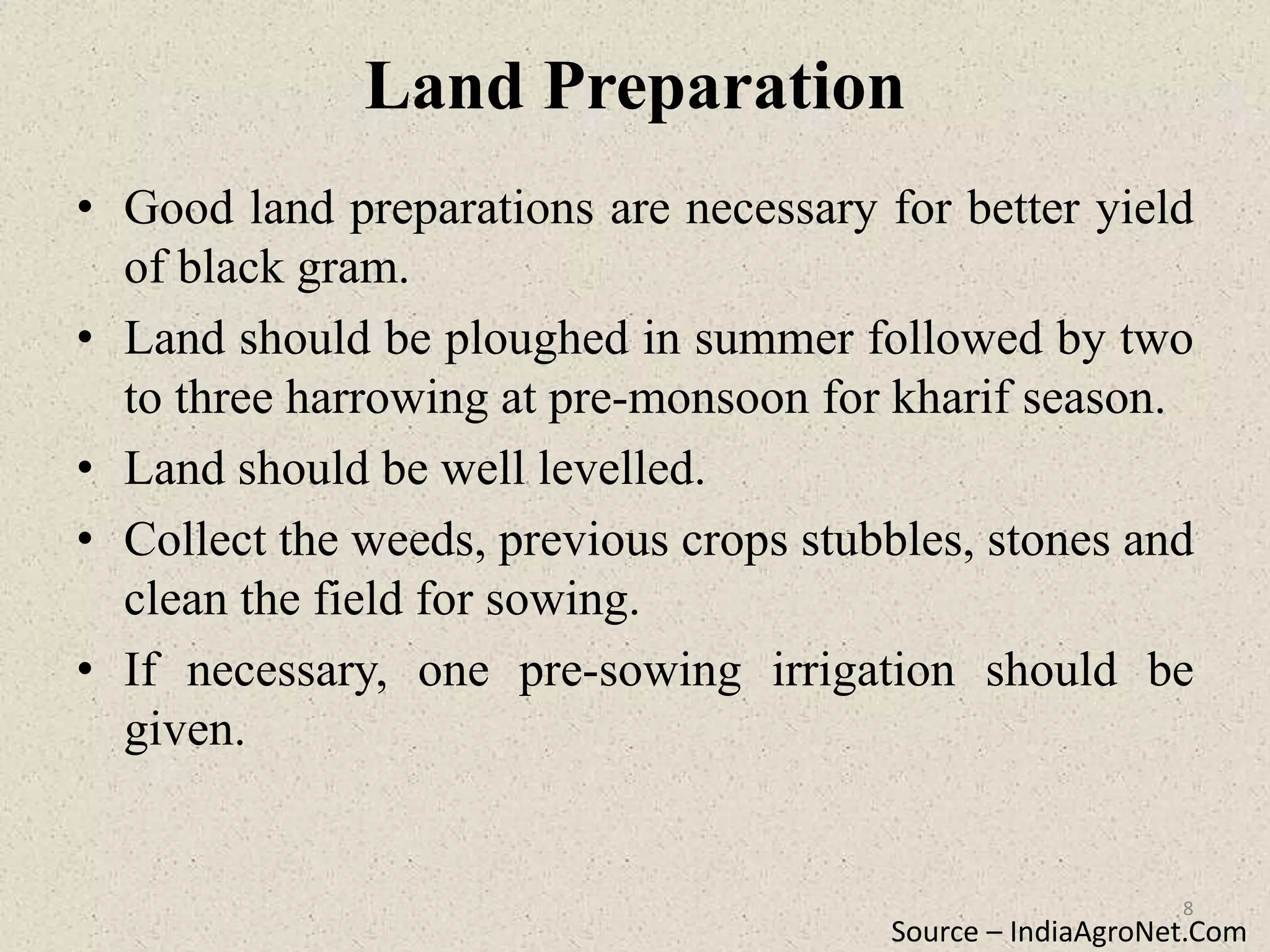
Land Preparation
• Goodland preparations are necessary for better yield
of black gram.
• Land should be ploughed in summer followed by two
to three harrowing at pre-monsoon for kharif season.
• Land should be well levelled.
• Collect the weeds, previous crops stubbles, stones and
clean the field for sowing.
• If necessary, one pre-sowing irrigation should be
given.
Source – IndiaAgroNet.Com
8
9.
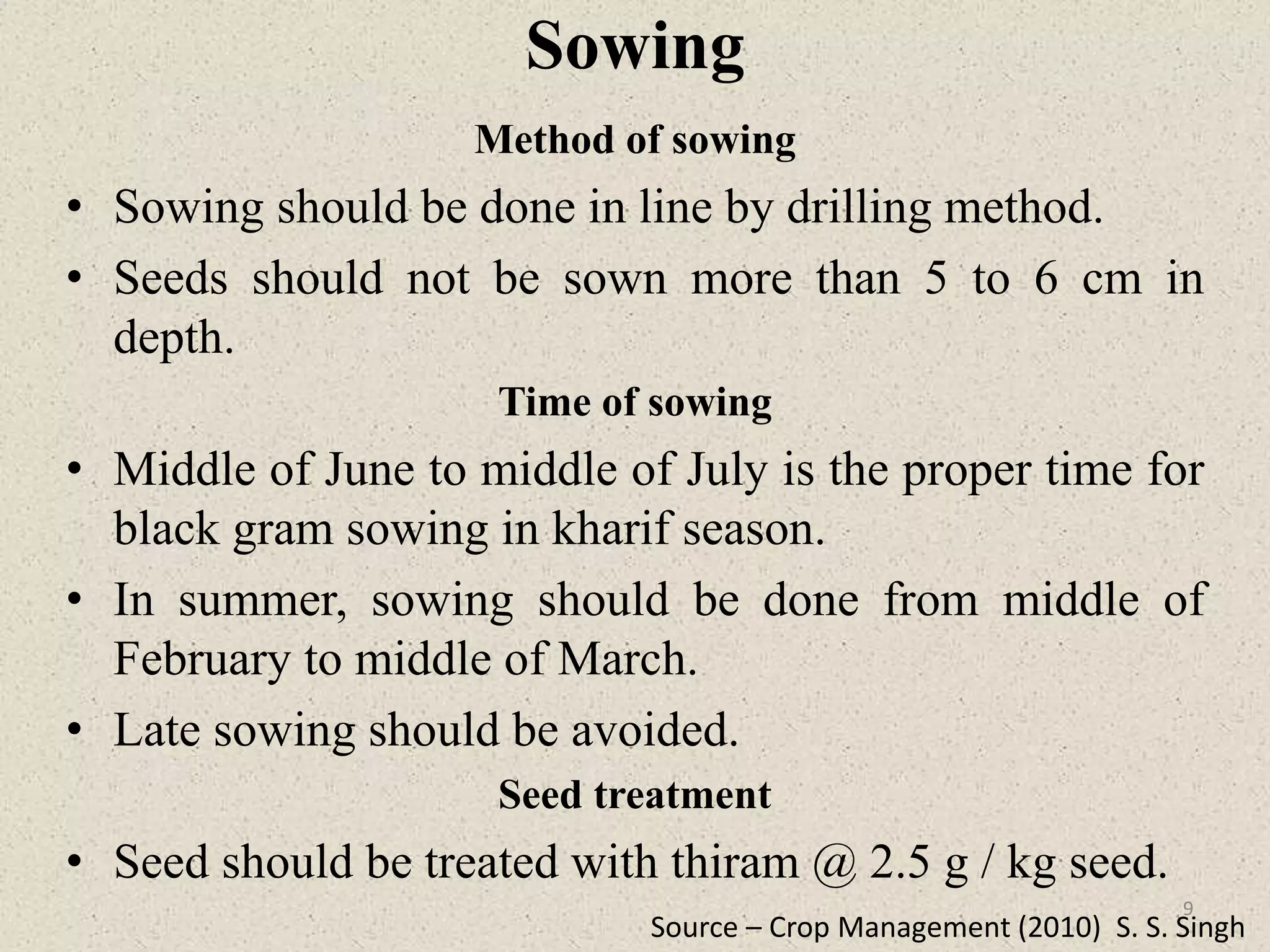
Sowing
Method of sowing
•Sowing should be done in line by drilling method.
• Seeds should not be sown more than 5 to 6 cm in
depth.
Time of sowing
• Middle of June to middle of July is the proper time for
black gram sowing in kharif season.
• In summer, sowing should be done from middle of
February to middle of March.
• Late sowing should be avoided.
Seed treatment
• Seed should be treated with thiram @ 2.5 g / kg seed.
Source – Crop Management (2010) S. S. Singh
9
10.
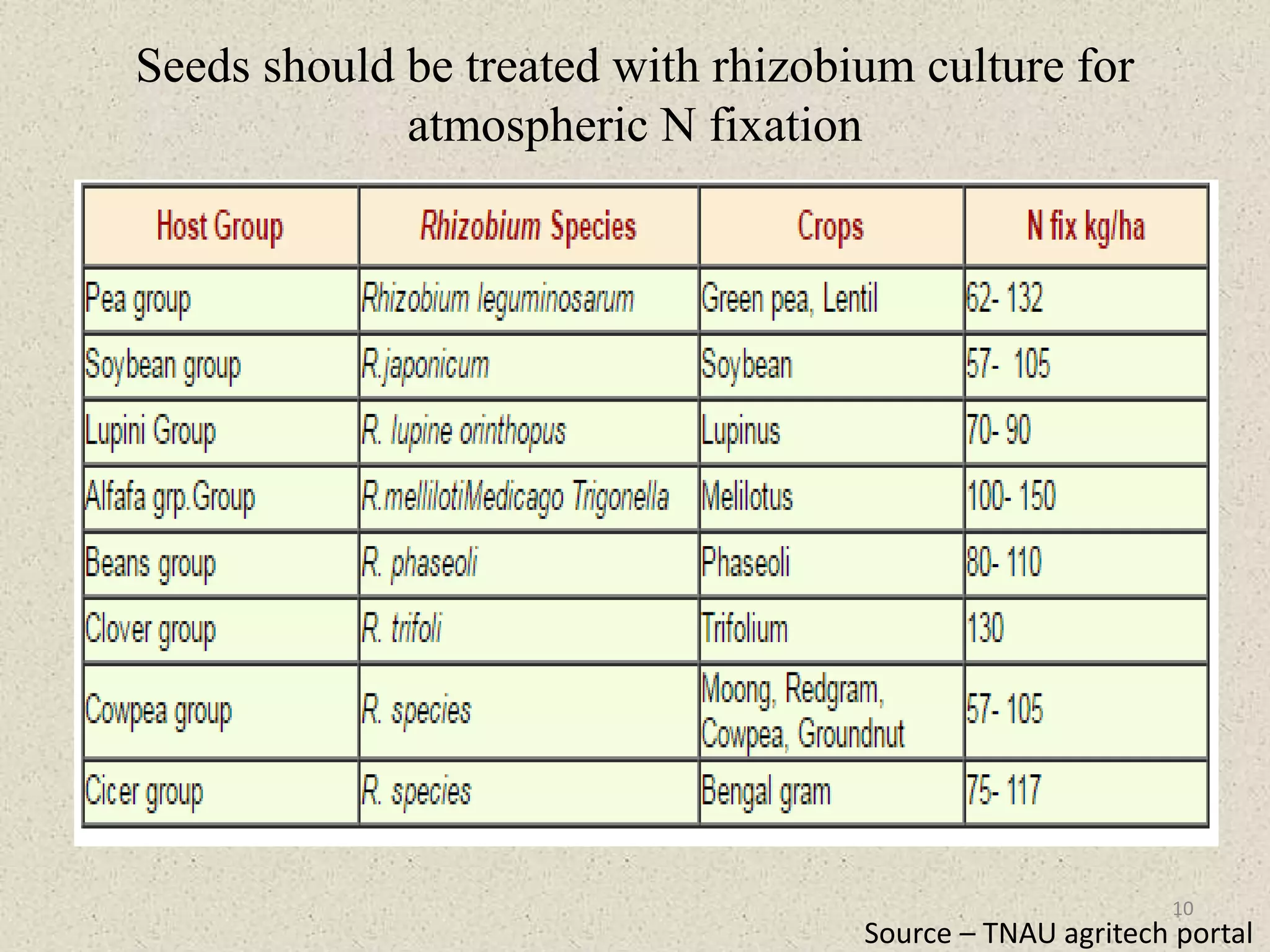
Seeds should betreated with rhizobium culture for
atmospheric N fixation
Source – TNAU agritech portal
10
11.
Seed rate andspacing
Season Seed rate Spacing
Kharif 12 to 15 kg / ha* 30 X 10 cm
Summer 20 to 25 kg / ha* 20-25 X 10 cm
*Kharif season crop requires lesser seed rate and wider spacing because of very profuse
plant growth but summer season crops need closer spacing and thereby a higher seed rate
is required.
Source – Crop Management (2010) S. S. Singh
11
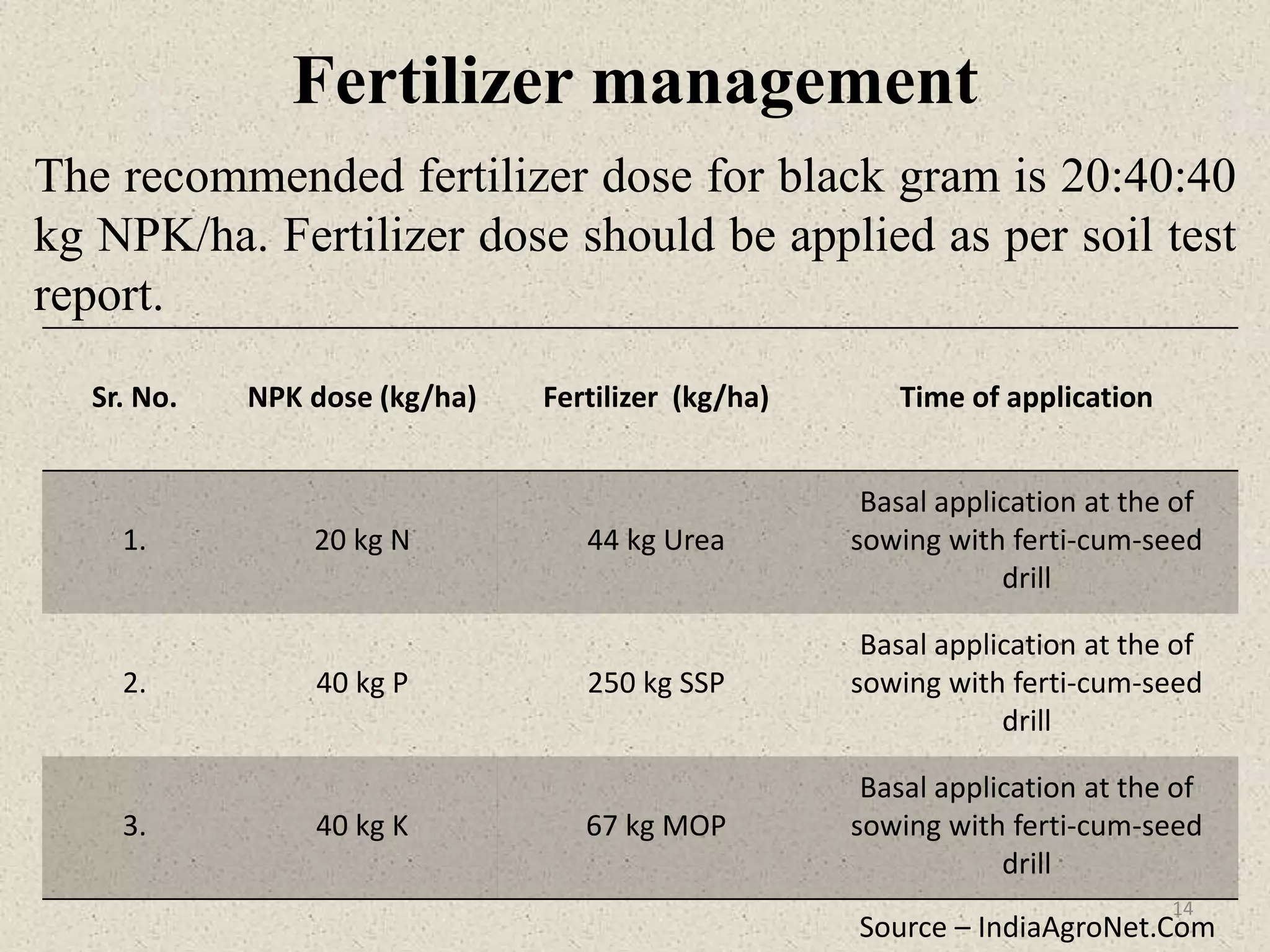
Fertilizer management
The recommendedfertilizer dose for black gram is 20:40:40
kg NPK/ha. Fertilizer dose should be applied as per soil test
report.
Sr. No. NPK dose (kg/ha) Fertilizer (kg/ha) Time of application
1. 20 kg N 44 kg Urea
Basal application at the of
sowing with ferti-cum-seed
drill
2. 40 kg P 250 kg SSP
Basal application at the of
sowing with ferti-cum-seed
drill
3. 40 kg K 67 kg MOP
Basal application at the of
sowing with ferti-cum-seed
drill
Source – IndiaAgroNet.Com
14
15.
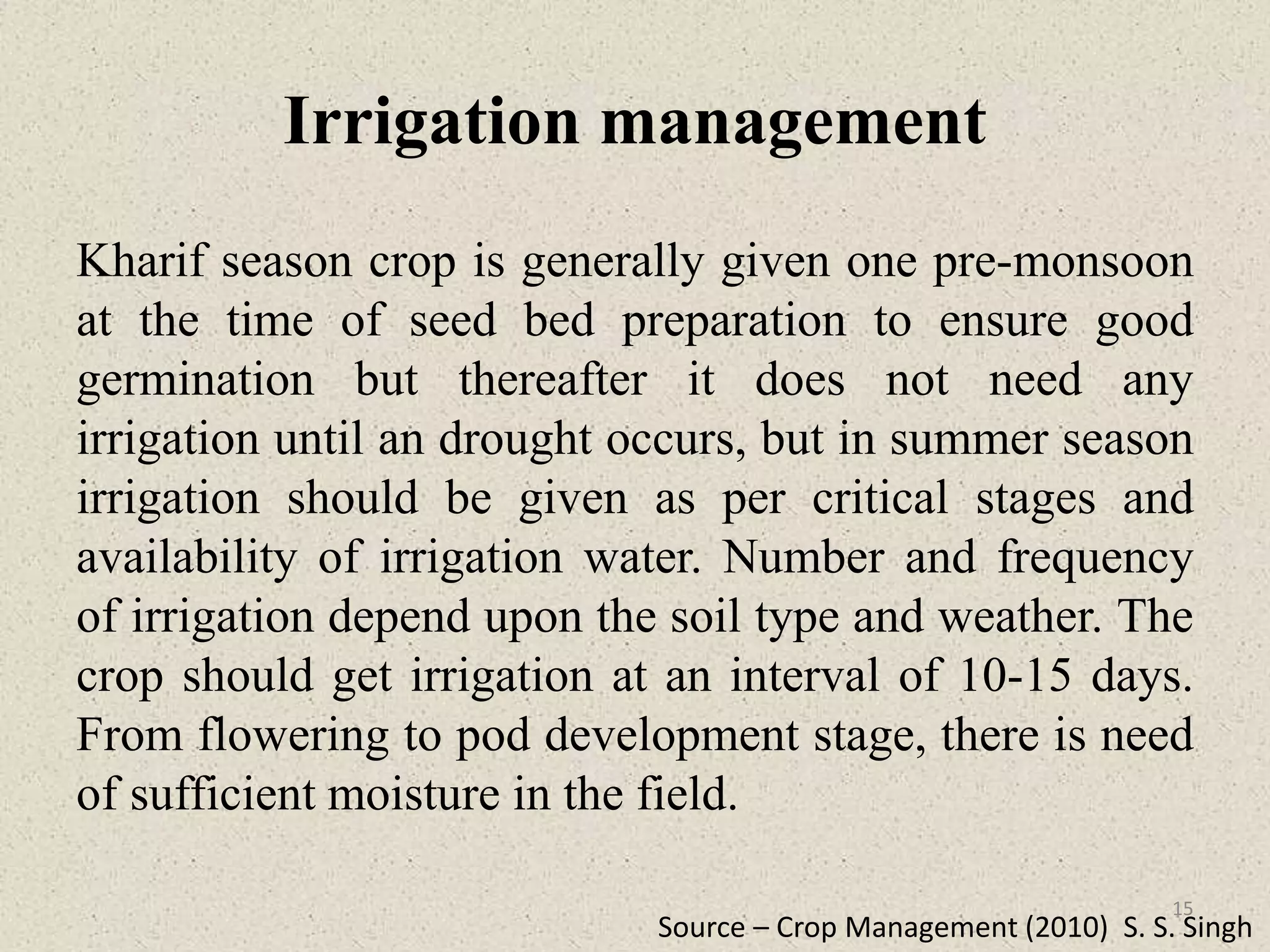
Irrigation management
Kharif seasoncrop is generally given one pre-monsoon
at the time of seed bed preparation to ensure good
germination but thereafter it does not need any
irrigation until an drought occurs, but in summer season
irrigation should be given as per critical stages and
availability of irrigation water. Number and frequency
of irrigation depend upon the soil type and weather. The
crop should get irrigation at an interval of 10-15 days.
From flowering to pod development stage, there is need
of sufficient moisture in the field.
Source – Crop Management (2010) S. S. Singh
15
16.
Weed management
Two handweeding should be done once after 20-25
days and second time after about 35-40 days of sowing
depending upon the weed intensity. Weeds can be
controlled by the use of herbicides if labour is not
available i.e. Basalin 1 kg a.i. / ha in 800-1000 litres of
water as pre-planting application.
Source – Crop Management (2010) S. S. Singh
16
17.
Signs of maturity,harvesting & threshing
• Pods and plant dried, Grains become hard, and
moisture in grain at harvesting should be 20-22 %.
• Pod shattering is common problem in pulse.
Therefore picking should be done as soon as pods
mature.
• Harvesting should be done 2-3 pickings.
• The pods or whole crop after complete drying should
be threshed manually or by machine.
Yield
• A well managed crop, as indicated above, may
produce 10 to 12 quintals of grain per hectare.
Source - ICAR - Handbook of Agriculture
17
18.
References
Singh, S.S. (2010): Crop Management, Kalyani Publishers. 4:192-196.
Rai, M. (2013) : Handbook of Agriculture, Indian Council of Agriculture
Research. 6:1087-1119.
Internet Source :
• Retrieved from wikipedia : https://en.wikipedia.org/wiki/Vigna_mungo
• Retrieved from iKISAN : http://www.ikisan.com/up-blackgram-history.html
• Retrieved from agropedia : http://agropedia.iitk.ac.in/content/area-production-
and-productivity-major-pulses
• Retrieved from Indian Institute of Pulses Research : http://www.iipr.res.in/e-
pulse-data-book.html
• Retrieved from IndiaAgroNet.Com :
https://www.indiaagronet.com/indiaagronet/crop%20info/black_gram.htm
• Retrieved from TNAU agritech portal :
http://agritech.tnau.ac.in/agriculture/CropProduction/Pulses/pulses_blackgra
m.html
18