PROFESSOR JAYASHANKAR TELANANA
STATE AGRICULTURE UNIVERSITY,
COLLEGE OF AGRICULTURE , RAJENDRA NAGAR
MANAGEMENT PRACTICES TO INCREASE
AND STABILIZE PEARL MILLET
PRODUCTION IN INDIA
BY
SHAIKH WASIM CHAND
RAM/15-13
Pearl Millet
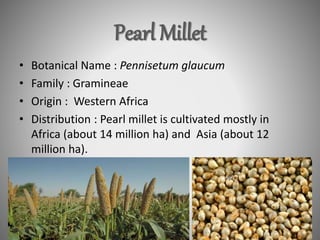
• Botanical Name : Pennisetum glaucum
• Family : Gramineae
• Origin : Western Africa
• Distribution : Pearl millet is cultivated mostly in
Africa (about 14 million ha) and Asia (about 12
million ha).
Pearl millet Area in India
• India is the largest producer of pearl millet.
• Area (9–10 million ha)
• Production (8-9 million t)
• Average productivity of 780 kg/ha.
• It is grown as irrigated crop during the summer
season in GJ, MH, AP, KN and TN.
• Summer pearl millet is popular in Gujarat with very
high yield exceeding 4–5 t/ha with excellent grain
quality.
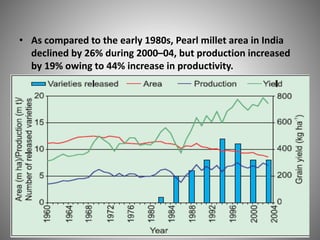
• As compared to the early 1980s, Pearl millet area in India
declined by 26% during 2000–04, but production increased
by 19% owing to 44% increase in productivity.
Soil and Climate
• It yields best on fertile, well-drained loamy soils.
• Pearl millet not grow well in waterlogged conditions.
• It is grown on soils of poor fertility with low organic
matter content, but it yields low.
• Pearl millet can grow even under unfavorable
conditions of drought stress and high temperatures.
• Pearl millet is a warm-weather crop and grows best
at 30–34°C air temperature.
• Germination = 23 to 32°C.
• The optimum rainfall requirement 600 and 800 mm.
• But, pearl millet can be grown in areas which receive
even less than 350 mm of seasonal rainfall.
Management Practices
Field Preparation :
• Timely sowing, which ensures higher yield.
• Provide favorable conditions for sowing, allowing
germination, emergence and good plant
development.
• Maintenance of fertility and productivity.
• Summer plowing.
• Good seedbed preparation and is essential for
the successful establishment of the crop.
Nutrient Management
• The low yields in pearl millet due to the crop being
grown under poor soils, low nutrient content, erratic
rainfall conditions etc.
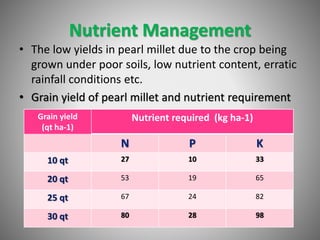
• Grain yield of pearl millet and nutrient requirement
Grain yield
(qt ha-1)
Nutrient required (kg ha-1)
N P K
10 qt 27 10 33
20 qt 53 19 65
25 qt 67 24 82
30 qt 80 28 98
• Nitrogen nutrition :
• Nitrogen plays an important role for good growth.
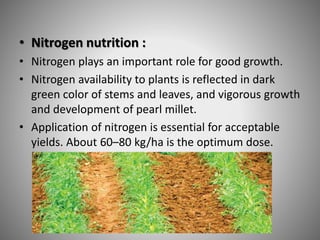
• Nitrogen availability to plants is reflected in dark
green color of stems and leaves, and vigorous growth
and development of pearl millet.
• Application of nitrogen is essential for acceptable
yields. About 60–80 kg/ha is the optimum dose.
• Phosphorus nutrition :
• To provide energy for the growth and
development of pearl millet plants.
• Without phosphorus plants cannot grow even
when nitrogen supply is plenty.
• It takes phosphorus from seedling stage to grain-
filling stage.
• SSP is good source of phosphorus requirement
for Pearlmillet.
• Potassium nutrition :
• Provides resistance to insect pests, diseases and
water stress.
• Improves the quality of the crop produce.
• If a soil contains less than 150 kg ha-1 of available
potassium, recommended dose of potassium
application results higher yield in pearl millets.
• Micronutrients :
• Pearl millet response well to micro nutrients.
• The results indicates grain yield increases with application
micronutrient.
• Irrigated pearl millet responds well to Zinc up to
25 kg Zn So₄ /ha.
• Shekhawat et al reported that application of micronutrient
increased grain yield of pearl millet over NPK.
• The percentage of increase in grain yield due to
application of micronutrients over NPK alone are ,
• Mn - 5.47 %
• Zn – 16.48 %
• B – 4.55 %
• Mo – 7.70 %
• Fe – 19.35 %
Other nutrients
• Secondary nutrients and Micronutrients plays an
important role to increase the pearl millet
production.
• Application of organic manures like well-decomposed
FYM and Compost, Green Manuring and Green-Leaf
Manuring practices provide nutrients.
• These nutrients are equally essential for pearl millet
plants for proper growth , development and disease
resistance.
• Experimental evidence indicate the applying
10-15 t /ha of bulky organic manure improving yield
of pearl millet as well as improving soil productivity.
Cropping Systems
• Commonly practiced cropping systems are:
• Crop rotation practices :
• It maintains soil fertility.
• Check soil erosion.
• Reduce the buildup of pest.
• Mitigate risk of weather changes.
• Increase net profits.
• Intercropping Practices :
• Intercropping refers to growing more than one crop in the
same land area in rows of definite proportion and pattern.
• Produce higher yields per unit area through better use of
natural resources.
• Offer greater stability in production under adverse weather
conditions , disease and insect infestation.
• Meet the domestic needs of the farmer.
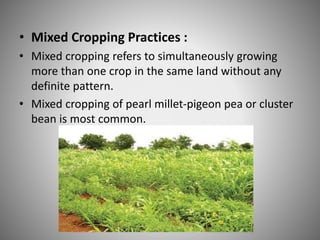
• Mixed Cropping Practices :
• Mixed cropping refers to simultaneously growing
more than one crop in the same land without any
definite pattern.
• Mixed cropping of pearl millet-pigeon pea or cluster
bean is most common.
Seeds and Sowing
• Seeds and Seed Preparation :
• To prevent seed borne diseases as well as pests.
• Seed hardening practice for better germination.
• Soaking seeds in 1% calcium chloride or in plain
water for 6 hours before sowing results in increased
yield under drought conditions.
• Soak seeds in 10% salt solution reduce the incidence
of Ergot disease.
• Pearl millet cultivars :
• Pearl millet hybrids offer several advantages over
OPVs besides 25–30% higher grain yields.
• high-yielding, popular hybrids and varieties are ,
• HHB 67 Improved
• GHB 538
• GHB 558
• ICMH 356
• GK 1004 AP HYBRID VARIETIES
• PAC 903
• AIMP 92901, ASP-1, ICTP 8203, Ananth
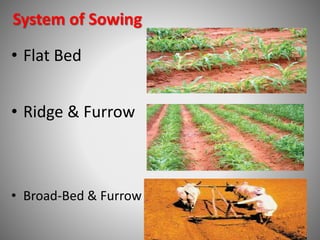
System of Sowing
• Flat Bed
• Ridge & Furrow
• Broad-Bed & Furrow
• Seed rate :
• In general 6-8 kg/ha and in black soil 3 Kg/ha under
high water retentive capacity
• Spacing: 30x10 cm or 60 X 10 cm
• Sowing time :
• Kharif : June-July
• Rabi : September-October
• Summer : January-February
(as an irrigated crop in TN ,KN,PB,GJ, AP)
Transplanting of Pearl Millet
• Pearl millet is also transplanted in some parts of
Tamil Nadu, Andhra Pradesh, Karnataka and Gujarat.
• This practice is common under irrigated conditions.
• A nursery of 300 m² is sufficient to supply seedlings
to plant one ha main field.
• It saves 3-4 weeks if crop is responsive to
transplanting.
• Transplanted pearl millet gives much yield as that of
direct seeded crop.
• Healthy seedlings (15 to 20 days old) are
transplanted in the water-soaked fields.
• Under south Indian conditions, summer
irrigated pearl millet is usually grown by
transplantation.
• Sow the seedlings on ridges and furrows with
a spacing of 45 x 20 cm .
• A plant population of 1,75,000 /ha is
optimum for hybrids.
• Earthing up is done around 40 DAP.
• The grain yield around 4 t/ha under good
management practices.
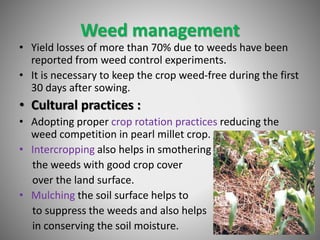
Weed management
• Yield losses of more than 70% due to weeds have been
reported from weed control experiments.
• It is necessary to keep the crop weed-free during the first
30 days after sowing.
• Cultural practices :
• Adopting proper crop rotation practices reducing the
weed competition in pearl millet crop.
• Intercropping also helps in smothering
the weeds with good crop cover
over the land surface.
• Mulching the soil surface helps to
to suppress the weeds and also helps
in conserving the soil moisture.
• Chemical control :
• Pre-emergence application :
• It applied after sowing but before emergence of
seedling.
- Atrazine (0.5-1.0)
- Pendimethalin (1.0-1.5)
- Tebutryn (1.0-2.0) for light soils
- Norea (1.0-2.0) for heavy soils
• Post-emergence application :
• In case of severe infestation.
• Low rates of 2,4-D (0.5-1.0 kg/ha) may be applied
when the plants are about 10 to 30 cm tall.
Water Management
• Pearl millet is mainly rainfed crop.
• Only about 8% of pearl millet area is irrigated in
India.
Moisture conservation :
• Soil and water conservation practices significance to
increase pearl millet production.
• Antitranspirants and reflectants may minimize the
water loss due to transpiration.
• Deep ploughing increases rain water into soil.
• Mulches are effective in reducing evaporation losses
Scheduling Irrigation :
• Summer irrigated Pearl millet require six irrigation for
high yields at given stages,
• Transplanting
• 1 week after transplanting
• 3 week after transplanting
• Panicle initiation
• Flowering
• Grain development
Case Studies
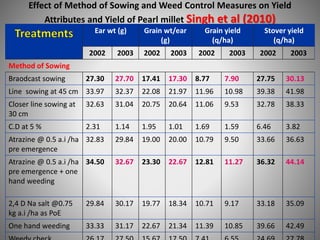
Effect of Method of Sowing and Weed Control Measures on Yield
Attributes and Yield of Pearl millet Singh et al (2010)
Ear wt (g) Grain wt/ear
(g)
Grain yield
(q/ha)
Stover yield
(q/ha)
2002 2003 2002 2003 2002 2003 2002 2003
Method of Sowing
Braodcast sowing 27.30 27.70 17.41 17.30 8.77 7.90 27.75 30.13
Line sowing at 45 cm 33.97 32.37 22.08 21.97 11.96 10.98 39.38 41.98
Closer line sowing at
30 cm
32.63 31.04 20.75 20.64 11.06 9.53 32.78 38.33
C.D at 5 % 2.31 1.14 1.95 1.01 1.69 1.59 6.46 3.82
Atrazine @ 0.5 a.i /ha
pre emergence
32.83 29.84 19.00 20.00 10.79 9.50 33.66 36.63
Atrazine @ 0.5 a.i /ha
pre emergence + one
hand weeding
34.50 32.67 23.30 22.67 12.81 11.27 36.32 44.14
2,4 D Na salt @0.75
kg a.i /ha as PoE
29.84 30.17 19.77 18.34 10.71 9.17 33.18 35.09
One hand weeding 33.33 31.17 22.67 21.34 11.39 10.85 39.66 42.49
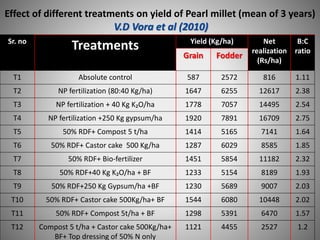
Effect of different treatments on yield of Pearl millet (mean of 3 years)
V.D Vora et al (2010)
Sr. no
Treatments Yield (Kg/ha) Net
realization
(Rs/ha)
B:C
ratio
Grain Fodder
T1 Absolute control 587 2572 816 1.11
T2 NP fertilization (80:40 Kg/ha) 1647 6255 12617 2.38
T3 NP fertilization + 40 Kg K₂O/ha 1778 7057 14495 2.54
T4 NP fertilization +250 Kg gypsum/ha 1920 7891 16709 2.75
T5 50% RDF+ Compost 5 t/ha 1414 5165 7141 1.64
T6 50% RDF+ Castor cake 500 Kg/ha 1287 6029 8585 1.85
T7 50% RDF+ Bio-fertilizer 1451 5854 11182 2.32
T8 50% RDF+40 Kg K₂O/ha + BF 1233 5154 8189 1.93
T9 50% RDF+250 Kg Gypsum/ha +BF 1230 5689 9007 2.03
T10 50% RDF+ Castor cake 500Kg/ha+ BF 1544 6080 10448 2.02
T11 50% RDF+ Compost 5t/ha + BF 1298 5391 6470 1.57
T12 Compost 5 t/ha + Castor cake 500Kg/ha+
BF+ Top dressing of 50% N only
1121 4455 2527 1.2
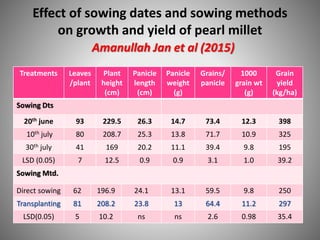
Effect of sowing dates and sowing methods
on growth and yield of pearl millet
Amanullah Jan et al (2015)
Treatments Leaves
/plant
Plant
height
(cm)
Panicle
length
(cm)
Panicle
weight
(g)
Grains/
panicle
1000
grain wt
(g)
Grain
yield
(kg/ha)
Sowing Dts
20th june 93 229.5 26.3 14.7 73.4 12.3 398
10th july 80 208.7 25.3 13.8 71.7 10.9 325
30th july 41 169 20.2 11.1 39.4 9.8 195
LSD (0.05) 7 12.5 0.9 0.9 3.1 1.0 39.2
Sowing Mtd.
Direct sowing 62 196.9 24.1 13.1 59.5 9.8 250
Transplanting 81 208.2 23.8 13 64.4 11.2 297
LSD(0.05) 5 10.2 ns ns 2.6 0.98 35.4
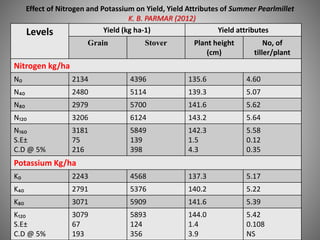
Effect of Nitrogen and Potassium on Yield, Yield Attributes of Summer Pearlmillet
K. B. PARMAR (2012)
Levels Yield (kg ha-1) Yield attributes
Grain Stover Plant height
(cm)
No, of
tiller/plant
Nitrogen kg/ha
N₀ 2134 4396 135.6 4.60
N₄₀ 2480 5114 139.3 5.07
N₈₀ 2979 5700 141.6 5.62
N₁₂₀ 3206 6124 143.2 5.64
N₁₆₀
S.E±
C.D @ 5%
3181
75
216
5849
139
398
142.3
1.5
4.3
5.58
0.12
0.35
Potassium Kg/ha
K₀ 2243 4568 137.3 5.17
K₄₀ 2791 5376 140.2 5.22
K₈₀ 3071 5909 141.6 5.39
K₁₂₀
S.E±
C.D @ 5%
3079
67
193
5893
124
356
144.0
1.4
3.9
5.42
0.108
NS
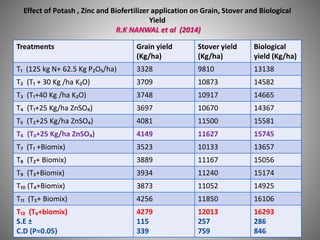
Effect of Potash , Zinc and Biofertilizer application on Grain, Stover and Biological
Yield
R.K NANWAL et al (2014)
Treatments Grain yield
(Kg/ha)
Stover yield
(Kg/ha)
Biological
yield (Kg/ha)
T₁ (125 kg N+ 62.5 Kg P₂O₅/ha) 3328 9810 13138
T₂ (T₁ + 30 Kg /ha K₂O) 3709 10873 14582
T₃ (T₁+40 Kg /ha K₂O) 3748 10917 14665
T₄ (T₁+25 Kg/ha ZnSO₄) 3697 10670 14367
T₅ (T₂+25 Kg/ha ZnSO₄) 4081 11500 15581
T₆ (T₃+25 Kg/ha ZnSO₄) 4149 11627 15745
T₇ (T₁ +Biomix) 3523 10133 13657
T₈ (T₂+ Biomix) 3889 11167 15056
T₉ (T₃+Biomix) 3934 11240 15174
T₁₀ (T₄+Biomix) 3873 11052 14925
T₁₁ (T₅+ Biomix) 4256 11850 16106
T₁₂ (T₆+biomix)
S.E ±
C.D (P=0.05)
4279
115
339
12013
257
759
16293
286
846
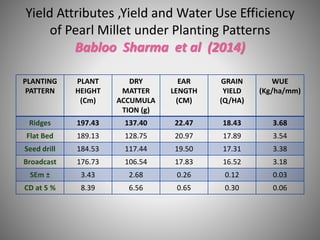
Yield Attributes ,Yield and Water Use Efficiency
of Pearl Millet under Planting Patterns
Babloo Sharma et al (2014)
PLANTING
PATTERN
PLANT
HEIGHT
(Cm)
DRY
MATTER
ACCUMULA
TION (g)
EAR
LENGTH
(CM)
GRAIN
YIELD
(Q/HA)
WUE
(Kg/ha/mm)
Ridges 197.43 137.40 22.47 18.43 3.68
Flat Bed 189.13 128.75 20.97 17.89 3.54
Seed drill 184.53 117.44 19.50 17.31 3.38
Broadcast 176.73 106.54 17.83 16.52 3.18
SEm ± 3.43 2.68 0.26 0.12 0.03
CD at 5 % 8.39 6.56 0.65 0.30 0.06
Pearl millet

Pearl millet

  • 1.
    PROFESSOR JAYASHANKAR TELANANA STATEAGRICULTURE UNIVERSITY, COLLEGE OF AGRICULTURE , RAJENDRA NAGAR MANAGEMENT PRACTICES TO INCREASE AND STABILIZE PEARL MILLET PRODUCTION IN INDIA BY SHAIKH WASIM CHAND RAM/15-13
  • 2.
    Pearl Millet • BotanicalName : Pennisetum glaucum • Family : Gramineae • Origin : Western Africa • Distribution : Pearl millet is cultivated mostly in Africa (about 14 million ha) and Asia (about 12 million ha).
  • 3.
    Pearl millet Areain India • India is the largest producer of pearl millet. • Area (9–10 million ha) • Production (8-9 million t) • Average productivity of 780 kg/ha. • It is grown as irrigated crop during the summer season in GJ, MH, AP, KN and TN. • Summer pearl millet is popular in Gujarat with very high yield exceeding 4–5 t/ha with excellent grain quality.
  • 4.
    • As comparedto the early 1980s, Pearl millet area in India declined by 26% during 2000–04, but production increased by 19% owing to 44% increase in productivity.
  • 5.
    Soil and Climate •It yields best on fertile, well-drained loamy soils. • Pearl millet not grow well in waterlogged conditions. • It is grown on soils of poor fertility with low organic matter content, but it yields low. • Pearl millet can grow even under unfavorable conditions of drought stress and high temperatures. • Pearl millet is a warm-weather crop and grows best at 30–34°C air temperature. • Germination = 23 to 32°C. • The optimum rainfall requirement 600 and 800 mm. • But, pearl millet can be grown in areas which receive even less than 350 mm of seasonal rainfall.
  • 6.
    Management Practices Field Preparation: • Timely sowing, which ensures higher yield. • Provide favorable conditions for sowing, allowing germination, emergence and good plant development. • Maintenance of fertility and productivity. • Summer plowing. • Good seedbed preparation and is essential for the successful establishment of the crop.
  • 7.
    Nutrient Management • Thelow yields in pearl millet due to the crop being grown under poor soils, low nutrient content, erratic rainfall conditions etc. • Grain yield of pearl millet and nutrient requirement Grain yield (qt ha-1) Nutrient required (kg ha-1) N P K 10 qt 27 10 33 20 qt 53 19 65 25 qt 67 24 82 30 qt 80 28 98
  • 8.
    • Nitrogen nutrition: • Nitrogen plays an important role for good growth. • Nitrogen availability to plants is reflected in dark green color of stems and leaves, and vigorous growth and development of pearl millet. • Application of nitrogen is essential for acceptable yields. About 60–80 kg/ha is the optimum dose.
  • 9.
    • Phosphorus nutrition: • To provide energy for the growth and development of pearl millet plants. • Without phosphorus plants cannot grow even when nitrogen supply is plenty. • It takes phosphorus from seedling stage to grain- filling stage. • SSP is good source of phosphorus requirement for Pearlmillet.
  • 10.
    • Potassium nutrition: • Provides resistance to insect pests, diseases and water stress. • Improves the quality of the crop produce. • If a soil contains less than 150 kg ha-1 of available potassium, recommended dose of potassium application results higher yield in pearl millets.
  • 11.
    • Micronutrients : •Pearl millet response well to micro nutrients. • The results indicates grain yield increases with application micronutrient. • Irrigated pearl millet responds well to Zinc up to 25 kg Zn So₄ /ha. • Shekhawat et al reported that application of micronutrient increased grain yield of pearl millet over NPK. • The percentage of increase in grain yield due to application of micronutrients over NPK alone are , • Mn - 5.47 % • Zn – 16.48 % • B – 4.55 % • Mo – 7.70 % • Fe – 19.35 %
  • 12.
    Other nutrients • Secondarynutrients and Micronutrients plays an important role to increase the pearl millet production. • Application of organic manures like well-decomposed FYM and Compost, Green Manuring and Green-Leaf Manuring practices provide nutrients. • These nutrients are equally essential for pearl millet plants for proper growth , development and disease resistance. • Experimental evidence indicate the applying 10-15 t /ha of bulky organic manure improving yield of pearl millet as well as improving soil productivity.
  • 13.
    Cropping Systems • Commonlypracticed cropping systems are: • Crop rotation practices : • It maintains soil fertility. • Check soil erosion. • Reduce the buildup of pest. • Mitigate risk of weather changes. • Increase net profits.
  • 14.
    • Intercropping Practices: • Intercropping refers to growing more than one crop in the same land area in rows of definite proportion and pattern. • Produce higher yields per unit area through better use of natural resources. • Offer greater stability in production under adverse weather conditions , disease and insect infestation. • Meet the domestic needs of the farmer.
  • 15.
    • Mixed CroppingPractices : • Mixed cropping refers to simultaneously growing more than one crop in the same land without any definite pattern. • Mixed cropping of pearl millet-pigeon pea or cluster bean is most common.
  • 16.
    Seeds and Sowing •Seeds and Seed Preparation : • To prevent seed borne diseases as well as pests. • Seed hardening practice for better germination. • Soaking seeds in 1% calcium chloride or in plain water for 6 hours before sowing results in increased yield under drought conditions. • Soak seeds in 10% salt solution reduce the incidence of Ergot disease.
  • 17.
    • Pearl milletcultivars : • Pearl millet hybrids offer several advantages over OPVs besides 25–30% higher grain yields. • high-yielding, popular hybrids and varieties are , • HHB 67 Improved • GHB 538 • GHB 558 • ICMH 356 • GK 1004 AP HYBRID VARIETIES • PAC 903 • AIMP 92901, ASP-1, ICTP 8203, Ananth
  • 18.
    System of Sowing •Flat Bed • Ridge & Furrow • Broad-Bed & Furrow
  • 19.
    • Seed rate: • In general 6-8 kg/ha and in black soil 3 Kg/ha under high water retentive capacity • Spacing: 30x10 cm or 60 X 10 cm • Sowing time : • Kharif : June-July • Rabi : September-October • Summer : January-February (as an irrigated crop in TN ,KN,PB,GJ, AP)
  • 20.
    Transplanting of PearlMillet • Pearl millet is also transplanted in some parts of Tamil Nadu, Andhra Pradesh, Karnataka and Gujarat. • This practice is common under irrigated conditions. • A nursery of 300 m² is sufficient to supply seedlings to plant one ha main field. • It saves 3-4 weeks if crop is responsive to transplanting. • Transplanted pearl millet gives much yield as that of direct seeded crop. • Healthy seedlings (15 to 20 days old) are transplanted in the water-soaked fields.
  • 21.
    • Under southIndian conditions, summer irrigated pearl millet is usually grown by transplantation. • Sow the seedlings on ridges and furrows with a spacing of 45 x 20 cm . • A plant population of 1,75,000 /ha is optimum for hybrids. • Earthing up is done around 40 DAP. • The grain yield around 4 t/ha under good management practices.
  • 22.
    Weed management • Yieldlosses of more than 70% due to weeds have been reported from weed control experiments. • It is necessary to keep the crop weed-free during the first 30 days after sowing. • Cultural practices : • Adopting proper crop rotation practices reducing the weed competition in pearl millet crop. • Intercropping also helps in smothering the weeds with good crop cover over the land surface. • Mulching the soil surface helps to to suppress the weeds and also helps in conserving the soil moisture.
  • 23.
    • Chemical control: • Pre-emergence application : • It applied after sowing but before emergence of seedling. - Atrazine (0.5-1.0) - Pendimethalin (1.0-1.5) - Tebutryn (1.0-2.0) for light soils - Norea (1.0-2.0) for heavy soils • Post-emergence application : • In case of severe infestation. • Low rates of 2,4-D (0.5-1.0 kg/ha) may be applied when the plants are about 10 to 30 cm tall.
  • 24.
    Water Management • Pearlmillet is mainly rainfed crop. • Only about 8% of pearl millet area is irrigated in India. Moisture conservation : • Soil and water conservation practices significance to increase pearl millet production. • Antitranspirants and reflectants may minimize the water loss due to transpiration. • Deep ploughing increases rain water into soil. • Mulches are effective in reducing evaporation losses
  • 25.
    Scheduling Irrigation : •Summer irrigated Pearl millet require six irrigation for high yields at given stages, • Transplanting • 1 week after transplanting • 3 week after transplanting • Panicle initiation • Flowering • Grain development
  • 26.
  • 27.
    Effect of Methodof Sowing and Weed Control Measures on Yield Attributes and Yield of Pearl millet Singh et al (2010) Ear wt (g) Grain wt/ear (g) Grain yield (q/ha) Stover yield (q/ha) 2002 2003 2002 2003 2002 2003 2002 2003 Method of Sowing Braodcast sowing 27.30 27.70 17.41 17.30 8.77 7.90 27.75 30.13 Line sowing at 45 cm 33.97 32.37 22.08 21.97 11.96 10.98 39.38 41.98 Closer line sowing at 30 cm 32.63 31.04 20.75 20.64 11.06 9.53 32.78 38.33 C.D at 5 % 2.31 1.14 1.95 1.01 1.69 1.59 6.46 3.82 Atrazine @ 0.5 a.i /ha pre emergence 32.83 29.84 19.00 20.00 10.79 9.50 33.66 36.63 Atrazine @ 0.5 a.i /ha pre emergence + one hand weeding 34.50 32.67 23.30 22.67 12.81 11.27 36.32 44.14 2,4 D Na salt @0.75 kg a.i /ha as PoE 29.84 30.17 19.77 18.34 10.71 9.17 33.18 35.09 One hand weeding 33.33 31.17 22.67 21.34 11.39 10.85 39.66 42.49
  • 28.
    Effect of differenttreatments on yield of Pearl millet (mean of 3 years) V.D Vora et al (2010) Sr. no Treatments Yield (Kg/ha) Net realization (Rs/ha) B:C ratio Grain Fodder T1 Absolute control 587 2572 816 1.11 T2 NP fertilization (80:40 Kg/ha) 1647 6255 12617 2.38 T3 NP fertilization + 40 Kg K₂O/ha 1778 7057 14495 2.54 T4 NP fertilization +250 Kg gypsum/ha 1920 7891 16709 2.75 T5 50% RDF+ Compost 5 t/ha 1414 5165 7141 1.64 T6 50% RDF+ Castor cake 500 Kg/ha 1287 6029 8585 1.85 T7 50% RDF+ Bio-fertilizer 1451 5854 11182 2.32 T8 50% RDF+40 Kg K₂O/ha + BF 1233 5154 8189 1.93 T9 50% RDF+250 Kg Gypsum/ha +BF 1230 5689 9007 2.03 T10 50% RDF+ Castor cake 500Kg/ha+ BF 1544 6080 10448 2.02 T11 50% RDF+ Compost 5t/ha + BF 1298 5391 6470 1.57 T12 Compost 5 t/ha + Castor cake 500Kg/ha+ BF+ Top dressing of 50% N only 1121 4455 2527 1.2
  • 29.
    Effect of sowingdates and sowing methods on growth and yield of pearl millet Amanullah Jan et al (2015) Treatments Leaves /plant Plant height (cm) Panicle length (cm) Panicle weight (g) Grains/ panicle 1000 grain wt (g) Grain yield (kg/ha) Sowing Dts 20th june 93 229.5 26.3 14.7 73.4 12.3 398 10th july 80 208.7 25.3 13.8 71.7 10.9 325 30th july 41 169 20.2 11.1 39.4 9.8 195 LSD (0.05) 7 12.5 0.9 0.9 3.1 1.0 39.2 Sowing Mtd. Direct sowing 62 196.9 24.1 13.1 59.5 9.8 250 Transplanting 81 208.2 23.8 13 64.4 11.2 297 LSD(0.05) 5 10.2 ns ns 2.6 0.98 35.4
  • 30.
    Effect of Nitrogenand Potassium on Yield, Yield Attributes of Summer Pearlmillet K. B. PARMAR (2012) Levels Yield (kg ha-1) Yield attributes Grain Stover Plant height (cm) No, of tiller/plant Nitrogen kg/ha N₀ 2134 4396 135.6 4.60 N₄₀ 2480 5114 139.3 5.07 N₈₀ 2979 5700 141.6 5.62 N₁₂₀ 3206 6124 143.2 5.64 N₁₆₀ S.E± C.D @ 5% 3181 75 216 5849 139 398 142.3 1.5 4.3 5.58 0.12 0.35 Potassium Kg/ha K₀ 2243 4568 137.3 5.17 K₄₀ 2791 5376 140.2 5.22 K₈₀ 3071 5909 141.6 5.39 K₁₂₀ S.E± C.D @ 5% 3079 67 193 5893 124 356 144.0 1.4 3.9 5.42 0.108 NS
  • 31.
    Effect of Potash, Zinc and Biofertilizer application on Grain, Stover and Biological Yield R.K NANWAL et al (2014) Treatments Grain yield (Kg/ha) Stover yield (Kg/ha) Biological yield (Kg/ha) T₁ (125 kg N+ 62.5 Kg P₂O₅/ha) 3328 9810 13138 T₂ (T₁ + 30 Kg /ha K₂O) 3709 10873 14582 T₃ (T₁+40 Kg /ha K₂O) 3748 10917 14665 T₄ (T₁+25 Kg/ha ZnSO₄) 3697 10670 14367 T₅ (T₂+25 Kg/ha ZnSO₄) 4081 11500 15581 T₆ (T₃+25 Kg/ha ZnSO₄) 4149 11627 15745 T₇ (T₁ +Biomix) 3523 10133 13657 T₈ (T₂+ Biomix) 3889 11167 15056 T₉ (T₃+Biomix) 3934 11240 15174 T₁₀ (T₄+Biomix) 3873 11052 14925 T₁₁ (T₅+ Biomix) 4256 11850 16106 T₁₂ (T₆+biomix) S.E ± C.D (P=0.05) 4279 115 339 12013 257 759 16293 286 846
  • 32.
    Yield Attributes ,Yieldand Water Use Efficiency of Pearl Millet under Planting Patterns Babloo Sharma et al (2014) PLANTING PATTERN PLANT HEIGHT (Cm) DRY MATTER ACCUMULA TION (g) EAR LENGTH (CM) GRAIN YIELD (Q/HA) WUE (Kg/ha/mm) Ridges 197.43 137.40 22.47 18.43 3.68 Flat Bed 189.13 128.75 20.97 17.89 3.54 Seed drill 184.53 117.44 19.50 17.31 3.38 Broadcast 176.73 106.54 17.83 16.52 3.18 SEm ± 3.43 2.68 0.26 0.12 0.03 CD at 5 % 8.39 6.56 0.65 0.30 0.06