CHICK EMBRYONIC DEVELOPMENT
PRESENTED BY:
AROOBA BAIG
SHUMAILA SHAD
RIDA KHALID
ANAS MALIK
MUHAMMAD TOUSEEF
ANAS SAJAD
Chicken
• Is a domesticated fowl
• As one of the most common and widespread domestic animals
CLLASSIFICATION
• Kingdom: Animalia
• Phylum: Chordata
• Class: Aves
• Order: Galliformes
• Family: Phasianidae
• Subfamily: Phasianinae
• Genus: Gallus
• Species: G. gallus
• Subspecies: G. g. domesticus
CHICK EGG
EGG
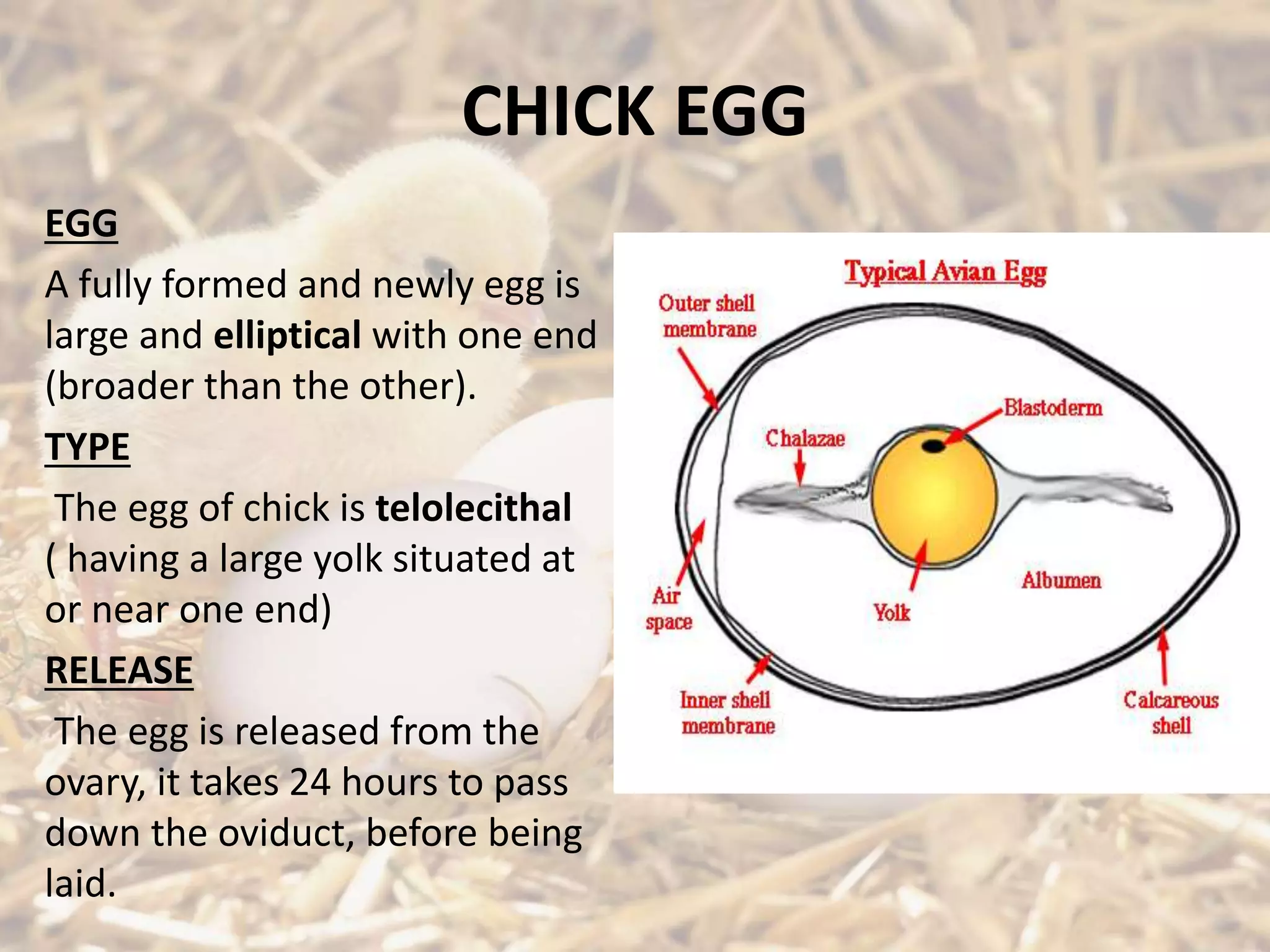
A fully formed and newly egg is
large and elliptical with one end
(broader than the other).
TYPE
The egg of chick is telolecithal
( having a large yolk situated at
or near one end)
RELEASE
The egg is released from the
ovary, it takes 24 hours to pass
down the oviduct, before being
laid.
CHICK EGG
FERTILIZATION
The fertilization is internal, upper part of the oviduct,
resulting two polar bodies degenerate and disappear.
STRUCTURE OF EGGSHAPE
It is oval in shape
SIZE
3cm wide and 5cm long
SHELL
Made up 95% calcium carbonate, white and porous and
exchange of gases occur, soft and flexible in a freshly –laid
egg but soon become hard and brittle.
MEMBRANE
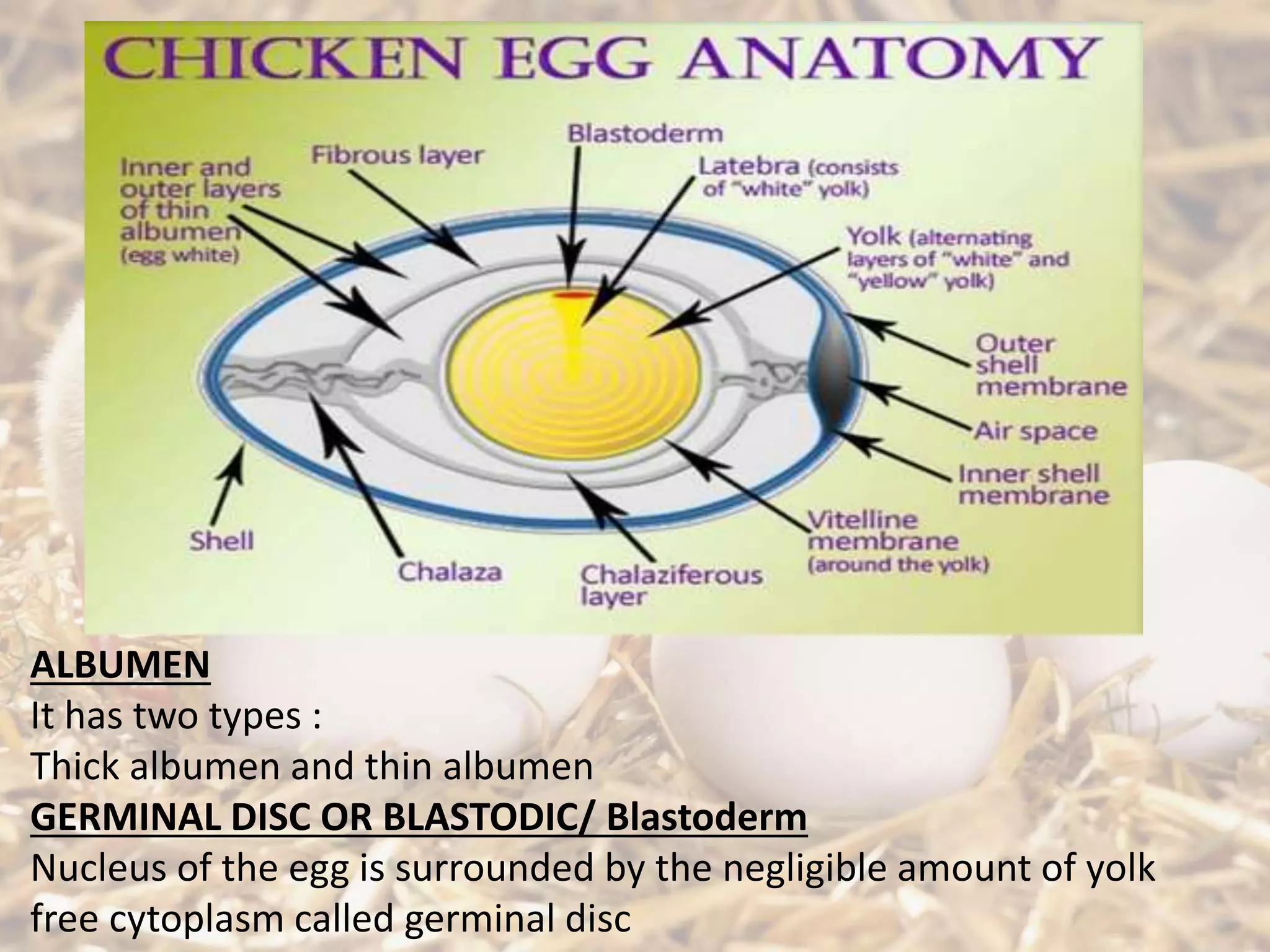
Two types of membrane, shell membrane and vitelline membrane,
separated at the broad end of the egg to enclose an air space
YOLK MEMBRANE
The layer of yellow yolk is thicker than those of the white yolks. Yolk
contains about 50% water.
Yolk consist of phospholipids, lecithin
• Yellow yolk shows 60% fats and 70% proteins.
• White yolk contains less fat and also less of fat soluble carotene.
CHALAZA
Two end of the egg are some fibrous ,rope like twisted structure
formed during journey of the oviduct
LATEBRA
The central flask shaped area that is enclosed of white yolk is called
latebra.
ALBUMEN
It has two types :
Thick albumen and thin albumen
GERMINAL DISC OR BLASTODIC/ Blastoderm
Nucleus of the egg is surrounded by the negligible amount of yolk
free cytoplasm called germinal disc
RIDA KHALID
DEVELOPMENT OF CHICK
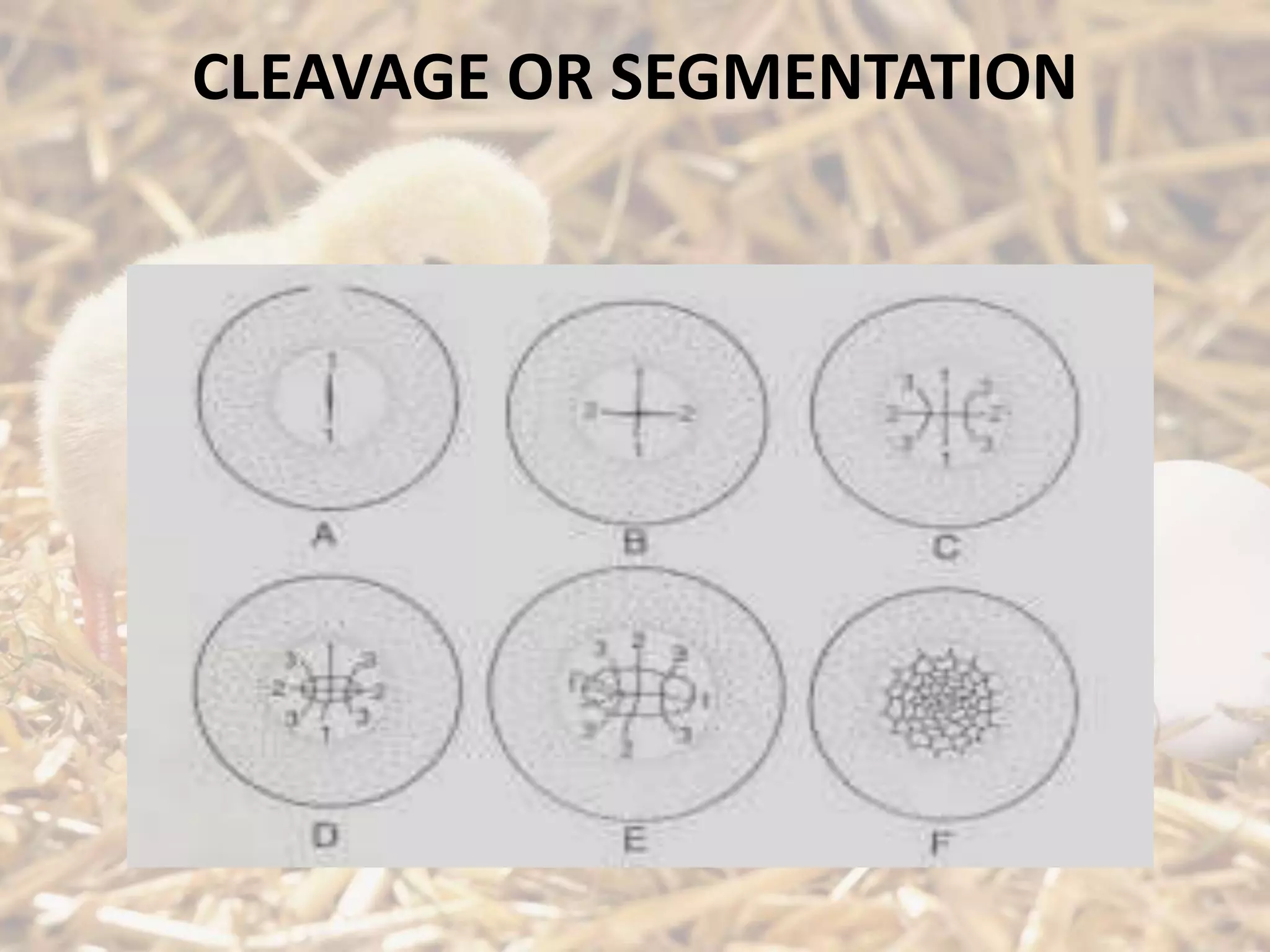
CLEAVAGE OR SEGMENTATION
• It starts with the cleavage. It is meroblastic means
confined to small area of blastodisc. Duration it takes
12-16 hours
• First cleavage forms two cells
• Second cleavage occurs after 20 min of first cleavage
four cells formed
• Third cleavage eight cells formed
• Irregular cleavage occurs in four hours at the end
cleavage 256 irregular cells formed
CLEAVAGE OR SEGMENTATION
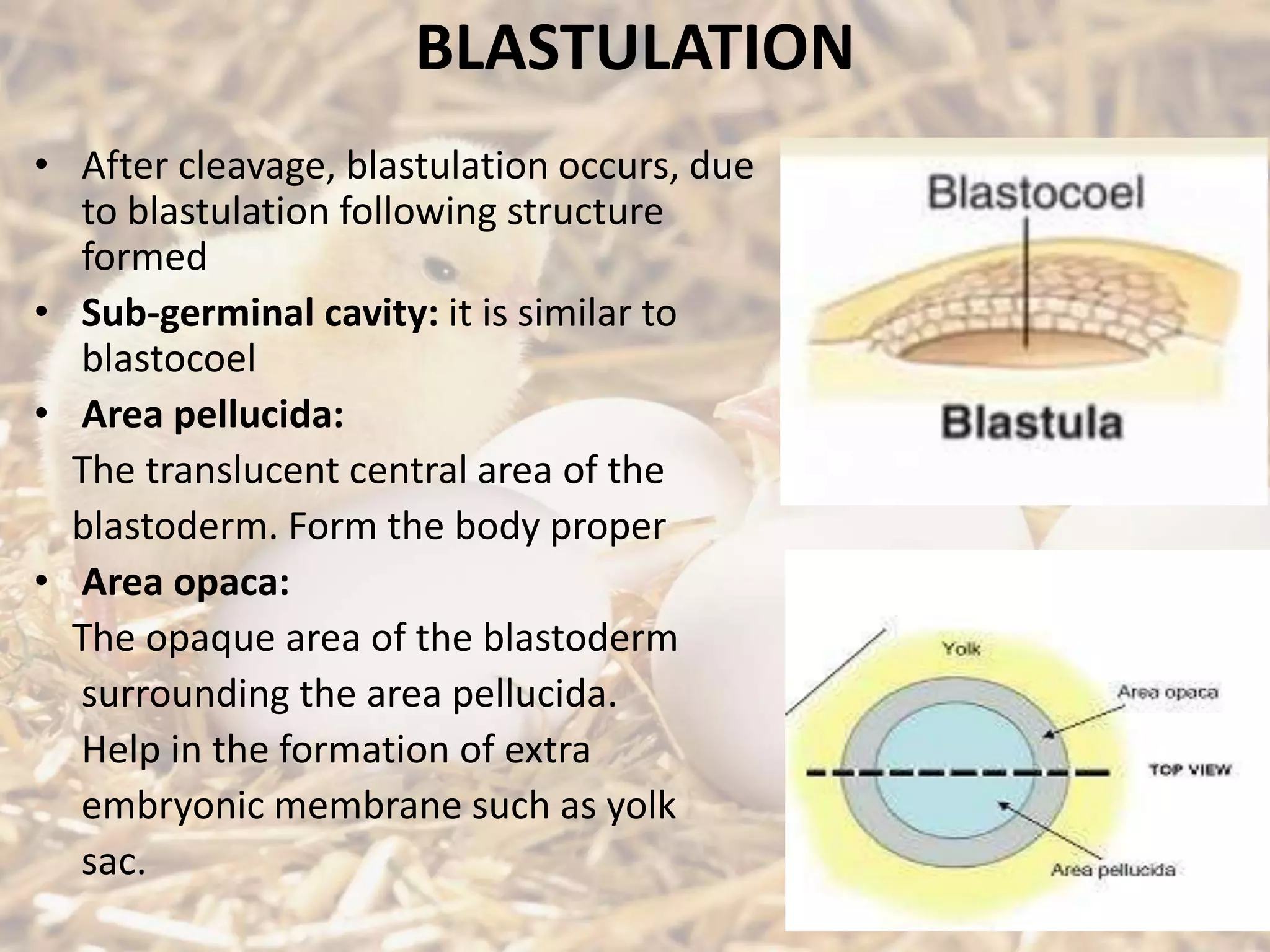
BLASTULATION
• After cleavage, blastulation occurs, due
to blastulation following structure
formed
• Sub-germinal cavity: it is similar to
blastocoel
• Area pellucida:
The translucent central area of the
blastoderm. Form the body proper
• Area opaca:
The opaque area of the blastoderm
surrounding the area pellucida.
Help in the formation of extra
embryonic membrane such as yolk
sac.
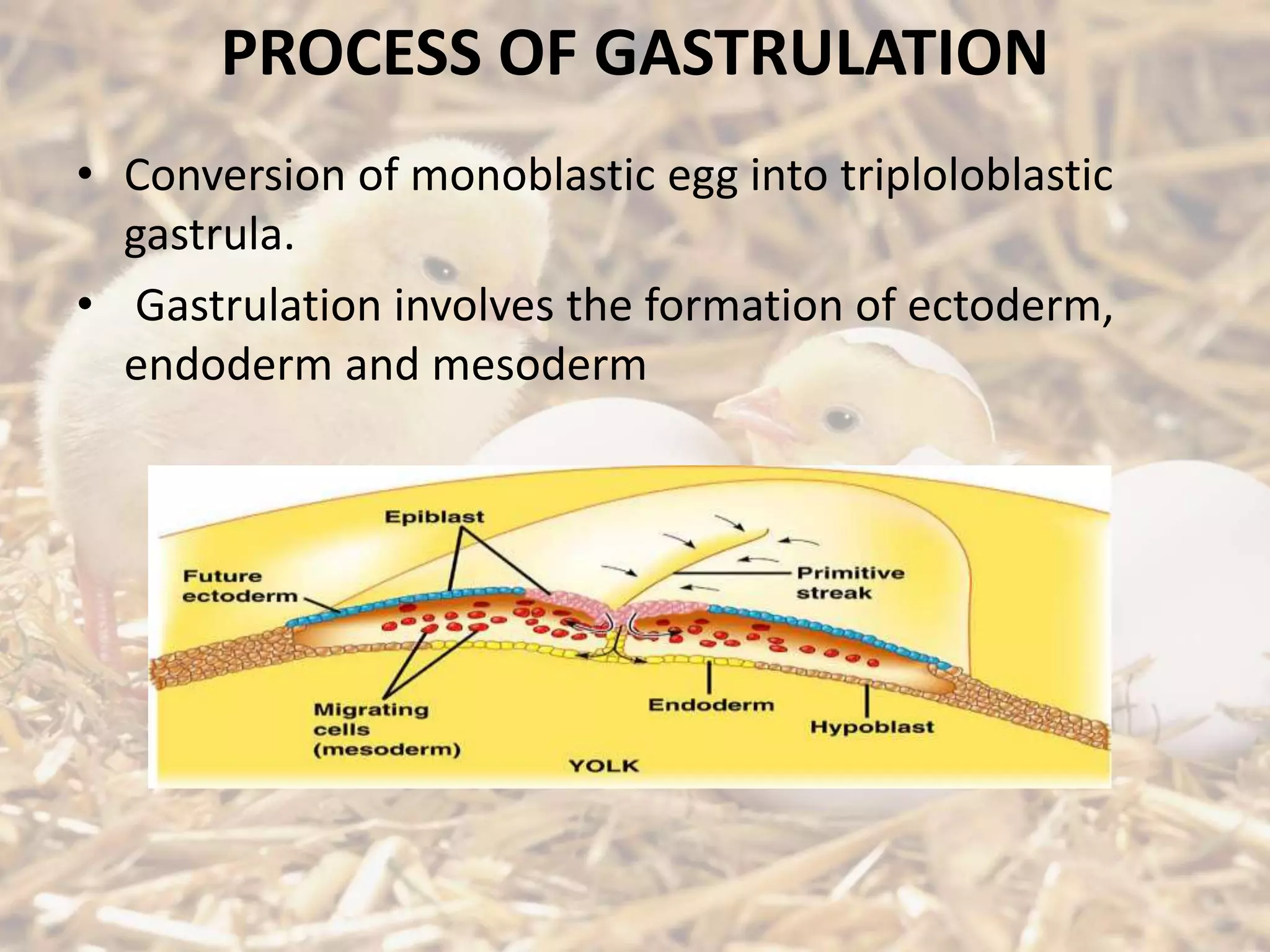
PROCESS OF GASTRULATION
• Conversion of monoblastic egg into triploloblastic
gastrula.
• Gastrulation involves the formation of ectoderm,
endoderm and mesoderm
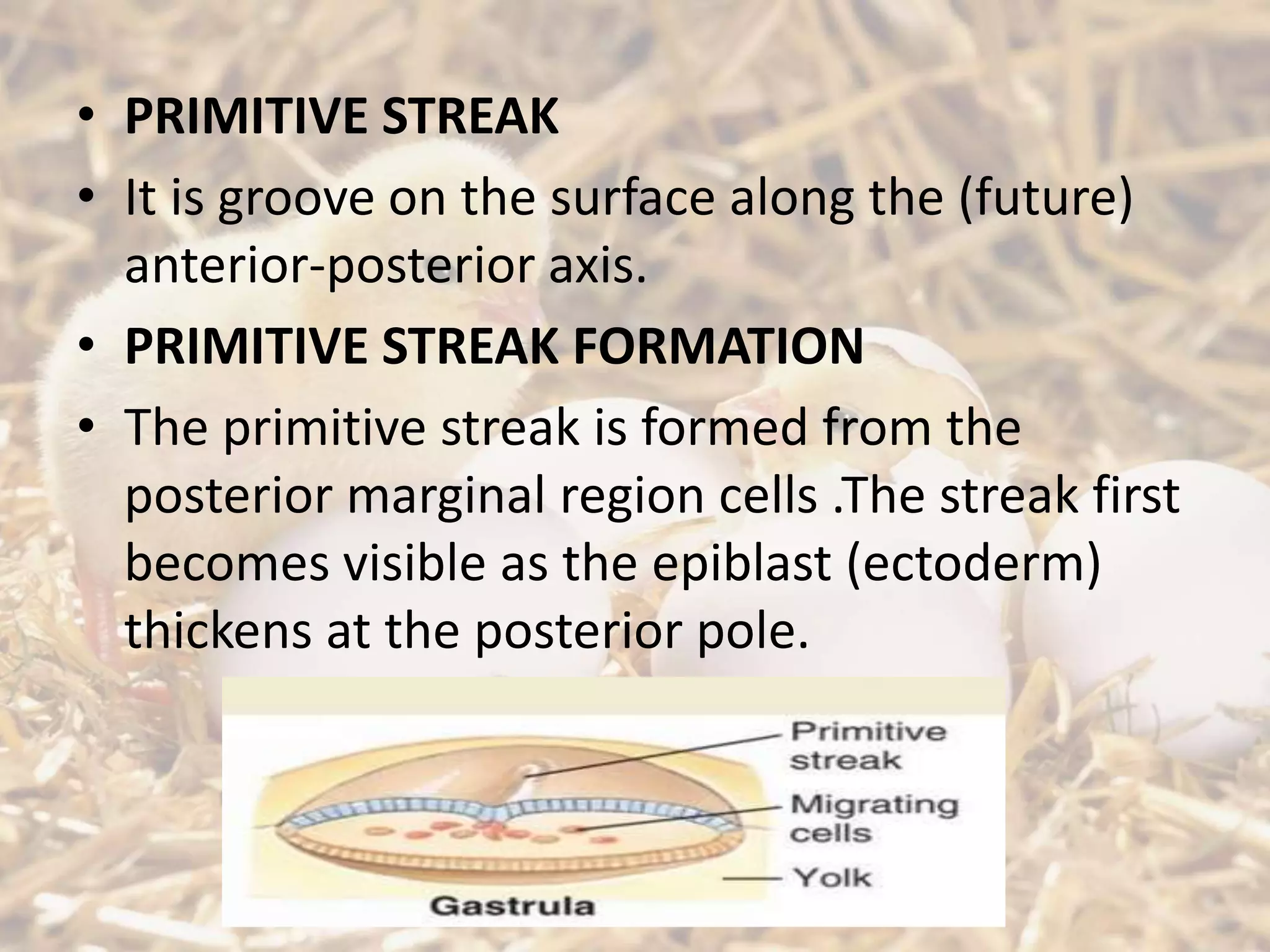
• PRIMITIVE STREAK
• It is groove on the surface along the (future)
anterior-posterior axis.
• PRIMITIVE STREAK FORMATION
• The primitive streak is formed from the
posterior marginal region cells .The streak first
becomes visible as the epiblast (ectoderm)
thickens at the posterior pole.
PRIMITIVE STREAK FORMATION 7-8
HOURS AFTER FERTILIZATION
• The epiblast (ectoderm) is separated from the
hypoblast(endoderm) by the blastocoel. The
epiblast will give rise to the three germ layers
the embryo, while the hypoblast will give rise
to extra embryonic structure.
AROOBA BAIG
PRIMITIVE STREAK EXTENTION 15-16
HOURS AFTER FERTILIZATION
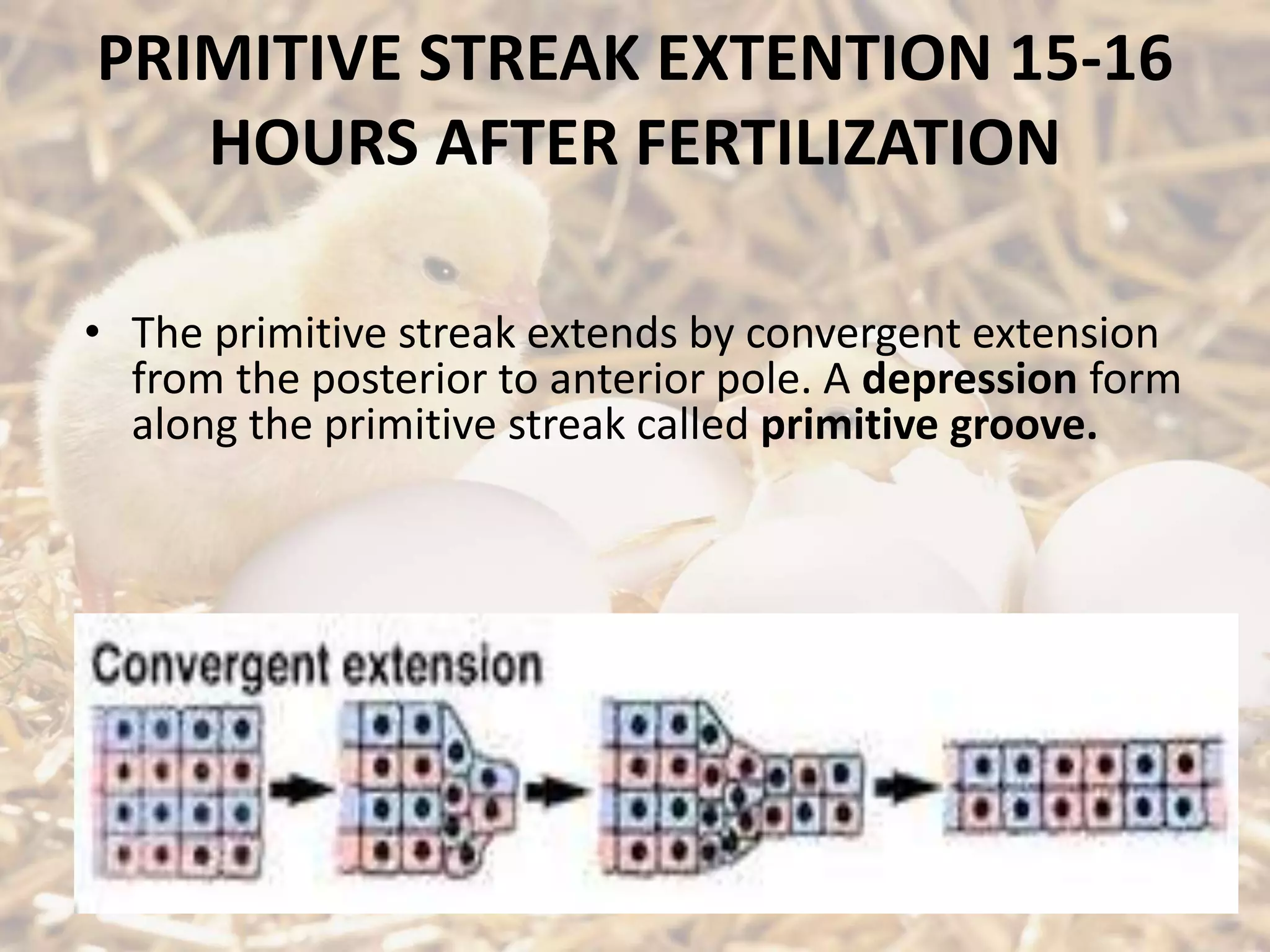
• The primitive streak extends by convergent extension
from the posterior to anterior pole. A depression form
along the primitive streak called primitive groove.
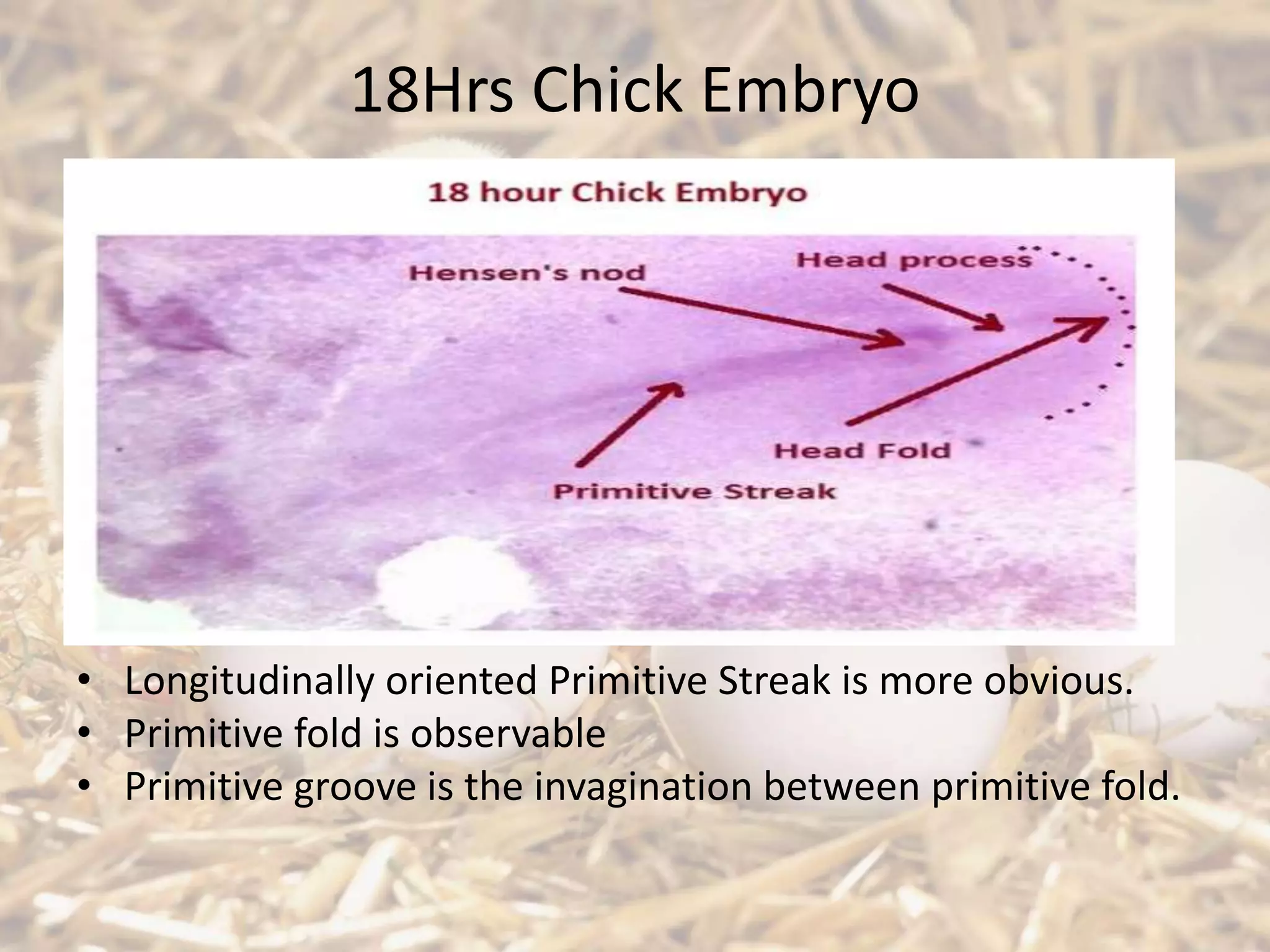
18Hrs Chick Embryo
• Longitudinally oriented Primitive Streak is more obvious.
• Primitive fold is observable
• Primitive groove is the invagination between primitive fold.
FORMATION OF HENSON’S NODE 19-
22 HOURS AFTER FERTILIZATION
• This bird egg view shows the primitive streak and Henson’s
node .At this stage ingression through the primitive streak
of cells destined (fated) to become endoderm and
mesoderm has begun.
• HENSON’S NODE
• It is formed by cells of presumptive notochord and floor of
neural tube and is located posteriorly.
• Carnial end of the primitive streak is thickened and called
Hensen’s Node, which partially surrounds the depression
called Hensen’s pit.
• A distinct curved line, anterior to the hensen’s pit called
Head fold.
• And between the hensen’s node and head fold is head
process.
FORMATION OF NOTOCHORD
(NOTOGENESIS)
• A narrow strip of blastoderm just in front of
primitive knot, consist of presumptive
notochordal cell responsible for the formation
of notochord.
• Notochord is visible carnial to the Hensen’s
node and in between the neural fold.
• Notochord is rod-like supporting structure.
SOMITES
• Somites are present, they are the blocks of the
mesoderm.
• They appear on either side of the notochord.
• They give rise to the no. of structures,
including skeletal muscle, bone and dermis of
skin.
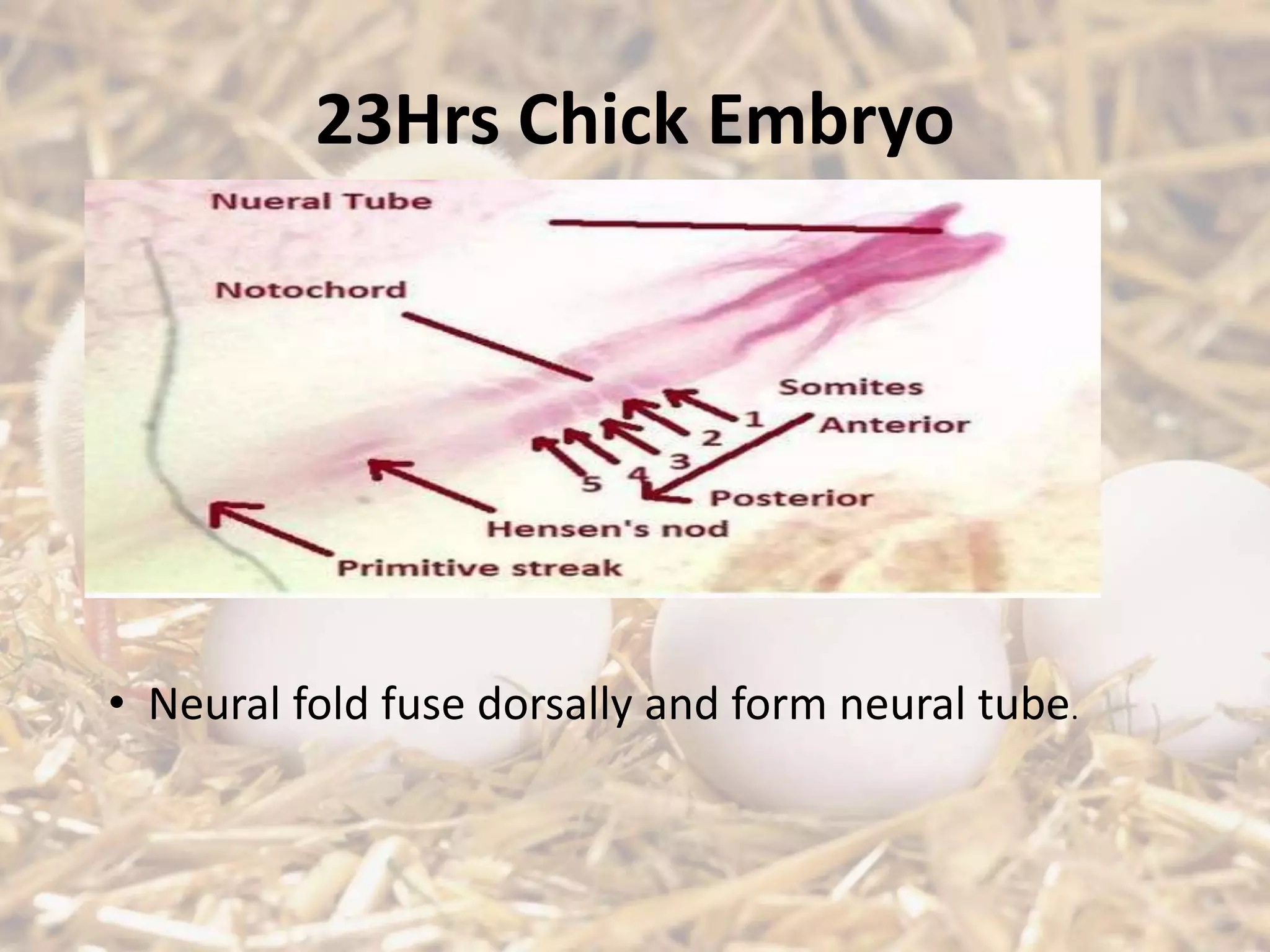
23Hrs Chick Embryo
• Neural fold fuse dorsally and form neural tube.
MUHAMMAD TOUSEEF
FORMATION OF NEURAL TUBE
(NEUROGENESIS)
• In front of the primitive streak lie neural plate
cells. These cells folds roll up and unite mid-
dorsally ,enclosing a neural tube , forming fore
brain , mid and hind brain.
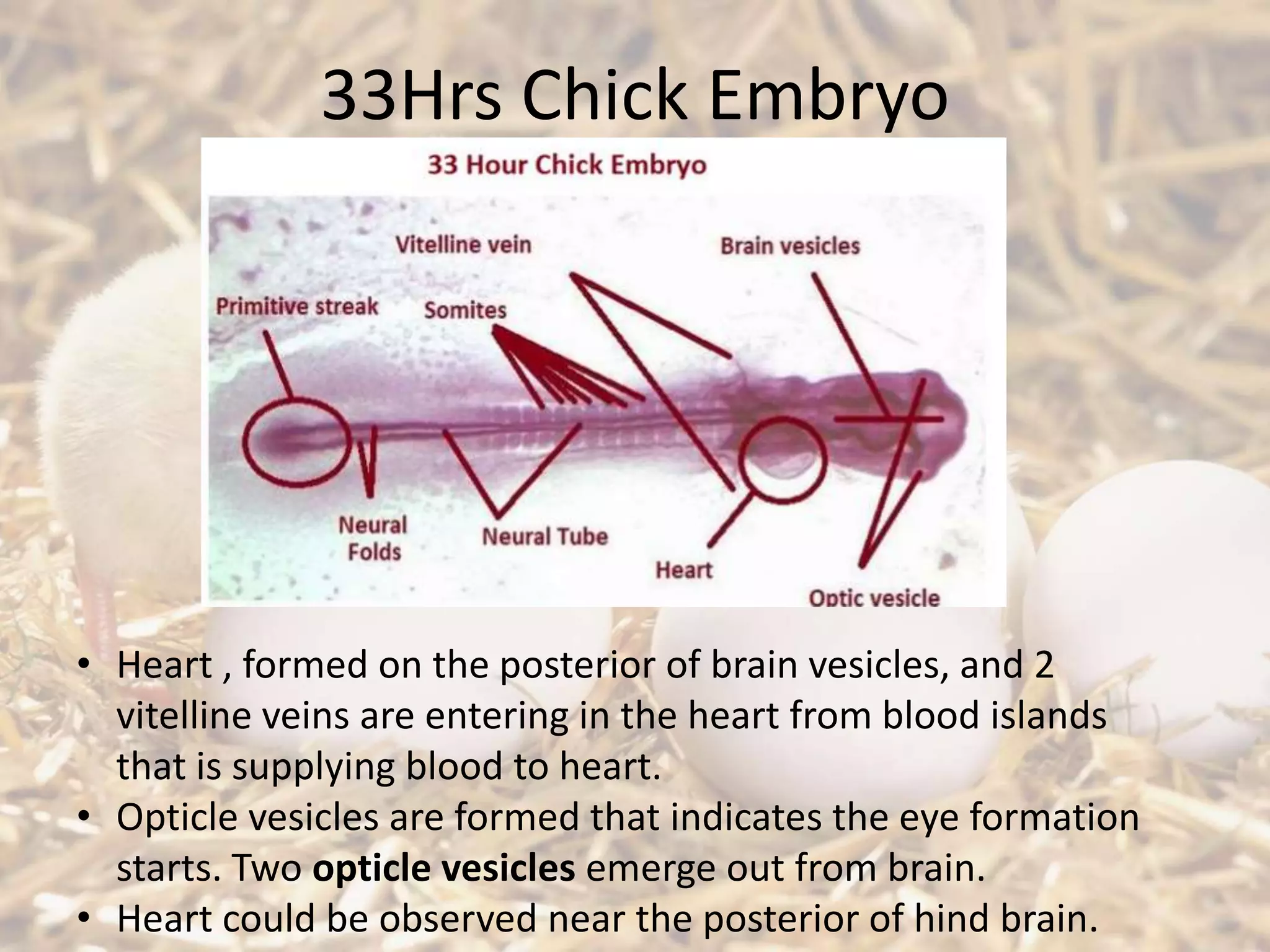
33Hrs Chick Embryo
• Heart , formed on the posterior of brain vesicles, and 2
vitelline veins are entering in the heart from blood islands
that is supplying blood to heart.
• Opticle vesicles are formed that indicates the eye formation
starts. Two opticle vesicles emerge out from brain.
• Heart could be observed near the posterior of hind brain.
Chick Embryo after 40-45 hrs
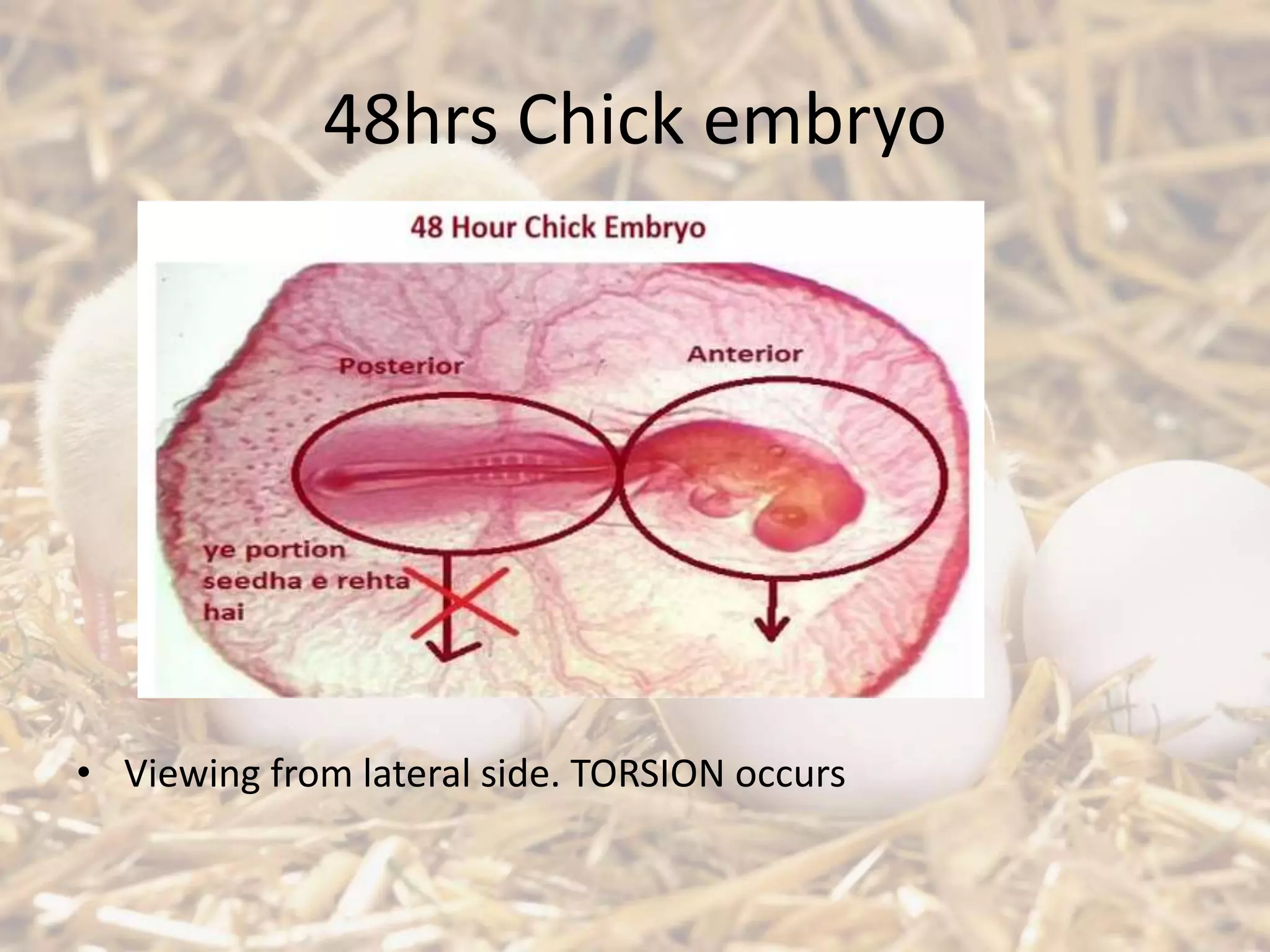
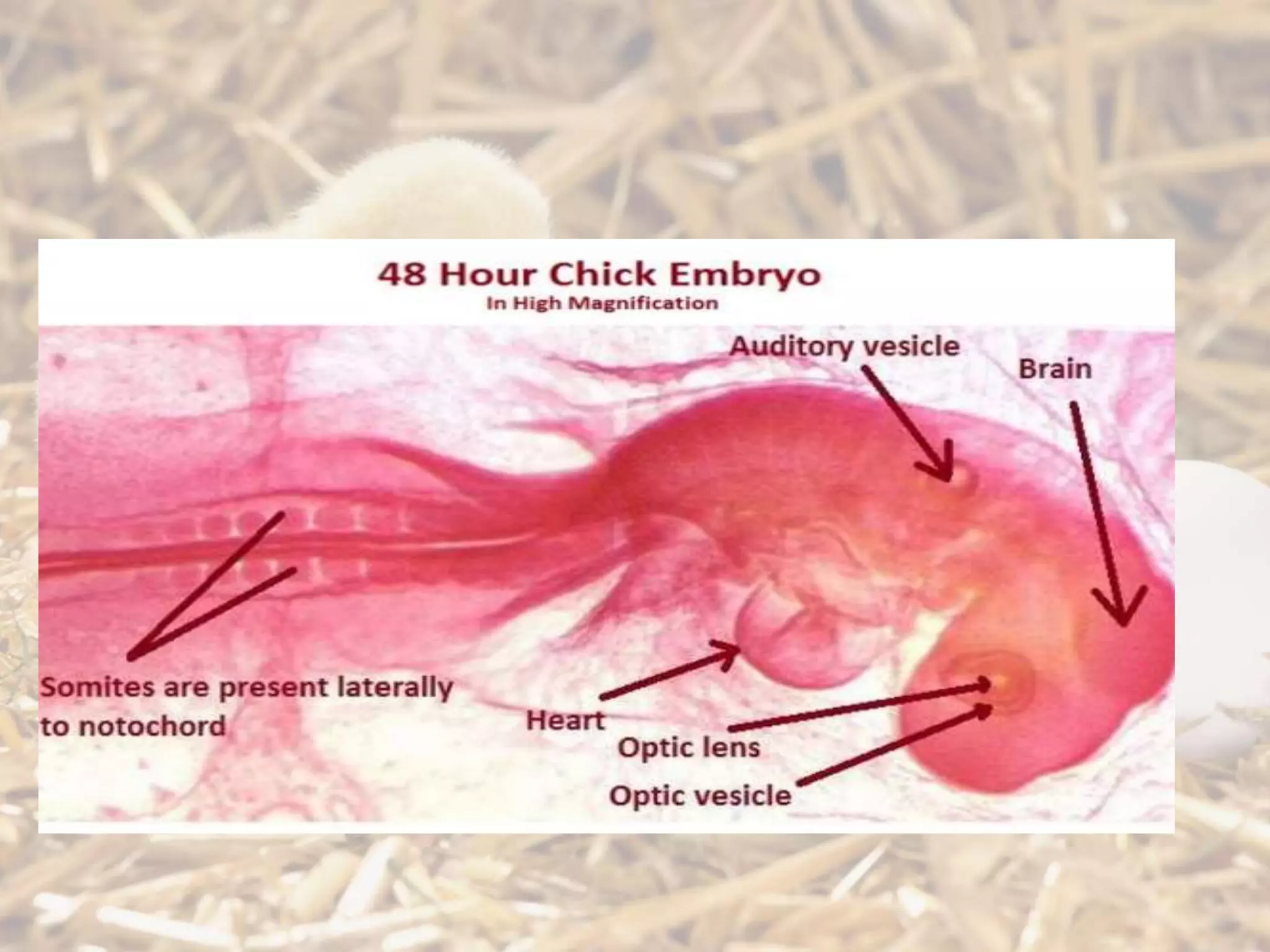
48hrs Chick embryo
• Viewing from lateral side. TORSION occurs
ORGANOGENY
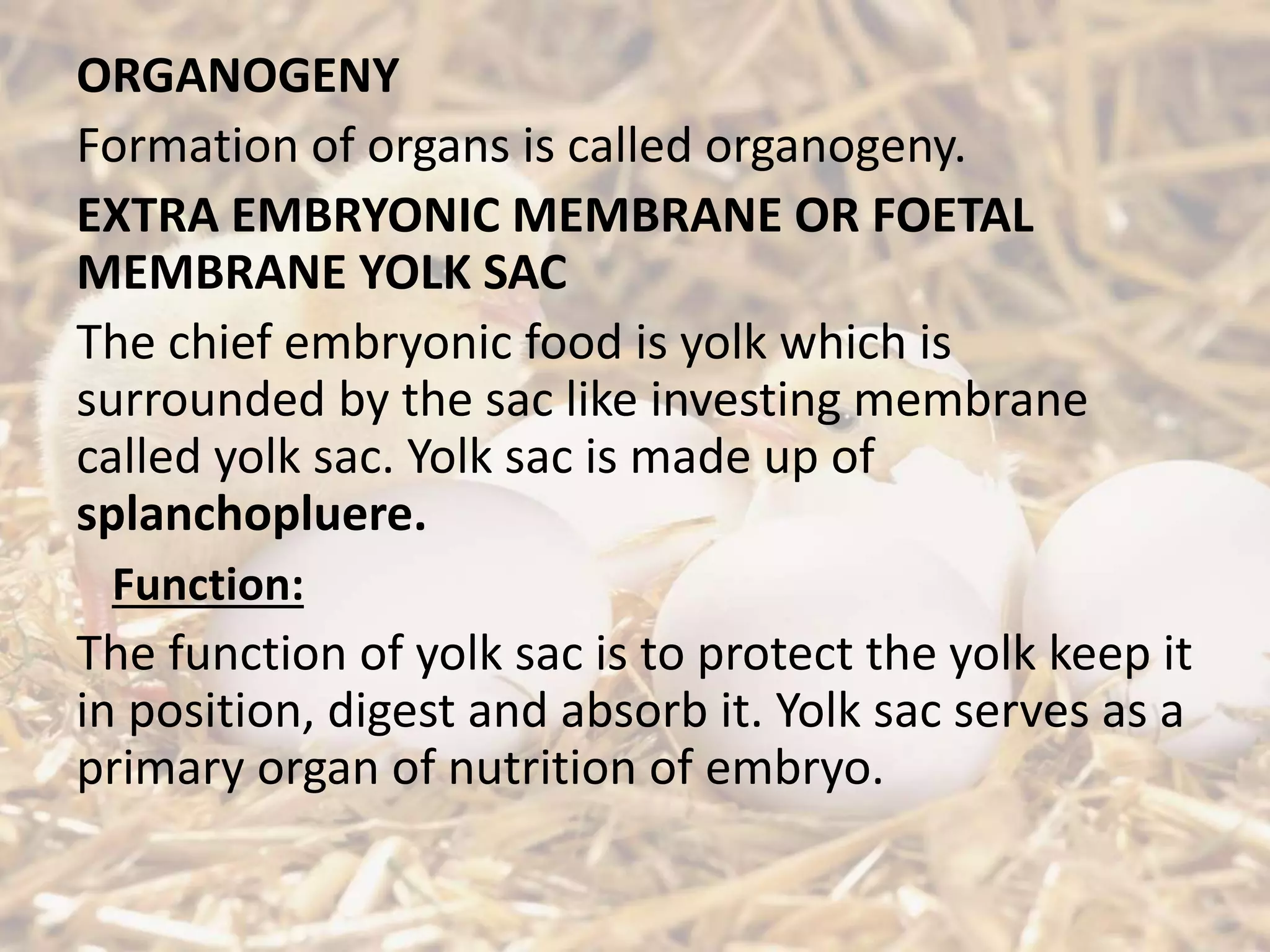
Formation of organs is called organogeny.
EXTRA EMBRYONIC MEMBRANE OR FOETAL
MEMBRANE YOLK SAC
The chief embryonic food is yolk which is
surrounded by the sac like investing membrane
called yolk sac. Yolk sac is made up of
splanchopluere.
Function:
The function of yolk sac is to protect the yolk keep it
in position, digest and absorb it. Yolk sac serves as a
primary organ of nutrition of embryo.
AMNION :
• It is made up of inner ectoderm,
the space between amnion and
embryo is filled with amniotic
cavity having amniotic fluid.
FUNCTION
• It protect the embryo from
mechanical jerks and prevent its
desiccation.
CHORION:
• It is made up of outer ectoderm
,the cavity between amnion and
chorion is called chorionic cavity
FUNCTION
• Chorion also provides the liquid
medium for the embryo.
ALLANTOISE:
• The bladder like structure is called
allantoise.
SHUMAILA SHAD
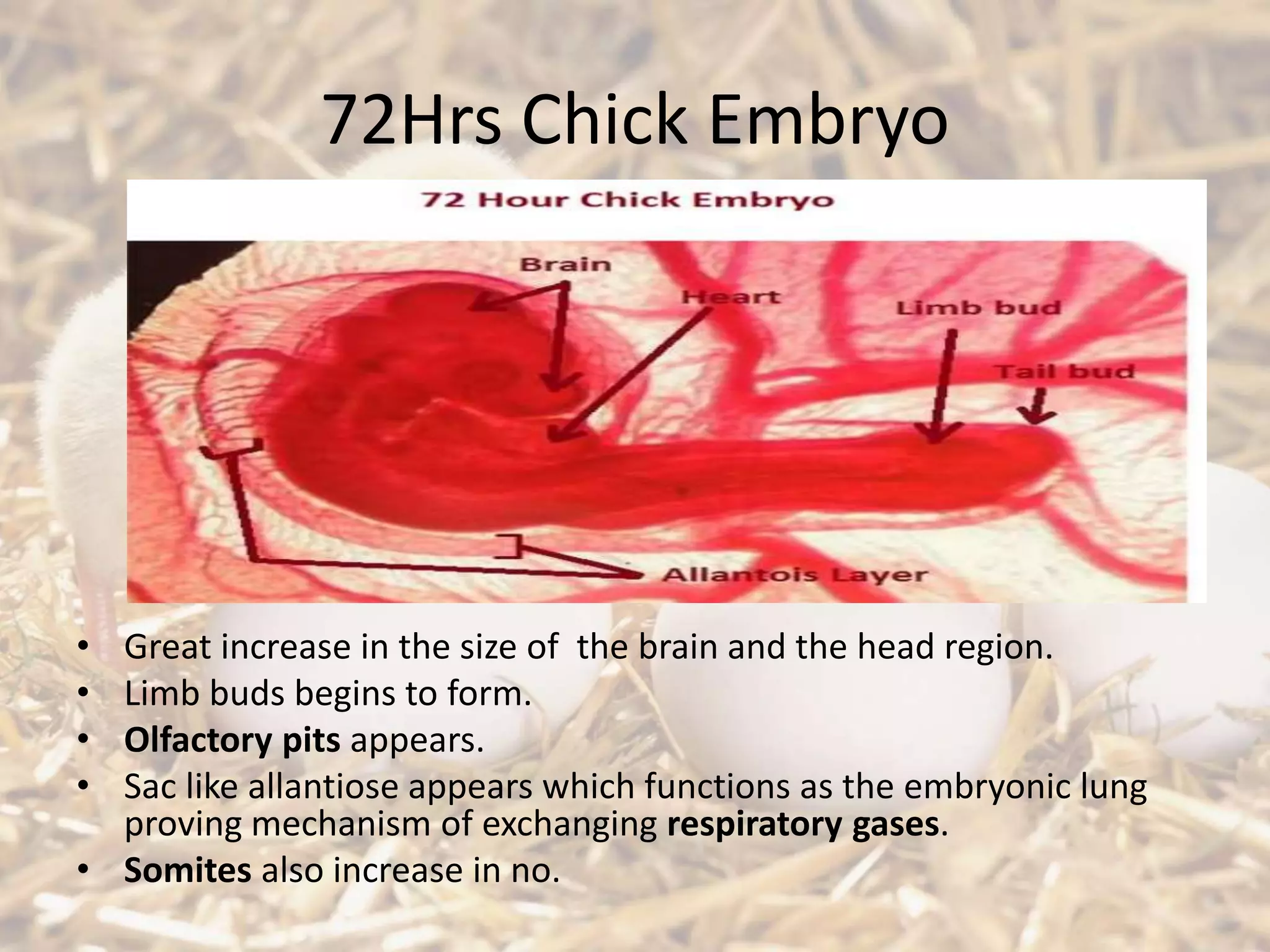
72Hrs Chick Embryo
• Great increase in the size of the brain and the head region.
• Limb buds begins to form.
• Olfactory pits appears.
• Sac like allantiose appears which functions as the embryonic lung
proving mechanism of exchanging respiratory gases.
• Somites also increase in no.
ALLANTO- CHORION:
• The mesodermal layers joined the allantoise with chorion
called allanto-chorion , a compound layer is formed
FUNCTION
• It serves as Respiratory organ , Excretory organ, Nutritional
organ
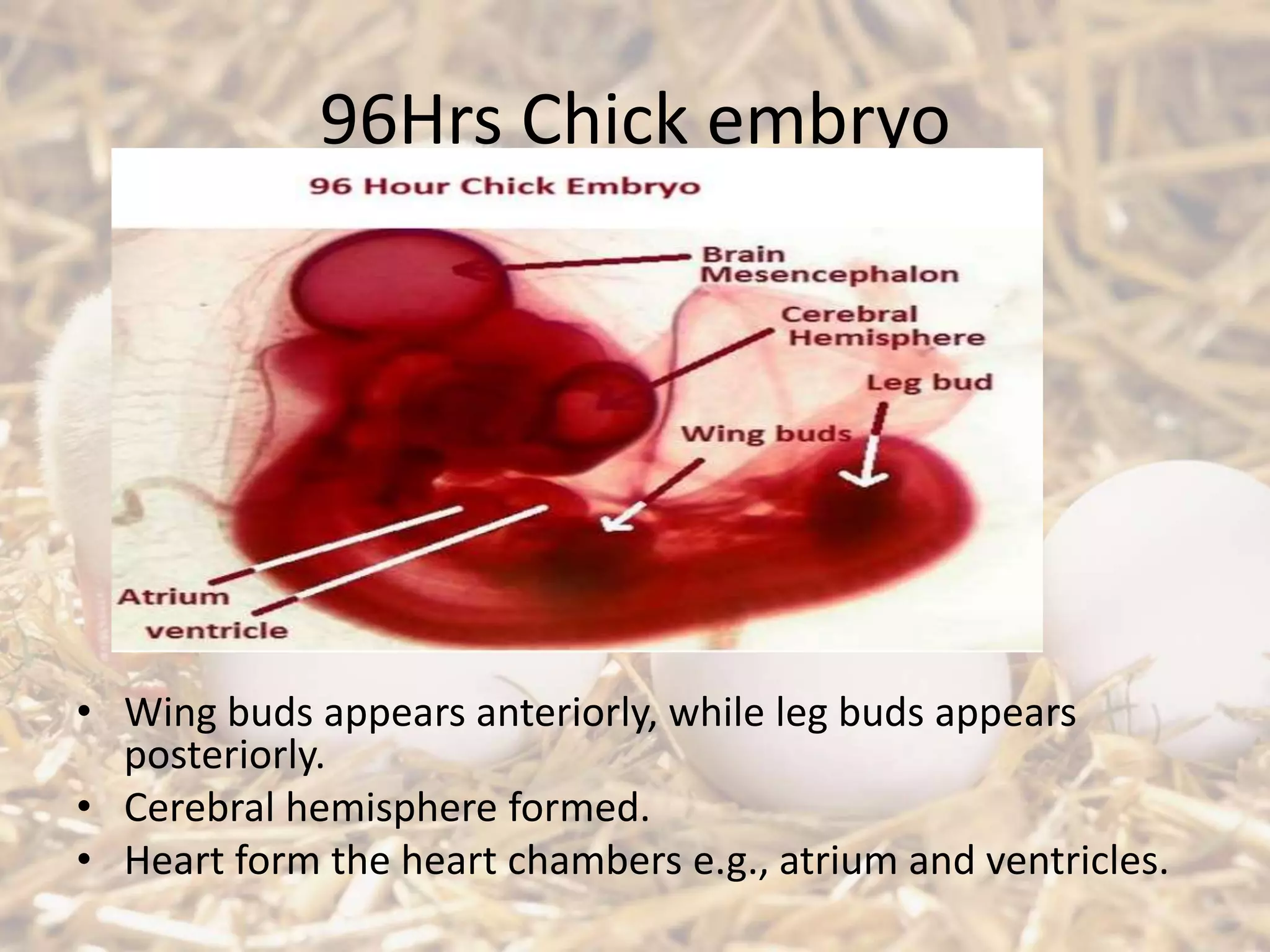
96Hrs Chick embryo
• Wing buds appears anteriorly, while leg buds appears
posteriorly.
• Cerebral hemisphere formed.
• Heart form the heart chambers e.g., atrium and ventricles.
VIDEO
Final chick embryonic-development-ppt

Final chick embryonic-development-ppt

  • 1.
    CHICK EMBRYONIC DEVELOPMENT PRESENTEDBY: AROOBA BAIG SHUMAILA SHAD RIDA KHALID ANAS MALIK MUHAMMAD TOUSEEF
  • 2.
  • 3.
    Chicken • Is adomesticated fowl • As one of the most common and widespread domestic animals CLLASSIFICATION • Kingdom: Animalia • Phylum: Chordata • Class: Aves • Order: Galliformes • Family: Phasianidae • Subfamily: Phasianinae • Genus: Gallus • Species: G. gallus • Subspecies: G. g. domesticus
  • 4.
    CHICK EGG EGG A fullyformed and newly egg is large and elliptical with one end (broader than the other). TYPE The egg of chick is telolecithal ( having a large yolk situated at or near one end) RELEASE The egg is released from the ovary, it takes 24 hours to pass down the oviduct, before being laid.
  • 5.
    CHICK EGG FERTILIZATION The fertilizationis internal, upper part of the oviduct, resulting two polar bodies degenerate and disappear. STRUCTURE OF EGGSHAPE It is oval in shape SIZE 3cm wide and 5cm long SHELL Made up 95% calcium carbonate, white and porous and exchange of gases occur, soft and flexible in a freshly –laid egg but soon become hard and brittle.
  • 6.
    MEMBRANE Two types ofmembrane, shell membrane and vitelline membrane, separated at the broad end of the egg to enclose an air space YOLK MEMBRANE The layer of yellow yolk is thicker than those of the white yolks. Yolk contains about 50% water. Yolk consist of phospholipids, lecithin • Yellow yolk shows 60% fats and 70% proteins. • White yolk contains less fat and also less of fat soluble carotene. CHALAZA Two end of the egg are some fibrous ,rope like twisted structure formed during journey of the oviduct LATEBRA The central flask shaped area that is enclosed of white yolk is called latebra.
  • 7.
    ALBUMEN It has twotypes : Thick albumen and thin albumen GERMINAL DISC OR BLASTODIC/ Blastoderm Nucleus of the egg is surrounded by the negligible amount of yolk free cytoplasm called germinal disc
  • 8.
  • 9.
    DEVELOPMENT OF CHICK CLEAVAGEOR SEGMENTATION • It starts with the cleavage. It is meroblastic means confined to small area of blastodisc. Duration it takes 12-16 hours • First cleavage forms two cells • Second cleavage occurs after 20 min of first cleavage four cells formed • Third cleavage eight cells formed • Irregular cleavage occurs in four hours at the end cleavage 256 irregular cells formed
  • 10.
  • 11.
    BLASTULATION • After cleavage,blastulation occurs, due to blastulation following structure formed • Sub-germinal cavity: it is similar to blastocoel • Area pellucida: The translucent central area of the blastoderm. Form the body proper • Area opaca: The opaque area of the blastoderm surrounding the area pellucida. Help in the formation of extra embryonic membrane such as yolk sac.
  • 12.
    PROCESS OF GASTRULATION •Conversion of monoblastic egg into triploloblastic gastrula. • Gastrulation involves the formation of ectoderm, endoderm and mesoderm
  • 13.
    • PRIMITIVE STREAK •It is groove on the surface along the (future) anterior-posterior axis. • PRIMITIVE STREAK FORMATION • The primitive streak is formed from the posterior marginal region cells .The streak first becomes visible as the epiblast (ectoderm) thickens at the posterior pole.
  • 14.
    PRIMITIVE STREAK FORMATION7-8 HOURS AFTER FERTILIZATION • The epiblast (ectoderm) is separated from the hypoblast(endoderm) by the blastocoel. The epiblast will give rise to the three germ layers the embryo, while the hypoblast will give rise to extra embryonic structure.
  • 15.
  • 16.
    PRIMITIVE STREAK EXTENTION15-16 HOURS AFTER FERTILIZATION • The primitive streak extends by convergent extension from the posterior to anterior pole. A depression form along the primitive streak called primitive groove.
  • 17.
    18Hrs Chick Embryo •Longitudinally oriented Primitive Streak is more obvious. • Primitive fold is observable • Primitive groove is the invagination between primitive fold.
  • 18.
    FORMATION OF HENSON’SNODE 19- 22 HOURS AFTER FERTILIZATION • This bird egg view shows the primitive streak and Henson’s node .At this stage ingression through the primitive streak of cells destined (fated) to become endoderm and mesoderm has begun. • HENSON’S NODE • It is formed by cells of presumptive notochord and floor of neural tube and is located posteriorly. • Carnial end of the primitive streak is thickened and called Hensen’s Node, which partially surrounds the depression called Hensen’s pit. • A distinct curved line, anterior to the hensen’s pit called Head fold. • And between the hensen’s node and head fold is head process.
  • 19.
    FORMATION OF NOTOCHORD (NOTOGENESIS) •A narrow strip of blastoderm just in front of primitive knot, consist of presumptive notochordal cell responsible for the formation of notochord. • Notochord is visible carnial to the Hensen’s node and in between the neural fold. • Notochord is rod-like supporting structure.
  • 20.
    SOMITES • Somites arepresent, they are the blocks of the mesoderm. • They appear on either side of the notochord. • They give rise to the no. of structures, including skeletal muscle, bone and dermis of skin.
  • 21.
    23Hrs Chick Embryo •Neural fold fuse dorsally and form neural tube.
  • 22.
  • 23.
    FORMATION OF NEURALTUBE (NEUROGENESIS) • In front of the primitive streak lie neural plate cells. These cells folds roll up and unite mid- dorsally ,enclosing a neural tube , forming fore brain , mid and hind brain.
  • 24.
    33Hrs Chick Embryo •Heart , formed on the posterior of brain vesicles, and 2 vitelline veins are entering in the heart from blood islands that is supplying blood to heart. • Opticle vesicles are formed that indicates the eye formation starts. Two opticle vesicles emerge out from brain. • Heart could be observed near the posterior of hind brain.
  • 25.
  • 26.
    48hrs Chick embryo •Viewing from lateral side. TORSION occurs
  • 28.
    ORGANOGENY Formation of organsis called organogeny. EXTRA EMBRYONIC MEMBRANE OR FOETAL MEMBRANE YOLK SAC The chief embryonic food is yolk which is surrounded by the sac like investing membrane called yolk sac. Yolk sac is made up of splanchopluere. Function: The function of yolk sac is to protect the yolk keep it in position, digest and absorb it. Yolk sac serves as a primary organ of nutrition of embryo.
  • 29.
    AMNION : • Itis made up of inner ectoderm, the space between amnion and embryo is filled with amniotic cavity having amniotic fluid. FUNCTION • It protect the embryo from mechanical jerks and prevent its desiccation. CHORION: • It is made up of outer ectoderm ,the cavity between amnion and chorion is called chorionic cavity FUNCTION • Chorion also provides the liquid medium for the embryo. ALLANTOISE: • The bladder like structure is called allantoise.
  • 30.
  • 31.
    72Hrs Chick Embryo •Great increase in the size of the brain and the head region. • Limb buds begins to form. • Olfactory pits appears. • Sac like allantiose appears which functions as the embryonic lung proving mechanism of exchanging respiratory gases. • Somites also increase in no.
  • 32.
    ALLANTO- CHORION: • Themesodermal layers joined the allantoise with chorion called allanto-chorion , a compound layer is formed FUNCTION • It serves as Respiratory organ , Excretory organ, Nutritional organ
  • 33.
    96Hrs Chick embryo •Wing buds appears anteriorly, while leg buds appears posteriorly. • Cerebral hemisphere formed. • Heart form the heart chambers e.g., atrium and ventricles.
  • 35.

Editor's Notes

  • #15 Hypoblast:endoblast embryol the inner layer of an embryo at an early stage of development that becomes theendoderm at gastrulation The epiblast gives rise to the three primary germ layers (ectoderm, definitive endoderm, and mesoderm) and to the extraembryonic mesoderm of the visceral yolk sac, the allantois, and the amnion.
  • #17 During convergent extension, two or more rows of cells intercalate, but the intercalation is highly directional. Cells converge by intercalating perpendicular to the axis of extension, resulting in the overall extension of the tissue in a preferred direction. If we had a way to label cells from rows on either side of the axis of extension, they would be found to mix with one another as a result of these oriented intercalation events. 
  • #19 Carnial end- anterior end