EMBRYONIC AND FETAL
GROWTH AND DEVELOPMENT
Objectives
At the end of 1 hour interactive lecture-discussion and
small group activity, the students will be able to
1. Define related terminologies
2. Identify the different stages of human intrauterine development.

3. Identify the 3 primary germ layers that develop into specific organ
systems.
4. Identify and describe the different changes involve in each stage of
embryonic development
5. Identify and describe the different changes involve in each stage of

fetal development
6. Integrate Christian values in the discussion of the concept of
human prenatal development
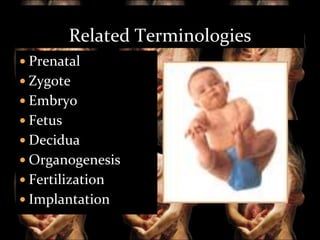
Related Terminologies
 Prenatal
 Zygote
 Embryo
 Fetus

 Decidua
 Organogenesis
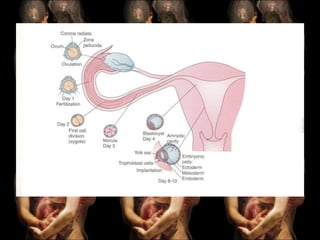
 Fertilization

 Implantation
STAGES OF HUMAN PRENATAL
DEVELOPMENT
1.
2.

3.

First 12-14 days = zygote
From 15th day up to the 8th week =
embryo
From 8th week to the time of birth
= fetus
ORIGIN AND DEVELOPMENT
OF ORGAN SYSTEM
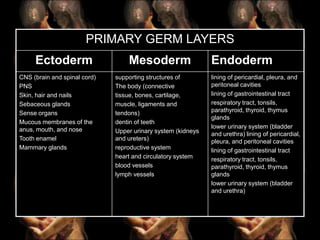
PRIMARY GERM LAYERS
Ectoderm
CNS (brain and spinal cord)
PNS
Skin, hair and nails
Sebaceous glands
Sense organs
Mucous membranes of the
anus, mouth, and nose
Tooth enamel
Mammary glands

Mesoderm
supporting structures of
The body (connective
tissue, bones, cartilage,
muscle, ligaments and
tendons)
dentin of teeth
Upper urinary system (kidneys
and ureters)
reproductive system
heart and circulatory system
blood vessels
lymph vessels

Endoderm
lining of pericardial, pleura, and
peritoneal cavities
lining of gastrointestinal tract
respiratory tract, tonsils,
parathyroid, thyroid, thymus
glands
lower urinary system (bladder
and urethra) lining of pericardial,
pleura, and peritoneal cavities
lining of gastrointestinal tract
respiratory tract, tonsils,
parathyroid, thyroid, thymus
glands
lower urinary system (bladder
and urethra)
FETAL GROWTH AND
DEVELOPMENT
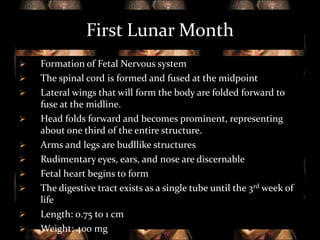
First Lunar Month











Formation of Fetal Nervous system
The spinal cord is formed and fused at the midpoint
Lateral wings that will form the body are folded forward to
fuse at the midline.
Head folds forward and becomes prominent, representing
about one third of the entire structure.
Arms and legs are budllike structures
Rudimentary eyes, ears, and nose are discernable
Fetal heart begins to form
The digestive tract exists as a single tube until the 3rd week of
life
Length: 0.75 to 1 cm
Weight: 400 mg
Second Lunar Month
 All vital organs are formed by the 8th week
 The heart, with a septum and valves, is beating rhythmically.

 Facial features are definitely discernible.
 Arms and legs are developed
 External genitalia are present, but sex is not distinguishable by









simple observation
The primitive tail is regressing
Abdomen appears large because the fetal intestine is growing
rapidly
Placenta develops fully
Sonogram shows gestational sac
Length: 2.5 cm (1 inch)
Weight: 20g
Third Lunar Month
 Kidneys are able to function – urine is formed by the 12th week.
 Buds of milk teeth form
 Beginning bone ossification
 Nail beds are forming on finger and toes.
 Spontaneous movements are possible, although they are usually








to faint to be felt by the mother.
Sex is distinguishable by outward appearance
Fetus swallows amniotic fluid
Heartbeat is audible through doppler technology
Feto-placental circulation is established by selective osmosis; no
direct exchange between fetal and maternal blood.
Length: 7 to 8 cm
Weight: 45 g
Fourth Lunar Month
 Lanugo appears
 Buds of permanent teeth form
 Heart beat maybe audible with fetoscope
 Liver and pancreas are functioning
 Fetus actively swallows amniotic fluid

 Fetal urine is present in the amniotic fluid
 Sex can be determined by ultrasonography
 Length: 10 to 17 cm
 Weight: 55 to 120 g
Fifth Lunar Month
 Vernix caseosa appear
 Lanugo covers entire body
 Hair forms, extending to include eyebrows and hair on the








head.
Meconium is present in the upper intestine
Formation of brown fat
Definite sleeping and activity patterns are distinguisable
Spontaneous fetal movements can bee sensed by the
mother
Length: 25 cm
Weight 223 g
Sixth Lunar Month
 Skin markedly wrinkled
 Attains proportions of full term baby

 Active production of lung surfactant begin
 Eyebrows and eyelashes are well defined
 Pupils are capable of reacting to light
 Eyelids, previously fused since the 12th week, are now






open
Hearing can be demonstrated by response to sudden
sound
Meconium is present as far as the rectum
Length: 28 to 36 cm
Weight: 550 g
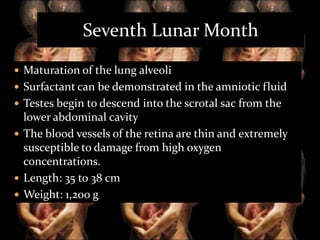
Seventh Lunar Month
 Maturation of the lung alveoli

 Surfactant can be demonstrated in the amniotic fluid
 Testes begin to descend into the scrotal sac from the

lower abdominal cavity
 The blood vessels of the retina are thin and extremely
susceptible to damage from high oxygen
concentrations.
 Length: 35 to 38 cm
 Weight: 1,200 g
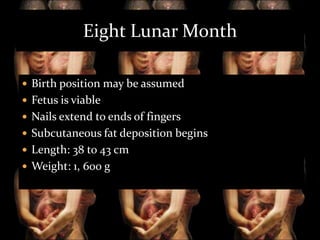
Eight Lunar Month
 Birth position may be assumed
 Fetus is viable
 Nails extend to ends of fingers
 Subcutaneous fat deposition begins
 Length: 38 to 43 cm
 Weight: 1, 600 g
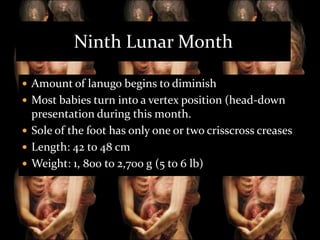
Ninth Lunar Month
 Amount of lanugo begins to diminish
 Most babies turn into a vertex position (head-down

presentation during this month.
 Sole of the foot has only one or two crisscross creases
 Length: 42 to 48 cm
 Weight: 1, 800 to 2,700 g (5 to 6 lb)
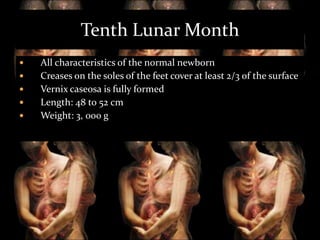
Tenth Lunar Month






All characteristics of the normal newborn
Creases on the soles of the feet cover at least 2/3 of the surface
Vernix caseosa is fully formed
Length: 48 to 52 cm
Weight: 3, 000 g
FOCUS OF FETAL DEVELOPMENT
 1ST TRIMESTER – PERIOD OF

ORGANOGENESIS
 2ND TRIMESTER – Period of continued
growth and development; rapid increase
in fetal length
 3rd TRIMESTER – period of most rapid
growth and development due to
deposition of subcutaneous fat.
Formation and development
of the Embryonic and Fetal
Structures
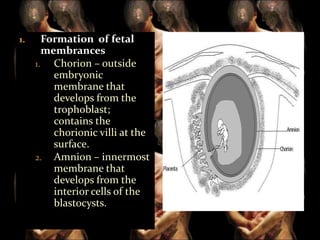
1.

Formation of fetal
membrances
1. Chorion – outside
embryonic
membrane that
develops from the
trophoblast;
contains the
chorionic villi at the
surface.
2. Amnion – innermost
membrane that
develops from the
interior cells of the
blastocysts.
Structure arising from amnion
 Amniotic fluid/ Bag of Water (BOW)
 Clear albuminous fluid in which the baby floats.
 Begins to form at 11-15 weeks gestation.
 Alkaline in nature (pH 1.0-1.25) with specific gravity of (1.007-1.025)
 Near term is clear, colorless, containing little white specks of vernix

caseossa and other solid particles.
 Average amount of 500ml-1000ml up to maximum of 1200ml
 Sources of are: amniotic cells, fetal urine, and maternal serum.
 Functions include:
 Cushions the fetus against danger.
 Equalize pressure
 Prevents adhesion in the sticky skin and umbilical cord
compression
 fetal movement
 thermoregulation
 Oral source of fluid for fetus.
Structure arising from amnion
 Umbilical Cord/ Funis
 21-23 inches or 50-53cm long with 2 ¾” thick.
 Has 1 vein (carrying blood from the placental villi to the fetus)

and 2 arteries (carrying blood from the fetus back to placental
villi). AVA
 Approximately 350ml/min blood flow rate.
 Covered with gelatinous mucopolysaccharide substance called
wharton’s jelly that gives body to the cord and prevents
pressure on the vein and arteries.
Structure arising from Chorion
Chorionic Villi – projections of the trophoblast that produce human
chorionic gonadotropin and begin osmosis of nutrients to the
embryo.
Parts of Chorionic Villi

Central core – loose connective tissue that contains the fetal
capillaries.


Syncytiotrophoblast/ syncytial layer – outer layer of chorionic
villi where production or various placental hormones
(HCG, somatomammotropin, human placentak
lactogen, estrogen, progesterone) during the first 2 months of
gestation happen.



Cytotrophoblast or Langerhan’s layer – inner layer of the
chorionic villi.




present as early as 12 days of gestation.
Protects the growing fetus from certain infectious organisms
such as spirochete of syphilis.
Disappears between 20th and 24th week of gestation.
Structure arising from Chorion
Placenta – rose from chorion together with decidua
basalis.
 Begins to function by the 4th week of gestation.
 Completely independently functioning organ by
14th week
 Transmit nutrients and oxygen to the fetus and
removes waste and carbon dioxide by diffusion.
 The endocrine organ of pregnancy
 Estrogen
 Progesterone
 Human Chorionic Gonadotropin
 Human Placental Lactogen/ Human Chorionic
Somatomammotropin
Functions of Placenta







Diffusion – movement of molecule from the area of higher
concentration to the area of lower concentration. (oxygen, carbon
dioxide, sodium, chloride, fat soluble vitamins, liquids including
narcotics, anesthetics and barbiturates cross the placenta by simple
diffusion.
Facilitated Diffusion - placental crossing of some substances that
is more rapid and more easily that requires less energy. (glucose)
Active Transport – a process that requires energy and action of
enzyme to facilitate transport. (essential amino acids and water
soluble vitamins)
Pinocytosis – absorption by the cellular membrane of
microdroplets of plasma and dissolve substances. (Gamma globulin,
lipoproteins, phospholipids, and other molecular structures that are
too large for diffusion and that cannot participate in active transport
cross in this manner.

Embryonic and fetal growth and development

  • 1.
  • 2.
    Objectives At the endof 1 hour interactive lecture-discussion and small group activity, the students will be able to 1. Define related terminologies 2. Identify the different stages of human intrauterine development. 3. Identify the 3 primary germ layers that develop into specific organ systems. 4. Identify and describe the different changes involve in each stage of embryonic development 5. Identify and describe the different changes involve in each stage of fetal development 6. Integrate Christian values in the discussion of the concept of human prenatal development
  • 3.
    Related Terminologies  Prenatal Zygote  Embryo  Fetus  Decidua  Organogenesis  Fertilization  Implantation
  • 4.
    STAGES OF HUMANPRENATAL DEVELOPMENT 1. 2. 3. First 12-14 days = zygote From 15th day up to the 8th week = embryo From 8th week to the time of birth = fetus
  • 5.
  • 7.
    PRIMARY GERM LAYERS Ectoderm CNS(brain and spinal cord) PNS Skin, hair and nails Sebaceous glands Sense organs Mucous membranes of the anus, mouth, and nose Tooth enamel Mammary glands Mesoderm supporting structures of The body (connective tissue, bones, cartilage, muscle, ligaments and tendons) dentin of teeth Upper urinary system (kidneys and ureters) reproductive system heart and circulatory system blood vessels lymph vessels Endoderm lining of pericardial, pleura, and peritoneal cavities lining of gastrointestinal tract respiratory tract, tonsils, parathyroid, thyroid, thymus glands lower urinary system (bladder and urethra) lining of pericardial, pleura, and peritoneal cavities lining of gastrointestinal tract respiratory tract, tonsils, parathyroid, thyroid, thymus glands lower urinary system (bladder and urethra)
  • 8.
  • 9.
    First Lunar Month           Formationof Fetal Nervous system The spinal cord is formed and fused at the midpoint Lateral wings that will form the body are folded forward to fuse at the midline. Head folds forward and becomes prominent, representing about one third of the entire structure. Arms and legs are budllike structures Rudimentary eyes, ears, and nose are discernable Fetal heart begins to form The digestive tract exists as a single tube until the 3rd week of life Length: 0.75 to 1 cm Weight: 400 mg
  • 10.
    Second Lunar Month All vital organs are formed by the 8th week  The heart, with a septum and valves, is beating rhythmically.  Facial features are definitely discernible.  Arms and legs are developed  External genitalia are present, but sex is not distinguishable by       simple observation The primitive tail is regressing Abdomen appears large because the fetal intestine is growing rapidly Placenta develops fully Sonogram shows gestational sac Length: 2.5 cm (1 inch) Weight: 20g
  • 11.
    Third Lunar Month Kidneys are able to function – urine is formed by the 12th week.  Buds of milk teeth form  Beginning bone ossification  Nail beds are forming on finger and toes.  Spontaneous movements are possible, although they are usually       to faint to be felt by the mother. Sex is distinguishable by outward appearance Fetus swallows amniotic fluid Heartbeat is audible through doppler technology Feto-placental circulation is established by selective osmosis; no direct exchange between fetal and maternal blood. Length: 7 to 8 cm Weight: 45 g
  • 12.
    Fourth Lunar Month Lanugo appears  Buds of permanent teeth form  Heart beat maybe audible with fetoscope  Liver and pancreas are functioning  Fetus actively swallows amniotic fluid  Fetal urine is present in the amniotic fluid  Sex can be determined by ultrasonography  Length: 10 to 17 cm  Weight: 55 to 120 g
  • 13.
    Fifth Lunar Month Vernix caseosa appear  Lanugo covers entire body  Hair forms, extending to include eyebrows and hair on the       head. Meconium is present in the upper intestine Formation of brown fat Definite sleeping and activity patterns are distinguisable Spontaneous fetal movements can bee sensed by the mother Length: 25 cm Weight 223 g
  • 14.
    Sixth Lunar Month Skin markedly wrinkled  Attains proportions of full term baby  Active production of lung surfactant begin  Eyebrows and eyelashes are well defined  Pupils are capable of reacting to light  Eyelids, previously fused since the 12th week, are now     open Hearing can be demonstrated by response to sudden sound Meconium is present as far as the rectum Length: 28 to 36 cm Weight: 550 g
  • 15.
    Seventh Lunar Month Maturation of the lung alveoli  Surfactant can be demonstrated in the amniotic fluid  Testes begin to descend into the scrotal sac from the lower abdominal cavity  The blood vessels of the retina are thin and extremely susceptible to damage from high oxygen concentrations.  Length: 35 to 38 cm  Weight: 1,200 g
  • 16.
    Eight Lunar Month Birth position may be assumed  Fetus is viable  Nails extend to ends of fingers  Subcutaneous fat deposition begins  Length: 38 to 43 cm  Weight: 1, 600 g
  • 17.
    Ninth Lunar Month Amount of lanugo begins to diminish  Most babies turn into a vertex position (head-down presentation during this month.  Sole of the foot has only one or two crisscross creases  Length: 42 to 48 cm  Weight: 1, 800 to 2,700 g (5 to 6 lb)
  • 18.
    Tenth Lunar Month      Allcharacteristics of the normal newborn Creases on the soles of the feet cover at least 2/3 of the surface Vernix caseosa is fully formed Length: 48 to 52 cm Weight: 3, 000 g
  • 19.
    FOCUS OF FETALDEVELOPMENT  1ST TRIMESTER – PERIOD OF ORGANOGENESIS  2ND TRIMESTER – Period of continued growth and development; rapid increase in fetal length  3rd TRIMESTER – period of most rapid growth and development due to deposition of subcutaneous fat.
  • 20.
    Formation and development ofthe Embryonic and Fetal Structures
  • 21.
    1. Formation of fetal membrances 1.Chorion – outside embryonic membrane that develops from the trophoblast; contains the chorionic villi at the surface. 2. Amnion – innermost membrane that develops from the interior cells of the blastocysts.
  • 22.
    Structure arising fromamnion  Amniotic fluid/ Bag of Water (BOW)  Clear albuminous fluid in which the baby floats.  Begins to form at 11-15 weeks gestation.  Alkaline in nature (pH 1.0-1.25) with specific gravity of (1.007-1.025)  Near term is clear, colorless, containing little white specks of vernix caseossa and other solid particles.  Average amount of 500ml-1000ml up to maximum of 1200ml  Sources of are: amniotic cells, fetal urine, and maternal serum.  Functions include:  Cushions the fetus against danger.  Equalize pressure  Prevents adhesion in the sticky skin and umbilical cord compression  fetal movement  thermoregulation  Oral source of fluid for fetus.
  • 23.
    Structure arising fromamnion  Umbilical Cord/ Funis  21-23 inches or 50-53cm long with 2 ¾” thick.  Has 1 vein (carrying blood from the placental villi to the fetus) and 2 arteries (carrying blood from the fetus back to placental villi). AVA  Approximately 350ml/min blood flow rate.  Covered with gelatinous mucopolysaccharide substance called wharton’s jelly that gives body to the cord and prevents pressure on the vein and arteries.
  • 24.
    Structure arising fromChorion Chorionic Villi – projections of the trophoblast that produce human chorionic gonadotropin and begin osmosis of nutrients to the embryo. Parts of Chorionic Villi  Central core – loose connective tissue that contains the fetal capillaries.  Syncytiotrophoblast/ syncytial layer – outer layer of chorionic villi where production or various placental hormones (HCG, somatomammotropin, human placentak lactogen, estrogen, progesterone) during the first 2 months of gestation happen.  Cytotrophoblast or Langerhan’s layer – inner layer of the chorionic villi.    present as early as 12 days of gestation. Protects the growing fetus from certain infectious organisms such as spirochete of syphilis. Disappears between 20th and 24th week of gestation.
  • 25.
    Structure arising fromChorion Placenta – rose from chorion together with decidua basalis.  Begins to function by the 4th week of gestation.  Completely independently functioning organ by 14th week  Transmit nutrients and oxygen to the fetus and removes waste and carbon dioxide by diffusion.  The endocrine organ of pregnancy  Estrogen  Progesterone  Human Chorionic Gonadotropin  Human Placental Lactogen/ Human Chorionic Somatomammotropin
  • 26.
    Functions of Placenta     Diffusion– movement of molecule from the area of higher concentration to the area of lower concentration. (oxygen, carbon dioxide, sodium, chloride, fat soluble vitamins, liquids including narcotics, anesthetics and barbiturates cross the placenta by simple diffusion. Facilitated Diffusion - placental crossing of some substances that is more rapid and more easily that requires less energy. (glucose) Active Transport – a process that requires energy and action of enzyme to facilitate transport. (essential amino acids and water soluble vitamins) Pinocytosis – absorption by the cellular membrane of microdroplets of plasma and dissolve substances. (Gamma globulin, lipoproteins, phospholipids, and other molecular structures that are too large for diffusion and that cannot participate in active transport cross in this manner.