T.Y.B.Sc ZOOLOGY
SEM V
PAPER IV
UNIT 4
Chick Developmental Biology
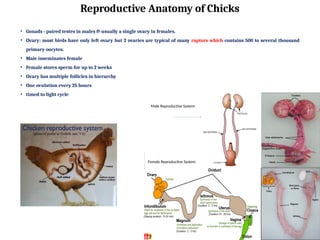
• Gonads - paired testes in males & usually a single ovary in females.
• Ovary: most birds have only left ovary but 2 ovaries are typical of many raptors which contains 500 to several thousand
primary oocytes.
• Male inseminates female
• Female stores sperm for up to 2 weeks
• Ovary has multiple follicles in hierarchy
• One ovulation every 25 hours
• timed to light cycle
Reproductive Anatomy of Chicks
Male Reproductive System
Female Reproductive System
1. Primary Follicle ruptures
• Sperm attach to germinal disk over egg
• Acrosome reaction
• One sperm penetrates egg membrane
• Zygote begins development
2.Transiting the oviduct
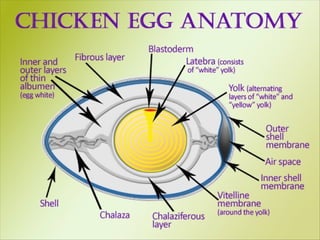
• Egg white albumen deposited
• Egg membrane deposited
• Shell added in Shell gland
3. Oviposition
• about 22-24 hours after ovulation
• Embryo already at about 1000 cells
4. Embryo on side of yolk
• Floats up (hen rocks and reorients)
• Incubation temperature of 39 to 40 C
5.Embryo divides into Embryo and Extra-embryonic tissue
6.Extra-embryonic tissue
• Blood cell production
• Blood islands >> Blood ring
• Fuses with embryo circulatory system
• Grows out around yolk
• Heart pumps blood out around yolk and back to embryo
• Absorbs yolk and albumen
7.Eventually, chick grows around and encompasses last of yolk through cloacal opening
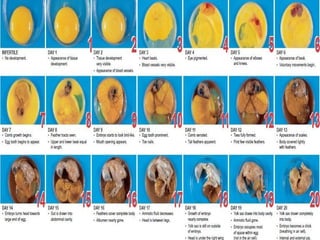
8.Chick emerges from egg after 21 days
Steps in Chick Embryology
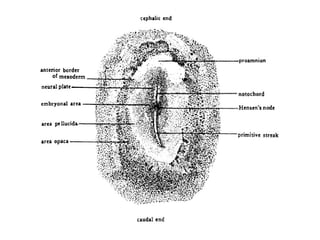
1. 18 hrs chick embryos show a longitudinal thickening in the middle
called primitive streak and is the first indication of axis of the embryo.
2. A fully formed primitive streak contains a primitive grove, a pair of
primitive folds and primitive pit.
3. The area pellucida and area opaca are prominent
4. In the front, the primitive streak ends in a small pit, the primitive pit
or Hensen's node.
5. This structure is homologue with the dorsal lip of the blastopore in
amphibians.
6. Just in front of this node one can distinguish the formation of the
notochord (Chorda).
7. This structure induces the formation of the neural plate and later the
neural groove.
8. The primitive streak lies in the middle of the area pellucida as a clear line.
9. At the tail side of the area pellucida it is characterized by a primitive
groove surrounded by 2 thicker walls of the blastoderm, the primitive
walls.
10.The proamnion lies in front of (= pro) this head fold as a clear zone.
16-18 hr Chick Embryo
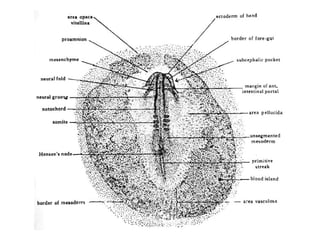
1. At 24 hrs. incubation period the chick embryo is oval in shape.
2. The primitive streak is fully formed and the process of gastrulation is completed.
3. The Notochord extends from the Hensen's node as head process into the
mesoderm-free area anteriorly.
4. The head fold and fore-gut develop in the embryo.
5. The mesoderm differentiates into somites, intermediate and lateral plate
mesoderm.
6. This the first stage in which somites are present. Somites are blocks of mesoderm
which appear on either side of the notochord and will give rise to a number of
structures, including skeletal muscle, bone and the dermis of the skin.
7. They first appear toward the anterior end of the embryo, and then progressively
further posterior.
8. The first somite appears at about 21 hours, and additional somites appear at the
rate of about one per hour.
9. The coelom begins to develop in the lateral plate mesoderm.
10.The blood islands appear in the area opaca. Pericardial region and primordial of
heart are established.
11.The area opaca further modifies into the area vasculosa and area vitellina.
12.The neurectoderm gives rise to the neural folds and neural groove. The fusion
of neural folds begins from the mid-region.
24 hr Chick Embryo
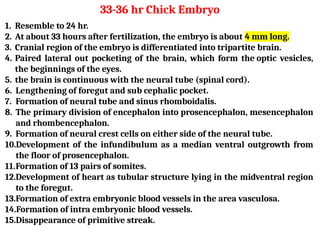
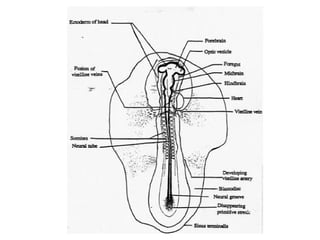
1. Resemble to 24 hr.
2. At about 33 hours after fertilization, the embryo is about 4 mm long.
3. Cranial region of the embryo is differentiated into tripartite brain.
4. Paired lateral out pocketing of the brain, which form the optic vesicles,
the beginnings of the eyes.
5. the brain is continuous with the neural tube (spinal cord).
6. Lengthening of foregut and sub cephalic pocket.
7. Formation of neural tube and sinus rhomboidalis.
8. The primary division of encephalon into prosencephalon, mesencephalon
and rhombencephalon.
9. Formation of neural crest cells on either side of the neural tube.
10.Development of the infundibulum as a median ventral outgrowth from
the floor of prosencephalon.
11.Formation of 13 pairs of somites.
12.Development of heart as tubular structure lying in the midventral region
to the foregut.
13.Formation of extra embryonic blood vessels in the area vasculosa.
14.Formation of intra embryonic blood vessels.
15.Disappearance of primitive streak.
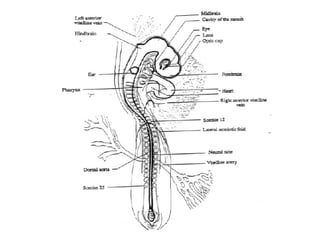
33-36 hr Chick Embryo
48 hr Chick Embryo
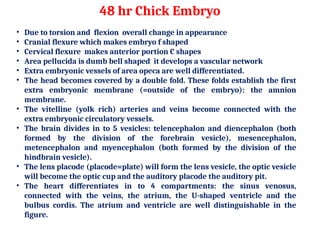
• Due to torsion and flexion overall change in appearance
• Cranial flexure which makes embryo f shaped
• Cervical flexure makes anterior portion C shapes
• Area pellucida is dumb bell shaped it develops a vascular network
• Extra embryonic vessels of area opeca are well differentiated.
• The head becomes covered by a double fold. These folds establish the first
extra embryonic membrane (=outside of the embryo): the amnion
membrane.
• The vitelline (yolk rich) arteries and veins become connected with the
extra embryonic circulatory vessels.
• The brain divides in to 5 vesicles: telencephalon and diencephalon (both
formed by the division of the forebrain vesicle), mesencephalon,
metencephalon and myencephalon (both formed by the division of the
hindbrain vesicle).
• The lens placode (placode=plate) will form the lens vesicle, the optic vesicle
will become the optic cup and the auditory placode the auditory pit.
• The heart differentiates in to 4 compartments: the sinus venosus,
connected with the veins, the atrium, the U-shaped ventricle and the
bulbus cordis. The atrium and ventricle are well distinguishable in the
figure.
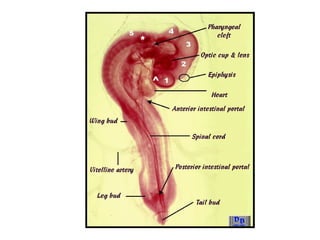
72 hr Chick Embryo
• 72 Hours after fertilization, the rotation of the embryo to the left is
arrived such behind the region of the heart and only the caudal
part of the embryo must twist 90 degrees.
• The fourth pharyngeal groove develops and the pharyngeal arches
are thicker. Due to the cranial flexure, the pharyngeal region (=
region of the trachea) is now located at the ventral side of the
head.
• The further development of the five brain vesicles (telencephalon,
diencephalon, metencephalon, mesencephalon and
myencephalon) in to the different head structures is clearly
visible.
• The eye vesicles differentiate as two lateral projections of the
diencephalon and come in contact with the external layer
(ectoderm) to form the optic cup (neurectoderm) and the lens
(ectoderm).
• The dorsal projection of the diencephalon is also visible and will
differentiate in to the epiphysis (epi= at the upper side).
• The depression at the ventral side of the diencephalon develops in
to the hypophysis (hypo= under; not visible in this fig.).
• The auditory vesicles develop at the level of the myencephalon.
Chick Embryology presentation Veena Dongare

Chick Embryology presentation Veena Dongare

  • 1.
    T.Y.B.Sc ZOOLOGY SEM V PAPERIV UNIT 4 Chick Developmental Biology
  • 2.
    • Gonads -paired testes in males & usually a single ovary in females. • Ovary: most birds have only left ovary but 2 ovaries are typical of many raptors which contains 500 to several thousand primary oocytes. • Male inseminates female • Female stores sperm for up to 2 weeks • Ovary has multiple follicles in hierarchy • One ovulation every 25 hours • timed to light cycle Reproductive Anatomy of Chicks Male Reproductive System Female Reproductive System
  • 5.
    1. Primary Follicleruptures • Sperm attach to germinal disk over egg • Acrosome reaction • One sperm penetrates egg membrane • Zygote begins development 2.Transiting the oviduct • Egg white albumen deposited • Egg membrane deposited • Shell added in Shell gland 3. Oviposition • about 22-24 hours after ovulation • Embryo already at about 1000 cells 4. Embryo on side of yolk • Floats up (hen rocks and reorients) • Incubation temperature of 39 to 40 C 5.Embryo divides into Embryo and Extra-embryonic tissue 6.Extra-embryonic tissue • Blood cell production • Blood islands >> Blood ring • Fuses with embryo circulatory system • Grows out around yolk • Heart pumps blood out around yolk and back to embryo • Absorbs yolk and albumen 7.Eventually, chick grows around and encompasses last of yolk through cloacal opening 8.Chick emerges from egg after 21 days Steps in Chick Embryology
  • 6.
    1. 18 hrschick embryos show a longitudinal thickening in the middle called primitive streak and is the first indication of axis of the embryo. 2. A fully formed primitive streak contains a primitive grove, a pair of primitive folds and primitive pit. 3. The area pellucida and area opaca are prominent 4. In the front, the primitive streak ends in a small pit, the primitive pit or Hensen's node. 5. This structure is homologue with the dorsal lip of the blastopore in amphibians. 6. Just in front of this node one can distinguish the formation of the notochord (Chorda). 7. This structure induces the formation of the neural plate and later the neural groove. 8. The primitive streak lies in the middle of the area pellucida as a clear line. 9. At the tail side of the area pellucida it is characterized by a primitive groove surrounded by 2 thicker walls of the blastoderm, the primitive walls. 10.The proamnion lies in front of (= pro) this head fold as a clear zone. 16-18 hr Chick Embryo
  • 8.
    1. At 24hrs. incubation period the chick embryo is oval in shape. 2. The primitive streak is fully formed and the process of gastrulation is completed. 3. The Notochord extends from the Hensen's node as head process into the mesoderm-free area anteriorly. 4. The head fold and fore-gut develop in the embryo. 5. The mesoderm differentiates into somites, intermediate and lateral plate mesoderm. 6. This the first stage in which somites are present. Somites are blocks of mesoderm which appear on either side of the notochord and will give rise to a number of structures, including skeletal muscle, bone and the dermis of the skin. 7. They first appear toward the anterior end of the embryo, and then progressively further posterior. 8. The first somite appears at about 21 hours, and additional somites appear at the rate of about one per hour. 9. The coelom begins to develop in the lateral plate mesoderm. 10.The blood islands appear in the area opaca. Pericardial region and primordial of heart are established. 11.The area opaca further modifies into the area vasculosa and area vitellina. 12.The neurectoderm gives rise to the neural folds and neural groove. The fusion of neural folds begins from the mid-region. 24 hr Chick Embryo
  • 10.
    1. Resemble to24 hr. 2. At about 33 hours after fertilization, the embryo is about 4 mm long. 3. Cranial region of the embryo is differentiated into tripartite brain. 4. Paired lateral out pocketing of the brain, which form the optic vesicles, the beginnings of the eyes. 5. the brain is continuous with the neural tube (spinal cord). 6. Lengthening of foregut and sub cephalic pocket. 7. Formation of neural tube and sinus rhomboidalis. 8. The primary division of encephalon into prosencephalon, mesencephalon and rhombencephalon. 9. Formation of neural crest cells on either side of the neural tube. 10.Development of the infundibulum as a median ventral outgrowth from the floor of prosencephalon. 11.Formation of 13 pairs of somites. 12.Development of heart as tubular structure lying in the midventral region to the foregut. 13.Formation of extra embryonic blood vessels in the area vasculosa. 14.Formation of intra embryonic blood vessels. 15.Disappearance of primitive streak. 33-36 hr Chick Embryo
  • 12.
    48 hr ChickEmbryo • Due to torsion and flexion overall change in appearance • Cranial flexure which makes embryo f shaped • Cervical flexure makes anterior portion C shapes • Area pellucida is dumb bell shaped it develops a vascular network • Extra embryonic vessels of area opeca are well differentiated. • The head becomes covered by a double fold. These folds establish the first extra embryonic membrane (=outside of the embryo): the amnion membrane. • The vitelline (yolk rich) arteries and veins become connected with the extra embryonic circulatory vessels. • The brain divides in to 5 vesicles: telencephalon and diencephalon (both formed by the division of the forebrain vesicle), mesencephalon, metencephalon and myencephalon (both formed by the division of the hindbrain vesicle). • The lens placode (placode=plate) will form the lens vesicle, the optic vesicle will become the optic cup and the auditory placode the auditory pit. • The heart differentiates in to 4 compartments: the sinus venosus, connected with the veins, the atrium, the U-shaped ventricle and the bulbus cordis. The atrium and ventricle are well distinguishable in the figure.
  • 14.
    72 hr ChickEmbryo • 72 Hours after fertilization, the rotation of the embryo to the left is arrived such behind the region of the heart and only the caudal part of the embryo must twist 90 degrees. • The fourth pharyngeal groove develops and the pharyngeal arches are thicker. Due to the cranial flexure, the pharyngeal region (= region of the trachea) is now located at the ventral side of the head. • The further development of the five brain vesicles (telencephalon, diencephalon, metencephalon, mesencephalon and myencephalon) in to the different head structures is clearly visible. • The eye vesicles differentiate as two lateral projections of the diencephalon and come in contact with the external layer (ectoderm) to form the optic cup (neurectoderm) and the lens (ectoderm). • The dorsal projection of the diencephalon is also visible and will differentiate in to the epiphysis (epi= at the upper side). • The depression at the ventral side of the diencephalon develops in to the hypophysis (hypo= under; not visible in this fig.). • The auditory vesicles develop at the level of the myencephalon.