Principles of Development

   Chapter 8
Early Concepts: Preformation vs
Epigenesis
  The  question of how a zygote
   becomes an animal has been
   asked for centuries.
  As recently as the 18th century,
   the prevailing theory was a notion
   called preformation – the idea
   that the egg or sperm contains an
   embryo.
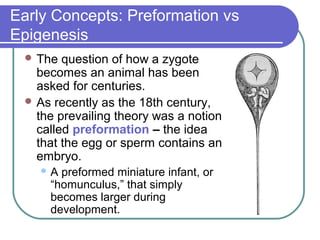
    A preformed miniature infant, or
     “homunculus,” that simply
     becomes larger during
     development.
Early Concepts: Preformation vs
Epigenesis
  Kaspar  Friederich Wolff (1759)
   demonstrated there was no preformed
   chick in the early egg.
    Undifferentiated granular material became
     arranged into layers.
    The layers thickened, thinned, and folded to
     produce the embryo.
Early Concepts: Preformation vs
Epigenesis
  Epigenesis    is the concept that the
   fertilized egg contains building materials
   only, somehow assembled by an
   unknown directing force.
  Although current ideas of development
   are essentially epigenetic in concept, far
   more is known about what directs growth
   and differentiation.
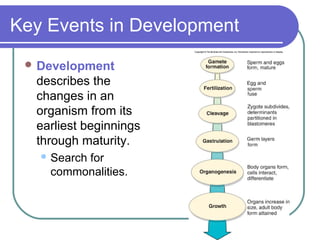
Key Events in Development
  Development
  describes the
  changes in an
  organism from its
  earliest beginnings
  through maturity.
    Search
         for
    commonalities.
Key Events in Development
  Specializationof cell types occurs as a
   hierarchy of developmental decisions.
    Cell types arise from conditions created in
     preceding stages.
    Interactions become increasingly restrictive.

  With    each new stage:
    Each stage limits developmental fate.
    Cells lose option to become something different
          Said to be determined.
Key Events in Development

  The two basic processes responsible for
  this progressive subdivision:
    Cytoplasmic   localization
    Induction
Fertilization

  Fertilization
               is the initial event in
   development in sexual reproduction.
     Union of male and female gametes
     Provides for recombination of paternal and
      maternal genes.
       Restores   the diploid number.
     Activates    the egg to begin development.
Fertilization
  Oocyte     Maturation
     Egg   grows in size by accumulating yolk.
       Containsmuch mRNA, ribosomes, tRNA
        and elements for protein synthesis.
     Morphogenetic       determinants direct the
      activation and repression of specific genes
      later in post-fertilization development.
     Egg nucleus grows in size, bloated with
      RNA.
       Now   called the germinal vesicle.
Fertilization
  Mostof these preparations in the egg
  occur during the prolonged prophase I.
    In   mammals
  Oocyte    now has a highly structured
  system.
    Afterfertilization it will support nutritional
     requirements of the embryo and direct its
     development through cleavage.
  Aftermeiosis resumes, the egg is ready to
  fuse its nucleus with the sperm nucleus.
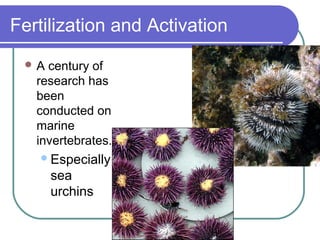
Fertilization and Activation
 A  century of
   research has
   been
   conducted on
   marine
   invertebrates.
    Especially
      sea
      urchins
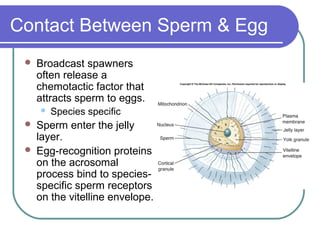
Contact Between Sperm & Egg
    Broadcast spawners
     often release a
     chemotactic factor that
     attracts sperm to eggs.
        Species specific
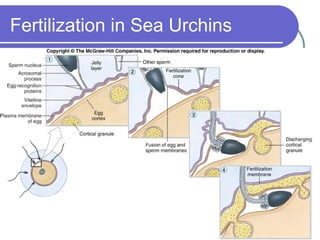
    Sperm enter the jelly
     layer.
    Egg-recognition proteins
     on the acrosomal
     process bind to species-
     specific sperm receptors
     on the vitelline envelope.
Fertilization in Sea Urchins
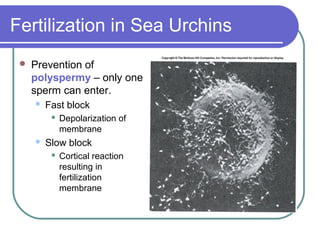
    Prevention of
     polyspermy – only one
     sperm can enter.
        Fast block
             Depolarization of
              membrane
        Slow block
             Cortical reaction
              resulting in
              fertilization
              membrane
Fertilization in Sea Urchins
  The  cortical reaction follows the fusion of
   thousands of enzyme-rich cortical granules
   with the egg membrane.
    Cortical granules release contents between the
     membrane and vitelline envelope.
    Creates an osmotic gradient
        Water rushes into space
        Elevates the envelope

        Lifts away all bound sperm except the one sperm that has

         successfully fused with the egg plasma membrane.
Fertilization in Sea Urchins
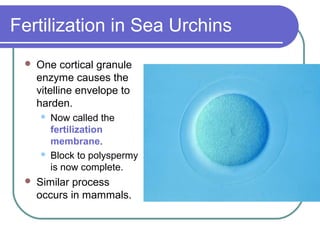
    One cortical granule
     enzyme causes the
     vitelline envelope to
     harden.
        Now called the
         fertilization
         membrane.
        Block to polyspermy
         is now complete.
    Similar process
     occurs in mammals.
Fertilization in Sea Urchins
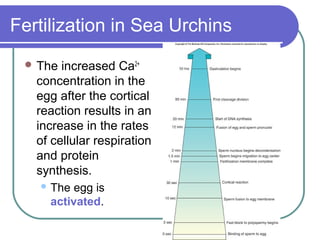
  The  increased Ca2+
   concentration in the
   egg after the cortical
   reaction results in an
   increase in the rates
   of cellular respiration
   and protein
   synthesis.
    The  egg is
     activated.
Fusion of Pronuclei

  Aftersperm and egg membranes fuse,
   the sperm loses its flagellum.
  Enlarged sperm nucleus is the male
   pronucleus and migrates inward to
   contact the female pronucleus.
  Fusion of male and female pronuclei
   forms a diploid zygote nucleus.
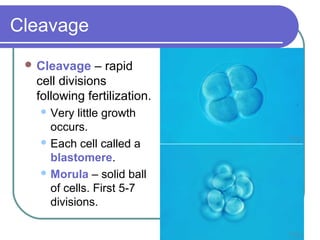
Cleavage
  Cleavage   – rapid
  cell divisions
  following fertilization.
    Very  little growth
     occurs.
    Each cell called a
     blastomere.
    Morula – solid ball
     of cells. First 5-7
     divisions.
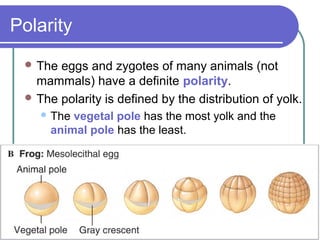
Polarity
  The eggs and zygotes of many animals (not
   mammals) have a definite polarity.
  The polarity is defined by the distribution of yolk.
     The vegetal pole has the most yolk and the
      animal pole has the least.
Body Axes
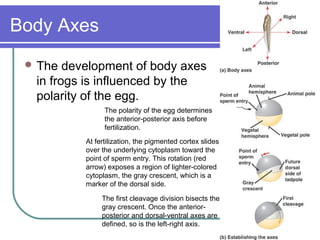
  The  development of body axes
  in frogs is influenced by the
  polarity of the egg.
                The polarity of the egg determines
                the anterior-posterior axis before
                fertilization.
          At fertilization, the pigmented cortex slides
          over the underlying cytoplasm toward the
          point of sperm entry. This rotation (red
          arrow) exposes a region of lighter-colored
          cytoplasm, the gray crescent, which is a
          marker of the dorsal side.

               The first cleavage division bisects the
               gray crescent. Once the anterior-
               posterior and dorsal-ventral axes are
               defined, so is the left-right axis.
Amount of Yolk
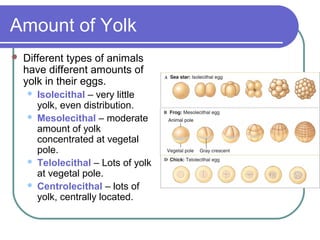
   Different types of animals
    have different amounts of
    yolk in their eggs.
       Isolecithal – very little
        yolk, even distribution.
       Mesolecithal – moderate
        amount of yolk
        concentrated at vegetal
        pole.
       Telolecithal – Lots of yolk
        at vegetal pole.
       Centrolecithal – lots of
        yolk, centrally located.
Cleavage in Frogs
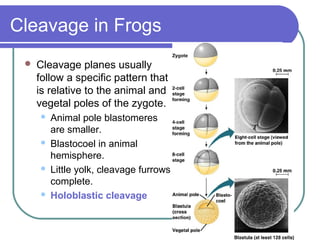
    Cleavage planes usually
     follow a specific pattern that
     is relative to the animal and
     vegetal poles of the zygote.
        Animal pole blastomeres
         are smaller.
        Blastocoel in animal
         hemisphere.
        Little yolk, cleavage furrows
         complete.
        Holoblastic cleavage
Cleavage in Birds
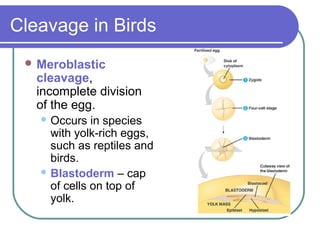
  Meroblastic
   cleavage,
   incomplete division
   of the egg.
    Occurs   in species
     with yolk-rich eggs,
     such as reptiles and
     birds.
    Blastoderm – cap
     of cells on top of
     yolk.
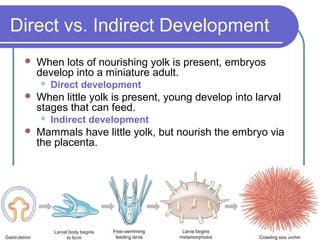
Direct vs. Indirect Development
    When lots of nourishing yolk is present, embryos
     develop into a miniature adult.
        Direct development
    When little yolk is present, young develop into larval
     stages that can feed.
        Indirect development
    Mammals have little yolk, but nourish the embryo via
     the placenta.
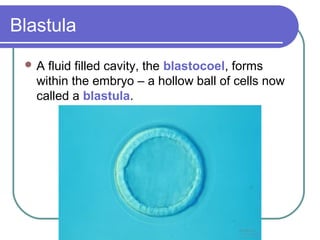
Blastula
 A  fluid filled cavity, the blastocoel, forms
   within the embryo – a hollow ball of cells now
   called a blastula.
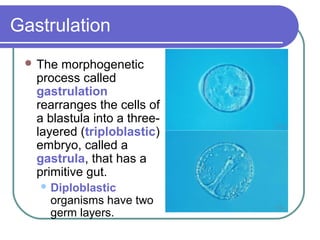
Gastrulation
  The  morphogenetic
   process called
   gastrulation
   rearranges the cells of
   a blastula into a three-
   layered (triploblastic)
   embryo, called a
   gastrula, that has a
   primitive gut.
    Diploblastic
     organisms have two
     germ layers.
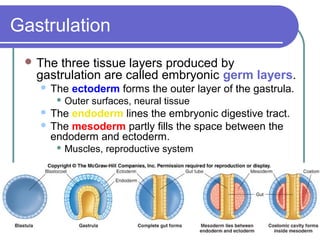
Gastrulation
  The three tissue layers produced by
   gastrulation are called embryonic germ layers.
      The ectoderm forms the outer layer of the gastrula.
         Outer   surfaces, neural tissue
    The endoderm lines the embryonic digestive tract.
    The mesoderm partly fills the space between the
     endoderm and ectoderm.
         Muscles,   reproductive system
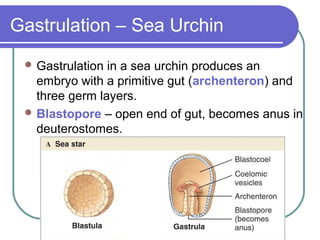
Gastrulation – Sea Urchin
  Gastrulation in a sea urchin produces an
   embryo with a primitive gut (archenteron) and
   three germ layers.
  Blastopore – open end of gut, becomes anus in
   deuterostomes.
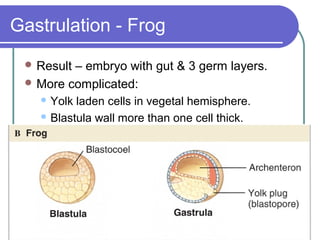
Gastrulation - Frog
  Result– embryo with gut & 3 germ layers.
  More complicated:
    Yolk laden cells in vegetal hemisphere.
    Blastula wall more than one cell thick.
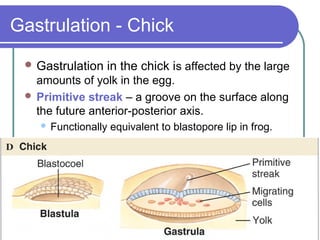
Gastrulation - Chick
  Gastrulation     in the chick is affected by the large
   amounts of yolk in the egg.
  Primitive streak – a groove on the surface along
   the future anterior-posterior axis.
       Functionally equivalent to blastopore lip in frog.
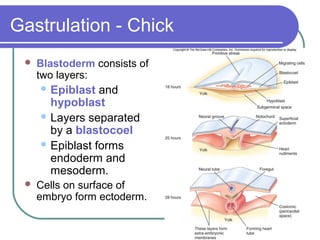
Gastrulation - Chick
    Blastoderm consists of
     two layers:
      Epiblast  and
       hypoblast
      Layers separated
       by a blastocoel
      Epiblast forms
       endoderm and
       mesoderm.
    Cells on surface of
     embryo form ectoderm.
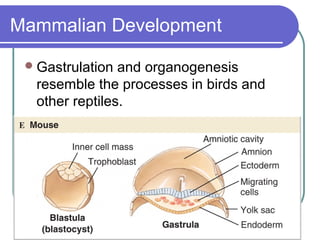
Gastrulation - Mouse
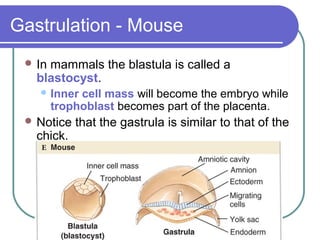
  Inmammals the blastula is called a
   blastocyst.
    Inner   cell mass will become the embryo while
        trophoblast becomes part of the placenta.
  Notice   that the gastrula is similar to that of the
   chick.
Suites of Developmental Characters

  Two   major groups of triploblastic animals:
    Protostomes
    Deuterostomes

  Differentiated   by:
    Spiral vs. radial cleavage
    Regulative vs. mosaic cleavage

    Blastopore becomes mouth vs. anus

    Schizocoelous vs. enterocoelous coelom formation.
Deuterostome Development

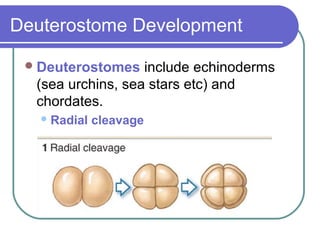
  Deuterostomes   include echinoderms
  (sea urchins, sea stars etc) and
  chordates.
    Radial   cleavage
Deuterostome Development
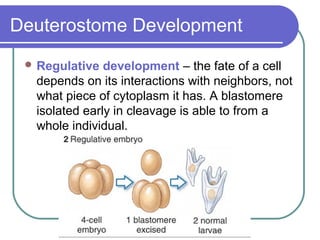
  Regulative  development – the fate of a cell
  depends on its interactions with neighbors, not
  what piece of cytoplasm it has. A blastomere
  isolated early in cleavage is able to from a
  whole individual.
Deuterostome Development
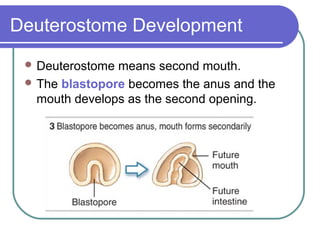
  Deuterostome means second mouth.
  The blastopore becomes the anus and the
   mouth develops as the second opening.
Deuterostome Development

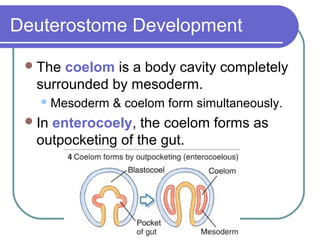
  The  coelom is a body cavity completely
   surrounded by mesoderm.
    Mesoderm   & coelom form simultaneously.
  Inenterocoely, the coelom forms as
   outpocketing of the gut.
Deuterostome Development

  Typicaldeuterostomes have coeloms
  that develop by enterocoely.
    Vertebrates   use a modified version of
     schizocoely.
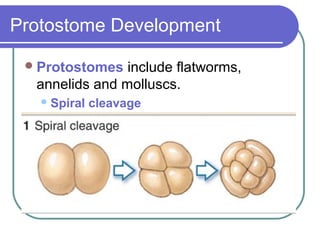
Protostome Development

  Protostomes  include flatworms,
  annelids and molluscs.
    Spiral   cleavage
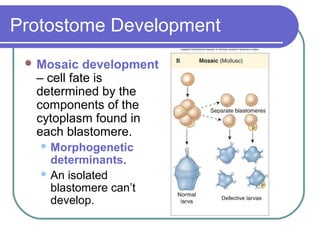
Protostome Development
  Mosaic   development
  – cell fate is
  determined by the
  components of the
  cytoplasm found in
  each blastomere.
    Morphogenetic
     determinants.
    An isolated
     blastomere can’t
     develop.
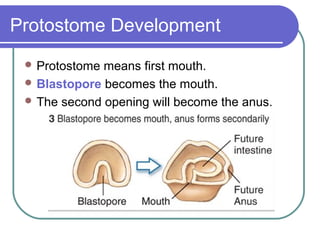
Protostome Development
  Protostome means first mouth.
  Blastopore becomes the mouth.
  The second opening will become the anus.
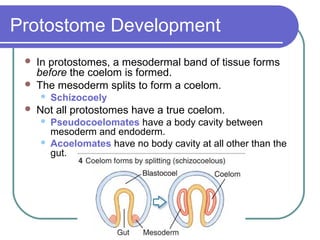
Protostome Development
    In protostomes, a mesodermal band of tissue forms
     before the coelom is formed.
    The mesoderm splits to form a coelom.
        Schizocoely
    Not all protostomes have a true coelom.
        Pseudocoelomates have a body cavity between
         mesoderm and endoderm.
        Acoelomates have no body cavity at all other than the
         gut.
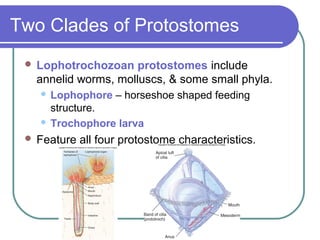
Two Clades of Protostomes
  Lophotrochozoan    protostomes include
   annelid worms, molluscs, & some small phyla.
    Lophophore – horseshoe shaped feeding
     structure.
    Trochophore larva

  Feature   all four protostome characteristics.
Two Clades of Protostomes

  The ecdysozoan protostomes include
  arthropods, roundworms, and other taxa
  that molt their exoskeletons.
    Ecdysis – shedding of the cuticle.
    Many do not show spiral cleavage.
Building a Body Plan

  An organism’s development is
   determined by the genome of the zygote
   and also by differences that arise
   between early embryonic cells.
    Different genes will be expressed in
     different cells.
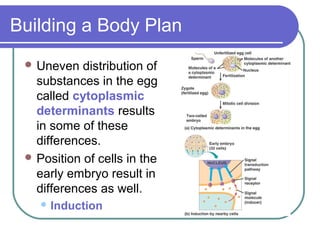
Building a Body Plan
  Uneven   distribution of
   substances in the egg
   called cytoplasmic
   determinants results
   in some of these
   differences.
  Position of cells in the
   early embryo result in
   differences as well.
     Induction
Restriction of Cellular Potency

  In many species that have cytoplasmic
   determinants only the zygote is
   totipotent, capable of developing into all
   the cell types found in the adult.
Restriction of Cellular Potency

  Unevenly distributed cytoplasmic
   determinants in the egg cell:
    Are important in establishing the body axes.
    Set up differences in blastomeres resulting
     from cleavage.
Restriction of Cellular Potency

  As embryonic development proceeds,
   the potency of cells becomes
   progressively more limited in all species.
Cell Fate Determination and Pattern
Formation by Inductive Signals
  Once   embryonic cell division creates
   cells that differ from each other,
    The  cells begin to influence each other’s
     fates by induction.
Induction
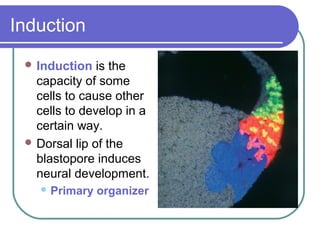
  Induction   is the
   capacity of some
   cells to cause other
   cells to develop in a
   certain way.
  Dorsal lip of the
   blastopore induces
   neural development.
    Primary   organizer
Spemann-Mangold Experiment
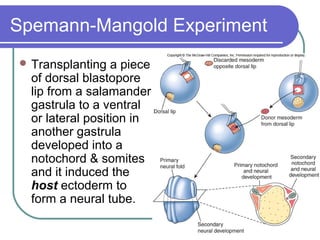
 Transplanting   a piece
  of dorsal blastopore
  lip from a salamander
  gastrula to a ventral
  or lateral position in
  another gastrula
  developed into a
  notochord & somites
  and it induced the
  host ectoderm to
  form a neural tube.
Building a Body Plan

  Cell differentiation – the specialization
   of cells in their structure and function.
  Morphogenesis – the process by which
   an animal takes shape and differentiated
   cells end up in their appropriate
   locations.
Building a Body Plan
  The   sequence includes
    Cell movement
    Changes in adhesion

    Cell proliferation

  There  is no “hard-wired” master control panel
   directing development.
    Sequence of local patterns in which one step in
     development is a subunit of another.
    Each step in the developmental hierarchy is a
     necessary preliminary for the next.
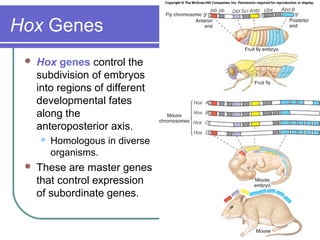
Hox Genes
    Hox genes control the
     subdivision of embryos
     into regions of different
     developmental fates
     along the
     anteroposterior axis.
        Homologous in diverse
         organisms.
    These are master genes
     that control expression
     of subordinate genes.
Formation of the Vertebrate
Limb
  Inductivesignals play a major role in
   pattern formation – the development of
   an animal’s spatial organization.
Formation of the Vertebrate
Limb
  The molecular cues that control pattern
   formation, called positional
   information:
    Tella cell where it is with respect to the
     animal’s body axes.
    Determine how the cell and its descendents
     respond to future molecular signals.
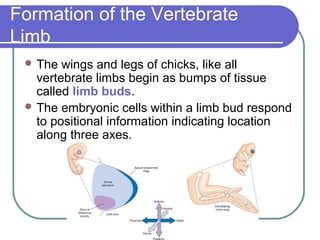
Formation of the Vertebrate
Limb
  The  wings and legs of chicks, like all
   vertebrate limbs begin as bumps of tissue
   called limb buds.
  The embryonic cells within a limb bud respond
   to positional information indicating location
   along three axes.
Formation of the Vertebrate
Limb
  One limb-bud organizer region is the apical
   ectodermal ridge (AER).
      A thickened area of ectoderm at the tip of the bud.
  The  second major limb-bud organizer region is
   the zone of polarizing activity (ZPA).
      A block of mesodermal tissue located underneath
       the ectoderm where the posterior side of the bud is
       attached to the body.
Morphogenesis

  Morphogenesis  is a major aspect of
  development in both plants and animals
  but only in animals does it involve the
  movement of cells.
The Cytoskeleton, Cell Motility, and
Convergent Extension
  Changes   in the shape of a cell usually
   involve reorganization of the
   cytoskeleton.
Changes in Cell Shape
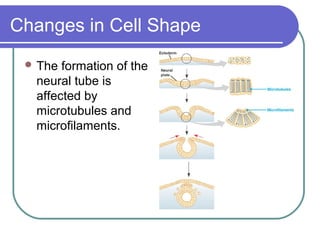
  The formation of the
  neural tube is
  affected by
  microtubules and
  microfilaments.
Cell Migration

  The cytoskeleton also drives cell
   migration, or cell crawling.
    The    active movement of cells from one
        place to another.
  Ingastrulation, tissue invagination is
   caused by changes in both cell shape
   and cell migration.
Evo-Devo

  Evolutionary  developmental biology -
  evolution is a process in which
  organisms become different as a result
  of changes in the genetic control of
  development.
    Genes  that control development are similar
    in diverse groups of animals.
      Hox   genes
Evo-Devo

  Insteadof evolution proceeding by the
  gradual accumulation of numerous small
  mutations, could it proceed by relatively
  few mutations in a few developmental
  genes?
    The induction of legs or eyes by a mutation
    in one gene suggests that these and other
    organs can develop as modules.
The Common Vertebrate Heritage

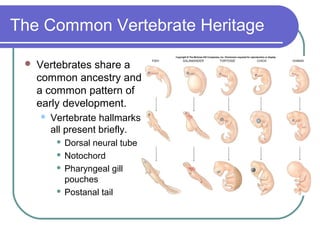
    Vertebrates share a
     common ancestry and
     a common pattern of
     early development.
        Vertebrate hallmarks
         all present briefly.
           Dorsal neural tube
           Notochord

           Pharyngeal gill

            pouches
           Postanal tail
Amniotes

  The embryos of birds, reptiles, and
  mammals develop within a fluid-filled sac
  that is contained within a shell or the
  uterus.
    Organisms   with these adaptations form a
     monophyletic group called amniotes.
    Allows for embryo to develop away from
     water.
Amniotes

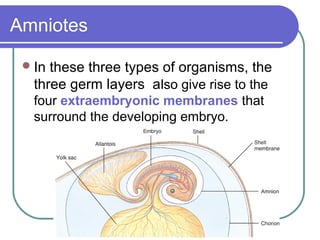
  In these three types of organisms, the
   three germ layers also give rise to the
   four extraembryonic membranes that
   surround the developing embryo.
Amniotes
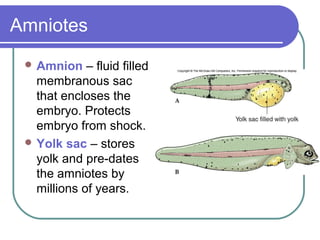
  Amnion    – fluid filled
   membranous sac
   that encloses the
   embryo. Protects
   embryo from shock.
  Yolk sac – stores
   yolk and pre-dates
   the amniotes by
   millions of years.
Amniotes
  Allantois - storage of metabolic wastes during
   development.
  Chorion - lies beneath the eggshell and
   encloses the embryo and other
   extraembryonic membrane.
      As embryo grows, the need for oxygen increases.
           Allantois and chorion fuse to form a respiratory surface,
            the chorioallantoic membrane.
  Evolution  of the shelled amniotic egg made
   internal fertilization a requirement.
The Mammalian Placenta and Early
Mammalian Development
  Most mammalian embryos do not
   develop within an egg shell.
    Develop  within the mother’s body.
    Most retained in the mother’s body.

  Monotremes
    Primitive mammals that lay eggs.
    Large yolky eggs resembling bird eggs.

    Duck-billed platypus and spiny anteater.
The Mammalian Placenta and Early
Mammalian Development
  Marsupials
    Embryosborn at an early stage of
    development and continue development in
    abdominal pouch of mother.
  Placental   Mammals
    Represent  94% of the class Mammalia.
    Evolution of the placenta required:
      Reconstruction  of extraembryonic membranes.
      Modification of oviduct - expanded region formed
       a uterus.
Mammalian Development

  The   eggs of placental mammals:
    Are small and store few nutrients.
    Exhibit holoblastic cleavage.

    Show no obvious polarity.
Mammalian Development

  Gastrulation and organogenesis
  resemble the processes in birds and
  other reptiles.
Mammalian Development

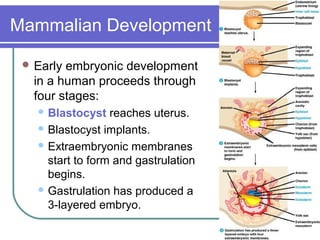
  Early embryonic development
   in a human proceeds through
   four stages:
    Blastocyst   reaches uterus.
    Blastocyst implants.

    Extraembryonic membranes
     start to form and gastrulation
     begins.
    Gastrulation has produced a
     3-layered embryo.
Mammalian Development
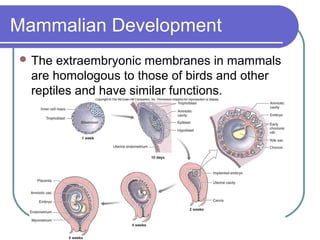
 The  extraembryonic membranes in mammals
  are homologous to those of birds and other
  reptiles and have similar functions.
Mammalian Development
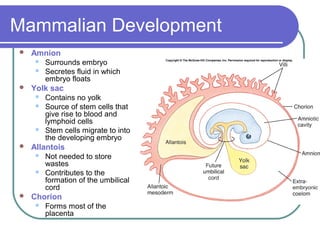
   Amnion
        Surrounds embryo
        Secretes fluid in which
         embryo floats
   Yolk sac
        Contains no yolk
        Source of stem cells that
         give rise to blood and
         lymphoid cells
        Stem cells migrate to into
         the developing embryo
   Allantois
        Not needed to store
         wastes
        Contributes to the
         formation of the umbilical
         cord
   Chorion
        Forms most of the
         placenta
Organogenesis

  Variousregions of the three embryonic
  germ layers develop into the rudiments
  of organs during the process of
  organogenesis.
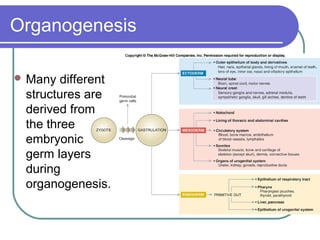
Organogenesis

 Many  different
 structures are
 derived from
 the three
 embryonic
 germ layers
 during
 organogenesis.
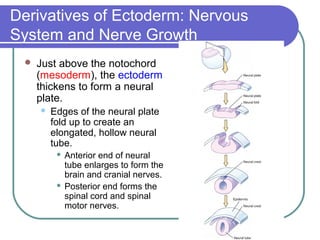
Derivatives of Ectoderm: Nervous
System and Nerve Growth
    Just above the notochord
     (mesoderm), the ectoderm
     thickens to form a neural
     plate.
        Edges of the neural plate
         fold up to create an
         elongated, hollow neural
         tube.
           Anterior end of neural
            tube enlarges to form the
            brain and cranial nerves.
           Posterior end forms the
            spinal cord and spinal
            motor nerves.
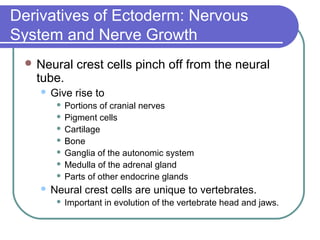
Derivatives of Ectoderm: Nervous
System and Nerve Growth
  Neural       crest cells pinch off from the neural
   tube.
       Give rise to
          Portions of cranial nerves
          Pigment cells

          Cartilage

          Bone

          Ganglia of the autonomic system

          Medulla of the adrenal gland

          Parts of other endocrine glands

       Neural crest cells are unique to vertebrates.
            Important in evolution of the vertebrate head and jaws.
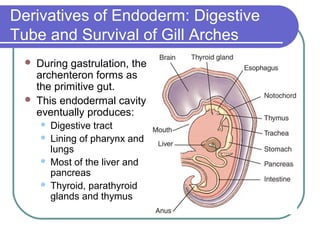
Derivatives of Endoderm: Digestive
Tube and Survival of Gill Arches
    During gastrulation, the
     archenteron forms as
     the primitive gut.
    This endodermal cavity
     eventually produces:
        Digestive tract
        Lining of pharynx and
         lungs
        Most of the liver and
         pancreas
        Thyroid, parathyroid
         glands and thymus
Derivatives of Endoderm: Digestive
Tube and Survival of Gill Arches
  Pharyngeal   pouches are derivatives of the
   digestive tract.
     Arise in early embryonic development of all
      vertebrates.
     During development, endodermally-lined
      pharyngeal pouches interact with overlying
      ectoderm to form gill arches.
     In fish, gill arches develop into gills.
     In terrestrial vertebrates:
         No respiratory function
         1st arch and endoderm-lined pouch form upper and lower
          jaws, and inner ear.
         2nd, 3rd, and 4th gill pouches form tonsils, parathyroid
          gland and thymus.
Derivatives of Mesoderm: Support,
Movement and the Beating Heart
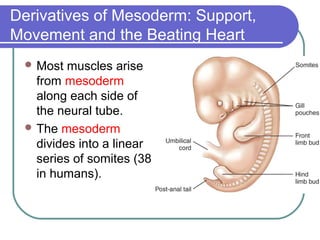
  Most  muscles arise
   from mesoderm
   along each side of
   the neural tube.
  The mesoderm
   divides into a linear
   series of somites (38
   in humans).
Derivatives of Mesoderm: Support,
Movement and the Beating Heart
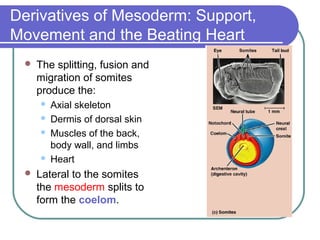
    The splitting, fusion and
     migration of somites
     produce the:
        Axial skeleton
        Dermis of dorsal skin
        Muscles of the back,
         body wall, and limbs
        Heart
    Lateral to the somites
     the mesoderm splits to
     form the coelom.

Processes on animal development

  • 1.
  • 2.
    Early Concepts: Preformationvs Epigenesis  The question of how a zygote becomes an animal has been asked for centuries.  As recently as the 18th century, the prevailing theory was a notion called preformation – the idea that the egg or sperm contains an embryo. A preformed miniature infant, or “homunculus,” that simply becomes larger during development.
  • 3.
    Early Concepts: Preformationvs Epigenesis  Kaspar Friederich Wolff (1759) demonstrated there was no preformed chick in the early egg.  Undifferentiated granular material became arranged into layers.  The layers thickened, thinned, and folded to produce the embryo.
  • 4.
    Early Concepts: Preformationvs Epigenesis  Epigenesis is the concept that the fertilized egg contains building materials only, somehow assembled by an unknown directing force.  Although current ideas of development are essentially epigenetic in concept, far more is known about what directs growth and differentiation.
  • 5.
    Key Events inDevelopment  Development describes the changes in an organism from its earliest beginnings through maturity.  Search for commonalities.
  • 6.
    Key Events inDevelopment  Specializationof cell types occurs as a hierarchy of developmental decisions.  Cell types arise from conditions created in preceding stages.  Interactions become increasingly restrictive.  With each new stage:  Each stage limits developmental fate.  Cells lose option to become something different  Said to be determined.
  • 7.
    Key Events inDevelopment  The two basic processes responsible for this progressive subdivision:  Cytoplasmic localization  Induction
  • 8.
    Fertilization  Fertilization is the initial event in development in sexual reproduction.  Union of male and female gametes  Provides for recombination of paternal and maternal genes.  Restores the diploid number.  Activates the egg to begin development.
  • 9.
    Fertilization  Oocyte Maturation  Egg grows in size by accumulating yolk.  Containsmuch mRNA, ribosomes, tRNA and elements for protein synthesis.  Morphogenetic determinants direct the activation and repression of specific genes later in post-fertilization development.  Egg nucleus grows in size, bloated with RNA.  Now called the germinal vesicle.
  • 10.
    Fertilization  Mostofthese preparations in the egg occur during the prolonged prophase I.  In mammals  Oocyte now has a highly structured system.  Afterfertilization it will support nutritional requirements of the embryo and direct its development through cleavage.  Aftermeiosis resumes, the egg is ready to fuse its nucleus with the sperm nucleus.
  • 11.
    Fertilization and Activation A century of research has been conducted on marine invertebrates.  Especially sea urchins
  • 12.
    Contact Between Sperm& Egg  Broadcast spawners often release a chemotactic factor that attracts sperm to eggs.  Species specific  Sperm enter the jelly layer.  Egg-recognition proteins on the acrosomal process bind to species- specific sperm receptors on the vitelline envelope.
  • 13.
    Fertilization in SeaUrchins  Prevention of polyspermy – only one sperm can enter.  Fast block  Depolarization of membrane  Slow block  Cortical reaction resulting in fertilization membrane
  • 14.
    Fertilization in SeaUrchins  The cortical reaction follows the fusion of thousands of enzyme-rich cortical granules with the egg membrane.  Cortical granules release contents between the membrane and vitelline envelope.  Creates an osmotic gradient  Water rushes into space  Elevates the envelope  Lifts away all bound sperm except the one sperm that has successfully fused with the egg plasma membrane.
  • 15.
  • 16.
    Fertilization in SeaUrchins  One cortical granule enzyme causes the vitelline envelope to harden.  Now called the fertilization membrane.  Block to polyspermy is now complete.  Similar process occurs in mammals.
  • 17.
    Fertilization in SeaUrchins  The increased Ca2+ concentration in the egg after the cortical reaction results in an increase in the rates of cellular respiration and protein synthesis.  The egg is activated.
  • 18.
    Fusion of Pronuclei  Aftersperm and egg membranes fuse, the sperm loses its flagellum.  Enlarged sperm nucleus is the male pronucleus and migrates inward to contact the female pronucleus.  Fusion of male and female pronuclei forms a diploid zygote nucleus.
  • 19.
    Cleavage  Cleavage – rapid cell divisions following fertilization.  Very little growth occurs.  Each cell called a blastomere.  Morula – solid ball of cells. First 5-7 divisions.
  • 20.
    Polarity  Theeggs and zygotes of many animals (not mammals) have a definite polarity.  The polarity is defined by the distribution of yolk.  The vegetal pole has the most yolk and the animal pole has the least.
  • 21.
    Body Axes The development of body axes in frogs is influenced by the polarity of the egg. The polarity of the egg determines the anterior-posterior axis before fertilization. At fertilization, the pigmented cortex slides over the underlying cytoplasm toward the point of sperm entry. This rotation (red arrow) exposes a region of lighter-colored cytoplasm, the gray crescent, which is a marker of the dorsal side. The first cleavage division bisects the gray crescent. Once the anterior- posterior and dorsal-ventral axes are defined, so is the left-right axis.
  • 22.
    Amount of Yolk  Different types of animals have different amounts of yolk in their eggs.  Isolecithal – very little yolk, even distribution.  Mesolecithal – moderate amount of yolk concentrated at vegetal pole.  Telolecithal – Lots of yolk at vegetal pole.  Centrolecithal – lots of yolk, centrally located.
  • 23.
    Cleavage in Frogs  Cleavage planes usually follow a specific pattern that is relative to the animal and vegetal poles of the zygote.  Animal pole blastomeres are smaller.  Blastocoel in animal hemisphere.  Little yolk, cleavage furrows complete.  Holoblastic cleavage
  • 24.
    Cleavage in Birds  Meroblastic cleavage, incomplete division of the egg.  Occurs in species with yolk-rich eggs, such as reptiles and birds.  Blastoderm – cap of cells on top of yolk.
  • 25.
    Direct vs. IndirectDevelopment  When lots of nourishing yolk is present, embryos develop into a miniature adult.  Direct development  When little yolk is present, young develop into larval stages that can feed.  Indirect development  Mammals have little yolk, but nourish the embryo via the placenta.
  • 26.
    Blastula A fluid filled cavity, the blastocoel, forms within the embryo – a hollow ball of cells now called a blastula.
  • 27.
    Gastrulation  The morphogenetic process called gastrulation rearranges the cells of a blastula into a three- layered (triploblastic) embryo, called a gastrula, that has a primitive gut.  Diploblastic organisms have two germ layers.
  • 28.
    Gastrulation  Thethree tissue layers produced by gastrulation are called embryonic germ layers.  The ectoderm forms the outer layer of the gastrula.  Outer surfaces, neural tissue  The endoderm lines the embryonic digestive tract.  The mesoderm partly fills the space between the endoderm and ectoderm.  Muscles, reproductive system
  • 29.
    Gastrulation – SeaUrchin  Gastrulation in a sea urchin produces an embryo with a primitive gut (archenteron) and three germ layers.  Blastopore – open end of gut, becomes anus in deuterostomes.
  • 30.
    Gastrulation - Frog  Result– embryo with gut & 3 germ layers.  More complicated:  Yolk laden cells in vegetal hemisphere.  Blastula wall more than one cell thick.
  • 31.
    Gastrulation - Chick  Gastrulation in the chick is affected by the large amounts of yolk in the egg.  Primitive streak – a groove on the surface along the future anterior-posterior axis.  Functionally equivalent to blastopore lip in frog.
  • 32.
    Gastrulation - Chick  Blastoderm consists of two layers:  Epiblast and hypoblast  Layers separated by a blastocoel  Epiblast forms endoderm and mesoderm.  Cells on surface of embryo form ectoderm.
  • 33.
    Gastrulation - Mouse  Inmammals the blastula is called a blastocyst.  Inner cell mass will become the embryo while trophoblast becomes part of the placenta.  Notice that the gastrula is similar to that of the chick.
  • 34.
    Suites of DevelopmentalCharacters  Two major groups of triploblastic animals:  Protostomes  Deuterostomes  Differentiated by:  Spiral vs. radial cleavage  Regulative vs. mosaic cleavage  Blastopore becomes mouth vs. anus  Schizocoelous vs. enterocoelous coelom formation.
  • 35.
    Deuterostome Development Deuterostomes include echinoderms (sea urchins, sea stars etc) and chordates.  Radial cleavage
  • 36.
    Deuterostome Development Regulative development – the fate of a cell depends on its interactions with neighbors, not what piece of cytoplasm it has. A blastomere isolated early in cleavage is able to from a whole individual.
  • 37.
    Deuterostome Development Deuterostome means second mouth.  The blastopore becomes the anus and the mouth develops as the second opening.
  • 38.
    Deuterostome Development The coelom is a body cavity completely surrounded by mesoderm.  Mesoderm & coelom form simultaneously.  Inenterocoely, the coelom forms as outpocketing of the gut.
  • 39.
    Deuterostome Development Typicaldeuterostomes have coeloms that develop by enterocoely.  Vertebrates use a modified version of schizocoely.
  • 40.
    Protostome Development Protostomes include flatworms, annelids and molluscs.  Spiral cleavage
  • 41.
    Protostome Development Mosaic development – cell fate is determined by the components of the cytoplasm found in each blastomere.  Morphogenetic determinants.  An isolated blastomere can’t develop.
  • 42.
    Protostome Development Protostome means first mouth.  Blastopore becomes the mouth.  The second opening will become the anus.
  • 43.
    Protostome Development  In protostomes, a mesodermal band of tissue forms before the coelom is formed.  The mesoderm splits to form a coelom.  Schizocoely  Not all protostomes have a true coelom.  Pseudocoelomates have a body cavity between mesoderm and endoderm.  Acoelomates have no body cavity at all other than the gut.
  • 44.
    Two Clades ofProtostomes  Lophotrochozoan protostomes include annelid worms, molluscs, & some small phyla.  Lophophore – horseshoe shaped feeding structure.  Trochophore larva  Feature all four protostome characteristics.
  • 45.
    Two Clades ofProtostomes  The ecdysozoan protostomes include arthropods, roundworms, and other taxa that molt their exoskeletons.  Ecdysis – shedding of the cuticle.  Many do not show spiral cleavage.
  • 46.
    Building a BodyPlan  An organism’s development is determined by the genome of the zygote and also by differences that arise between early embryonic cells.  Different genes will be expressed in different cells.
  • 47.
    Building a BodyPlan  Uneven distribution of substances in the egg called cytoplasmic determinants results in some of these differences.  Position of cells in the early embryo result in differences as well.  Induction
  • 48.
    Restriction of CellularPotency  In many species that have cytoplasmic determinants only the zygote is totipotent, capable of developing into all the cell types found in the adult.
  • 49.
    Restriction of CellularPotency  Unevenly distributed cytoplasmic determinants in the egg cell:  Are important in establishing the body axes.  Set up differences in blastomeres resulting from cleavage.
  • 50.
    Restriction of CellularPotency  As embryonic development proceeds, the potency of cells becomes progressively more limited in all species.
  • 51.
    Cell Fate Determinationand Pattern Formation by Inductive Signals  Once embryonic cell division creates cells that differ from each other,  The cells begin to influence each other’s fates by induction.
  • 52.
    Induction  Induction is the capacity of some cells to cause other cells to develop in a certain way.  Dorsal lip of the blastopore induces neural development.  Primary organizer
  • 53.
    Spemann-Mangold Experiment  Transplanting a piece of dorsal blastopore lip from a salamander gastrula to a ventral or lateral position in another gastrula developed into a notochord & somites and it induced the host ectoderm to form a neural tube.
  • 54.
    Building a BodyPlan  Cell differentiation – the specialization of cells in their structure and function.  Morphogenesis – the process by which an animal takes shape and differentiated cells end up in their appropriate locations.
  • 55.
    Building a BodyPlan  The sequence includes  Cell movement  Changes in adhesion  Cell proliferation  There is no “hard-wired” master control panel directing development.  Sequence of local patterns in which one step in development is a subunit of another.  Each step in the developmental hierarchy is a necessary preliminary for the next.
  • 56.
    Hox Genes  Hox genes control the subdivision of embryos into regions of different developmental fates along the anteroposterior axis.  Homologous in diverse organisms.  These are master genes that control expression of subordinate genes.
  • 57.
    Formation of theVertebrate Limb  Inductivesignals play a major role in pattern formation – the development of an animal’s spatial organization.
  • 58.
    Formation of theVertebrate Limb  The molecular cues that control pattern formation, called positional information:  Tella cell where it is with respect to the animal’s body axes.  Determine how the cell and its descendents respond to future molecular signals.
  • 59.
    Formation of theVertebrate Limb  The wings and legs of chicks, like all vertebrate limbs begin as bumps of tissue called limb buds.  The embryonic cells within a limb bud respond to positional information indicating location along three axes.
  • 60.
    Formation of theVertebrate Limb  One limb-bud organizer region is the apical ectodermal ridge (AER).  A thickened area of ectoderm at the tip of the bud.  The second major limb-bud organizer region is the zone of polarizing activity (ZPA).  A block of mesodermal tissue located underneath the ectoderm where the posterior side of the bud is attached to the body.
  • 61.
    Morphogenesis  Morphogenesis is a major aspect of development in both plants and animals but only in animals does it involve the movement of cells.
  • 62.
    The Cytoskeleton, CellMotility, and Convergent Extension  Changes in the shape of a cell usually involve reorganization of the cytoskeleton.
  • 63.
    Changes in CellShape  The formation of the neural tube is affected by microtubules and microfilaments.
  • 64.
    Cell Migration The cytoskeleton also drives cell migration, or cell crawling.  The active movement of cells from one place to another.  Ingastrulation, tissue invagination is caused by changes in both cell shape and cell migration.
  • 65.
    Evo-Devo  Evolutionary developmental biology - evolution is a process in which organisms become different as a result of changes in the genetic control of development.  Genes that control development are similar in diverse groups of animals.  Hox genes
  • 66.
    Evo-Devo  Insteadofevolution proceeding by the gradual accumulation of numerous small mutations, could it proceed by relatively few mutations in a few developmental genes?  The induction of legs or eyes by a mutation in one gene suggests that these and other organs can develop as modules.
  • 67.
    The Common VertebrateHeritage  Vertebrates share a common ancestry and a common pattern of early development.  Vertebrate hallmarks all present briefly.  Dorsal neural tube  Notochord  Pharyngeal gill pouches  Postanal tail
  • 68.
    Amniotes  Theembryos of birds, reptiles, and mammals develop within a fluid-filled sac that is contained within a shell or the uterus.  Organisms with these adaptations form a monophyletic group called amniotes.  Allows for embryo to develop away from water.
  • 69.
    Amniotes  Inthese three types of organisms, the three germ layers also give rise to the four extraembryonic membranes that surround the developing embryo.
  • 70.
    Amniotes  Amnion – fluid filled membranous sac that encloses the embryo. Protects embryo from shock.  Yolk sac – stores yolk and pre-dates the amniotes by millions of years.
  • 71.
    Amniotes  Allantois- storage of metabolic wastes during development.  Chorion - lies beneath the eggshell and encloses the embryo and other extraembryonic membrane.  As embryo grows, the need for oxygen increases.  Allantois and chorion fuse to form a respiratory surface, the chorioallantoic membrane.  Evolution of the shelled amniotic egg made internal fertilization a requirement.
  • 72.
    The Mammalian Placentaand Early Mammalian Development  Most mammalian embryos do not develop within an egg shell.  Develop within the mother’s body.  Most retained in the mother’s body.  Monotremes  Primitive mammals that lay eggs.  Large yolky eggs resembling bird eggs.  Duck-billed platypus and spiny anteater.
  • 73.
    The Mammalian Placentaand Early Mammalian Development  Marsupials  Embryosborn at an early stage of development and continue development in abdominal pouch of mother.  Placental Mammals  Represent 94% of the class Mammalia.  Evolution of the placenta required:  Reconstruction of extraembryonic membranes.  Modification of oviduct - expanded region formed a uterus.
  • 74.
    Mammalian Development The eggs of placental mammals:  Are small and store few nutrients.  Exhibit holoblastic cleavage.  Show no obvious polarity.
  • 75.
    Mammalian Development Gastrulation and organogenesis resemble the processes in birds and other reptiles.
  • 76.
    Mammalian Development Early embryonic development in a human proceeds through four stages:  Blastocyst reaches uterus.  Blastocyst implants.  Extraembryonic membranes start to form and gastrulation begins.  Gastrulation has produced a 3-layered embryo.
  • 77.
    Mammalian Development  The extraembryonic membranes in mammals are homologous to those of birds and other reptiles and have similar functions.
  • 78.
    Mammalian Development  Amnion  Surrounds embryo  Secretes fluid in which embryo floats  Yolk sac  Contains no yolk  Source of stem cells that give rise to blood and lymphoid cells  Stem cells migrate to into the developing embryo  Allantois  Not needed to store wastes  Contributes to the formation of the umbilical cord  Chorion  Forms most of the placenta
  • 79.
    Organogenesis  Variousregionsof the three embryonic germ layers develop into the rudiments of organs during the process of organogenesis.
  • 80.
    Organogenesis  Many different structures are derived from the three embryonic germ layers during organogenesis.
  • 81.
    Derivatives of Ectoderm:Nervous System and Nerve Growth  Just above the notochord (mesoderm), the ectoderm thickens to form a neural plate.  Edges of the neural plate fold up to create an elongated, hollow neural tube.  Anterior end of neural tube enlarges to form the brain and cranial nerves.  Posterior end forms the spinal cord and spinal motor nerves.
  • 82.
    Derivatives of Ectoderm:Nervous System and Nerve Growth  Neural crest cells pinch off from the neural tube.  Give rise to  Portions of cranial nerves  Pigment cells  Cartilage  Bone  Ganglia of the autonomic system  Medulla of the adrenal gland  Parts of other endocrine glands  Neural crest cells are unique to vertebrates.  Important in evolution of the vertebrate head and jaws.
  • 83.
    Derivatives of Endoderm:Digestive Tube and Survival of Gill Arches  During gastrulation, the archenteron forms as the primitive gut.  This endodermal cavity eventually produces:  Digestive tract  Lining of pharynx and lungs  Most of the liver and pancreas  Thyroid, parathyroid glands and thymus
  • 84.
    Derivatives of Endoderm:Digestive Tube and Survival of Gill Arches  Pharyngeal pouches are derivatives of the digestive tract.  Arise in early embryonic development of all vertebrates.  During development, endodermally-lined pharyngeal pouches interact with overlying ectoderm to form gill arches.  In fish, gill arches develop into gills.  In terrestrial vertebrates:  No respiratory function  1st arch and endoderm-lined pouch form upper and lower jaws, and inner ear.  2nd, 3rd, and 4th gill pouches form tonsils, parathyroid gland and thymus.
  • 85.
    Derivatives of Mesoderm:Support, Movement and the Beating Heart  Most muscles arise from mesoderm along each side of the neural tube.  The mesoderm divides into a linear series of somites (38 in humans).
  • 86.
    Derivatives of Mesoderm:Support, Movement and the Beating Heart  The splitting, fusion and migration of somites produce the:  Axial skeleton  Dermis of dorsal skin  Muscles of the back, body wall, and limbs  Heart  Lateral to the somites the mesoderm splits to form the coelom.