BY: SANJAY KUMAR LECTURER
What is Osmoregulation
 The maintenance of constant osmotic conditions
(water and solute concentration) in the body is
called osmoregulation.
 Animals may be either osmoregulators or
osmoconformers with respect to their external
environment.
 Osmolarity means how much solutes are
dissolved in a solution
https://youtu.be/Qg_SXsAwMmA
 Those animals that can maintain internal osmotic
concentrations different from the surrounding
medium are called osmoregulators
 Such animals are hypotonic or hypertonic to their
environment.
 Those animals that change the osmotic
concentrations of the body fluids according to that of
surrounding medium are called osmoconformers.
These are isotonic to their external environment.
 These include all marine invertebrates, some
freshwater invertebrates and some marine vertebrates
like hag fishes and elasmobranches (sharks and rays)
 Almost all osmoregulators.
 Generally hypertonic to their outer environment.
 These animals deal with these problems by
producing large volume of diluted urine.
 Their kidney actively reabsorbs the salts
 These animals also actively transport salts
from the external dilute medium with the help of
special salt cells called ionocytes.
 Ionocytes are found in the amphibian skin and
gills of fishes
 Teleosts (bony fishes) are osmoregulators in
marine environment which are hypotonic to
their environment.
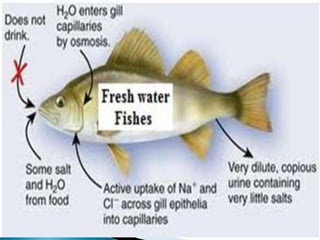
 So these fishes have tendency to lose water to
the environment, especially across the gill
epithelium.
 In order to replace the water loss, these
fishes usually drink large amount of water
unlike freshwater fishes.
https://youtu.be/Qg_SXsAwMmA
 Among the excess salts, Na+, Cl- and some amount of K+
are removed across the gill epithelium while divalent ions
like Mg++, Ca++ are excreted by the kidney.
 Some fishes also have special salt secreting glands in the
wall of rectum called rectal glands that remove salts into
the digestive tract which are then eliminated from the body
during egestion.
https://youtu.be/Qg_SXsAwMmA
 The blood composition of cartilaginous fishes, such as sharks and
rays, is similar to that of bony fishes.
 They maintained osmolarity by high levels of urea and
trimethylamine oxide (TMO) in the blood.
 The shark’s blood electrolytes composition is not similar to that of
sea-water, but maintain isotonicity with sea-water by storing urea at
high concentration.
 Sharks are ureotelic (secrete urea).
 Urea damages living tissues and deactivate enzymes, so to cope with
this problems, some fishes retain TMO in order to prevent tissue
damage and activate enzymes.
 The successful groups of land animals are arthropods
reptile, birds and mammals.
Water proof external covering
 The presence of chitinous exoskeleton in arthropods
and dead keratinized skin in vertebrates are
adaptation to reduce water loss by their bodies.
Storing and excretion of solid Wastes
 Reptiles, birds and Insects excrete Uric acid which is
insoluble in water and require little water (10ml for
1g) to remove uric acid.
Storing the Waste:
 Mammals do retain some urea in their kidney where it
help in reabsorption of water.
 Desert mammals are very much resistant in this
regard. They can tolerate against strong degree
of dehydration by special metabolic and
behavioral adaptation. This characteristic is
called anhydrobiosis.
 Actually, these animals feed upon seeds of desert
plants in which large amount of carbohydrate are
stored, during the breakdown of these
compounds; water is produced as by-product
that is utilized by these animals.
 Best example of such animals is kangaroo rat.
 They avoid day time heat, and emerge at night.
90% of the water that they use is metabolic water
derived from cellular oxidation.
Osmoregulation in Animals