TOPIC:-FILTER DESIGN 
By 
Nehe Pradeepkumar 
Dattatraya
 Introduction. 
 IIR Filter Design by Impulse invariance method. 
 IIR Filter Design by Bilinear transformation method. 
 FIR Filter Design by Frequency sampling technique. 
 Advantages and Disadvantages.
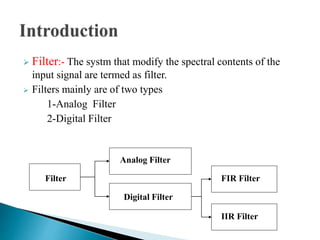
 Filter:- The systm that modify the spectral contents of the 
input signal are termed as filter. 
 Filters mainly are of two types 
1-Analog Filter 
2-Digital Filter 
Filter 
Analog Filter 
Digital Filter 
FIR Filter 
IIR Filter
 Performance of digital filter can not influenced due to 
component ageing, temp, &power supply variations 
 Highly immune to noise. 
 Operated over wide range of frequency. 
 Multiple filtering possible only in digital filter.
 Now we will introduce to the design method of the 
FIR filter and IIR filter respectively. 
 IIR is the infinite impulse response abbreviation. 
 Digital filters by the accumulator, the multiplier, and 
it constitutes IIR filter the way, generally may divide 
into three kinds, respectively is Direct form, Cascade 
form, and Parallel form. 
 IIR filter design methods include the impulse 
invariance, bilinear transformation.
 FIR is the finite impulse response abbreviation, 
because its design construction has not returned to the 
part which gives. 
 Its construction generally uses Direct form and 
Cascade form. 
 FIR filter design methods include the window 
function, frequency sampling.
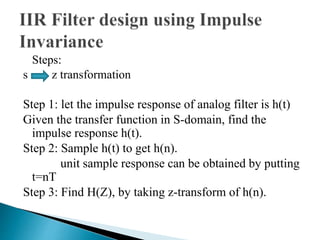
Steps: 
s z transformation 
Step 1: let the impulse response of analog filter is h(t) 
Given the transfer function in S-domain, find the 
impulse response h(t). 
Step 2: Sample h(t) to get h(n). 
unit sample response can be obtained by putting 
t=nT 
Step 3: Find H(Z), by taking z-transform of h(n).
 The most straightforward of these is the impulse 
invariance transformation 
 Let h(t) be the impulse response corresponding to 
H(s), and define the continuous to discrete time 
transformation by setting h(n)=h(nT) 
We sample the continuous time impulse response to 
produce the discrete time filter
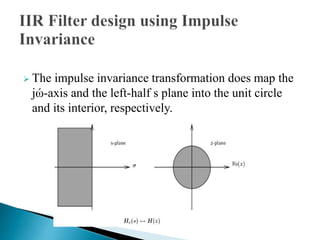
 The impulse invariance transformation does map the 
jώ-axis and the left-half s plane into the unit circle 
and its interior, respectively.
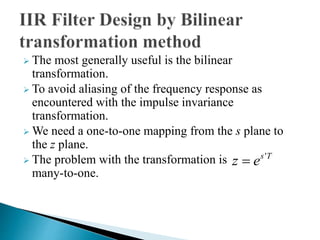
 The most generally useful is the bilinear 
transformation. 
 To avoid aliasing of the frequency response as 
encountered with the impulse invariance 
transformation. 
We need a one-to-one mapping from the s plane to 
the z plane. 
 The problem with the transformation is 
many-to-one. 
s 'T z  e
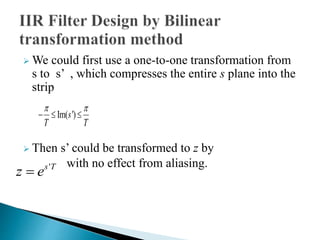
We could first use a one-to-one transformation from 
s to s’ , which compresses the entire s plane into the 
strip 
  
  Im(s ') 
 
T T 
 Then s’ could be transformed to z by 
with no effect from aliasing. 
s 'T z  e
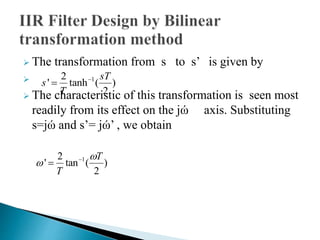
 The transformation from s to s’ is given by 
 
1 2 
sT 
  
' tanh ( ) 
2 
s 
T 
 The characteristic of this transformation is seen most 
readily from its effect on the jώ axis. Substituting 
s=jώ and s’= jώ’ , we obtain 
1 2 
T 
' tan ( ) 
2 
T 
 
  
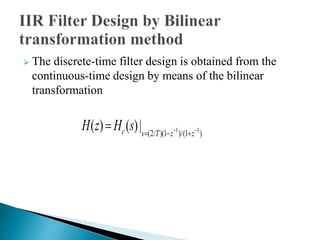
 The discrete-time filter design is obtained from the 
continuous-time design by means of the bilinear 
transformation 
H ( z ) H ( s ) | c s  T  z   
z 
 1 1 (2/ )(1 )/(1 ) 

' ( ) d H  
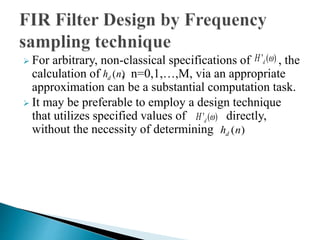
 For arbitrary, non-classical specifications of , the 
calculation of hn 
() , n=0,1,…,M, via an appropriate 
d approximation can be a substantial computation task. 
 It may be preferable to employ a design technique 
that utilizes specified values of H ' (  
) directly, 
d without the necessity of determining 
() d hn
We wish to derive a linear phase IIR filter with real 
nonzero h(n) . The impulse response must be 
symmetric 
M 
[ /2] 
k n 
  
h n A A 
 
 
( )   
2 cos( ) 
0 
 
1 
2 ( 1/ 2) 
1 
k 
k 
M 
where are real and denotes the integer part 
k A[ / 2] M
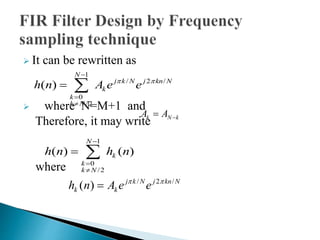
 It can be rewritten as 
 
h n A e e   
  
 where N=M+1 and 
Therefore, it may write 
 
  
h n h n 
( ) ( ) 
where 
1 
/ 2 / 
0 
/2 
( ) 
N 
j k N j kn N 
k 
k 
 
k  
N 
k N k A A  
1 
0 
/2 
N 
k 
k 
 
k  
N 
/ 2 / ( ) j k N j kn N 
k k h n A e e   
 with corresponding transform 
N 
 
  
H z H z 
( ) ( ) 
where 
 Hence 
1 
k 
0 
k N 
/2 
k 
 
 
j  
k / 
N N 
A e z 
 
(1 ) 
H z 
 
 
k j k N 
2 / 1 
( ) 
k 
1 
 
 
e z 
 
sin  
/ 2 
' ( ) 
 ( 1)/2 which has a linear phase 
sin[( / / 2)] 
j T N 
k k 
TN 
H A e 
k N T 
 
  
   

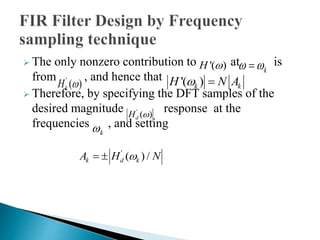
 The only nonzero contribution to H'(  ) at   
 is 
k from , and hence that 
'( ) k H  '( )k k H   N A 
 Therefore, by specifying the DFT samples of the 
desired magnitude response at the 
H ' ()  
d frequencies , and setting 
k  
' ( ) / k d k A   H  N
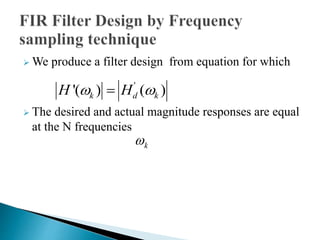
We produce a filter design from equation for which 
H '(k )  Hd' (k ) 
 The desired and actual magnitude responses are equal 
at the N frequencies 
k 
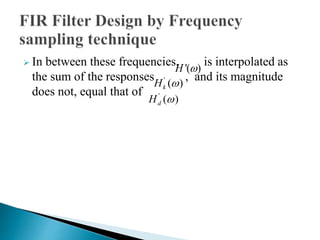
 In between these frequencies, is interpolated as 
H '() 
the sum of the responses , and its magnitude 
does not, equal that of 
' () k H  
' () d H 
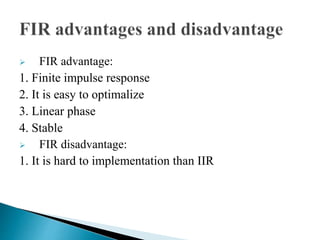
 FIR advantage: 
1. Finite impulse response 
2. It is easy to optimalize 
3. Linear phase 
4. Stable 
 FIR disadvantage: 
1. It is hard to implementation than IIR
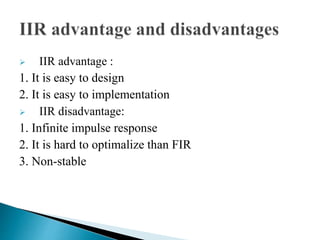
 IIR advantage : 
1. It is easy to design 
2. It is easy to implementation 
 IIR disadvantage: 
1. Infinite impulse response 
2. It is hard to optimalize than FIR 
3. Non-stable
filter design

filter design

  • 1.
    TOPIC:-FILTER DESIGN By Nehe Pradeepkumar Dattatraya
  • 2.
     Introduction. IIR Filter Design by Impulse invariance method.  IIR Filter Design by Bilinear transformation method.  FIR Filter Design by Frequency sampling technique.  Advantages and Disadvantages.
  • 3.
     Filter:- Thesystm that modify the spectral contents of the input signal are termed as filter.  Filters mainly are of two types 1-Analog Filter 2-Digital Filter Filter Analog Filter Digital Filter FIR Filter IIR Filter
  • 4.
     Performance ofdigital filter can not influenced due to component ageing, temp, &power supply variations  Highly immune to noise.  Operated over wide range of frequency.  Multiple filtering possible only in digital filter.
  • 5.
     Now wewill introduce to the design method of the FIR filter and IIR filter respectively.  IIR is the infinite impulse response abbreviation.  Digital filters by the accumulator, the multiplier, and it constitutes IIR filter the way, generally may divide into three kinds, respectively is Direct form, Cascade form, and Parallel form.  IIR filter design methods include the impulse invariance, bilinear transformation.
  • 6.
     FIR isthe finite impulse response abbreviation, because its design construction has not returned to the part which gives.  Its construction generally uses Direct form and Cascade form.  FIR filter design methods include the window function, frequency sampling.
  • 7.
    Steps: s ztransformation Step 1: let the impulse response of analog filter is h(t) Given the transfer function in S-domain, find the impulse response h(t). Step 2: Sample h(t) to get h(n). unit sample response can be obtained by putting t=nT Step 3: Find H(Z), by taking z-transform of h(n).
  • 8.
     The moststraightforward of these is the impulse invariance transformation  Let h(t) be the impulse response corresponding to H(s), and define the continuous to discrete time transformation by setting h(n)=h(nT) We sample the continuous time impulse response to produce the discrete time filter
  • 9.
     The impulseinvariance transformation does map the jώ-axis and the left-half s plane into the unit circle and its interior, respectively.
  • 10.
     The mostgenerally useful is the bilinear transformation.  To avoid aliasing of the frequency response as encountered with the impulse invariance transformation. We need a one-to-one mapping from the s plane to the z plane.  The problem with the transformation is many-to-one. s 'T z  e
  • 11.
    We could firstuse a one-to-one transformation from s to s’ , which compresses the entire s plane into the strip     Im(s ')  T T  Then s’ could be transformed to z by with no effect from aliasing. s 'T z  e
  • 12.
     The transformationfrom s to s’ is given by  1 2 sT   ' tanh ( ) 2 s T  The characteristic of this transformation is seen most readily from its effect on the jώ axis. Substituting s=jώ and s’= jώ’ , we obtain 1 2 T ' tan ( ) 2 T    
  • 13.
     The discrete-timefilter design is obtained from the continuous-time design by means of the bilinear transformation H ( z ) H ( s ) | c s  T  z   z  1 1 (2/ )(1 )/(1 ) 
  • 14.
    ' ( )d H   For arbitrary, non-classical specifications of , the calculation of hn () , n=0,1,…,M, via an appropriate d approximation can be a substantial computation task.  It may be preferable to employ a design technique that utilizes specified values of H ' (  ) directly, d without the necessity of determining () d hn
  • 15.
    We wish toderive a linear phase IIR filter with real nonzero h(n) . The impulse response must be symmetric M [ /2] k n   h n A A   ( )   2 cos( ) 0  1 2 ( 1/ 2) 1 k k M where are real and denotes the integer part k A[ / 2] M
  • 16.
     It canbe rewritten as  h n A e e      where N=M+1 and Therefore, it may write    h n h n ( ) ( ) where 1 / 2 / 0 /2 ( ) N j k N j kn N k k  k  N k N k A A  1 0 /2 N k k  k  N / 2 / ( ) j k N j kn N k k h n A e e   
  • 17.
     with correspondingtransform N    H z H z ( ) ( ) where  Hence 1 k 0 k N /2 k   j  k / N N A e z  (1 ) H z   k j k N 2 / 1 ( ) k 1   e z  sin  / 2 ' ( )  ( 1)/2 which has a linear phase sin[( / / 2)] j T N k k TN H A e k N T       
  • 18.
     The onlynonzero contribution to H'(  ) at    is k from , and hence that '( ) k H  '( )k k H   N A  Therefore, by specifying the DFT samples of the desired magnitude response at the H ' ()  d frequencies , and setting k  ' ( ) / k d k A   H  N
  • 19.
    We produce afilter design from equation for which H '(k )  Hd' (k )  The desired and actual magnitude responses are equal at the N frequencies k 
  • 20.
     In betweenthese frequencies, is interpolated as H '() the sum of the responses , and its magnitude does not, equal that of ' () k H  ' () d H 
  • 21.
     FIR advantage: 1. Finite impulse response 2. It is easy to optimalize 3. Linear phase 4. Stable  FIR disadvantage: 1. It is hard to implementation than IIR
  • 22.
     IIR advantage: 1. It is easy to design 2. It is easy to implementation  IIR disadvantage: 1. Infinite impulse response 2. It is hard to optimalize than FIR 3. Non-stable