Filter design process
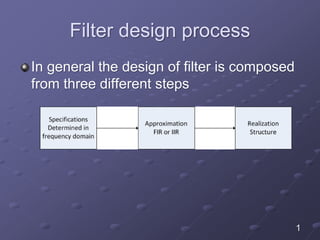
In general the design of filter is composed
from three different steps
1
Filter design techniques
In the design of frequency selective filters,
the desired filter characteristics are
specified in the frequency domain in terms
of the desired magnitude and phase
response of the filter
In the filter design process, we determine
the coefficients of a causal FIR or IIR filter
that closely approximate the desired
frequency response specifications
2
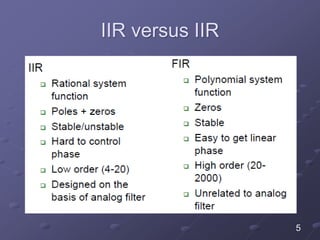
Which type of filter is to be used
In general FIR filters are used in filtering
problems where a linear phase is required
IIR filters can be used if linear phase is not
required
In general IIR filter has a lower side-lobes
in the stop band than an FIR having the
same number of parameters
3
Which type of filter is to be used
If some phase distortion is tolerable then
IIR filter is preferable because its
implementation requires fewer
parameters, less memory and lower
computational complexity
A comparison between FIR and IIR filters
is made in the next slide
4
IIR versus IIR
5
Relation between IIR filter and
the difference equations
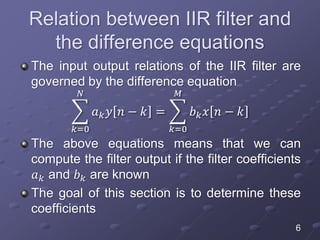
The input output relations of the IIR filter are
governed by the difference equation
𝑘=0
𝑁
𝑎 𝑘 𝑦 𝑛 − 𝑘 =
𝑘=0
𝑀
𝑏 𝑘 𝑥 𝑛 − 𝑘
The above equations means that we can
compute the filter output if the filter coefficients
𝑎 𝑘 and 𝑏 𝑘 are known
The goal of this section is to determine these
coefficients
6
Relation between IIR filter and
the difference equations
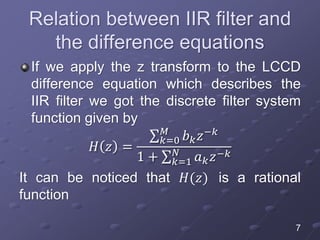
If we apply the z transform to the LCCD
difference equation which describes the
IIR filter we got the discrete filter system
function given by
𝐻 𝑧 =
𝑘=0
𝑀
𝑏 𝑘 𝑧−𝑘
1 + 𝑘=1
𝑁
𝑎 𝑘 𝑧−𝑘
It can be noticed that 𝐻(𝑧) is a rational
function
7
Causality and its implications
All ideal filters are non causal
Non causal means that these filters are
not physically realizable
To illustrate this concept let us consider an
ideal low pass filer
The frequency response of the filter is
given by 𝐻 𝜔 =
1 𝜔 ≤ 𝜔𝑐
0 𝜔𝑐 < 𝜔 < 𝜋
8
Causality and its implications
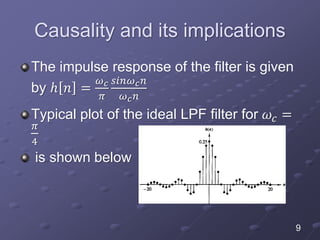
The impulse response of the filter is given
by ℎ 𝑛 =
𝜔 𝑐
𝜋
𝑠𝑖𝑛𝜔 𝑐 𝑛
𝜔 𝑐 𝑛
Typical plot of the ideal LPF filter for 𝜔𝑐 =
𝜋
4
is shown below
9
Causality and its implications
From the plot of ℎ[𝑛] it is clear that ℎ 𝑛 ≠
0 for 𝑛 < 0 which means that the filter is
not causal
If the filter is not causal this means that the
filter output samples 𝑦[𝑛] depends on the
future values of the input 𝑥[𝑛 + 1], 𝑥[𝑛 +
2] which is impossible to estimate
10
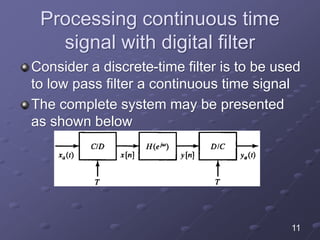
Processing continuous time
signal with digital filter
Consider a discrete-time filter is to be used
to low pass filter a continuous time signal
The complete system may be presented
as shown below
11
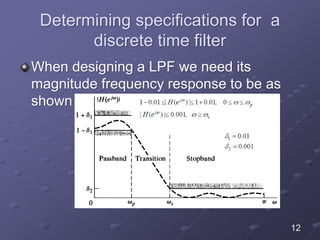
Determining specifications for a
discrete time filter
When designing a LPF we need its
magnitude frequency response to be as
shown
12
Design of discrete time IIR filters
from continuous time filters
The traditional approach to design IIR
filters involves the transformation of a
continuous-time filter into a discrete-time
filter meeting prescribed specifications
This design procedure can be achieved by
finding the system function 𝐻𝑐(𝑠) or the
impulse response of the continuous filter
ℎ 𝑐(𝑡)
13
Design of discrete time IIR filters
from continuous time filters
There are four well known analog filters
used in the design of IIR digital filters
these are
 Butterworth
 Chebyshev I
 Chebyshev II
 Elliptic
14
Design of discrete time IIR filters
from continuous time filters
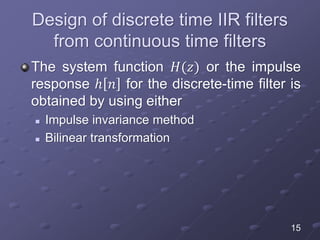
The system function 𝐻(𝑧) or the impulse
response ℎ 𝑛 for the discrete-time filter is
obtained by using either
 Impulse invariance method
 Bilinear transformation
15
IIR filter design by Impulse
invariance
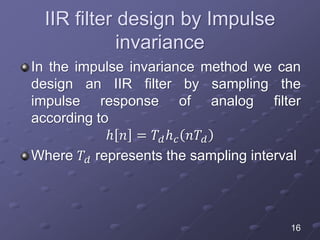
In the impulse invariance method we can
design an IIR filter by sampling the
impulse response of analog filter
according to
ℎ 𝑛 = 𝑇𝑑ℎ 𝑐 𝑛𝑇𝑑
Where 𝑇𝑑 represents the sampling interval
16
IIR filter design by Impulse
invariance
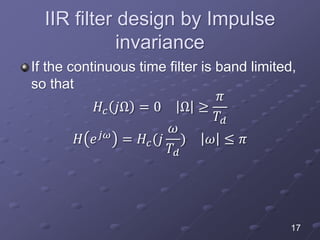
If the continuous time filter is band limited,
so that
𝐻𝑐 𝑗Ω = 0 Ω ≥
𝜋
𝑇𝑑
𝐻 𝑒 𝑗𝜔
= 𝐻𝑐(𝑗
𝜔
𝑇𝑑
) 𝜔 ≤ 𝜋
17
IIR filter design by Impulse
invariance
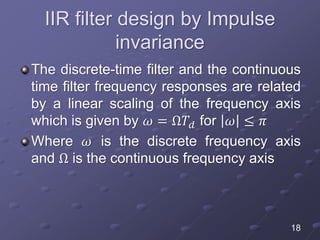
The discrete-time filter and the continuous
time filter frequency responses are related
by a linear scaling of the frequency axis
which is given by 𝜔 = Ω𝑇𝑑 for 𝜔 ≤ 𝜋
Where 𝜔 is the discrete frequency axis
and Ω is the continuous frequency axis
18
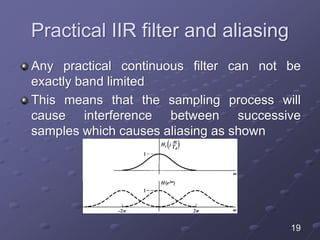
Practical IIR filter and aliasing
Any practical continuous filter can not be
exactly band limited
This means that the sampling process will
cause interference between successive
samples which causes aliasing as shown
19
Practical IIR filter and aliasing
The aliasing problem makes the impulse
invariance method not a suitable method for
the design of high pass filters
However if the continuous time filter
approaches zero at high frequencies, the
aliasing is negligible and can be ignored
20
IIR filter and continuous to discrete
system function transformation
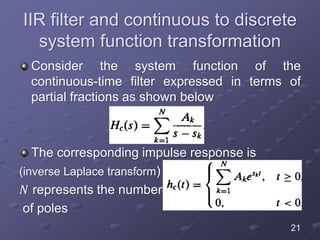
Consider the system function of the
continuous-time filter expressed in terms of
partial fractions as shown below
The corresponding impulse response is
(inverse Laplace transform)
𝑁 represents the number
of poles
21
IIR filter and continuous to discrete
system function transformation
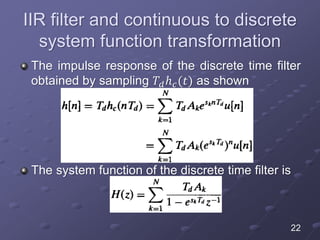
The impulse response of the discrete time filter
obtained by sampling 𝑇𝑑ℎ 𝑐(𝑡) as shown
The system function of the discrete time filter is
22
IIR filter and continuous to discrete
system function transformation
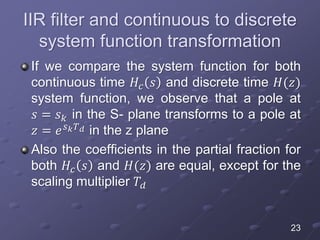
If we compare the system function for both
continuous time 𝐻𝑐 𝑠 and discrete time 𝐻(𝑧)
system function, we observe that a pole at
𝑠 = 𝑠 𝑘 in the S- plane transforms to a pole at
𝑧 = 𝑒 𝑠 𝑘 𝑇 𝑑 in the z plane
Also the coefficients in the partial fraction for
both 𝐻𝑐 𝑠 and 𝐻(𝑧) are equal, except for the
scaling multiplier 𝑇𝑑
23
IIR filter and continuous to discrete
system function transformation
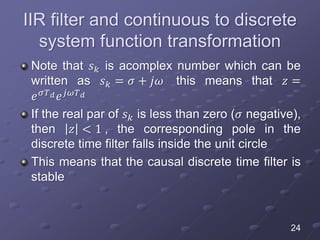
Note that 𝑠 𝑘 is acomplex number which can be
written as 𝑠 𝑘 = 𝜎 + 𝑗𝜔 this means that 𝑧 =
𝑒 𝜎𝑇 𝑑 𝑒 𝑗𝜔𝑇 𝑑
If the real par of 𝑠 𝑘 is less than zero (𝜎 negative),
then 𝑧 < 1 , the corresponding pole in the
discrete time filter falls inside the unit circle
This means that the causal discrete time filter is
stable
24
Example 1
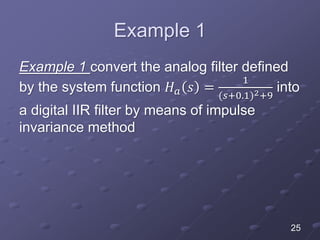
Example 1 convert the analog filter defined
by the system function 𝐻 𝑎 𝑠 =
1
(𝑠+0.1)2+9
into
a digital IIR filter by means of impulse
invariance method
25
Example1 solution
Solution
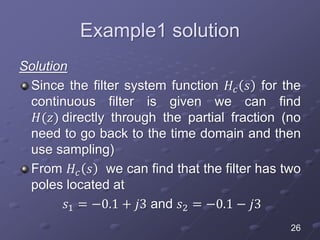
Since the filter system function 𝐻𝑐 𝑠 for the
continuous filter is given we can find
𝐻(𝑧) directly through the partial fraction (no
need to go back to the time domain and then
use sampling)
From 𝐻𝑐 𝑠 we can find that the filter has two
poles located at
𝑠1 = −0.1 + 𝑗3 and 𝑠2 = −0.1 − 𝑗3
26
Example1 solution
Solution
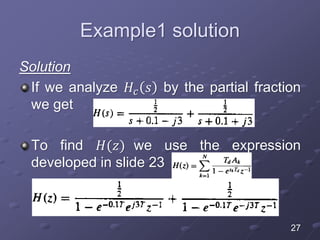
If we analyze 𝐻𝑐 𝑠 by the partial fraction
we get
To find 𝐻(𝑧) we use the expression
developed in slide 23
27
Example1 solution
If we plot the poles and zeros of the
previous example we can see that 𝜎 < 0
and both poles are located in the left side
of the s plane as shown below
28
Example 1 solution
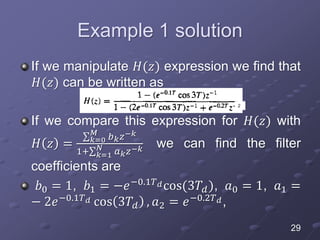
If we manipulate 𝐻(𝑧) expression we find that
𝐻(𝑧) can be written as
If we compare this expression for 𝐻(𝑧) with
𝐻 𝑧 = 𝑘=0
𝑀
𝑏 𝑘 𝑧−𝑘
1+ 𝑘=1
𝑁
𝑎 𝑘 𝑧−𝑘 we can find the filter
coefficients are
𝑏0 = 1, 𝑏1 = −𝑒−0.1𝑇 𝑑cos(3𝑇𝑑), 𝑎0 = 1, 𝑎1 =
− 2𝑒−0.1𝑇 𝑑 cos 3𝑇𝑑 , 𝑎2 = 𝑒−0.2𝑇 𝑑,
29
2
Example 2
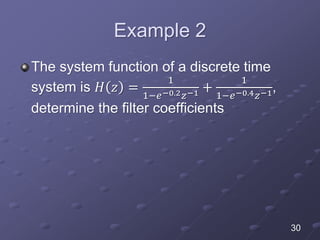
The system function of a discrete time
system is 𝐻 𝑧 =
1
1−𝑒−0.2 𝑧−1 +
1
1−𝑒−0.4 𝑧−1,
determine the filter coefficients
30
Example 2 solution
Note the discrete time system can be
rewritten as 𝐻 𝑧 =
2− 𝑒−0.4+𝑒−0.2 𝑧−1
1− 𝑒−0.4+𝑒−0.2 𝑧−1+𝑒−0.6 𝑧−2
If we compare this expression for 𝐻(𝑧) with
𝐻 𝑧 = 𝑘=0
𝑀
𝑏 𝑘 𝑧−𝑘
1+ 𝑘=1
𝑁
𝑎 𝑘 𝑧−𝑘 we can find the filter
coefficients are
𝑏0 = 2 , 𝑏1 = 𝑒−0.4
+ 𝑒−0.2
, 𝑎0 = 1 , 𝑎1 =
− 𝑒−0.4
− 𝑒−0.2
, 𝑎2 = 𝑒−0.6
31
Example 3
Design a Butterworth filter whose continuous
frequency response is given by
𝐻𝑐(𝑗Ω) 2 =
1
1+
Ω
Ω 𝑐
2𝑁
using the impulse invariance method
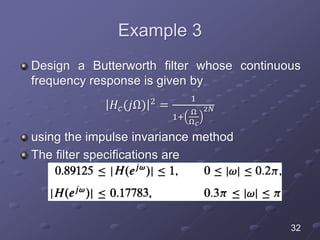
The filter specifications are
32
Example 3 solution
Solution
Since the parameter 𝑇𝑑 cancels in the impulse
invariance procedure we can select 𝑇𝑑 = 1 ,
therefore Ω = 𝜔
In order to deign the filter we need to transform
the discrete filter specifications to specifications
on the continuous time filter
33
Example 3 solution
Solution
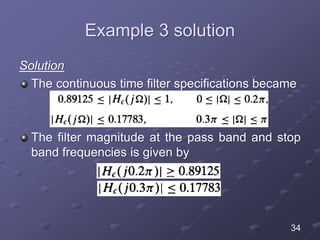
The continuous time filter specifications became
The filter magnitude at the pass band and stop
band frequencies is given by
34
Example 3 solution
Solution
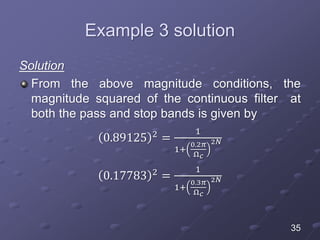
From the above magnitude conditions, the
magnitude squared of the continuous filter at
both the pass and stop bands is given by
0.89125 2 =
1
1+
0.2𝜋
Ω 𝑐
2𝑁
0.17783 2
=
1
1+
0.3𝜋
Ω 𝑐
2𝑁
35
Example 3 solution
Solution
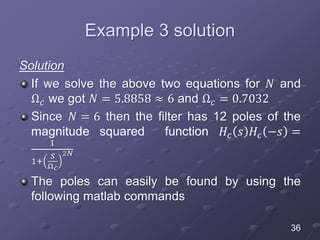
If we solve the above two equations for 𝑁 and
Ω 𝑐 we got 𝑁 = 5.8858 ≈ 6 and Ω 𝑐 = 0.7032
Since 𝑁 = 6 then the filter has 12 poles of the
magnitude squared function 𝐻𝑐 𝑠 𝐻𝑐 −𝑠 =
1
1+
𝑆
Ω 𝑐
2𝑁
The poles can easily be found by using the
following matlab commands
36
Example 3 solution
𝑎 = 1
b=[68.399 0 0 0 0 0 0 0 0 0 0 0 1]
[𝑧 𝑝 𝑘] = 𝑡𝑓2𝑧𝑝(𝑎, 𝑏)
37
Example 3 solution
Solution
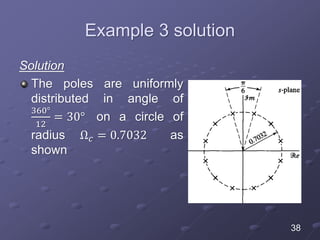
The poles are uniformly
distributed in angle of
360°
12
= 30° on a circle of
radius Ω 𝑐 = 0.7032 as
shown
38
Example 3 solution
Solution
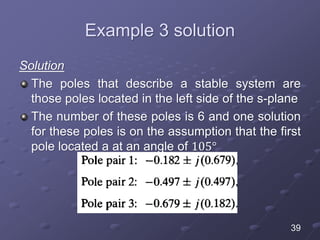
The poles that describe a stable system are
those poles located in the left side of the s-plane
The number of these poles is 6 and one solution
for these poles is on the assumption that the first
pole located a at an angle of 105°
39
Example 3 solution
Solution
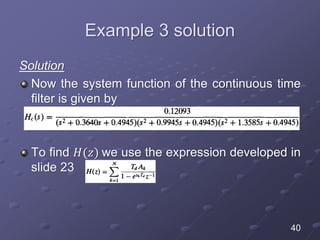
Now the system function of the continuous time
filter is given by
To find 𝐻(𝑧) we use the expression developed in
slide 23
40
Example 3 solution
Solution
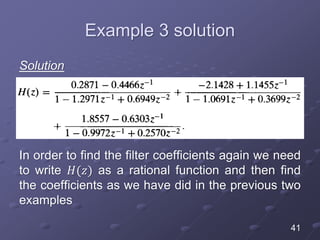
In order to find the filter coefficients again we need
to write 𝐻(𝑧) as a rational function and then find
the coefficients as we have did in the previous two
examples
41
Impulse invariance summery
To summarize, the impulse invariance method maps
the s-plane to the z-plane by sampling the impulse
response of continuous (analog) time filter
Impulse invariance suffers from aliasing problem
and therefore is not suitable for HPF design
42
Impulse invariance summery
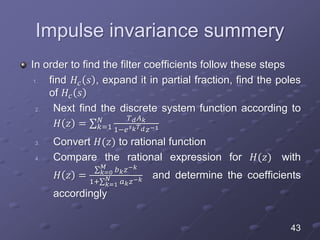
In order to find the filter coefficients follow these steps
1. find 𝐻𝑐 𝑠 , expand it in partial fraction, find the poles
of 𝐻𝑐 𝑠
2. Next find the discrete system function according to
𝐻 𝑧 = 𝑘=1
𝑁 𝑇 𝑑 𝐴 𝑘
1−𝑒 𝑠 𝑘 𝑇 𝑑 𝑧−1
3. Convert 𝐻(𝑧) to rational function
4. Compare the rational expression for 𝐻(𝑧) with
𝐻 𝑧 = 𝑘=0
𝑀
𝑏 𝑘 𝑧−𝑘
1+ 𝑘=1
𝑁 𝑎 𝑘 𝑧−𝑘 and determine the coefficients
accordingly
43
Bilinear transformation
The bilinear transformation is an algebraic
transformation between the 𝑠 and 𝑧 planes
Bilinear transformation maps the entire 𝑗Ω-
axis in the s-plane to one revolution of the
unit circle in the z-plane
Bilinear transformation avoids the aliasing
problem associated with time invariant
approach
44
Bilinear transformation
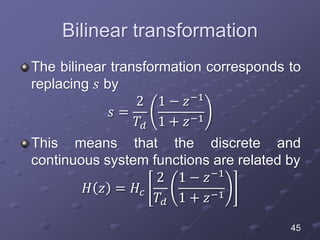
The bilinear transformation corresponds to
replacing 𝑠 by
𝑠 =
2
𝑇𝑑
1 − 𝑧−1
1 + 𝑧−1
This means that the discrete and
continuous system functions are related by
𝐻 𝑧 = 𝐻𝑐
2
𝑇𝑑
1 − 𝑧−1
1 + 𝑧−1
45
Bilinear transformation
To develop the properties of the algebraic
transformation we solve for 𝑧 to obtain
𝑧 =
2
𝑇𝑑
1 +
𝑇𝑑
2
𝑠
1 −
𝑇𝑑
2
𝑠
Substituting 𝑠 = 𝜎 + 𝑗𝜔, we got
𝑧 =
1 + 𝜎
𝑇𝑑
2
+ 𝑗Ω
𝑇𝑑
2
1 − 𝜎
𝑇𝑑
2
− 𝑗Ω
𝑇𝑑
2
46
Bilinear transformation
Again as in the time invariant procedure, if 𝜎 <
0, 𝑧 < 1, for any value of Ω
This means the poles fall in the left half of the s-
plane or inside the unit circle of the z-plane,
which means that the system is stable
Similarly if of 𝜎 > 0, 𝑧 > 1, for any value of Ω
The poles fall in the right half of the s-plane or
outside the unit circle of the z-plane, which
means that the system is unstable
47
Bilinear transformation
In order to show that the 𝑗Ω-axis of the s-plane
maps onto the unit circle, substitute 𝜎 = 0 into
𝑧 =
1+𝜎
𝑇 𝑑
2
+𝑗Ω
𝑇 𝑑
2
1−𝜎
𝑇 𝑑
2
−𝑗Ω
𝑇 𝑑
2
and simplify the expression we
got
𝑧 =
1 + 𝑗Ω
𝑇𝑑
2
1 − 𝑗Ω
𝑇𝑑
2
Recall that 𝑧 = 𝑒 𝜎 𝑒 𝑗𝜔 = 𝑒 𝑗𝜔
48
Bilinear transformation
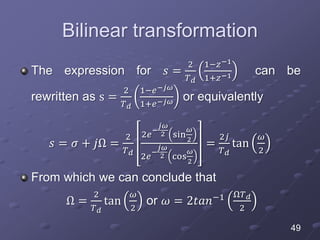
The expression for 𝑠 =
2
𝑇 𝑑
1−𝑧−1
1+𝑧−1 can be
rewritten as s =
2
𝑇 𝑑
1−𝑒−𝑗𝜔
1+𝑒−𝑗𝜔 or equivalently
𝑠 = 𝜎 + 𝑗Ω =
2
𝑇 𝑑
2𝑒
−
𝑗𝜔
2 sin
𝜔
2
2𝑒
−
𝑗𝜔
2 cos
𝜔
2
=
2𝑗
𝑇 𝑑
tan
𝜔
2
From which we can conclude that
Ω =
2
𝑇 𝑑
tan
𝜔
2
or 𝜔 = 2𝑡𝑎𝑛−1 Ω𝑇 𝑑
2
49
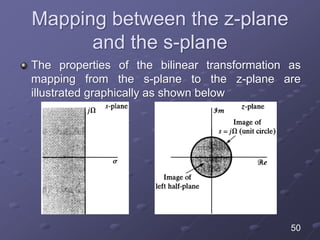
Mapping between the z-plane
and the s-plane
The properties of the bilinear transformation as
mapping from the s-plane to the z-plane are
illustrated graphically as shown below
50
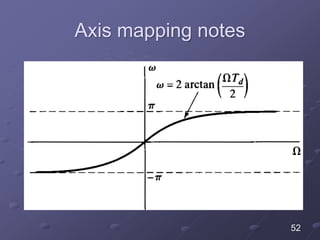
Axis mapping notes
Note that the Bilinear transformation maps
the range of continuous frequencies 0 ≤
Ω ≤ ∞ maps to 0 ≤ 𝜔 ≤ 𝜋 on the discrete
frequency axis
Also the range of continuous frequencies
− ∞ ≤ Ω ≤ 0 maps to −𝜋 ≤ 𝜔 ≤ 0 on the
discrete frequency axis as illustrated in the
next slide
51
Axis mapping notes
52
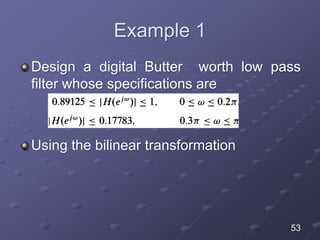
Example 1
Design a digital Butter worth low pass
filter whose specifications are
Using the bilinear transformation
53
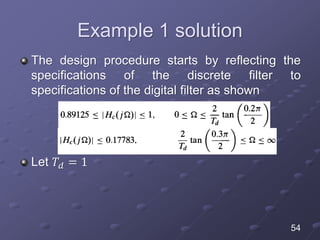
Example 1 solution
The design procedure starts by reflecting the
specifications of the discrete filter to
specifications of the digital filter as shown
Let 𝑇𝑑 = 1
54
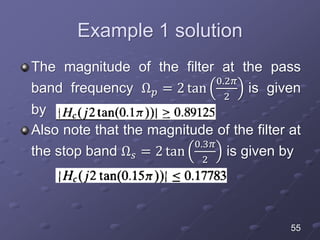
Example 1 solution
The magnitude of the filter at the pass
band frequency Ω 𝑝 = 2 tan
0.2𝜋
2
is given
by
Also note that the magnitude of the filter at
the stop band Ω 𝑠 = 2 tan
0.3𝜋
2
is given by
55
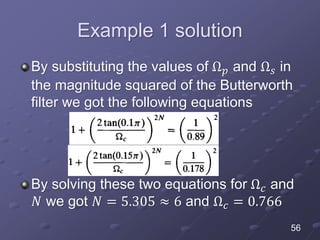
Example 1 solution
By substituting the values of Ω 𝑝 and Ω 𝑠 in
the magnitude squared of the Butterworth
filter we got the following equations
By solving these two equations for Ω 𝑐 and
𝑁 we got 𝑁 = 5.305 ≈ 6 and Ω 𝑐 = 0.766
56
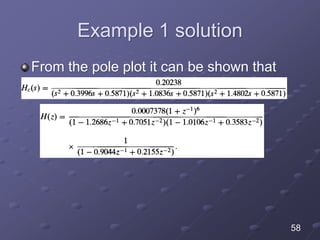
Example 1 solution
If we plot the poles of 𝐻𝑐 𝑠 2
of the filter
we got the following graph
57
Example 1 solution
From the pole plot it can be shown that
58
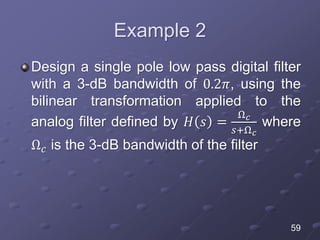
Example 2
Design a single pole low pass digital filter
with a 3-dB bandwidth of 0.2𝜋, using the
bilinear transformation applied to the
analog filter defined by 𝐻 𝑠 =
Ω 𝑐
𝑠+Ω 𝑐
where
Ω 𝑐 is the 3-dB bandwidth of the filter
59
Example 2 solution
By using the linear transformation we have
Ω 𝑐 =
2
𝑇 𝑑
tan
0.2𝜋
2
=
0.65
𝑇 𝑑
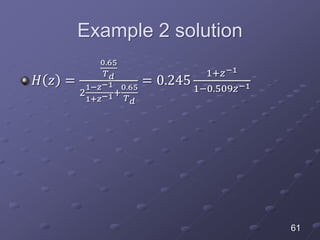
The system function of the analog filter can
be written as 𝐻 𝑠 =
0.65
𝑇 𝑑
𝑠+
0.65
𝑇 𝑑
By substituting 𝑠 =
2
𝑇 𝑑
1−𝑧−1
1+𝑧−1, we got the
discrete system function as
60
Example 2 solution
𝐻 𝑧 =
0.65
𝑇 𝑑
2
1−𝑧−1
1+𝑧−1+
0.65
𝑇 𝑑
= 0.245
1+𝑧−1
1−0.509𝑧−1
61
IIR filter design in MATALB
We have seen from the previous discussion both
the impulse invariance and bilinear
transformations needs too many computations
A simpler way to design an IIR filter can be done
easily with the aid of MATLAB
It is easy to show this by an example
62
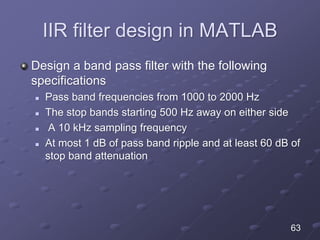
IIR filter design in MATLAB
Design a band pass filter with the following
specifications
 Pass band frequencies from 1000 to 2000 Hz
 The stop bands starting 500 Hz away on either side
 A 10 kHz sampling frequency
 At most 1 dB of pass band ripple and at least 60 dB of
stop band attenuation
63
IIR filter design in MATLAB
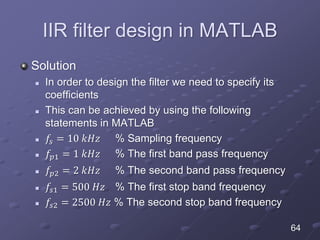
Solution
 In order to design the filter we need to specify its
coefficients
 This can be achieved by using the following
statements in MATLAB
 𝑓𝑠 = 10 𝑘𝐻𝑧 % Sampling frequency
 𝑓𝑝1 = 1 𝑘𝐻𝑧 % The first band pass frequency
 𝑓𝑝2 = 2 𝑘𝐻𝑧 % The second band pass frequency
 𝑓𝑠1 = 500 𝐻𝑧 % The first stop band frequency
 𝑓𝑠2 = 2500 𝐻𝑧 % The second stop band frequency
64
IIR filter design in MATLAB
 𝑅𝑝 = 1 𝑑𝐵 % The ripple in the pass band
 𝑅 𝑆 = 60 𝑑𝐵 % The attenuation in the stop band
 The filter order and normalized frequencies can be
computed by using the following statement
 [𝑛, 𝑊𝑛] = 𝑏𝑢𝑡𝑡𝑜𝑟𝑑
𝑓𝑝1 𝑓𝑝2
𝑓𝑠
,
𝑓𝑠1 𝑓𝑠2
𝑓𝑠
, 𝑅 𝑝, 𝑅 𝑠
 The filter coefficients can be computed from the
following statements
 𝑏, 𝑎 = 𝑏𝑢𝑡𝑡𝑒𝑟 𝑛, 𝑊𝑛 ;
65
IIR filter design in MATLAB
More examples to design IIR filter is by the use of these
statements
 [𝑏, 𝑎] = 𝑏𝑢𝑡𝑡𝑒𝑟(𝑛, 𝑊𝑛, 𝑜𝑝𝑡𝑖𝑜𝑛𝑠)
 [𝑏, 𝑎] = 𝑏𝑢𝑡𝑡𝑒𝑟(5,0.4); % Lowpass Butterworth
 [𝑏, 𝑎] = 𝑐ℎ𝑒𝑏𝑦1(𝑛, 𝑅𝑝, 𝑊𝑛, 𝑜𝑝𝑡𝑖𝑜𝑛𝑠)
 [𝑏, 𝑎] = 𝑐ℎ𝑒𝑏𝑦1(4,1, [0.4 0.7]); % Bandpass Chebyshev Type I
 [𝑏, 𝑎] = 𝑐ℎ𝑒𝑏𝑦2(𝑛, 𝑅𝑠, 𝑊𝑛, 𝑜𝑝𝑡𝑖𝑜𝑛𝑠)
 [𝑏, 𝑎] = 𝑐ℎ𝑒𝑏𝑦2(6,60,0.8, ′ℎ𝑖𝑔ℎ′); % Highpass Chebyshev Type II
 [𝑏, 𝑎] = 𝑒𝑙𝑙𝑖𝑝(𝑛, 𝑅𝑝, 𝑅𝑠, 𝑊𝑛, 𝑜𝑝𝑡𝑖𝑜𝑛𝑠)
 [𝑏, 𝑎] = 𝑒𝑙𝑙𝑖𝑝(3,1,60, [0.4 0.7], ′𝑠𝑡𝑜𝑝′); % Bandstop elliptic
66
Filter design in MATLAB
We can design IIR or FIR filters in MATALB
using the filter design and analysis tool
FDATOOL
In the command window of MATLAB type
FDATOOL
A window the filter design window will appear as
shown in the next slide
67
68
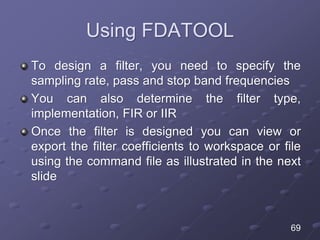
Using FDATOOL
To design a filter, you need to specify the
sampling rate, pass and stop band frequencies
You can also determine the filter type,
implementation, FIR or IIR
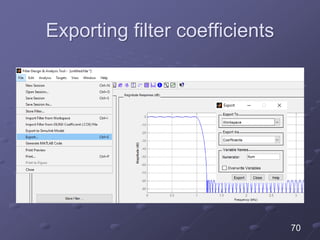
Once the filter is designed you can view or
export the filter coefficients to workspace or file
using the command file as illustrated in the next
slide
69
Exporting filter coefficients
70

Filter design techniques ch7 iir

  • 1.
    Filter design process Ingeneral the design of filter is composed from three different steps 1
  • 2.
    Filter design techniques Inthe design of frequency selective filters, the desired filter characteristics are specified in the frequency domain in terms of the desired magnitude and phase response of the filter In the filter design process, we determine the coefficients of a causal FIR or IIR filter that closely approximate the desired frequency response specifications 2
  • 3.
    Which type offilter is to be used In general FIR filters are used in filtering problems where a linear phase is required IIR filters can be used if linear phase is not required In general IIR filter has a lower side-lobes in the stop band than an FIR having the same number of parameters 3
  • 4.
    Which type offilter is to be used If some phase distortion is tolerable then IIR filter is preferable because its implementation requires fewer parameters, less memory and lower computational complexity A comparison between FIR and IIR filters is made in the next slide 4
  • 5.
  • 6.
    Relation between IIRfilter and the difference equations The input output relations of the IIR filter are governed by the difference equation 𝑘=0 𝑁 𝑎 𝑘 𝑦 𝑛 − 𝑘 = 𝑘=0 𝑀 𝑏 𝑘 𝑥 𝑛 − 𝑘 The above equations means that we can compute the filter output if the filter coefficients 𝑎 𝑘 and 𝑏 𝑘 are known The goal of this section is to determine these coefficients 6
  • 7.
    Relation between IIRfilter and the difference equations If we apply the z transform to the LCCD difference equation which describes the IIR filter we got the discrete filter system function given by 𝐻 𝑧 = 𝑘=0 𝑀 𝑏 𝑘 𝑧−𝑘 1 + 𝑘=1 𝑁 𝑎 𝑘 𝑧−𝑘 It can be noticed that 𝐻(𝑧) is a rational function 7
  • 8.
    Causality and itsimplications All ideal filters are non causal Non causal means that these filters are not physically realizable To illustrate this concept let us consider an ideal low pass filer The frequency response of the filter is given by 𝐻 𝜔 = 1 𝜔 ≤ 𝜔𝑐 0 𝜔𝑐 < 𝜔 < 𝜋 8
  • 9.
    Causality and itsimplications The impulse response of the filter is given by ℎ 𝑛 = 𝜔 𝑐 𝜋 𝑠𝑖𝑛𝜔 𝑐 𝑛 𝜔 𝑐 𝑛 Typical plot of the ideal LPF filter for 𝜔𝑐 = 𝜋 4 is shown below 9
  • 10.
    Causality and itsimplications From the plot of ℎ[𝑛] it is clear that ℎ 𝑛 ≠ 0 for 𝑛 < 0 which means that the filter is not causal If the filter is not causal this means that the filter output samples 𝑦[𝑛] depends on the future values of the input 𝑥[𝑛 + 1], 𝑥[𝑛 + 2] which is impossible to estimate 10
  • 11.
    Processing continuous time signalwith digital filter Consider a discrete-time filter is to be used to low pass filter a continuous time signal The complete system may be presented as shown below 11
  • 12.
    Determining specifications fora discrete time filter When designing a LPF we need its magnitude frequency response to be as shown 12
  • 13.
    Design of discretetime IIR filters from continuous time filters The traditional approach to design IIR filters involves the transformation of a continuous-time filter into a discrete-time filter meeting prescribed specifications This design procedure can be achieved by finding the system function 𝐻𝑐(𝑠) or the impulse response of the continuous filter ℎ 𝑐(𝑡) 13
  • 14.
    Design of discretetime IIR filters from continuous time filters There are four well known analog filters used in the design of IIR digital filters these are  Butterworth  Chebyshev I  Chebyshev II  Elliptic 14
  • 15.
    Design of discretetime IIR filters from continuous time filters The system function 𝐻(𝑧) or the impulse response ℎ 𝑛 for the discrete-time filter is obtained by using either  Impulse invariance method  Bilinear transformation 15
  • 16.
    IIR filter designby Impulse invariance In the impulse invariance method we can design an IIR filter by sampling the impulse response of analog filter according to ℎ 𝑛 = 𝑇𝑑ℎ 𝑐 𝑛𝑇𝑑 Where 𝑇𝑑 represents the sampling interval 16
  • 17.
    IIR filter designby Impulse invariance If the continuous time filter is band limited, so that 𝐻𝑐 𝑗Ω = 0 Ω ≥ 𝜋 𝑇𝑑 𝐻 𝑒 𝑗𝜔 = 𝐻𝑐(𝑗 𝜔 𝑇𝑑 ) 𝜔 ≤ 𝜋 17
  • 18.
    IIR filter designby Impulse invariance The discrete-time filter and the continuous time filter frequency responses are related by a linear scaling of the frequency axis which is given by 𝜔 = Ω𝑇𝑑 for 𝜔 ≤ 𝜋 Where 𝜔 is the discrete frequency axis and Ω is the continuous frequency axis 18
  • 19.
    Practical IIR filterand aliasing Any practical continuous filter can not be exactly band limited This means that the sampling process will cause interference between successive samples which causes aliasing as shown 19
  • 20.
    Practical IIR filterand aliasing The aliasing problem makes the impulse invariance method not a suitable method for the design of high pass filters However if the continuous time filter approaches zero at high frequencies, the aliasing is negligible and can be ignored 20
  • 21.
    IIR filter andcontinuous to discrete system function transformation Consider the system function of the continuous-time filter expressed in terms of partial fractions as shown below The corresponding impulse response is (inverse Laplace transform) 𝑁 represents the number of poles 21
  • 22.
    IIR filter andcontinuous to discrete system function transformation The impulse response of the discrete time filter obtained by sampling 𝑇𝑑ℎ 𝑐(𝑡) as shown The system function of the discrete time filter is 22
  • 23.
    IIR filter andcontinuous to discrete system function transformation If we compare the system function for both continuous time 𝐻𝑐 𝑠 and discrete time 𝐻(𝑧) system function, we observe that a pole at 𝑠 = 𝑠 𝑘 in the S- plane transforms to a pole at 𝑧 = 𝑒 𝑠 𝑘 𝑇 𝑑 in the z plane Also the coefficients in the partial fraction for both 𝐻𝑐 𝑠 and 𝐻(𝑧) are equal, except for the scaling multiplier 𝑇𝑑 23
  • 24.
    IIR filter andcontinuous to discrete system function transformation Note that 𝑠 𝑘 is acomplex number which can be written as 𝑠 𝑘 = 𝜎 + 𝑗𝜔 this means that 𝑧 = 𝑒 𝜎𝑇 𝑑 𝑒 𝑗𝜔𝑇 𝑑 If the real par of 𝑠 𝑘 is less than zero (𝜎 negative), then 𝑧 < 1 , the corresponding pole in the discrete time filter falls inside the unit circle This means that the causal discrete time filter is stable 24
  • 25.
    Example 1 Example 1convert the analog filter defined by the system function 𝐻 𝑎 𝑠 = 1 (𝑠+0.1)2+9 into a digital IIR filter by means of impulse invariance method 25
  • 26.
    Example1 solution Solution Since thefilter system function 𝐻𝑐 𝑠 for the continuous filter is given we can find 𝐻(𝑧) directly through the partial fraction (no need to go back to the time domain and then use sampling) From 𝐻𝑐 𝑠 we can find that the filter has two poles located at 𝑠1 = −0.1 + 𝑗3 and 𝑠2 = −0.1 − 𝑗3 26
  • 27.
    Example1 solution Solution If weanalyze 𝐻𝑐 𝑠 by the partial fraction we get To find 𝐻(𝑧) we use the expression developed in slide 23 27
  • 28.
    Example1 solution If weplot the poles and zeros of the previous example we can see that 𝜎 < 0 and both poles are located in the left side of the s plane as shown below 28
  • 29.
    Example 1 solution Ifwe manipulate 𝐻(𝑧) expression we find that 𝐻(𝑧) can be written as If we compare this expression for 𝐻(𝑧) with 𝐻 𝑧 = 𝑘=0 𝑀 𝑏 𝑘 𝑧−𝑘 1+ 𝑘=1 𝑁 𝑎 𝑘 𝑧−𝑘 we can find the filter coefficients are 𝑏0 = 1, 𝑏1 = −𝑒−0.1𝑇 𝑑cos(3𝑇𝑑), 𝑎0 = 1, 𝑎1 = − 2𝑒−0.1𝑇 𝑑 cos 3𝑇𝑑 , 𝑎2 = 𝑒−0.2𝑇 𝑑, 29 2
  • 30.
    Example 2 The systemfunction of a discrete time system is 𝐻 𝑧 = 1 1−𝑒−0.2 𝑧−1 + 1 1−𝑒−0.4 𝑧−1, determine the filter coefficients 30
  • 31.
    Example 2 solution Notethe discrete time system can be rewritten as 𝐻 𝑧 = 2− 𝑒−0.4+𝑒−0.2 𝑧−1 1− 𝑒−0.4+𝑒−0.2 𝑧−1+𝑒−0.6 𝑧−2 If we compare this expression for 𝐻(𝑧) with 𝐻 𝑧 = 𝑘=0 𝑀 𝑏 𝑘 𝑧−𝑘 1+ 𝑘=1 𝑁 𝑎 𝑘 𝑧−𝑘 we can find the filter coefficients are 𝑏0 = 2 , 𝑏1 = 𝑒−0.4 + 𝑒−0.2 , 𝑎0 = 1 , 𝑎1 = − 𝑒−0.4 − 𝑒−0.2 , 𝑎2 = 𝑒−0.6 31
  • 32.
    Example 3 Design aButterworth filter whose continuous frequency response is given by 𝐻𝑐(𝑗Ω) 2 = 1 1+ Ω Ω 𝑐 2𝑁 using the impulse invariance method The filter specifications are 32
  • 33.
    Example 3 solution Solution Sincethe parameter 𝑇𝑑 cancels in the impulse invariance procedure we can select 𝑇𝑑 = 1 , therefore Ω = 𝜔 In order to deign the filter we need to transform the discrete filter specifications to specifications on the continuous time filter 33
  • 34.
    Example 3 solution Solution Thecontinuous time filter specifications became The filter magnitude at the pass band and stop band frequencies is given by 34
  • 35.
    Example 3 solution Solution Fromthe above magnitude conditions, the magnitude squared of the continuous filter at both the pass and stop bands is given by 0.89125 2 = 1 1+ 0.2𝜋 Ω 𝑐 2𝑁 0.17783 2 = 1 1+ 0.3𝜋 Ω 𝑐 2𝑁 35
  • 36.
    Example 3 solution Solution Ifwe solve the above two equations for 𝑁 and Ω 𝑐 we got 𝑁 = 5.8858 ≈ 6 and Ω 𝑐 = 0.7032 Since 𝑁 = 6 then the filter has 12 poles of the magnitude squared function 𝐻𝑐 𝑠 𝐻𝑐 −𝑠 = 1 1+ 𝑆 Ω 𝑐 2𝑁 The poles can easily be found by using the following matlab commands 36
  • 37.
    Example 3 solution 𝑎= 1 b=[68.399 0 0 0 0 0 0 0 0 0 0 0 1] [𝑧 𝑝 𝑘] = 𝑡𝑓2𝑧𝑝(𝑎, 𝑏) 37
  • 38.
    Example 3 solution Solution Thepoles are uniformly distributed in angle of 360° 12 = 30° on a circle of radius Ω 𝑐 = 0.7032 as shown 38
  • 39.
    Example 3 solution Solution Thepoles that describe a stable system are those poles located in the left side of the s-plane The number of these poles is 6 and one solution for these poles is on the assumption that the first pole located a at an angle of 105° 39
  • 40.
    Example 3 solution Solution Nowthe system function of the continuous time filter is given by To find 𝐻(𝑧) we use the expression developed in slide 23 40
  • 41.
    Example 3 solution Solution Inorder to find the filter coefficients again we need to write 𝐻(𝑧) as a rational function and then find the coefficients as we have did in the previous two examples 41
  • 42.
    Impulse invariance summery Tosummarize, the impulse invariance method maps the s-plane to the z-plane by sampling the impulse response of continuous (analog) time filter Impulse invariance suffers from aliasing problem and therefore is not suitable for HPF design 42
  • 43.
    Impulse invariance summery Inorder to find the filter coefficients follow these steps 1. find 𝐻𝑐 𝑠 , expand it in partial fraction, find the poles of 𝐻𝑐 𝑠 2. Next find the discrete system function according to 𝐻 𝑧 = 𝑘=1 𝑁 𝑇 𝑑 𝐴 𝑘 1−𝑒 𝑠 𝑘 𝑇 𝑑 𝑧−1 3. Convert 𝐻(𝑧) to rational function 4. Compare the rational expression for 𝐻(𝑧) with 𝐻 𝑧 = 𝑘=0 𝑀 𝑏 𝑘 𝑧−𝑘 1+ 𝑘=1 𝑁 𝑎 𝑘 𝑧−𝑘 and determine the coefficients accordingly 43
  • 44.
    Bilinear transformation The bilineartransformation is an algebraic transformation between the 𝑠 and 𝑧 planes Bilinear transformation maps the entire 𝑗Ω- axis in the s-plane to one revolution of the unit circle in the z-plane Bilinear transformation avoids the aliasing problem associated with time invariant approach 44
  • 45.
    Bilinear transformation The bilineartransformation corresponds to replacing 𝑠 by 𝑠 = 2 𝑇𝑑 1 − 𝑧−1 1 + 𝑧−1 This means that the discrete and continuous system functions are related by 𝐻 𝑧 = 𝐻𝑐 2 𝑇𝑑 1 − 𝑧−1 1 + 𝑧−1 45
  • 46.
    Bilinear transformation To developthe properties of the algebraic transformation we solve for 𝑧 to obtain 𝑧 = 2 𝑇𝑑 1 + 𝑇𝑑 2 𝑠 1 − 𝑇𝑑 2 𝑠 Substituting 𝑠 = 𝜎 + 𝑗𝜔, we got 𝑧 = 1 + 𝜎 𝑇𝑑 2 + 𝑗Ω 𝑇𝑑 2 1 − 𝜎 𝑇𝑑 2 − 𝑗Ω 𝑇𝑑 2 46
  • 47.
    Bilinear transformation Again asin the time invariant procedure, if 𝜎 < 0, 𝑧 < 1, for any value of Ω This means the poles fall in the left half of the s- plane or inside the unit circle of the z-plane, which means that the system is stable Similarly if of 𝜎 > 0, 𝑧 > 1, for any value of Ω The poles fall in the right half of the s-plane or outside the unit circle of the z-plane, which means that the system is unstable 47
  • 48.
    Bilinear transformation In orderto show that the 𝑗Ω-axis of the s-plane maps onto the unit circle, substitute 𝜎 = 0 into 𝑧 = 1+𝜎 𝑇 𝑑 2 +𝑗Ω 𝑇 𝑑 2 1−𝜎 𝑇 𝑑 2 −𝑗Ω 𝑇 𝑑 2 and simplify the expression we got 𝑧 = 1 + 𝑗Ω 𝑇𝑑 2 1 − 𝑗Ω 𝑇𝑑 2 Recall that 𝑧 = 𝑒 𝜎 𝑒 𝑗𝜔 = 𝑒 𝑗𝜔 48
  • 49.
    Bilinear transformation The expressionfor 𝑠 = 2 𝑇 𝑑 1−𝑧−1 1+𝑧−1 can be rewritten as s = 2 𝑇 𝑑 1−𝑒−𝑗𝜔 1+𝑒−𝑗𝜔 or equivalently 𝑠 = 𝜎 + 𝑗Ω = 2 𝑇 𝑑 2𝑒 − 𝑗𝜔 2 sin 𝜔 2 2𝑒 − 𝑗𝜔 2 cos 𝜔 2 = 2𝑗 𝑇 𝑑 tan 𝜔 2 From which we can conclude that Ω = 2 𝑇 𝑑 tan 𝜔 2 or 𝜔 = 2𝑡𝑎𝑛−1 Ω𝑇 𝑑 2 49
  • 50.
    Mapping between thez-plane and the s-plane The properties of the bilinear transformation as mapping from the s-plane to the z-plane are illustrated graphically as shown below 50
  • 51.
    Axis mapping notes Notethat the Bilinear transformation maps the range of continuous frequencies 0 ≤ Ω ≤ ∞ maps to 0 ≤ 𝜔 ≤ 𝜋 on the discrete frequency axis Also the range of continuous frequencies − ∞ ≤ Ω ≤ 0 maps to −𝜋 ≤ 𝜔 ≤ 0 on the discrete frequency axis as illustrated in the next slide 51
  • 52.
  • 53.
    Example 1 Design adigital Butter worth low pass filter whose specifications are Using the bilinear transformation 53
  • 54.
    Example 1 solution Thedesign procedure starts by reflecting the specifications of the discrete filter to specifications of the digital filter as shown Let 𝑇𝑑 = 1 54
  • 55.
    Example 1 solution Themagnitude of the filter at the pass band frequency Ω 𝑝 = 2 tan 0.2𝜋 2 is given by Also note that the magnitude of the filter at the stop band Ω 𝑠 = 2 tan 0.3𝜋 2 is given by 55
  • 56.
    Example 1 solution Bysubstituting the values of Ω 𝑝 and Ω 𝑠 in the magnitude squared of the Butterworth filter we got the following equations By solving these two equations for Ω 𝑐 and 𝑁 we got 𝑁 = 5.305 ≈ 6 and Ω 𝑐 = 0.766 56
  • 57.
    Example 1 solution Ifwe plot the poles of 𝐻𝑐 𝑠 2 of the filter we got the following graph 57
  • 58.
    Example 1 solution Fromthe pole plot it can be shown that 58
  • 59.
    Example 2 Design asingle pole low pass digital filter with a 3-dB bandwidth of 0.2𝜋, using the bilinear transformation applied to the analog filter defined by 𝐻 𝑠 = Ω 𝑐 𝑠+Ω 𝑐 where Ω 𝑐 is the 3-dB bandwidth of the filter 59
  • 60.
    Example 2 solution Byusing the linear transformation we have Ω 𝑐 = 2 𝑇 𝑑 tan 0.2𝜋 2 = 0.65 𝑇 𝑑 The system function of the analog filter can be written as 𝐻 𝑠 = 0.65 𝑇 𝑑 𝑠+ 0.65 𝑇 𝑑 By substituting 𝑠 = 2 𝑇 𝑑 1−𝑧−1 1+𝑧−1, we got the discrete system function as 60
  • 61.
    Example 2 solution 𝐻𝑧 = 0.65 𝑇 𝑑 2 1−𝑧−1 1+𝑧−1+ 0.65 𝑇 𝑑 = 0.245 1+𝑧−1 1−0.509𝑧−1 61
  • 62.
    IIR filter designin MATALB We have seen from the previous discussion both the impulse invariance and bilinear transformations needs too many computations A simpler way to design an IIR filter can be done easily with the aid of MATLAB It is easy to show this by an example 62
  • 63.
    IIR filter designin MATLAB Design a band pass filter with the following specifications  Pass band frequencies from 1000 to 2000 Hz  The stop bands starting 500 Hz away on either side  A 10 kHz sampling frequency  At most 1 dB of pass band ripple and at least 60 dB of stop band attenuation 63
  • 64.
    IIR filter designin MATLAB Solution  In order to design the filter we need to specify its coefficients  This can be achieved by using the following statements in MATLAB  𝑓𝑠 = 10 𝑘𝐻𝑧 % Sampling frequency  𝑓𝑝1 = 1 𝑘𝐻𝑧 % The first band pass frequency  𝑓𝑝2 = 2 𝑘𝐻𝑧 % The second band pass frequency  𝑓𝑠1 = 500 𝐻𝑧 % The first stop band frequency  𝑓𝑠2 = 2500 𝐻𝑧 % The second stop band frequency 64
  • 65.
    IIR filter designin MATLAB  𝑅𝑝 = 1 𝑑𝐵 % The ripple in the pass band  𝑅 𝑆 = 60 𝑑𝐵 % The attenuation in the stop band  The filter order and normalized frequencies can be computed by using the following statement  [𝑛, 𝑊𝑛] = 𝑏𝑢𝑡𝑡𝑜𝑟𝑑 𝑓𝑝1 𝑓𝑝2 𝑓𝑠 , 𝑓𝑠1 𝑓𝑠2 𝑓𝑠 , 𝑅 𝑝, 𝑅 𝑠  The filter coefficients can be computed from the following statements  𝑏, 𝑎 = 𝑏𝑢𝑡𝑡𝑒𝑟 𝑛, 𝑊𝑛 ; 65
  • 66.
    IIR filter designin MATLAB More examples to design IIR filter is by the use of these statements  [𝑏, 𝑎] = 𝑏𝑢𝑡𝑡𝑒𝑟(𝑛, 𝑊𝑛, 𝑜𝑝𝑡𝑖𝑜𝑛𝑠)  [𝑏, 𝑎] = 𝑏𝑢𝑡𝑡𝑒𝑟(5,0.4); % Lowpass Butterworth  [𝑏, 𝑎] = 𝑐ℎ𝑒𝑏𝑦1(𝑛, 𝑅𝑝, 𝑊𝑛, 𝑜𝑝𝑡𝑖𝑜𝑛𝑠)  [𝑏, 𝑎] = 𝑐ℎ𝑒𝑏𝑦1(4,1, [0.4 0.7]); % Bandpass Chebyshev Type I  [𝑏, 𝑎] = 𝑐ℎ𝑒𝑏𝑦2(𝑛, 𝑅𝑠, 𝑊𝑛, 𝑜𝑝𝑡𝑖𝑜𝑛𝑠)  [𝑏, 𝑎] = 𝑐ℎ𝑒𝑏𝑦2(6,60,0.8, ′ℎ𝑖𝑔ℎ′); % Highpass Chebyshev Type II  [𝑏, 𝑎] = 𝑒𝑙𝑙𝑖𝑝(𝑛, 𝑅𝑝, 𝑅𝑠, 𝑊𝑛, 𝑜𝑝𝑡𝑖𝑜𝑛𝑠)  [𝑏, 𝑎] = 𝑒𝑙𝑙𝑖𝑝(3,1,60, [0.4 0.7], ′𝑠𝑡𝑜𝑝′); % Bandstop elliptic 66
  • 67.
    Filter design inMATLAB We can design IIR or FIR filters in MATALB using the filter design and analysis tool FDATOOL In the command window of MATLAB type FDATOOL A window the filter design window will appear as shown in the next slide 67
  • 68.
  • 69.
    Using FDATOOL To designa filter, you need to specify the sampling rate, pass and stop band frequencies You can also determine the filter type, implementation, FIR or IIR Once the filter is designed you can view or export the filter coefficients to workspace or file using the command file as illustrated in the next slide 69
  • 70.