EC533: Digital Signal Processing
  5          l      l

          Lecture 7
 Realization of Discrete-Time
           Systems
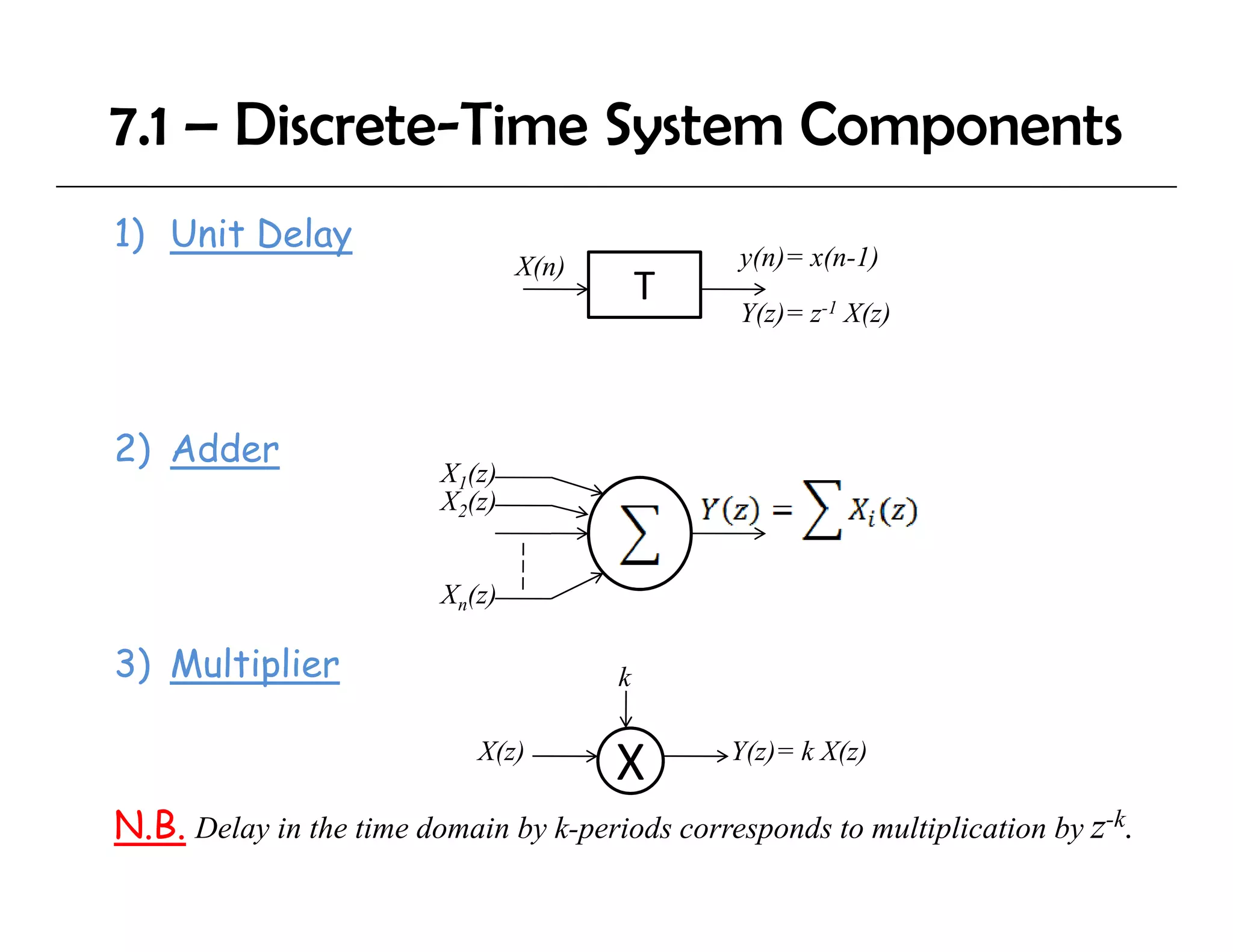
7.1 – Discrete-Time System Components
1) Unit Delay
                                 X(n)            y(n)= x(n-1)
                                            T
                                                 Y(z)= z-1 X(z)


2) Adder
                         X1(z)
                         X2(z)


                         Xn(z)

3) M lti li
   Multiplier                           k

                            X(z)                Y(z)= k X(z)
                                        X
N.B. Delay in the time domain by k-periods corresponds to multiplication by z-k.
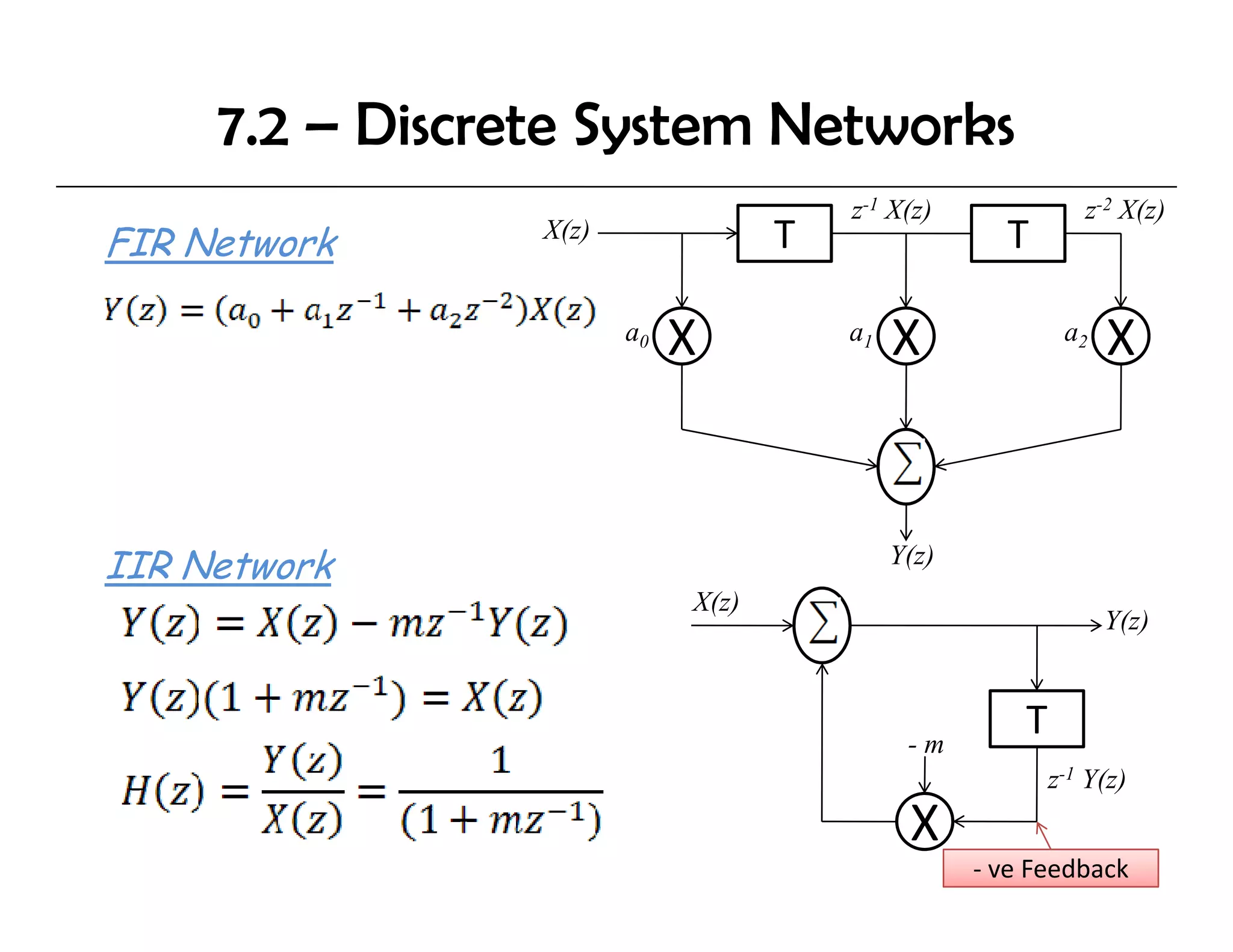
7.2 – Discrete System Networks
                                        z-1 X(z)               z-2 X(z)
FIR Network      X(z)               T                 T

                        a0
                             X          a1
                                             X               a2
                                                                  X


IIR Network                                  Y(z)
                             X(z)
                                                                  Y(z)


                                              -m
                                                        T
                                                            z-1 Y( )
                                                                Y(z)
                                              X
                                                    ‐ ve Feedback
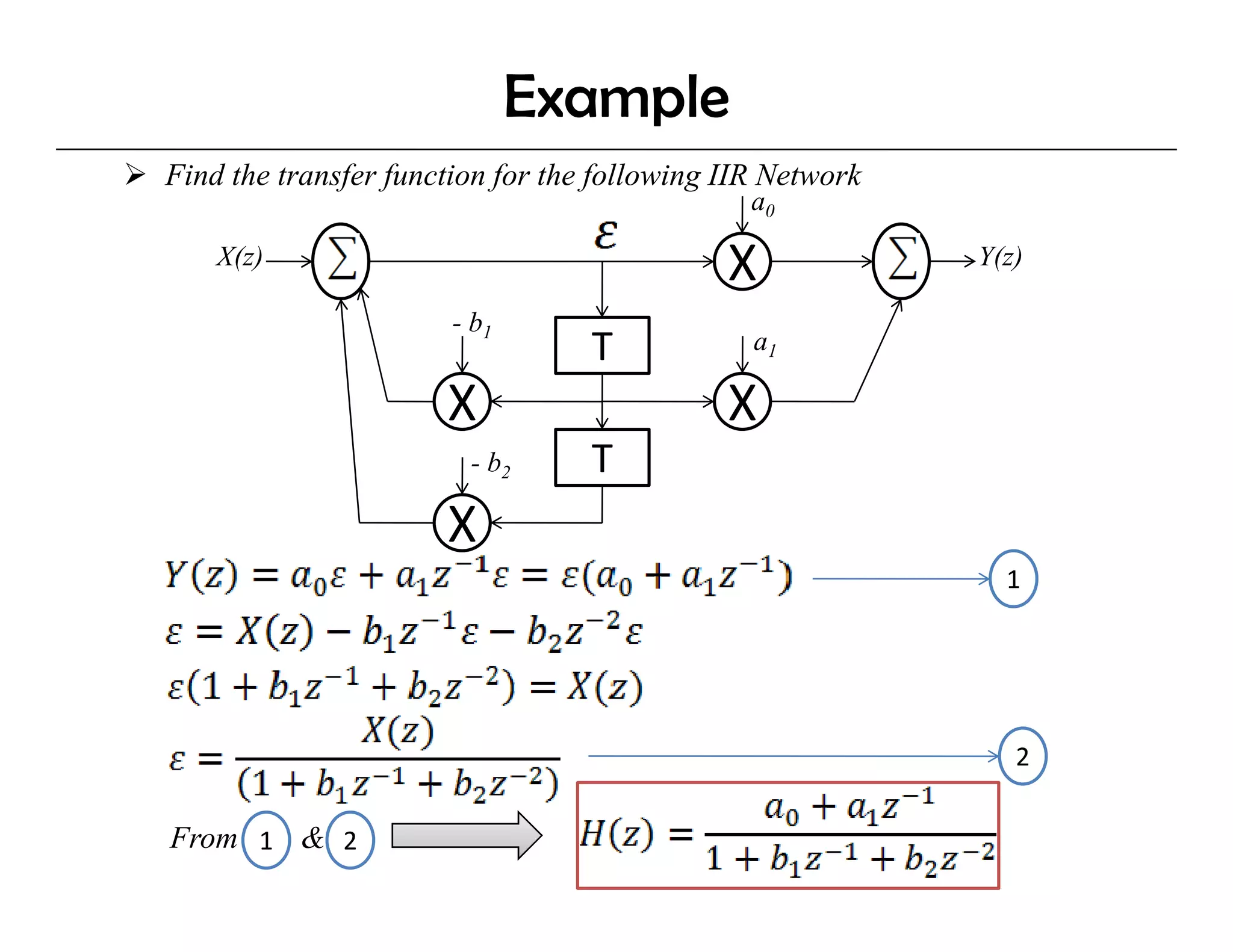
Example
Find the transfer function for the following IIR Network
                                               a0
    X(z)
                                             X             Y(z)

                       - b1
                                  T            a1

                      X                      X
                        - b2      T
                      X
                                                             1


                                                              2

From 1 & 2
7.3 – Realization of Discrete Systems
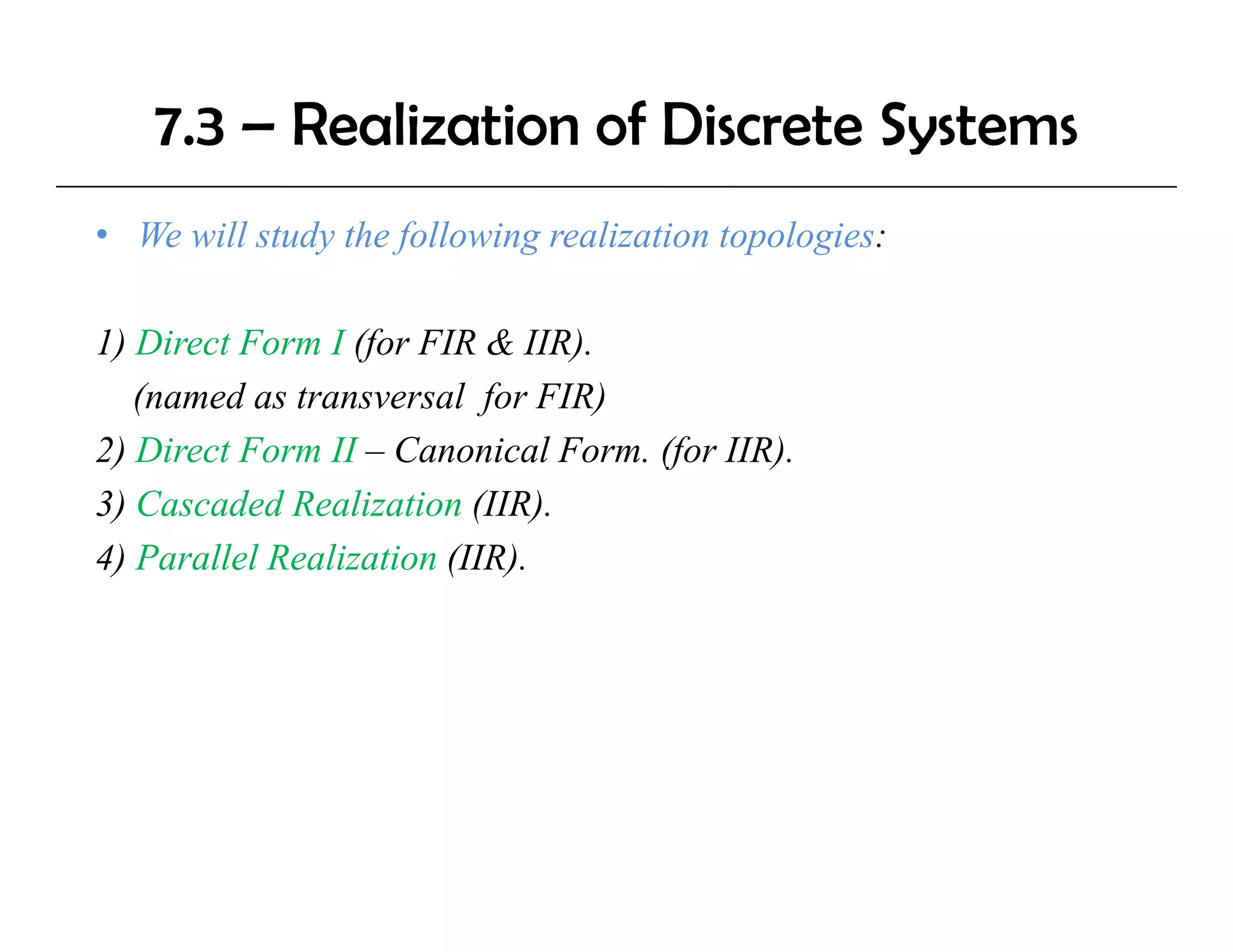
• We will study the following realization topologies:

1) Direct Form I (for FIR & IIR).
   (
   (named as transversal for FIR)
                           f      )
2) Direct Form II – Canonical Form. (for IIR).
3) Cascaded Realization (IIR).
4) Parallel Realization (IIR).
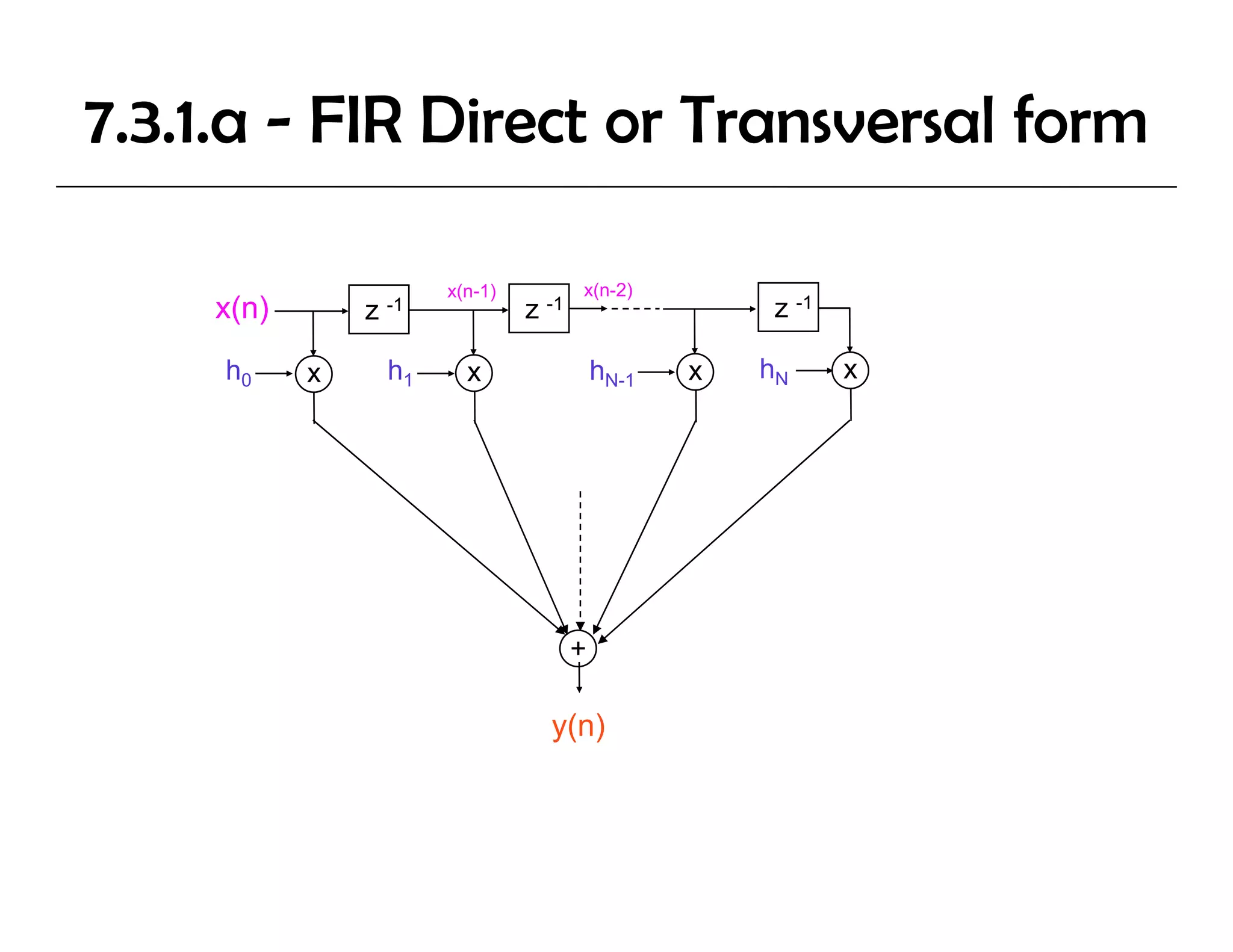
7.3.1.a - FIR Direct or Transversal form

                        x(n 1)
                        x(n-1)            x(n 2)
                                          x(n-2)
    x(n)
     ( )       z   -1            z   -1                   z -1
                                                             1


     h0    x       h1     x                   hN-1   x   hN      x


                                          +

                                     y(n)
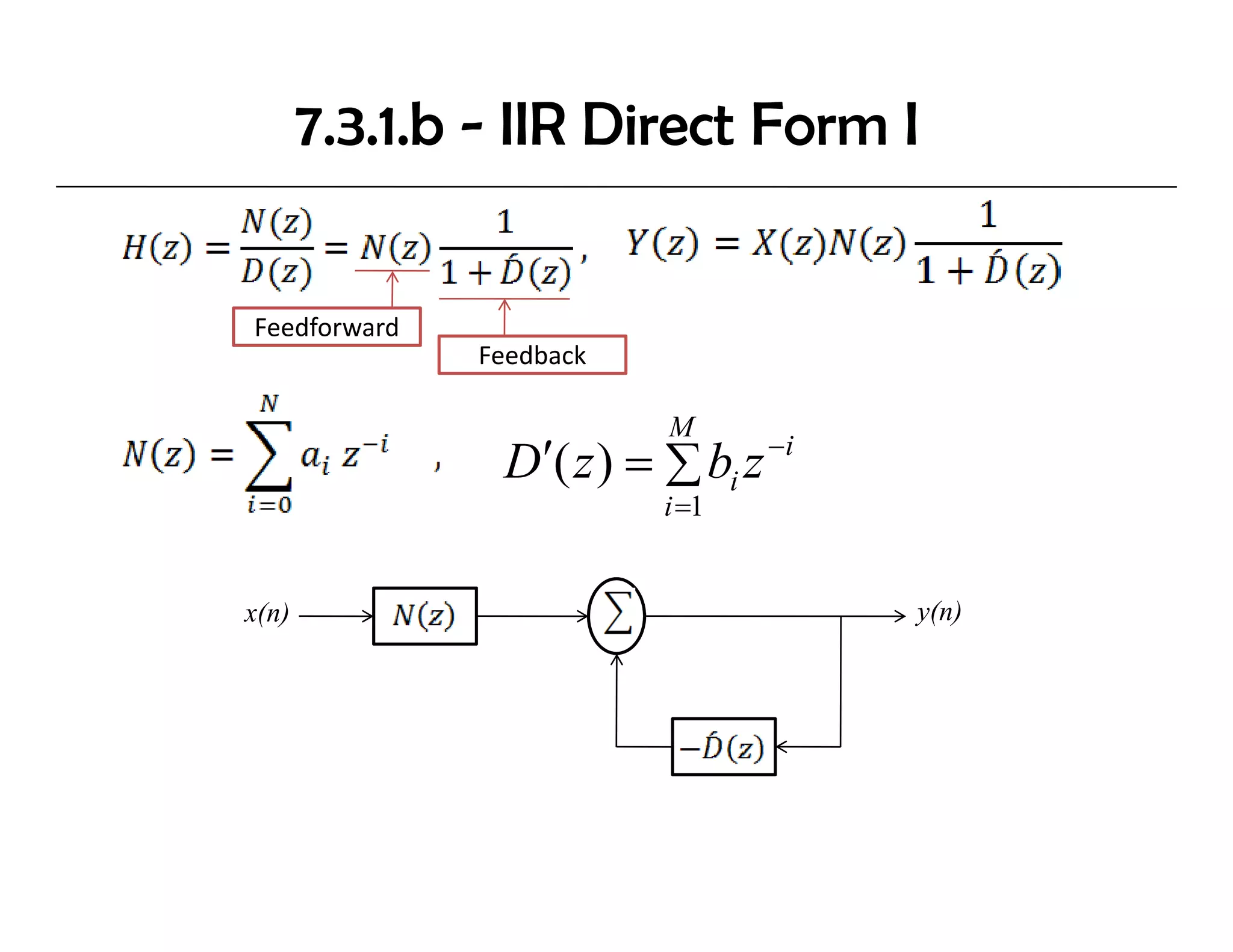
7.3.1.b - IIR Direct Form I


Feedforward
              Feedback

                          M
                D′( z ) = ∑ bi z −i
                          i =1


x(n)                                  y(n)
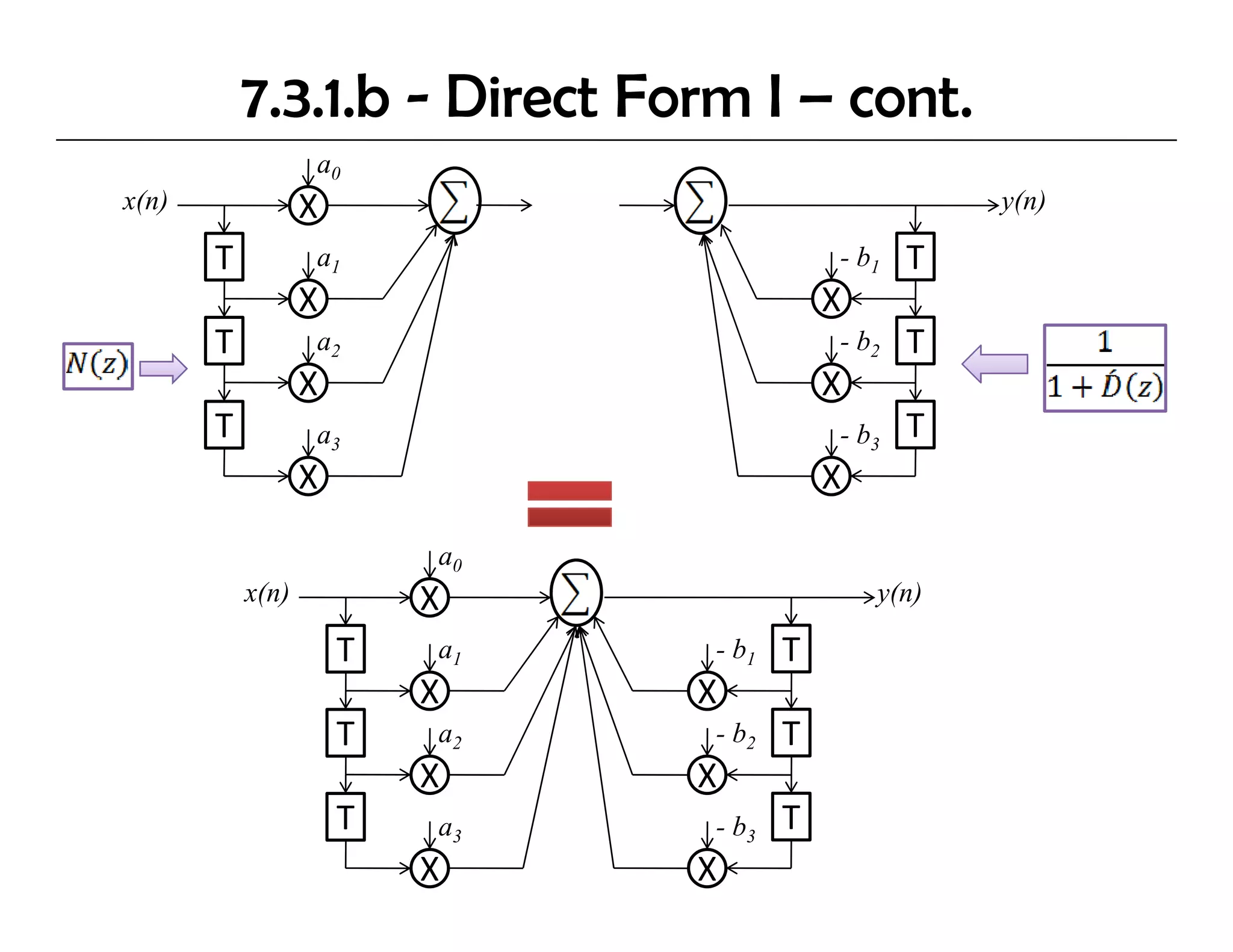
7.3.1.b - Direct Form I – cont.
                  a0
x(n)              X                                  y(n)

       T          a1                      - b1   T
                  X                       X
       T          a2                      - b2   T
                  X                       X
       T          a3                      - b3   T
                  X                       X

                          a0
           x(n)           X                   y(n)

                      T   a1   - b1   T
                          X    X
                      T   a2   - b2   T
                          X    X
                      T   a3   - b3   T
                          X    X
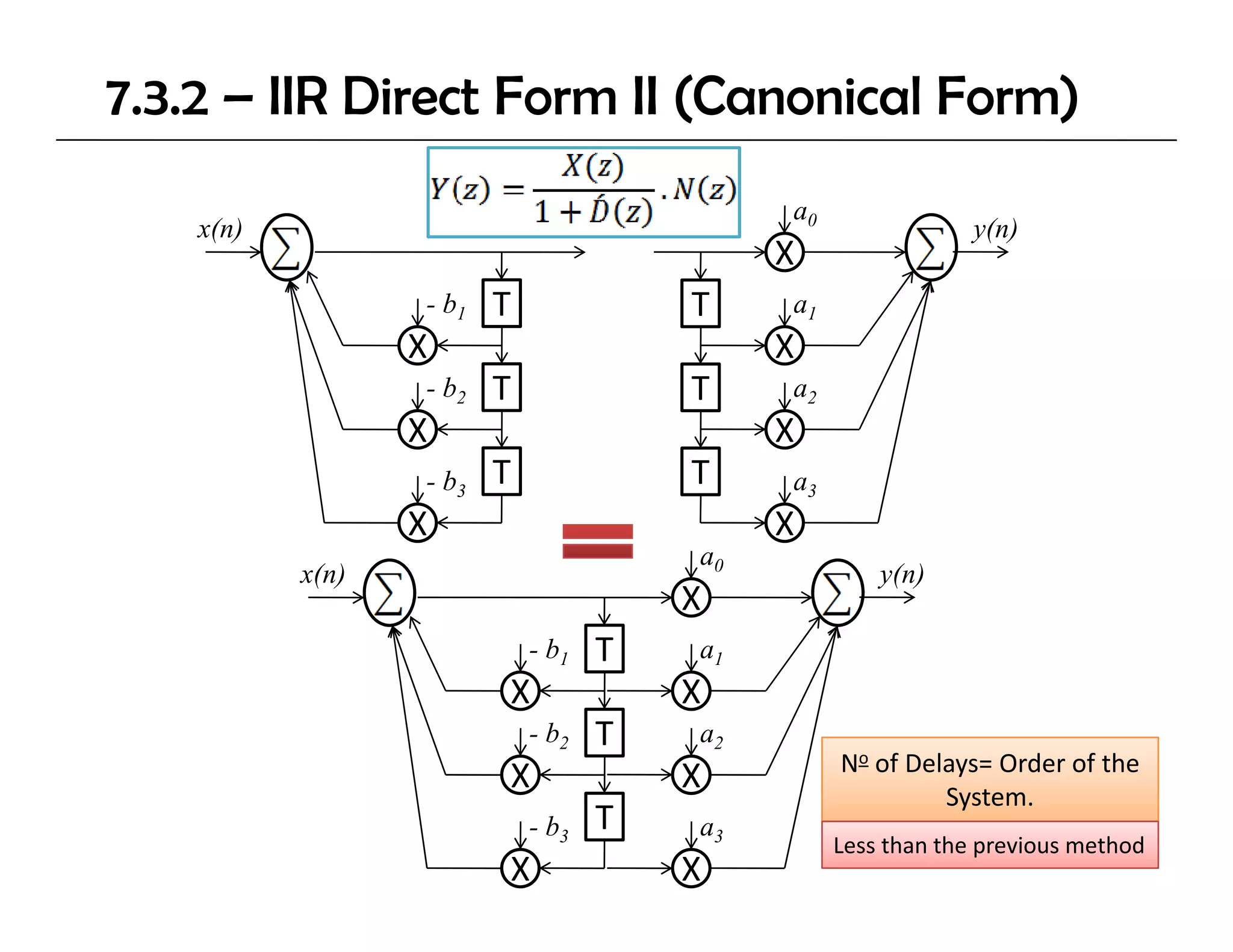
7.3.2 – IIR Direct Form II (Canonical Form)
                                             a0
    x(n)                                                       y(n)
                                             X
                  - b1   T              T    a1
                  X                          X
                  - b2   T              T    a2
                  X                          X
                  - b3   T              T    a3
                  X                          X
                                        a0
           x(n)                                       y(n)
                                        X
                             - b1   T   a1
                         X              X
                             - b2   T   a2
                                                  No of Delays= Order of the 
                                                            y
                         X              X                  System.
                             - b3   T   a3
                                                  Less than the previous method
                         X              X
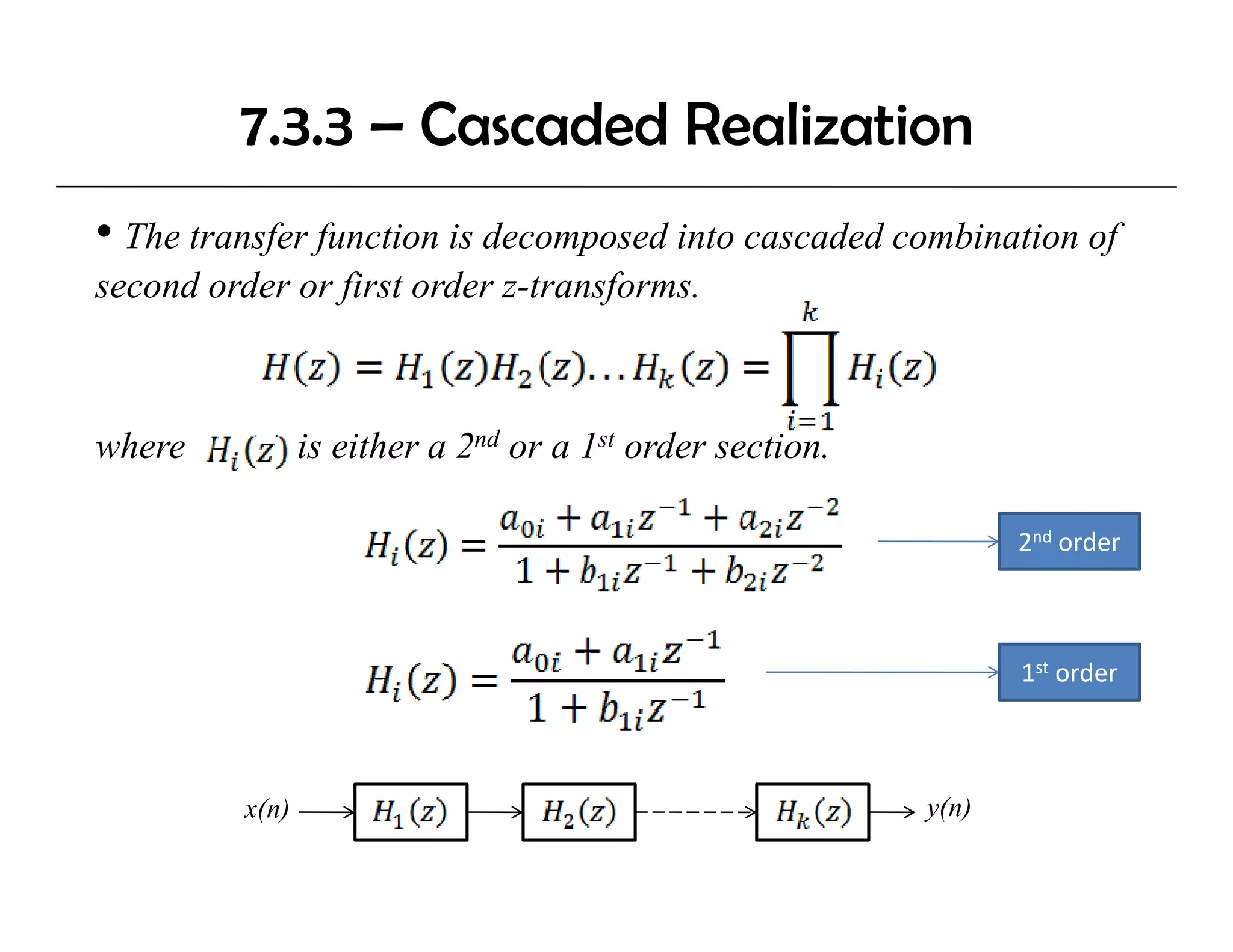
7.3.3 – Cascaded Realization
• The transfer function is decomposed into cascaded combination of
second order or first order z-transforms.
                            z transforms.


where            is either a 2nd or a 1st order section.

                                                                  2nd order
                                                                        d


                                                                  1st order


          x(n)                                             y(n)
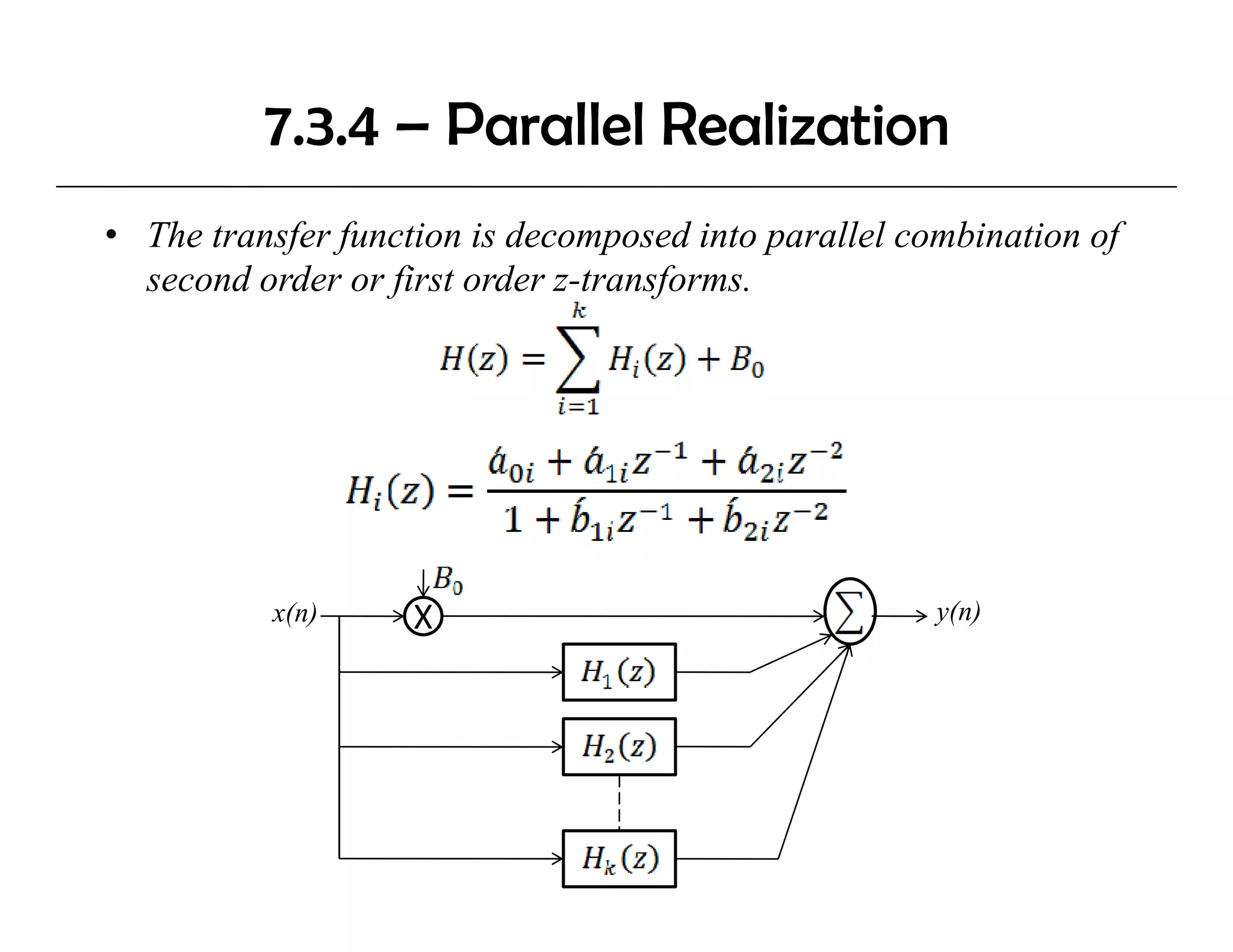
7.3.4 – Parallel Realization
• The transfer function is decomposed into parallel combination of
  second order or first order z-transforms.
                  f                  f


          x(n)      X                                 y(n)
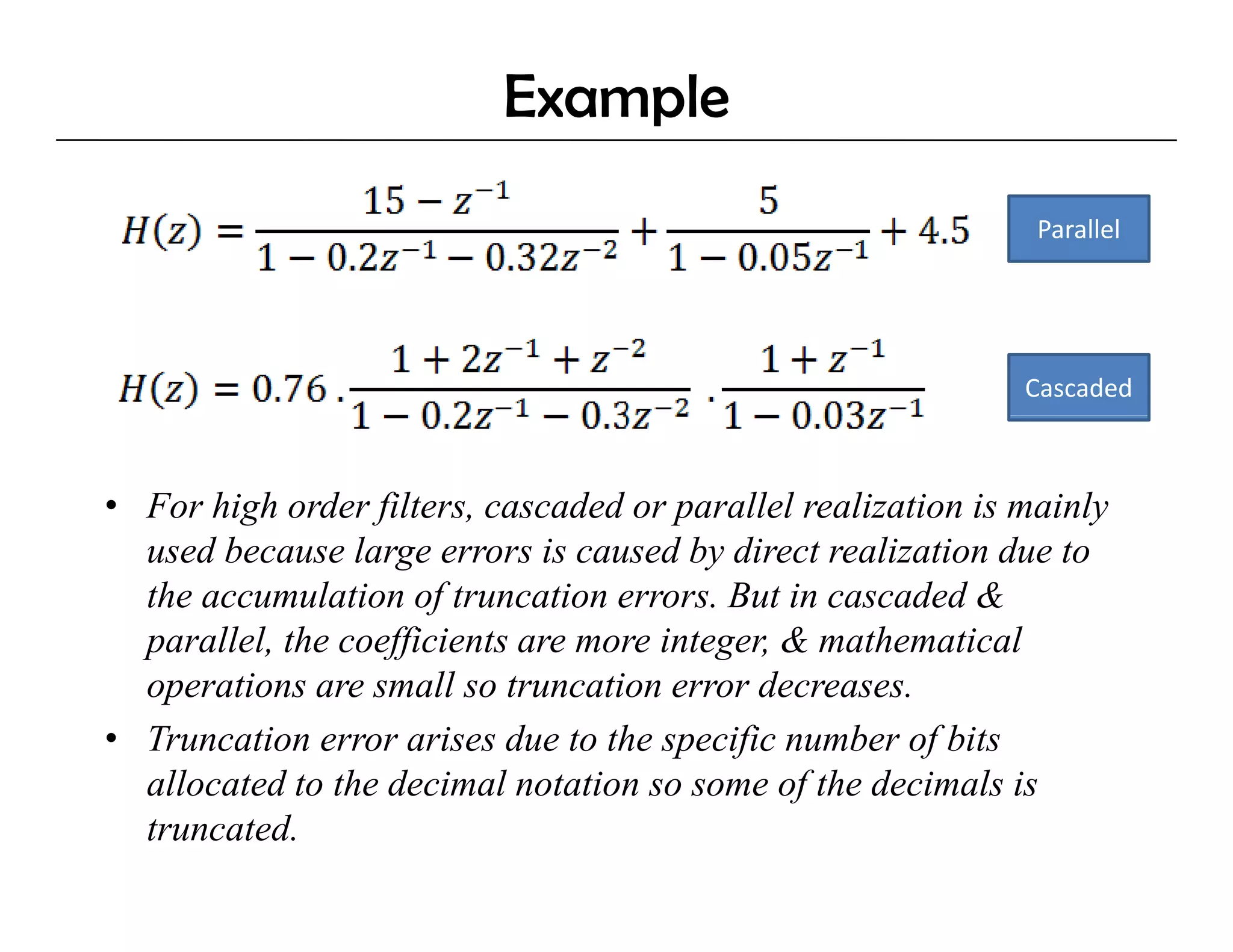
Example
                                                               Parallel


                                                              Cascaded


• For high order filters, cascaded or parallel realization is mainly
  used because large errors is caused by direct realization due to
  the accumulation of truncation errors. But in cascaded &
  p
  parallel, the coefficients are more integer, & mathematical
          ,        ff                     g ,
  operations are small so truncation error decreases.
• Truncation error arises due to the specific number of bits
  allocated to the decimal notation so some of the decimals is
    ll t d t th d i l t ti                      f th d i l i
  truncated.
7.4 – Digital Filters
• A digital filters is a mathematical algorithm, implemented in
hardware and/or software, that operates on a digital input signal to
                  software
produce a digital output signal for achieving a filtering objective.

• Digital filters are systems, but not all systems are filters.


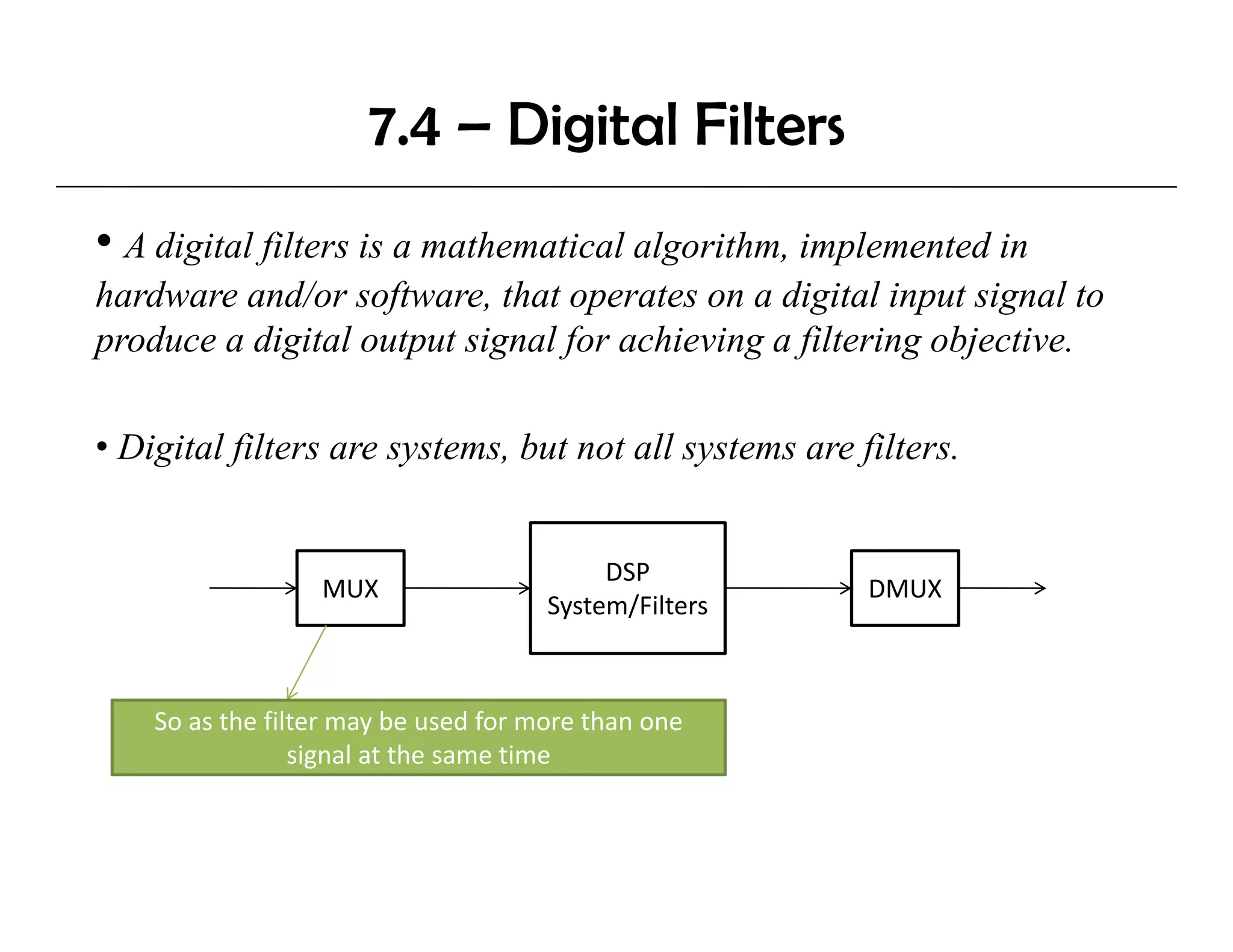
                                           DSP
                  MUX                                   DMUX
                                      System/Filters


    So as the filter may be used for more than one 
                 signal at the same time
7.4.1 – Advantages & Disadvantages of
                  Digital Filters
                    g

•    Advantages of Digital Filters
1)   No impedance matching problem.
2)   Size is small, made from IC’s.
3)   Programmable if made software.
                             software
4)   Can achieve linear phase; No phase distortion.
5) One digital filter can be used for several inputs at the same time.


•    Disadvantages of Digital Filters
1) E
   Expensive.
         i
2) Harder to design.
3) Quantization noise is present.
7.4.2 – Types of Digital Filters


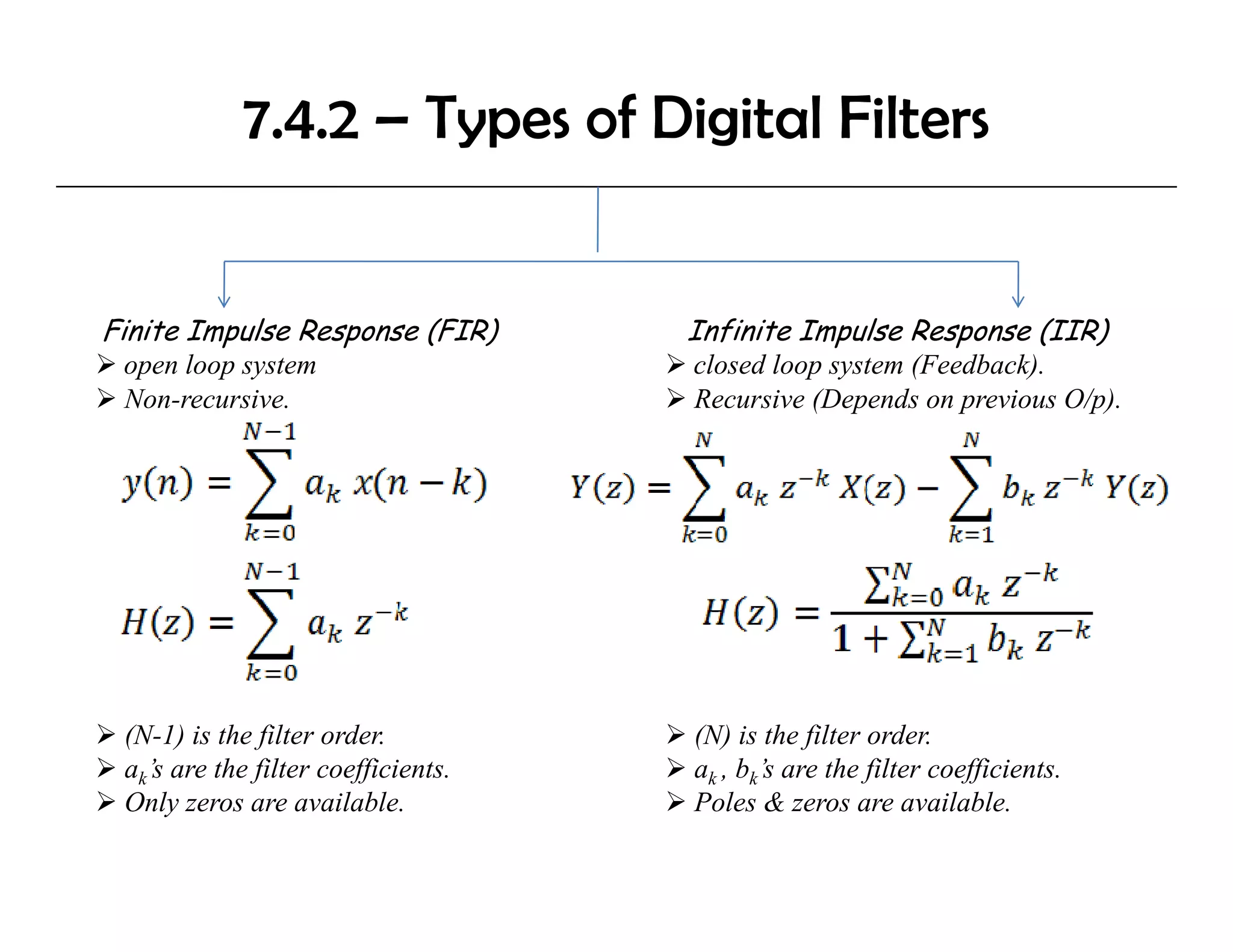
Finite Impulse Response (FIR)        Infinite Impulse Response (IIR)
 open loop system                    closed loop system (Feedback).
 Non-recursive.                      Recursive (Depends on previous O/p).


 (N-1) is the filter order.          (N) is the filter order.
 ak’s are the filter coefficients.
    s                                ak , bk’s are the filter coefficients.
                                             s
 Only zeros are available.           Poles & zeros are available.
7.4.3 – Choosing between FIR & IIR Filters
1) FIR filter can have exactly linear phase response, while that of IIR filter is
   nonlinear. (needed in some applications like digital audio).
2) FIR filters are always stable (have zeros only), while IIR filters are not
   guaranteed.
3) Finite word length effects are much less severe in FIR than IIR.
 )                 g ff
4) FIR requires more coefficients for sharp cut-off filters than IIR. more
   processing time, storage will be needed.
5) Analogue filters can be readily transformed into equivalent IIR digital filters
   meeting similar specifications. This is not possible with FIR, as they have no
   analogue counterpart.
6) FIR is algebraically more difficult to synthesize, if CAD tool is not available.
                                          synthesize                     available


             Use IIR if sharp cut‐off filters is needed.
  So
            Use FIR if no of coefficients is not too large & if no phase distortion is required
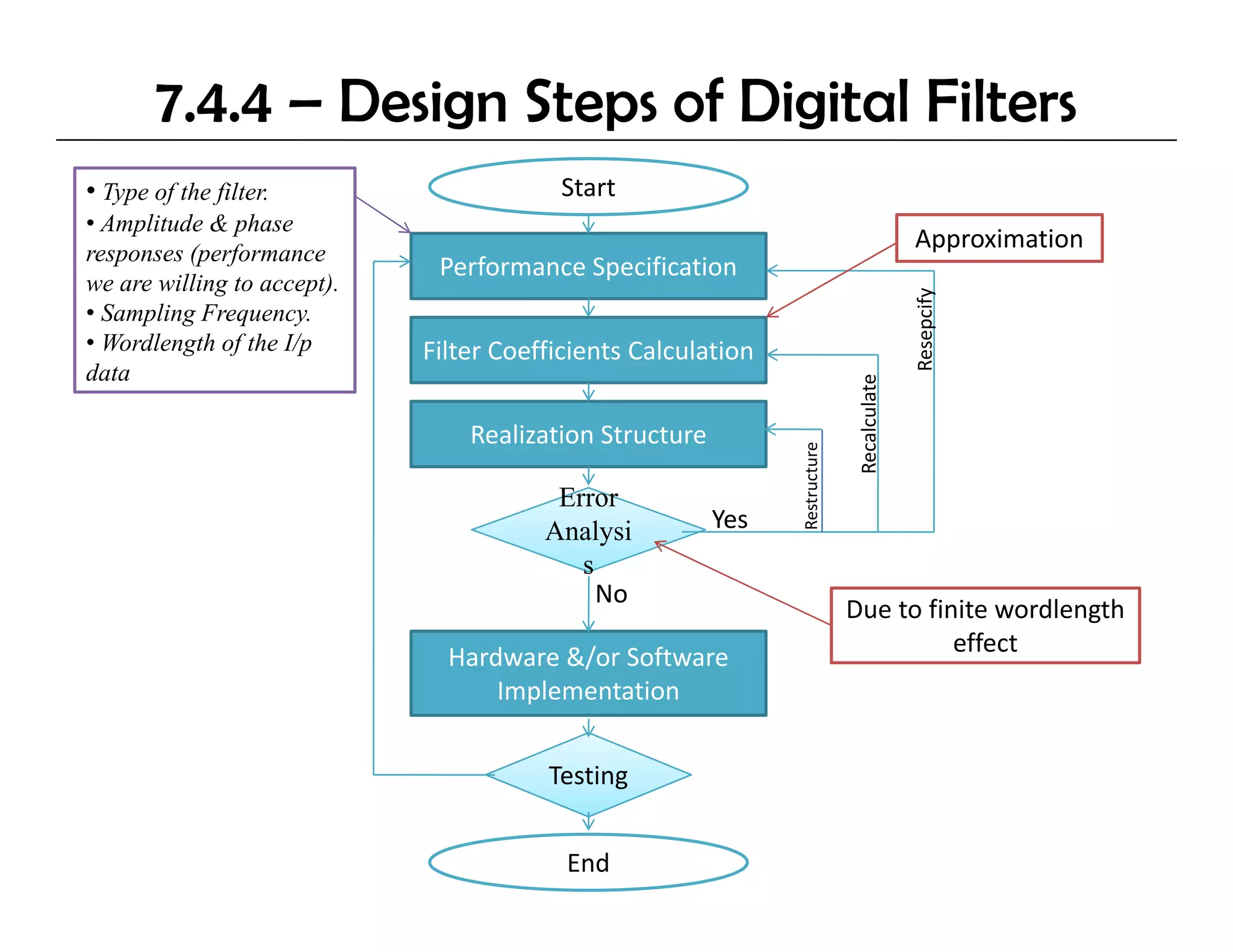
7.4.4 – Design Steps of Digital Filters
• Type of the filter.                    Start
• Amplitude & phase
responses (performance
                                                                                            Approximation
                              Performance Specification
we are willing to accept).
             g        p)


                                                                                            Resepcify
                                                                                                    y
• Sampling Frequency.
• Wordlength of the I/p      Filter Coefficients Calculation
data


                                                                                    ulate
                                                                              Recalcu
                                 Realization Structure


                                                               Restructure
                                         Error
                                        Analysi          Yes
                                           s
                                             No
                                                                             Due to finite wordlength
                                                                                       effect
                               Hardware &/or Software 
                               Hardware &/or Software
                                   Implementation


                                        Testing


                                          End
7.5 - Digital Filter Specification

• Digital Filter designed to pass signal components of certain
     g               g       p      g       p        f
  frequencies without distortion.

• The frequency response should be equal to the signal’s
  frequencies to pass the signal. (passband)

• The frequency response should be equal to zero to block the
  signal. (stopband)
7.5 - Digital Filter Specification – cont.
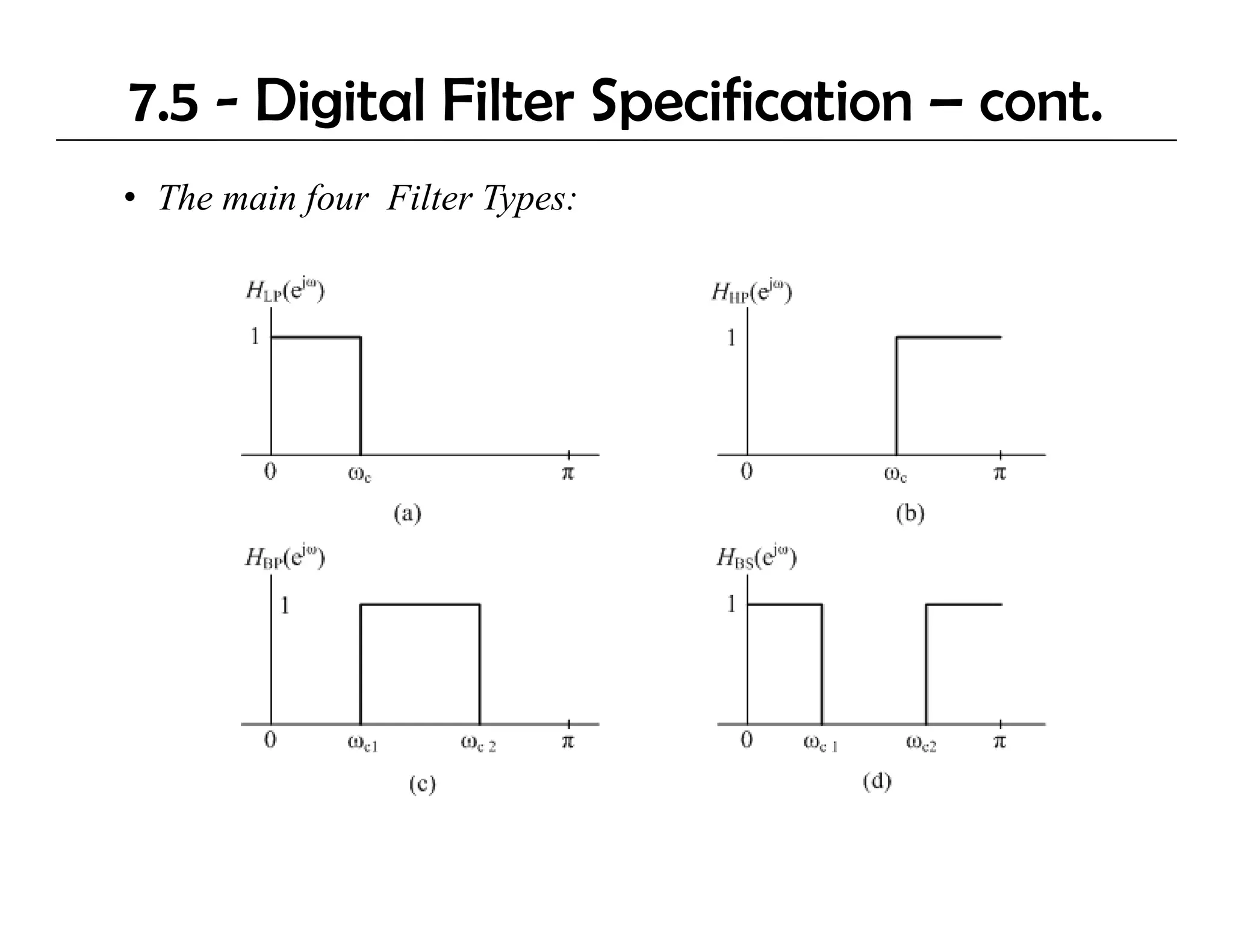
• The main four Filter Types:
7.5 - Digital Filter Specification – cont.
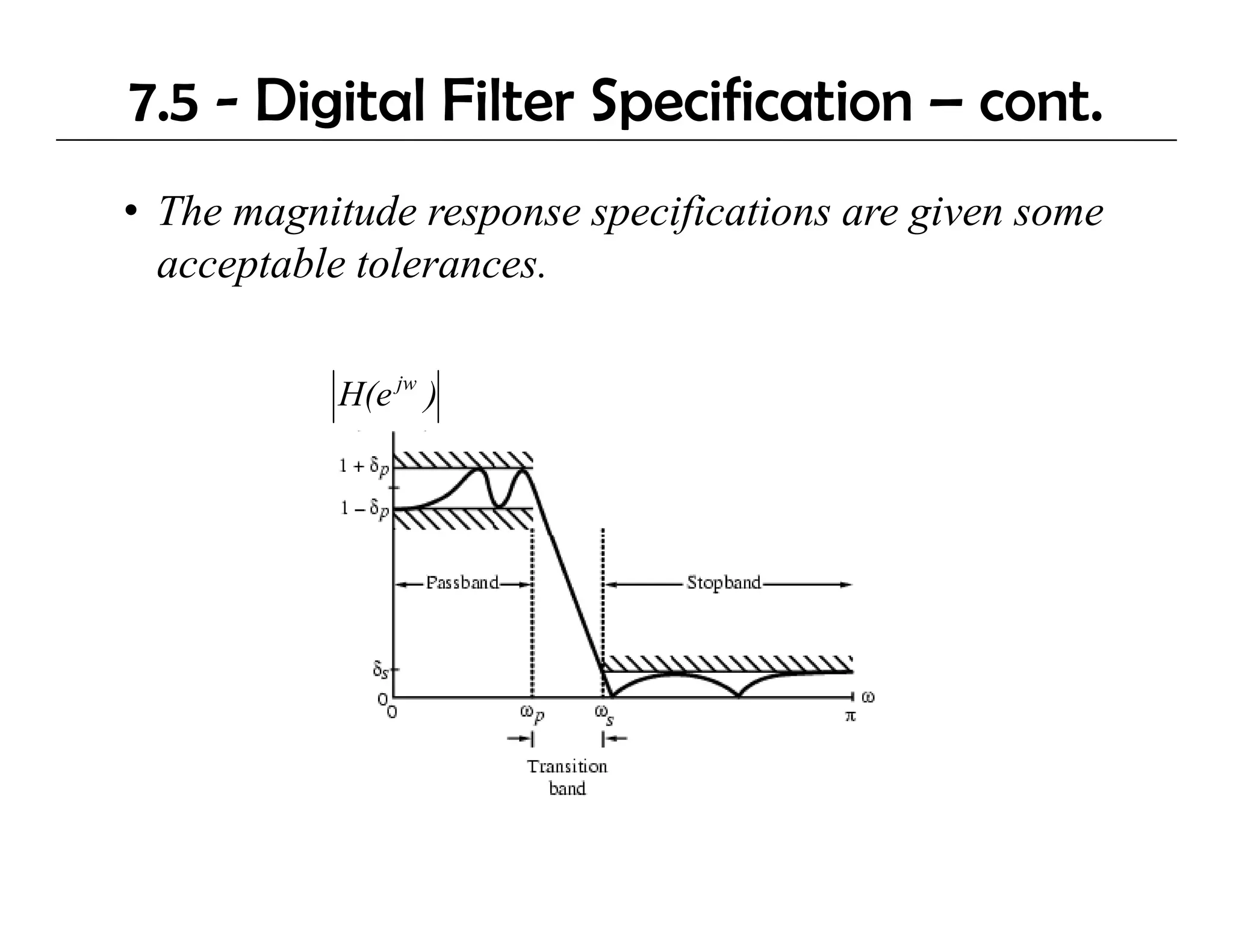
• The magnitude response specifications are given some
  acceptable tolerances.

           H(e jw )
7.5 - Digital Filter Specification – cont.

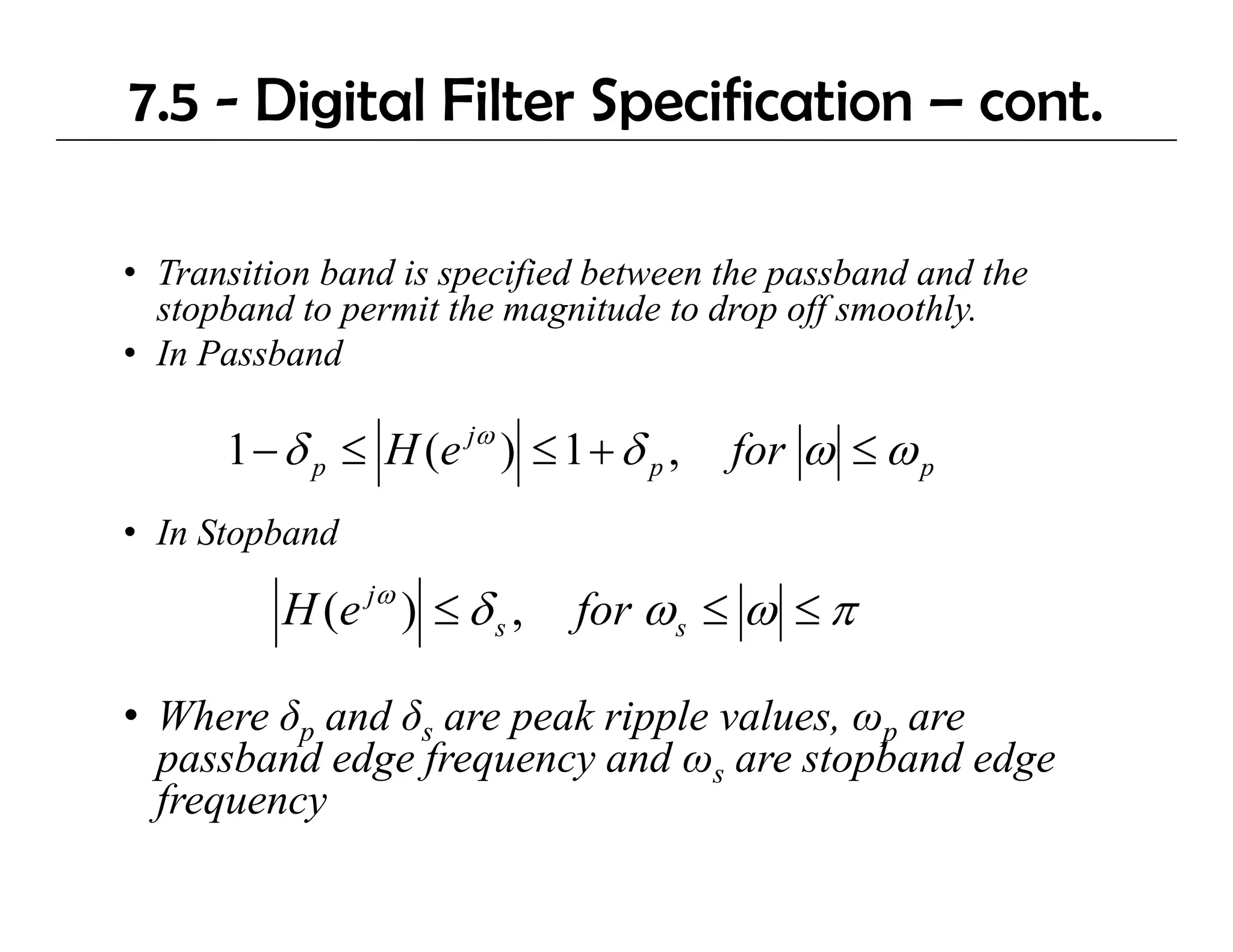
• Transition band is specified between the passband and the
  stopband to permit the magnitude to drop off smoothly.
      b d             h           d    d     ff     hl
• In Passband

      1 − δ p ≤ H ( e jω ) ≤ 1 + δ p ,   for ω ≤ ω p
• In Stopband
                jω
          H (e ) ≤ δ s ,      for ω s ≤ ω ≤ π

• Where δp and δs are peak ripple values, ωp are
  p
  passband edge f q
             g frequency and ωs are stopband edge
                         y                p      g
  frequency
7.5 - Digital Filter Specification – cont.

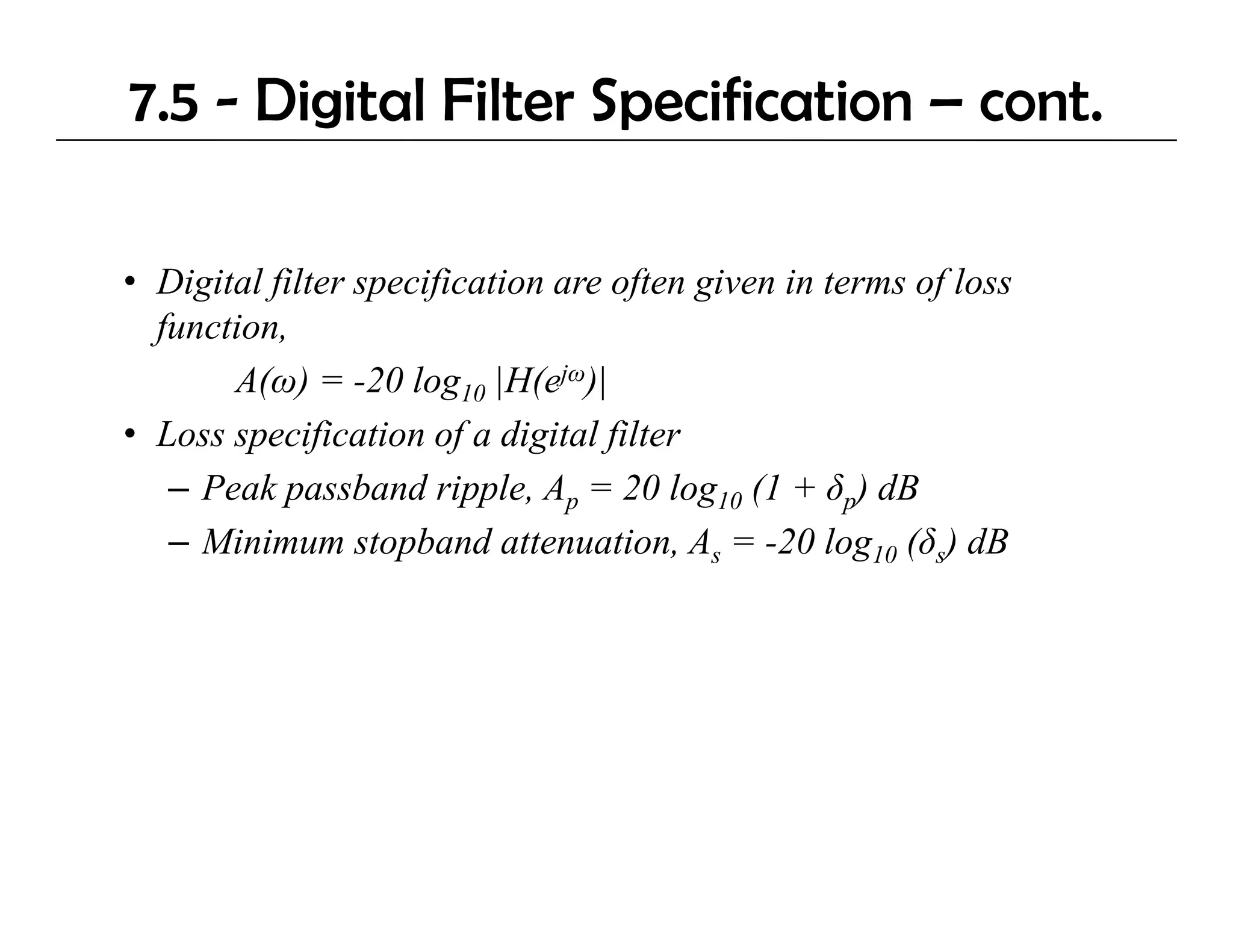
• Digital f
    g     filter specification are often given in terms of loss
                  p f                f g                 f
  function,
       A(ω) = -20 log10 |H(ejω)|
• Loss specification of a digital filter
   – Peak passband ripple, Ap = 20 log10 (1 + δp) dB
   – Mi i
     Minimum stopband attenuation, As = -20 l 10 (δs) dB
                  t b d tt         ti         20 log
7.5 - Digital Filter Specification – cont.
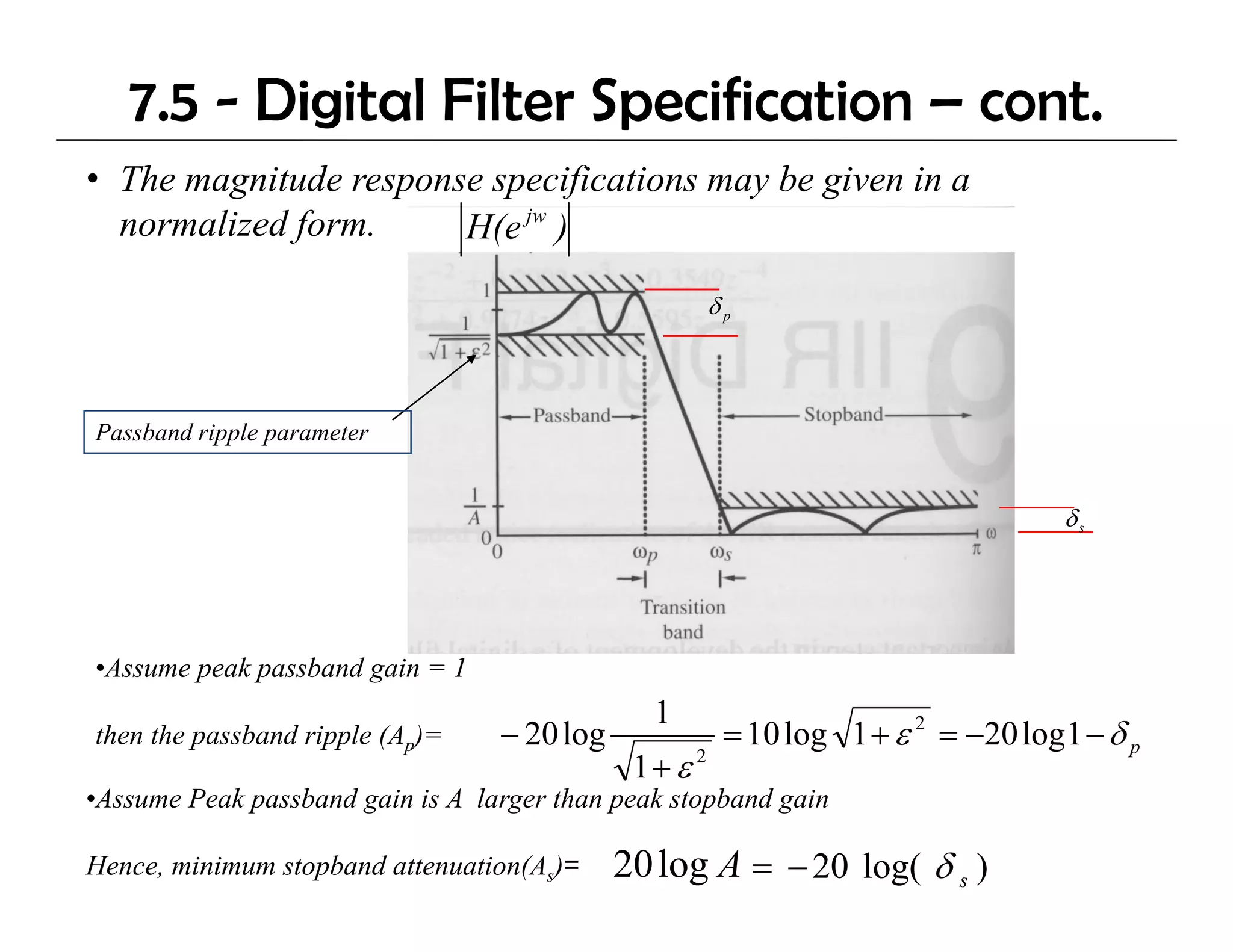
• The magnitude response specifications may be given in a
  normalized form.     H(e jw )

                                                       δp


Passband ripple parameter


                                                                                   δs


•Assume peak passband gain = 1
                                               1
then the passband ripple (Ap)=    − 20 log              = 10 log 1 + ε 2 = −20 log 1 − δ p
                                              1+ ε 2
•Assume Peak passband gain is A larger than peak stopband gain

Hence, minimum stopband attenuation(As)=     20 log A = − 20 log( δ s )

Dsp U Lec07 Realization Of Discrete Time Systems

  • 1.
    EC533: Digital Signal Processing 5 l l Lecture 7 Realization of Discrete-Time Systems
  • 2.
    7.1 – Discrete-TimeSystem Components 1) Unit Delay X(n) y(n)= x(n-1) T Y(z)= z-1 X(z) 2) Adder X1(z) X2(z) Xn(z) 3) M lti li Multiplier k X(z) Y(z)= k X(z) X N.B. Delay in the time domain by k-periods corresponds to multiplication by z-k.
  • 3.
    7.2 – DiscreteSystem Networks z-1 X(z) z-2 X(z) FIR Network X(z) T T a0 X a1 X a2 X IIR Network Y(z) X(z) Y(z) -m T z-1 Y( ) Y(z) X ‐ ve Feedback
  • 4.
    Example Find the transferfunction for the following IIR Network a0 X(z) X Y(z) - b1 T a1 X X - b2 T X 1 2 From 1 & 2
  • 5.
    7.3 – Realizationof Discrete Systems • We will study the following realization topologies: 1) Direct Form I (for FIR & IIR). ( (named as transversal for FIR) f ) 2) Direct Form II – Canonical Form. (for IIR). 3) Cascaded Realization (IIR). 4) Parallel Realization (IIR).
  • 6.
    7.3.1.a - FIRDirect or Transversal form x(n 1) x(n-1) x(n 2) x(n-2) x(n) ( ) z -1 z -1 z -1 1 h0 x h1 x hN-1 x hN x + y(n)
  • 7.
    7.3.1.b - IIRDirect Form I Feedforward Feedback M D′( z ) = ∑ bi z −i i =1 x(n) y(n)
  • 8.
    7.3.1.b - DirectForm I – cont. a0 x(n) X y(n) T a1 - b1 T X X T a2 - b2 T X X T a3 - b3 T X X a0 x(n) X y(n) T a1 - b1 T X X T a2 - b2 T X X T a3 - b3 T X X
  • 9.
    7.3.2 – IIRDirect Form II (Canonical Form) a0 x(n) y(n) X - b1 T T a1 X X - b2 T T a2 X X - b3 T T a3 X X a0 x(n) y(n) X - b1 T a1 X X - b2 T a2 No of Delays= Order of the  y X X System. - b3 T a3 Less than the previous method X X
  • 10.
    7.3.3 – CascadedRealization • The transfer function is decomposed into cascaded combination of second order or first order z-transforms. z transforms. where is either a 2nd or a 1st order section. 2nd order d 1st order x(n) y(n)
  • 11.
    7.3.4 – ParallelRealization • The transfer function is decomposed into parallel combination of second order or first order z-transforms. f f x(n) X y(n)
  • 12.
    Example Parallel Cascaded • For high order filters, cascaded or parallel realization is mainly used because large errors is caused by direct realization due to the accumulation of truncation errors. But in cascaded & p parallel, the coefficients are more integer, & mathematical , ff g , operations are small so truncation error decreases. • Truncation error arises due to the specific number of bits allocated to the decimal notation so some of the decimals is ll t d t th d i l t ti f th d i l i truncated.
  • 13.
    7.4 – DigitalFilters • A digital filters is a mathematical algorithm, implemented in hardware and/or software, that operates on a digital input signal to software produce a digital output signal for achieving a filtering objective. • Digital filters are systems, but not all systems are filters. DSP MUX DMUX System/Filters So as the filter may be used for more than one  signal at the same time
  • 14.
    7.4.1 – Advantages& Disadvantages of Digital Filters g • Advantages of Digital Filters 1) No impedance matching problem. 2) Size is small, made from IC’s. 3) Programmable if made software. software 4) Can achieve linear phase; No phase distortion. 5) One digital filter can be used for several inputs at the same time. • Disadvantages of Digital Filters 1) E Expensive. i 2) Harder to design. 3) Quantization noise is present.
  • 15.
    7.4.2 – Typesof Digital Filters Finite Impulse Response (FIR) Infinite Impulse Response (IIR) open loop system closed loop system (Feedback). Non-recursive. Recursive (Depends on previous O/p). (N-1) is the filter order. (N) is the filter order. ak’s are the filter coefficients. s ak , bk’s are the filter coefficients. s Only zeros are available. Poles & zeros are available.
  • 16.
    7.4.3 – Choosingbetween FIR & IIR Filters 1) FIR filter can have exactly linear phase response, while that of IIR filter is nonlinear. (needed in some applications like digital audio). 2) FIR filters are always stable (have zeros only), while IIR filters are not guaranteed. 3) Finite word length effects are much less severe in FIR than IIR. ) g ff 4) FIR requires more coefficients for sharp cut-off filters than IIR. more processing time, storage will be needed. 5) Analogue filters can be readily transformed into equivalent IIR digital filters meeting similar specifications. This is not possible with FIR, as they have no analogue counterpart. 6) FIR is algebraically more difficult to synthesize, if CAD tool is not available. synthesize available Use IIR if sharp cut‐off filters is needed. So Use FIR if no of coefficients is not too large & if no phase distortion is required
  • 17.
    7.4.4 – DesignSteps of Digital Filters • Type of the filter. Start • Amplitude & phase responses (performance Approximation Performance Specification we are willing to accept). g p) Resepcify y • Sampling Frequency. • Wordlength of the I/p Filter Coefficients Calculation data ulate Recalcu Realization Structure Restructure Error Analysi Yes s No Due to finite wordlength effect Hardware &/or Software  Hardware &/or Software Implementation Testing End
  • 18.
    7.5 - DigitalFilter Specification • Digital Filter designed to pass signal components of certain g g p g p f frequencies without distortion. • The frequency response should be equal to the signal’s frequencies to pass the signal. (passband) • The frequency response should be equal to zero to block the signal. (stopband)
  • 19.
    7.5 - DigitalFilter Specification – cont. • The main four Filter Types:
  • 20.
    7.5 - DigitalFilter Specification – cont. • The magnitude response specifications are given some acceptable tolerances. H(e jw )
  • 21.
    7.5 - DigitalFilter Specification – cont. • Transition band is specified between the passband and the stopband to permit the magnitude to drop off smoothly. b d h d d ff hl • In Passband 1 − δ p ≤ H ( e jω ) ≤ 1 + δ p , for ω ≤ ω p • In Stopband jω H (e ) ≤ δ s , for ω s ≤ ω ≤ π • Where δp and δs are peak ripple values, ωp are p passband edge f q g frequency and ωs are stopband edge y p g frequency
  • 22.
    7.5 - DigitalFilter Specification – cont. • Digital f g filter specification are often given in terms of loss p f f g f function, A(ω) = -20 log10 |H(ejω)| • Loss specification of a digital filter – Peak passband ripple, Ap = 20 log10 (1 + δp) dB – Mi i Minimum stopband attenuation, As = -20 l 10 (δs) dB t b d tt ti 20 log
  • 23.
    7.5 - DigitalFilter Specification – cont. • The magnitude response specifications may be given in a normalized form. H(e jw ) δp Passband ripple parameter δs •Assume peak passband gain = 1 1 then the passband ripple (Ap)= − 20 log = 10 log 1 + ε 2 = −20 log 1 − δ p 1+ ε 2 •Assume Peak passband gain is A larger than peak stopband gain Hence, minimum stopband attenuation(As)= 20 log A = − 20 log( δ s )