Discrete Fourier Transform
1
• The DFT pair was given
as N  1 1
N
N  1
 
j 2  / N
kn
X k 
 n 
0
 x[n]e
 j 2  / N kn x[n]  
k  0 X k
e
• Baseline for computational
complexity:
– Each DFT coefficient requires
• N complex multiplications
• N-1 complex additions
– All N DFT coefficients require
• N2 complex multiplications
• N(N-1) complex additions
• Complexity in terms of real operations
• 4N2 real multiplications
• 2N(N-1) real additions
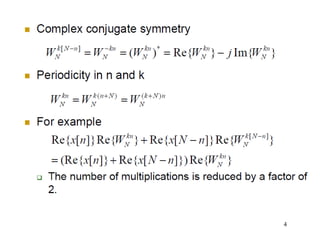
• Most fast methods are based on symmetry
properties
– Conjugate symmetry
– Periodicity in n and k
e  j2  / N k N  n 
 e  j2  / N kN
e  j2  / N k  n   e j2  / N kn
e  j2  / N kn
 e  j2  / N k n  N 
 e j2  / N k  N n
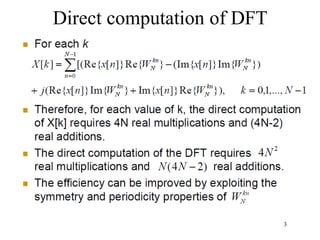
Direct computation of DFT
2
Direct computation of DFT
3
4
FFT
5
6
2
rk
N
N
rk
N / 2
N
Decimation-In-Time FFT Algorithms
• Makes use of both symmetry and periodicity
• Consider special case of N an integer power of
2
• Separate x[n] into two sequence of length N/2
– Even indexed samples in the first sequence
– Odd indexed samples in the other sequence
X k
 
N  1
 x[n]e
n  0
 j2  / N kn
N  1

x[n
]e
n
even

 j2  / N kn
N  1
 x[n]e
n odd

 j 2  / N kn
• Substitute variables n=2r for n even and n=2r+1 for
odd N / 2  1
X k
 

r  0
x[2
r ]W
 1]W
2 r  1 k
N / 2  1
 
x[2 r
r  0
N / 2
 1
N / 2  1
 
r  0
x[2
r ]W
N
r  0
N / 2
 W k
 x[2 r  1]W rk
k
 G k   W H k

• G[k] and H[k] are the N/2-point DFT’s of each
subsequence
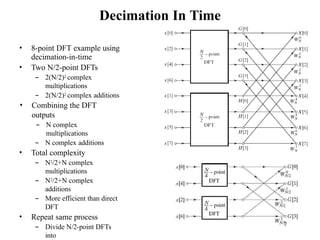
Decimation In Time
• 8-point DFT example using
decimation-in-time
• Two N/2-point DFTs
– 2(N/2)2 complex
multiplications
– 2(N/2)2 complex additions
• Combining the DFT
outputs
– N complex
multiplications
– N complex additions
• Total complexity
– N2/2+N complex
multiplications
– N2/2+N complex
additions
– More efficient than direct
DFT
• Repeat same process
– Divide N/2-point DFTs
into
7
Decimation In Time Cont’d
• After two steps of decimation in
time
• Repeat until we’re left with two-point
DFT’s
8
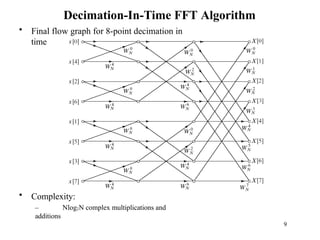
Decimation-In-Time FFT Algorithm
• Final flow graph for 8-point decimation in
time
• Complexity:
– Nlog2N complex multiplications and
additions
9
Butterfly Computation
• Flow graph constitutes of
butterflies
• We can implement each butterfly with one multiplication
• Final complexity for decimation-in-time FFT
– (N/2)log2N complex multiplications and
additions
10
11
In-Place Computation
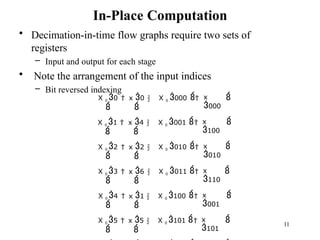
• Decimation-in-time flow graphs require two sets of
registers
– Input and output for each stage
• Note the arrangement of the input indices
– Bit reversed indexing
X 0 0

 x 0

 X 0 000  x
000

X 0 1

 x 4

 X 0 001  x
100

X 0 2

 x 2

 X 0 010  x
010

X 0 3

 x 6

 X 0 011  x
110

X 0 4

 x 1

 X 0 100  x
001

X 0 5

 x 5

 X 0 101  x
101

12
Decimation-In-Frequency FFT Algorithm
nk
N
N N N
n 2
r
N
N N / 2
N / 2
X k
 
• The DFT equation
N  1

n  0
• Split the DFT equation into even and odd frequency
indexes
N  1 N / 2  1 N  1
x[n]W
X 2 r
 
 x[n]W n 2 r

x[n]W n 2 r 


n  0
x[n]W n 2 r
n  0
• Substitute variables to get
n  N / 2
N / 2  1 N / 2  1
  x[n
n  0
N / 2  1
X 2 r
 

n 
0
x[n]W  N / 2 ]W
n  N / 2 2 r  
n 
0
x[n]  x[n  N / 2 ]W nr
• Similarly for odd-numbered frequencies
N / 2  1
X 2 r  1    x[n]  x[n
 N / 2 ]W n 2 r  1 
n 
0
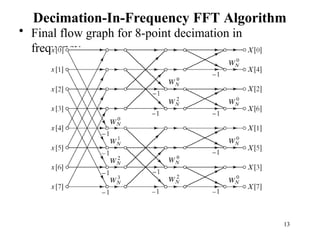
Decimation-In-Frequency FFT Algorithm
• Final flow graph for 8-point decimation in
frequency
13
x n  y n

D/C
H(ej)
C/D
He j   H j / T 
c
Filter Design Techniques
• Any discrete-time system that modifies certain frequencies
• Frequency-selective filters pass only certain frequencies
• Filter Design Steps
– Specification
• Problem or application specific
– Approximation of specification with a discrete-time system
• Our focus is to go from spec to discrete-time system
– Implementation
• Realization of discrete-time systems depends on target technology
• We already studied the use of discrete-time systems to implement a
continuous-time system
– If our specifications are given in continuous time we can use
xc(t)
yr(t)
 

14
IIR Filters
Digital Filter Specifications
• Only the magnitude approximation problem
• Four basic types of ideal filters with magnitude
responses as shown below (Piecewise flat)
15
Digital Filter Specifications
16
• These filters are unealisable because (one of the
following is sufficient)
– their impulse responses infinitely long non-
causal
– Their amplitude responses cannot be equal to
a constant over a band of frequencies
Another perspective that provides some
understanding can be obtained by looking at
the ideal amplitude squared.
Digital Filter Specifications
17
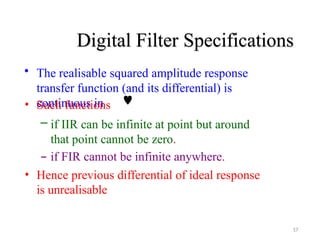
• The realisable squared amplitude response
transfer function (and its differential) is
continuous in
• Such functions 
– if IIR can be infinite at point but around
that point cannot be zero.
– if FIR cannot be infinite anywhere.
• Hence previous differential of ideal response
is unrealisable
Digital Filter Specifications
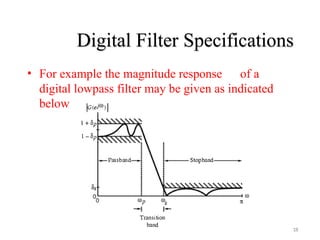
• For example the magnitude response of a
digital lowpass filter may be given as indicated
below
18
p
• In the passband 0     we
requireG ( e j ) 
1
that with a deviation
 p
p
1    G ( e j )  1   p ,   
p
  

• In the stopband  s we re qs
uire G ( e
j
)  0
that with a deviation
G ( e j )   s ,  s   

Digital Filter Specifications
19
p
Filter specification parameters


s

p

s
• - passband edge frequency
• - stopband edge frequency
• - peak ripple value in the
passband
• - peak ripple value in the
stopband
Digital Filter Specifications
20
• Practical specifications are often given
in terms of loss function (in dB)
• G ( )

 20 log 10 G ( e
j )
• Peak passband
ripple p   20 log
 10 (1   p ) dB
• Minimum stopband attenuation
 s   20
log 10 ( s ) dB
Digital Filter Specifications
21
p
s
p
• In practice, passband edge frequency F
and
stopband edge frequency arFes
specified in Hz
• For digital filter design, normalized
bandedge frequencies need to be computed
from
specifications in Hz using  2
F
p
 
 FT
p
FT
p
 2 FT
2
Fs

s
 s
   2 F
T
FT FT
250
Digital Filter Specifications
p s
T
 7
• Example - Let F
kHz,
F  3
F  25 kHz
kHz,
and
• Then

2( 7  10 3 )
p  3  0 .56

25  10
2( 3  10 3 )
 s  3  0 .24

25  10
Digital Filter Specifications
23
IIR Digital Filter Design
24
Standard approach
(1)Convert the digital filter specifications into
an analogue prototype lowpass filter
specifications
(2)Determine the analogue lowpass filter
transfer function H a ( s )
(3)Transform H a ( s ) by replacing the
complex variable to the digital transfer
function
G ( z )
IIR Digital Filter Design
25
• This approach has been widely used for
the following reasons:
(1)Analogue approximation techniques
are highly advanced
(2)They usually yield closed-
form solutions
(3)Extensive tables are available
for analogue filter design
(4)Very often applications require
digital simulation of analogue systems
D a ( s )
• Let an analogue transfer function
be H ( s )

a
Pa
( s )
where the subscript “a” indicates
the analogue domain
• A digital transfer function derived from
this is denoted as
G ( z )

P
( z )
D
( z )
IIR Digital Filter Design
26
IIR Digital Filter Design
27
• Basic idea behind the conversion of H ( s ) intoG
( z )
a
is to apply a mapping from the s-
domain to the z-
domain so that essential properties of the
analogue frequency response are preserved
• Thus mapping function should be such that
– Imaginary (j  ) axis in the s-plane
be mapped onto the unit circle of the
z-plane
– A stable analogue transfer function be
mapped into a stable digital transfer function
Specification for effective frequency response of a continuous-time
lowpass filter and its corresponding specifications for discrete-time
system.
dp or d1 passband ripple
ds or d2 stopband ripple
Wp, wp passband edge frequency
Ws, ws stopband edge frequency
e2 passband ripple parameter
1 – dp = 1/1 + e2
BW bandwidth = wu – wl
wc 3-dB cutoff frequency
wu, wl upper and lower 3-dB cutoff
frequensies
Dw transition band = |wp – ws|
Ap passband ripple in dB
=  20log10(1 
dp) As stopband attenuation in
dB
= -
20log10(ds) 28
29
Design of Discrete-Time IIR Filters
• From Analog (Continuous-Time)
Filters
– Approximation of Derivatives
– Impulse Invariance
– the Bilinear Transformation
Reasons of Design of Discrete-Time IIR Filters
from Continuous-Time Filters
30
• The art of continuous-time IIR filter design is highly advanced and,
since useful results can be achieved, it is advantageous to
use the design procedures already developed for continuous-time
filters.
• Many useful continuous-time IIR design methods have relatively
simple closed-form design formulas. Therefore, discrete-time
IIR filter design methods based on such standard continuous-
time design formulas are rather simple to carry out.
• The standard approximation methods that work well for continuous-
time IIR filters do not lead to simple closed-form design
formulas when these methods are applied directly to the
discrete-time IIR case.
31
Characteristics of Commonly Used Analog Filters
• Butterworth Filter
• Chebyshev Filter
– Chebyshev Type I
– Chebyshev Type II of Inverse Chebyshev Filter
32
Butterworth Filter
• Lowpass Butterworth filters are all-pole filters characterized by the magnitude-squared
frequency response
|H(W)|2 = 1/[1 + (W/Wc)2N] = 1/[1 + e2(W/Wp)2N]
where N is the order of the filter, Wc is its – 3-dB frequency (cutoff frequency), Wp
is the bandpass edge frequency, and 1/(1 + e2) is the band-edge value of |
H(W)|2.
• At W = Ws (where Ws is the stopband edge frequency) we have
1/[1 + e2(Ws/Wp)2N] = d2
2
and
N = (1/2)log10[(1/d2
2) – 1]/log10(Ws/Wc) = log10(d/e)/log10(Ws/Wp)
where d2= 1/1 + d2
2.
• Thus the Butterworth filter is completely characterized by the parameters N, d2, e, and
the ratio Ws/Wp.
2
H j  c
Butterworth Lowpass
Filters
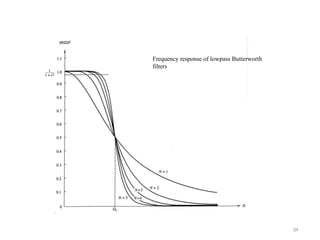
• Passband is designed to be maximally flat
• The magnitude-squared function is of the
form 
1
c
1  j / j
2 N
H s 
2

1  s / j
1
c
2 N
sk
  1 1 / 2 N
j    e
 j / 2 N 2 k  N  1 
c c
for k  0,1,...,2N - 1
c
33
Frequency response of lowpass Butterworth
filters
34
35
Chebyshev Filters
• The magnitude squared response of the analog lowpass Type I
Chebyshev filter of Nth order is given by:
|H(W)|2 = 1/[1 + e2T 2(W/W )].
N
where TN(W) is the Chebyshev polynomial of order
N: TN(W) = cos(Ncos-1 W), |W|  1,
= cosh(Ncosh-1 W), |W| >
1.
The polynomial can be derived via a recurrence relation given
by Tr(W) = 2WTr-1(W) – Tr-2(W), r  2,
with T0(W) = 1 and T1(W) = W.
• The magnitude squared response of the analog lowpass Type II or
inverse Chebyshev filter of Nth order is given by:
|H(W)|2 = 1/[1 + e2{TN(Ws/Wp)/ TN(Ws/W)}2].
c
N
N
c
Chebyshev
Filters
• Equiripple in the passband and monotonic in the stopband
• Or equiripple in the stopband and monotonic in the
passband
2 1

H  j 
1   2
V 2
 /  
V x   cos N cos  1 x 
36
N
Frequency response of
lowpass Type I Chebyshev
filter
|H(W)|2 = 1/[1 + e2T 2(W/W )]
Frequency response of
lowpass Type II Chebyshev filter
|H(W)|2 = 1/[1 + e2{T 2(W /W )/T 2(W /W)}]
N
s
p
N
s
37
38
N = log10[( 1 - d 2 +  1 – d 2(1 + e2))/ed
]/log 2 2 2
10
[(W /W ) +  (W /W )2 –
1 ]
s p s p
= [cosh-1(d/e)]/[cosh-1(Ws/Wp)]
for both Type I and II Chebyshev filters, and
where d2 = 1/  1 + d2.
• The poles of a Type I Chebyshev filter lie on an ellipse in the s-plane with major
axis r1 = Wp{(b2 + 1)/2b] and minor axis r1 = Wp{(b2 - 1)/2b] where b is related to
e according to
b = {[ 1 + e2 + 1]/e}1/N
• The zeros of a Type II Chebyshev filter are located on the imaginary axis.
Type I: pole positions are
xk = r2cosfk
yk = r1sinfk
fk = [p/2] + [(2k + 1)p/2N]
r1 = Wp[b2 + 1]/2b
r2 = Wp[b2 – 1]/2b
b = {[ 1 + e2 + 1]/e}1/N
Type II: zero positions are
sk = jWs/sinfk
and pole positions are
vk = Wsxk/ x 2 + y 2
k
k
wk = Wsyk/ x 2 + y 2
k
k 2
b = {[1 +  1 – d 2
]/d }1/N
Determination of the pole locations
for a Chebyshev filter.
k = 0, 1, …, N-1.
39
Approximation of Derivative Method
• Approximation of derivative method is the simplest one for converting an
analog filter into a digital filter by approximating the differential equation
by an equivalent difference equation.
– For the derivative dy(t)/dt at time t = nT, we substitute the backward difference
[y(nT) – y(nT – T)]/T. Thus

t  nT
 T )

y [ n ]  y [ n  1]
T
where T represents the sampling period. Then, s = (1 – z-1)/T
– The second derivative d2y(t)/dt2 is derived into second difference as follow:

t  nT T 2
y [ n ]  2 y [ n  1]  y [ n  2 ]
which s2 = [(1 – z-1)/T]2. So, for the kth derivative of y(t), sk = [(1 – z-1)/T]k.
dy ( t ) y ( nT )  y ( nT
dt T
dy
( t )
dt
40
Approximation of Derivative
Method
41
• Hence, the system function for the digital IIR filter obtained as a result of
the approximation of the derivatives by finite difference is
H(z) = Ha(s)|s=(z-1)/Tz
• It is clear that points in the LHP of the s-plane are mapped into the
corresponding points inside the unit circle in the z-plane and points in
the RHP of the s-plane are mapped into points outside this circle.
– Consequently, a stable analog filter is transformed into a stable digital filter due
to this mapping property.
jW
Unit circle
s
s-
plane
z-plane
Example: Approximation of derivative method
Convert the analog bandpass filter with system function
Ha(s) = 1/[(s + 0.1)2 + 9]
Into a digital IIR filter by use of the backward difference for the
derivative.
Substitute for s = (1 – z-1)/T into Ha(s) yields
H(z) = 1/[((1 – z-1)/T) + 0.1)2
+ 9]
H ( z ) 
T 2
1  0 .2 T  9 .01 T 2
 1
1 
2 ( 1  0 .1 T ) z
 1
z
 2
1  0 .2 T  9 .01 T 2
T can be selected to satisfied specification of designed filter. For example, if T =
0.1, the poles are located at
p1,2
= 0.91  j0.27 = 0.949exp[
j16.5o]
42
• If the continuous-time filter is bandlimited to
H c
 j   0
c 
Filter Design by Impulse Invariance
• Remember impulse invariance
– Mapping a continuous-time impulse response to discrete-time
– Mapping a continuous-time frequency response to discrete-time
hn  
T h
nT

d
c
d
   2

H e j
   H  j  j
c
k 

 Td
Td

k


j

 

   /
T d
H e   H 
j


Td

 

• If we start from discrete-time specifications Td cancels out
– Start with discrete-time spec in terms of 
– Go to continuous-time =  /T and design continuous-time
filter
– Use impulse invariance to map it back to discrete-time = T
• Works best for bandlimited filters due to possible aliasing
43
Impulse Invariance of System Functions
• Develop impulse invariance relation between system
functions
• Partial fraction expansion of transfer function
H s  

N
A k
c
• Corresponding impulse response

N
h t    
c k  1
k  1 s
 s k



A
e
s k t
0
t 
0
t  0
• Impulse response of discrete-time filter


 T dh c nT d 
 
h n
• System
function
N
s k nT d


N s k T d
n 

u n

u n   T d A k
e
k  1

k 
1
T d A k
e
 
H z
N T
A
d
k


k 
1
1  e
s k T d
z
 1
• Pole s=sk in s-domain transform into pole at e
s k T d
k
44
• Step 1: define specifications of filter
– Ripple in frequency bands
– Critical frequencies: passband edge, stopband edge, and/or cutoff frequencies.
– Filter band type: lowpass, highpass, bandpass, bandstop.
• Step 2: linear transform critical frequencies as follow
W = w/Td
• Step 3: select filter structure type and its order: Bessel, Butterworth,
Chebyshev type I, Chebyshev type II or inverse Chebyshev, elliptic.
• Step 4: convert Ha(s) to H(z) using linear transform in step 2.
• Step 5: verify the result. If it does not meet requirement, return to step 3.
Impulse Invariant Algorithm
45
Example: Impulse invariant method
Convert the analog filter with system function
Ha(s) = [s + 0.1]/[(s + 0.1)2 + 9]
into a digital IIR filter by means of the impulse invariance method.
The analog filter has a zero at s = - 0.1 and a pair of complex conjugate poles at pk = - 0.1 
j3. Thus,
H s  
a
1 1
2
 2
s  0 .1  j 3 s  0 .1  j
3
Then
H  z  
1
 2
1  e
46
1
2
 0 .1 T
e
j 3 T
z
 1
1  e
 0 .1 T
e
 j 3 T
z
 1
Frequency response
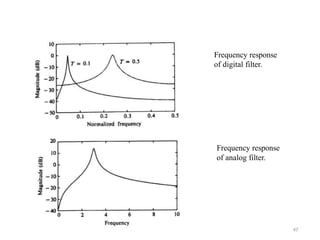
of digital filter.
Frequency response
of analog filter.
47
Disadvantage of previous
techniques: frequency
warping  aliasing effect
and error in specifications
48
of designed filter (frequencies)
So, prewarping of frequency
is considered.


H j 
Example
• Impulse invariance applied to
Butterworth 0 . 89125  H e j   1 0    0 . 2

0 . 3   

H e j   0.17783
• Since sampling rate Td cancels out we can assume Td=1
• Map spec to continuous time
0 . 89125  H  j   1
H  j   0.17783
0    0 . 2

0 . 3    

• Butterworth filter is monotonic so spec will be satisfied if
H c
j0 .2    0 .89125 and H c
j0 .3    0.17783 2

1
c
1  j / j
c 
2
N
• Determine N and c to satisfy these conditions
49
 1 
Example Cont’d
• Satisfy both constrains

2


1     

and 1     








 0 . 3   2 N 
1
 c 
0 .89125
  c

0 .17783
• Solve these equations to get
 0 . 2   2 N  1
 2
N  5 . 8858  6 and  c
 0 .
70474
sk  
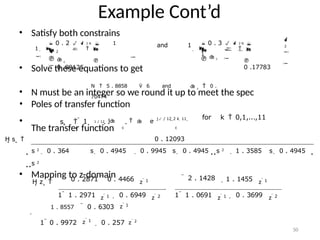
• N must be an integer so we round it up to meet the spec
• Poles of transfer function
• 1 / 12 j    e
 j / 12 2 k  11 
c c
for k  0,1,...,11
The transfer function
H s   0 . 12093
 0 . 9945 s  0 . 4945 s 2
 1 . 3585 s  0 . 4945 
s 2
 0 . 364 s  0 . 4945
s 2
• Mapping to z-domain
H z   0 . 2871  0 . 4466 z  1  2 . 1428  1 . 1455 z  1

z  1
50
1  1 . 2971  0 . 6949 z  2 1  1 . 0691 z  1  0 . 3699 z  2
1 . 8557  0 . 6303 z  1

z  1
1  0 . 9972  0 . 257 z  2
THANK
YOU

Digital signal processing 22 scheme notes

  • 1.
    Discrete Fourier Transform 1 •The DFT pair was given as N  1 1 N N  1   j 2  / N kn X k   n  0  x[n]e  j 2  / N kn x[n]   k  0 X k e • Baseline for computational complexity: – Each DFT coefficient requires • N complex multiplications • N-1 complex additions – All N DFT coefficients require • N2 complex multiplications • N(N-1) complex additions • Complexity in terms of real operations • 4N2 real multiplications • 2N(N-1) real additions • Most fast methods are based on symmetry properties – Conjugate symmetry – Periodicity in n and k e  j2  / N k N  n   e  j2  / N kN e  j2  / N k  n   e j2  / N kn e  j2  / N kn  e  j2  / N k n  N   e j2  / N k  N n
  • 2.
  • 3.
  • 4.
  • 5.
  • 6.
    6 2 rk N N rk N / 2 N Decimation-In-TimeFFT Algorithms • Makes use of both symmetry and periodicity • Consider special case of N an integer power of 2 • Separate x[n] into two sequence of length N/2 – Even indexed samples in the first sequence – Odd indexed samples in the other sequence X k   N  1  x[n]e n  0  j2  / N kn N  1  x[n ]e n even   j2  / N kn N  1  x[n]e n odd   j 2  / N kn • Substitute variables n=2r for n even and n=2r+1 for odd N / 2  1 X k    r  0 x[2 r ]W  1]W 2 r  1 k N / 2  1   x[2 r r  0 N / 2  1 N / 2  1   r  0 x[2 r ]W N r  0 N / 2  W k  x[2 r  1]W rk k  G k   W H k  • G[k] and H[k] are the N/2-point DFT’s of each subsequence
  • 7.
    Decimation In Time •8-point DFT example using decimation-in-time • Two N/2-point DFTs – 2(N/2)2 complex multiplications – 2(N/2)2 complex additions • Combining the DFT outputs – N complex multiplications – N complex additions • Total complexity – N2/2+N complex multiplications – N2/2+N complex additions – More efficient than direct DFT • Repeat same process – Divide N/2-point DFTs into 7
  • 8.
    Decimation In TimeCont’d • After two steps of decimation in time • Repeat until we’re left with two-point DFT’s 8
  • 9.
    Decimation-In-Time FFT Algorithm •Final flow graph for 8-point decimation in time • Complexity: – Nlog2N complex multiplications and additions 9
  • 10.
    Butterfly Computation • Flowgraph constitutes of butterflies • We can implement each butterfly with one multiplication • Final complexity for decimation-in-time FFT – (N/2)log2N complex multiplications and additions 10
  • 11.
    11 In-Place Computation • Decimation-in-timeflow graphs require two sets of registers – Input and output for each stage • Note the arrangement of the input indices – Bit reversed indexing X 0 0   x 0   X 0 000  x 000  X 0 1   x 4   X 0 001  x 100  X 0 2   x 2   X 0 010  x 010  X 0 3   x 6   X 0 011  x 110  X 0 4   x 1   X 0 100  x 001  X 0 5   x 5   X 0 101  x 101 
  • 12.
    12 Decimation-In-Frequency FFT Algorithm nk N NN N n 2 r N N N / 2 N / 2 X k   • The DFT equation N  1  n  0 • Split the DFT equation into even and odd frequency indexes N  1 N / 2  1 N  1 x[n]W X 2 r    x[n]W n 2 r  x[n]W n 2 r    n  0 x[n]W n 2 r n  0 • Substitute variables to get n  N / 2 N / 2  1 N / 2  1   x[n n  0 N / 2  1 X 2 r    n  0 x[n]W  N / 2 ]W n  N / 2 2 r   n  0 x[n]  x[n  N / 2 ]W nr • Similarly for odd-numbered frequencies N / 2  1 X 2 r  1    x[n]  x[n  N / 2 ]W n 2 r  1  n  0
  • 13.
    Decimation-In-Frequency FFT Algorithm •Final flow graph for 8-point decimation in frequency 13
  • 14.
    x n y n  D/C H(ej) C/D He j   H j / T  c Filter Design Techniques • Any discrete-time system that modifies certain frequencies • Frequency-selective filters pass only certain frequencies • Filter Design Steps – Specification • Problem or application specific – Approximation of specification with a discrete-time system • Our focus is to go from spec to discrete-time system – Implementation • Realization of discrete-time systems depends on target technology • We already studied the use of discrete-time systems to implement a continuous-time system – If our specifications are given in continuous time we can use xc(t) yr(t)    14 IIR Filters
  • 15.
    Digital Filter Specifications •Only the magnitude approximation problem • Four basic types of ideal filters with magnitude responses as shown below (Piecewise flat) 15
  • 16.
    Digital Filter Specifications 16 •These filters are unealisable because (one of the following is sufficient) – their impulse responses infinitely long non- causal – Their amplitude responses cannot be equal to a constant over a band of frequencies Another perspective that provides some understanding can be obtained by looking at the ideal amplitude squared.
  • 17.
    Digital Filter Specifications 17 •The realisable squared amplitude response transfer function (and its differential) is continuous in • Such functions  – if IIR can be infinite at point but around that point cannot be zero. – if FIR cannot be infinite anywhere. • Hence previous differential of ideal response is unrealisable
  • 18.
    Digital Filter Specifications •For example the magnitude response of a digital lowpass filter may be given as indicated below 18
  • 19.
    p • In thepassband 0     we requireG ( e j )  1 that with a deviation  p p 1    G ( e j )  1   p ,    p     • In the stopband  s we re qs uire G ( e j )  0 that with a deviation G ( e j )   s ,  s     Digital Filter Specifications 19
  • 20.
    p Filter specification parameters   s  p  s •- passband edge frequency • - stopband edge frequency • - peak ripple value in the passband • - peak ripple value in the stopband Digital Filter Specifications 20
  • 21.
    • Practical specificationsare often given in terms of loss function (in dB) • G ( )   20 log 10 G ( e j ) • Peak passband ripple p   20 log  10 (1   p ) dB • Minimum stopband attenuation  s   20 log 10 ( s ) dB Digital Filter Specifications 21
  • 22.
    p s p • In practice,passband edge frequency F and stopband edge frequency arFes specified in Hz • For digital filter design, normalized bandedge frequencies need to be computed from specifications in Hz using  2 F p    FT p FT p  2 FT 2 Fs  s  s    2 F T FT FT 250 Digital Filter Specifications
  • 23.
    p s T  7 •Example - Let F kHz, F  3 F  25 kHz kHz, and • Then  2( 7  10 3 ) p  3  0 .56  25  10 2( 3  10 3 )  s  3  0 .24  25  10 Digital Filter Specifications 23
  • 24.
    IIR Digital FilterDesign 24 Standard approach (1)Convert the digital filter specifications into an analogue prototype lowpass filter specifications (2)Determine the analogue lowpass filter transfer function H a ( s ) (3)Transform H a ( s ) by replacing the complex variable to the digital transfer function G ( z )
  • 25.
    IIR Digital FilterDesign 25 • This approach has been widely used for the following reasons: (1)Analogue approximation techniques are highly advanced (2)They usually yield closed- form solutions (3)Extensive tables are available for analogue filter design (4)Very often applications require digital simulation of analogue systems
  • 26.
    D a (s ) • Let an analogue transfer function be H ( s )  a Pa ( s ) where the subscript “a” indicates the analogue domain • A digital transfer function derived from this is denoted as G ( z )  P ( z ) D ( z ) IIR Digital Filter Design 26
  • 27.
    IIR Digital FilterDesign 27 • Basic idea behind the conversion of H ( s ) intoG ( z ) a is to apply a mapping from the s- domain to the z- domain so that essential properties of the analogue frequency response are preserved • Thus mapping function should be such that – Imaginary (j  ) axis in the s-plane be mapped onto the unit circle of the z-plane – A stable analogue transfer function be mapped into a stable digital transfer function
  • 28.
    Specification for effectivefrequency response of a continuous-time lowpass filter and its corresponding specifications for discrete-time system. dp or d1 passband ripple ds or d2 stopband ripple Wp, wp passband edge frequency Ws, ws stopband edge frequency e2 passband ripple parameter 1 – dp = 1/1 + e2 BW bandwidth = wu – wl wc 3-dB cutoff frequency wu, wl upper and lower 3-dB cutoff frequensies Dw transition band = |wp – ws| Ap passband ripple in dB =  20log10(1  dp) As stopband attenuation in dB = - 20log10(ds) 28
  • 29.
    29 Design of Discrete-TimeIIR Filters • From Analog (Continuous-Time) Filters – Approximation of Derivatives – Impulse Invariance – the Bilinear Transformation
  • 30.
    Reasons of Designof Discrete-Time IIR Filters from Continuous-Time Filters 30 • The art of continuous-time IIR filter design is highly advanced and, since useful results can be achieved, it is advantageous to use the design procedures already developed for continuous-time filters. • Many useful continuous-time IIR design methods have relatively simple closed-form design formulas. Therefore, discrete-time IIR filter design methods based on such standard continuous- time design formulas are rather simple to carry out. • The standard approximation methods that work well for continuous- time IIR filters do not lead to simple closed-form design formulas when these methods are applied directly to the discrete-time IIR case.
  • 31.
    31 Characteristics of CommonlyUsed Analog Filters • Butterworth Filter • Chebyshev Filter – Chebyshev Type I – Chebyshev Type II of Inverse Chebyshev Filter
  • 32.
    32 Butterworth Filter • LowpassButterworth filters are all-pole filters characterized by the magnitude-squared frequency response |H(W)|2 = 1/[1 + (W/Wc)2N] = 1/[1 + e2(W/Wp)2N] where N is the order of the filter, Wc is its – 3-dB frequency (cutoff frequency), Wp is the bandpass edge frequency, and 1/(1 + e2) is the band-edge value of | H(W)|2. • At W = Ws (where Ws is the stopband edge frequency) we have 1/[1 + e2(Ws/Wp)2N] = d2 2 and N = (1/2)log10[(1/d2 2) – 1]/log10(Ws/Wc) = log10(d/e)/log10(Ws/Wp) where d2= 1/1 + d2 2. • Thus the Butterworth filter is completely characterized by the parameters N, d2, e, and the ratio Ws/Wp.
  • 33.
    2 H j c Butterworth Lowpass Filters • Passband is designed to be maximally flat • The magnitude-squared function is of the form  1 c 1  j / j 2 N H s  2  1  s / j 1 c 2 N sk   1 1 / 2 N j    e  j / 2 N 2 k  N  1  c c for k  0,1,...,2N - 1 c 33
  • 34.
    Frequency response oflowpass Butterworth filters 34
  • 35.
    35 Chebyshev Filters • Themagnitude squared response of the analog lowpass Type I Chebyshev filter of Nth order is given by: |H(W)|2 = 1/[1 + e2T 2(W/W )]. N where TN(W) is the Chebyshev polynomial of order N: TN(W) = cos(Ncos-1 W), |W|  1, = cosh(Ncosh-1 W), |W| > 1. The polynomial can be derived via a recurrence relation given by Tr(W) = 2WTr-1(W) – Tr-2(W), r  2, with T0(W) = 1 and T1(W) = W. • The magnitude squared response of the analog lowpass Type II or inverse Chebyshev filter of Nth order is given by: |H(W)|2 = 1/[1 + e2{TN(Ws/Wp)/ TN(Ws/W)}2].
  • 36.
    c N N c Chebyshev Filters • Equiripple inthe passband and monotonic in the stopband • Or equiripple in the stopband and monotonic in the passband 2 1  H  j  1   2 V 2  /   V x   cos N cos  1 x  36
  • 37.
    N Frequency response of lowpassType I Chebyshev filter |H(W)|2 = 1/[1 + e2T 2(W/W )] Frequency response of lowpass Type II Chebyshev filter |H(W)|2 = 1/[1 + e2{T 2(W /W )/T 2(W /W)}] N s p N s 37
  • 38.
    38 N = log10[(1 - d 2 +  1 – d 2(1 + e2))/ed ]/log 2 2 2 10 [(W /W ) +  (W /W )2 – 1 ] s p s p = [cosh-1(d/e)]/[cosh-1(Ws/Wp)] for both Type I and II Chebyshev filters, and where d2 = 1/  1 + d2. • The poles of a Type I Chebyshev filter lie on an ellipse in the s-plane with major axis r1 = Wp{(b2 + 1)/2b] and minor axis r1 = Wp{(b2 - 1)/2b] where b is related to e according to b = {[ 1 + e2 + 1]/e}1/N • The zeros of a Type II Chebyshev filter are located on the imaginary axis.
  • 39.
    Type I: polepositions are xk = r2cosfk yk = r1sinfk fk = [p/2] + [(2k + 1)p/2N] r1 = Wp[b2 + 1]/2b r2 = Wp[b2 – 1]/2b b = {[ 1 + e2 + 1]/e}1/N Type II: zero positions are sk = jWs/sinfk and pole positions are vk = Wsxk/ x 2 + y 2 k k wk = Wsyk/ x 2 + y 2 k k 2 b = {[1 +  1 – d 2 ]/d }1/N Determination of the pole locations for a Chebyshev filter. k = 0, 1, …, N-1. 39
  • 40.
    Approximation of DerivativeMethod • Approximation of derivative method is the simplest one for converting an analog filter into a digital filter by approximating the differential equation by an equivalent difference equation. – For the derivative dy(t)/dt at time t = nT, we substitute the backward difference [y(nT) – y(nT – T)]/T. Thus  t  nT  T )  y [ n ]  y [ n  1] T where T represents the sampling period. Then, s = (1 – z-1)/T – The second derivative d2y(t)/dt2 is derived into second difference as follow:  t  nT T 2 y [ n ]  2 y [ n  1]  y [ n  2 ] which s2 = [(1 – z-1)/T]2. So, for the kth derivative of y(t), sk = [(1 – z-1)/T]k. dy ( t ) y ( nT )  y ( nT dt T dy ( t ) dt 40
  • 41.
    Approximation of Derivative Method 41 •Hence, the system function for the digital IIR filter obtained as a result of the approximation of the derivatives by finite difference is H(z) = Ha(s)|s=(z-1)/Tz • It is clear that points in the LHP of the s-plane are mapped into the corresponding points inside the unit circle in the z-plane and points in the RHP of the s-plane are mapped into points outside this circle. – Consequently, a stable analog filter is transformed into a stable digital filter due to this mapping property. jW Unit circle s s- plane z-plane
  • 42.
    Example: Approximation ofderivative method Convert the analog bandpass filter with system function Ha(s) = 1/[(s + 0.1)2 + 9] Into a digital IIR filter by use of the backward difference for the derivative. Substitute for s = (1 – z-1)/T into Ha(s) yields H(z) = 1/[((1 – z-1)/T) + 0.1)2 + 9] H ( z )  T 2 1  0 .2 T  9 .01 T 2  1 1  2 ( 1  0 .1 T ) z  1 z  2 1  0 .2 T  9 .01 T 2 1  0 .2 T  9 .01 T 2 T can be selected to satisfied specification of designed filter. For example, if T = 0.1, the poles are located at p1,2 = 0.91  j0.27 = 0.949exp[ j16.5o] 42
  • 43.
    • If thecontinuous-time filter is bandlimited to H c  j   0 c  Filter Design by Impulse Invariance • Remember impulse invariance – Mapping a continuous-time impulse response to discrete-time – Mapping a continuous-time frequency response to discrete-time hn   T h nT  d c d    2  H e j    H  j  j c k    Td Td  k   j        / T d H e   H  j   Td     • If we start from discrete-time specifications Td cancels out – Start with discrete-time spec in terms of  – Go to continuous-time =  /T and design continuous-time filter – Use impulse invariance to map it back to discrete-time = T • Works best for bandlimited filters due to possible aliasing 43
  • 44.
    Impulse Invariance ofSystem Functions • Develop impulse invariance relation between system functions • Partial fraction expansion of transfer function H s    N A k c • Corresponding impulse response  N h t     c k  1 k  1 s  s k    A e s k t 0 t  0 t  0 • Impulse response of discrete-time filter    T dh c nT d    h n • System function N s k nT d   N s k T d n   u n  u n   T d A k e k  1  k  1 T d A k e   H z N T A d k   k  1 1  e s k T d z  1 • Pole s=sk in s-domain transform into pole at e s k T d k 44
  • 45.
    • Step 1:define specifications of filter – Ripple in frequency bands – Critical frequencies: passband edge, stopband edge, and/or cutoff frequencies. – Filter band type: lowpass, highpass, bandpass, bandstop. • Step 2: linear transform critical frequencies as follow W = w/Td • Step 3: select filter structure type and its order: Bessel, Butterworth, Chebyshev type I, Chebyshev type II or inverse Chebyshev, elliptic. • Step 4: convert Ha(s) to H(z) using linear transform in step 2. • Step 5: verify the result. If it does not meet requirement, return to step 3. Impulse Invariant Algorithm 45
  • 46.
    Example: Impulse invariantmethod Convert the analog filter with system function Ha(s) = [s + 0.1]/[(s + 0.1)2 + 9] into a digital IIR filter by means of the impulse invariance method. The analog filter has a zero at s = - 0.1 and a pair of complex conjugate poles at pk = - 0.1  j3. Thus, H s   a 1 1 2  2 s  0 .1  j 3 s  0 .1  j 3 Then H  z   1  2 1  e 46 1 2  0 .1 T e j 3 T z  1 1  e  0 .1 T e  j 3 T z  1
  • 47.
    Frequency response of digitalfilter. Frequency response of analog filter. 47
  • 48.
    Disadvantage of previous techniques:frequency warping  aliasing effect and error in specifications 48 of designed filter (frequencies) So, prewarping of frequency is considered.  
  • 49.
    H j  Example •Impulse invariance applied to Butterworth 0 . 89125  H e j   1 0    0 . 2  0 . 3     H e j   0.17783 • Since sampling rate Td cancels out we can assume Td=1 • Map spec to continuous time 0 . 89125  H  j   1 H  j   0.17783 0    0 . 2  0 . 3      • Butterworth filter is monotonic so spec will be satisfied if H c j0 .2    0 .89125 and H c j0 .3    0.17783 2  1 c 1  j / j c  2 N • Determine N and c to satisfy these conditions 49
  • 50.
     1  ExampleCont’d • Satisfy both constrains  2   1       and 1               0 . 3   2 N  1  c  0 .89125   c  0 .17783 • Solve these equations to get  0 . 2   2 N  1  2 N  5 . 8858  6 and  c  0 . 70474 sk   • N must be an integer so we round it up to meet the spec • Poles of transfer function • 1 / 12 j    e  j / 12 2 k  11  c c for k  0,1,...,11 The transfer function H s   0 . 12093  0 . 9945 s  0 . 4945 s 2  1 . 3585 s  0 . 4945  s 2  0 . 364 s  0 . 4945 s 2 • Mapping to z-domain H z   0 . 2871  0 . 4466 z  1  2 . 1428  1 . 1455 z  1  z  1 50 1  1 . 2971  0 . 6949 z  2 1  1 . 0691 z  1  0 . 3699 z  2 1 . 8557  0 . 6303 z  1  z  1 1  0 . 9972  0 . 257 z  2
  • 51.