


Dr.K.G.SHANTHI
Professor/ECE
shanthiece@rmkcet.ac.in
RMK College of Engineering and Technology
(Time Reversal, Time Shifting , Time Scaling, Amplitude scaling,
Signal addition, Signal Multiplication)
2
3
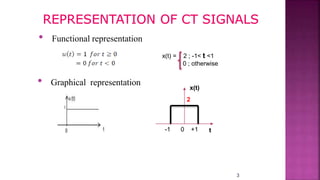
• Functional representation
x(t) = 2 ; -1< t <1
0 ; otherwise
-1 0 +1
x(t)
2
t
• Graphical representation
4
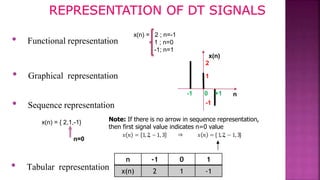
• Functional representation
x(n) = 2 ; n=-1
1 ; n=0
-1; n=1
n
x(n)
2
1
-1
-1 0 +1
n -1 0 1
x(n) 2 1 -1
x(n) = { 2,1,-1}
n=0
Note: If there is no arrow in sequence representation,
then first signal value indicates n=0 value
• Graphical representation
• Sequence representation
• Tabular representation
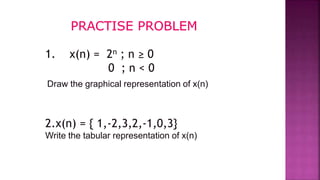
1. x(n) = 2n ; n ≥ 0
0 ; n < 0
2.x(n) = { 1,-2,3,2,-1,0,3}
Write the tabular representation of x(n)
5
Draw the graphical representation of x(n)
6
Operation on Independent variable
Time Inversion or Time Folding or Time Reversal
Time Shifting
Time Scaling
Operation on Dependent variable
Amplitude scaling
Signal addition
Signal Multiplication
7
Signals
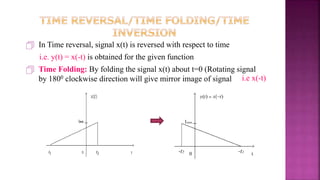
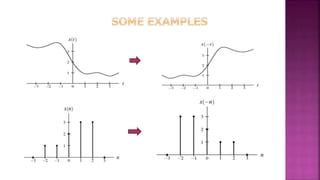
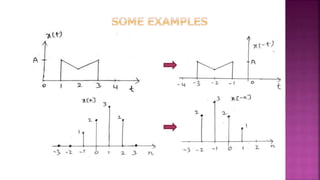
 In Time reversal, signal x(t) is reversed with respect to time
i.e. y(t) = x(-t) is obtained for the given function
 Time Folding: By folding the signal x(t) about t=0 (Rotating signal
by 1800 clockwise direction will give mirror image of signal
8
i.e x(-t)
9
10
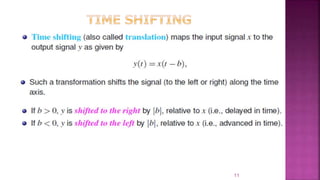
11
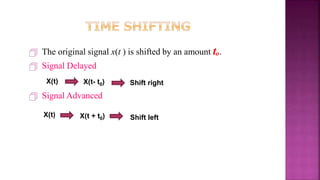
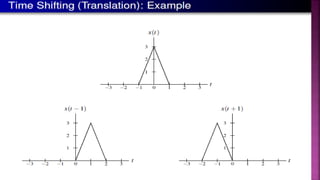
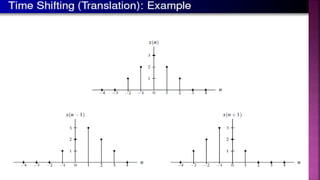
 The original signal x(t ) is shifted by an amount tₒ.
 Signal Delayed
 Signal Advanced
12
X(t) X(t- t0) Shift right
X(t) X(t + t0) Shift left
13
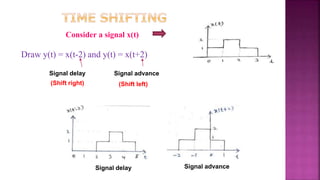
Draw y(t) = x(t-2) and y(t) = x(t+2)
Signal delay
(Shift right)
Signal advance
(Shift left)
Signal delay Signal advance
Consider a signal x(t)
14
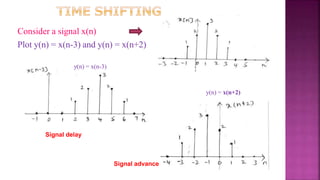
Consider a signal x(n)
Plot y(n) = x(n-3) and y(n) = x(n+2)
Signal delay
Signal advance
y(n) = x(n-3)
y(n) = x(n+2)
15
16
17
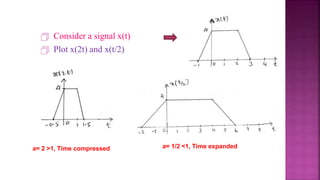
 Consider a signal x(t)
 Plot x(2t) and x(t/2)
18
a= 2 >1, Time compressed a= 1/2 <1, Time expanded
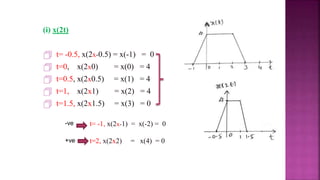
(i) x(2t)
 t= -0.5, x(2x-0.5) = x(-1) = 0
 t=0, x(2x0) = x(0) = 4
 t=0.5, x(2x0.5) = x(1) = 4
 t=1, x(2x1) = x(2) = 4
 t=1.5, x(2x1.5) = x(3) = 0
19
t= -1, x(2x-1) = x(-2) = 0
t=2, x(2x2) = x(4) = 0
-ve
+ve
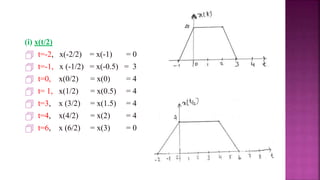
(i) x(t/2)
 t=-2, x(-2/2) = x(-1) = 0
 t=-1, x (-1/2) = x(-0.5) = 3
 t=0, x(0/2) = x(0) = 4
 t= 1, x(1/2) = x(0.5) = 4
 t=3, x (3/2) = x(1.5) = 4
 t=4, x(4/2) = x(2) = 4
 t=6, x (6/2) = x(3) = 0
20
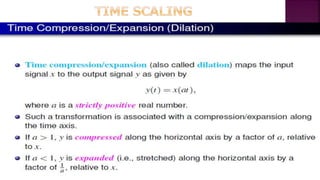
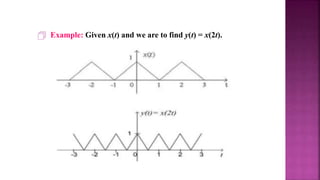
 Example: Given x(t) and we are to find y(t) = x(2t).
21
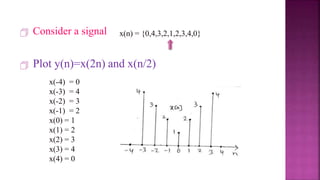
 Consider a signal
 Plot y(n)=x(2n) and x(n/2)
22
x(-4) = 0
x(-3) = 4
x(-2) = 3
x(-1) = 2
x(0) = 1
x(1) = 2
x(2) = 3
x(3) = 4
x(4) = 0
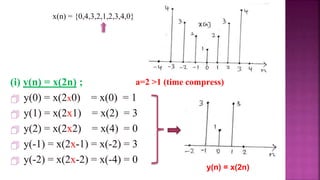
x(n) = {0,4,3,2,1,2,3,4,0}
(i) y(n) = x(2n) ;
 y(0) = x(2x0) = x(0) = 1
 y(1) = x(2x1) = x(2) = 3
 y(2) = x(2x2) = x(4) = 0
 y(-1) = x(2x-1) = x(-2) = 3
 y(-2) = x(2x-2) = x(-4) = 0
23
y(n) = x(2n)
a=2 >1 (time compress)
x(n) = {0,4,3,2,1,2,3,4,0}
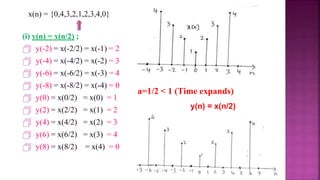
(i) y(n) = x(n/2) ;
 y(-2) = x(-2/2) = x(-1) = 2
 y(-4) = x(-4/2) = x(-2) = 3
 y(-6) = x(-6/2) = x(-3) = 4
 y(-8) = x(-8/2) = x(-4) = 0
 y(0) = x(0/2) = x(0) = 1
 y(2) = x(2/2) = x(1) = 2
 y(4) = x(4/2) = x(2) = 3
 y(6) = x(6/2) = x(3) = 4
 y(8) = x(8/2) = x(4) = 0
24
y(n) = x(n/2)
a=1/2 < 1 (Time expands)
x(n) = {0,4,3,2,1,2,3,4,0}
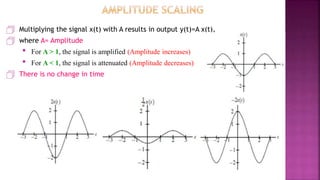
 Multiplying the signal x(t) with A results in output y(t)=A x(t),
 where A= Amplitude
• For A ˃ 1, the signal is amplified (Amplitude increases)
• For A < 1, the signal is attenuated (Amplitude decreases)
 There is no change in time
25
26
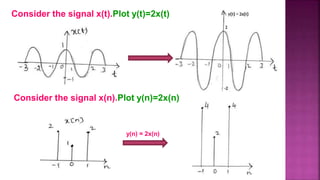
y(n) = 2x(n)
Consider the signal x(n).Plot y(n)=2x(n)
Consider the signal x(t).Plot y(t)=2x(t)
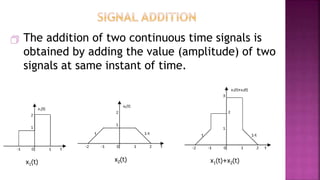
 The addition of two continuous time signals is
obtained by adding the value (amplitude) of two
signals at same instant of time.
27
x1(t) x2(t) x1(t)+x2(t)
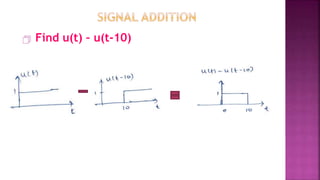
 Find u(t) – u(t-10)
28
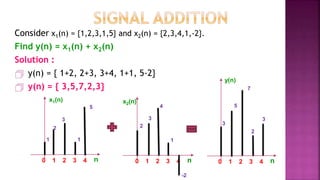
Consider x1(n) = {1,2,3,1,5} and x2(n) = {2,3,4,1,-2}.
Find y(n) = x1(n) + x2(n)
Solution :
 y(n) = { 1+2, 2+3, 3+4, 1+1, 5-2}
 y(n) = { 3,5,7,2,3}
29
0 1 2 3 4
x1(n)
1
2
3
5
n
1
0 1 2 3 4
x2(n)
2
3
4
n
1
-2
0 1 2 3 4
y(n)
3
2
3
5
n
7
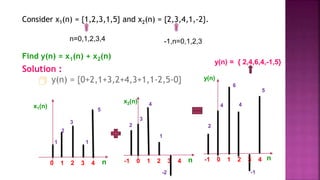
Consider x1(n) = {1,2,3,1,5} and x2(n) = {2,3,4,1,-2}.
Find y(n) = x1(n) + x2(n)
Solution :
 y(n) = {0+2,1+3,2+4,3+1,1-2,5-0}
30
-1,n=0,1,2,3
n=0,1,2,3,4
0 1 2 3 4
x1(n)
1
2
3
5
n
1
-1 0 1 2 3 4
x2(n)
2
3
4
n
1
-2
-1 0 1 2 3 4
y(n)
2
-1
5
4
n
6
4
y(n) = { 2,4,6,4,-1,5}
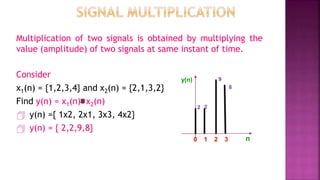
Multiplication of two signals is obtained by multiplying the
value (amplitude) of two signals at same instant of time.
Consider
x1(n) = {1,2,3,4} and x2(n) = {2,1,3,2}
Find y(n) = x1(n) x2(n)
 y(n) ={ 1x2, 2x1, 3x3, 4x2}
 y(n) = { 2,2,9,8}
31
0 1 2 3
y(n)
2 2
9
8
n
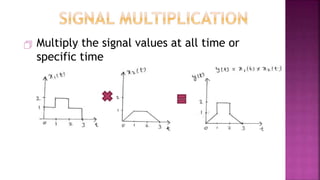
 Multiply the signal values at all time or
specific time
32
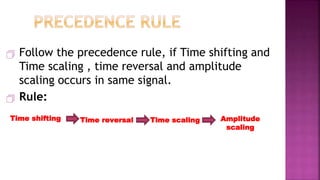
 Follow the precedence rule, if Time shifting and
Time scaling , time reversal and amplitude
scaling occurs in same signal.
 Rule:
33
Amplitude
scaling
Time shifting Time reversal Time scaling
34
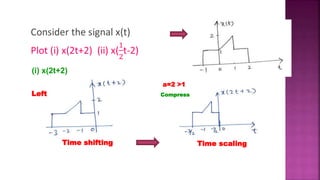
(i) x(2t+2)
Time shifting Time scaling
Left
a=2 >1
Compress
35
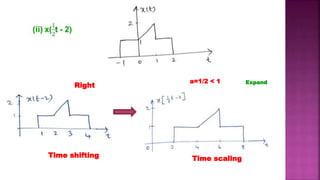
Time shifting Time scaling
Right
a=1/2 < 1 Expand
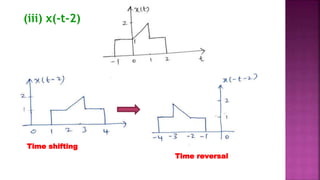
(iii) x(-t-2)
36
Time shifting
Time reversal
37

Unit 1 Operation on signals

  • 1.
    Dr.K.G.SHANTHI Professor/ECE shanthiece@rmkcet.ac.in RMK College ofEngineering and Technology (Time Reversal, Time Shifting , Time Scaling, Amplitude scaling, Signal addition, Signal Multiplication)
  • 2.
  • 3.
    3 • Functional representation x(t)= 2 ; -1< t <1 0 ; otherwise -1 0 +1 x(t) 2 t • Graphical representation
  • 4.
    4 • Functional representation x(n)= 2 ; n=-1 1 ; n=0 -1; n=1 n x(n) 2 1 -1 -1 0 +1 n -1 0 1 x(n) 2 1 -1 x(n) = { 2,1,-1} n=0 Note: If there is no arrow in sequence representation, then first signal value indicates n=0 value • Graphical representation • Sequence representation • Tabular representation
  • 5.
    1. x(n) =2n ; n ≥ 0 0 ; n < 0 2.x(n) = { 1,-2,3,2,-1,0,3} Write the tabular representation of x(n) 5 Draw the graphical representation of x(n)
  • 6.
  • 7.
    Operation on Independentvariable Time Inversion or Time Folding or Time Reversal Time Shifting Time Scaling Operation on Dependent variable Amplitude scaling Signal addition Signal Multiplication 7 Signals
  • 8.
     In Timereversal, signal x(t) is reversed with respect to time i.e. y(t) = x(-t) is obtained for the given function  Time Folding: By folding the signal x(t) about t=0 (Rotating signal by 1800 clockwise direction will give mirror image of signal 8 i.e x(-t)
  • 9.
  • 10.
  • 11.
  • 12.
     The originalsignal x(t ) is shifted by an amount tₒ.  Signal Delayed  Signal Advanced 12 X(t) X(t- t0) Shift right X(t) X(t + t0) Shift left
  • 13.
    13 Draw y(t) =x(t-2) and y(t) = x(t+2) Signal delay (Shift right) Signal advance (Shift left) Signal delay Signal advance Consider a signal x(t)
  • 14.
    14 Consider a signalx(n) Plot y(n) = x(n-3) and y(n) = x(n+2) Signal delay Signal advance y(n) = x(n-3) y(n) = x(n+2)
  • 15.
  • 16.
  • 17.
  • 18.
     Consider asignal x(t)  Plot x(2t) and x(t/2) 18 a= 2 >1, Time compressed a= 1/2 <1, Time expanded
  • 19.
    (i) x(2t)  t=-0.5, x(2x-0.5) = x(-1) = 0  t=0, x(2x0) = x(0) = 4  t=0.5, x(2x0.5) = x(1) = 4  t=1, x(2x1) = x(2) = 4  t=1.5, x(2x1.5) = x(3) = 0 19 t= -1, x(2x-1) = x(-2) = 0 t=2, x(2x2) = x(4) = 0 -ve +ve
  • 20.
    (i) x(t/2)  t=-2,x(-2/2) = x(-1) = 0  t=-1, x (-1/2) = x(-0.5) = 3  t=0, x(0/2) = x(0) = 4  t= 1, x(1/2) = x(0.5) = 4  t=3, x (3/2) = x(1.5) = 4  t=4, x(4/2) = x(2) = 4  t=6, x (6/2) = x(3) = 0 20
  • 21.
     Example: Givenx(t) and we are to find y(t) = x(2t). 21
  • 22.
     Consider asignal  Plot y(n)=x(2n) and x(n/2) 22 x(-4) = 0 x(-3) = 4 x(-2) = 3 x(-1) = 2 x(0) = 1 x(1) = 2 x(2) = 3 x(3) = 4 x(4) = 0 x(n) = {0,4,3,2,1,2,3,4,0}
  • 23.
    (i) y(n) =x(2n) ;  y(0) = x(2x0) = x(0) = 1  y(1) = x(2x1) = x(2) = 3  y(2) = x(2x2) = x(4) = 0  y(-1) = x(2x-1) = x(-2) = 3  y(-2) = x(2x-2) = x(-4) = 0 23 y(n) = x(2n) a=2 >1 (time compress) x(n) = {0,4,3,2,1,2,3,4,0}
  • 24.
    (i) y(n) =x(n/2) ;  y(-2) = x(-2/2) = x(-1) = 2  y(-4) = x(-4/2) = x(-2) = 3  y(-6) = x(-6/2) = x(-3) = 4  y(-8) = x(-8/2) = x(-4) = 0  y(0) = x(0/2) = x(0) = 1  y(2) = x(2/2) = x(1) = 2  y(4) = x(4/2) = x(2) = 3  y(6) = x(6/2) = x(3) = 4  y(8) = x(8/2) = x(4) = 0 24 y(n) = x(n/2) a=1/2 < 1 (Time expands) x(n) = {0,4,3,2,1,2,3,4,0}
  • 25.
     Multiplying thesignal x(t) with A results in output y(t)=A x(t),  where A= Amplitude • For A ˃ 1, the signal is amplified (Amplitude increases) • For A < 1, the signal is attenuated (Amplitude decreases)  There is no change in time 25
  • 26.
    26 y(n) = 2x(n) Considerthe signal x(n).Plot y(n)=2x(n) Consider the signal x(t).Plot y(t)=2x(t)
  • 27.
     The additionof two continuous time signals is obtained by adding the value (amplitude) of two signals at same instant of time. 27 x1(t) x2(t) x1(t)+x2(t)
  • 28.
     Find u(t)– u(t-10) 28
  • 29.
    Consider x1(n) ={1,2,3,1,5} and x2(n) = {2,3,4,1,-2}. Find y(n) = x1(n) + x2(n) Solution :  y(n) = { 1+2, 2+3, 3+4, 1+1, 5-2}  y(n) = { 3,5,7,2,3} 29 0 1 2 3 4 x1(n) 1 2 3 5 n 1 0 1 2 3 4 x2(n) 2 3 4 n 1 -2 0 1 2 3 4 y(n) 3 2 3 5 n 7
  • 30.
    Consider x1(n) ={1,2,3,1,5} and x2(n) = {2,3,4,1,-2}. Find y(n) = x1(n) + x2(n) Solution :  y(n) = {0+2,1+3,2+4,3+1,1-2,5-0} 30 -1,n=0,1,2,3 n=0,1,2,3,4 0 1 2 3 4 x1(n) 1 2 3 5 n 1 -1 0 1 2 3 4 x2(n) 2 3 4 n 1 -2 -1 0 1 2 3 4 y(n) 2 -1 5 4 n 6 4 y(n) = { 2,4,6,4,-1,5}
  • 31.
    Multiplication of twosignals is obtained by multiplying the value (amplitude) of two signals at same instant of time. Consider x1(n) = {1,2,3,4} and x2(n) = {2,1,3,2} Find y(n) = x1(n) x2(n)  y(n) ={ 1x2, 2x1, 3x3, 4x2}  y(n) = { 2,2,9,8} 31 0 1 2 3 y(n) 2 2 9 8 n
  • 32.
     Multiply thesignal values at all time or specific time 32
  • 33.
     Follow theprecedence rule, if Time shifting and Time scaling , time reversal and amplitude scaling occurs in same signal.  Rule: 33 Amplitude scaling Time shifting Time reversal Time scaling
  • 34.
    34 (i) x(2t+2) Time shiftingTime scaling Left a=2 >1 Compress
  • 35.
    35 Time shifting Timescaling Right a=1/2 < 1 Expand
  • 36.
  • 37.