IIR Filter Design
&
FIR Filter Design

Utkarsh Kulshrestha
Kuldeep Saini
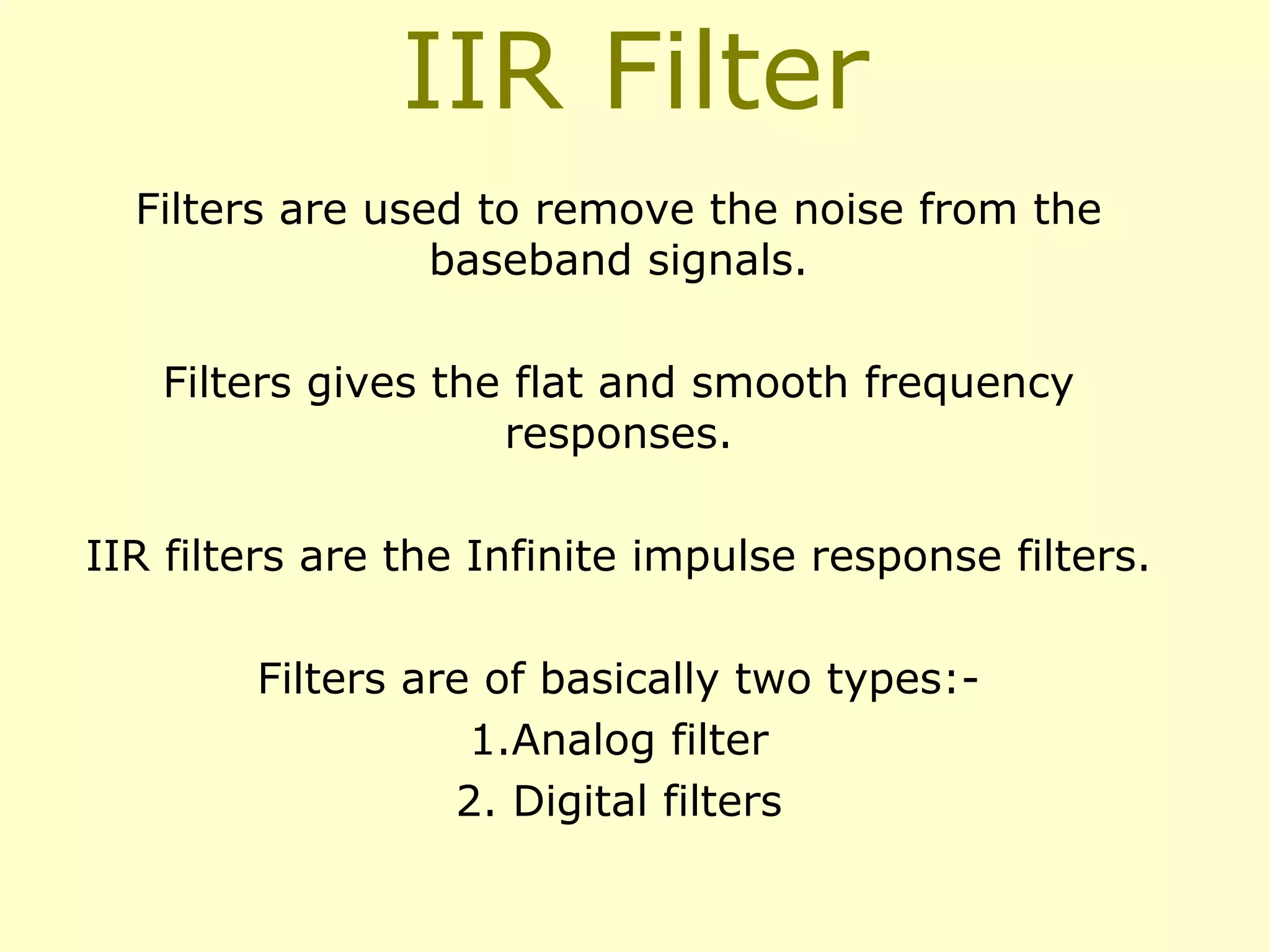
IIR Filter
Filters are used to remove the noise from the
baseband signals.
Filters gives the flat and smooth frequency
responses.
IIR filters are the Infinite impulse response filters.
Filters are of basically two types:1.Analog filter
2. Digital filters
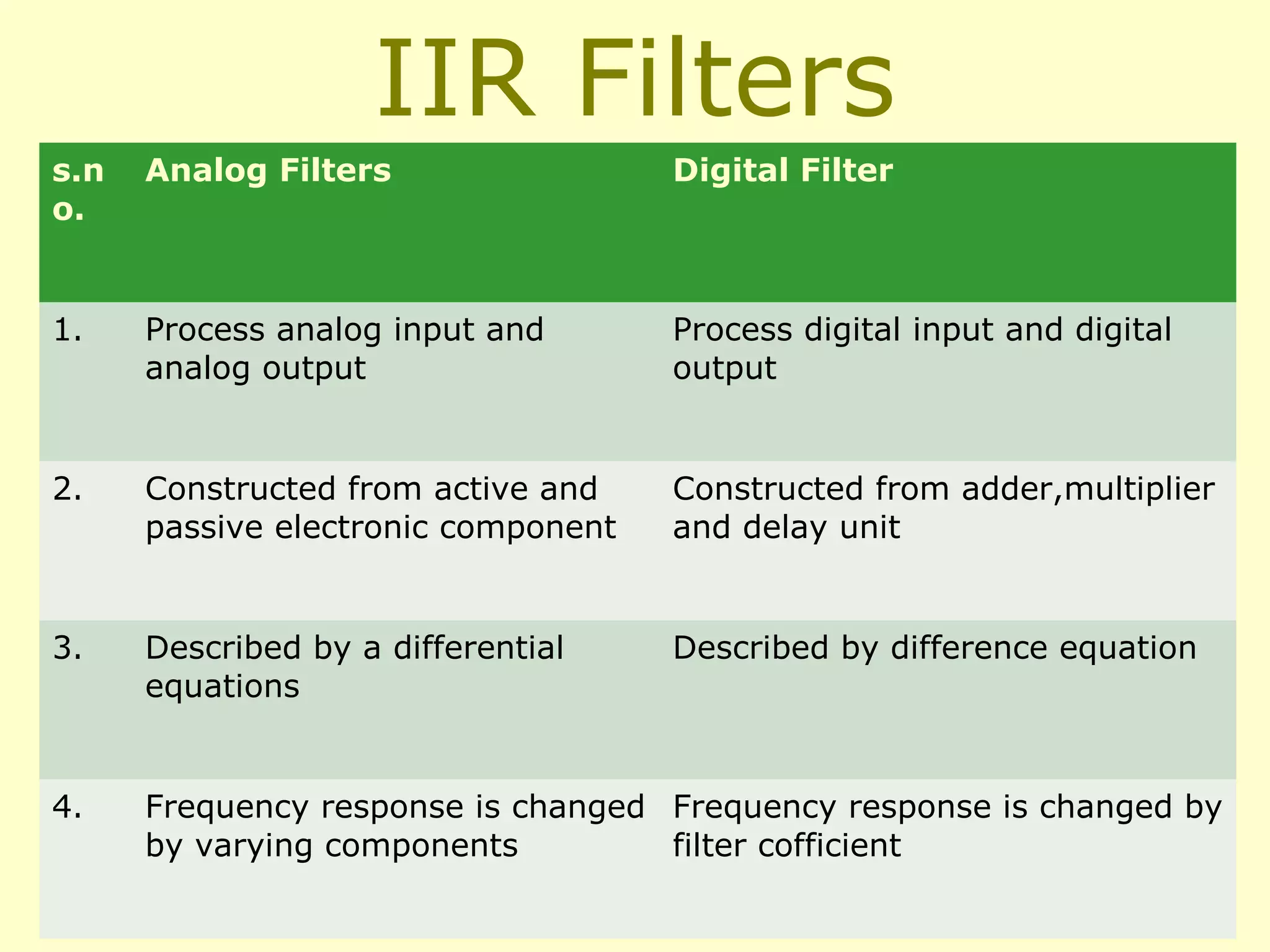
IIR Filters
s.n
o.

Analog Filters

Digital Filter

1.

Process analog input and
analog output

Process digital input and digital
output

2.

Constructed from active and
passive electronic component

Constructed from adder,multiplier
and delay unit

3.

Described by a differential
equations

Described by difference equation

4.

Frequency response is changed Frequency response is changed by
by varying components
filter cofficient
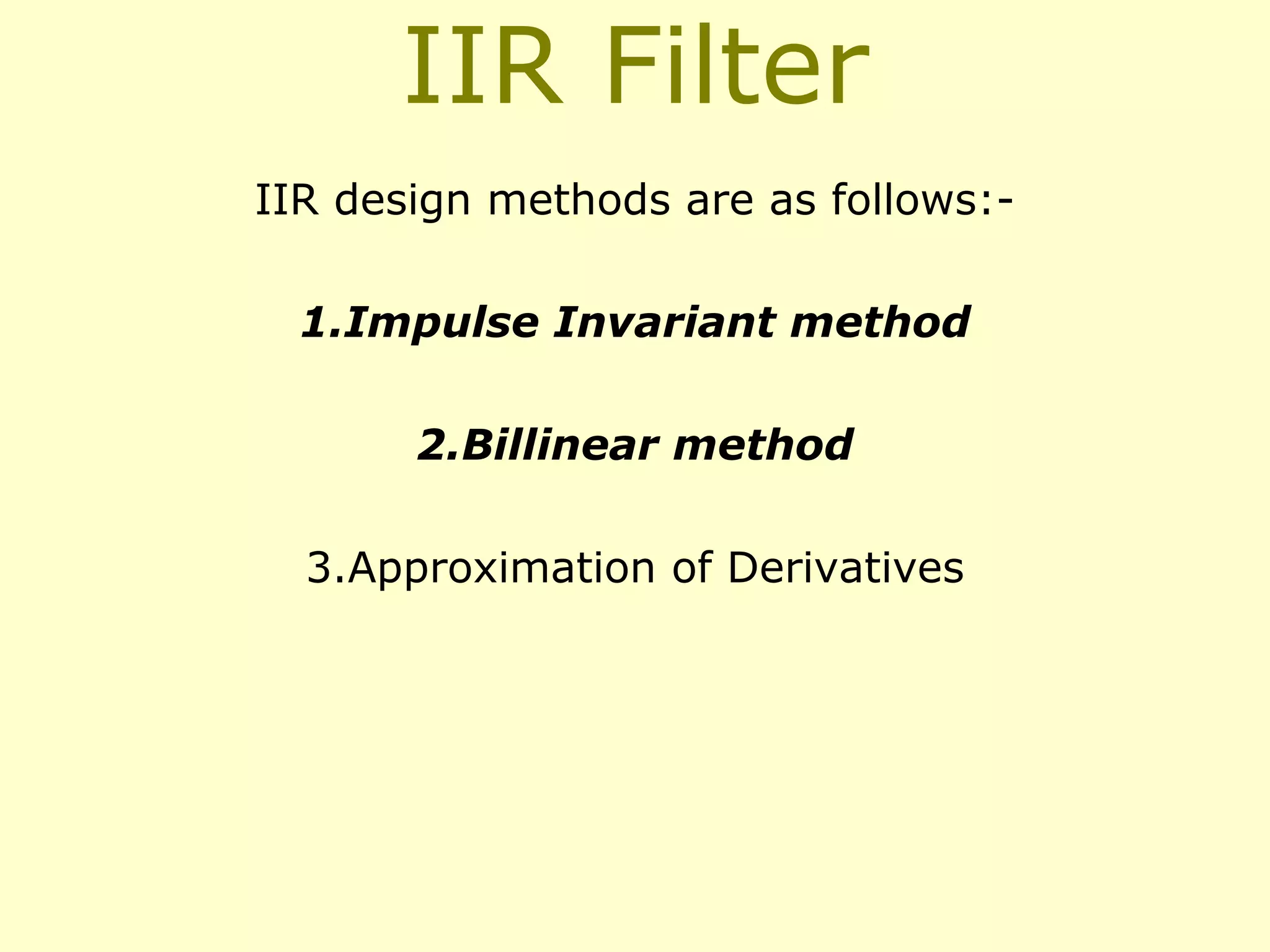
IIR Filter
IIR design methods are as follows:1.Impulse Invariant method
2.Billinear method
3.Approximation of Derivatives
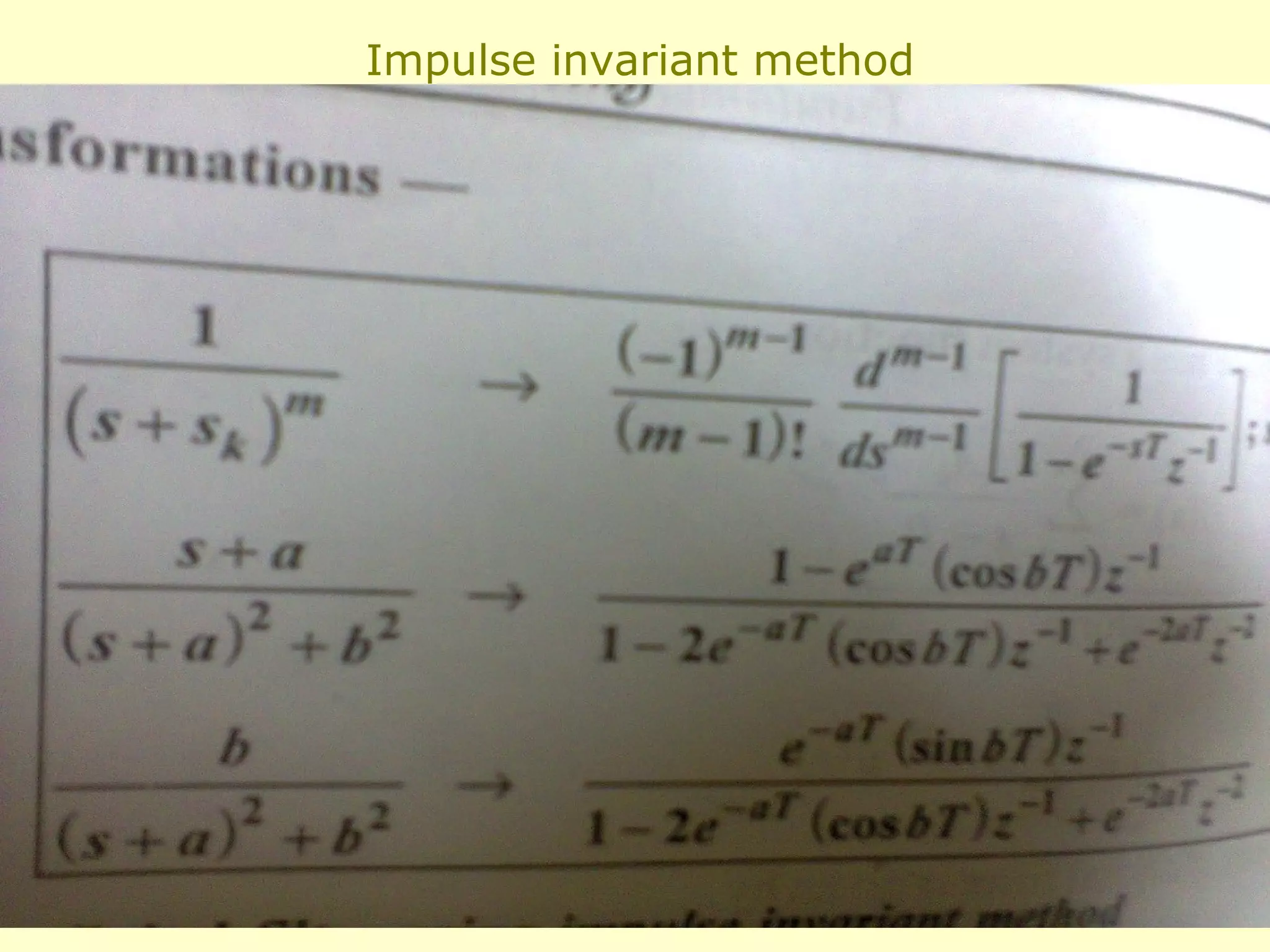
Impulse invariant method
IIR Filters
Bilinear Transformation:-

1- Bilinear transformation is transformation
from analog s-plane to digital z-plane.
2-It avoid the alising problem occurs in
impulse invariant method.
3-This conversion maps analog poles to
digital poles and analog zeros to digital
zeros.
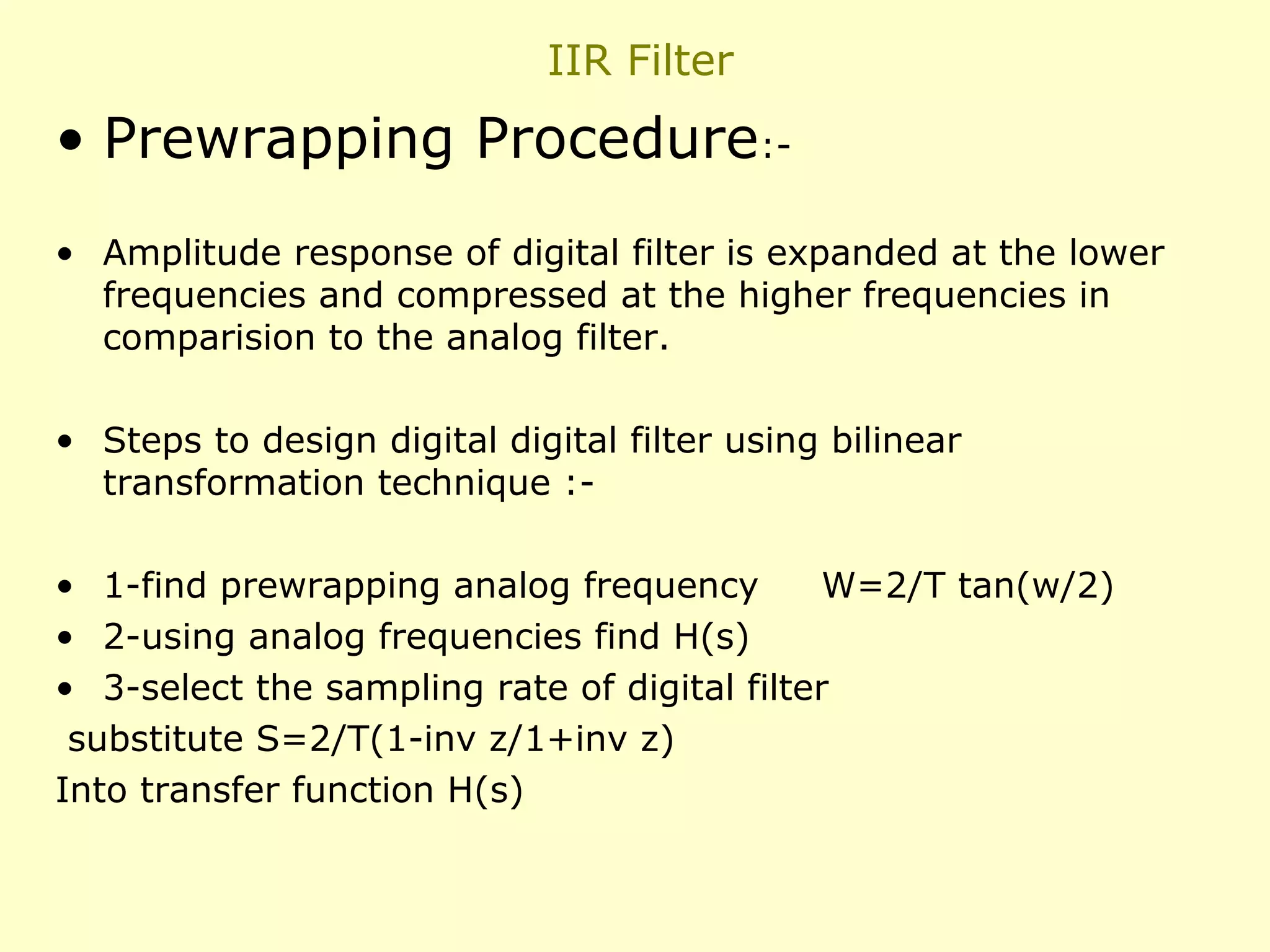
IIR Filter

• Prewrapping Procedure:• Amplitude response of digital filter is expanded at the lower
frequencies and compressed at the higher frequencies in
comparision to the analog filter.
• Steps to design digital digital filter using bilinear
transformation technique :• 1-find prewrapping analog frequency
W=2/T tan(w/2)
• 2-using analog frequencies find H(s)
• 3-select the sampling rate of digital filter
substitute S=2/T(1-inv z/1+inv z)
Into transfer function H(s)
Butterworth Filter

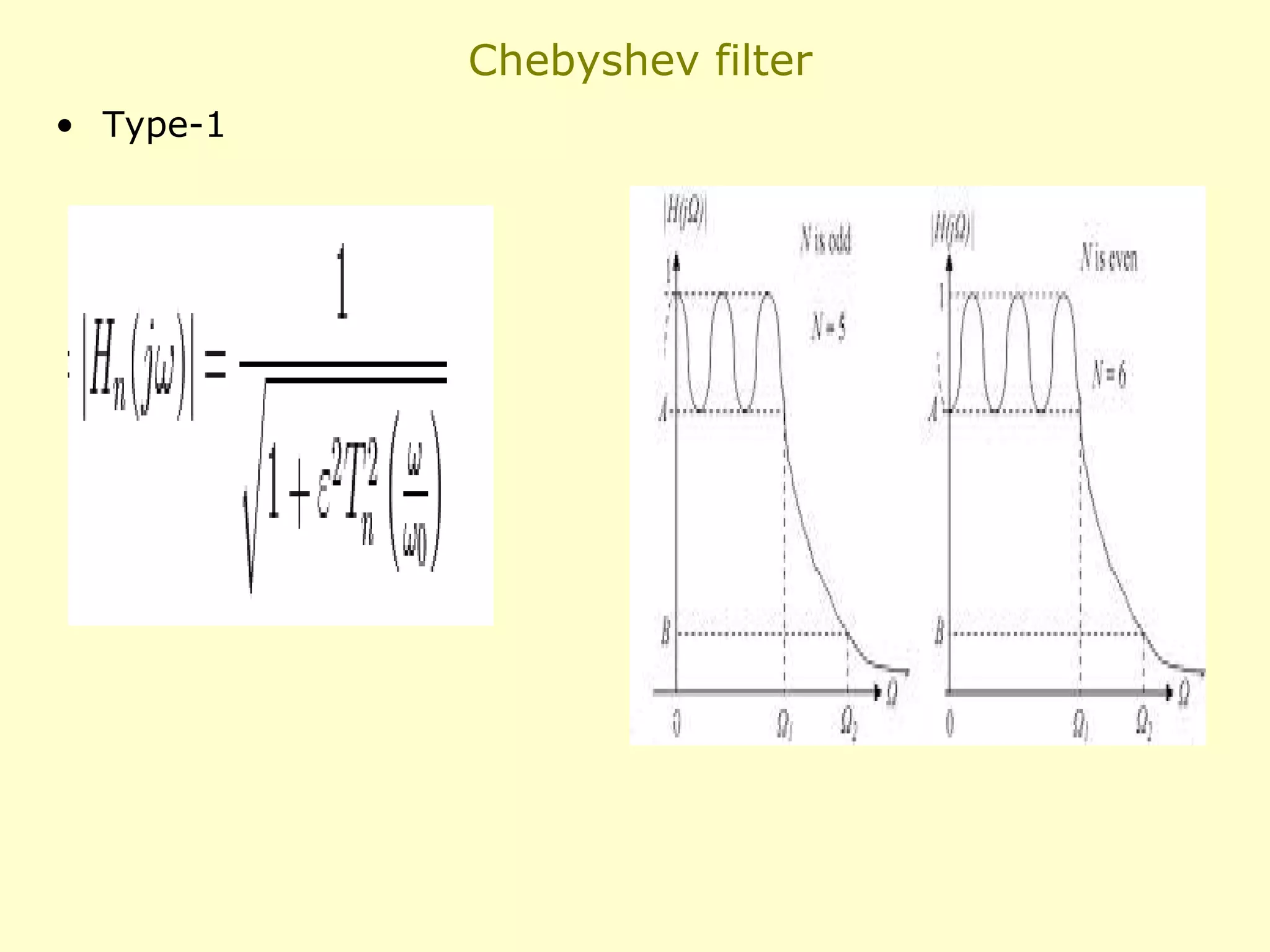
The butterworth filter has magnitude
frequency response is flat in passband and
stopband.

As the filter order increases then the
butterworth response approximates the ideal
filter response.
Chebyshev filter
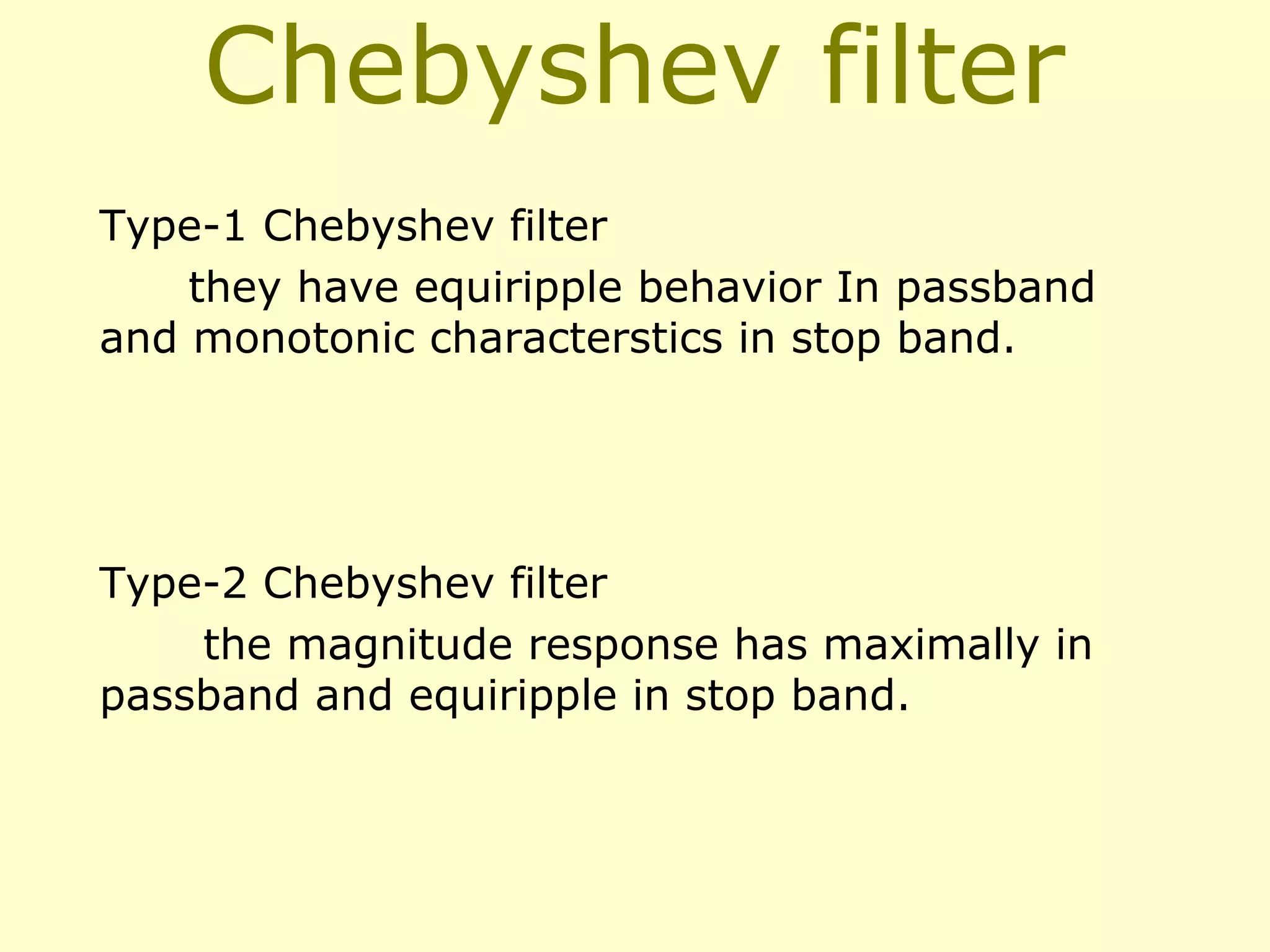
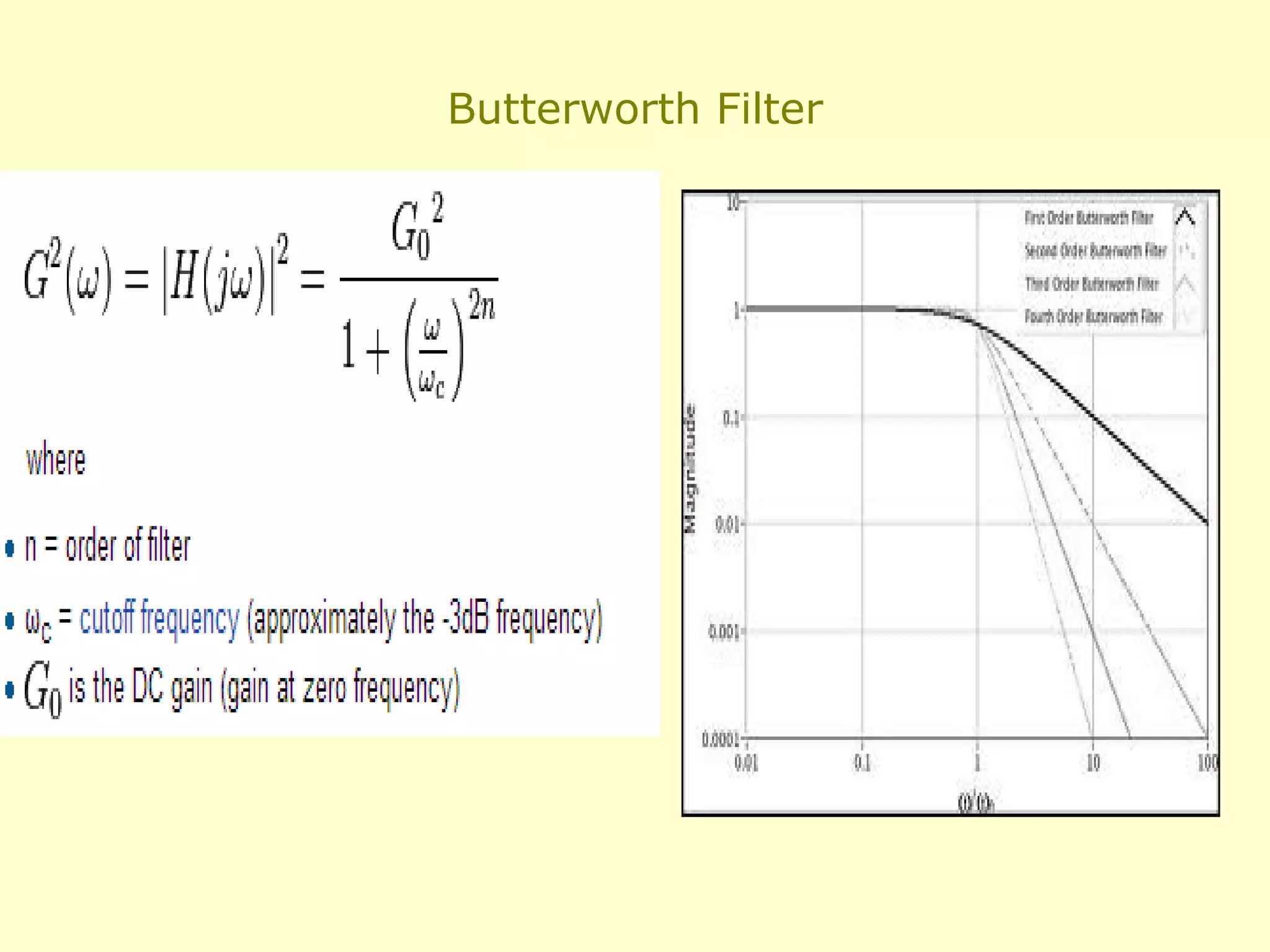
Type-1 Chebyshev filter
they have equiripple behavior In passband
and monotonic characterstics in stop band.

Type-2 Chebyshev filter
the magnitude response has maximally in
passband and equiripple in stop band.
Chebyshev filter
• Type-1
Butterworth Filter
Chebyshev Filter
FIR filter

It is a Digital filter which has Finite Impulse
response duration.
They have usually no feedback.
It has finite number of non zero terms.
FIR filters are used where linear phase response
in passband is required.
It is used for data transmission, speech
processing and always stable.
Design technique for FIR filter
1. Fourier series method
2. Windowing method
Rectangular window
Raised cosine window
Hamming window
Hanning window
Blackmann window
Bartlett window
Kaiser window

3.Frequency sampling method
Filter Design by Windowing
• Simplest way of designing FIR filters
• Method is all discrete-time no continuous-time involved
• Start with ideal frequency response
∞
π
1
jω
− jω n
Hd e = ∑ hd [n]e
hd [n] =
Hd e jω e jωndω
2π −∫π
n = −∞

( )

( )

• Choose ideal frequency response as desired response
• Most ideal impulse responses are of infinite length
• The easiest way to obtain a causal FIR filter from ideal is
hd [n] 0 ≤ n ≤ M
h[n] = 
else
 0
• More generally
h[n] = hd [n]w[n]

where

1 0 ≤ n ≤ M
w[n] = 
else
0
Properties of Windows
• Prefer windows that concentrate around DC in frequency
– Less distortion, closer approximation

• Prefer window that has minimal span in time
– Less coefficient in designed filter, computationally efficient

• So we want concentration in time and in frequency
– Contradictory requirements

• Example: Rectangular window

( ) = ∑e

We

jω

M

n=0

− jω n

1 − e − jω ( M + 1 )
sin[ ω(M + 1) / 2]
=
= e − jωM / 2
sin[ ω / 2]
1 − e − jω

351M Digital Signal Processing
Rectangular Window
• Narrowest main lob
– 4π/(M+1)
– Sharpest transitions at
discontinuities in
frequency

• Large side lobs
– -13 dB
– Large oscillation
around discontinuities

• Simplest window
possible
0≤n≤M
else
0

[n] = 1
w

Bartlett (Triangular) Window
• Medium main lob
– 8π/M

• Side lobs
– -25 dB

• Hamming window
performs better
• Simple equation
0 ≤ n ≤ M/2
 2n / M

w[n] = 2 − 2n / M M / 2 ≤ n ≤ M

0
else


18
Hanning Window
• Medium main lob
– 8π/M

• Side lobs
– -31 dB

• Hamming window
performs better
• Same complexity as
Hamming
1 
 2πn 
 1 − cos
 0 ≤ n ≤ M
w[n] = 2 
 M 

0
else

Hamming Window
• Medium main lob
– 8π/M

• Good side lobs
– -41 dB

• Simpler than Blackman

 2πn 
0.54 − 0.46 cos
 0≤n≤M
w[n] = 
 M 

0
else

Kaiser Window Filter Design Method
• Parameterized equation
forming a set of windows
– Parameter to change mainlob width and side-lob area
trade-off

w[ n] = {I ( Beta) | I (alpha ), | n |<= M − 1  2
0, otherwise

– I0(.) represents zeroth-order
modified Bessel function of 1st
kind

21
Determining Kaiser Window Parameters
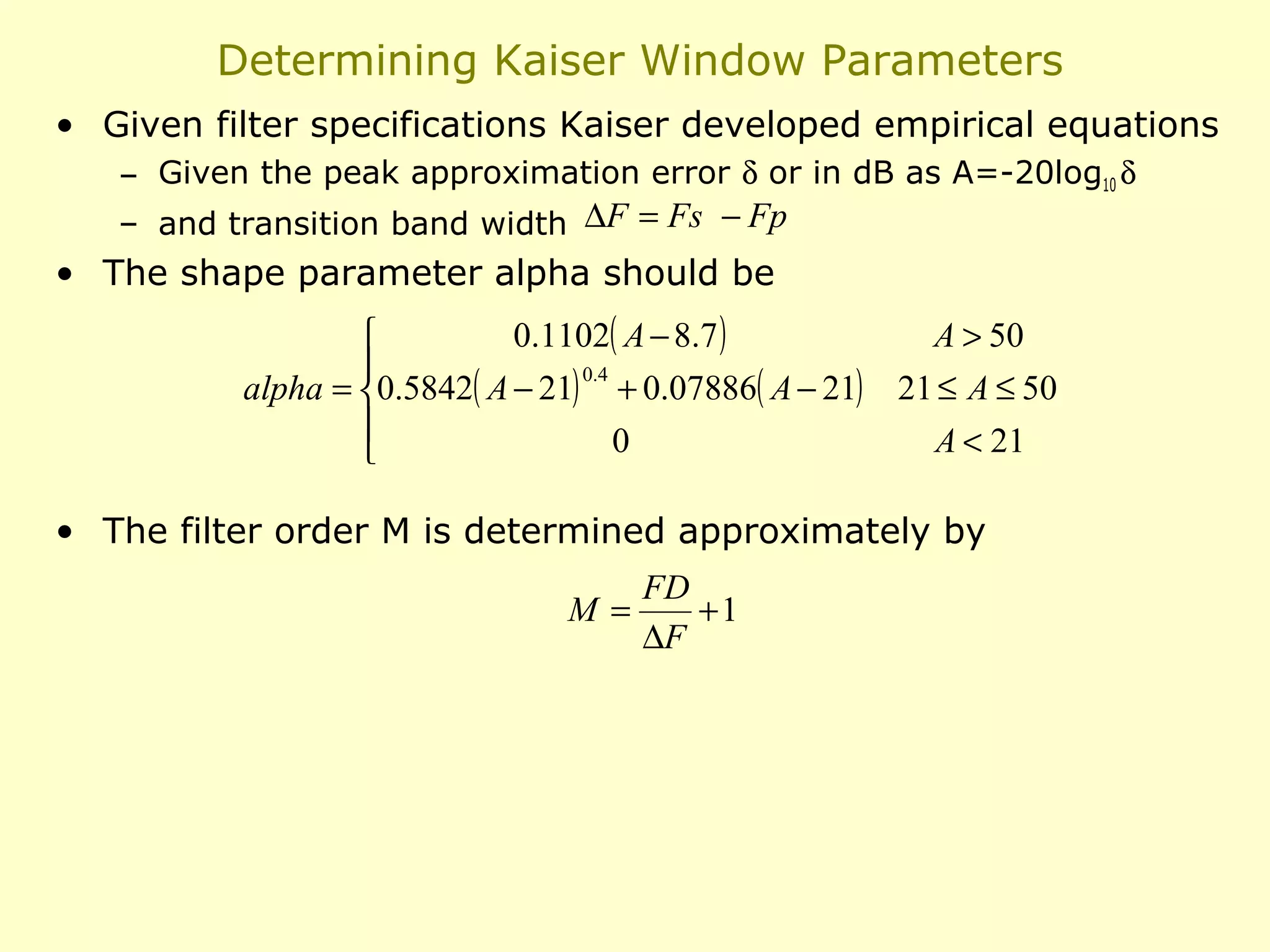
• Given filter specifications Kaiser developed empirical equations
– Given the peak approximation error δ or in dB as A=-20log10 δ
– and transition band width ∆F = Fs − Fp

• The shape parameter alpha should be
0.1102( A − 8.7 )
A > 50


0.4
alpha = 0.5842( A − 21) + 0.07886( A − 21) 21 ≤ A ≤ 50

0
A < 21


• The filter order M is determined approximately by
FD
M=
+1
∆F
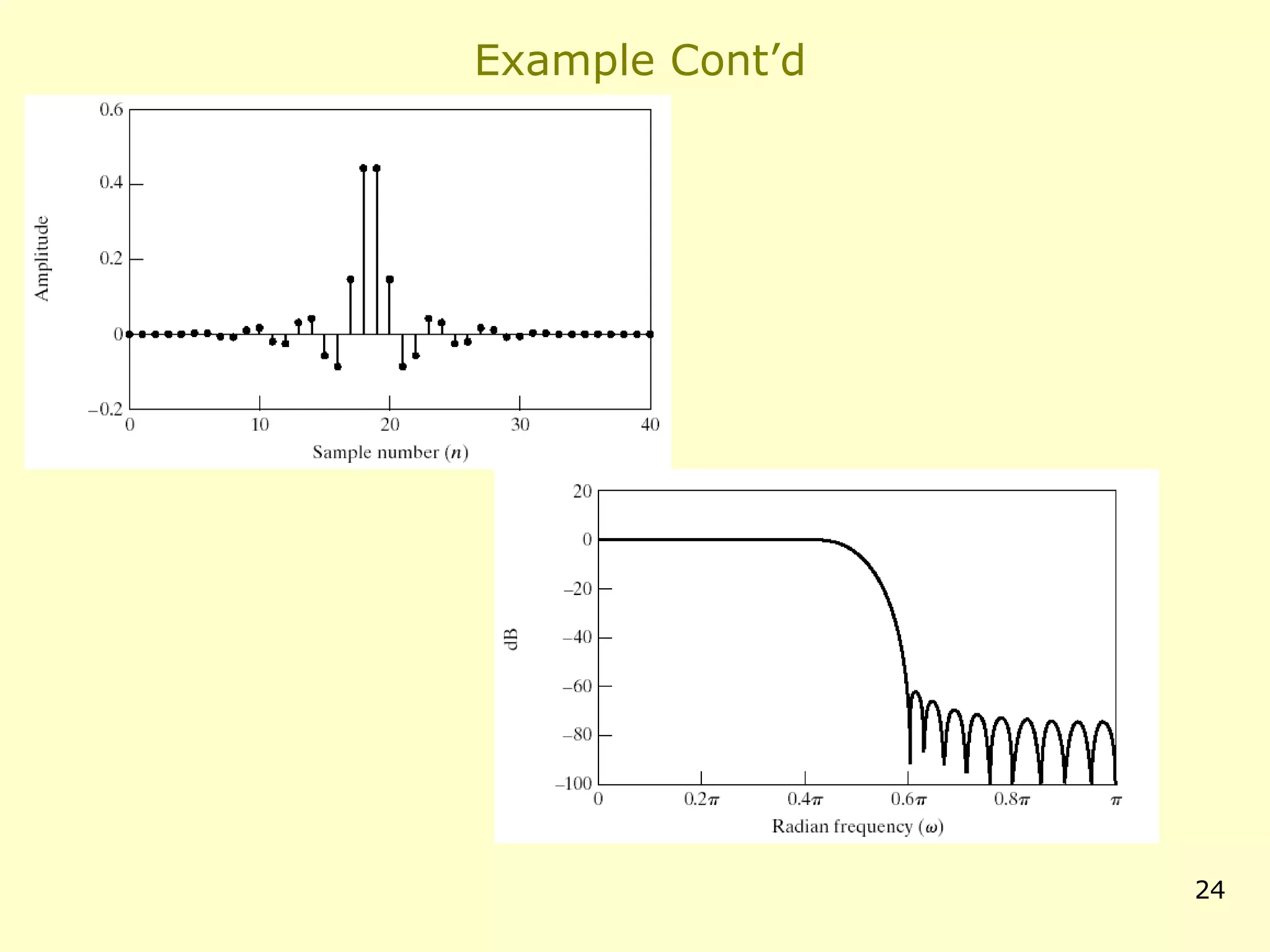
Example: Kaiser Window Design of a Lowpass Filter
• Specifications ωp = 0.4π, ωp = 0.6π, δ1 = 0.01, δ2 = 0.001
• Window design methods assume δ1 = δ2 = 0.001
• Determine cut-off frequency
– Due to the symmetry we can choose it to be ωc = 0.5π
• Compute
∆ω = ωs − ωp = 0.2π

A = −20 log10 δ = 60

• And Kaiser window parameters
alpha = 5.653
M = 37
• Then the impulse response is given as
2


 n − 18.5  

I0 5.653 1 − 


18.5  

h[n] =  sin[0.5π(n − 18.5) ] 



π(n − 18.5)
I0 (5.653)

0


0≤n≤M
else
Example Cont’d

24
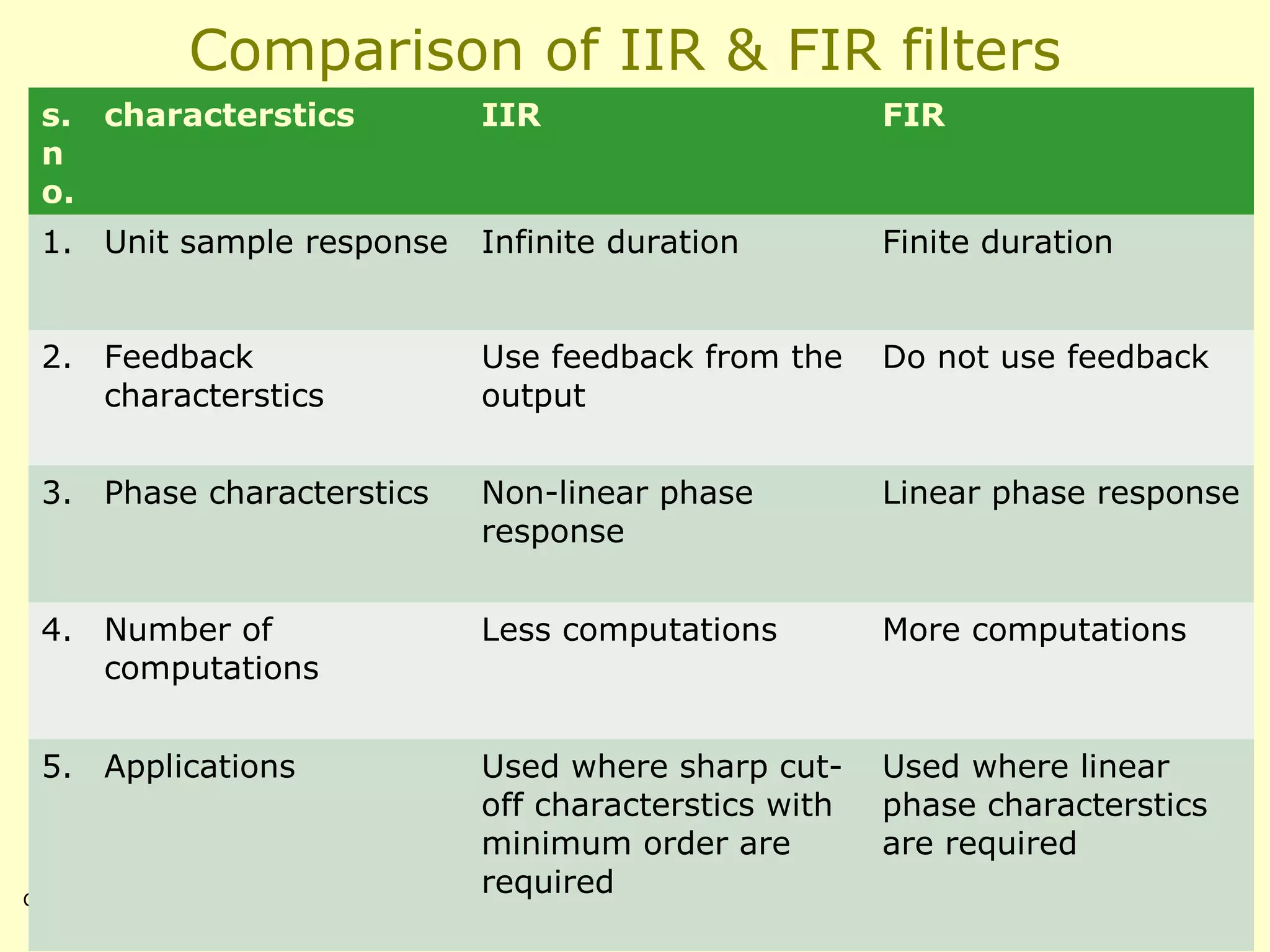
Comparison of IIR & FIR filters
s. characterstics
n
o.

IIR

FIR

1. Unit sample response

Infinite duration

Finite duration

2. Feedback
characterstics

Use feedback from the
output

Do not use feedback

3. Phase characterstics

Non-linear phase
response

Linear phase response

4. Number of
computations

Less computations

More computations

5. Applications

Used where sharp cutoff characterstics with
minimum order are
required

Used where linear
phase characterstics
are required

Copyright (C) 2005 Güner Arslan

351M Digital Signal Processing

25
More on FIR &
IIR Next time…

Fir filter_utkarsh_kulshrestha

  • 1.
    IIR Filter Design & FIRFilter Design Utkarsh Kulshrestha Kuldeep Saini
  • 2.
    IIR Filter Filters areused to remove the noise from the baseband signals. Filters gives the flat and smooth frequency responses. IIR filters are the Infinite impulse response filters. Filters are of basically two types:1.Analog filter 2. Digital filters
  • 3.
    IIR Filters s.n o. Analog Filters DigitalFilter 1. Process analog input and analog output Process digital input and digital output 2. Constructed from active and passive electronic component Constructed from adder,multiplier and delay unit 3. Described by a differential equations Described by difference equation 4. Frequency response is changed Frequency response is changed by by varying components filter cofficient
  • 4.
    IIR Filter IIR designmethods are as follows:1.Impulse Invariant method 2.Billinear method 3.Approximation of Derivatives
  • 5.
  • 6.
    IIR Filters Bilinear Transformation:- 1-Bilinear transformation is transformation from analog s-plane to digital z-plane. 2-It avoid the alising problem occurs in impulse invariant method. 3-This conversion maps analog poles to digital poles and analog zeros to digital zeros.
  • 7.
    IIR Filter • PrewrappingProcedure:• Amplitude response of digital filter is expanded at the lower frequencies and compressed at the higher frequencies in comparision to the analog filter. • Steps to design digital digital filter using bilinear transformation technique :• 1-find prewrapping analog frequency W=2/T tan(w/2) • 2-using analog frequencies find H(s) • 3-select the sampling rate of digital filter substitute S=2/T(1-inv z/1+inv z) Into transfer function H(s)
  • 8.
    Butterworth Filter The butterworthfilter has magnitude frequency response is flat in passband and stopband. As the filter order increases then the butterworth response approximates the ideal filter response.
  • 9.
    Chebyshev filter Type-1 Chebyshevfilter they have equiripple behavior In passband and monotonic characterstics in stop band. Type-2 Chebyshev filter the magnitude response has maximally in passband and equiripple in stop band.
  • 10.
  • 11.
  • 12.
  • 13.
    FIR filter It isa Digital filter which has Finite Impulse response duration. They have usually no feedback. It has finite number of non zero terms. FIR filters are used where linear phase response in passband is required. It is used for data transmission, speech processing and always stable.
  • 14.
    Design technique forFIR filter 1. Fourier series method 2. Windowing method Rectangular window Raised cosine window Hamming window Hanning window Blackmann window Bartlett window Kaiser window 3.Frequency sampling method
  • 15.
    Filter Design byWindowing • Simplest way of designing FIR filters • Method is all discrete-time no continuous-time involved • Start with ideal frequency response ∞ π 1 jω − jω n Hd e = ∑ hd [n]e hd [n] = Hd e jω e jωndω 2π −∫π n = −∞ ( ) ( ) • Choose ideal frequency response as desired response • Most ideal impulse responses are of infinite length • The easiest way to obtain a causal FIR filter from ideal is hd [n] 0 ≤ n ≤ M h[n] =  else  0 • More generally h[n] = hd [n]w[n] where 1 0 ≤ n ≤ M w[n] =  else 0
  • 16.
    Properties of Windows •Prefer windows that concentrate around DC in frequency – Less distortion, closer approximation • Prefer window that has minimal span in time – Less coefficient in designed filter, computationally efficient • So we want concentration in time and in frequency – Contradictory requirements • Example: Rectangular window ( ) = ∑e We jω M n=0 − jω n 1 − e − jω ( M + 1 ) sin[ ω(M + 1) / 2] = = e − jωM / 2 sin[ ω / 2] 1 − e − jω 351M Digital Signal Processing
  • 17.
    Rectangular Window • Narrowestmain lob – 4π/(M+1) – Sharpest transitions at discontinuities in frequency • Large side lobs – -13 dB – Large oscillation around discontinuities • Simplest window possible 0≤n≤M else 0 [n] = 1 w 
  • 18.
    Bartlett (Triangular) Window •Medium main lob – 8π/M • Side lobs – -25 dB • Hamming window performs better • Simple equation 0 ≤ n ≤ M/2  2n / M  w[n] = 2 − 2n / M M / 2 ≤ n ≤ M  0 else  18
  • 19.
    Hanning Window • Mediummain lob – 8π/M • Side lobs – -31 dB • Hamming window performs better • Same complexity as Hamming 1   2πn   1 − cos  0 ≤ n ≤ M w[n] = 2   M   0 else 
  • 20.
    Hamming Window • Mediummain lob – 8π/M • Good side lobs – -41 dB • Simpler than Blackman   2πn  0.54 − 0.46 cos  0≤n≤M w[n] =   M   0 else 
  • 21.
    Kaiser Window FilterDesign Method • Parameterized equation forming a set of windows – Parameter to change mainlob width and side-lob area trade-off w[ n] = {I ( Beta) | I (alpha ), | n |<= M − 1 2 0, otherwise – I0(.) represents zeroth-order modified Bessel function of 1st kind 21
  • 22.
    Determining Kaiser WindowParameters • Given filter specifications Kaiser developed empirical equations – Given the peak approximation error δ or in dB as A=-20log10 δ – and transition band width ∆F = Fs − Fp • The shape parameter alpha should be 0.1102( A − 8.7 ) A > 50   0.4 alpha = 0.5842( A − 21) + 0.07886( A − 21) 21 ≤ A ≤ 50  0 A < 21  • The filter order M is determined approximately by FD M= +1 ∆F
  • 23.
    Example: Kaiser WindowDesign of a Lowpass Filter • Specifications ωp = 0.4π, ωp = 0.6π, δ1 = 0.01, δ2 = 0.001 • Window design methods assume δ1 = δ2 = 0.001 • Determine cut-off frequency – Due to the symmetry we can choose it to be ωc = 0.5π • Compute ∆ω = ωs − ωp = 0.2π A = −20 log10 δ = 60 • And Kaiser window parameters alpha = 5.653 M = 37 • Then the impulse response is given as 2    n − 18.5    I0 5.653 1 −    18.5    h[n] =  sin[0.5π(n − 18.5) ]     π(n − 18.5) I0 (5.653)  0  0≤n≤M else
  • 24.
  • 25.
    Comparison of IIR& FIR filters s. characterstics n o. IIR FIR 1. Unit sample response Infinite duration Finite duration 2. Feedback characterstics Use feedback from the output Do not use feedback 3. Phase characterstics Non-linear phase response Linear phase response 4. Number of computations Less computations More computations 5. Applications Used where sharp cutoff characterstics with minimum order are required Used where linear phase characterstics are required Copyright (C) 2005 Güner Arslan 351M Digital Signal Processing 25
  • 26.
    More on FIR& IIR Next time…