


DR SHAHNAWAZ F SHAH
MD, FPM, FIAPM,FCPM (MUHS)
Interventional Spine & Pain Physician
Surat
OBJECTIVES
• Introduction
• Classification
• General Functions
• Individual Characteristics (Vit A & D)
• Individual Dietary Sources & RDA
• Individual Mechanism of Action
• Individual Function
• Deficiencies
– XEROPHTHALMIA
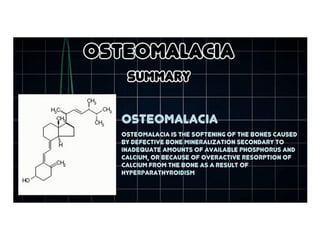
– RICKETS & OSTEOMALACIA
INTRODUCTION
 The Latin word “vita”, means "life".
 Vitamins are organic components in food that
are needed in very small amounts
 for growth
 for maintaining good health
 Eating a healthy diet remains the best way to
get sufficient amounts of the vitamins and
minerals you need
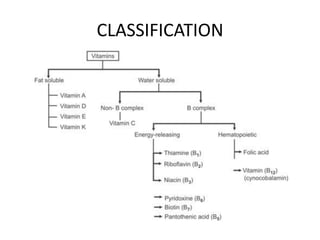
CLASSIFICATION
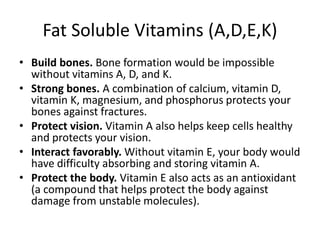
Fat Soluble Vitamins (A,D,E,K)
• Build bones. Bone formation would be impossible
without vitamins A, D, and K.
• Strong bones. A combination of calcium, vitamin D,
vitamin K, magnesium, and phosphorus protects your
bones against fractures.
• Protect vision. Vitamin A also helps keep cells healthy
and protects your vision.
• Interact favorably. Without vitamin E, your body would
have difficulty absorbing and storing vitamin A.
• Protect the body. Vitamin E also acts as an antioxidant
(a compound that helps protect the body against
damage from unstable molecules).
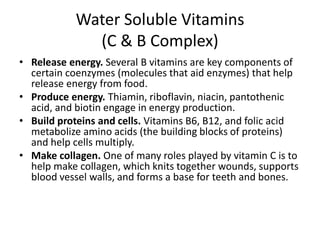
Water Soluble Vitamins
(C & B Complex)
• Release energy. Several B vitamins are key components of
certain coenzymes (molecules that aid enzymes) that help
release energy from food.
• Produce energy. Thiamin, riboflavin, niacin, pantothenic
acid, and biotin engage in energy production.
• Build proteins and cells. Vitamins B6, B12, and folic acid
metabolize amino acids (the building blocks of proteins)
and help cells multiply.
• Make collagen. One of many roles played by vitamin C is to
help make collagen, which knits together wounds, supports
blood vessel walls, and forms a base for teeth and bones.
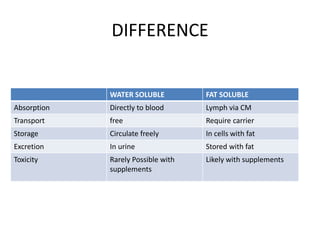
DIFFERENCE
WATER SOLUBLE FAT SOLUBLE
Absorption Directly to blood Lymph via CM
Transport free Require carrier
Storage Circulate freely In cells with fat
Excretion In urine Stored with fat
Toxicity Rarely Possible with
supplements
Likely with supplements
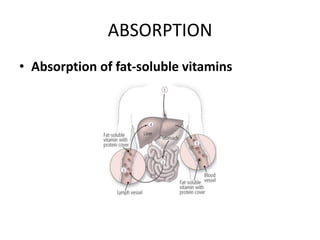
ABSORPTION
• Absorption of fat-soluble vitamins
VITAMIN A
It is the name given to a group of related
compounds :
Retinol (vitamin A alcohol)
Retinal ( vitamin A aldehyde)
Retinoic acid ( vitamin A acid)
Its provitamin carotenes are found in plants.
SOURCES
Yellow and dark green vegetables and fruits are
sources of provitamin A carotenes
Non Veg
• Fish Oil
• Liver
• Egg
Yolk
Veg
• Carrots
• Mango
• Papaya
Dairy
• Milk
• Cheese
• Butter
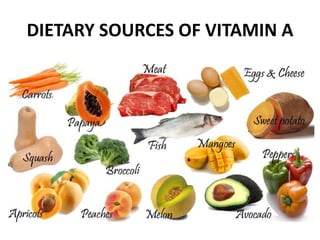
DIETARY SOURCES OF VITAMIN A
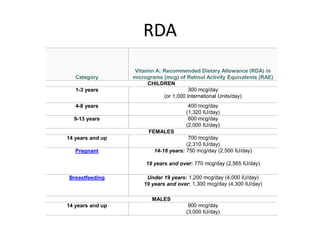
RDA
Category
Vitamin A: Recommended Dietary Allowance (RDA) in
micrograms (mcg) of Retinol Activity Equivalents (RAE)
CHILDREN
1-3 years 300 mcg/day
(or 1,000 International Units/day)
4-8 years 400 mcg/day
(1,320 IU/day)
9-13 years 600 mcg/day
(2,000 IU/day)
FEMALES
14 years and up 700 mcg/day
(2,310 IU/day)
Pregnant 14-18 years: 750 mcg/day (2,500 IU/day)
19 years and over: 770 mcg/day (2,565 IU/day)
Breastfeeding Under 19 years: 1,200 mcg/day (4,000 IU/day)
19 years and over: 1,300 mcg/day (4,300 IU/day)
MALES
14 years and up 900 mcg/day
(3,000 IU/day)
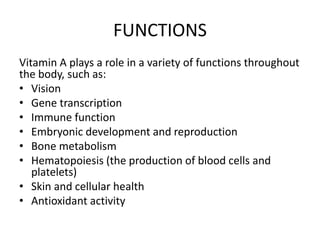
FUNCTIONS
Vitamin A plays a role in a variety of functions throughout
the body, such as:
• Vision
• Gene transcription
• Immune function
• Embryonic development and reproduction
• Bone metabolism
• Hematopoiesis (the production of blood cells and
platelets)
• Skin and cellular health
• Antioxidant activity
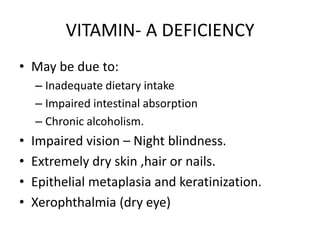
VITAMIN- A DEFICIENCY
• May be due to:
– Inadequate dietary intake
– Impaired intestinal absorption
– Chronic alcoholism.
• Impaired vision – Night blindness.
• Extremely dry skin ,hair or nails.
• Epithelial metaplasia and keratinization.
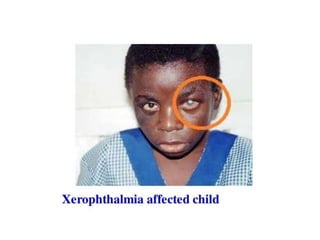
• Xerophthalmia (dry eye)
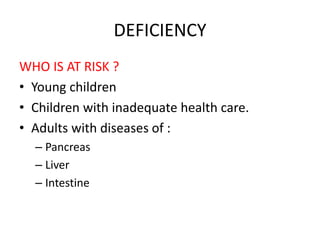
DEFICIENCY
WHO IS AT RISK ?
• Young children
• Children with inadequate health care.
• Adults with diseases of :
– Pancreas
– Liver
– Intestine
TREATMENT
• Xerophthalmia:
– 60 mg of Vitamin A in Oily Solution in soft gel
Capsule on day 1 & day 14
• Adults with Night Blindness or Bitot’s Spots:
– 3mg/d or 7.5mg per week for 3 months
• For prevention in high risk areas-
– Infants(6 to 11 months)- 30mg of Vit A
– Children(12 to 59 months)- 60mg of Vit A
Too Much Can Be Toxic !!
Hypervitaminosis A leads to toxic symptoms:
Dry , itchy skin
Hair loss
Liver damage
Skin coloration
Loss of appetite
Head ache and fatigue
Blurred vision
VITAMIN D
• SUNSHINE VITAMIN, ANTIRACHITIC FACTOR,
CALCIFEROL
• Two important forms
– D2 (ergocalciferol) - in plants
– D3 (cholecalciferol) - in animals.
• derivatives of cholesterol and are involved in
the calcium and phosphorous metabolism.
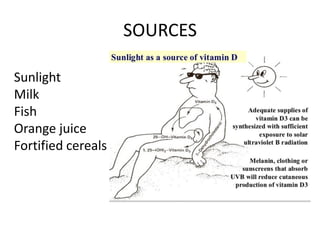
SOURCES
Sunlight
Milk
Fish
Orange juice
Fortified cereals
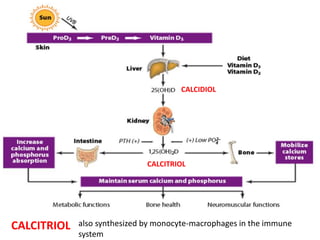
also synthesized by monocyte-macrophages in the immune
system
CALCIDIOL
CALCITRIOL
CALCITRIOL
FUNCTIONS
• Maintenance of adequate plasma levels of
calcium and phosphorous
• Bone mineralization
• Metabolic functions
• Neuromuscular transmission
• acts locally as a cytokine, defending the body
against microbial invaders by stimulating the
innate immune system.
HUMAN REQUIREMENTS
• Greatly influenced by the amount of
ultraviolet light to which the individual is
exposed
• Half an hour of direct sunlight on the cheeks
of a baby each day is sufficient to generate
daily requirement of vitamin D
• For adults also, exposure to sunlight for 30
minutes a day is believed to satisfy the daily
requirement.
• In some areas, the sunshine is not much
beneficial
• 400 IU is recommended for infants,lactating
mother,and pregnent women.
• For adult also 400 IU is adequate.
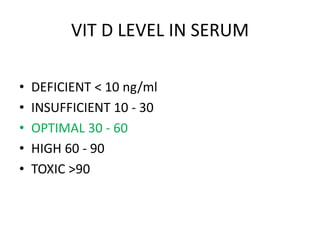
VIT D LEVEL IN SERUM
• DEFICIENT < 10 ng/ml
• INSUFFICIENT 10 - 30
• OPTIMAL 30 - 60
• HIGH 60 - 90
• TOXIC >90
Too Much Vitamin D !!!
• High dose can cause accumulation in the liver.
• Signs of toxicity include:
– excess calcium in the blood
– nausea
– vomiting
– decreased appetite.
VIT D DEFICIENCY
• Rickets
– Disease of growing bones of children(in it
epiphyseal plate not closed) in which defective
mineralization occurs in both bone and cartilage
of epiphyseal growth plate.
• Osteomalacia
– Disorder of mature bones in adult (after
epiphyseal plate closure) in which mineralization
of new osteoid bone is inadequate or delayed
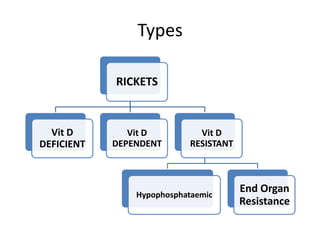
Types
RICKETS
Vit D
DEFICIENT
Vit D
DEPENDENT
Vit D
RESISTANT
Hypophosphataemic
End Organ
Resistance
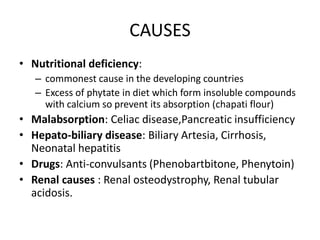
CAUSES
• Nutritional deficiency:
– commonest cause in the developing countries
– Excess of phytate in diet which form insoluble compounds
with calcium so prevent its absorption (chapati flour)
• Malabsorption: Celiac disease,Pancreatic insufficiency
• Hepato-biliary disease: Biliary Artesia, Cirrhosis,
Neonatal hepatitis
• Drugs: Anti-convulsants (Phenobartbitone, Phenytoin)
• Renal causes : Renal osteodystrophy, Renal tubular
acidosis.
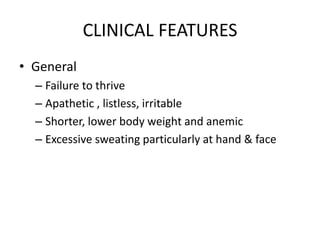
CLINICAL FEATURES
• General
– Failure to thrive
– Apathetic , listless, irritable
– Shorter, lower body weight and anemic
– Excessive sweating particularly at hand & face
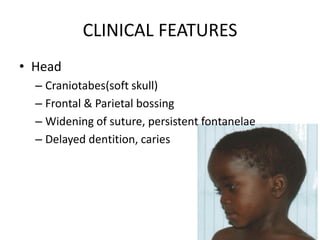
CLINICAL FEATURES
• Head
– Craniotabes(soft skull)
– Frontal & Parietal bossing
– Widening of suture, persistent fontanelae
– Delayed dentition, caries
CLINICAL FEATURES
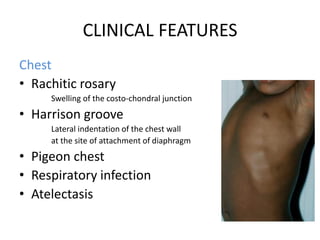
Chest
• Rachitic rosary
Swelling of the costo-chondral junction
• Harrison groove
Lateral indentation of the chest wall
at the site of attachment of diaphragm
• Pigeon chest
• Respiratory infection
• Atelectasis
CLINICAL FEATURES
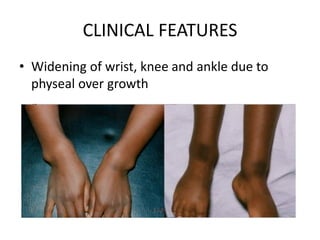
• Widening of wrist, knee and ankle due to
physeal over growth
CLINICAL FEATURES
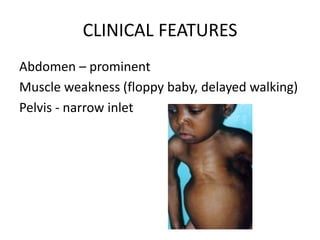
Abdomen – prominent
Muscle weakness (floppy baby, delayed walking)
Pelvis - narrow inlet
CLINICAL FEATURES
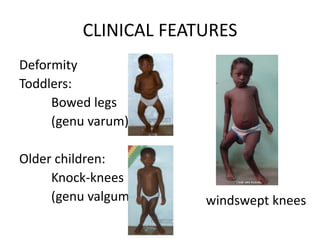
Deformity
Toddlers:
Bowed legs
(genu varum)
Older children:
Knock-knees
(genu valgum) windswept knees
CLINICAL FEATURES
• Thoracic kyphosis
• increased tendency for fracture, especially
green stick #
• Growth disturbance
• Bone pain or tenderness
• Tetany
• Sign of PEM
Extra – skeletal manifestations
• SEIZURES
• TETANY i.e periodic painful muscular spasms
and tremors, caused by faulty calcium
metabolism and associated with diminished
function of the parathyroid glands.
• HYPOTONIA AND DELAYED MOTOR
DEVELOPMENT Muscle weakness
DIAGNOSIS
• Clinical features of rickets:
– Skeletal manifestations
– Extraskeletal manifestations
• Investigations
– Serum Ca,
– S.Ph,
– Alkaline phosphatase,
– PTH ,
– S.Vit-D,
– S.creatinine
– X-Ray of long bones & joints
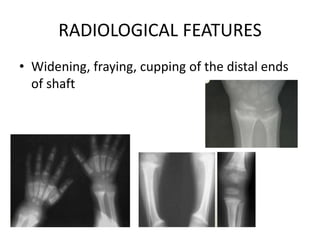
RADIOLOGICAL FEATURES
• Widening, fraying, cupping of the distal ends
of shaft
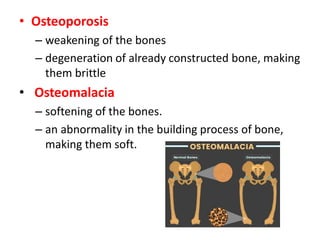
• Osteoporosis
– weakening of the bones
– degeneration of already constructed bone, making
them brittle
• Osteomalacia
– softening of the bones.
– an abnormality in the building process of bone,
making them soft.
CAUSES
• Vitamin D deficiency - most common cause
• Kidney or liver problems
• Celiac disease - Celiac disease is an
autoimmune disorder, which means eating
gluten can cause sensitivity in people with this
disease.
• Surgery
CLINICAL FEATURES
• Insidious course
• Bone pain, back ache and bone tenderness
• Proximal muscle weakness
• Fracture
• Vertebral collapse, kyphosis or knock knee
perhaps due to adolescent rickets- may
increase in later life.
CLINICAL FEATURES
• Long standing case sign of secondary
hyperparathyroidism
– Depression
– Polyuria
– Increased thirst
– Constipation
– Nephrolithiasis
– Peptic Ulcer Disease
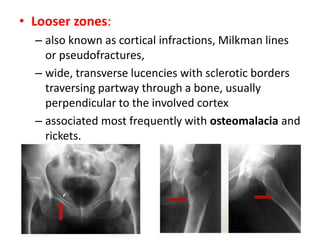
• Looser zones:
– also known as cortical infractions, Milkman lines
or pseudofractures,
– wide, transverse lucencies with sclerotic borders
traversing partway through a bone, usually
perpendicular to the involved cortex
– associated most frequently with osteomalacia and
rickets.
DIAGNOSIS
• Blood and urine tests - low levels of vitamin D,
calcium and phosphorus.
• X-rays - small cracks in the bones.
• Alkaline phosphatase isoenzymes test –
– an enzyme produced by osteoblasts (the cells that
form new bones)
– high level
• Bone biopsy - A needle is inserted through skin
into the pelvic bone above the hip to collect a
small sample of the bone.
DEFERENTIAL DIAGNOSIS
Osteomalacia Osteoporosis
Feelings Unwell Well
PAIN Generalized
chronic ache
after fracture
Muscles weakness normal
Looser’s zone Present Absent
S. Ph3 level decrease normal
Alk. Ph3ase increase normal
DEFERENTIAL DIAGNOSIS
Primary Hyperparathyroidism
Hypercalcaemia
Hypophosphaetemia
Raised PTH & alkaline phosphatase
Myeloma
Anemia
Increase ESR
Blood and urine electrophoresis raised of single Ig
Bence jones protein
TREATMENT
Depending on etiology, severity and metabolic
abnormality
• If the caused by a lack of vitamin D:
– Adequate Sun Exposure
– Intake of Fortified Foods
– Oral administration of 1.25mg(50,000IU)/week for 6 to 8
weeks followed by 20μg/d(800IU) from food and
supplements until normal level is achieved
• If calcium and phosphate levels are low in the body,
calcium and phosphate supplements are given.
• If osteomalacia is due to an underlying condition, the
treatment procedure will start immediately.
RICKETS TREATMENT
• Vit D deficiency state
– Vit D 300,000-600,000 IU IM /Orally in a day (2-4 doses) OR
– Vit D 2,000 – 5,000 I.U./day 4- 6 wk
– Calcium --- 1g/ day
– General nutrition , sunlight
– Followed by 400 IU / day
• Absorption defect
– Vit- D 1,500 – 25,000 IU / day
– Calcium 1 g/ day
– Treatment of underling pathology; where appropriat, low fat or gluten free
diet
• Vit D resistant
– Vit D 20,000- 60,000 IU/day Or dihydrotachysterol (dose 1/3 of vit D)
– Neutral phosphate-1.5- 6 g/ day (4-5 dose)
– Calcium – 1 g / day
PREVENTION
• Eat foods rich in vitamin D like oily fish, egg
yolks, milk, yogurt, cereal, etc.
• Eat foods rich in calcium like milk, yogurt,
cheese, tofu, leafy greens, etc.
• Adequate Sun Exposure
For more updates:
thepainkillerMD

Fat Soluble Vitamins- A,D

  • 1.
    DR SHAHNAWAZ FSHAH MD, FPM, FIAPM,FCPM (MUHS) Interventional Spine & Pain Physician Surat
  • 2.
    OBJECTIVES • Introduction • Classification •General Functions • Individual Characteristics (Vit A & D) • Individual Dietary Sources & RDA • Individual Mechanism of Action • Individual Function • Deficiencies – XEROPHTHALMIA – RICKETS & OSTEOMALACIA
  • 3.
    INTRODUCTION  The Latinword “vita”, means "life".  Vitamins are organic components in food that are needed in very small amounts  for growth  for maintaining good health  Eating a healthy diet remains the best way to get sufficient amounts of the vitamins and minerals you need
  • 4.
  • 5.
    Fat Soluble Vitamins(A,D,E,K) • Build bones. Bone formation would be impossible without vitamins A, D, and K. • Strong bones. A combination of calcium, vitamin D, vitamin K, magnesium, and phosphorus protects your bones against fractures. • Protect vision. Vitamin A also helps keep cells healthy and protects your vision. • Interact favorably. Without vitamin E, your body would have difficulty absorbing and storing vitamin A. • Protect the body. Vitamin E also acts as an antioxidant (a compound that helps protect the body against damage from unstable molecules).
  • 6.
    Water Soluble Vitamins (C& B Complex) • Release energy. Several B vitamins are key components of certain coenzymes (molecules that aid enzymes) that help release energy from food. • Produce energy. Thiamin, riboflavin, niacin, pantothenic acid, and biotin engage in energy production. • Build proteins and cells. Vitamins B6, B12, and folic acid metabolize amino acids (the building blocks of proteins) and help cells multiply. • Make collagen. One of many roles played by vitamin C is to help make collagen, which knits together wounds, supports blood vessel walls, and forms a base for teeth and bones.
  • 7.
    DIFFERENCE WATER SOLUBLE FATSOLUBLE Absorption Directly to blood Lymph via CM Transport free Require carrier Storage Circulate freely In cells with fat Excretion In urine Stored with fat Toxicity Rarely Possible with supplements Likely with supplements
  • 8.
    ABSORPTION • Absorption offat-soluble vitamins
  • 10.
    VITAMIN A It isthe name given to a group of related compounds : Retinol (vitamin A alcohol) Retinal ( vitamin A aldehyde) Retinoic acid ( vitamin A acid) Its provitamin carotenes are found in plants.
  • 11.
    SOURCES Yellow and darkgreen vegetables and fruits are sources of provitamin A carotenes Non Veg • Fish Oil • Liver • Egg Yolk Veg • Carrots • Mango • Papaya Dairy • Milk • Cheese • Butter
  • 12.
  • 13.
    RDA Category Vitamin A: RecommendedDietary Allowance (RDA) in micrograms (mcg) of Retinol Activity Equivalents (RAE) CHILDREN 1-3 years 300 mcg/day (or 1,000 International Units/day) 4-8 years 400 mcg/day (1,320 IU/day) 9-13 years 600 mcg/day (2,000 IU/day) FEMALES 14 years and up 700 mcg/day (2,310 IU/day) Pregnant 14-18 years: 750 mcg/day (2,500 IU/day) 19 years and over: 770 mcg/day (2,565 IU/day) Breastfeeding Under 19 years: 1,200 mcg/day (4,000 IU/day) 19 years and over: 1,300 mcg/day (4,300 IU/day) MALES 14 years and up 900 mcg/day (3,000 IU/day)
  • 14.
    FUNCTIONS Vitamin A playsa role in a variety of functions throughout the body, such as: • Vision • Gene transcription • Immune function • Embryonic development and reproduction • Bone metabolism • Hematopoiesis (the production of blood cells and platelets) • Skin and cellular health • Antioxidant activity
  • 15.
    VITAMIN- A DEFICIENCY •May be due to: – Inadequate dietary intake – Impaired intestinal absorption – Chronic alcoholism. • Impaired vision – Night blindness. • Extremely dry skin ,hair or nails. • Epithelial metaplasia and keratinization. • Xerophthalmia (dry eye)
  • 16.
    DEFICIENCY WHO IS ATRISK ? • Young children • Children with inadequate health care. • Adults with diseases of : – Pancreas – Liver – Intestine
  • 22.
    TREATMENT • Xerophthalmia: – 60mg of Vitamin A in Oily Solution in soft gel Capsule on day 1 & day 14 • Adults with Night Blindness or Bitot’s Spots: – 3mg/d or 7.5mg per week for 3 months • For prevention in high risk areas- – Infants(6 to 11 months)- 30mg of Vit A – Children(12 to 59 months)- 60mg of Vit A
  • 23.
    Too Much CanBe Toxic !! Hypervitaminosis A leads to toxic symptoms: Dry , itchy skin Hair loss Liver damage Skin coloration Loss of appetite Head ache and fatigue Blurred vision
  • 25.
    VITAMIN D • SUNSHINEVITAMIN, ANTIRACHITIC FACTOR, CALCIFEROL • Two important forms – D2 (ergocalciferol) - in plants – D3 (cholecalciferol) - in animals. • derivatives of cholesterol and are involved in the calcium and phosphorous metabolism.
  • 26.
  • 27.
    also synthesized bymonocyte-macrophages in the immune system CALCIDIOL CALCITRIOL CALCITRIOL
  • 28.
    FUNCTIONS • Maintenance ofadequate plasma levels of calcium and phosphorous • Bone mineralization • Metabolic functions • Neuromuscular transmission • acts locally as a cytokine, defending the body against microbial invaders by stimulating the innate immune system.
  • 29.
    HUMAN REQUIREMENTS • Greatlyinfluenced by the amount of ultraviolet light to which the individual is exposed • Half an hour of direct sunlight on the cheeks of a baby each day is sufficient to generate daily requirement of vitamin D • For adults also, exposure to sunlight for 30 minutes a day is believed to satisfy the daily requirement.
  • 30.
    • In someareas, the sunshine is not much beneficial • 400 IU is recommended for infants,lactating mother,and pregnent women. • For adult also 400 IU is adequate.
  • 31.
    VIT D LEVELIN SERUM • DEFICIENT < 10 ng/ml • INSUFFICIENT 10 - 30 • OPTIMAL 30 - 60 • HIGH 60 - 90 • TOXIC >90
  • 32.
    Too Much VitaminD !!! • High dose can cause accumulation in the liver. • Signs of toxicity include: – excess calcium in the blood – nausea – vomiting – decreased appetite.
  • 33.
    VIT D DEFICIENCY •Rickets – Disease of growing bones of children(in it epiphyseal plate not closed) in which defective mineralization occurs in both bone and cartilage of epiphyseal growth plate. • Osteomalacia – Disorder of mature bones in adult (after epiphyseal plate closure) in which mineralization of new osteoid bone is inadequate or delayed
  • 34.
    Types RICKETS Vit D DEFICIENT Vit D DEPENDENT VitD RESISTANT Hypophosphataemic End Organ Resistance
  • 35.
    CAUSES • Nutritional deficiency: –commonest cause in the developing countries – Excess of phytate in diet which form insoluble compounds with calcium so prevent its absorption (chapati flour) • Malabsorption: Celiac disease,Pancreatic insufficiency • Hepato-biliary disease: Biliary Artesia, Cirrhosis, Neonatal hepatitis • Drugs: Anti-convulsants (Phenobartbitone, Phenytoin) • Renal causes : Renal osteodystrophy, Renal tubular acidosis.
  • 36.
    CLINICAL FEATURES • General –Failure to thrive – Apathetic , listless, irritable – Shorter, lower body weight and anemic – Excessive sweating particularly at hand & face
  • 37.
    CLINICAL FEATURES • Head –Craniotabes(soft skull) – Frontal & Parietal bossing – Widening of suture, persistent fontanelae – Delayed dentition, caries
  • 38.
    CLINICAL FEATURES Chest • Rachiticrosary Swelling of the costo-chondral junction • Harrison groove Lateral indentation of the chest wall at the site of attachment of diaphragm • Pigeon chest • Respiratory infection • Atelectasis
  • 39.
    CLINICAL FEATURES • Wideningof wrist, knee and ankle due to physeal over growth
  • 40.
    CLINICAL FEATURES Abdomen –prominent Muscle weakness (floppy baby, delayed walking) Pelvis - narrow inlet
  • 41.
    CLINICAL FEATURES Deformity Toddlers: Bowed legs (genuvarum) Older children: Knock-knees (genu valgum) windswept knees
  • 42.
    CLINICAL FEATURES • Thoracickyphosis • increased tendency for fracture, especially green stick # • Growth disturbance • Bone pain or tenderness • Tetany • Sign of PEM
  • 43.
    Extra – skeletalmanifestations • SEIZURES • TETANY i.e periodic painful muscular spasms and tremors, caused by faulty calcium metabolism and associated with diminished function of the parathyroid glands. • HYPOTONIA AND DELAYED MOTOR DEVELOPMENT Muscle weakness
  • 44.
    DIAGNOSIS • Clinical featuresof rickets: – Skeletal manifestations – Extraskeletal manifestations • Investigations – Serum Ca, – S.Ph, – Alkaline phosphatase, – PTH , – S.Vit-D, – S.creatinine – X-Ray of long bones & joints
  • 45.
    RADIOLOGICAL FEATURES • Widening,fraying, cupping of the distal ends of shaft
  • 47.
    • Osteoporosis – weakeningof the bones – degeneration of already constructed bone, making them brittle • Osteomalacia – softening of the bones. – an abnormality in the building process of bone, making them soft.
  • 48.
    CAUSES • Vitamin Ddeficiency - most common cause • Kidney or liver problems • Celiac disease - Celiac disease is an autoimmune disorder, which means eating gluten can cause sensitivity in people with this disease. • Surgery
  • 49.
    CLINICAL FEATURES • Insidiouscourse • Bone pain, back ache and bone tenderness • Proximal muscle weakness • Fracture • Vertebral collapse, kyphosis or knock knee perhaps due to adolescent rickets- may increase in later life.
  • 50.
    CLINICAL FEATURES • Longstanding case sign of secondary hyperparathyroidism – Depression – Polyuria – Increased thirst – Constipation – Nephrolithiasis – Peptic Ulcer Disease
  • 51.
    • Looser zones: –also known as cortical infractions, Milkman lines or pseudofractures, – wide, transverse lucencies with sclerotic borders traversing partway through a bone, usually perpendicular to the involved cortex – associated most frequently with osteomalacia and rickets.
  • 52.
    DIAGNOSIS • Blood andurine tests - low levels of vitamin D, calcium and phosphorus. • X-rays - small cracks in the bones. • Alkaline phosphatase isoenzymes test – – an enzyme produced by osteoblasts (the cells that form new bones) – high level • Bone biopsy - A needle is inserted through skin into the pelvic bone above the hip to collect a small sample of the bone.
  • 53.
    DEFERENTIAL DIAGNOSIS Osteomalacia Osteoporosis FeelingsUnwell Well PAIN Generalized chronic ache after fracture Muscles weakness normal Looser’s zone Present Absent S. Ph3 level decrease normal Alk. Ph3ase increase normal
  • 54.
    DEFERENTIAL DIAGNOSIS Primary Hyperparathyroidism Hypercalcaemia Hypophosphaetemia RaisedPTH & alkaline phosphatase Myeloma Anemia Increase ESR Blood and urine electrophoresis raised of single Ig Bence jones protein
  • 55.
    TREATMENT Depending on etiology,severity and metabolic abnormality • If the caused by a lack of vitamin D: – Adequate Sun Exposure – Intake of Fortified Foods – Oral administration of 1.25mg(50,000IU)/week for 6 to 8 weeks followed by 20μg/d(800IU) from food and supplements until normal level is achieved • If calcium and phosphate levels are low in the body, calcium and phosphate supplements are given. • If osteomalacia is due to an underlying condition, the treatment procedure will start immediately.
  • 56.
    RICKETS TREATMENT • VitD deficiency state – Vit D 300,000-600,000 IU IM /Orally in a day (2-4 doses) OR – Vit D 2,000 – 5,000 I.U./day 4- 6 wk – Calcium --- 1g/ day – General nutrition , sunlight – Followed by 400 IU / day • Absorption defect – Vit- D 1,500 – 25,000 IU / day – Calcium 1 g/ day – Treatment of underling pathology; where appropriat, low fat or gluten free diet • Vit D resistant – Vit D 20,000- 60,000 IU/day Or dihydrotachysterol (dose 1/3 of vit D) – Neutral phosphate-1.5- 6 g/ day (4-5 dose) – Calcium – 1 g / day
  • 57.
    PREVENTION • Eat foodsrich in vitamin D like oily fish, egg yolks, milk, yogurt, cereal, etc. • Eat foods rich in calcium like milk, yogurt, cheese, tofu, leafy greens, etc. • Adequate Sun Exposure
  • 58.