TYPHOID FEVER
DR SHAHNAWAZ F SHAH
MD, FPM, FIAPM,FCPM (MUHS)
Interventional Spine & Pain Physician
Surat
INTRODUCTION
• Typhoid fever also known as Enteric fever
• Typhoid fever is an acute illness associated with
fever caused by the Salmonella typhi bacteria. It
can also be caused by Salmonella paratyphi, a
related bacterium that usually causes a less
severe illness.
• Major cause morbidity and mortality.
• Food water borne disease.
The bacteria are deposited in water or food by a
human carrier and then spread to other people.
CAUSE
BACTERIA
• Cause by Bacteria -Salmonella
Typhi.
• Family-Enterobacteriacea.
• Gram negative bacilii.
• Best grows at 37 C.
TRANSMISSION
• faecal-oral route.
• close contact with patients
or carriers.
• contaminated water and food.
• flies and cockroaches.
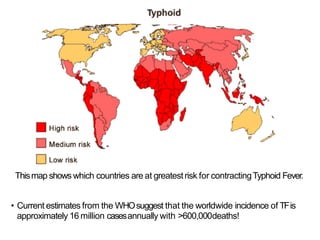
Thismap shows which countries are at greatestrisk for contractingTyphoid Fever.
• Current estimates from the WHOsuggest that the worldwide incidence of TFis
approximately 16 million casesannually with >600,000deaths!
Istyphoid contagious?
•Typhoid fever is highly contagious.
•An infected person can pass the bacteria out
of their body in their stools (faeces) or, less
commonly, in their urine.
•Contamination of the water supply can, in turn,
taint the food supply. The bacteria can survive
for weeks in water or dried sewage.
How DoPeople Get Typhoid Fever?
• Work in or travel to area where
typhoid fever is endemic
• Work as a clinical microbiologist
handling Salmonella typhi
bacteria
• Have close contact with
someone who is infected or
has recently been infected
with typhoid fever
• Drink water contaminated by
sewage that contains S. typhi
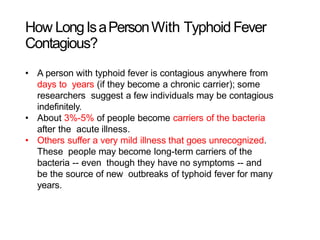
How LongIsaPersonWith Typhoid Fever
Contagious?
• A person with typhoid fever is contagious anywhere from
days to years (if they become a chronic carrier); some
researchers suggest a few individuals may be contagious
indefinitely.
• About 3%-5% of people become carriers of the bacteria
after the acute illness.
• Others suffer a very mild illness that goes unrecognized.
These people may become long-term carriers of the
bacteria -- even though they have no symptoms -- and
be the source of new outbreaks of typhoid fever for many
years.
 With appropriate antibiotic therapy, most patients recover from the
disease.
 However, 30% of people who do not receive therapy will die. Annually,
in the United States, there are about 300-400 cases and only one or
two deaths each year.
 Most of those who got sick had failed to receive a vaccination prior to
travel.
 Typhoid fever kills hundreds of thousands of people annually each
year. Most deaths occur in developing countries where the disease is
common. With adequate treatment, less than 1% of victims should die.
 There is a concern that multi-antibiotic-resistant strains of
bacteria are becoming more common worldwide.
What Isthe Prognosisof TyphoidFever?
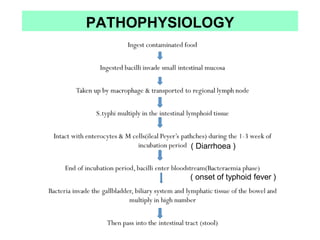
PATHOPHYSIOLOGY
( Diarrhoea )
( onset of typhoid fever )
What Are the Symptomsof
Typhoid Fever?
Incubation period is typically
about 10-14 days but can be
longer, and the onset may be
insidious.
Symptoms are often non-
specific and clinically non-
distinguishable from other
febrile illnesses. However,
clinical severity varies and
severe cases may lead to
serious complications or even
death.
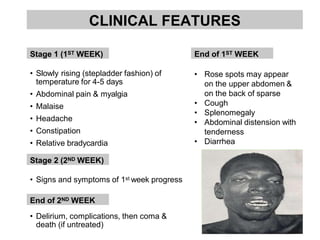
CLINICAL FEATURES
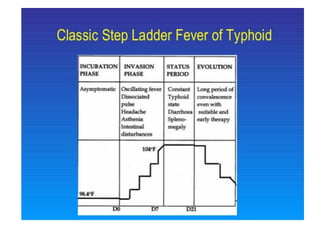
• Slowly rising (stepladder fashion) of
temperature for 4-5 days
• Abdominal pain & myalgia
• Malaise
• Headache
• Constipation
• Relative bradycardia
• Signs and symptoms of 1st week progress
• Delirium, complications, then coma &
death (if untreated)
Stage 1 (1ST WEEK)
Stage 2 (2ND WEEK)
• Rose spots may appear
on the upper abdomen &
on the back of sparse
• Cough
• Splenomegaly
• Abdominal distension with
tenderness
• Diarrhea
End of 1ST WEEK
End of 2ND WEEK
Slightly raised, rose-red spots, which fade on pressure. It is usually
visible only on white skin
• Febrile become toxic & anorexic
• Significant weight loss
• Typhoid state (Apathy, confusion & psychosis)
• High risk (5-10%) of hemorrhage and perforation may cause death
Stage 3 (3RD WEEK)
Stage 4 (4TH WEEK)
Recovery period
If the individual survives to the fourth week, the fever, mental state,
and abdominal distension slowly improve over a few days.
 Intestinal and neurologic complications may still occur in surviving
untreated
individuals.
 Weight loss and debilitating weakness last months.
Some survivors become asymptomatic S typhi carriers and have the
potential to transmit the bacteria indefinitely.
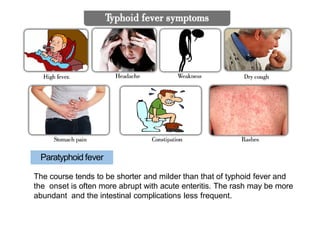
Paratyphoid fever
The course tends to be shorter and milder than that of typhoid fever and
the onset is often more abrupt with acute enteritis. The rash may be more
abundant and the intestinal complications less frequent.
Complications
BOWEL
Perforation
Hemorrhage
SEPTICAEMIC FOCI
Bone and joint infection
Meningitis
Cholecystiti
s
TOXIC PHENOMENA
Myocarditis
Nephriti
s
CHRONIC CARRIAGE
Persistent Gallbladder Carriage
Diagnosis &Investigation
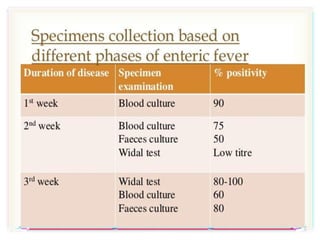
• Blood culture
• Specific serologic test
Identify Salmonella antibodies / antigens
[ Fluorescent antibody study to look for
substances that are specific to Typhoid
bacteria ]
Widal Test and ELISA
• Urine and Stool Culture (2nd & 3rd week)
• Marrow Culture *
- 90% sensitive unless until after 5
days commencement of antibiotic
- obtained from CSF, peritoneal
fluid, mesenteric LNs, resected intestine,
gallbladder, pharynx, tonsils, abscess,
bone
• Punch-biopsy samples of rose spots Culture
- 63% sensitive
Other non- specific lab studies
• Moderate anemic, increased ESR,
thrombocytopenia, lymphopenia
• Slightly elevated PT and aPTT, decreased
fibrinogen level
• Liver transaminases & bilirubin – increased 2x
normal
• Mild hyponatremia & hypokalemia
• Serum ALT: LDH > 9:1 = viral hepatitis
< 9:1 = typhoid hepatitis
TREATMENT
•Activity – rest is helpful
•Medical care
oAntibiotic
oCorticosterois ( for severe typhoid fever)
oAntipyretics
•Diet - fluid and electrolytes should be
monitored. Soft digestible diet is preferable
in absence of abdominal distension and
ileus
•Surgical care – in cases of intestinal perforation
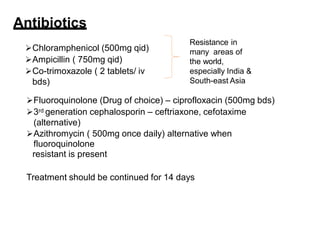
Antibiotics
Chloramphenicol (500mg qid)
Ampicillin ( 750mg qid)
Co-trimoxazole ( 2 tablets/ iv
bds)
Fluoroquinolone (Drug of choice) – ciprofloxacin (500mg bds)
3rd generation cephalosporin – ceftriaxone, cefotaxime
(alternative)
Azithromycin ( 500mg once daily) alternative when
fluoroquinolone
resistant is present
Treatment should be continued for 14 days
Resistance in
many areas of
the world,
especially India &
South-east Asia
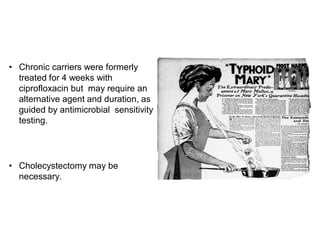
• Chronic carriers were formerly
treated for 4 weeks with
ciprofloxacin but may require an
alternative agent and duration, as
guided by antimicrobial sensitivity
testing.
• Cholecystectomy may be
necessary.
For more updates:
thepainkillerMD

Typhoid

  • 1.
    TYPHOID FEVER DR SHAHNAWAZF SHAH MD, FPM, FIAPM,FCPM (MUHS) Interventional Spine & Pain Physician Surat
  • 2.
    INTRODUCTION • Typhoid feveralso known as Enteric fever • Typhoid fever is an acute illness associated with fever caused by the Salmonella typhi bacteria. It can also be caused by Salmonella paratyphi, a related bacterium that usually causes a less severe illness. • Major cause morbidity and mortality. • Food water borne disease. The bacteria are deposited in water or food by a human carrier and then spread to other people.
  • 3.
    CAUSE BACTERIA • Cause byBacteria -Salmonella Typhi. • Family-Enterobacteriacea. • Gram negative bacilii. • Best grows at 37 C. TRANSMISSION • faecal-oral route. • close contact with patients or carriers. • contaminated water and food. • flies and cockroaches.
  • 4.
    Thismap shows whichcountries are at greatestrisk for contractingTyphoid Fever. • Current estimates from the WHOsuggest that the worldwide incidence of TFis approximately 16 million casesannually with >600,000deaths!
  • 5.
    Istyphoid contagious? •Typhoid feveris highly contagious. •An infected person can pass the bacteria out of their body in their stools (faeces) or, less commonly, in their urine. •Contamination of the water supply can, in turn, taint the food supply. The bacteria can survive for weeks in water or dried sewage.
  • 6.
    How DoPeople GetTyphoid Fever? • Work in or travel to area where typhoid fever is endemic • Work as a clinical microbiologist handling Salmonella typhi bacteria • Have close contact with someone who is infected or has recently been infected with typhoid fever • Drink water contaminated by sewage that contains S. typhi
  • 7.
    How LongIsaPersonWith TyphoidFever Contagious? • A person with typhoid fever is contagious anywhere from days to years (if they become a chronic carrier); some researchers suggest a few individuals may be contagious indefinitely. • About 3%-5% of people become carriers of the bacteria after the acute illness. • Others suffer a very mild illness that goes unrecognized. These people may become long-term carriers of the bacteria -- even though they have no symptoms -- and be the source of new outbreaks of typhoid fever for many years.
  • 8.
     With appropriateantibiotic therapy, most patients recover from the disease.  However, 30% of people who do not receive therapy will die. Annually, in the United States, there are about 300-400 cases and only one or two deaths each year.  Most of those who got sick had failed to receive a vaccination prior to travel.  Typhoid fever kills hundreds of thousands of people annually each year. Most deaths occur in developing countries where the disease is common. With adequate treatment, less than 1% of victims should die.  There is a concern that multi-antibiotic-resistant strains of bacteria are becoming more common worldwide. What Isthe Prognosisof TyphoidFever?
  • 9.
    PATHOPHYSIOLOGY ( Diarrhoea ) (onset of typhoid fever )
  • 10.
    What Are theSymptomsof Typhoid Fever? Incubation period is typically about 10-14 days but can be longer, and the onset may be insidious. Symptoms are often non- specific and clinically non- distinguishable from other febrile illnesses. However, clinical severity varies and severe cases may lead to serious complications or even death.
  • 11.
    CLINICAL FEATURES • Slowlyrising (stepladder fashion) of temperature for 4-5 days • Abdominal pain & myalgia • Malaise • Headache • Constipation • Relative bradycardia • Signs and symptoms of 1st week progress • Delirium, complications, then coma & death (if untreated) Stage 1 (1ST WEEK) Stage 2 (2ND WEEK) • Rose spots may appear on the upper abdomen & on the back of sparse • Cough • Splenomegaly • Abdominal distension with tenderness • Diarrhea End of 1ST WEEK End of 2ND WEEK
  • 13.
    Slightly raised, rose-redspots, which fade on pressure. It is usually visible only on white skin
  • 14.
    • Febrile becometoxic & anorexic • Significant weight loss • Typhoid state (Apathy, confusion & psychosis) • High risk (5-10%) of hemorrhage and perforation may cause death Stage 3 (3RD WEEK) Stage 4 (4TH WEEK) Recovery period If the individual survives to the fourth week, the fever, mental state, and abdominal distension slowly improve over a few days.  Intestinal and neurologic complications may still occur in surviving untreated individuals.  Weight loss and debilitating weakness last months. Some survivors become asymptomatic S typhi carriers and have the potential to transmit the bacteria indefinitely.
  • 15.
    Paratyphoid fever The coursetends to be shorter and milder than that of typhoid fever and the onset is often more abrupt with acute enteritis. The rash may be more abundant and the intestinal complications less frequent.
  • 16.
    Complications BOWEL Perforation Hemorrhage SEPTICAEMIC FOCI Bone andjoint infection Meningitis Cholecystiti s TOXIC PHENOMENA Myocarditis Nephriti s CHRONIC CARRIAGE Persistent Gallbladder Carriage
  • 17.
    Diagnosis &Investigation • Bloodculture • Specific serologic test Identify Salmonella antibodies / antigens [ Fluorescent antibody study to look for substances that are specific to Typhoid bacteria ] Widal Test and ELISA • Urine and Stool Culture (2nd & 3rd week) • Marrow Culture * - 90% sensitive unless until after 5 days commencement of antibiotic - obtained from CSF, peritoneal fluid, mesenteric LNs, resected intestine, gallbladder, pharynx, tonsils, abscess, bone • Punch-biopsy samples of rose spots Culture - 63% sensitive
  • 19.
    Other non- specificlab studies • Moderate anemic, increased ESR, thrombocytopenia, lymphopenia • Slightly elevated PT and aPTT, decreased fibrinogen level • Liver transaminases & bilirubin – increased 2x normal • Mild hyponatremia & hypokalemia • Serum ALT: LDH > 9:1 = viral hepatitis < 9:1 = typhoid hepatitis
  • 21.
    TREATMENT •Activity – restis helpful •Medical care oAntibiotic oCorticosterois ( for severe typhoid fever) oAntipyretics •Diet - fluid and electrolytes should be monitored. Soft digestible diet is preferable in absence of abdominal distension and ileus •Surgical care – in cases of intestinal perforation
  • 22.
    Antibiotics Chloramphenicol (500mg qid) Ampicillin( 750mg qid) Co-trimoxazole ( 2 tablets/ iv bds) Fluoroquinolone (Drug of choice) – ciprofloxacin (500mg bds) 3rd generation cephalosporin – ceftriaxone, cefotaxime (alternative) Azithromycin ( 500mg once daily) alternative when fluoroquinolone resistant is present Treatment should be continued for 14 days Resistance in many areas of the world, especially India & South-east Asia
  • 23.
    • Chronic carrierswere formerly treated for 4 weeks with ciprofloxacin but may require an alternative agent and duration, as guided by antimicrobial sensitivity testing. • Cholecystectomy may be necessary.
  • 25.