vitamins
Prepared by
Shivanee vyas (m.pharmacy)
content
Definition
Types of vitamins
Vitamin toxicities
Multivitamins tablet
Definition:
Vitamin are chemically organic
substance that are essential in small
amount to maintain normal metabolic
function.
Vitamin are obtained from food,
generally not synthesized in the body.
Types of vitamins
Lipid soluble vitamins :
those vitamin which are soluble in lipid is
known as lipid soluble vitamin.
Example: vitamin A , D ,E, and ,K
• Water soluble vitamins:
those vitamins which are soluble in water
is known as water soluble vitamins.
Example: vitamins B complex and vitamin c
Lipid soluble vitamins
Vitamin A:
It is also known as RETINOL.
Source:
It is found in milk, butter, cod liver oil,
It is also found in yellow vegetables and
crop like maize , carrot, papaya and
Green leafy vegetables .
Physiological function:
 It is essential for normal growth.
 It is the component of retinol pigment
rhodopsin & iodopsin.
Deficiency:
 night blindness, xerophthalmia,
 slow growth.
Selected interaction: oral anti-
Coagulant , large vitamin A dose
Vitamin D:
 IT is also known as CALCIFEROL and
ANTIRACHITIC.
SOURCES: Butter, egg yolk,
milk ,Exposure of skin to sun light .
Physiological function:
Facilited absorbtion of calcium &
Phosphorus by intestine & their
Retention .
Deficiency:
 Rickets in child.
 Osteomalacia in adult.
 Dental carries.
Selected interaction:
Phenitoin, Phenobarbital,
Treat patient with calcitriol.
Vitamin E
 IT is also known as alpha TOCOFEROL or
FERTILITY VITAMIN.
SOURCES : Leafy vegetable,
Whole cereals grain, corn oil ,
Vegetable oil.
Physiological function:
It prevent damage of plasma membrane
Maintain normal function of reproductive
organ, muscle & heart.
Deficiency:
 Anaemia
 Reproductive failure
 Muscular dystrophy
Selected interaction:
Oral anticoagulants.
Iron therapy
Vitamin k
 It is also known as ANTIHAEMORRHAGIC
vitamin Or
PHYLLOQUINON .
SOURCES : Green leafy
vegetables
Produced by intestinal bacteria
Physiological function:
Synthesis of prothombin.
Deficiency :
• Prolonged bleeding or HAEMORRHAGES
• gastrointestinal bleeding.
• Selected interaction:
• Oral anticoagulants
• Vitamin K rich diet.
Water soluble vitamins
B complex
Vitamin B1:
it is also known as THIAMINE
& ANTINEURITIC .
SOURCES: outer cover of cereals,
milk, meat, yeast, groundnut
Physiological function
 It is act as co-enzyme & form thiamine
pyrophosphate (TPP), required for respiration
 Growth of neuron & muscle.
Deficiency: beriberi
SELECTED INTERECTION
unstable in neutral and
Alkaline solution
Vitamin B2
 It is also known as RIBOFLAVIN
SOURCES: milk, egg, green leafy
vegetable, pulses
Physiological function: it is
essential for growth, act as coenzyme
Maintain normal healthy skin.
deficiency:
 Cheilosis, keratitis
 Eye inflamation
 Glossitis.
Vitamin B3
 IT is also known as NIACINE.
 SOURCES: whole grain, fish, green vegetable
It is synthesized from the amino acid
Physiological function:
Act as coenzyme (NAD), (NADP)
Act as hydrogen donor& acceptor
in respiration.
Deficiency:
 Pellagra
 Hartnups disease
 Canine black tongue disease.
Vitamin B5
 It is also known as PANTHOTHENIC ACID.
 SOURCES:
 various food stuffs like yeast, milk ,liver, honey,
wheat germs .
Physiological function:
 It act as coenzyme
 Required for synthesis of
 Acetylcholine.
Deficiency:
 Burning feet syndrome
 Insomnia
 Muscle weakness
 G.I.T disorder
Vitamin B6
 It is also known as PYRIDOXINE
 SOURCES: nuts, meat, whole grain, milk
Intestinal bacteria
Physiological function:
Act as coenzyme & form
pyridoxal phosphate, req. For the
metabolism of amino acid
Maintain nervous sys.
Deficiency:
 Skin lesions
 CNS disorder
 It can also lead pellagra .
 Convulsion
Selected interaction:
 Isoniazid
 Phenitoin
 Oral contraceptives
Vitamin B7
 It is also known as BIOTIN/ANTI-EGG WHITE INJURY
FACTOR.
 SOURCES: fresh fruit & vegetable, honey, egg
yolk, milk.
Physiological function:
 Act as coenzyme & involve in
different type of metabolic reaction
Deficiency:
 Hair loss
 Skin lesions
 Weakness
 Loss of muscular control
Vitamin B9/ B10
 It is also known as FOLIC ACID OR
PTEROYL-GLUTAMIC ACID .
 SOURCES: mushroom, yeast, liver,
green vegetable.
Physiological function:
 It form a coenzyme which help DNA
 & RNA synthesis
 Growth & maturation of RBC
DEFICIENCY:
 Megaloblastic anaemia.
 Diarrhoea, sour mouth.
Selected interaction:
 Methotrexate, phenitoin
 Timethoprim pyrimethamine
 Folic acid antagonist rarely
 produce anaemia with high dose
Vitamin B12
 It is also known as CYANOCOBALAMIN.
SORCES: meat, egg, fish, other dairy product,
spirulina (algae).
Physiological function:
 It perform major function by
 acting
coenzyme
For synthesis of nucleic acid.
Maturation of RBC & proper growth.
Deficiency:
 Megaloblastic anaemia
 Glossitis
 Neurologic degeneration(deficiency
prolonged & sever).
Selected interaction:
Alcohol
amino salicylic acid.
Vitamin C
 IT is also known as ASCORBIC ACID.
SORCES: It is mainly found in
citrus fruit like lemon , orange,
amla, tomato, green vegetable.
Physiological function:
 Formation of normal collegen ,
 bone matrix ,healthy gums and teeth,
 absorption of iron
 It has antioxidant property
 Help in wound healing.
Deficiency:
 Scurvy
 Loose & falling teeth
 Bone weakness
 Delayed wound healing
 Nervous disorder
Selected interaction:
 Testape, clinistix
 Phenothiazines
VITAMIN DAILY
REQ.
Medicine
A 2 mg lycoshine
D 0.01 mg calcimax fort
E 20 mg evione 200
K .1 mg ampro vit
B1 1.5 mg
acidophilus
B3
B5 10 mg b complex
B6 2 mg proferric
B7 0.3 mg b complex
B9/B10
0.4 mg folic acid 5 mg
bp
B12 0.003 mg nutra bulk
C 50mg limcee
Toxicities:
Vit. A : severe headache, dizziness,
drowsiness (6-8hr), redness & swelling of skin
(12-20hr).
Vit. D: Initially: weakness, fatigue, dry mouth
Prolonged: deposition of cal. Salt in soft tissue
Vit.k: death occurred after 4 administration of
phytonadione. large dose of meanadione or its
derivatives cause haemolytic anaemia .
Vit.E :NAUSEA, FLATURENCE,DIARRHOEA.
VIT. B1: ORALLY: non- toxic
Parentally: itching, rare anaphylactic reaction,
pain .
VIT. B3: headache, abnormal liver function,
hyperuricemia.
Vit. B6: nontoxic, transient induce pyridoxine
dependency(200mg daily for 1 month).
Vit.C: diarrhoea, headache, serious toxicity
uncommon.
Multivitamin tablet
 Drug: vitamins
 Brand name: becosule capsule.
 Company: Pfizer
 Ingredients:
cal. Pantothenate 50 mg
Vit b12 15 mcg
Folic acid 1.5 mg
Vit b1 10 mg
Vit b2 10mg
Vit b6 3mg
Vit c 150mg
Niacinamide 100mg
Biotin 100mcg
Drug :vitamins
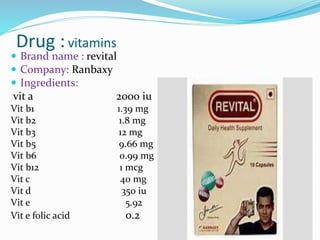
 Brand name : revital
 Company: Ranbaxy
 Ingredients:
vit a 2000 iu
Vit b1 1.39 mg
Vit b2 1.8 mg
Vit b3 12 mg
Vit b5 9.66 mg
Vit b6 0.99 mg
Vit b12 1 mcg
Vit c 40 mg
Vit d 350 iu
Vit e 5.92
Vit e folic acid 0.2
Drug: vitamin
 Brand name :beplex forte tablet
 Company: Anglo French
 Ingredients:
Vit b1 10 mg
Vit b2 10 mg
Vit b6 3 mg
Folic acid 1.5 mg
Vit c 150 mg
Vit b12 15 mcg
Biotin 260 mcg
Nicotinic acid 25 mg
Niacinamide 75 mg
Cal pantothenate 50 mg
Drug: vitamin
 Brand name: supradyn
 Company: Abbott health care
 Ingredients:
 Ascorbic acid 150 mg
 Biotin 0.25 mg
 Vit a 1000 iu
 Vit b1 10 mg
 Vit b12 15 mg
 Vit b2 10 mg
 Vit b6 3 mg
 Vit d 1000 iu
 Vit e 25 mg
drug Brand name Company
vitamin bevone Zuventus health care ltd
vitamin heifer Alkem laboratories Ltd
vitamin Becozym c forte Abbott health care
vitamin Irona -xt Bio science health care
vitamin dexorange Franco Indian
vitamin zincovit apex
vitamin zentop Coral laboratories Ltd
vitamin Polybion sf Merck limited
vitamin nurokind Mankind pharmaceutical
PvT Ltd
vitamin Lykofit -x Unit biotech

Vitamins

  • 1.
  • 2.
  • 3.
    Definition: Vitamin are chemicallyorganic substance that are essential in small amount to maintain normal metabolic function. Vitamin are obtained from food, generally not synthesized in the body.
  • 4.
    Types of vitamins Lipidsoluble vitamins : those vitamin which are soluble in lipid is known as lipid soluble vitamin. Example: vitamin A , D ,E, and ,K • Water soluble vitamins: those vitamins which are soluble in water is known as water soluble vitamins. Example: vitamins B complex and vitamin c
  • 5.
    Lipid soluble vitamins VitaminA: It is also known as RETINOL. Source: It is found in milk, butter, cod liver oil, It is also found in yellow vegetables and crop like maize , carrot, papaya and Green leafy vegetables .
  • 6.
    Physiological function:  Itis essential for normal growth.  It is the component of retinol pigment rhodopsin & iodopsin. Deficiency:  night blindness, xerophthalmia,  slow growth. Selected interaction: oral anti- Coagulant , large vitamin A dose
  • 7.
    Vitamin D:  ITis also known as CALCIFEROL and ANTIRACHITIC. SOURCES: Butter, egg yolk, milk ,Exposure of skin to sun light . Physiological function: Facilited absorbtion of calcium & Phosphorus by intestine & their Retention .
  • 8.
    Deficiency:  Rickets inchild.  Osteomalacia in adult.  Dental carries. Selected interaction: Phenitoin, Phenobarbital, Treat patient with calcitriol.
  • 9.
    Vitamin E  ITis also known as alpha TOCOFEROL or FERTILITY VITAMIN. SOURCES : Leafy vegetable, Whole cereals grain, corn oil , Vegetable oil. Physiological function: It prevent damage of plasma membrane Maintain normal function of reproductive organ, muscle & heart.
  • 10.
    Deficiency:  Anaemia  Reproductivefailure  Muscular dystrophy Selected interaction: Oral anticoagulants. Iron therapy
  • 11.
    Vitamin k  Itis also known as ANTIHAEMORRHAGIC vitamin Or PHYLLOQUINON . SOURCES : Green leafy vegetables Produced by intestinal bacteria Physiological function: Synthesis of prothombin.
  • 12.
    Deficiency : • Prolongedbleeding or HAEMORRHAGES • gastrointestinal bleeding. • Selected interaction: • Oral anticoagulants • Vitamin K rich diet.
  • 13.
    Water soluble vitamins Bcomplex Vitamin B1: it is also known as THIAMINE & ANTINEURITIC . SOURCES: outer cover of cereals, milk, meat, yeast, groundnut
  • 14.
    Physiological function  Itis act as co-enzyme & form thiamine pyrophosphate (TPP), required for respiration  Growth of neuron & muscle. Deficiency: beriberi SELECTED INTERECTION unstable in neutral and Alkaline solution
  • 15.
    Vitamin B2  Itis also known as RIBOFLAVIN SOURCES: milk, egg, green leafy vegetable, pulses Physiological function: it is essential for growth, act as coenzyme Maintain normal healthy skin.
  • 16.
    deficiency:  Cheilosis, keratitis Eye inflamation  Glossitis.
  • 17.
    Vitamin B3  ITis also known as NIACINE.  SOURCES: whole grain, fish, green vegetable It is synthesized from the amino acid Physiological function: Act as coenzyme (NAD), (NADP) Act as hydrogen donor& acceptor in respiration.
  • 18.
    Deficiency:  Pellagra  Hartnupsdisease  Canine black tongue disease.
  • 19.
    Vitamin B5  Itis also known as PANTHOTHENIC ACID.  SOURCES:  various food stuffs like yeast, milk ,liver, honey, wheat germs . Physiological function:  It act as coenzyme  Required for synthesis of  Acetylcholine.
  • 20.
    Deficiency:  Burning feetsyndrome  Insomnia  Muscle weakness  G.I.T disorder
  • 21.
    Vitamin B6  Itis also known as PYRIDOXINE  SOURCES: nuts, meat, whole grain, milk Intestinal bacteria Physiological function: Act as coenzyme & form pyridoxal phosphate, req. For the metabolism of amino acid Maintain nervous sys.
  • 22.
    Deficiency:  Skin lesions CNS disorder  It can also lead pellagra .  Convulsion Selected interaction:  Isoniazid  Phenitoin  Oral contraceptives
  • 23.
    Vitamin B7  Itis also known as BIOTIN/ANTI-EGG WHITE INJURY FACTOR.  SOURCES: fresh fruit & vegetable, honey, egg yolk, milk. Physiological function:  Act as coenzyme & involve in different type of metabolic reaction
  • 24.
    Deficiency:  Hair loss Skin lesions  Weakness  Loss of muscular control
  • 25.
    Vitamin B9/ B10 It is also known as FOLIC ACID OR PTEROYL-GLUTAMIC ACID .  SOURCES: mushroom, yeast, liver, green vegetable. Physiological function:  It form a coenzyme which help DNA  & RNA synthesis  Growth & maturation of RBC
  • 26.
    DEFICIENCY:  Megaloblastic anaemia. Diarrhoea, sour mouth. Selected interaction:  Methotrexate, phenitoin  Timethoprim pyrimethamine  Folic acid antagonist rarely  produce anaemia with high dose
  • 27.
    Vitamin B12  Itis also known as CYANOCOBALAMIN. SORCES: meat, egg, fish, other dairy product, spirulina (algae). Physiological function:  It perform major function by  acting coenzyme For synthesis of nucleic acid. Maturation of RBC & proper growth.
  • 28.
    Deficiency:  Megaloblastic anaemia Glossitis  Neurologic degeneration(deficiency prolonged & sever). Selected interaction: Alcohol amino salicylic acid.
  • 29.
    Vitamin C  ITis also known as ASCORBIC ACID. SORCES: It is mainly found in citrus fruit like lemon , orange, amla, tomato, green vegetable. Physiological function:  Formation of normal collegen ,  bone matrix ,healthy gums and teeth,  absorption of iron  It has antioxidant property  Help in wound healing.
  • 30.
    Deficiency:  Scurvy  Loose& falling teeth  Bone weakness  Delayed wound healing  Nervous disorder Selected interaction:  Testape, clinistix  Phenothiazines
  • 31.
    VITAMIN DAILY REQ. Medicine A 2mg lycoshine D 0.01 mg calcimax fort E 20 mg evione 200 K .1 mg ampro vit B1 1.5 mg acidophilus
  • 32.
    B3 B5 10 mgb complex B6 2 mg proferric B7 0.3 mg b complex B9/B10 0.4 mg folic acid 5 mg bp B12 0.003 mg nutra bulk C 50mg limcee
  • 33.
    Toxicities: Vit. A :severe headache, dizziness, drowsiness (6-8hr), redness & swelling of skin (12-20hr). Vit. D: Initially: weakness, fatigue, dry mouth Prolonged: deposition of cal. Salt in soft tissue Vit.k: death occurred after 4 administration of phytonadione. large dose of meanadione or its derivatives cause haemolytic anaemia .
  • 34.
    Vit.E :NAUSEA, FLATURENCE,DIARRHOEA. VIT.B1: ORALLY: non- toxic Parentally: itching, rare anaphylactic reaction, pain . VIT. B3: headache, abnormal liver function, hyperuricemia. Vit. B6: nontoxic, transient induce pyridoxine dependency(200mg daily for 1 month). Vit.C: diarrhoea, headache, serious toxicity uncommon.
  • 35.
    Multivitamin tablet  Drug:vitamins  Brand name: becosule capsule.  Company: Pfizer  Ingredients: cal. Pantothenate 50 mg Vit b12 15 mcg Folic acid 1.5 mg Vit b1 10 mg Vit b2 10mg Vit b6 3mg Vit c 150mg Niacinamide 100mg Biotin 100mcg
  • 36.
    Drug :vitamins  Brandname : revital  Company: Ranbaxy  Ingredients: vit a 2000 iu Vit b1 1.39 mg Vit b2 1.8 mg Vit b3 12 mg Vit b5 9.66 mg Vit b6 0.99 mg Vit b12 1 mcg Vit c 40 mg Vit d 350 iu Vit e 5.92 Vit e folic acid 0.2
  • 37.
    Drug: vitamin  Brandname :beplex forte tablet  Company: Anglo French  Ingredients: Vit b1 10 mg Vit b2 10 mg Vit b6 3 mg Folic acid 1.5 mg Vit c 150 mg Vit b12 15 mcg Biotin 260 mcg Nicotinic acid 25 mg Niacinamide 75 mg Cal pantothenate 50 mg
  • 38.
    Drug: vitamin  Brandname: supradyn  Company: Abbott health care  Ingredients:  Ascorbic acid 150 mg  Biotin 0.25 mg  Vit a 1000 iu  Vit b1 10 mg  Vit b12 15 mg  Vit b2 10 mg  Vit b6 3 mg  Vit d 1000 iu  Vit e 25 mg
  • 39.
    drug Brand nameCompany vitamin bevone Zuventus health care ltd vitamin heifer Alkem laboratories Ltd vitamin Becozym c forte Abbott health care vitamin Irona -xt Bio science health care vitamin dexorange Franco Indian vitamin zincovit apex vitamin zentop Coral laboratories Ltd vitamin Polybion sf Merck limited vitamin nurokind Mankind pharmaceutical PvT Ltd vitamin Lykofit -x Unit biotech