NUMERICAL METHODS
TOPIC 2: REGULI-FALSI
(FALSE POSITION) METHOD
REGULI-FALSI (FALSE POSITION)
• The REGULI-FALSI method (also known as False Position linear-
interpolation method) involves obtaining values for two roots to the
equation f(x)=0 by trial-and-error.
• In this method, the nonlinear function f(x) is assumed to be a linear
function g(x) in the interval (a,b), and the root of the function g(x),
x=c, is taken as the next approximation of the root of the nonlinear
equation function f(x), x=𝛼
• The method is called linear interpolation method.
𝑓(𝑥)
𝑥
𝑎
𝑏
g(𝑥)
𝑓(𝑥)
𝑐 𝛼
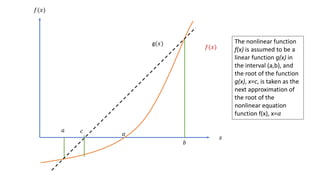
The nonlinear function
f(x) is assumed to be a
linear function g(x) in
the interval (a,b), and
the root of the function
g(x), x=c, is taken as the
next approximation of
the root of the
nonlinear equation
function f(x), x=𝛼
REGULI-FALSI (FALSE POSITION)
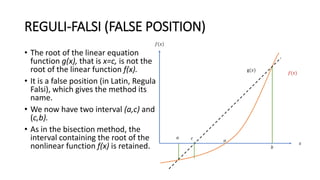
• The root of the linear equation
function g(x), that is x=c, is not the
root of the linear function f(x).
• It is a false position (in Latin, Regula
Falsi), which gives the method its
name.
• We now have two interval (a,c) and
(c,b).
• As in the bisection method, the
interval containing the root of the
nonlinear function f(x) is retained.
REGULI-FALSI (FALSE POSITION)
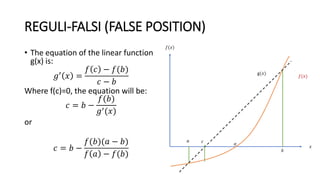
• The equation of the linear function
g(x) is:
𝑔′
𝑥 =
𝑓 𝑐 − 𝑓(𝑏)
𝑐 − 𝑏
Where f(c)=0, the equation will be:
𝑐 = 𝑏 −
𝑓(𝑏)
𝑔′(𝑥)
or
𝑐 = 𝑏 −
𝑓(𝑏)(𝑎 − 𝑏)
𝑓 𝑎 − 𝑓(𝑏)
REGULI-FALSI (FALSE POSITION)
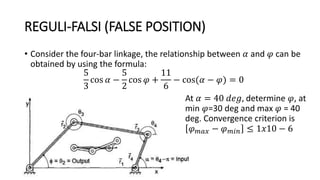
• Consider the four-bar linkage, the relationship between 𝛼 and 𝜑 can be
obtained by using the formula:
5
3
cos 𝛼 −
5
2
cos 𝜑 +
11
6
− cos(𝛼 − 𝜑) = 0
At 𝛼 = 40 𝑑𝑒𝑔, determine 𝜑, at
min 𝜑=30 deg and max 𝜑 = 40
deg. Convergence criterion is
𝜑𝑚𝑎𝑥 − 𝜑𝑚𝑖𝑛 ≤ 1𝑥10 − 6
REGULI-FALSI (FALSE POSITION)
• Look for recent study/innovation on the application of Reguli-Falsi in
your specific field.
• Summary shall be submitted in 1 page
• No duplication
False Position Method.pptx

False Position Method.pptx

  • 1.
    NUMERICAL METHODS TOPIC 2:REGULI-FALSI (FALSE POSITION) METHOD
  • 2.
    REGULI-FALSI (FALSE POSITION) •The REGULI-FALSI method (also known as False Position linear- interpolation method) involves obtaining values for two roots to the equation f(x)=0 by trial-and-error. • In this method, the nonlinear function f(x) is assumed to be a linear function g(x) in the interval (a,b), and the root of the function g(x), x=c, is taken as the next approximation of the root of the nonlinear equation function f(x), x=𝛼 • The method is called linear interpolation method.
  • 3.
    𝑓(𝑥) 𝑥 𝑎 𝑏 g(𝑥) 𝑓(𝑥) 𝑐 𝛼 The nonlinearfunction f(x) is assumed to be a linear function g(x) in the interval (a,b), and the root of the function g(x), x=c, is taken as the next approximation of the root of the nonlinear equation function f(x), x=𝛼
  • 4.
    REGULI-FALSI (FALSE POSITION) •The root of the linear equation function g(x), that is x=c, is not the root of the linear function f(x). • It is a false position (in Latin, Regula Falsi), which gives the method its name. • We now have two interval (a,c) and (c,b). • As in the bisection method, the interval containing the root of the nonlinear function f(x) is retained.
  • 5.
    REGULI-FALSI (FALSE POSITION) •The equation of the linear function g(x) is: 𝑔′ 𝑥 = 𝑓 𝑐 − 𝑓(𝑏) 𝑐 − 𝑏 Where f(c)=0, the equation will be: 𝑐 = 𝑏 − 𝑓(𝑏) 𝑔′(𝑥) or 𝑐 = 𝑏 − 𝑓(𝑏)(𝑎 − 𝑏) 𝑓 𝑎 − 𝑓(𝑏)
  • 6.
    REGULI-FALSI (FALSE POSITION) •Consider the four-bar linkage, the relationship between 𝛼 and 𝜑 can be obtained by using the formula: 5 3 cos 𝛼 − 5 2 cos 𝜑 + 11 6 − cos(𝛼 − 𝜑) = 0 At 𝛼 = 40 𝑑𝑒𝑔, determine 𝜑, at min 𝜑=30 deg and max 𝜑 = 40 deg. Convergence criterion is 𝜑𝑚𝑎𝑥 − 𝜑𝑚𝑖𝑛 ≤ 1𝑥10 − 6
  • 7.
    REGULI-FALSI (FALSE POSITION) •Look for recent study/innovation on the application of Reguli-Falsi in your specific field. • Summary shall be submitted in 1 page • No duplication