Sinusoids and Phasors
ECECR2 214
Engr. Christine T. Rasimo
Why study AC?
– Ac is more efficient and economical for long distance
transmission
– Many real applications use ac, e.g. electrical home appliances,
factories, labs, etc.
– AC can be transmitted across long distances without much energy
loss, unlike DC.
– The power loss during transmission in AC is less when compared to
DC.
Introduction
• To deal with ac, we will only consider sinusoidally time-varying
excitation → sinusoid
– Sinusoid definition
• A sinusoid is a signal that has the form of the sine and cosine function
• A sinusoidal current is usually referred to as alternating current
(ac). Such a current reverses at regular time intervals and has
alternately positive and negative values.
• Circuits driven by sinusoidal current or voltage sources are
called AC circuits
Why sinusoids are of our interest?
1. By nature, it is characteristically sinusoidal - anything that repeats its
motions periodically, e.g., pendulum, ripples on the ocean surface, etc.
2. Easy to generate and transmit - they are used in our homes,
factories, etc.
3. Can be analyzed using Fourier analysis - easy to manipulate signals
any practical periodic signal can be represented by a sum of sinusoids.
4. Easy to be handled mathematically - the derivative and integral of a
sinusoid are themselves sinusoids.
Sinusoid
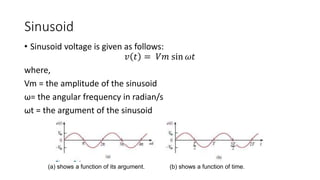
• Sinusoid voltage is given as follows:
𝑣 𝑡 = 𝑉𝑚 sin 𝜔𝑡
where,
Vm = the amplitude of the sinusoid
ω= the angular frequency in radian/s
ωt = the argument of the sinusoid
(a) shows a function of its argument. (b) shows a function of time.
Sinusoid
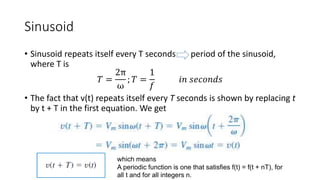
• Sinusoid repeats itself every T seconds period of the sinusoid,
where T is
𝑇 =
2π
ω
; 𝑇 =
1
𝑓
𝑖𝑛 𝑠𝑒𝑐𝑜𝑛𝑑𝑠
• The fact that v(t) repeats itself every T seconds is shown by replacing t
by t + T in the first equation. We get
which means
A periodic function is one that satisfies f(t) = f(t + nT), for
all t and for all integers n.
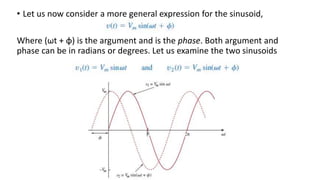
• Let us now consider a more general expression for the sinusoid,
Where (ωt + φ) is the argument and is the phase. Both argument and
phase can be in radians or degrees. Let us examine the two sinusoids
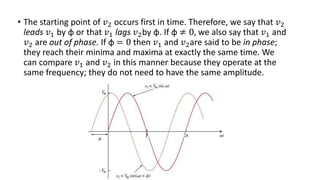
• The starting point of 𝑣2 occurs first in time. Therefore, we say that 𝑣2
leads 𝑣1 by φ or that 𝑣1 lags 𝑣2by φ. If φ ≠ 0, we also say that 𝑣1 and
𝑣2 are out of phase. If φ = 0 then 𝑣1 and 𝑣2are said to be in phase;
they reach their minima and maxima at exactly the same time. We
can compare 𝑣1 and 𝑣2 in this manner because they operate at the
same frequency; they do not need to have the same amplitude.
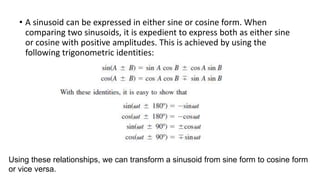
• A sinusoid can be expressed in either sine or cosine form. When
comparing two sinusoids, it is expedient to express both as either sine
or cosine with positive amplitudes. This is achieved by using the
following trigonometric identities:
Using these relationships, we can transform a sinusoid from sine form to cosine form
or vice versa.
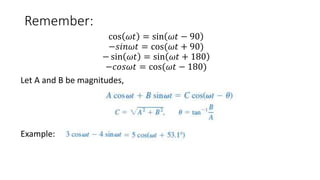
Remember:
cos 𝜔𝑡 = sin 𝜔𝑡 − 90
−𝑠𝑖𝑛𝜔𝑡 = cos(𝜔𝑡 + 90)
− sin 𝜔𝑡 = sin 𝜔𝑡 + 180
−𝑐𝑜𝑠𝜔𝑡 = cos(𝜔𝑡 − 180)
Let A and B be magnitudes,
Example:
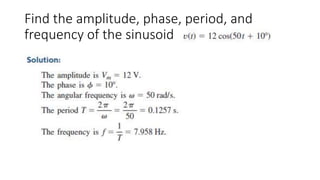
Find the amplitude, phase, period, and
frequency of the sinusoid
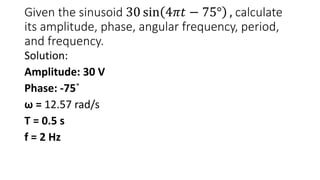
Given the sinusoid 30 sin 4𝜋𝑡 − 75° , calculate
its amplitude, phase, angular frequency, period,
and frequency.
Solution:
Amplitude: 30 V
Phase: -75˚
ω = 12.57 rad/s
T = 0.5 s
f = 2 Hz
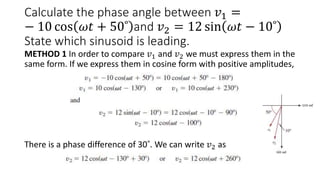
Calculate the phase angle between 𝑣1 =
− 10 cos 𝜔𝑡 + 50˚ and 𝑣2 = 12 sin 𝜔𝑡 − 10˚
State which sinusoid is leading.
METHOD 1 In order to compare 𝑣1 and 𝑣2 we must express them in the
same form. If we express them in cosine form with positive amplitudes,
There is a phase difference of 30˚. We can write 𝑣2 as
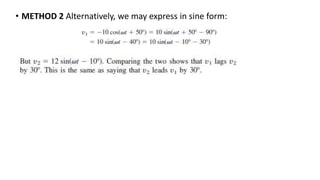
• METHOD 2 Alternatively, we may express in sine form:
Phasors
• Sinusoids are easily expressed in terms of phasors, which are more
convenient to work with than sine and cosine functions.
• A phasor is a complex number that represents the amplitude and phase of
a sinusoid.
• Phasors provide a simple means of analyzing linear circuits excited by
sinusoidal sources; solutions of such circuits would be intractable
otherwise. The notion of solving ac circuits using phasors was first
introduced by Charles Steinmetz in 1893. Before we completely define
phasors and apply them to circuit analysis, we need to be thoroughly
familiar with complex numbers.
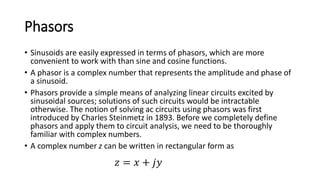
• A complex number z can be written in rectangular form as
𝑧 = 𝑥 + 𝑗𝑦
Complex Numbers
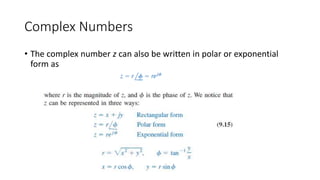
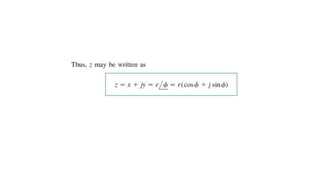
• The complex number z can also be written in polar or exponential
form as
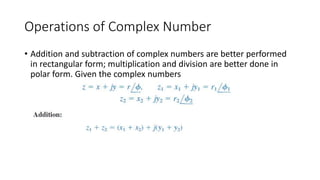
Operations of Complex Number
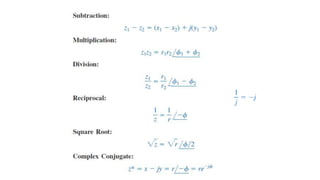
• Addition and subtraction of complex numbers are better performed
in rectangular form; multiplication and division are better done in
polar form. Given the complex numbers
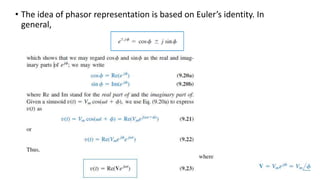
• The idea of phasor representation is based on Euler’s identity. In
general,
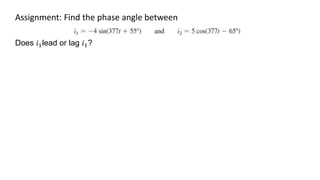
Assignment: Find the phase angle between
Does 𝑖1lead or lag 𝑖1?

sinusoids and phasors in AC circuits.pptx

  • 1.
    Sinusoids and Phasors ECECR2214 Engr. Christine T. Rasimo
  • 2.
    Why study AC? –Ac is more efficient and economical for long distance transmission – Many real applications use ac, e.g. electrical home appliances, factories, labs, etc. – AC can be transmitted across long distances without much energy loss, unlike DC. – The power loss during transmission in AC is less when compared to DC.
  • 3.
    Introduction • To dealwith ac, we will only consider sinusoidally time-varying excitation → sinusoid – Sinusoid definition • A sinusoid is a signal that has the form of the sine and cosine function • A sinusoidal current is usually referred to as alternating current (ac). Such a current reverses at regular time intervals and has alternately positive and negative values. • Circuits driven by sinusoidal current or voltage sources are called AC circuits
  • 4.
    Why sinusoids areof our interest? 1. By nature, it is characteristically sinusoidal - anything that repeats its motions periodically, e.g., pendulum, ripples on the ocean surface, etc. 2. Easy to generate and transmit - they are used in our homes, factories, etc. 3. Can be analyzed using Fourier analysis - easy to manipulate signals any practical periodic signal can be represented by a sum of sinusoids. 4. Easy to be handled mathematically - the derivative and integral of a sinusoid are themselves sinusoids.
  • 5.
    Sinusoid • Sinusoid voltageis given as follows: 𝑣 𝑡 = 𝑉𝑚 sin 𝜔𝑡 where, Vm = the amplitude of the sinusoid ω= the angular frequency in radian/s ωt = the argument of the sinusoid (a) shows a function of its argument. (b) shows a function of time.
  • 6.
    Sinusoid • Sinusoid repeatsitself every T seconds period of the sinusoid, where T is 𝑇 = 2π ω ; 𝑇 = 1 𝑓 𝑖𝑛 𝑠𝑒𝑐𝑜𝑛𝑑𝑠 • The fact that v(t) repeats itself every T seconds is shown by replacing t by t + T in the first equation. We get which means A periodic function is one that satisfies f(t) = f(t + nT), for all t and for all integers n.
  • 7.
    • Let usnow consider a more general expression for the sinusoid, Where (ωt + φ) is the argument and is the phase. Both argument and phase can be in radians or degrees. Let us examine the two sinusoids
  • 8.
    • The startingpoint of 𝑣2 occurs first in time. Therefore, we say that 𝑣2 leads 𝑣1 by φ or that 𝑣1 lags 𝑣2by φ. If φ ≠ 0, we also say that 𝑣1 and 𝑣2 are out of phase. If φ = 0 then 𝑣1 and 𝑣2are said to be in phase; they reach their minima and maxima at exactly the same time. We can compare 𝑣1 and 𝑣2 in this manner because they operate at the same frequency; they do not need to have the same amplitude.
  • 9.
    • A sinusoidcan be expressed in either sine or cosine form. When comparing two sinusoids, it is expedient to express both as either sine or cosine with positive amplitudes. This is achieved by using the following trigonometric identities: Using these relationships, we can transform a sinusoid from sine form to cosine form or vice versa.
  • 10.
    Remember: cos 𝜔𝑡 =sin 𝜔𝑡 − 90 −𝑠𝑖𝑛𝜔𝑡 = cos(𝜔𝑡 + 90) − sin 𝜔𝑡 = sin 𝜔𝑡 + 180 −𝑐𝑜𝑠𝜔𝑡 = cos(𝜔𝑡 − 180) Let A and B be magnitudes, Example:
  • 11.
    Find the amplitude,phase, period, and frequency of the sinusoid
  • 12.
    Given the sinusoid30 sin 4𝜋𝑡 − 75° , calculate its amplitude, phase, angular frequency, period, and frequency. Solution: Amplitude: 30 V Phase: -75˚ ω = 12.57 rad/s T = 0.5 s f = 2 Hz
  • 13.
    Calculate the phaseangle between 𝑣1 = − 10 cos 𝜔𝑡 + 50˚ and 𝑣2 = 12 sin 𝜔𝑡 − 10˚ State which sinusoid is leading. METHOD 1 In order to compare 𝑣1 and 𝑣2 we must express them in the same form. If we express them in cosine form with positive amplitudes, There is a phase difference of 30˚. We can write 𝑣2 as
  • 14.
    • METHOD 2Alternatively, we may express in sine form:
  • 15.
    Phasors • Sinusoids areeasily expressed in terms of phasors, which are more convenient to work with than sine and cosine functions. • A phasor is a complex number that represents the amplitude and phase of a sinusoid. • Phasors provide a simple means of analyzing linear circuits excited by sinusoidal sources; solutions of such circuits would be intractable otherwise. The notion of solving ac circuits using phasors was first introduced by Charles Steinmetz in 1893. Before we completely define phasors and apply them to circuit analysis, we need to be thoroughly familiar with complex numbers. • A complex number z can be written in rectangular form as 𝑧 = 𝑥 + 𝑗𝑦
  • 16.
    Complex Numbers • Thecomplex number z can also be written in polar or exponential form as
  • 18.
    Operations of ComplexNumber • Addition and subtraction of complex numbers are better performed in rectangular form; multiplication and division are better done in polar form. Given the complex numbers
  • 20.
    • The ideaof phasor representation is based on Euler’s identity. In general,
  • 23.
    Assignment: Find thephase angle between Does 𝑖1lead or lag 𝑖1?