Section 2.2
Section Summary
 Set Operations
 Union
 Intersection
 Complementation
 Difference
 More on Set Cardinality
 Set Identities
 Proving Identities
 Membership Tables
Union
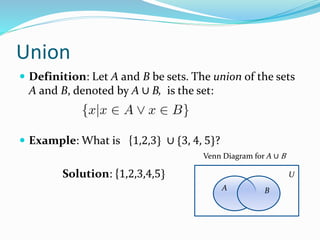
 Definition: Let A and B be sets. The union of the sets
A and B, denoted by A ∪ B, is the set:
 Example: What is {1,2,3} ∪ {3, 4, 5}?
Solution: {1,2,3,4,5} U
A B
Venn Diagram for A ∪ B
Intersection
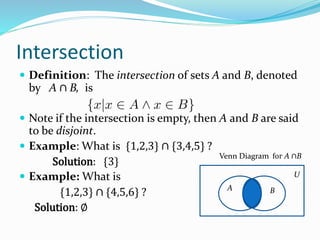
 Definition: The intersection of sets A and B, denoted
by A ∩ B, is
 Note if the intersection is empty, then A and B are said
to be disjoint.
 Example: What is {1,2,3} ∩ {3,4,5} ?
Solution: {3}
 Example: What is
{1,2,3} ∩ {4,5,6} ?
Solution: ∅
U
A B
Venn Diagram for A ∩B
Complement
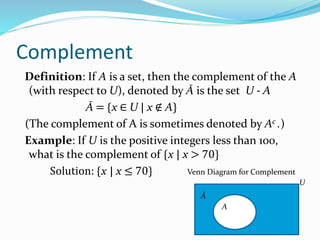
Definition: If A is a set, then the complement of the A
(with respect to U), denoted by Ā is the set U - A
Ā = {x ∈ U | x ∉ A}
(The complement of A is sometimes denoted by Ac .)
Example: If U is the positive integers less than 100,
what is the complement of {x | x > 70}
Solution: {x | x ≤ 70}
A
U
Venn Diagram for Complement
Ā
Difference
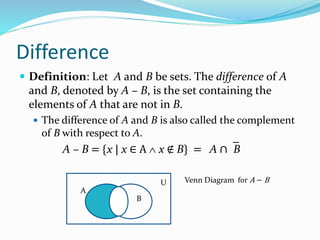
 Definition: Let A and B be sets. The difference of A
and B, denoted by A – B, is the set containing the
elements of A that are not in B.
 The difference of A and B is also called the complement
of B with respect to A.
A – B = {x | x ∈ A  x ∉ B} = A ∩B
U
A
B
Venn Diagram for A − B
The Cardinality of the Union of Two
Sets
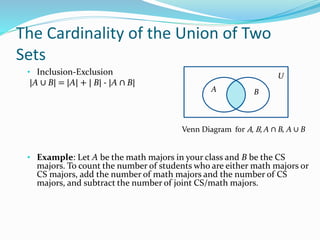
• Inclusion-Exclusion
|A ∪ B| = |A| + | B| - |A ∩ B|
• Example: Let A be the math majors in your class and B be the CS
majors. To count the number of students who are either math majors or
CS majors, add the number of math majors and the number of CS
majors, and subtract the number of joint CS/math majors.
U
A B
Venn Diagram for A, B, A ∩ B, A ∪ B
Review Questions
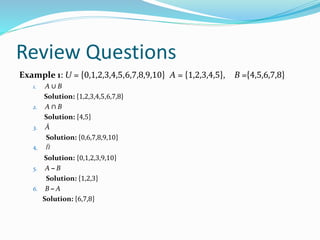
Example 1: U = {0,1,2,3,4,5,6,7,8,9,10} A = {1,2,3,4,5}, B ={4,5,6,7,8}
1. A ∪ B
Solution: {1,2,3,4,5,6,7,8}
2. A ∩ B
Solution: {4,5}
3. Ā
Solution: {0,6,7,8,9,10}
4.
Solution: {0,1,2,3,9,10}
5. A – B
Solution: {1,2,3}
6. B – A
Solution: {6,7,8}
Review Questions
Example 2: U = {0,1,2,3,4,5,6,7,8,9,10} A = {1,2,3,4,5}, B ={4,5,6,7,8},
C = {2, 5, 8, 9}
1. A ∪ (B ∩ C)
Solution:
A ∪ ({5, 8}) = {1, 2, 3, 4, 5, 8}
2. (A ∪ B) ∩ (A ∪ C)
Solution:
A ∪ B = {1, 2, 3, 4, 5, 6, 7, 8}
A ∪ C = {1, 2, 3, 4, 5, 8, 9}
{1, 2, 3, 4, 5, 6, 7, 8} ∩ {1, 2, 3, 4, 5, 8, 9}
= {1, 2, 3, 4, 5, 8}
Review Questions
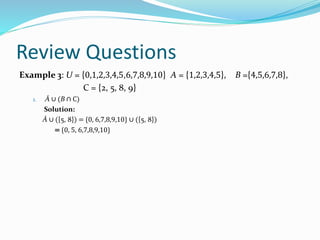
Example 3: U = {0,1,2,3,4,5,6,7,8,9,10} A = {1,2,3,4,5}, B ={4,5,6,7,8},
C = {2, 5, 8, 9}
1. Ā ∪ (B ∩ C)
Solution:
Ā ∪ ({5, 8}) = {0, 6,7,8,9,10} ∪ ({5, 8})
= {0, 5, 6,7,8,9,10}
Symmetric Difference
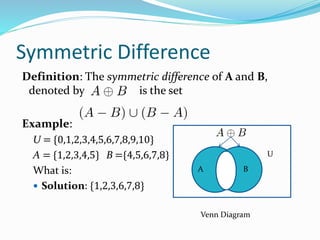
Definition: The symmetric difference of A and B,
denoted by is the set
Example:
U = {0,1,2,3,4,5,6,7,8,9,10}
A = {1,2,3,4,5} B ={4,5,6,7,8}
What is:
 Solution: {1,2,3,6,7,8}
U
A B
Venn Diagram
Venn Diagram with 3 sets
1. A
2. A ∪ B
3. B ∩ C
4. C’
5. A ∩ B ∩ C
U
A B
C
10
1
2 3
4
5
67
8
9
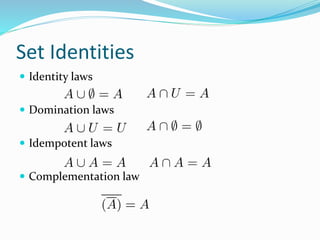
Set Identities
 Identity laws
 Domination laws
 Idempotent laws
 Complementation law
Set Identities
 Commutative laws
 Associative laws
 Distributive laws
Continued on next slide 
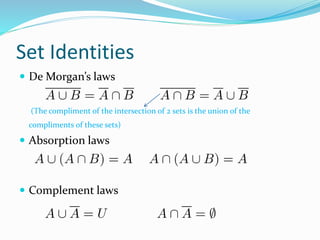
Set Identities
 De Morgan’s laws
(The compliment of the intersection of 2 sets is the union of the
compliments of these sets)
 Absorption laws
 Complement laws
Proving Set Identities
 Different ways to prove set identities:
1. Prove that each set (side of the identity) is a subset of
the other.
2. Use set builder notation and propositional logic.
3. Membership Tables: Verify that elements in the same
combination of sets always either belong or do not
belong to the same side of the identity. Use 1 to
indicate it is in the set and a 0 to indicate that it is not.
Proof of Second De Morgan Law
Example: Prove that
Solution: We prove this identity by showing that:
1) and
2)
Proof of Second De Morgan Law
These steps show that:
Proof of Second De Morgan Law
These steps show that:
Set-Builder Notation: Second De
Morgan Law

2.2 Set Operations

  • 1.
  • 2.
    Section Summary  SetOperations  Union  Intersection  Complementation  Difference  More on Set Cardinality  Set Identities  Proving Identities  Membership Tables
  • 3.
    Union  Definition: LetA and B be sets. The union of the sets A and B, denoted by A ∪ B, is the set:  Example: What is {1,2,3} ∪ {3, 4, 5}? Solution: {1,2,3,4,5} U A B Venn Diagram for A ∪ B
  • 4.
    Intersection  Definition: Theintersection of sets A and B, denoted by A ∩ B, is  Note if the intersection is empty, then A and B are said to be disjoint.  Example: What is {1,2,3} ∩ {3,4,5} ? Solution: {3}  Example: What is {1,2,3} ∩ {4,5,6} ? Solution: ∅ U A B Venn Diagram for A ∩B
  • 5.
    Complement Definition: If Ais a set, then the complement of the A (with respect to U), denoted by Ā is the set U - A Ā = {x ∈ U | x ∉ A} (The complement of A is sometimes denoted by Ac .) Example: If U is the positive integers less than 100, what is the complement of {x | x > 70} Solution: {x | x ≤ 70} A U Venn Diagram for Complement Ā
  • 6.
    Difference  Definition: LetA and B be sets. The difference of A and B, denoted by A – B, is the set containing the elements of A that are not in B.  The difference of A and B is also called the complement of B with respect to A. A – B = {x | x ∈ A  x ∉ B} = A ∩B U A B Venn Diagram for A − B
  • 7.
    The Cardinality ofthe Union of Two Sets • Inclusion-Exclusion |A ∪ B| = |A| + | B| - |A ∩ B| • Example: Let A be the math majors in your class and B be the CS majors. To count the number of students who are either math majors or CS majors, add the number of math majors and the number of CS majors, and subtract the number of joint CS/math majors. U A B Venn Diagram for A, B, A ∩ B, A ∪ B
  • 8.
    Review Questions Example 1:U = {0,1,2,3,4,5,6,7,8,9,10} A = {1,2,3,4,5}, B ={4,5,6,7,8} 1. A ∪ B Solution: {1,2,3,4,5,6,7,8} 2. A ∩ B Solution: {4,5} 3. Ā Solution: {0,6,7,8,9,10} 4. Solution: {0,1,2,3,9,10} 5. A – B Solution: {1,2,3} 6. B – A Solution: {6,7,8}
  • 9.
    Review Questions Example 2:U = {0,1,2,3,4,5,6,7,8,9,10} A = {1,2,3,4,5}, B ={4,5,6,7,8}, C = {2, 5, 8, 9} 1. A ∪ (B ∩ C) Solution: A ∪ ({5, 8}) = {1, 2, 3, 4, 5, 8} 2. (A ∪ B) ∩ (A ∪ C) Solution: A ∪ B = {1, 2, 3, 4, 5, 6, 7, 8} A ∪ C = {1, 2, 3, 4, 5, 8, 9} {1, 2, 3, 4, 5, 6, 7, 8} ∩ {1, 2, 3, 4, 5, 8, 9} = {1, 2, 3, 4, 5, 8}
  • 10.
    Review Questions Example 3:U = {0,1,2,3,4,5,6,7,8,9,10} A = {1,2,3,4,5}, B ={4,5,6,7,8}, C = {2, 5, 8, 9} 1. Ā ∪ (B ∩ C) Solution: Ā ∪ ({5, 8}) = {0, 6,7,8,9,10} ∪ ({5, 8}) = {0, 5, 6,7,8,9,10}
  • 11.
    Symmetric Difference Definition: Thesymmetric difference of A and B, denoted by is the set Example: U = {0,1,2,3,4,5,6,7,8,9,10} A = {1,2,3,4,5} B ={4,5,6,7,8} What is:  Solution: {1,2,3,6,7,8} U A B Venn Diagram
  • 12.
    Venn Diagram with3 sets 1. A 2. A ∪ B 3. B ∩ C 4. C’ 5. A ∩ B ∩ C U A B C 10 1 2 3 4 5 67 8 9
  • 13.
    Set Identities  Identitylaws  Domination laws  Idempotent laws  Complementation law
  • 14.
    Set Identities  Commutativelaws  Associative laws  Distributive laws Continued on next slide 
  • 15.
    Set Identities  DeMorgan’s laws (The compliment of the intersection of 2 sets is the union of the compliments of these sets)  Absorption laws  Complement laws
  • 16.
    Proving Set Identities Different ways to prove set identities: 1. Prove that each set (side of the identity) is a subset of the other. 2. Use set builder notation and propositional logic. 3. Membership Tables: Verify that elements in the same combination of sets always either belong or do not belong to the same side of the identity. Use 1 to indicate it is in the set and a 0 to indicate that it is not.
  • 17.
    Proof of SecondDe Morgan Law Example: Prove that Solution: We prove this identity by showing that: 1) and 2)
  • 18.
    Proof of SecondDe Morgan Law These steps show that:
  • 19.
    Proof of SecondDe Morgan Law These steps show that:
  • 20.