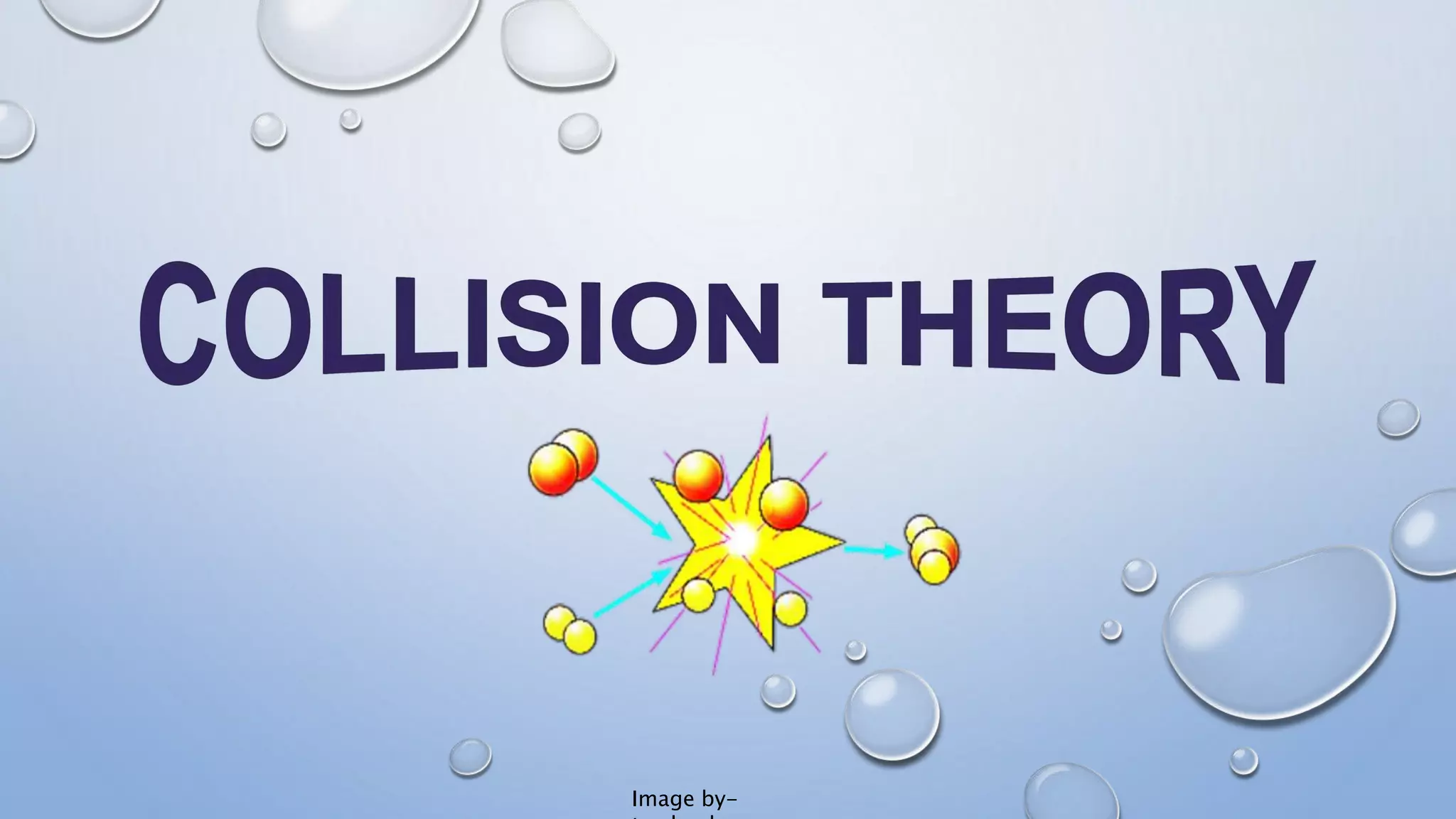
Image by-
CONTENTS
Introduction
Main postulates of collision theory
Mathematical treatment of collision theory
Test of simple collision theory
Failure of simple collision theory
Modification of collision theory
General weakness of collision theory
Points to remember
INTRODUCTION
• Proposed by Max Trautz & William Lewis.
• Based on the kinetic theory of gases.
• According to this theory, the reactant molecules have to collide in a
certain way with a certain amount of energy in order to form a new
product.
• Since, for the collision at least two molecule are must involve, therefore
this reaction is known as Bimolecular reaction.
MAIN POSTULATES OF COLLISION THEORY
• Collision is required between the reactant molecules to convert them
into product.
• Reactant molecules are assumed to be a solid sphere.
• Due to collision, kinetic energy of the reactant molecules increases, & the
molecules which acquire the energy either equal to or more than
activation energy, converts into the product.
• The number of collision between the reactant molecule can be increased
by increasing the temperature of the reactant.
• Thus, Rate of reaction ∝ Temperature.
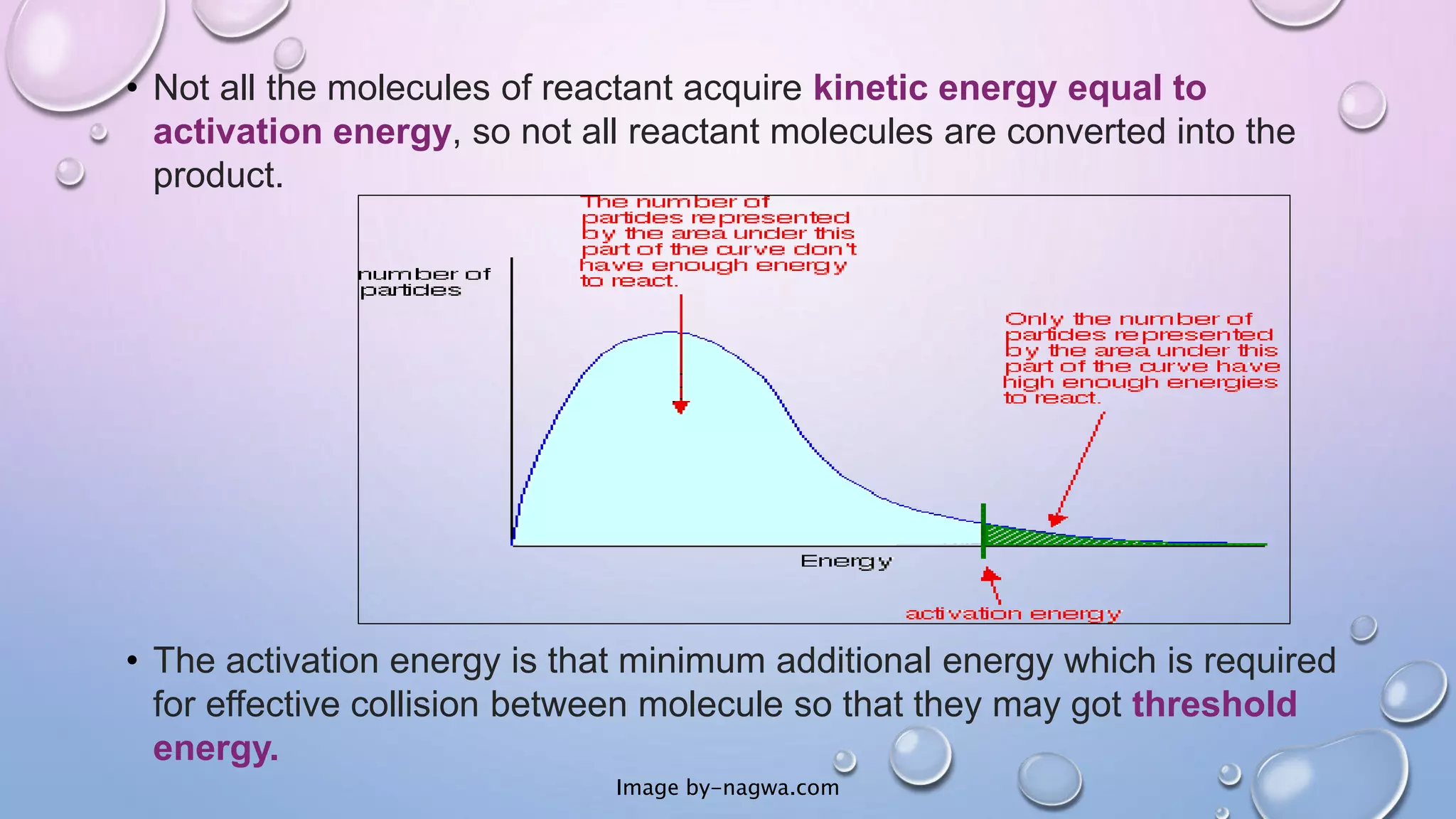
• Not all the molecules of reactant acquire kinetic energy equal to
activation energy, so not all reactant molecules are converted into the
product.
• The activation energy is that minimum additional energy which is required
for effective collision between molecule so that they may got threshold
energy.
Image by-nagwa.com
MATHEMATICAL TREATMENT OF COLLISION THEORY
A+B Product
According to collision theory,
Rate of reaction ∝ Number of collision between A&B
According to Rate law, Rate of reaction ∝ 𝑨 [𝑩]
So, Number of collision ∝ concentration of reactants
According to Arrhenius law, Rate of reaction= Z𝑒−𝐸𝑎/𝑅𝑇 …(1)
Where, Z= no. of binary collision per unit time, 𝐸𝑎= activation energy
According to kinetic theory, the rate of reaction is related with the no. of
molecule per unit volume i.e. rate ∝ nxn
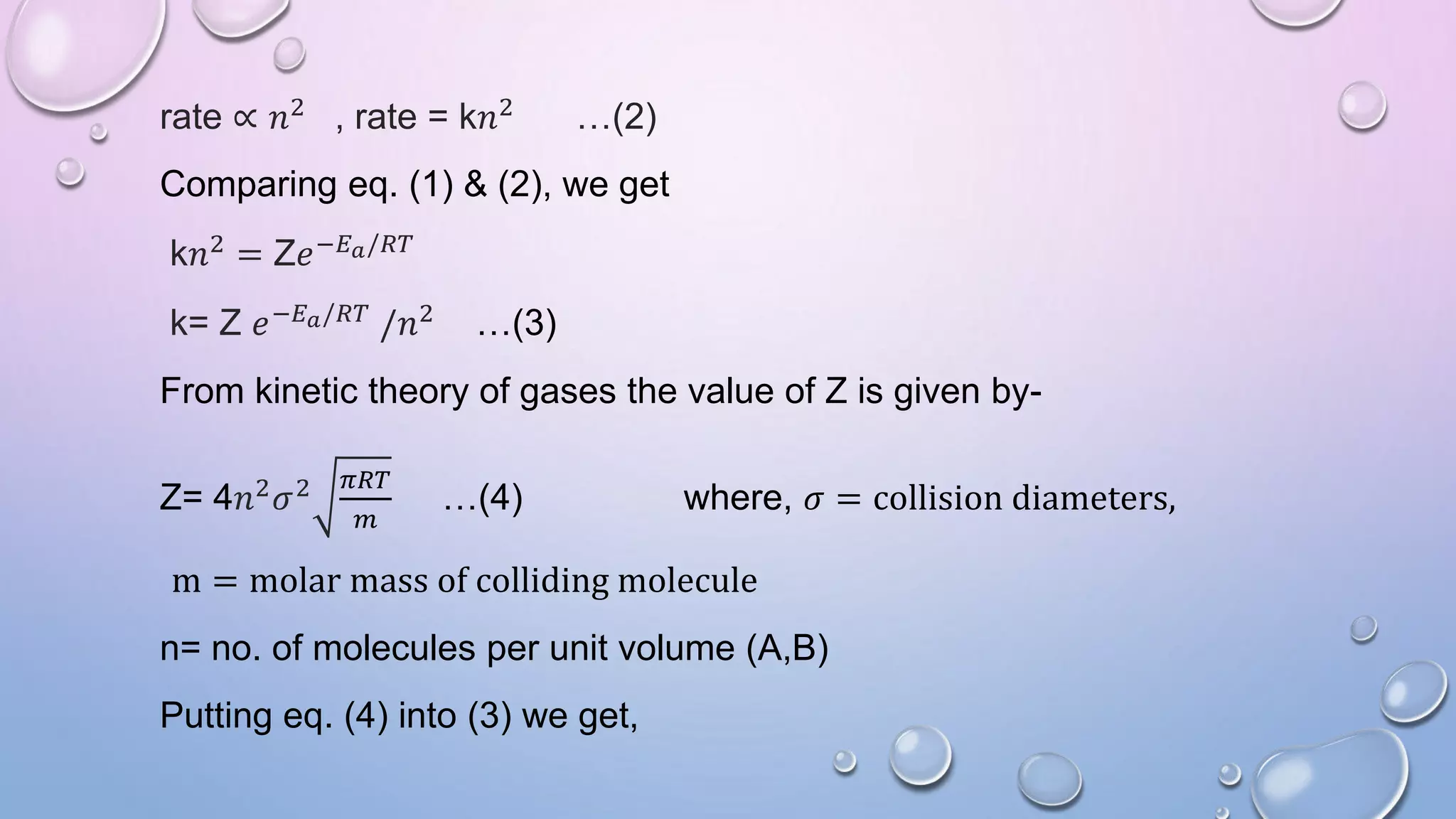
rate ∝ 𝑛2 , rate = k𝑛2 …(2)
Comparing eq. (1) & (2), we get
k𝑛2 = Z𝑒−𝐸𝑎/𝑅𝑇
k= Z 𝑒−𝐸𝑎/𝑅𝑇 /𝑛2 …(3)
From kinetic theory of gases the value of Z is given by-
Z= 4𝑛2
𝜎2 𝜋𝑅𝑇
𝑚
…(4) where, 𝜎 = collision diameters,
m = molar mass of colliding molecule
n= no. of molecules per unit volume (A,B)
Putting eq. (4) into (3) we get,
k= 4𝑛2𝜎2 𝜋𝑅𝑇
𝑚
x 𝑒−𝐸𝑎/𝑅𝑇 /𝑛2
After simplifying we’ll get,
k= 4𝜎2 𝜋𝑅𝑇
𝑚
x 𝑒−𝐸𝑎/𝑅𝑇
…(5)
k= z𝑒−𝐸𝑎/𝑅𝑇 , where z= 4𝜎2 𝜋𝑅𝑇
𝑚
is the collision number.
Collision number / collision frequency is the number of collisions per unit
time in per unit volume.
When two molecules of different types are involved in collision, z becomes-
z= 𝜎2[8𝜋𝑅𝑇 (
𝑚1+𝑚2
𝑚1𝑚2
] where, (
𝑚1+𝑚2
𝑚1𝑚2
)= reduced mass
TEST OF SIMPLE COLLISION THEORY
• Theory can be tested by comparing values of “z” calculated from the
mathematical eq. derived above & the experimental value of “z”.
• Alternatively theory can be tested by comparing the values of rate
constant (K) obtained from theory & from observed value.
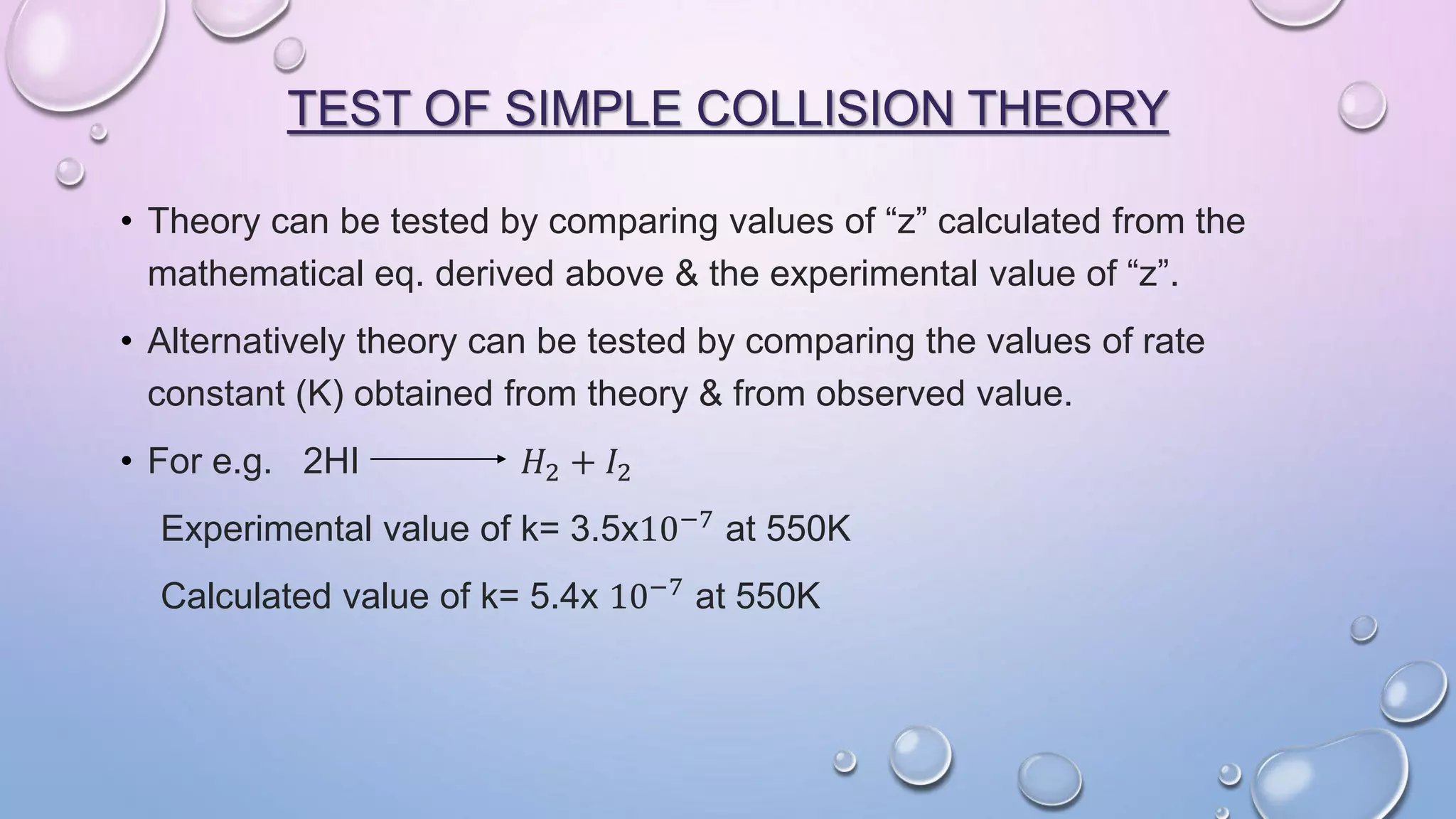
• For e.g. 2HI 𝐻2 + 𝐼2
Experimental value of k= 3.5x10⁻⁷ at 550K
Calculated value of k= 5.4x 10⁻⁷ at 550K
FAILURE OF SIMPLE COLLISION THEORY
1. In polymerization of ethene:- there is vast difference between the
observed & theoretical value of K.
2. Polymerization of 1,3-butadiene :- it occurs at rate which is slower
of 10−4 times than theoretical value.
3. Many chain reactions proceed with much higher rate than theoretical
value.
For e.g. specifically reaction between hydrogen and bromine occurs at a
very high speed than the calculated value.
MODIFICATION OF COLLISION THEORY
Collision is the only factor for a chemical reaction in gaseous state then all
reactions must have same rate, which is not same for all reactions.
Thus, some modifications have been suggested in simple theory-
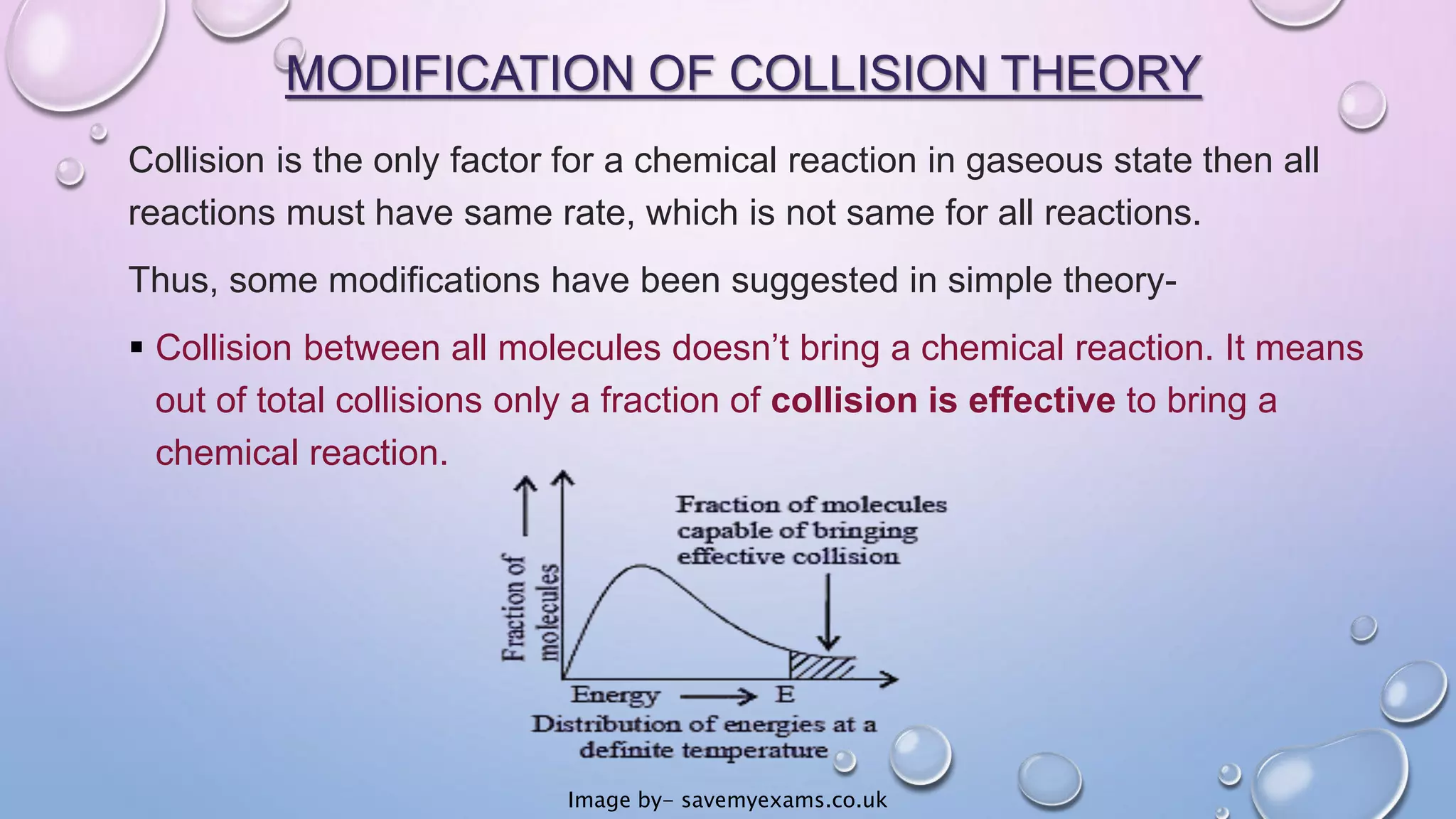
 Collision between all molecules doesn’t bring a chemical reaction. It means
out of total collisions only a fraction of collision is effective to bring a
chemical reaction.
Image by- savemyexams.co.uk
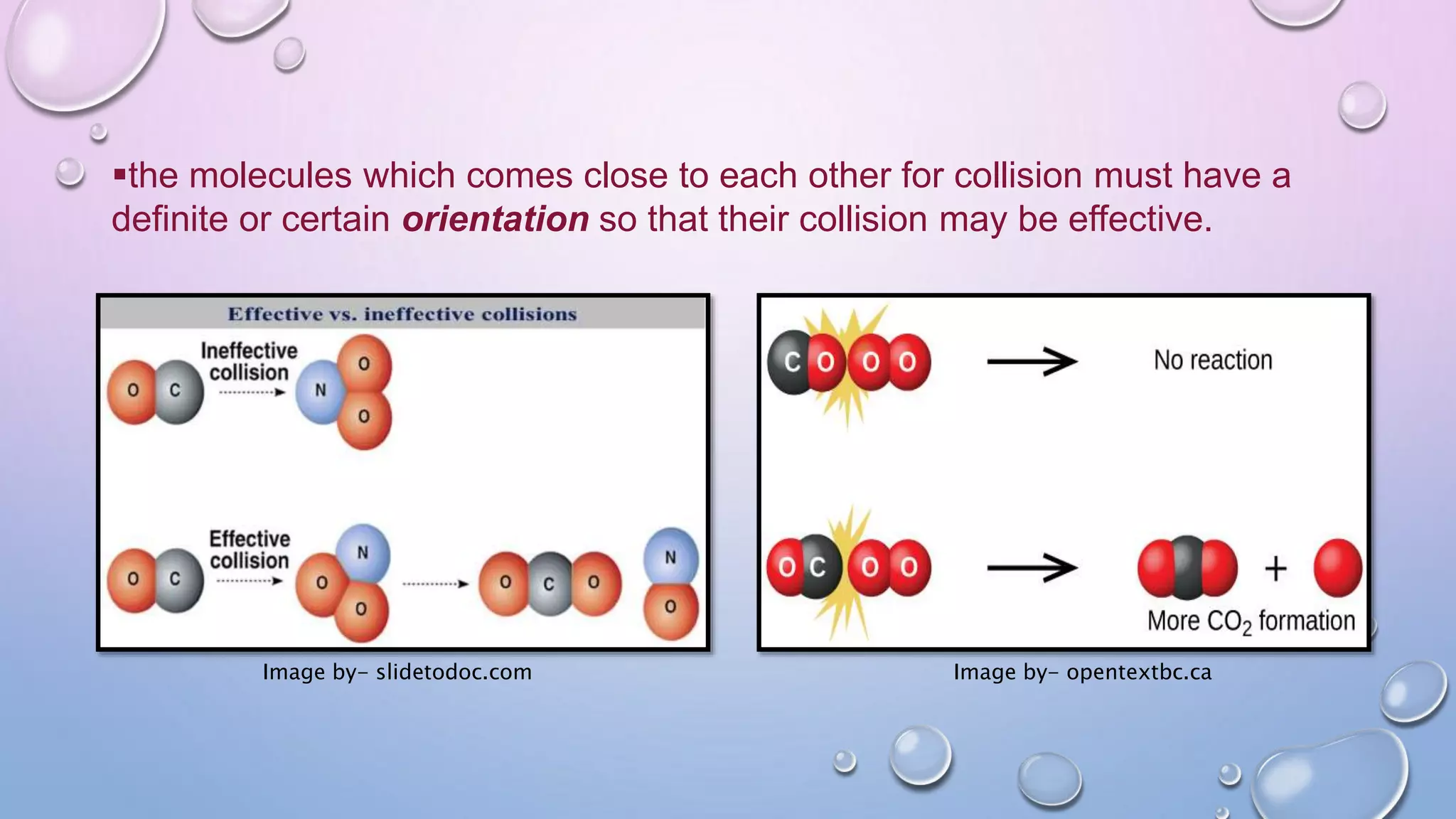
the molecules which comes close to each other for collision must have a
definite or certain orientation so that their collision may be effective.
Image by- opentextbc.ca
Image by- slidetodoc.com
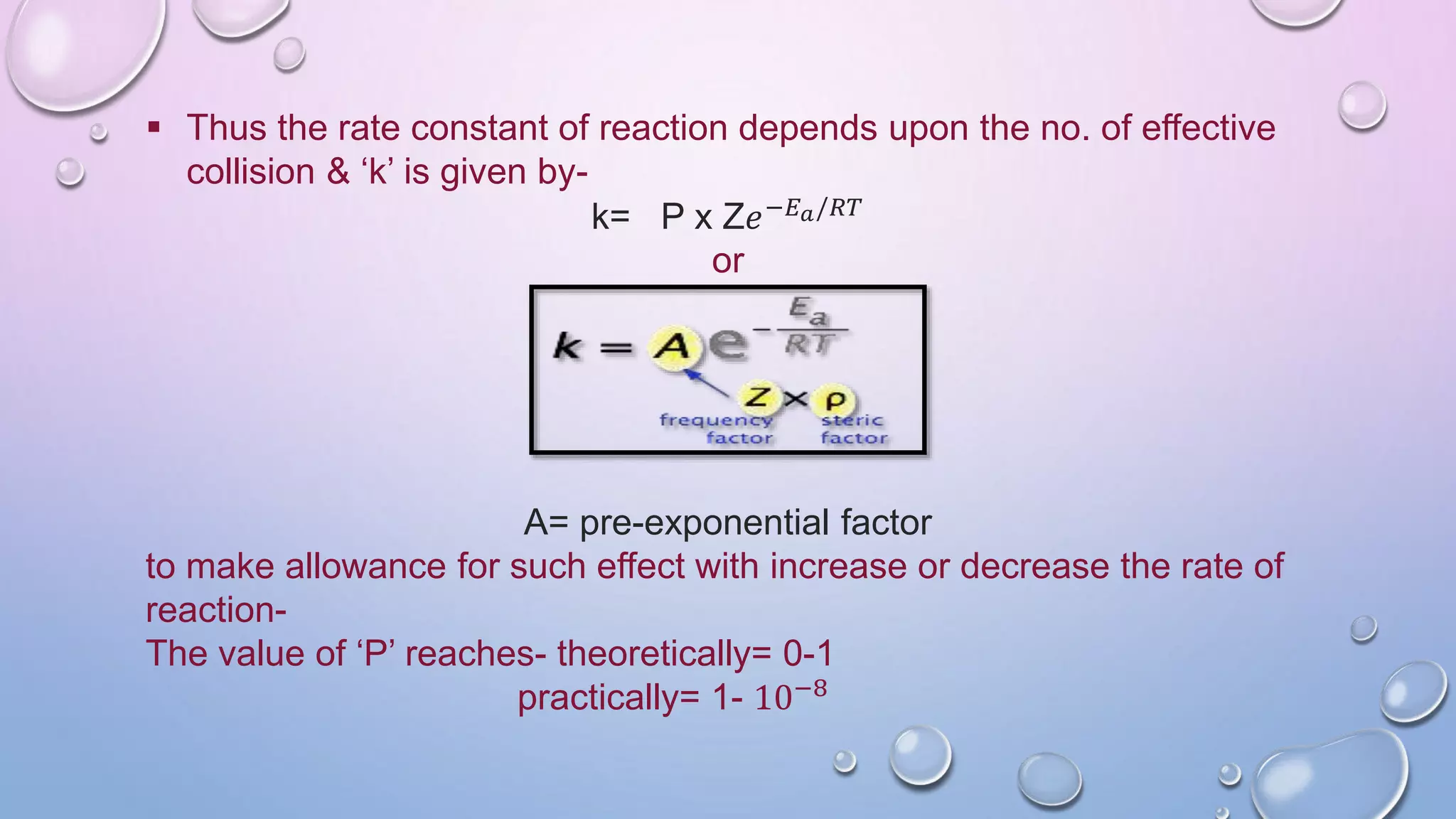
 Thus the rate constant of reaction depends upon the no. of effective
collision & ‘k’ is given by-
k= P x Z𝑒−𝐸𝑎/𝑅𝑇
or
A= pre-exponential factor
to make allowance for such effect with increase or decrease the rate of
reaction-
The value of ‘P’ reaches- theoretically= 0-1
practically= 1- 10−8
GENERAL WEAKNESS OF COLLISION THEORY
Co-relation between ‘P’ & characteristic of reaction molecules have not
been very successful.
Theory doesn’t give any explanation for abnormally high rate of some
reactions for e.g. Chain reactions
Simple collision theory doesn’t give any physical explanation of
relationship between the “P” & “ΔS” (change in entropy)
The theory is unsuccessful for unimolecular reaction until Lindmann’s
theory is considered.
Theory is based upon classical mechanics, which needs a lot of
modifications.
There is no consideration have been taken for the internal motion
(rotational motion) of the reactants.
Theory considers molecule as a hard sphere which is not true for the
gaseous molecules specifically.
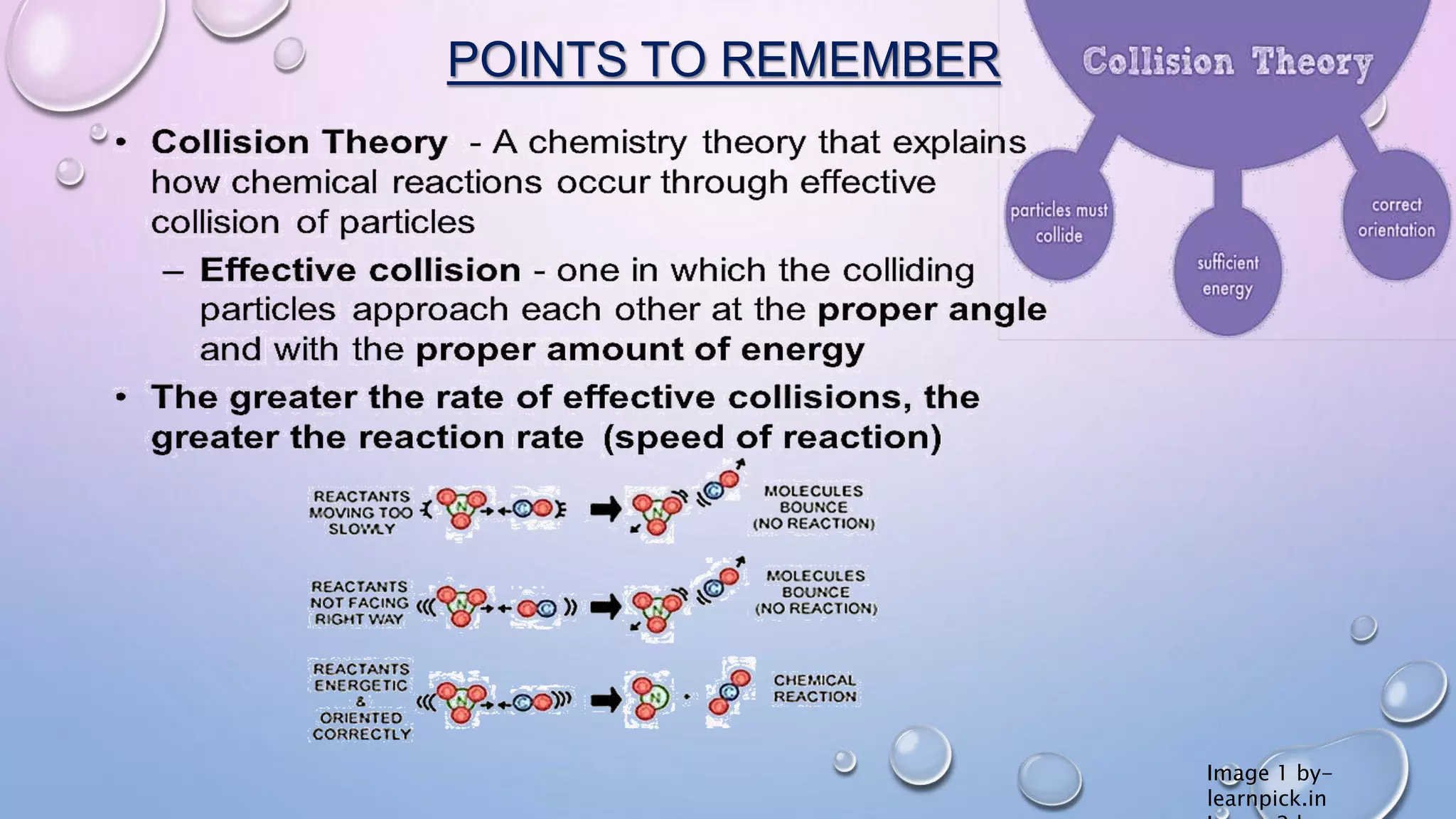
POINTS TO REMEMBER
Image 1 by-
learnpick.in
REFERENCES
• Dalal, Mandeep (2018). A textbook of physical chemistry-Volume-1.
Dalal Institute, Main market, Sector 14, Rohtak, Haryana 124001, India.
• Denise granger (2017). What is collision theory of chemical reactions?
Socratic Q & A, Google search.
Image by- memesgenerator.net

Collision Theory

  • 2.
  • 3.
    CONTENTS Introduction Main postulates ofcollision theory Mathematical treatment of collision theory Test of simple collision theory Failure of simple collision theory Modification of collision theory General weakness of collision theory Points to remember
  • 4.
    INTRODUCTION • Proposed byMax Trautz & William Lewis. • Based on the kinetic theory of gases. • According to this theory, the reactant molecules have to collide in a certain way with a certain amount of energy in order to form a new product. • Since, for the collision at least two molecule are must involve, therefore this reaction is known as Bimolecular reaction.
  • 5.
    MAIN POSTULATES OFCOLLISION THEORY • Collision is required between the reactant molecules to convert them into product. • Reactant molecules are assumed to be a solid sphere. • Due to collision, kinetic energy of the reactant molecules increases, & the molecules which acquire the energy either equal to or more than activation energy, converts into the product. • The number of collision between the reactant molecule can be increased by increasing the temperature of the reactant. • Thus, Rate of reaction ∝ Temperature.
  • 6.
    • Not allthe molecules of reactant acquire kinetic energy equal to activation energy, so not all reactant molecules are converted into the product. • The activation energy is that minimum additional energy which is required for effective collision between molecule so that they may got threshold energy. Image by-nagwa.com
  • 7.
    MATHEMATICAL TREATMENT OFCOLLISION THEORY A+B Product According to collision theory, Rate of reaction ∝ Number of collision between A&B According to Rate law, Rate of reaction ∝ 𝑨 [𝑩] So, Number of collision ∝ concentration of reactants According to Arrhenius law, Rate of reaction= Z𝑒−𝐸𝑎/𝑅𝑇 …(1) Where, Z= no. of binary collision per unit time, 𝐸𝑎= activation energy According to kinetic theory, the rate of reaction is related with the no. of molecule per unit volume i.e. rate ∝ nxn
  • 8.
    rate ∝ 𝑛2, rate = k𝑛2 …(2) Comparing eq. (1) & (2), we get k𝑛2 = Z𝑒−𝐸𝑎/𝑅𝑇 k= Z 𝑒−𝐸𝑎/𝑅𝑇 /𝑛2 …(3) From kinetic theory of gases the value of Z is given by- Z= 4𝑛2 𝜎2 𝜋𝑅𝑇 𝑚 …(4) where, 𝜎 = collision diameters, m = molar mass of colliding molecule n= no. of molecules per unit volume (A,B) Putting eq. (4) into (3) we get,
  • 9.
    k= 4𝑛2𝜎2 𝜋𝑅𝑇 𝑚 x𝑒−𝐸𝑎/𝑅𝑇 /𝑛2 After simplifying we’ll get, k= 4𝜎2 𝜋𝑅𝑇 𝑚 x 𝑒−𝐸𝑎/𝑅𝑇 …(5) k= z𝑒−𝐸𝑎/𝑅𝑇 , where z= 4𝜎2 𝜋𝑅𝑇 𝑚 is the collision number. Collision number / collision frequency is the number of collisions per unit time in per unit volume. When two molecules of different types are involved in collision, z becomes- z= 𝜎2[8𝜋𝑅𝑇 ( 𝑚1+𝑚2 𝑚1𝑚2 ] where, ( 𝑚1+𝑚2 𝑚1𝑚2 )= reduced mass
  • 10.
    TEST OF SIMPLECOLLISION THEORY • Theory can be tested by comparing values of “z” calculated from the mathematical eq. derived above & the experimental value of “z”. • Alternatively theory can be tested by comparing the values of rate constant (K) obtained from theory & from observed value. • For e.g. 2HI 𝐻2 + 𝐼2 Experimental value of k= 3.5x10⁻⁷ at 550K Calculated value of k= 5.4x 10⁻⁷ at 550K
  • 11.
    FAILURE OF SIMPLECOLLISION THEORY 1. In polymerization of ethene:- there is vast difference between the observed & theoretical value of K. 2. Polymerization of 1,3-butadiene :- it occurs at rate which is slower of 10−4 times than theoretical value. 3. Many chain reactions proceed with much higher rate than theoretical value. For e.g. specifically reaction between hydrogen and bromine occurs at a very high speed than the calculated value.
  • 12.
    MODIFICATION OF COLLISIONTHEORY Collision is the only factor for a chemical reaction in gaseous state then all reactions must have same rate, which is not same for all reactions. Thus, some modifications have been suggested in simple theory-  Collision between all molecules doesn’t bring a chemical reaction. It means out of total collisions only a fraction of collision is effective to bring a chemical reaction. Image by- savemyexams.co.uk
  • 13.
    the molecules whichcomes close to each other for collision must have a definite or certain orientation so that their collision may be effective. Image by- opentextbc.ca Image by- slidetodoc.com
  • 14.
     Thus therate constant of reaction depends upon the no. of effective collision & ‘k’ is given by- k= P x Z𝑒−𝐸𝑎/𝑅𝑇 or A= pre-exponential factor to make allowance for such effect with increase or decrease the rate of reaction- The value of ‘P’ reaches- theoretically= 0-1 practically= 1- 10−8
  • 15.
    GENERAL WEAKNESS OFCOLLISION THEORY Co-relation between ‘P’ & characteristic of reaction molecules have not been very successful. Theory doesn’t give any explanation for abnormally high rate of some reactions for e.g. Chain reactions Simple collision theory doesn’t give any physical explanation of relationship between the “P” & “ΔS” (change in entropy) The theory is unsuccessful for unimolecular reaction until Lindmann’s theory is considered.
  • 16.
    Theory is basedupon classical mechanics, which needs a lot of modifications. There is no consideration have been taken for the internal motion (rotational motion) of the reactants. Theory considers molecule as a hard sphere which is not true for the gaseous molecules specifically.
  • 17.
    POINTS TO REMEMBER Image1 by- learnpick.in
  • 18.
    REFERENCES • Dalal, Mandeep(2018). A textbook of physical chemistry-Volume-1. Dalal Institute, Main market, Sector 14, Rohtak, Haryana 124001, India. • Denise granger (2017). What is collision theory of chemical reactions? Socratic Q & A, Google search.
  • 19.