The menstrual cycle
• Target
• To know the menstrual cycle and why it
takes place.
Hormone
release
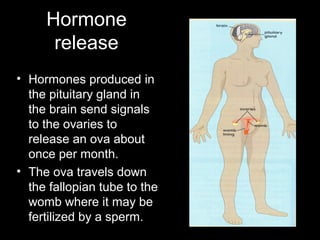
• Hormones produced in
the pituitary gland in
the brain send signals
to the ovaries to
release an ova about
once per month.
• The ova travels down
the fallopian tube to the
womb where it may be
fertilized by a sperm.
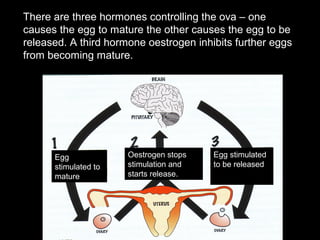
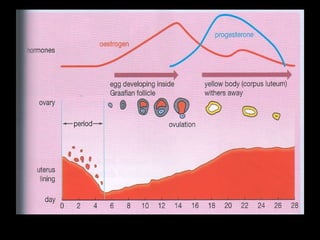
There are three hormones controlling the ova – one
causes the egg to mature the other causes the egg to be
released. A third hormone oestrogen inhibits further eggs
from becoming mature.
Egg
stimulated to
mature
Oestrogen stops
stimulation and
starts release.
Egg stimulated
to be released
The ova
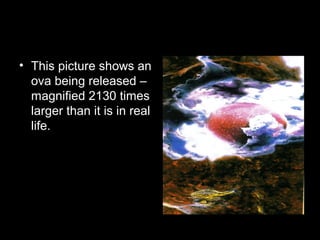
• This picture shows an
ova being released –
magnified 2130 times
larger than it is in real
life.
Menstruation
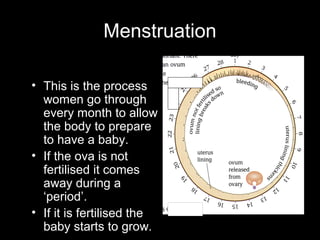
• This is the process
women go through
every month to allow
the body to prepare
to have a baby.
• If the ova is not
fertilised it comes
away during a
‘period’.
• If it is fertilised the
baby starts to grow.
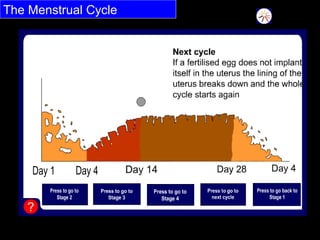
The Menstrual Cycle
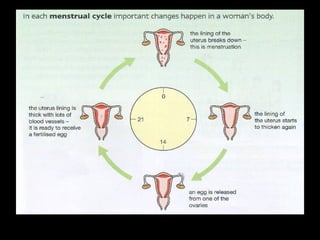
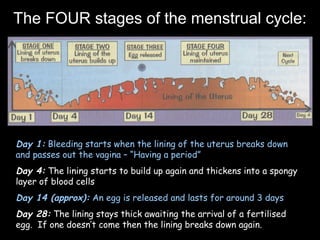
The FOUR stages of the menstrual cycle:
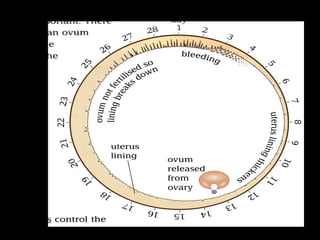
Day 1: Bleeding starts when the lining of the uterus breaks down
and passes out the vagina – “Having a period”
Day 4: The lining starts to build up again and thickens into a spongy
layer of blood cells
Day 14 (approx): An egg is released and lasts for around 3 days
Day 28: The lining stays thick awaiting the arrival of a fertilised
egg. If one doesn’t come then the lining breaks down again.
Questions
1. What do we call the monthly cycle?
2. When does this cycle start?
3. When does this cycle stop?
4. What does the uterus do in this cycle?
5. What do we call it when the uterus
lining breaks down?
6. What is another name for periods?
• Menstrual cycle
• Puberty
• Menopause
• Thickens
• Period
• menstruation

Human reproduction lesson 9

  • 1.
    The menstrual cycle •Target • To know the menstrual cycle and why it takes place.
  • 3.
    Hormone release • Hormones producedin the pituitary gland in the brain send signals to the ovaries to release an ova about once per month. • The ova travels down the fallopian tube to the womb where it may be fertilized by a sperm.
  • 4.
    There are threehormones controlling the ova – one causes the egg to mature the other causes the egg to be released. A third hormone oestrogen inhibits further eggs from becoming mature. Egg stimulated to mature Oestrogen stops stimulation and starts release. Egg stimulated to be released
  • 5.
    The ova • Thispicture shows an ova being released – magnified 2130 times larger than it is in real life.
  • 6.
    Menstruation • This isthe process women go through every month to allow the body to prepare to have a baby. • If the ova is not fertilised it comes away during a ‘period’. • If it is fertilised the baby starts to grow.
  • 9.
  • 10.
    The FOUR stagesof the menstrual cycle: Day 1: Bleeding starts when the lining of the uterus breaks down and passes out the vagina – “Having a period” Day 4: The lining starts to build up again and thickens into a spongy layer of blood cells Day 14 (approx): An egg is released and lasts for around 3 days Day 28: The lining stays thick awaiting the arrival of a fertilised egg. If one doesn’t come then the lining breaks down again.
  • 11.
    Questions 1. What dowe call the monthly cycle? 2. When does this cycle start? 3. When does this cycle stop? 4. What does the uterus do in this cycle? 5. What do we call it when the uterus lining breaks down? 6. What is another name for periods?
  • 12.
    • Menstrual cycle •Puberty • Menopause • Thickens • Period • menstruation