Copyright Sautter 2015
REACTION RATES
• What does “rate” mean ?
• Can you think of an everyday measurement of
rate ?
• How about a car speed in miles per hour!
• How about water flow in gallons per minute!
• How about an audience entering a stadium in
people per hour!
• What do all these measures have in common?
2
REACTION RATES
(cont’d)
• Each one contains a time unit and the word
“per”.”Per” means divide! How then is the
rate value set up mathematically?
• In each case an amount unit (miles, gallons
or people) is divided by a time unit (hours,
minutes or possibly seconds).
• Generally then rates are ratios (divisions)
with an amount divided by time.
• Rate =  amount /  time
3
REACTION RATES
(cont’d)
• In chemistry, the amount unit may vary but
is often in moles, moles per liter (molarity),
grams or even liters.
• Rates of chemical reactions then, are most
often measured as moles per second,
molarity per second.
• Rates of reaction can be measured in terms
of reactants consumed ( negative rates) or
products produced (positive rates).
4
REACTION RATES
(cont’d)
• The progress of reactions, as reactants are
converted to products are often represented by a
graph.
• When interpreting the graph it is important to
recognize whether the amount of products or
reactants is being measured !
• If the reactants are being measured the direction of
the reaction and the sign of the rate will be
different than if the products are measured.
• Study the following graphs and see if you can
determine the direction of the reaction and the
appropriate rates.
5
RXN RATE?
RXN RATE ?
FORWARD OR
REVERSE RXN?
RXN RATE?
FORWARD OR REVERSE?
RATE = 0
RXN RATE?
FORWARD OR REVERSE?
REACTION RATES
TIME
M
O
L
E
S
A
TIME
M
O
L
E
S
A
TIME
M
O
L
E
S
A
TIME
M
O
L
E
S
A
A  B + C
FORWARD RXN
RATE = CONSTANT
FORWARD RXN
RATE = VARIABLE REVERSE RXN
RATE = VARIABLE
SLOPE OF A TANGENT LINE TO AN AMOUNT VS. TIME GRAPH = RATE
GRAPH 1 GRAPH 2
GRAPH 3 GRAPH 4
6
REACTION RATES
(cont’d)
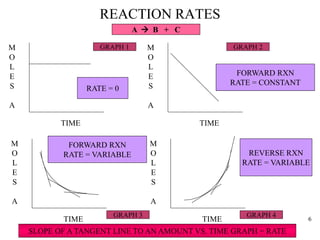
• In graph 1, the slope of the graph (rise divided
by run) equals zero. The rate is therefore zero
and no net reaction is occurring.
• In graph 2, as time goes on the moles of
reactant A decrease, therefore reactant is being
consumed and the reaction is progressing in
the forward direction. The slope of the line is
constant (rise divided by run is the same at all
points) and negative with respect to reactant A
(it is being consumed) and therefore the rate is
negative (sloping downward to the right) and
constant. 7
REACTION RATES
(cont’d)
• In graph 3, as time goes on the moles of
reactant A decrease, therefore reactant is
being consumed and the reaction is
progressing in the forward direction. The
slope of the line is not constant (rise divided
by run is not the same at all points) but is
negative (sloping downward to the right)
and therefore the rate is negative with
respect to reactant A (it is being consumed)
and variable as the changing slopes of the
tangent lines show.
8
REACTION RATES
(cont’d)
• In graph 4, as time goes on the moles of
reactant A increase, therefore reactant is
being formed and the reaction is
progressing in the reverse direction. The
slope of the line is not constant (rise divided
by run is not the same at all points) and
positive (sloping upward to the right) and
therefore the rate is positive with respect to
reactant A (it is being formed) and variable
as the changing slopes of the tangent lines
show.
9
FACTORS THAT EFFECT REACTION
RATES
• FIVE FACTORS CAN CHANGE THE RATE OF
REACTION. CAN YOU NAME THEM?
• THEY ARE :
• (1) CONCENTRATION OF REACTANTS
(REMEMBER THAT CONCENTRATION IN GASES IS
DIRECTLY RELATED TO PRESSURE, PV =nRT)
• (2) TEMPERATURE
• (3) SURFACE AREA OF THE REACTANTS
• (4) CATALYSTS
• (5) THE NATURE OF THE REACTANTS 10
FACTORS THAT EFFECT REACTION
RATES (CONT’D)
• HOW DOES THE CONCENTRATION (PRESSURE)
OF THE REACTANTS EFFECT REACTON RATE?
• AS CONCENTRATION INCREASES, REACTON
RATE INCREASES.
• WHY? THE ANSWER LIES IN TWO
FUNDAMENTAL CONCEPTS IN CHEMISTRY.
THE KINETIC MOLECULAR THEORY AND THE
COLLISION THEORY OF REACTION!
• CAN YOU EXPLAIN THESE TWO IDEAS?
11
FACTORS THAT EFFECT REACTION
RATES (CONT’D)
• A PRIMARY CONCEPT OF THE KINETIC
MOLECULAR THEORY IS THAT MOLECULES ARE
IN CONSTANT RANDOM MOTION AND THAT AS
TEMPERATURE INCREASES THE AVERAGE SPEED
(KINETIC ENERGY) OF THOSE MOLECULES
INCREASES.
• THE COLLISION THEORY OF REACTION TELLS US
THAT MOLECULES MUST FIRST COLLIDE WITH
EACHOTHER BEFORE THEY CAN REACT. IT ALSO
SAYS THAT INCREASING THE NUMBER OF
COLLISIONS PER SECOND (FREQUENCY) AND
INCREASING THE ENERGY OF COLLISION WILL
INCREASE REACTION RATE.
12
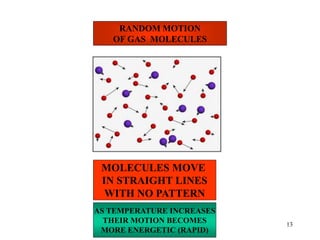
RANDOM MOTION
OF GAS MOLECULES
MOLECULES MOVE
IN STRAIGHT LINES
WITH NO PATTERN
AS TEMPERATURE INCREASES
THEIR MOTION BECOMES
MORE ENERGETIC (RAPID)
13
HOW CONCENTRATION EFFECTS
REACTION RATES
• AS MORE MOLECULES OCCUPY A GIVEN
SPACE (CONCENTRATION INCREASES)
COLLISIONS BETWEEN MOLECULES BECOME
MORE FREQUENT AND REACTION RATE
INCREASES.
• RATE OF REACTION IS DIRECTLY
PROPORTIONAL TO THE CONCENTRATION OF
THE REACTANTS
14
HOW CONCENTRATION EFFECTS
REACTION RATES (THE RATE EQUATION)
• RATE ~ CONCENTRATION
• PROPORTIONALITIES CAN BE MADE INTO
EQUALITIES BY USING A CONSTANT
• FOR EXAMPLE: FEET CAN ALWAYS BE
CONVERTED TO INCHES BY USING THE NUMBER
12. (INCHES = FEET x 12)
• RATE = A CONSTANT x CONCENTRATION
• HOWEVER, ALL EQUATIONS ARE NOT LINEAR
(FIRST POWER), SOME ARE SQUARES OR CUBES
OR ETC.
15
HOW CONCENTRATION EFFECTS
REACTION RATES (THE RATE EQUATON)
• THEREFORE OUR EQUATION MAY BE WRITTEN AS:
RATE = CONSTANT x CONCENTRATIN RAISED TO
SOME POWER OR
RATE = k x [A]n
• k = A CONSTANT CALLED THE SPECIFIC RATE
CONSTANT (IT IS CONSTANT FOR A SPECIFIC
REACTION AT A SPECIFIC TEMPERATURE)
• [A] = THE CONCENTRATION OF REACTANT A IN
MOLES PER LITER (BRACKETS MEAN IN MOLES
PER LITER)
• n = THE POWER TO WHICH CONCENTRATION
MUST BE RAISED (ALSO CALLED REACTION
ORDER)
16
HOW CONCENTRATION EFFECTS
REACTION RATES (REACTION ORDER)
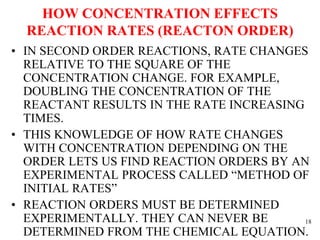
• REACTIONS WITH RATE EQUATIONS HAVING
n = 0 ARE ZERO ORDER REACTIONS. THOSE
WITH n = 1 ARE FIRST ORDER AND THOSE WITH
n = 2 ARE SECOND ORDER.
• IN ZERO ORDER REACTIONS, CHANGING THE
CONCENTRATION OF THE REACTANT HAS NO
EFFECT ON THE RATE.
• IN FIRST ORDER REACTIONS, RATE CHANGES
ONE FOR ONE WITH CONCENTRATION CHANGE.
FOR EXAMPLE, DOUBLING CONCENTRATION
DOUBLES THE RATE.
17
HOW CONCENTRATION EFFECTS
REACTION RATES (REACTON ORDER)
• IN SECOND ORDER REACTIONS, RATE CHANGES
RELATIVE TO THE SQUARE OF THE
CONCENTRATION CHANGE. FOR EXAMPLE,
DOUBLING THE CONCENTRATION OF THE
REACTANT RESULTS IN THE RATE INCREASING
TIMES.
• THIS KNOWLEDGE OF HOW RATE CHANGES
WITH CONCENTRATION DEPENDING ON THE
ORDER LETS US FIND REACTION ORDERS BY AN
EXPERIMENTAL PROCESS CALLED “METHOD OF
INITIAL RATES”
• REACTION ORDERS MUST BE DETERMINED
EXPERIMENTALLY. THEY CAN NEVER BE
DETERMINED FROM THE CHEMICAL EQUATION.
18
HOW CONCENTRATION EFFECTS
REACTION RATES (INITIAL RATES)
• USING THE METHOD OF INITIAL RATES REQUIRES
THAT A REACTION BE RUN AT SERIES OF DIFFERENT
STARTING CONCENTRATIONS AND THE RATE BE
DETERMINED FOR EACH.
• GIVEN THE FOLLOWING DATA FOR THE REACTION
A  B + C
(TABLE 1)
• EXPT [A] RATE (M/SEC)
1 1 x 10 -3 4 x 10 -1
2 2 x 10 -3 8 x 10 -1
3 4 x 10 -3 16 x 10 -1
• AS CONCENTRATION OF A DOUBLES, RATE DOUBLES.
THE REACTION IS FIRST ORDER IN REACTANT A
• RATE = k[A]1 OR RATE = k[A] 19
HOW CONCENTRATION EFFECTS
REACTION RATES (INITIAL RATES)
• FOR THE REACTION: A + B  C + D
• (TABLE 2)
1 1 x 10 -3 1 x 10 –3 4 x 10 -1
2 2 x 10 -3 1 x 10 -3 8 x 10 -1
3 1 x 10 -3 2 x 10 -3 16 x 10 –1
• USING EXPT 1 AND 2, [A] DOUBLES AND [B] IS
CONSTANT. THE DOUBLING OF THE RATE IS
THEREFORE CAUSED BY REACTANT A AND THE ORDER
WITH RESPECT TO A IS FIRST.
• USING EXPT 1 AND 3, [A] IS CONSTANT AND [B] IS
DOUBLED. THE FOUR TIMES RATE INCREASE IS
THEREFORE CAUSED BY REACTANT B AND THE ORDER
WITH RESPECT TO B IS SECOND.
• RATE = k[A]1[B]2 OR RATE = k[A][B]2
20
21
Click Here

Reaction Rates

  • 1.
  • 2.
    REACTION RATES • Whatdoes “rate” mean ? • Can you think of an everyday measurement of rate ? • How about a car speed in miles per hour! • How about water flow in gallons per minute! • How about an audience entering a stadium in people per hour! • What do all these measures have in common? 2
  • 3.
    REACTION RATES (cont’d) • Eachone contains a time unit and the word “per”.”Per” means divide! How then is the rate value set up mathematically? • In each case an amount unit (miles, gallons or people) is divided by a time unit (hours, minutes or possibly seconds). • Generally then rates are ratios (divisions) with an amount divided by time. • Rate =  amount /  time 3
  • 4.
    REACTION RATES (cont’d) • Inchemistry, the amount unit may vary but is often in moles, moles per liter (molarity), grams or even liters. • Rates of chemical reactions then, are most often measured as moles per second, molarity per second. • Rates of reaction can be measured in terms of reactants consumed ( negative rates) or products produced (positive rates). 4
  • 5.
    REACTION RATES (cont’d) • Theprogress of reactions, as reactants are converted to products are often represented by a graph. • When interpreting the graph it is important to recognize whether the amount of products or reactants is being measured ! • If the reactants are being measured the direction of the reaction and the sign of the rate will be different than if the products are measured. • Study the following graphs and see if you can determine the direction of the reaction and the appropriate rates. 5
  • 6.
    RXN RATE? RXN RATE? FORWARD OR REVERSE RXN? RXN RATE? FORWARD OR REVERSE? RATE = 0 RXN RATE? FORWARD OR REVERSE? REACTION RATES TIME M O L E S A TIME M O L E S A TIME M O L E S A TIME M O L E S A A  B + C FORWARD RXN RATE = CONSTANT FORWARD RXN RATE = VARIABLE REVERSE RXN RATE = VARIABLE SLOPE OF A TANGENT LINE TO AN AMOUNT VS. TIME GRAPH = RATE GRAPH 1 GRAPH 2 GRAPH 3 GRAPH 4 6
  • 7.
    REACTION RATES (cont’d) • Ingraph 1, the slope of the graph (rise divided by run) equals zero. The rate is therefore zero and no net reaction is occurring. • In graph 2, as time goes on the moles of reactant A decrease, therefore reactant is being consumed and the reaction is progressing in the forward direction. The slope of the line is constant (rise divided by run is the same at all points) and negative with respect to reactant A (it is being consumed) and therefore the rate is negative (sloping downward to the right) and constant. 7
  • 8.
    REACTION RATES (cont’d) • Ingraph 3, as time goes on the moles of reactant A decrease, therefore reactant is being consumed and the reaction is progressing in the forward direction. The slope of the line is not constant (rise divided by run is not the same at all points) but is negative (sloping downward to the right) and therefore the rate is negative with respect to reactant A (it is being consumed) and variable as the changing slopes of the tangent lines show. 8
  • 9.
    REACTION RATES (cont’d) • Ingraph 4, as time goes on the moles of reactant A increase, therefore reactant is being formed and the reaction is progressing in the reverse direction. The slope of the line is not constant (rise divided by run is not the same at all points) and positive (sloping upward to the right) and therefore the rate is positive with respect to reactant A (it is being formed) and variable as the changing slopes of the tangent lines show. 9
  • 10.
    FACTORS THAT EFFECTREACTION RATES • FIVE FACTORS CAN CHANGE THE RATE OF REACTION. CAN YOU NAME THEM? • THEY ARE : • (1) CONCENTRATION OF REACTANTS (REMEMBER THAT CONCENTRATION IN GASES IS DIRECTLY RELATED TO PRESSURE, PV =nRT) • (2) TEMPERATURE • (3) SURFACE AREA OF THE REACTANTS • (4) CATALYSTS • (5) THE NATURE OF THE REACTANTS 10
  • 11.
    FACTORS THAT EFFECTREACTION RATES (CONT’D) • HOW DOES THE CONCENTRATION (PRESSURE) OF THE REACTANTS EFFECT REACTON RATE? • AS CONCENTRATION INCREASES, REACTON RATE INCREASES. • WHY? THE ANSWER LIES IN TWO FUNDAMENTAL CONCEPTS IN CHEMISTRY. THE KINETIC MOLECULAR THEORY AND THE COLLISION THEORY OF REACTION! • CAN YOU EXPLAIN THESE TWO IDEAS? 11
  • 12.
    FACTORS THAT EFFECTREACTION RATES (CONT’D) • A PRIMARY CONCEPT OF THE KINETIC MOLECULAR THEORY IS THAT MOLECULES ARE IN CONSTANT RANDOM MOTION AND THAT AS TEMPERATURE INCREASES THE AVERAGE SPEED (KINETIC ENERGY) OF THOSE MOLECULES INCREASES. • THE COLLISION THEORY OF REACTION TELLS US THAT MOLECULES MUST FIRST COLLIDE WITH EACHOTHER BEFORE THEY CAN REACT. IT ALSO SAYS THAT INCREASING THE NUMBER OF COLLISIONS PER SECOND (FREQUENCY) AND INCREASING THE ENERGY OF COLLISION WILL INCREASE REACTION RATE. 12
  • 13.
    RANDOM MOTION OF GASMOLECULES MOLECULES MOVE IN STRAIGHT LINES WITH NO PATTERN AS TEMPERATURE INCREASES THEIR MOTION BECOMES MORE ENERGETIC (RAPID) 13
  • 14.
    HOW CONCENTRATION EFFECTS REACTIONRATES • AS MORE MOLECULES OCCUPY A GIVEN SPACE (CONCENTRATION INCREASES) COLLISIONS BETWEEN MOLECULES BECOME MORE FREQUENT AND REACTION RATE INCREASES. • RATE OF REACTION IS DIRECTLY PROPORTIONAL TO THE CONCENTRATION OF THE REACTANTS 14
  • 15.
    HOW CONCENTRATION EFFECTS REACTIONRATES (THE RATE EQUATION) • RATE ~ CONCENTRATION • PROPORTIONALITIES CAN BE MADE INTO EQUALITIES BY USING A CONSTANT • FOR EXAMPLE: FEET CAN ALWAYS BE CONVERTED TO INCHES BY USING THE NUMBER 12. (INCHES = FEET x 12) • RATE = A CONSTANT x CONCENTRATION • HOWEVER, ALL EQUATIONS ARE NOT LINEAR (FIRST POWER), SOME ARE SQUARES OR CUBES OR ETC. 15
  • 16.
    HOW CONCENTRATION EFFECTS REACTIONRATES (THE RATE EQUATON) • THEREFORE OUR EQUATION MAY BE WRITTEN AS: RATE = CONSTANT x CONCENTRATIN RAISED TO SOME POWER OR RATE = k x [A]n • k = A CONSTANT CALLED THE SPECIFIC RATE CONSTANT (IT IS CONSTANT FOR A SPECIFIC REACTION AT A SPECIFIC TEMPERATURE) • [A] = THE CONCENTRATION OF REACTANT A IN MOLES PER LITER (BRACKETS MEAN IN MOLES PER LITER) • n = THE POWER TO WHICH CONCENTRATION MUST BE RAISED (ALSO CALLED REACTION ORDER) 16
  • 17.
    HOW CONCENTRATION EFFECTS REACTIONRATES (REACTION ORDER) • REACTIONS WITH RATE EQUATIONS HAVING n = 0 ARE ZERO ORDER REACTIONS. THOSE WITH n = 1 ARE FIRST ORDER AND THOSE WITH n = 2 ARE SECOND ORDER. • IN ZERO ORDER REACTIONS, CHANGING THE CONCENTRATION OF THE REACTANT HAS NO EFFECT ON THE RATE. • IN FIRST ORDER REACTIONS, RATE CHANGES ONE FOR ONE WITH CONCENTRATION CHANGE. FOR EXAMPLE, DOUBLING CONCENTRATION DOUBLES THE RATE. 17
  • 18.
    HOW CONCENTRATION EFFECTS REACTIONRATES (REACTON ORDER) • IN SECOND ORDER REACTIONS, RATE CHANGES RELATIVE TO THE SQUARE OF THE CONCENTRATION CHANGE. FOR EXAMPLE, DOUBLING THE CONCENTRATION OF THE REACTANT RESULTS IN THE RATE INCREASING TIMES. • THIS KNOWLEDGE OF HOW RATE CHANGES WITH CONCENTRATION DEPENDING ON THE ORDER LETS US FIND REACTION ORDERS BY AN EXPERIMENTAL PROCESS CALLED “METHOD OF INITIAL RATES” • REACTION ORDERS MUST BE DETERMINED EXPERIMENTALLY. THEY CAN NEVER BE DETERMINED FROM THE CHEMICAL EQUATION. 18
  • 19.
    HOW CONCENTRATION EFFECTS REACTIONRATES (INITIAL RATES) • USING THE METHOD OF INITIAL RATES REQUIRES THAT A REACTION BE RUN AT SERIES OF DIFFERENT STARTING CONCENTRATIONS AND THE RATE BE DETERMINED FOR EACH. • GIVEN THE FOLLOWING DATA FOR THE REACTION A  B + C (TABLE 1) • EXPT [A] RATE (M/SEC) 1 1 x 10 -3 4 x 10 -1 2 2 x 10 -3 8 x 10 -1 3 4 x 10 -3 16 x 10 -1 • AS CONCENTRATION OF A DOUBLES, RATE DOUBLES. THE REACTION IS FIRST ORDER IN REACTANT A • RATE = k[A]1 OR RATE = k[A] 19
  • 20.
    HOW CONCENTRATION EFFECTS REACTIONRATES (INITIAL RATES) • FOR THE REACTION: A + B  C + D • (TABLE 2) 1 1 x 10 -3 1 x 10 –3 4 x 10 -1 2 2 x 10 -3 1 x 10 -3 8 x 10 -1 3 1 x 10 -3 2 x 10 -3 16 x 10 –1 • USING EXPT 1 AND 2, [A] DOUBLES AND [B] IS CONSTANT. THE DOUBLING OF THE RATE IS THEREFORE CAUSED BY REACTANT A AND THE ORDER WITH RESPECT TO A IS FIRST. • USING EXPT 1 AND 3, [A] IS CONSTANT AND [B] IS DOUBLED. THE FOUR TIMES RATE INCREASE IS THEREFORE CAUSED BY REACTANT B AND THE ORDER WITH RESPECT TO B IS SECOND. • RATE = k[A]1[B]2 OR RATE = k[A][B]2 20
  • 21.