• A catalyst is a substance which alters the speed
of a chemical reaction without itself
undergoing any chemical change and the
phenomenon is known as catalysis.
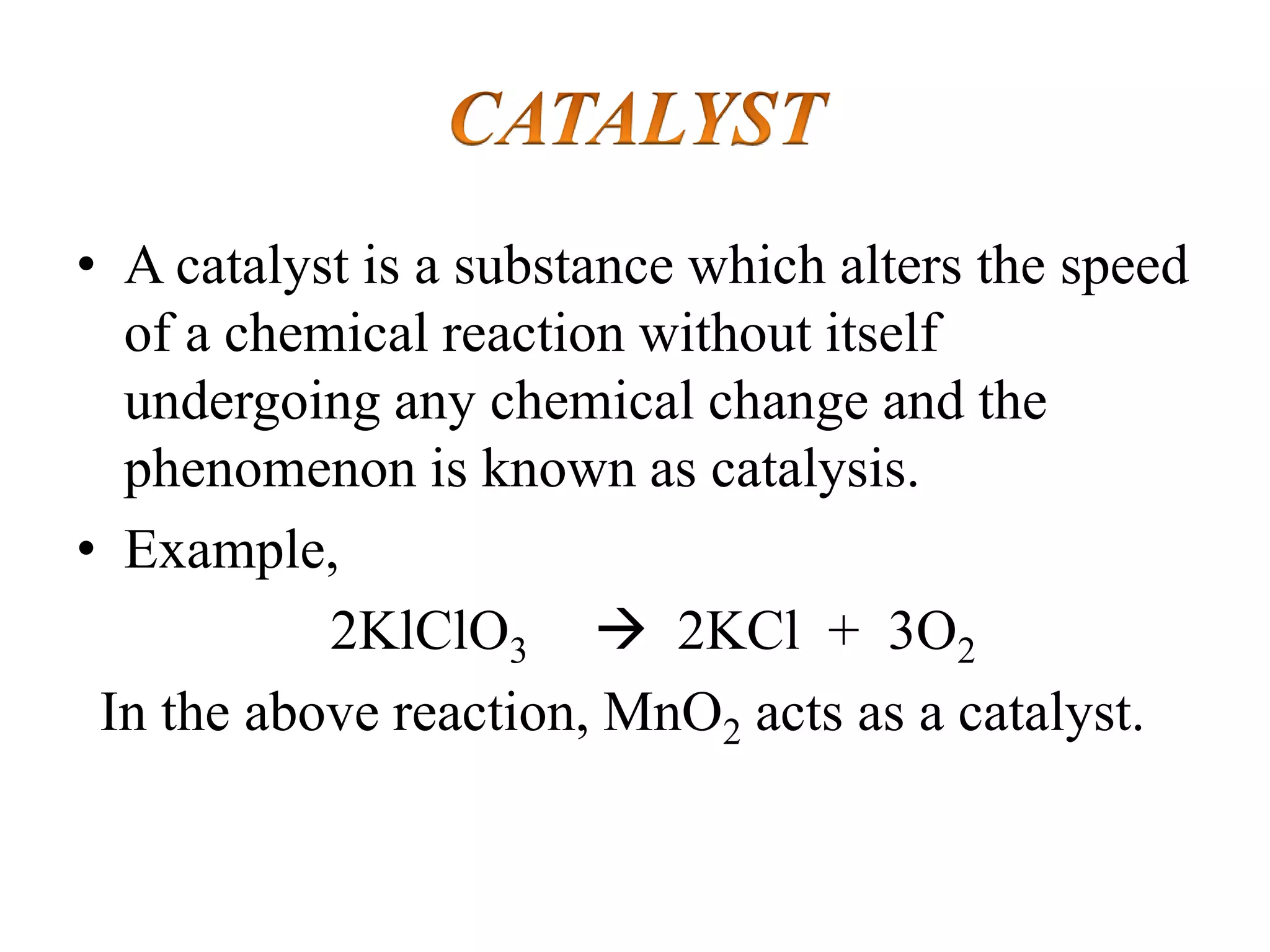
• Example,
2KlClO3  2KCl + 3O2
In the above reaction, MnO2 acts as a catalyst.
General characteristics of catalytic
reactions
• 1. The catalyst remains unchanged in mass and in
chemical composition at the end of the reaction.
• 2. Only a small quantity of catalyst is generally
needed.
• 3. A catalyst cannot initiate a reaction. The
function of a catalyst is only to alter the speed of
the reaction which is already occurring at a
particular rate.
• 4. A catalyst does not alter the position of
equilibrium in a reversible reaction.
• 5. The catalyst is generally specific in its action.
Types of catalytic reactions
• Catalytic reactions are classified into two
broad types;
1. Homogeneous catalysis
2. Heterogeneous catalysis
1. Homogeneous Catalysis
• In these reactions, the reactants and catalyst
remain in the same phase. The following are
some of the examples of homogeneous
catalysis.
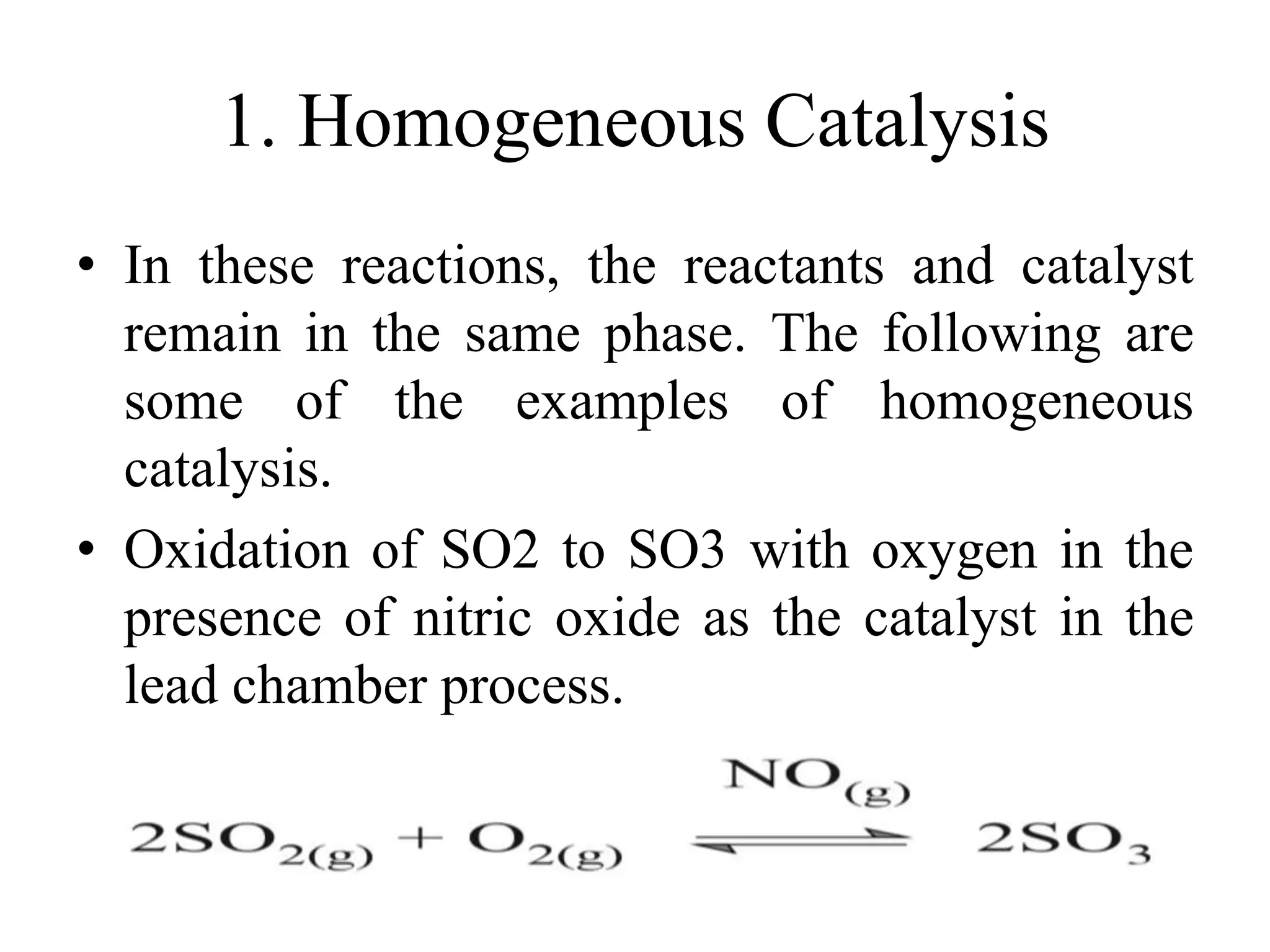
• Oxidation of SO2 to SO3 with oxygen in the
presence of nitric oxide as the catalyst in the
lead chamber process.
1. Homogeneous Catalysis
Hydrolysis of methyl acetate is catalysed
by H+ ions furnished by hydrochloric
acid.
2. Heterogeneous Catalysis
• The catalytic process in which the reactants and the
catalyst are in different phases is known as
heterogeneous catalysis. Some of the examples of
heterogeneous catalysis are given below.
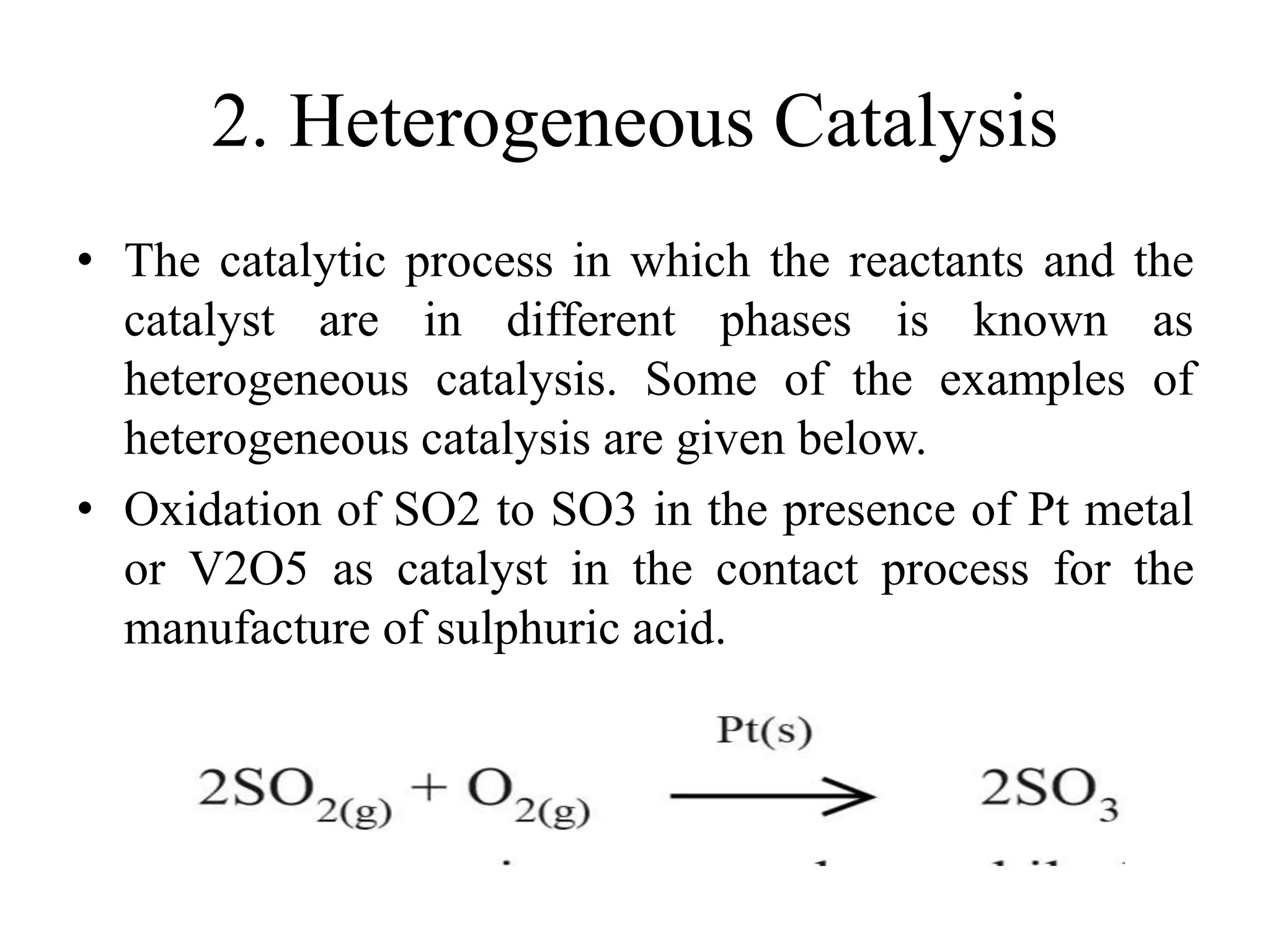
• Oxidation of SO2 to SO3 in the presence of Pt metal
or V2O5 as catalyst in the contact process for the
manufacture of sulphuric acid.
2. Heterogeneous Catalysis
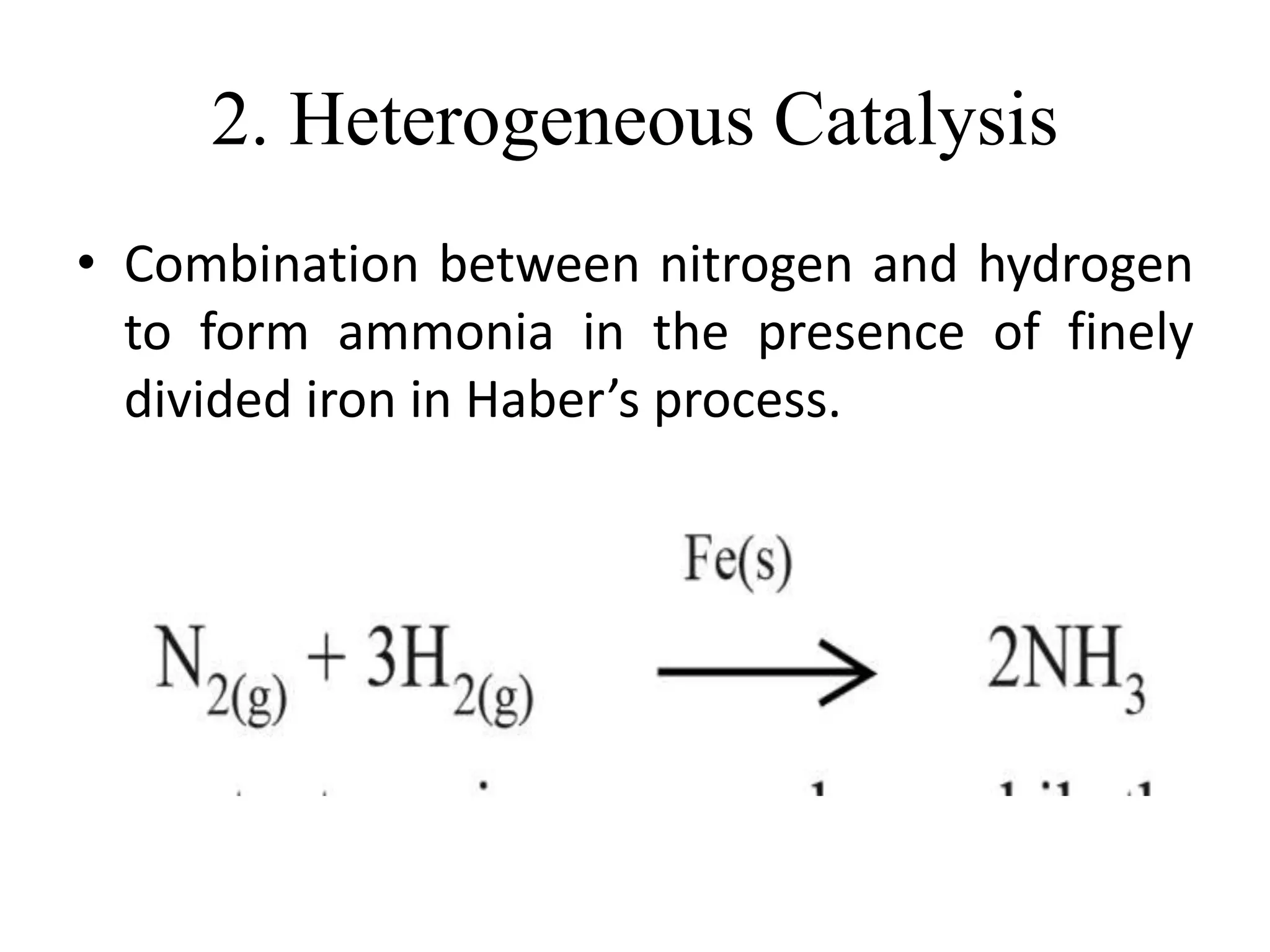
• Combination between nitrogen and hydrogen
to form ammonia in the presence of finely
divided iron in Haber’s process.
Types of catalysts
• Positive catalyst
• Negative Catalyst
• Auto catalyst
• Induced Catalyst
Positive catalyst
• A catalyst which enhances the speed of the
reaction is called positive catalyst and the
phenomenon is known as positive catalysis.
Various examples are given below :
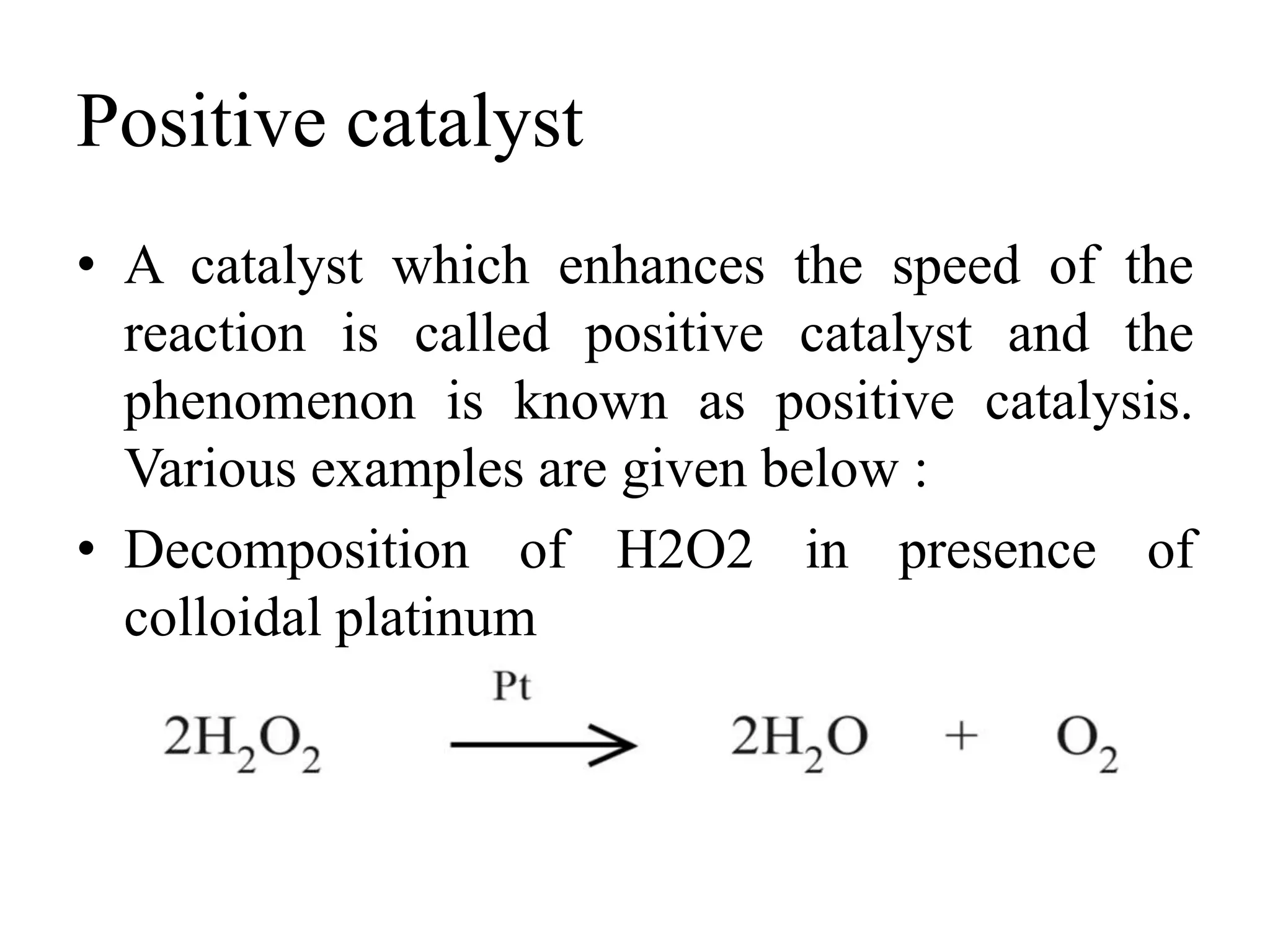
• Decomposition of H2O2 in presence of
colloidal platinum
Positive catalyst
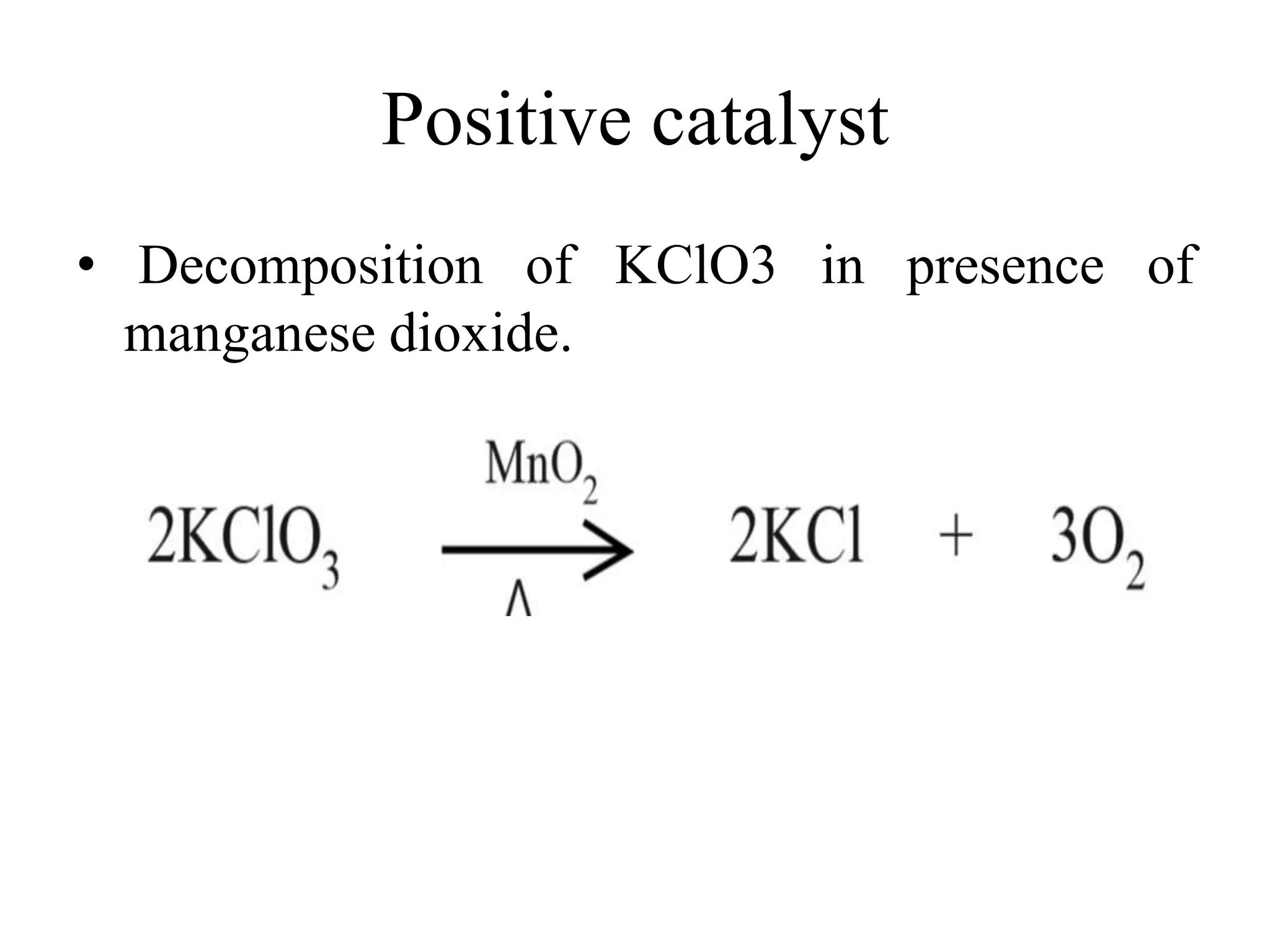
• Decomposition of KClO3 in presence of
manganese dioxide.
Negative Catalyst
• There are certain substances which, when
added to the reaction mixture, retard the
reaction rate instead of increasing it. These are
called negative catalysts or inhibitors and the
phenomenon is known as negative catalysis.
The examples are given below.
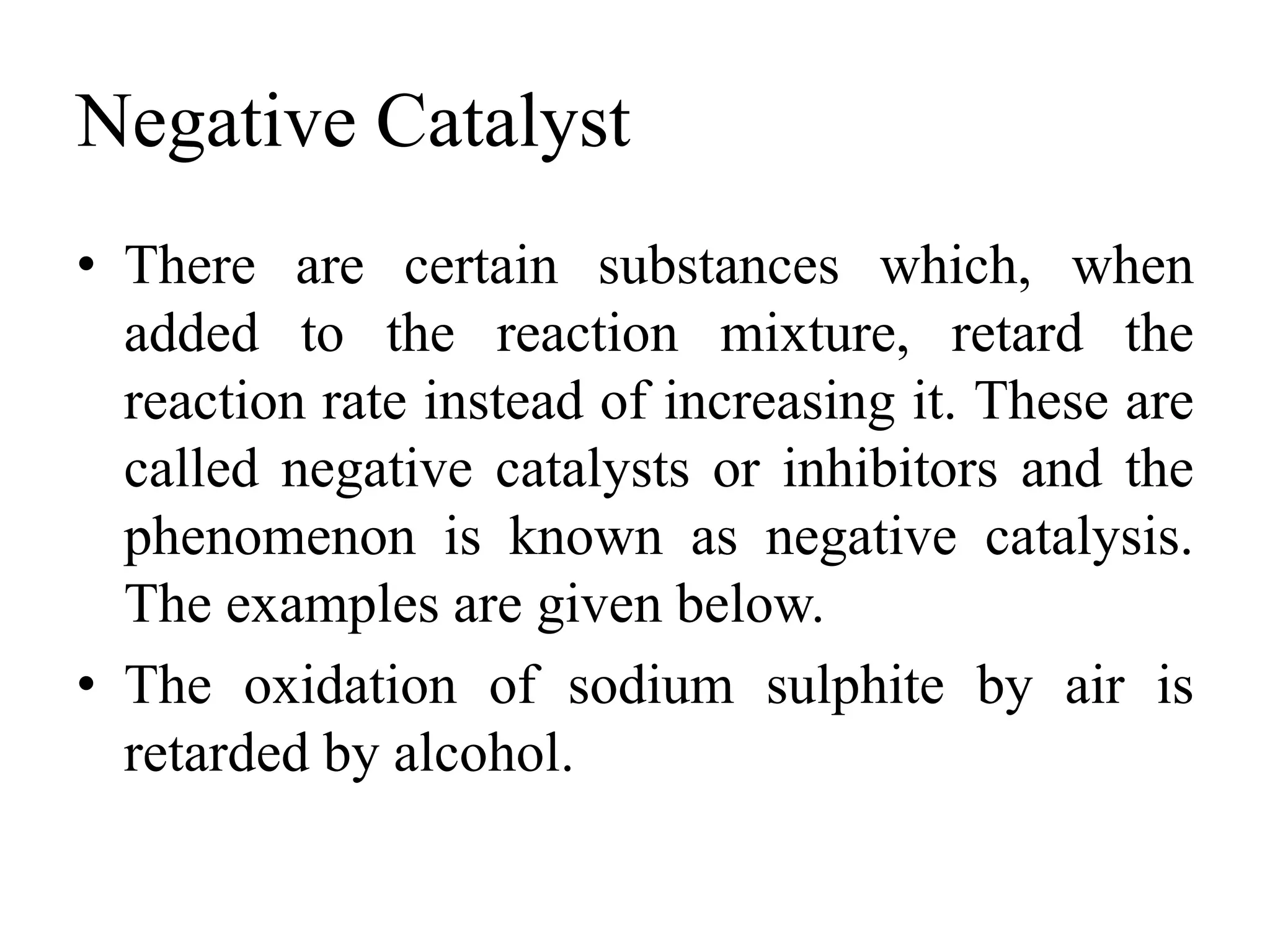
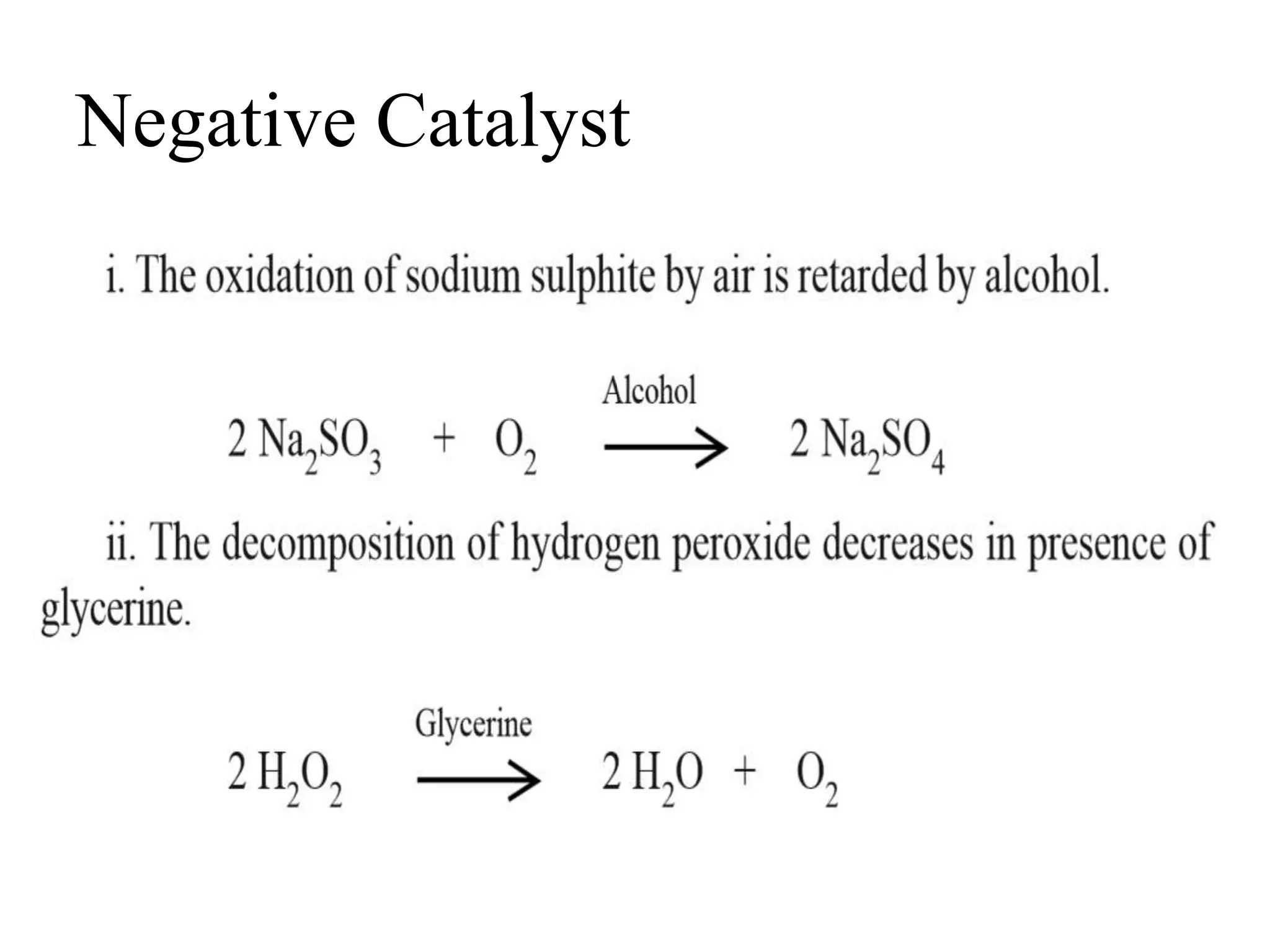
• The oxidation of sodium sulphite by air is
retarded by alcohol.
Negative Catalyst
Auto catalyst
• In certain reactions, it is observed that one of the products
formed during the reaction acts as a catalyst for that reaction.
Such type of catalyst is called auto catalyst and the
phenomenon is known as auto catalysis.
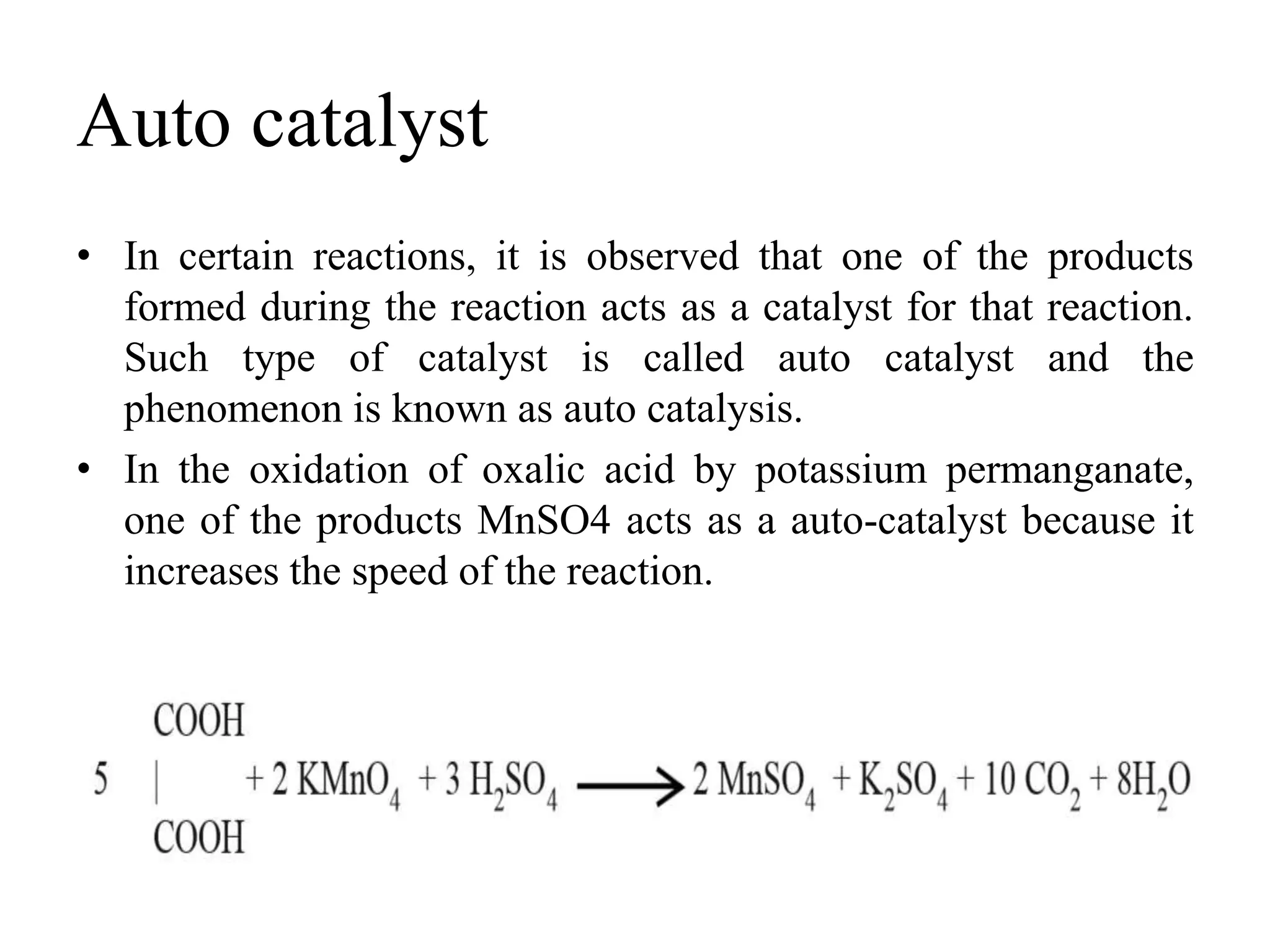
• In the oxidation of oxalic acid by potassium permanganate,
one of the products MnSO4 acts as a auto-catalyst because it
increases the speed of the reaction.
Induced Catalyst
• When one reactant influences the rate of other
reaction, which does not occur under ordinary
conditions, the phenomenon is known as induced
catalysis.
• Sodium arsenite solution is not oxidised by air. If,
however, air is passed through a mixture of the
solution of sodium arsenite and sodium sulphite,
both of them undergo simultaneous oxidation.
Thus sulphite has induced the arsenite and hence
is called induced catalyst.
Promoters
• The activity of a catalyst can be increased by addition
of a small quantity of a second material. A substance
which, though itself not a catalyst, promotes the
activity of a catalyst is called a promoter. Some
examples of the promoters are given below.
• In the Haber’s process for the synthesis of ammonia,
traces of molybdenum increase the activity of finely
divided iron which acts as a catalyst.
Catalytic Poisons
A substance which destroys the activity of the
catalyst is called a poison and the process is
called catalytic poisoning. Some of the
examples are
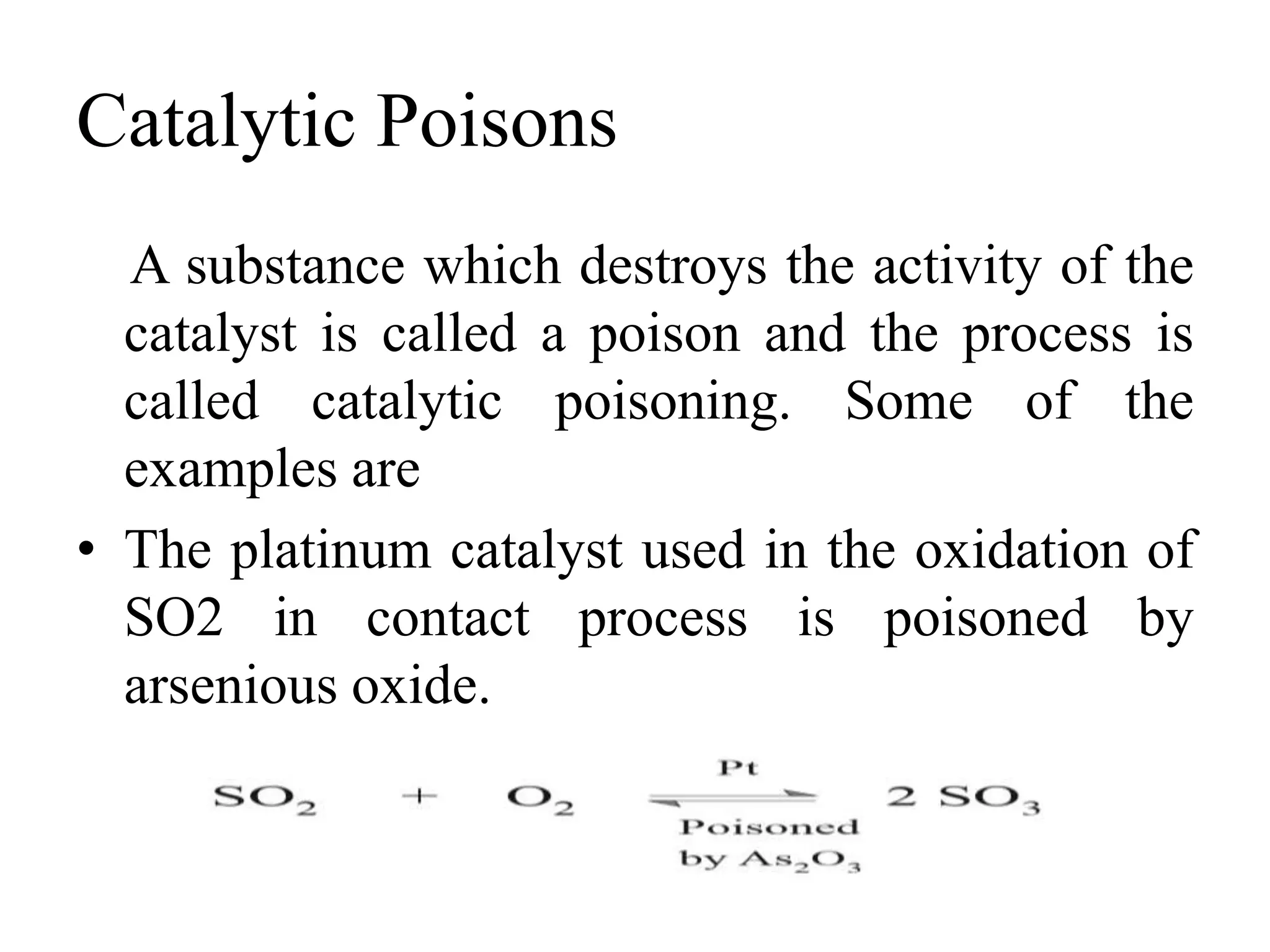
• The platinum catalyst used in the oxidation of
SO2 in contact process is poisoned by
arsenious oxide.
Catalytic Poisons
The iron catalyst used in the synthesis of
ammonia in Haber process is poisoned by H2S
Active Centres
• The catalytic surface has unbalanced chemical
bonds on it. The reactant gaseous molecules are
adsorbed on the surface by these free bonds. This
accelerates the rate of the reaction. The
distribution of free bonds on the catalytic surface
is not uniform. These are crowded at the peaks,
cracks and corners of the catalyst. The catalytic
activity due to adsorption of reacting molecules is
maximum at these spots. These are, therefore,
referred to as the active centres. If a catalyst has
more active centres, then its catalytic activity is
increased.
THEORIES OF CATALYSIS
• There are two main theories to explain
catalysis.
• 1. Intermediate compound formation theory
• 2. Adsorption theory
• In general, the intermediate compound
formation theory applies to homogeneous
catalytic reactions and the adsorption theory
applies to heterogeneous catalytic reactions
The Intermediate Compound
Formation Theory
• According to this theory, the catalyst first
forms an intermediate compound with one of
the reactants. The compound is formed with
less energy consumption than needed for the
actual reaction. The intermediate compound
being unstable combines with other reactant to
form the desired product and the catalyst is
regenerated.
Adsorption Theory
• This theory explains the mechanism of
heterogeneous catalysis. Here, the catalyst
functions by adsorption of the reacting
molecules on its surface.
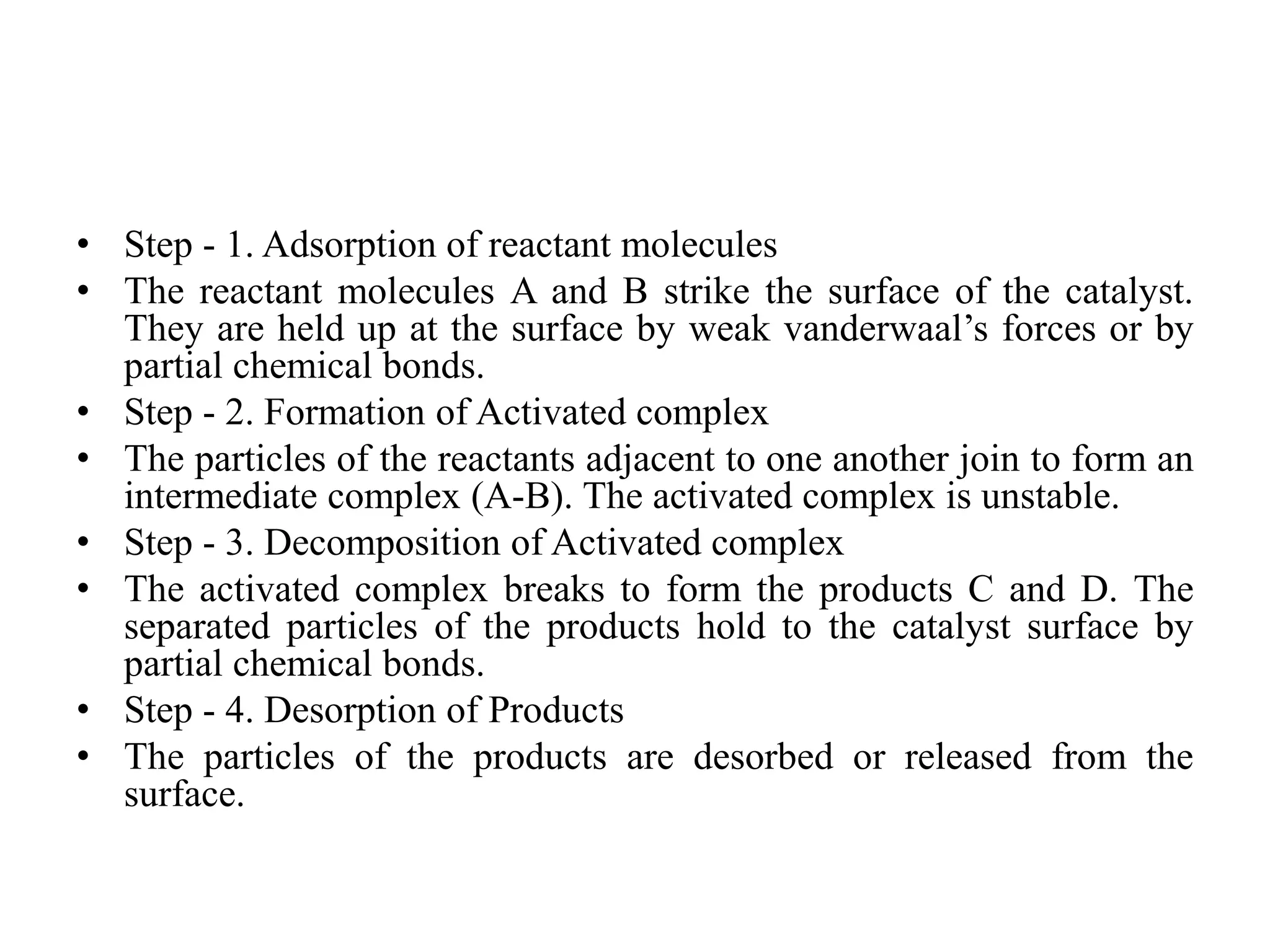
• Step - 1. Adsorption of reactant molecules
• The reactant molecules A and B strike the surface of the catalyst.
They are held up at the surface by weak vanderwaal’s forces or by
partial chemical bonds.
• Step - 2. Formation of Activated complex
• The particles of the reactants adjacent to one another join to form an
intermediate complex (A-B). The activated complex is unstable.
• Step - 3. Decomposition of Activated complex
• The activated complex breaks to form the products C and D. The
separated particles of the products hold to the catalyst surface by
partial chemical bonds.
• Step - 4. Desorption of Products
• The particles of the products are desorbed or released from the
surface.
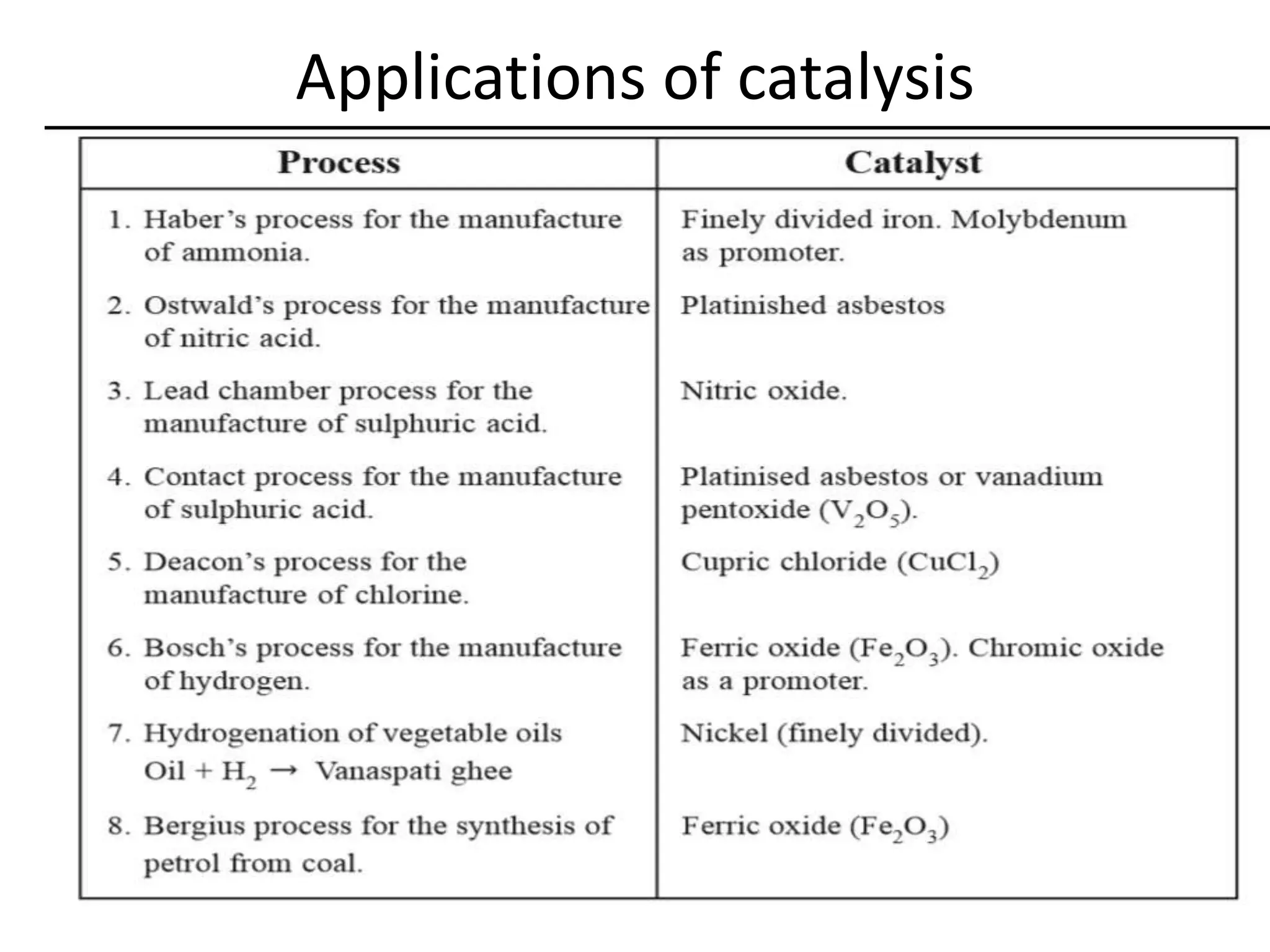
Applications of catalysis

Catalyst

  • 2.
    • A catalystis a substance which alters the speed of a chemical reaction without itself undergoing any chemical change and the phenomenon is known as catalysis. • Example, 2KlClO3  2KCl + 3O2 In the above reaction, MnO2 acts as a catalyst.
  • 3.
    General characteristics ofcatalytic reactions • 1. The catalyst remains unchanged in mass and in chemical composition at the end of the reaction. • 2. Only a small quantity of catalyst is generally needed. • 3. A catalyst cannot initiate a reaction. The function of a catalyst is only to alter the speed of the reaction which is already occurring at a particular rate. • 4. A catalyst does not alter the position of equilibrium in a reversible reaction. • 5. The catalyst is generally specific in its action.
  • 4.
    Types of catalyticreactions • Catalytic reactions are classified into two broad types; 1. Homogeneous catalysis 2. Heterogeneous catalysis
  • 5.
    1. Homogeneous Catalysis •In these reactions, the reactants and catalyst remain in the same phase. The following are some of the examples of homogeneous catalysis. • Oxidation of SO2 to SO3 with oxygen in the presence of nitric oxide as the catalyst in the lead chamber process.
  • 6.
    1. Homogeneous Catalysis Hydrolysisof methyl acetate is catalysed by H+ ions furnished by hydrochloric acid.
  • 7.
    2. Heterogeneous Catalysis •The catalytic process in which the reactants and the catalyst are in different phases is known as heterogeneous catalysis. Some of the examples of heterogeneous catalysis are given below. • Oxidation of SO2 to SO3 in the presence of Pt metal or V2O5 as catalyst in the contact process for the manufacture of sulphuric acid.
  • 8.
    2. Heterogeneous Catalysis •Combination between nitrogen and hydrogen to form ammonia in the presence of finely divided iron in Haber’s process.
  • 9.
    Types of catalysts •Positive catalyst • Negative Catalyst • Auto catalyst • Induced Catalyst
  • 10.
    Positive catalyst • Acatalyst which enhances the speed of the reaction is called positive catalyst and the phenomenon is known as positive catalysis. Various examples are given below : • Decomposition of H2O2 in presence of colloidal platinum
  • 11.
    Positive catalyst • Decompositionof KClO3 in presence of manganese dioxide.
  • 12.
    Negative Catalyst • Thereare certain substances which, when added to the reaction mixture, retard the reaction rate instead of increasing it. These are called negative catalysts or inhibitors and the phenomenon is known as negative catalysis. The examples are given below. • The oxidation of sodium sulphite by air is retarded by alcohol.
  • 13.
  • 14.
    Auto catalyst • Incertain reactions, it is observed that one of the products formed during the reaction acts as a catalyst for that reaction. Such type of catalyst is called auto catalyst and the phenomenon is known as auto catalysis. • In the oxidation of oxalic acid by potassium permanganate, one of the products MnSO4 acts as a auto-catalyst because it increases the speed of the reaction.
  • 15.
    Induced Catalyst • Whenone reactant influences the rate of other reaction, which does not occur under ordinary conditions, the phenomenon is known as induced catalysis. • Sodium arsenite solution is not oxidised by air. If, however, air is passed through a mixture of the solution of sodium arsenite and sodium sulphite, both of them undergo simultaneous oxidation. Thus sulphite has induced the arsenite and hence is called induced catalyst.
  • 16.
    Promoters • The activityof a catalyst can be increased by addition of a small quantity of a second material. A substance which, though itself not a catalyst, promotes the activity of a catalyst is called a promoter. Some examples of the promoters are given below. • In the Haber’s process for the synthesis of ammonia, traces of molybdenum increase the activity of finely divided iron which acts as a catalyst.
  • 17.
    Catalytic Poisons A substancewhich destroys the activity of the catalyst is called a poison and the process is called catalytic poisoning. Some of the examples are • The platinum catalyst used in the oxidation of SO2 in contact process is poisoned by arsenious oxide.
  • 18.
    Catalytic Poisons The ironcatalyst used in the synthesis of ammonia in Haber process is poisoned by H2S
  • 19.
    Active Centres • Thecatalytic surface has unbalanced chemical bonds on it. The reactant gaseous molecules are adsorbed on the surface by these free bonds. This accelerates the rate of the reaction. The distribution of free bonds on the catalytic surface is not uniform. These are crowded at the peaks, cracks and corners of the catalyst. The catalytic activity due to adsorption of reacting molecules is maximum at these spots. These are, therefore, referred to as the active centres. If a catalyst has more active centres, then its catalytic activity is increased.
  • 20.
    THEORIES OF CATALYSIS •There are two main theories to explain catalysis. • 1. Intermediate compound formation theory • 2. Adsorption theory • In general, the intermediate compound formation theory applies to homogeneous catalytic reactions and the adsorption theory applies to heterogeneous catalytic reactions
  • 21.
    The Intermediate Compound FormationTheory • According to this theory, the catalyst first forms an intermediate compound with one of the reactants. The compound is formed with less energy consumption than needed for the actual reaction. The intermediate compound being unstable combines with other reactant to form the desired product and the catalyst is regenerated.
  • 24.
    Adsorption Theory • Thistheory explains the mechanism of heterogeneous catalysis. Here, the catalyst functions by adsorption of the reacting molecules on its surface.
  • 26.
    • Step -1. Adsorption of reactant molecules • The reactant molecules A and B strike the surface of the catalyst. They are held up at the surface by weak vanderwaal’s forces or by partial chemical bonds. • Step - 2. Formation of Activated complex • The particles of the reactants adjacent to one another join to form an intermediate complex (A-B). The activated complex is unstable. • Step - 3. Decomposition of Activated complex • The activated complex breaks to form the products C and D. The separated particles of the products hold to the catalyst surface by partial chemical bonds. • Step - 4. Desorption of Products • The particles of the products are desorbed or released from the surface.
  • 27.