


Rate of Reaction
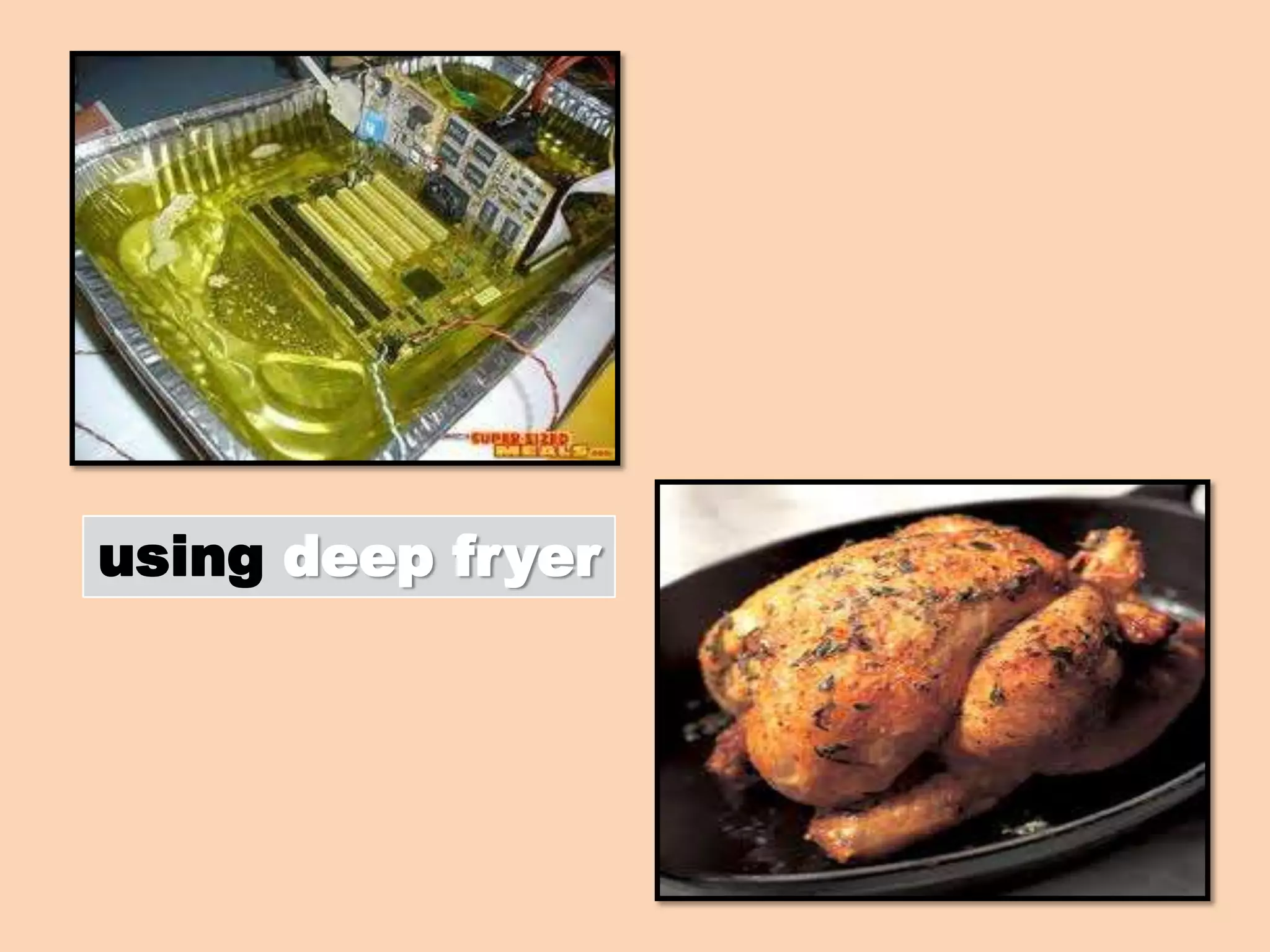
What is the best way to fry chicken quickly?Freestyle Fried Chicken
using deep fryer
cut into small part
EASY… call delivery
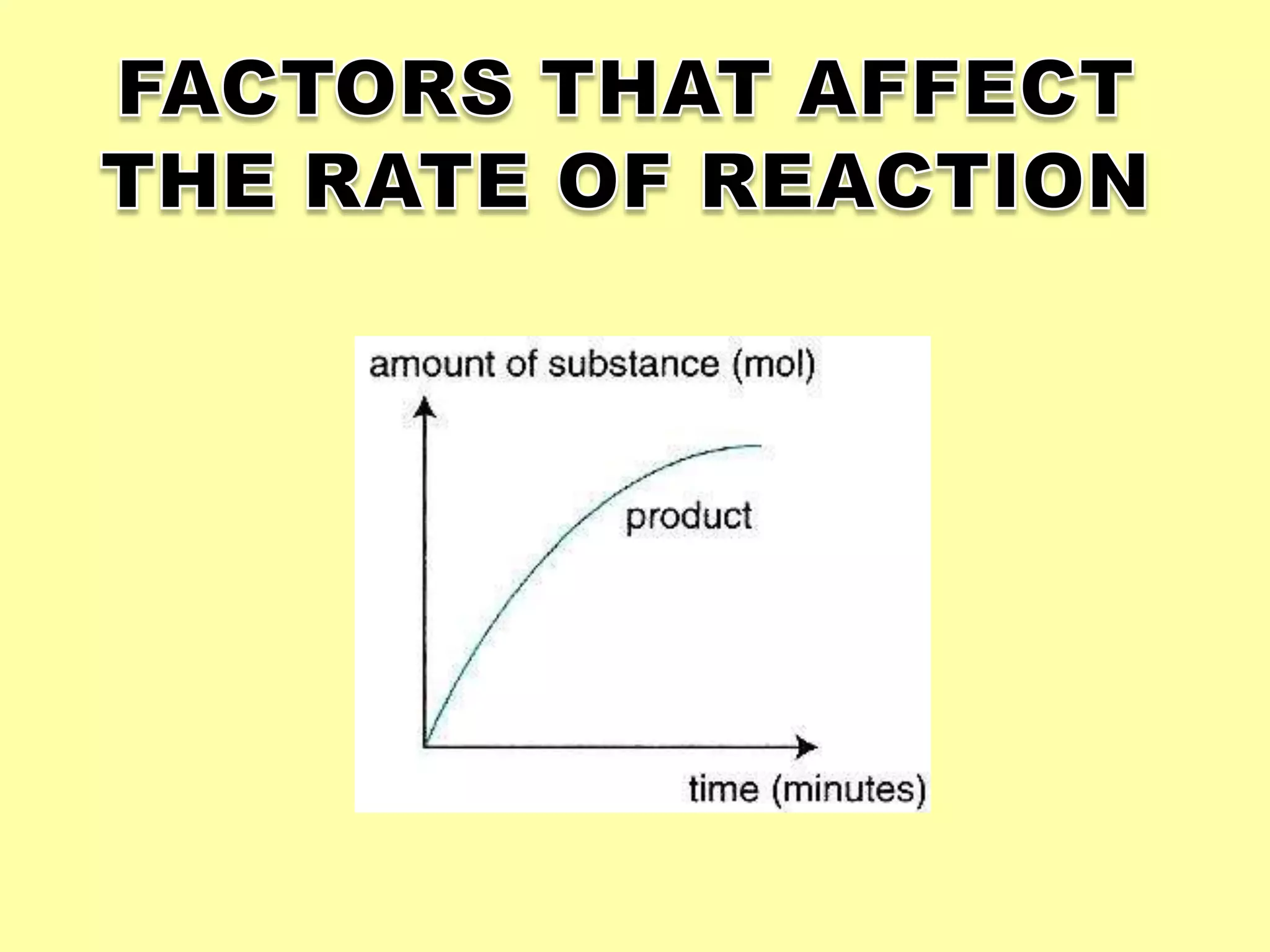
FACTORS THAT AFFECTTHE RATE OF REACTION
Rate of reaction is affected by :size of SOLIDconcentration of SOLUTIONtemperature of SOLUTIONPresence of catalystpressure of GAS reactant
experimentsInvestigate factors that affect the rate of reaction Factor 1:size of SOLIDFactor 2:concentrationof SOLUTIONFactor 3:temperature of SOLUTIONFactor 4:presence of catalyst
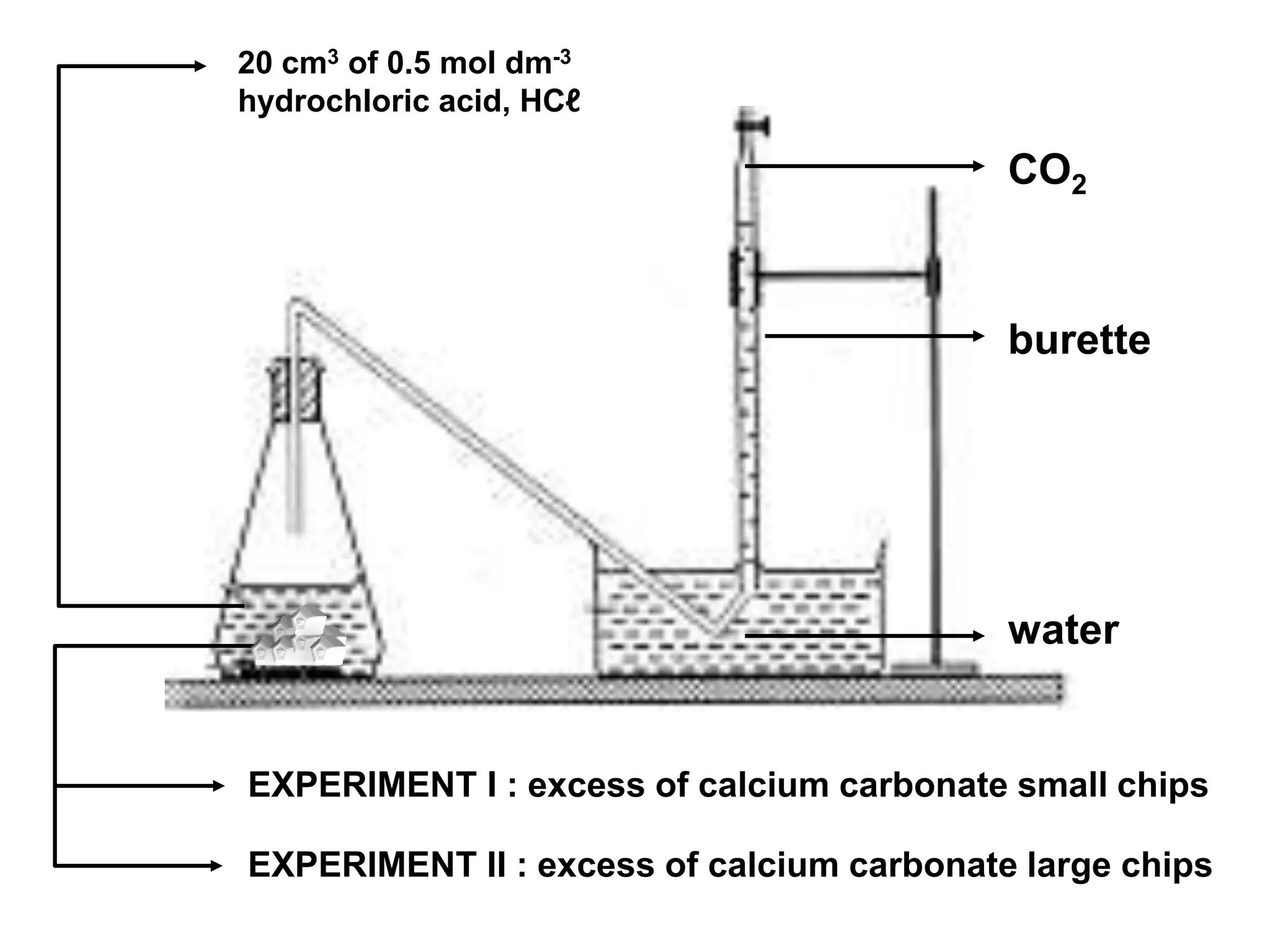
experimentsFactor 1:size of SOLIDReactant :Differents SIZE :calcium carbonate, CaCO3Fixed VOLUME and CONCENTRATION :20 cm3 of 0.5 mol dm-3hydrochloric acid, HCℓ
20 cm3 of 0.5 mol dm-3 hydrochloric acid, HCℓCO2burettewaterEXPERIMENT I : excess of calcium carbonate small chipsEXPERIMENT II : excess of calcium carbonate large chips
size of SOLIDcalcium carbonate, CaCO3LARGESMALLPOWDER
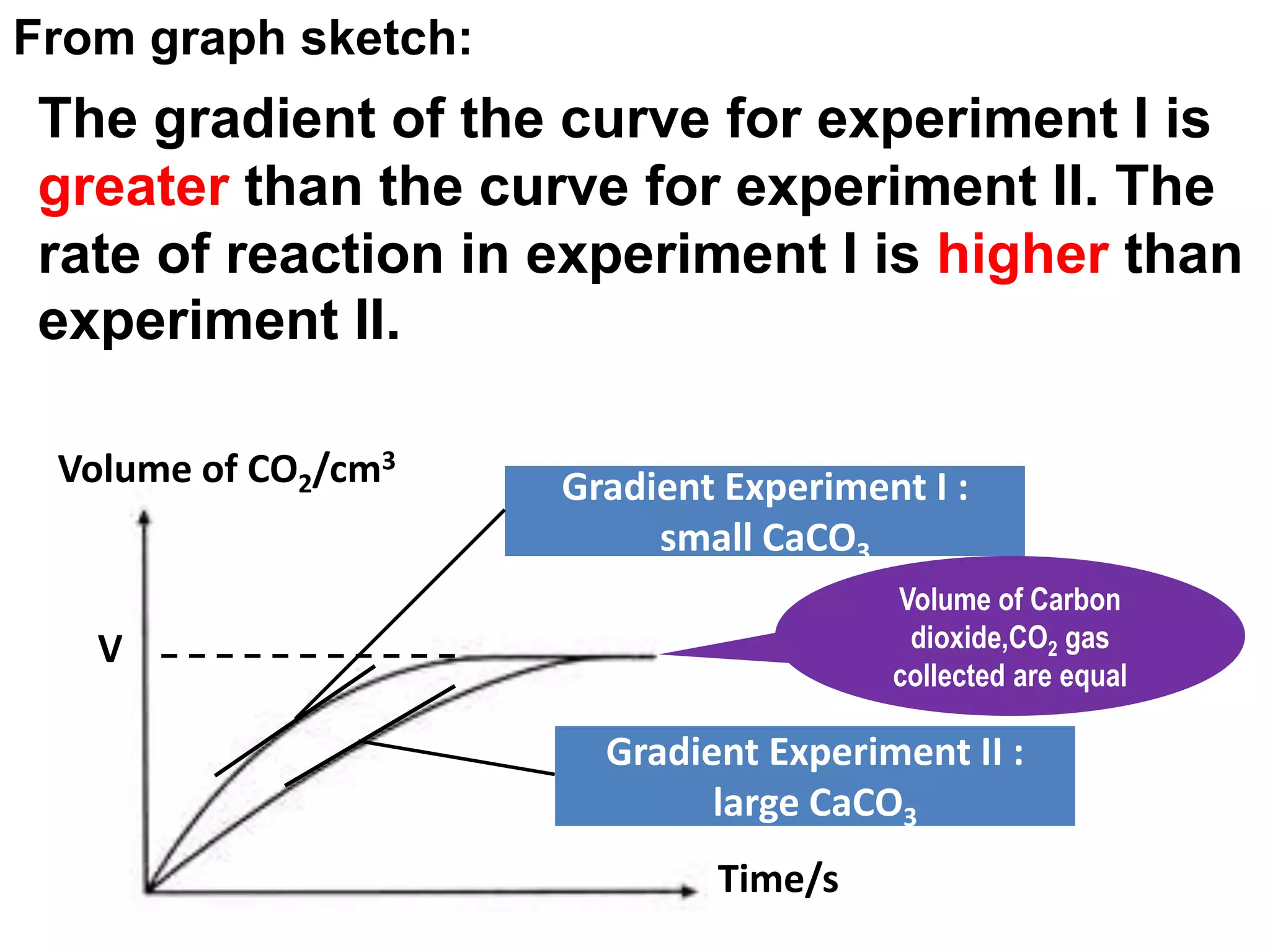
Balanced equation :CaCO3(s) + 2HCl(aq)  CaCl2(aq) + H2O(l) + CO2(g)Observable changes:Volume of carbon dioxide collected every 30 seconds by water displacement in the burette.Volume of CO2/cm3Experiment I : small CaCO3VExperiment II : large CaCO3Time/s
From graph sketch:The gradient of the curve for experiment I is greater than the curve for experiment II. The rate of reaction in experiment I is higher than experiment II.Volume of CO2/cm3Gradient Experiment I : small CaCO3Volume of Carbon dioxide,CO2 gas collected are equalVGradient Experiment II : large CaCO3Time/s
The gradient of the curve for experiment I is greater than the curve for experiment II. The rate of reaction in experiment I is higherthan experiment II.The rate of reaction of the small calcium carbonate chips is higher.Since calcium carbonate used in excess, all hydrochloric acid has reacted. [ HCℓ reacted completed  CaCO3excess].The number of mole of hydrochloric acid in both experiments:= 0.5 mol dm-3 x 20 cm3            1000= 0.01 molThe volume of carbon dioxide gas collected for both experiments are equal because number of mol of hydrochloric acid experiment I and experiment II are equal=    MV      1000
explaination…!break into small size1 unit2 unitTotal surface Area = 6 sides x 2 unit x 2 unit= 24 unit2Total surface Area = 8 cubes x 6 sides x 1 unit x 1 unit= 48 unit2Size of reactant (solid) decrease, total surface area for reaction occurs increase, reaction occurs faster, rate of reaction is higher.
experimentsFactor 2:concentration of SOLUTIONReactant :Differents CONCENTRATION :45 cm3 of 0.2 mol dm-3sodium thiosulphate, Na2S2O3 [diluted with different volume of distilled water]Fixed VOLUME and TEMPERATURE :5 cm3 of 1.0 mol dm-3sulphuric acid, H2SO4
Record the time as soon as the cross mark cannot be seenMencatatmasasebaiksahajatandapangkahtidakkelihatanExperiment repeated, four more times using 2.0 mol dm-3 sodium thiosulphate solution dilute with different volume of distilled water.Sodium thiosulphate solution + sulphuric acid + distilled waterLarutannatriumtiosulfat  + asidsulfurik + air sulingWhite paperKertasputihCross markTandapangkahV x 0.250
concentration of SOLUTIONExperiment 1: Concentration Na2S2O3 (high concentration)1. Measure 50 cm3 of 0.2 mol dm3 sodium thiosulphate solution and pour into conical flask.2. Measure 5 cm3sulphuric acid and mix into solution in conical flask. At the same time, start the stopwatch.3. Swirl and see “X” sign disappear (no longer visible) Concentration of Na2S203 used is changed when diluted with distilled water in Experiment 2 until Experiment 5. Total volume of Na2S203 and distilled are 50 cm3Experiment 2-5: Concentration Na2S2O3 (lower concentration)1. Measure 40 cm3 of 0.2 mol dm3 sodium thiosulphate solution and pour into conical flask and diluted with 10 cm3 distilled water. (total volume = 50 cm3)2. Measure 5 cm3sulphuric acid and mix into solution in conical flask. At the same time, start the stopwatch.3. Swirl and see “X” sign disappear (no longer visible)
Balanced equation :Na2S2O3(aq) + H2SO4(aq)  Na2SO4(aq) + H2O(l) + SO2(g) + S(s)Yellow precipitateObservable changes:Time taken for the ‘X’ sign placed under the conical flask to disappear from view. Fixed quantity of solid sulphur is formed in every experiment.
Graph concentration of Na2S2O3 against timeAs the concentration of sodium thiosulphate solution decrease, the longer time is needed for marked cross to disappear.Concentration of sodium thiosulphate solution is inversely proportional to time taken for the marked cross to disappear.The higher the concentration, the short is the time taken for the yellowsulphurprecipitate to appear and the faster for the ‘X’ sign to disappear.
Graph concentration of Na2S2O3 against 1/timeAs the concentration of sodium thiosulphate solution increase, the value of 1/time increases. 1/time represents the rate of reaction.The higher the concentration of sodium thiosulphate solution, the higher is the rate of reaction
explaination…!sulphur atomconcentrated solutiondiluted solutionNumber of particle per unit volume higherNumber of particle per unit volume lowerConcentration of reactant increase,Number of particle per unit volume increase, Products formed increase because reaction occurs faster, Rate of reaction is higher.
experimentsFactor 2:temperatureof SOLUTIONReactant :DifferentsTEMPERATURE :Heat sodium thiosulphate, Na2S2O3 solution increase temperature to 35oC, 40oC, 45oC, 50oC respectivelyFixed VOLUME and CONCENTRATION :5 cm3 of 1.0 mol dm-3sulphuric acid, H2SO450 cm3 of 0.2 mol dm-3 sodium thiosulphate, Na2S2O3
50 cm3 of 2.0 mol dm-3 sodium thiosulphate solution5cm3 1.0 mol dm-3 sulphuric acid Cross markTandapangkahWhite paperKertasputihSodium thiosulphate solution + sulphuric acidLarutannatriumtiosulfat  + asidsulfurik
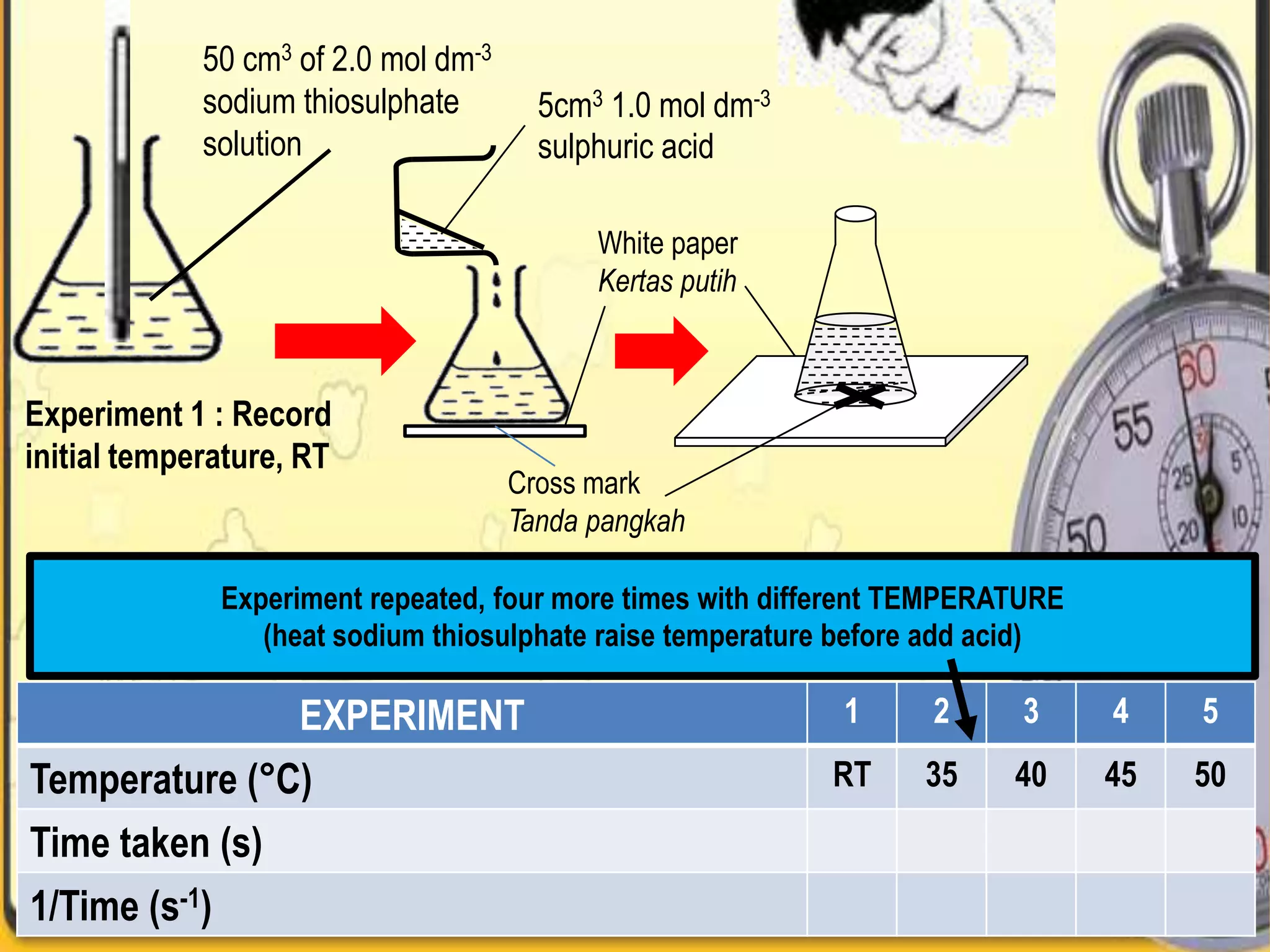
50 cm3 of 2.0 mol dm-3 sodium thiosulphate solution5cm3 1.0 mol dm-3 sulphuric acid White paperKertasputihExperiment 1 : Record initial temperature, RTCross markTandapangkahExperiment repeated, four more times with different TEMPERATURE (heat sodium thiosulphate raise temperature before add acid)
Balanced equation :Na2S2O3(aq) + H2SO4(aq)  Na2SO4(aq) + H2O(l) + SO2(g) + S(s)Yellow precipitateObservable changes:Time taken for the ‘X’ sign placed under the conical flask to disappear from view. Fixed quantity of solid sulphur is formed in every experiment.
Graph temperature of Na2S2O3 against timeFrom the graph;As the temperature of sodium thiosulphate solution decreases, a longer time needed for the marked cross to disappearTemperature of sodium thiosulphate solution is inversely proportional to time taken for the ‘X’ sign to disappear.Temperature of Na2S2O3, °CExp. 5Exp. 4Exp. 3Exp. 2Exp. 1Time / sThe higher the temperature, the lower/shorter is the time taken for the yellowsulphur precipitate to appear and the faster for the ‘X’ sign to disappear.
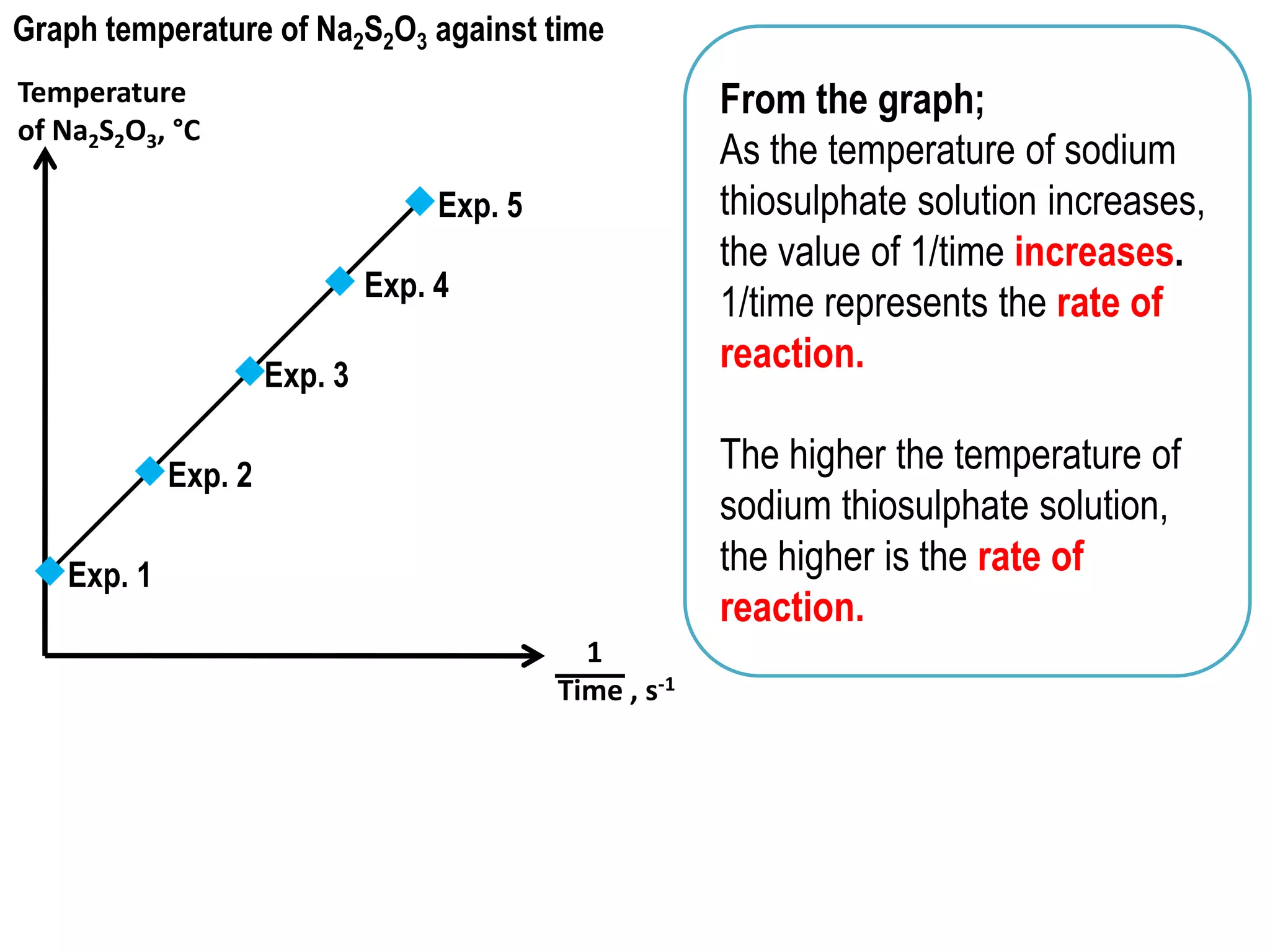
Graph temperature of Na2S2O3 against timeFrom the graph;As the temperature of sodium thiosulphate solution increases, the value of 1/time increases. 1/time represents the rate of reaction.The higher the temperature of sodium thiosulphate solution, the higher is the rate of reaction.Temperature of Na2S2O3, °CExp. 5Exp. 4Exp. 3Exp. 2Exp. 1    1Time , s-1
explaination…!Temperature : HighEnergy Content HighHigher Kinetic EnergyParticles Move FasterTemperature : LowEnergy Content LowLower Kinetic EnergyParticles Move SlowerTemperature of reactant increase,kinetic energy increase, particles move faster then easily collide each others, Products formed increase because reaction occurs faster, Rate of reaction is higher.
A (more/less) concentrated liquid detergent is more effective to remove dirt from the clothes as compared to the less concentrated detergent. This is because a (lower/higher) concentrated liquid detergent contains more particles per unit (volume/mass). The rate of removing dirt from the clothes is (lower/higher).ENHANCEMENTCORNERFood stored in refrigerator lasts longer than food stored in the kitchen cabinet. This is because in a (cold/hot/warm) condition, the bacteria are not active and only produce a (little /more) toxic. As a result, the rate of food decay is (higher/lower) and the food can be stored (shorter/longer).
Chicken in (bigger / smaller) chunks takes a (longer / shorter) time to cook as compared to chicken in (smaller / bigger) chunks. This is because the smaller chunks of chicken have a (larger / smaller) total surface area. (More/Less) heat can be (released / absorbed) resulting in (higher / lower) rate of cooking.ENHANCEMENTCORNERPROBLEM STATEMENTIn the industrial manufacture of chemicals, foods and others; very high temperature and pressure condition to run an industrial process to produce higher yield. Higher cost required to run an industrial process. What we will choose to solve this problem and get optimum condition, run an industrial process in shorter time, lower cost and more products can produced?

Rate Of Reaction

  • 1.
  • 2.
    What is thebest way to fry chicken quickly?Freestyle Fried Chicken
  • 3.
  • 4.
  • 5.
  • 6.
    FACTORS THAT AFFECTTHERATE OF REACTION
  • 7.
    Rate of reactionis affected by :size of SOLIDconcentration of SOLUTIONtemperature of SOLUTIONPresence of catalystpressure of GAS reactant
  • 8.
    experimentsInvestigate factors thataffect the rate of reaction Factor 1:size of SOLIDFactor 2:concentrationof SOLUTIONFactor 3:temperature of SOLUTIONFactor 4:presence of catalyst
  • 9.
    experimentsFactor 1:size ofSOLIDReactant :Differents SIZE :calcium carbonate, CaCO3Fixed VOLUME and CONCENTRATION :20 cm3 of 0.5 mol dm-3hydrochloric acid, HCℓ
  • 10.
    20 cm3 of0.5 mol dm-3 hydrochloric acid, HCℓCO2burettewaterEXPERIMENT I : excess of calcium carbonate small chipsEXPERIMENT II : excess of calcium carbonate large chips
  • 11.
    size of SOLIDcalciumcarbonate, CaCO3LARGESMALLPOWDER
  • 12.
    Balanced equation :CaCO3(s)+ 2HCl(aq)  CaCl2(aq) + H2O(l) + CO2(g)Observable changes:Volume of carbon dioxide collected every 30 seconds by water displacement in the burette.Volume of CO2/cm3Experiment I : small CaCO3VExperiment II : large CaCO3Time/s
  • 13.
    From graph sketch:Thegradient of the curve for experiment I is greater than the curve for experiment II. The rate of reaction in experiment I is higher than experiment II.Volume of CO2/cm3Gradient Experiment I : small CaCO3Volume of Carbon dioxide,CO2 gas collected are equalVGradient Experiment II : large CaCO3Time/s
  • 14.
    The gradient ofthe curve for experiment I is greater than the curve for experiment II. The rate of reaction in experiment I is higherthan experiment II.The rate of reaction of the small calcium carbonate chips is higher.Since calcium carbonate used in excess, all hydrochloric acid has reacted. [ HCℓ reacted completed  CaCO3excess].The number of mole of hydrochloric acid in both experiments:= 0.5 mol dm-3 x 20 cm3 1000= 0.01 molThe volume of carbon dioxide gas collected for both experiments are equal because number of mol of hydrochloric acid experiment I and experiment II are equal= MV 1000
  • 15.
    explaination…!break into smallsize1 unit2 unitTotal surface Area = 6 sides x 2 unit x 2 unit= 24 unit2Total surface Area = 8 cubes x 6 sides x 1 unit x 1 unit= 48 unit2Size of reactant (solid) decrease, total surface area for reaction occurs increase, reaction occurs faster, rate of reaction is higher.
  • 16.
    experimentsFactor 2:concentration ofSOLUTIONReactant :Differents CONCENTRATION :45 cm3 of 0.2 mol dm-3sodium thiosulphate, Na2S2O3 [diluted with different volume of distilled water]Fixed VOLUME and TEMPERATURE :5 cm3 of 1.0 mol dm-3sulphuric acid, H2SO4
  • 17.
    Record the timeas soon as the cross mark cannot be seenMencatatmasasebaiksahajatandapangkahtidakkelihatanExperiment repeated, four more times using 2.0 mol dm-3 sodium thiosulphate solution dilute with different volume of distilled water.Sodium thiosulphate solution + sulphuric acid + distilled waterLarutannatriumtiosulfat + asidsulfurik + air sulingWhite paperKertasputihCross markTandapangkahV x 0.250
  • 18.
    concentration of SOLUTIONExperiment1: Concentration Na2S2O3 (high concentration)1. Measure 50 cm3 of 0.2 mol dm3 sodium thiosulphate solution and pour into conical flask.2. Measure 5 cm3sulphuric acid and mix into solution in conical flask. At the same time, start the stopwatch.3. Swirl and see “X” sign disappear (no longer visible) Concentration of Na2S203 used is changed when diluted with distilled water in Experiment 2 until Experiment 5. Total volume of Na2S203 and distilled are 50 cm3Experiment 2-5: Concentration Na2S2O3 (lower concentration)1. Measure 40 cm3 of 0.2 mol dm3 sodium thiosulphate solution and pour into conical flask and diluted with 10 cm3 distilled water. (total volume = 50 cm3)2. Measure 5 cm3sulphuric acid and mix into solution in conical flask. At the same time, start the stopwatch.3. Swirl and see “X” sign disappear (no longer visible)
  • 19.
    Balanced equation :Na2S2O3(aq)+ H2SO4(aq)  Na2SO4(aq) + H2O(l) + SO2(g) + S(s)Yellow precipitateObservable changes:Time taken for the ‘X’ sign placed under the conical flask to disappear from view. Fixed quantity of solid sulphur is formed in every experiment.
  • 20.
    Graph concentration ofNa2S2O3 against timeAs the concentration of sodium thiosulphate solution decrease, the longer time is needed for marked cross to disappear.Concentration of sodium thiosulphate solution is inversely proportional to time taken for the marked cross to disappear.The higher the concentration, the short is the time taken for the yellowsulphurprecipitate to appear and the faster for the ‘X’ sign to disappear.
  • 21.
    Graph concentration ofNa2S2O3 against 1/timeAs the concentration of sodium thiosulphate solution increase, the value of 1/time increases. 1/time represents the rate of reaction.The higher the concentration of sodium thiosulphate solution, the higher is the rate of reaction
  • 22.
    explaination…!sulphur atomconcentrated solutiondilutedsolutionNumber of particle per unit volume higherNumber of particle per unit volume lowerConcentration of reactant increase,Number of particle per unit volume increase, Products formed increase because reaction occurs faster, Rate of reaction is higher.
  • 23.
    experimentsFactor 2:temperatureof SOLUTIONReactant:DifferentsTEMPERATURE :Heat sodium thiosulphate, Na2S2O3 solution increase temperature to 35oC, 40oC, 45oC, 50oC respectivelyFixed VOLUME and CONCENTRATION :5 cm3 of 1.0 mol dm-3sulphuric acid, H2SO450 cm3 of 0.2 mol dm-3 sodium thiosulphate, Na2S2O3
  • 24.
    50 cm3 of2.0 mol dm-3 sodium thiosulphate solution5cm3 1.0 mol dm-3 sulphuric acid Cross markTandapangkahWhite paperKertasputihSodium thiosulphate solution + sulphuric acidLarutannatriumtiosulfat + asidsulfurik
  • 25.
    50 cm3 of2.0 mol dm-3 sodium thiosulphate solution5cm3 1.0 mol dm-3 sulphuric acid White paperKertasputihExperiment 1 : Record initial temperature, RTCross markTandapangkahExperiment repeated, four more times with different TEMPERATURE (heat sodium thiosulphate raise temperature before add acid)
  • 26.
    Balanced equation :Na2S2O3(aq)+ H2SO4(aq)  Na2SO4(aq) + H2O(l) + SO2(g) + S(s)Yellow precipitateObservable changes:Time taken for the ‘X’ sign placed under the conical flask to disappear from view. Fixed quantity of solid sulphur is formed in every experiment.
  • 27.
    Graph temperature ofNa2S2O3 against timeFrom the graph;As the temperature of sodium thiosulphate solution decreases, a longer time needed for the marked cross to disappearTemperature of sodium thiosulphate solution is inversely proportional to time taken for the ‘X’ sign to disappear.Temperature of Na2S2O3, °CExp. 5Exp. 4Exp. 3Exp. 2Exp. 1Time / sThe higher the temperature, the lower/shorter is the time taken for the yellowsulphur precipitate to appear and the faster for the ‘X’ sign to disappear.
  • 28.
    Graph temperature ofNa2S2O3 against timeFrom the graph;As the temperature of sodium thiosulphate solution increases, the value of 1/time increases. 1/time represents the rate of reaction.The higher the temperature of sodium thiosulphate solution, the higher is the rate of reaction.Temperature of Na2S2O3, °CExp. 5Exp. 4Exp. 3Exp. 2Exp. 1 1Time , s-1
  • 29.
    explaination…!Temperature : HighEnergyContent HighHigher Kinetic EnergyParticles Move FasterTemperature : LowEnergy Content LowLower Kinetic EnergyParticles Move SlowerTemperature of reactant increase,kinetic energy increase, particles move faster then easily collide each others, Products formed increase because reaction occurs faster, Rate of reaction is higher.
  • 30.
    A (more/less) concentratedliquid detergent is more effective to remove dirt from the clothes as compared to the less concentrated detergent. This is because a (lower/higher) concentrated liquid detergent contains more particles per unit (volume/mass). The rate of removing dirt from the clothes is (lower/higher).ENHANCEMENTCORNERFood stored in refrigerator lasts longer than food stored in the kitchen cabinet. This is because in a (cold/hot/warm) condition, the bacteria are not active and only produce a (little /more) toxic. As a result, the rate of food decay is (higher/lower) and the food can be stored (shorter/longer).
  • 31.
    Chicken in (bigger/ smaller) chunks takes a (longer / shorter) time to cook as compared to chicken in (smaller / bigger) chunks. This is because the smaller chunks of chicken have a (larger / smaller) total surface area. (More/Less) heat can be (released / absorbed) resulting in (higher / lower) rate of cooking.ENHANCEMENTCORNERPROBLEM STATEMENTIn the industrial manufacture of chemicals, foods and others; very high temperature and pressure condition to run an industrial process to produce higher yield. Higher cost required to run an industrial process. What we will choose to solve this problem and get optimum condition, run an industrial process in shorter time, lower cost and more products can produced?