The Raw Materials of cell
The Building Blocks of Life
The Molecules of Cells
Biomolecules
Rahna.K.Rathnan
Assistant professor
Sahrdaya College of engineering and technology
Biomolecules are Organic
Molecules
 Molecules containing Carbon, Hydrogen, Nitrogen, and
Oxygen.
 All are polymers
 All are organic (C) compounds
 They make up living organisms
 Examples: Glucose (C6H12O6)
Biological Macromolecules
 Life depends on four types of organic macromolecules:
1. Carbohydrates
2. Lipids
3. Proteins
4. Nucleic acids
Can you think of an example of each?Can you think of an example of each?
 Carbohydrates
 Energy, support and recognition
 Proteins
 Enzymes, structure, recognition, transport pigments, signals,
mov’t
 Lipids
 Cell membrane structure energy storage, signals cellular
metabolism (VitK..)
 Nucleic Acids
 Hereditary and protein information, energy, signals
Function:
 Carbohydrates
 Polysaccharide of simple sugars
 Proteins.
 Polypeptide.of amino acids
 Lipids.
 Insoluble in water..although common polymer glycerol and fatty acid
 Nucleic Acids.
 Polynucleotide..of nucleotides
Structure:
Biomolecules made up of
 Subunits ( Monomer)
 The smaller molecules that are the building blocks of macro molecules
 Glucose ---------cellulose
 Amino Acids --------Proteins
 Fatty acids and glycerol -----------lipids
Carbohydrate
1. Carbohydrates
 Contain carbon, hydrogen and oxygen in a ratio of 1:2:1
 Account for less that 1% of body weight
 Used as energy source
 Called saccharides
Carbohydrate
 Simple sugars:
 Monosaccharide:
 Disaccharides
 Complex sugars
 Polysaccharides
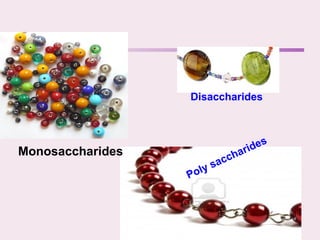
Monosaccharides
Disaccharides
Poly saccharides
Monosaccharides
 Simple sugars:
 Monosaccharide:
 “One” “Sugar”

glucose

Galactose

Fructose
Simple Sugars:Disaccharides
 Disaccharide
 “Two” “Sugars”
 Examples:
 Table sugar = Glucose + Fructose
 Maltose = Glucose + Glucose
 Lactose = galactose + Glucose
Disaccharides
Sucrose
Lactose
Polysaccharide
 “many sugars” Complex Sugar.: polymer
 any molecule made up of several repeating units.
 Starch is a polymer of glucose.
 Functions: Cells use them for energy and structure.
 They allow organisms to gradually use energy since it is
stored in a large structure. (like the Bank)
Polysaccharides
 Starch = energy storage in plants
 Glycogen = energy storage in animals
 Cellulose = plant cell wall
 All are long strings of glucose molecules
 Difference lies in how they are bonded together
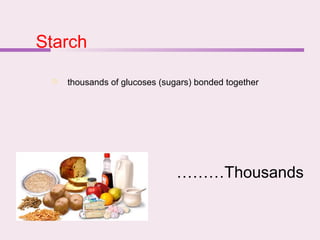
Starch
 thousands of glucoses (sugars) bonded together
………Thousands
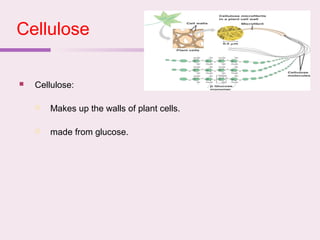
Cellulose
 Cellulose:
 Makes up the walls of plant cells.
 made from glucose.
Polysaccharides
Starch...bonds between
glucose can be digested
Amylose=plant Glycogen =animal
Cellulose…bonds
between glucose cannot
be digested by mammals
Polysaccharides
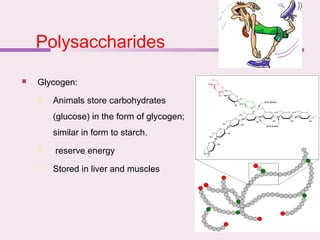
 Glycogen:
 Animals store carbohydrates
(glucose) in the form of glycogen;
similar in form to starch.
 reserve energy
 Stored in liver and muscles
Nucleic acidsNucleic acids
Nucleic Acids
 Molecules of heredity
 Macromolecules
 Made up of nucleotide
 Two types
 DNA ( Nucleus)
 RNA(90% cytoplasm,10% nucleolus)
 mRNA
 tRNA
 rRNA
Nucleic Acids
 Information storage
 DNA (deoxyribonucleic acid)
 Protein synthesis
 RNA (ribonucleic acid)
 Energy transfers
 ATP (adenosine tri-phosphate) and NAD
(nicotinamide adenine dinucleotide)
Nucleic acids
 Contain C, H, O, N, and P
 Made up of nucleotide
 Nucleotide consists of
 Sugar
 Phosphate group
 Nitrogenous base
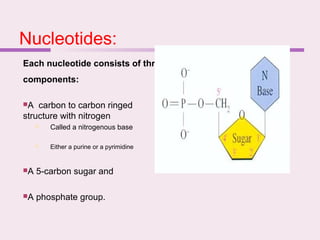
Nucleotides:
Each nucleotide consists of three
components:
A carbon to carbon ringed
structure with nitrogen
 Called a nitrogenous base
 Either a purine or a pyrimidine
A 5-carbon sugar and
A phosphate group.
Nitrogenous bases found in the two nucleic acid types
are different
DNA = A T C G
RNA = A U C G
Two types
Purine :A&G
Pyramidine : T,C,U
 Adenine, cytosine, and guanine
are found in both RNA and DNA
 Thymine -DNA
 uracil - RNA.
Nucleic acid types differ in the structure
of the sugar
That OH makes RNA less
stable---easily degraded
RNA is a transient
molecule..
 DNA contains
2-deoxyribose
 RNA contains ribose
 The only difference is
the presence or absence of a a OH
(hydroxyl group) on the second
carbon
All nucleotides have a phosphate group
 Phosphate – as found in
phospholipids
 HPO4
 Found between two
adjacent nucleotides in a
polypeptide
 Sugar – phosphate
backbone
Nucleotide Polymerization Reaction:
Phosphodiester Bond Formation
Structure of DNA
DNA Double HelixDNA Double Helix
NitrogenousNitrogenous
Base (A,T,G or C)Base (A,T,G or C)
““Rungs of ladder”Rungs of ladder”
““Legs of ladder”Legs of ladder”
Phosphate &Phosphate &
Sugar BackboneSugar Backbone
Chapter 10: DNA Structure & Analysis 32
Watson and Crick
Model
 Double stranded
 right-handed helix
 Antiparallel strands
 5’ to 3’polarity
 Sugar phosphate backbone on outside of
helix
 bases pointing inward
 Bases of opposite strands are H-bonded
together
 C-G; 3 bonds
 A-T; 2 bonds
• Major and minor groove
• Complementary base pairing
 Bases are 0.34 nm (3.4 angstroms) apart
in a strand
 3.4 nm 0r 34 angstroms per turn of the
helix
 10 nt per turn
 Helix is 2 nm or 20 angstroms in diameter
Complementary base pairing Rule
Adenine always base pairs with Thymine (or Uracil if RNA) -----
Double bond
Cytosine always base pairs with Guanine---------- triple bond
Purines Pyramidines
Adenine Thymine
Adenine Uracil
Guanine Cytosine
G C
T A
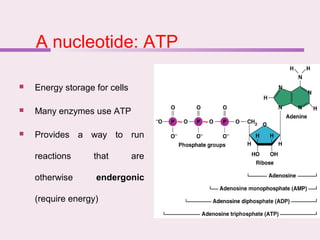
A nucleotide: ATP
 Energy storage for cells
 Many enzymes use ATP
 Provides a way to run
reactions that are
otherwise endergonic
(require energy)
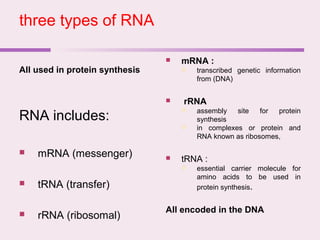
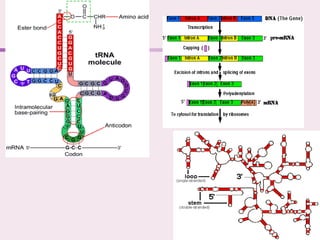
three types of RNA
All used in protein synthesis
All encoded in the DNA
RNA includes:
 mRNA (messenger)
 tRNA (transfer)
 rRNA (ribosomal)
 mRNA :
 transcribed genetic information
from (DNA)
 rRNA
 assembly site for protein
synthesis
 in complexes or protein and
RNA known as ribosomes,
 tRNA :
 essential carrier molecule for
amino acids to be used in
protein synthesis.
Lipids
 naturally occurring organic compounds
 Insoluble in water
 Soluble in ether, chloroform, acetone & benzene
 Contain carbon, hydrogen, and oxygen
 the ratio of C:H is 1:2 (much less O)
 contain other elements, phosphorous, nitrogen, and sulfur
 Form essential structures in cells
 Are important energy stores
40
Types of Lipids
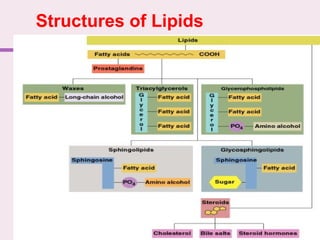
The types of lipids containing fatty acids are
 Waxes.
 Fats and oils (triacylglycerols).
 Glycerophospholipids.
 Prostaglandins.
41
Structures of Lipids
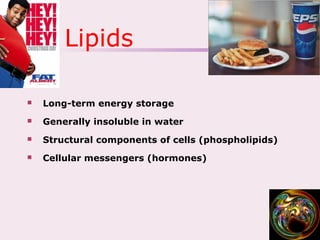
Lipids
 Long-term energy storage
 Generally insoluble in water
 Structural components of cells (phospholipids)
 Cellular messengers (hormones)
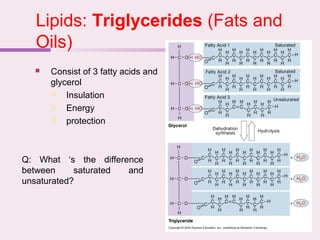
Lipids: Triglycerides (Fats and
Oils)
 Consist of 3 fatty acids and
glycerol
 Insulation
 Energy
 protection
Q: What ‘s the difference
between saturated and
unsaturated?
Lipids: Steroids and
Cholesterol
 All consist of a
complex ring
structure
Lipids: Phospholipids
Amphipathic
Protein
Protein Structure
 most abundant and important organic molecules
 Basic elements:
 carbon (C), hydrogen (H), oxygen (O), and nitrogen (N)
 Basic building blocks:
 20 amino acids
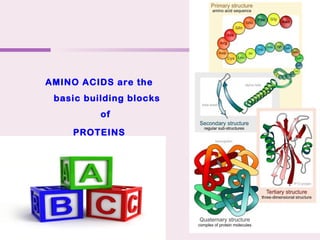
AMINO ACIDS are the
basic building blocks
of
PROTEINS
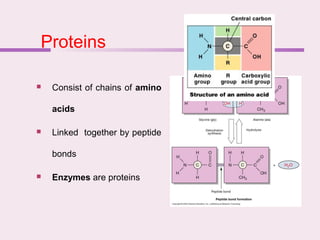
Proteins
 Consist of chains of amino
acids
 Linked together by peptide
bonds
 Enzymes are proteins
Each ball is
An Amino
Acid.
Bonded by
Peptide
Bonds
There are 20
Amino Acids
Each AMINO ACID
has
An amino group,
A carboxyl group,
A hydrogen atom and
a specific side chain (R group)
Bonded to
the α-carbon atom
Protein Function………..!! WOW!!
 Structural…. Bones,skin, nails, hooves, hair
 Enzymatic… Digest sugar, makes DNA, makes fatty acids
 Transport… Carries oxygen and fats in blood, Ca2+/Cl-
 Contractile.. Muscles for movement, move chromosomes
 Hormone…. regulate blood sugar, increase heart rate
 Immunity... Antibodies fight foreign substance
 Pigment….. Pigment in skin, eyes
 Recognition. On cell surfaces—Other molecules (receptors)
 Toxins…… Stops nerve transmission, effects movement of
ions, enzymes that destroy red blood cells
BIOLOGICAL FUNCTIONS OF PROTEINS
1. Catalytic function:
Nearly all chemical reactions in biological systems are catalyzed
by specific enzymes.
2. Transport and storage:
For example;
 Hemoglobin transports oxygen in erythrocytes
 Myoglobin carries & stores oxygen in muscle.
 Albumin transports free fatty acids in blood.
 Transferrin transports iron in blood.
3. Coordinated motion:Actin and myosin are contractile proteins in
muscle.
BIOLOGICAL FUNCTIONS OF PROTEINS (cont.)
4. Structural and Mechanical support:
For Example; collagen, a fibrous protein in skin and bone.
5. Defense function:
For Example Clotting factors prevent loss of blood.
Immunoglobulins protects against infections.
6. Generation and transmission of nerve impulses:
For example, rhodopsin is the photoreceptor protein in retinal
rod cells.
7. Control of growth and differentiation:
For Example
 growth factor proteins.
 hormones such as insulin and thyroid-stimulating
hormone.
General structure of protein
 polymers of twenty known amino acids.
 All biologically known amino acids are α L amino acids.
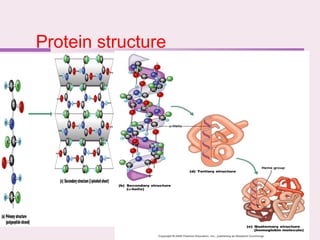
Protein Structure – 4 levels
Primary: amino acid sequence
Secondary: Hydrogen bonds form spirals or pleats
Tertiary: Secondary structure folds into a unique shape
Quaternary: several tertiary structures together
The shape of
protein is
important to its
function.
Enzyme: Quaternary Structure
Protein structure
Shape and Function
 Protein function is based on shape
 Shape is based on sequence of amino acids
 Denaturation:
 loss of shape and function (due to heat, pH change or
other factors)

Biomolecules

  • 1.
    The Raw Materialsof cell The Building Blocks of Life The Molecules of Cells Biomolecules Rahna.K.Rathnan Assistant professor Sahrdaya College of engineering and technology
  • 2.
    Biomolecules are Organic Molecules Molecules containing Carbon, Hydrogen, Nitrogen, and Oxygen.  All are polymers  All are organic (C) compounds  They make up living organisms  Examples: Glucose (C6H12O6)
  • 4.
    Biological Macromolecules  Lifedepends on four types of organic macromolecules: 1. Carbohydrates 2. Lipids 3. Proteins 4. Nucleic acids Can you think of an example of each?Can you think of an example of each?
  • 5.
     Carbohydrates  Energy,support and recognition  Proteins  Enzymes, structure, recognition, transport pigments, signals, mov’t  Lipids  Cell membrane structure energy storage, signals cellular metabolism (VitK..)  Nucleic Acids  Hereditary and protein information, energy, signals Function:
  • 6.
     Carbohydrates  Polysaccharideof simple sugars  Proteins.  Polypeptide.of amino acids  Lipids.  Insoluble in water..although common polymer glycerol and fatty acid  Nucleic Acids.  Polynucleotide..of nucleotides Structure:
  • 7.
    Biomolecules made upof  Subunits ( Monomer)  The smaller molecules that are the building blocks of macro molecules  Glucose ---------cellulose  Amino Acids --------Proteins  Fatty acids and glycerol -----------lipids
  • 8.
  • 9.
    1. Carbohydrates  Containcarbon, hydrogen and oxygen in a ratio of 1:2:1  Account for less that 1% of body weight  Used as energy source  Called saccharides
  • 10.
    Carbohydrate  Simple sugars: Monosaccharide:  Disaccharides  Complex sugars  Polysaccharides
  • 11.
  • 12.
    Monosaccharides  Simple sugars: Monosaccharide:  “One” “Sugar”  glucose  Galactose  Fructose
  • 13.
    Simple Sugars:Disaccharides  Disaccharide “Two” “Sugars”  Examples:  Table sugar = Glucose + Fructose  Maltose = Glucose + Glucose  Lactose = galactose + Glucose
  • 14.
  • 15.
    Polysaccharide  “many sugars”Complex Sugar.: polymer  any molecule made up of several repeating units.  Starch is a polymer of glucose.  Functions: Cells use them for energy and structure.  They allow organisms to gradually use energy since it is stored in a large structure. (like the Bank)
  • 16.
    Polysaccharides  Starch =energy storage in plants  Glycogen = energy storage in animals  Cellulose = plant cell wall  All are long strings of glucose molecules  Difference lies in how they are bonded together
  • 17.
    Starch  thousands ofglucoses (sugars) bonded together ………Thousands
  • 18.
    Cellulose  Cellulose:  Makesup the walls of plant cells.  made from glucose.
  • 19.
    Polysaccharides Starch...bonds between glucose canbe digested Amylose=plant Glycogen =animal Cellulose…bonds between glucose cannot be digested by mammals
  • 20.
    Polysaccharides  Glycogen:  Animalsstore carbohydrates (glucose) in the form of glycogen; similar in form to starch.  reserve energy  Stored in liver and muscles
  • 21.
  • 22.
    Nucleic Acids  Moleculesof heredity  Macromolecules  Made up of nucleotide  Two types  DNA ( Nucleus)  RNA(90% cytoplasm,10% nucleolus)  mRNA  tRNA  rRNA
  • 23.
    Nucleic Acids  Informationstorage  DNA (deoxyribonucleic acid)  Protein synthesis  RNA (ribonucleic acid)  Energy transfers  ATP (adenosine tri-phosphate) and NAD (nicotinamide adenine dinucleotide)
  • 24.
    Nucleic acids  ContainC, H, O, N, and P  Made up of nucleotide  Nucleotide consists of  Sugar  Phosphate group  Nitrogenous base
  • 25.
    Nucleotides: Each nucleotide consistsof three components: A carbon to carbon ringed structure with nitrogen  Called a nitrogenous base  Either a purine or a pyrimidine A 5-carbon sugar and A phosphate group.
  • 26.
    Nitrogenous bases foundin the two nucleic acid types are different DNA = A T C G RNA = A U C G Two types Purine :A&G Pyramidine : T,C,U  Adenine, cytosine, and guanine are found in both RNA and DNA  Thymine -DNA  uracil - RNA.
  • 27.
    Nucleic acid typesdiffer in the structure of the sugar That OH makes RNA less stable---easily degraded RNA is a transient molecule..  DNA contains 2-deoxyribose  RNA contains ribose  The only difference is the presence or absence of a a OH (hydroxyl group) on the second carbon
  • 28.
    All nucleotides havea phosphate group  Phosphate – as found in phospholipids  HPO4  Found between two adjacent nucleotides in a polypeptide  Sugar – phosphate backbone
  • 29.
  • 30.
  • 31.
    DNA Double HelixDNADouble Helix NitrogenousNitrogenous Base (A,T,G or C)Base (A,T,G or C) ““Rungs of ladder”Rungs of ladder” ““Legs of ladder”Legs of ladder” Phosphate &Phosphate & Sugar BackboneSugar Backbone
  • 32.
    Chapter 10: DNAStructure & Analysis 32 Watson and Crick Model  Double stranded  right-handed helix  Antiparallel strands  5’ to 3’polarity  Sugar phosphate backbone on outside of helix  bases pointing inward  Bases of opposite strands are H-bonded together  C-G; 3 bonds  A-T; 2 bonds
  • 33.
    • Major andminor groove • Complementary base pairing  Bases are 0.34 nm (3.4 angstroms) apart in a strand  3.4 nm 0r 34 angstroms per turn of the helix  10 nt per turn  Helix is 2 nm or 20 angstroms in diameter
  • 34.
    Complementary base pairingRule Adenine always base pairs with Thymine (or Uracil if RNA) ----- Double bond Cytosine always base pairs with Guanine---------- triple bond Purines Pyramidines Adenine Thymine Adenine Uracil Guanine Cytosine G C T A
  • 35.
    A nucleotide: ATP Energy storage for cells  Many enzymes use ATP  Provides a way to run reactions that are otherwise endergonic (require energy)
  • 36.
    three types ofRNA All used in protein synthesis All encoded in the DNA RNA includes:  mRNA (messenger)  tRNA (transfer)  rRNA (ribosomal)  mRNA :  transcribed genetic information from (DNA)  rRNA  assembly site for protein synthesis  in complexes or protein and RNA known as ribosomes,  tRNA :  essential carrier molecule for amino acids to be used in protein synthesis.
  • 39.
    Lipids  naturally occurringorganic compounds  Insoluble in water  Soluble in ether, chloroform, acetone & benzene  Contain carbon, hydrogen, and oxygen  the ratio of C:H is 1:2 (much less O)  contain other elements, phosphorous, nitrogen, and sulfur  Form essential structures in cells  Are important energy stores
  • 40.
    40 Types of Lipids Thetypes of lipids containing fatty acids are  Waxes.  Fats and oils (triacylglycerols).  Glycerophospholipids.  Prostaglandins.
  • 41.
  • 42.
    Lipids  Long-term energystorage  Generally insoluble in water  Structural components of cells (phospholipids)  Cellular messengers (hormones)
  • 43.
    Lipids: Triglycerides (Fatsand Oils)  Consist of 3 fatty acids and glycerol  Insulation  Energy  protection Q: What ‘s the difference between saturated and unsaturated?
  • 44.
    Lipids: Steroids and Cholesterol All consist of a complex ring structure
  • 45.
  • 46.
  • 47.
    Protein Structure  mostabundant and important organic molecules  Basic elements:  carbon (C), hydrogen (H), oxygen (O), and nitrogen (N)  Basic building blocks:  20 amino acids
  • 48.
    AMINO ACIDS arethe basic building blocks of PROTEINS
  • 49.
    Proteins  Consist ofchains of amino acids  Linked together by peptide bonds  Enzymes are proteins
  • 50.
    Each ball is AnAmino Acid. Bonded by Peptide Bonds There are 20 Amino Acids
  • 51.
    Each AMINO ACID has Anamino group, A carboxyl group, A hydrogen atom and a specific side chain (R group) Bonded to the α-carbon atom
  • 54.
    Protein Function………..!! WOW!! Structural…. Bones,skin, nails, hooves, hair  Enzymatic… Digest sugar, makes DNA, makes fatty acids  Transport… Carries oxygen and fats in blood, Ca2+/Cl-  Contractile.. Muscles for movement, move chromosomes  Hormone…. regulate blood sugar, increase heart rate  Immunity... Antibodies fight foreign substance  Pigment….. Pigment in skin, eyes  Recognition. On cell surfaces—Other molecules (receptors)  Toxins…… Stops nerve transmission, effects movement of ions, enzymes that destroy red blood cells
  • 55.
    BIOLOGICAL FUNCTIONS OFPROTEINS 1. Catalytic function: Nearly all chemical reactions in biological systems are catalyzed by specific enzymes. 2. Transport and storage: For example;  Hemoglobin transports oxygen in erythrocytes  Myoglobin carries & stores oxygen in muscle.  Albumin transports free fatty acids in blood.  Transferrin transports iron in blood. 3. Coordinated motion:Actin and myosin are contractile proteins in muscle.
  • 56.
    BIOLOGICAL FUNCTIONS OFPROTEINS (cont.) 4. Structural and Mechanical support: For Example; collagen, a fibrous protein in skin and bone. 5. Defense function: For Example Clotting factors prevent loss of blood. Immunoglobulins protects against infections. 6. Generation and transmission of nerve impulses: For example, rhodopsin is the photoreceptor protein in retinal rod cells. 7. Control of growth and differentiation: For Example  growth factor proteins.  hormones such as insulin and thyroid-stimulating hormone.
  • 57.
    General structure ofprotein  polymers of twenty known amino acids.  All biologically known amino acids are α L amino acids.
  • 58.
    Protein Structure –4 levels Primary: amino acid sequence Secondary: Hydrogen bonds form spirals or pleats Tertiary: Secondary structure folds into a unique shape Quaternary: several tertiary structures together
  • 59.
    The shape of proteinis important to its function. Enzyme: Quaternary Structure
  • 60.
  • 61.
    Shape and Function Protein function is based on shape  Shape is based on sequence of amino acids  Denaturation:  loss of shape and function (due to heat, pH change or other factors)

Editor's Notes

  • #30 Figure: 11-08 Caption: Demonstration of 5’-to-3’ synthesis of DNA.