EYE TRACKING TECHNOLOGY
A new track to the future technology
Group Members:
1. Tajwar, Ahmed Shah Rasheed 14-27226-2
2. Gazi, MD.Shaiful Islam 14-27159-2
3. Hossain, Md.Nazmul 14-27414-2
4. Uddin, MD Mazbah 14-27181-2
5. Rahman, MD.Ahashanur 14-27394-2
Course Teacher : Rethwan Faiz
EYE TRACKING – What is it?
 A common man’s perspective – “The process of watching or
tracking the movement of the Human eye”
 The TECHNICAL perspective – “Eye tracking is the process of
measuring either the point of gaze where one is looking or the motion of an
eye towards the point of contact”
EYE TRACKING – What’s the hype about?
 And the next addition to the list of the input devices is the technology of eye
tracking in an already existing output device, the monitor.
 The same device we use for output in PC’s and laptops is used as the
platform to implement the eye tracking technology.
 The eye tracking technology ensures faster input onto the monitor.
Eye tracker - The interface device
 This technology is often referred to as pupil center corneal reflection eye
tracking.
 An eye tracker is a device that uses projection patterns and optical sensors to
gather data about eye position, gaze direction or eye movements with very
high accuracy.
 The use of near-infrared light allows for accurate, continuous tracking
regardless of surrounding light conditions.
A few terms to make ourselves familiar
with…
 Eye-presence detection
 Eye control/gaze control
 Gaze direction and gaze point
How are the eye movements tracked?
Two simple techniques are followed
 Using a light source to illuminate the eye causing highly visible
reflections
 Using a camera to capture an image of the eye showing these
reflections
How does Eye Tracking work?
 Eye tracking the most commonly used technique is Pupil Centre Corneal Reflection (PCCR)
 The IR camera is embedded with the LED(light emitting diode), that emits IR radiation which
passes through the IR filter , that reduces the hazard caused by the rays in the eye.
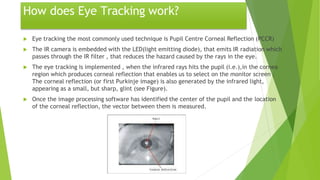
 The eye tracking is implemented , when the infrared rays hits the pupil (i.e.),in the cornea
region which produces corneal reflection that enables us to select on the monitor screen .
The corneal reflection (or first Purkinje image) is also generated by the infrared light,
appearing as a small, but sharp, glint (see Figure).
 Once the image processing software has identified the center of the pupil and the location
of the corneal reflection, the vector between them is measured.
Image processing software
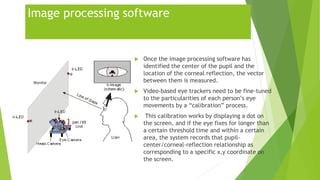
 Once the image processing software has
identified the center of the pupil and the
location of the corneal reflection, the vector
between them is measured.
 Video-based eye trackers need to be fine-tuned
to the particularities of each person’s eye
movements by a “calibration” process.
 This calibration works by displaying a dot on
the screen, and if the eye fixes for longer than
a certain threshold time and within a certain
area, the system records that pupil-
center/corneal-reflection relationship as
corresponding to a specific x,y coordinate on
the screen.
What are the long term effects of infrared
illumination?
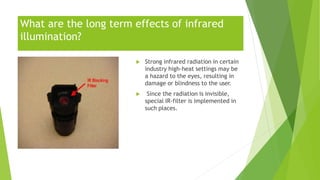
 Strong infrared radiation in certain
industry high-heat settings may be
a hazard to the eyes, resulting in
damage or blindness to the user.
 Since the radiation is invisible,
special IR-filter is implemented in
such places.
Does head movement affect eye
tracking results?
 During an eye tracking session head movements within the eye tracking box
have very little impact on the gaze data accuracy. The optical sensor of the
Eye Trackers is composed of two cameras that capture an image of the eyes at
a given frequency (60 Hz or 120 Hz).
 The two cameras produce two images of the eyes simultaneously and the
respective pupil and corneal reflections providing the eye tracker with two
different sources of information regarding the eye position.
 This type of “stereo data processing” offers a robust calculation of the position
of the eye in space and the point of gaze even if the position of the head
changes.
How does blinking affect eye tracking?
 Blinking is most often an involuntary act of shutting and opening the eyelids.
During each blink the eyelid blocks the pupil and cornea from the illuminator
resulting in raw data points missing the x,y coordinates information. During
analysis fixation filters can be used to remove these points and extrapolate
the data correctly into fixations.
 Provided that the head movements are within the eye tracker specifications,
i.e. that the missing data points do not originate from moving the head away
from the eye tracking box it is also possible to extract information on blinks
from the raw data collected by the eye tracker.
Eye movement metrics
 The process of eye tracking is, from a technical point of view, divided into two
different parts: registering the eye movements and presenting them to the user in
a meaningful way. While the eye tracker records the eye movements sample by
sample, the software running on the computer is responsible for interpreting the
fixations within the data.
 The measurements used in eye tracking:
 Fixations
 Scan path
FIXATIONS
 Fixations can be interpreted quite differently depending on the context.
 In an encoding task (e.g., browsing a web page), higher fixation frequency on a
particular area can be indicative of greater interest in the target, such as a
photograph in a news report, or it can be a sign that the target is complex in some
way and more difficult to encode.
 The duration of a fixation is also linked to the processing-time applied to the
object being fixated
SCANPATH
 In a search task, an optimal scan path is viewed as being a straight line to a desired
target, with relatively short fixation duration at the target .
 Scan path duration: A longer-lasting scan path indicates less efficient scanning.
 Scan path length: A longer scan path indicates less efficient searching (perhaps due
to a sub optimal layout).
 Scan path direction: This can determine a participant’s search strategy with menus,
lists and other interface elements.
 Spatial density: Smaller spatial density indicates more direct search.
ADVANTAGES
 Eye movement is faster than other current input media.
 No training or particular coordination is required of normal users.
 Can determine where the user’s interest is focused automatically.
 Helpful for usability studies to understand users interact with their
environments.
APPLICATIONS
 Eye gaze correction for videoconferencing
 Eye control is used by people who have speech impairments or physical
disabilities, by operators working in heavy industry or using industrial
vehicles, and in operating rooms.
 Maximizing controllers’ efficiency, minimizing dangers in air traffic
displays.
 Developing video games and graphics.
 Marketing research ,E-commerce website development and driving
fatigue.
 Potentially could provide new and more effective methods of computer-
human interaction.
Future Aspects
 Eye-tracking studies in HCI are beginning to burgeon, and the technique
seems set to become an established addition to the current battery of
usability-testing methods employed by commercial and academic HCI
researchers.
 In the future ,eye tracking will be implemented in many others devices also,
for easier and faster operations.
 The future seems rich for eye tracking and HCI.
Conclusion
 Our contention is that eye-movement tracking represents an important,
objective technique that can afford useful advantages for the in-depth
analysis of interface usability.
 Eye tracking is an important technique that offers an objective way to see where
in a scene a person’s visual attention is located.
 However, as with any other analytical technique, it is necessary to have a clear
methodology that is adequate to the context and objectives of the study if we
wish to understand and interpret the eye tracking data correctly.
Thank You!!

Eyetracking

  • 1.
    EYE TRACKING TECHNOLOGY Anew track to the future technology Group Members: 1. Tajwar, Ahmed Shah Rasheed 14-27226-2 2. Gazi, MD.Shaiful Islam 14-27159-2 3. Hossain, Md.Nazmul 14-27414-2 4. Uddin, MD Mazbah 14-27181-2 5. Rahman, MD.Ahashanur 14-27394-2 Course Teacher : Rethwan Faiz
  • 2.
    EYE TRACKING –What is it?  A common man’s perspective – “The process of watching or tracking the movement of the Human eye”  The TECHNICAL perspective – “Eye tracking is the process of measuring either the point of gaze where one is looking or the motion of an eye towards the point of contact”
  • 3.
    EYE TRACKING –What’s the hype about?  And the next addition to the list of the input devices is the technology of eye tracking in an already existing output device, the monitor.  The same device we use for output in PC’s and laptops is used as the platform to implement the eye tracking technology.  The eye tracking technology ensures faster input onto the monitor.
  • 4.
    Eye tracker -The interface device  This technology is often referred to as pupil center corneal reflection eye tracking.  An eye tracker is a device that uses projection patterns and optical sensors to gather data about eye position, gaze direction or eye movements with very high accuracy.  The use of near-infrared light allows for accurate, continuous tracking regardless of surrounding light conditions.
  • 5.
    A few termsto make ourselves familiar with…  Eye-presence detection  Eye control/gaze control  Gaze direction and gaze point
  • 6.
    How are theeye movements tracked? Two simple techniques are followed  Using a light source to illuminate the eye causing highly visible reflections  Using a camera to capture an image of the eye showing these reflections
  • 7.
    How does EyeTracking work?  Eye tracking the most commonly used technique is Pupil Centre Corneal Reflection (PCCR)  The IR camera is embedded with the LED(light emitting diode), that emits IR radiation which passes through the IR filter , that reduces the hazard caused by the rays in the eye.  The eye tracking is implemented , when the infrared rays hits the pupil (i.e.),in the cornea region which produces corneal reflection that enables us to select on the monitor screen . The corneal reflection (or first Purkinje image) is also generated by the infrared light, appearing as a small, but sharp, glint (see Figure).  Once the image processing software has identified the center of the pupil and the location of the corneal reflection, the vector between them is measured.
  • 8.
    Image processing software Once the image processing software has identified the center of the pupil and the location of the corneal reflection, the vector between them is measured.  Video-based eye trackers need to be fine-tuned to the particularities of each person’s eye movements by a “calibration” process.  This calibration works by displaying a dot on the screen, and if the eye fixes for longer than a certain threshold time and within a certain area, the system records that pupil- center/corneal-reflection relationship as corresponding to a specific x,y coordinate on the screen.
  • 9.
    What are thelong term effects of infrared illumination?  Strong infrared radiation in certain industry high-heat settings may be a hazard to the eyes, resulting in damage or blindness to the user.  Since the radiation is invisible, special IR-filter is implemented in such places.
  • 10.
    Does head movementaffect eye tracking results?  During an eye tracking session head movements within the eye tracking box have very little impact on the gaze data accuracy. The optical sensor of the Eye Trackers is composed of two cameras that capture an image of the eyes at a given frequency (60 Hz or 120 Hz).  The two cameras produce two images of the eyes simultaneously and the respective pupil and corneal reflections providing the eye tracker with two different sources of information regarding the eye position.  This type of “stereo data processing” offers a robust calculation of the position of the eye in space and the point of gaze even if the position of the head changes.
  • 11.
    How does blinkingaffect eye tracking?  Blinking is most often an involuntary act of shutting and opening the eyelids. During each blink the eyelid blocks the pupil and cornea from the illuminator resulting in raw data points missing the x,y coordinates information. During analysis fixation filters can be used to remove these points and extrapolate the data correctly into fixations.  Provided that the head movements are within the eye tracker specifications, i.e. that the missing data points do not originate from moving the head away from the eye tracking box it is also possible to extract information on blinks from the raw data collected by the eye tracker.
  • 12.
    Eye movement metrics The process of eye tracking is, from a technical point of view, divided into two different parts: registering the eye movements and presenting them to the user in a meaningful way. While the eye tracker records the eye movements sample by sample, the software running on the computer is responsible for interpreting the fixations within the data.  The measurements used in eye tracking:  Fixations  Scan path
  • 13.
    FIXATIONS  Fixations canbe interpreted quite differently depending on the context.  In an encoding task (e.g., browsing a web page), higher fixation frequency on a particular area can be indicative of greater interest in the target, such as a photograph in a news report, or it can be a sign that the target is complex in some way and more difficult to encode.  The duration of a fixation is also linked to the processing-time applied to the object being fixated
  • 14.
    SCANPATH  In asearch task, an optimal scan path is viewed as being a straight line to a desired target, with relatively short fixation duration at the target .  Scan path duration: A longer-lasting scan path indicates less efficient scanning.  Scan path length: A longer scan path indicates less efficient searching (perhaps due to a sub optimal layout).  Scan path direction: This can determine a participant’s search strategy with menus, lists and other interface elements.  Spatial density: Smaller spatial density indicates more direct search.
  • 15.
    ADVANTAGES  Eye movementis faster than other current input media.  No training or particular coordination is required of normal users.  Can determine where the user’s interest is focused automatically.  Helpful for usability studies to understand users interact with their environments.
  • 16.
    APPLICATIONS  Eye gazecorrection for videoconferencing  Eye control is used by people who have speech impairments or physical disabilities, by operators working in heavy industry or using industrial vehicles, and in operating rooms.  Maximizing controllers’ efficiency, minimizing dangers in air traffic displays.  Developing video games and graphics.  Marketing research ,E-commerce website development and driving fatigue.  Potentially could provide new and more effective methods of computer- human interaction.
  • 17.
    Future Aspects  Eye-trackingstudies in HCI are beginning to burgeon, and the technique seems set to become an established addition to the current battery of usability-testing methods employed by commercial and academic HCI researchers.  In the future ,eye tracking will be implemented in many others devices also, for easier and faster operations.  The future seems rich for eye tracking and HCI.
  • 18.
    Conclusion  Our contentionis that eye-movement tracking represents an important, objective technique that can afford useful advantages for the in-depth analysis of interface usability.  Eye tracking is an important technique that offers an objective way to see where in a scene a person’s visual attention is located.  However, as with any other analytical technique, it is necessary to have a clear methodology that is adequate to the context and objectives of the study if we wish to understand and interpret the eye tracking data correctly.
  • 19.