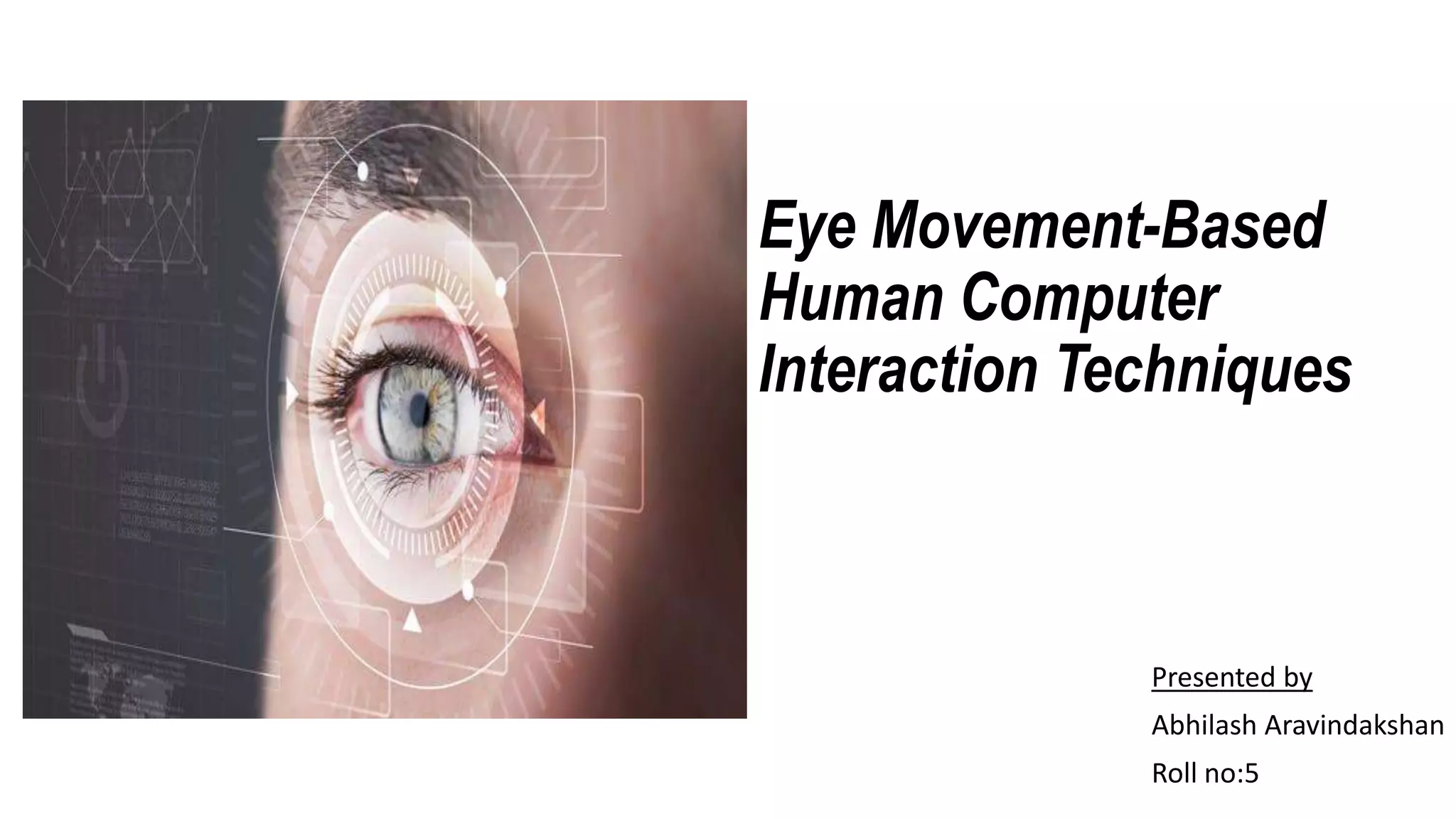
Eye Movement-Based
Human Computer
Interaction Techniques
Presented by
Abhilash Aravindakshan
Roll no:5
Contents
• Introduction
• Current Techniques
• Eye Tracking system
• Methods of Measuring
• Applications
• Advantages
• Limitation
• Conclu
Introduction
• Eye movement-based interaction is one of several areas of current research in human
computer interaction in which a new interface style seems to be emerging. In the non-
command style, the computer passively monitors the user and responds as appropriate, rather than
waiting for the user to issue specific commands.
Current Interfacing Techniques
• Normal Interface
• Touch Screen
• Voice
• Wave
• Eye movement
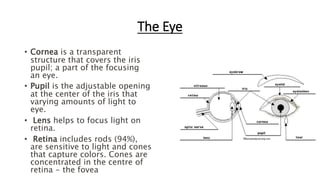
The Eye
• Cornea is a transparent
structure that covers the iris
pupil; a part of the focusing
an eye.
• Pupil is the adjustable opening
at the center of the iris that
varying amounts of light to
eye.
• Lens helps to focus light on
retina.
• Retina includes rods (94%),
are sensitive to light and cones
that capture colors. Cones are
concentrated in the centre of
retina - the fovea
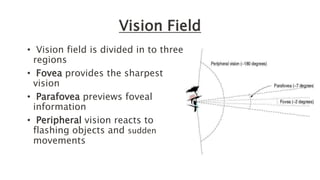
Vision Field
• Vision field is divided in to three
regions
• Fovea provides the sharpest
vision
• Parafovea previews foveal
information
• Peripheral vision reacts to
flashing objects and sudden
movements
Types of Eye Movements
• Fixation
• Saccade
• Pursuit
• Tremor
• Rotation
• Drift
Methods for Measuring Eye
Movements
• Electronic
• Mechanical
• Optical/Video
1. Single point
2. Two point
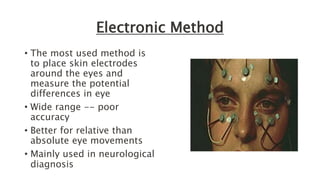
Electronic Method
• The most used method is
to place skin electrodes
around the eyes and
measure the potential
differences in eye
• Wide range -- poor
accuracy
• Better for relative than
absolute eye movements
• Mainly used in neurological
diagnosis
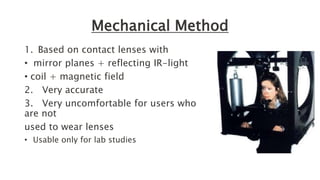
Mechanical Method
1. Based on contact lenses with
• mirror planes + reflecting IR-light
• coil + magnetic field
2. Very accurate
3. Very uncomfortable for users who
are not
used to wear lenses
• Usable only for lab studies
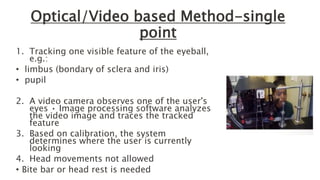
Optical/Video based Method-single
point
1. Tracking one visible feature of the eyeball,
e.g.:
• limbus (bondary of sclera and iris)
• pupil
2. A video camera observes one of the user's
eyes • Image processing software analyzes
the video image and traces the tracked
feature
3. Based on calibration, the system
determines where the user is currently
looking
4. Head movements not allowed
• Bite bar or head rest is needed
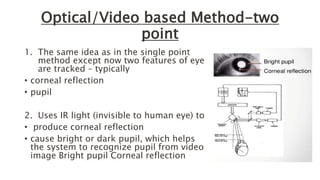
Optical/Video based Method-two
point
1. The same idea as in the single point
method except now two features of eye
are tracked – typically
• corneal reflection
• pupil
2. Uses IR light (invisible to human eye) to
• produce corneal reflection
• cause bright or dark pupil, which helps
the system to recognize pupil from video
image Bright pupil Corneal reflection
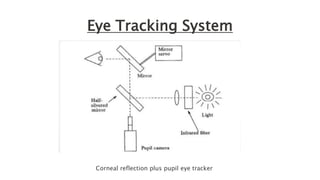
Eye Tracking System
Corneal reflection plus pupil eye tracker
Cont...
• Corneal reflection plus pupil eye tracker
• The pupil camera and illuminator operate along the same optical axis
• Servo controlled mirror is used to compensate for the user’s head
motions.
• tracks the corneal reflection from an infrared light shining on eye and
the outline of the pupil illuminated by same light.
• Computes the visual line of eye gaze by relationship between two
tracked points
Applications
• Automated drug screening.
• Retail advertising effectiveness.
• SurgicalTraining
• Training and simulation
• Vision Research
Advantages
• Eye movement is faster than other current input media.
• No training or particular coordination is required of normal users.
• Can determine where the user’s interest is focused automatically.
• Helpful for usability studies to understand users interact with their
environments
Limitations
• Equipment is expensive
• Some users can't work with the equipment (if they wear contact
lenses or have long eye lashes)
• Moving one's eyes is often an almost subconscious act.
Conclusion
• Emerging InteractionTechnique
• Eye tracking is far from “perfect”
• show the intensity of the user’s attention
Any questions..?
Thankyou.

Presentation%20(1).pptx

  • 1.
    Eye Movement-Based Human Computer InteractionTechniques Presented by Abhilash Aravindakshan Roll no:5
  • 2.
    Contents • Introduction • CurrentTechniques • Eye Tracking system • Methods of Measuring • Applications • Advantages • Limitation • Conclu
  • 3.
    Introduction • Eye movement-basedinteraction is one of several areas of current research in human computer interaction in which a new interface style seems to be emerging. In the non- command style, the computer passively monitors the user and responds as appropriate, rather than waiting for the user to issue specific commands.
  • 4.
    Current Interfacing Techniques •Normal Interface • Touch Screen • Voice • Wave • Eye movement
  • 5.
    The Eye • Corneais a transparent structure that covers the iris pupil; a part of the focusing an eye. • Pupil is the adjustable opening at the center of the iris that varying amounts of light to eye. • Lens helps to focus light on retina. • Retina includes rods (94%), are sensitive to light and cones that capture colors. Cones are concentrated in the centre of retina - the fovea
  • 6.
    Vision Field • Visionfield is divided in to three regions • Fovea provides the sharpest vision • Parafovea previews foveal information • Peripheral vision reacts to flashing objects and sudden movements
  • 7.
    Types of EyeMovements • Fixation • Saccade • Pursuit • Tremor • Rotation • Drift
  • 8.
    Methods for MeasuringEye Movements • Electronic • Mechanical • Optical/Video 1. Single point 2. Two point
  • 9.
    Electronic Method • Themost used method is to place skin electrodes around the eyes and measure the potential differences in eye • Wide range -- poor accuracy • Better for relative than absolute eye movements • Mainly used in neurological diagnosis
  • 10.
    Mechanical Method 1. Basedon contact lenses with • mirror planes + reflecting IR-light • coil + magnetic field 2. Very accurate 3. Very uncomfortable for users who are not used to wear lenses • Usable only for lab studies
  • 11.
    Optical/Video based Method-single point 1.Tracking one visible feature of the eyeball, e.g.: • limbus (bondary of sclera and iris) • pupil 2. A video camera observes one of the user's eyes • Image processing software analyzes the video image and traces the tracked feature 3. Based on calibration, the system determines where the user is currently looking 4. Head movements not allowed • Bite bar or head rest is needed
  • 12.
    Optical/Video based Method-two point 1.The same idea as in the single point method except now two features of eye are tracked – typically • corneal reflection • pupil 2. Uses IR light (invisible to human eye) to • produce corneal reflection • cause bright or dark pupil, which helps the system to recognize pupil from video image Bright pupil Corneal reflection
  • 13.
    Eye Tracking System Cornealreflection plus pupil eye tracker
  • 14.
    Cont... • Corneal reflectionplus pupil eye tracker • The pupil camera and illuminator operate along the same optical axis • Servo controlled mirror is used to compensate for the user’s head motions. • tracks the corneal reflection from an infrared light shining on eye and the outline of the pupil illuminated by same light. • Computes the visual line of eye gaze by relationship between two tracked points
  • 15.
    Applications • Automated drugscreening. • Retail advertising effectiveness. • SurgicalTraining • Training and simulation • Vision Research
  • 16.
    Advantages • Eye movementis faster than other current input media. • No training or particular coordination is required of normal users. • Can determine where the user’s interest is focused automatically. • Helpful for usability studies to understand users interact with their environments
  • 17.
    Limitations • Equipment isexpensive • Some users can't work with the equipment (if they wear contact lenses or have long eye lashes) • Moving one's eyes is often an almost subconscious act.
  • 18.
    Conclusion • Emerging InteractionTechnique •Eye tracking is far from “perfect” • show the intensity of the user’s attention
  • 19.
  • 20.