Driver Drowsiness Detection
Asaad Waqar
Former System Engineer
TUOL
asadwaqar16@gmail.com
+923009183381
Driver’s Drowsiness
• We have heard of many accidents that involve drivers lacking focus.
Most cases are due to the sleep factor(drowsiness)
• Psychological studies have demonstrated that drowsiness can
significantly impair productivity and the quality of work outcomes.
For example, drowsy driving, usually caused by sleep loss, nights or
very long working hours, is reported as one of the main causes of
serious accidents.
• We can divide the driver’s risky driving as:
– drunk driving
– distracted driving
– drug impaired driving
– drowsy driving
– unfastened seat belts, and speeding
Drowsiness & Distraction
• To overcome these mentioned problems
– driver alcohol detection system, distraction
detection system, drowsy detection system and
seat belt detection are actively studied.
• Besides drowsiness, distraction also plays its
part in accidents such as: looking away from
the drive way, not mentally active, using
mobile while driving, eating etc.
How to avoid this problem?
• Physiological measures
• Behavioral measures
• Vehicle-based s
1. Physiological measures: Electrocardiogram (ECG),
electromyogram (EMG), and electroencephalogram (EEG),
start to change in earlier stages of drowsiness. However, it
is inconvenient to drive a vehicle wearing devices to
receive physical signals.
2. Behavioral measures: have relatively high accuracy and do
not cause discomfort to a driver when a device for
behavioral drowsiness detection is installed on the
vehicle. Such as installing a webcam and monitoring
through it. Therefore, this tech is actively studied in the
automotive industries
3. Vehicle-based: Use embedded sensors to sense the path
speed and direction of vehicle.
Not applicable in all regions, especially where there
are more hurdles and turns. E.g.: In Pakistan.
1st Technique
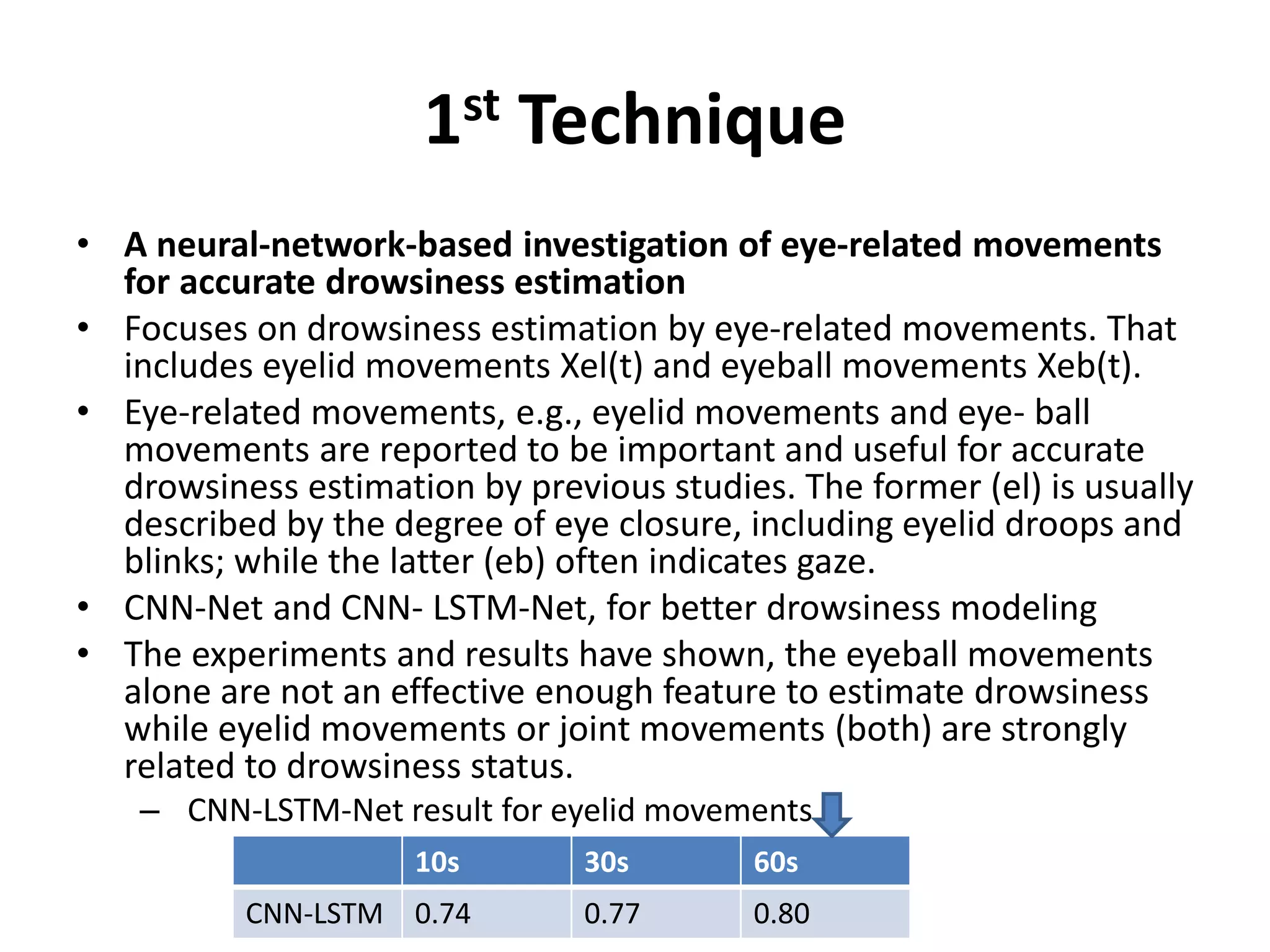
• A neural-network-based investigation of eye-related movements
for accurate drowsiness estimation
• Focuses on drowsiness estimation by eye-related movements. That
includes eyelid movements Xel(t) and eyeball movements Xeb(t).
• Eye-related movements, e.g., eyelid movements and eye- ball
movements are reported to be important and useful for accurate
drowsiness estimation by previous studies. The former (el) is usually
described by the degree of eye closure, including eyelid droops and
blinks; while the latter (eb) often indicates gaze.
• CNN-Net and CNN- LSTM-Net, for better drowsiness modeling
• The experiments and results have shown, the eyeball movements
alone are not an effective enough feature to estimate drowsiness
while eyelid movements or joint movements (both) are strongly
related to drowsiness status.
– CNN-LSTM-Net result for eyelid movements
10s 30s 60s
CNN-LSTM 0.74 0.77 0.80
2nd Technique
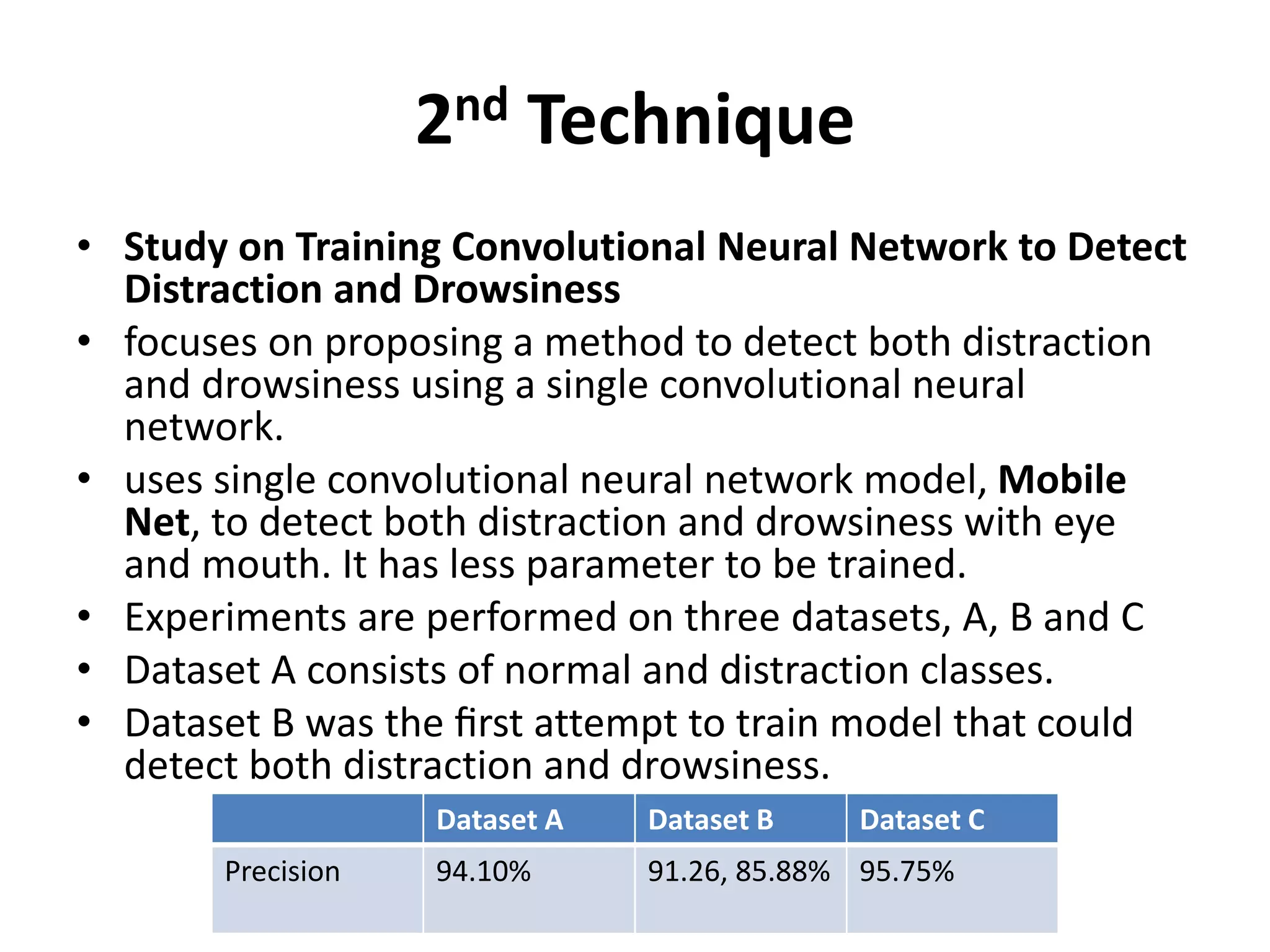
• Study on Training Convolutional Neural Network to Detect
Distraction and Drowsiness
• focuses on proposing a method to detect both distraction
and drowsiness using a single convolutional neural
network.
• uses single convolutional neural network model, Mobile
Net, to detect both distraction and drowsiness with eye
and mouth. It has less parameter to be trained.
• Experiments are performed on three datasets, A, B and C
• Dataset A consists of normal and distraction classes.
• Dataset B was the first attempt to train model that could
detect both distraction and drowsiness.
Dataset A Dataset B Dataset C
Precision 94.10% 91.26, 85.88% 95.75%
3rd Technique
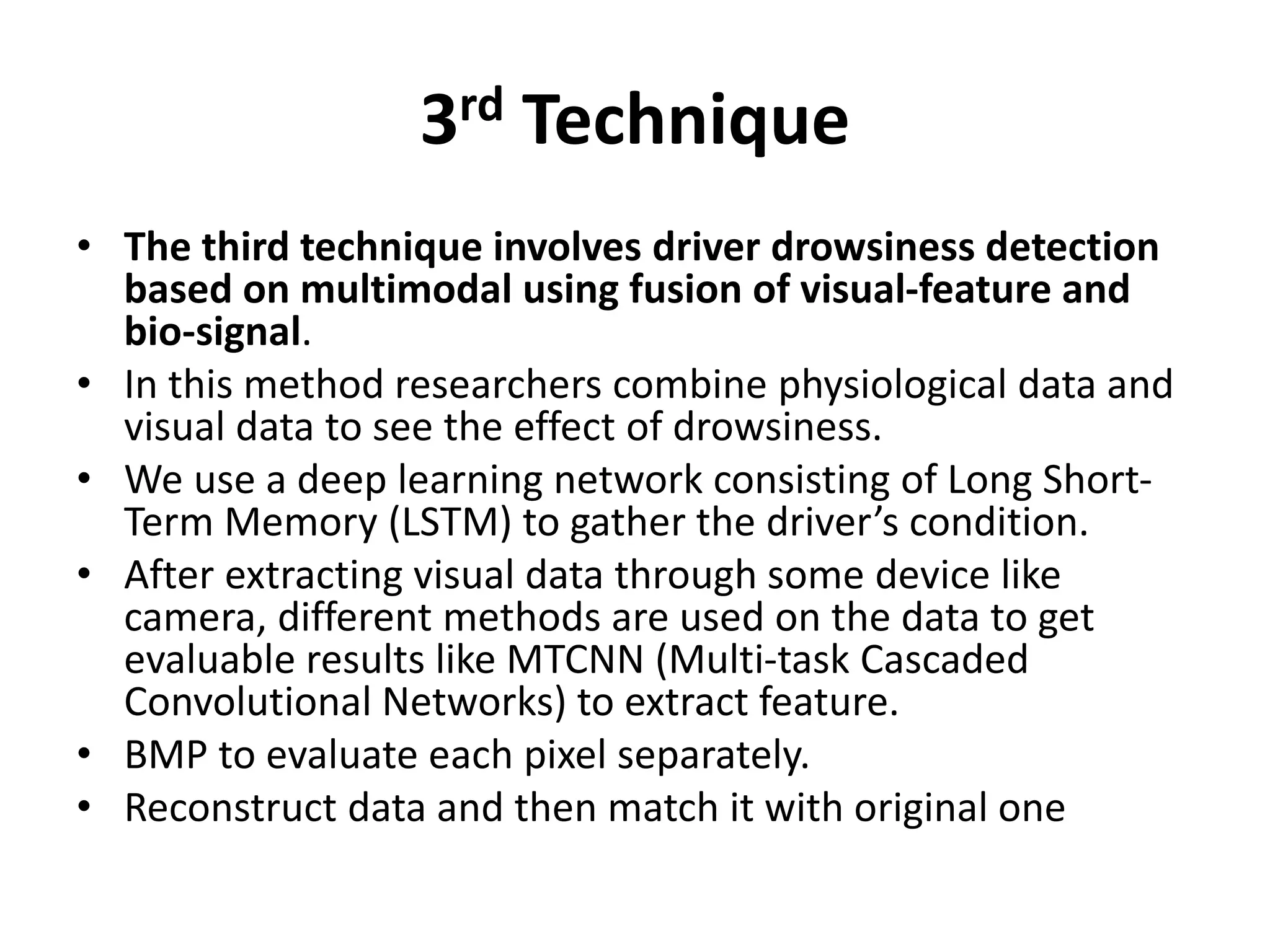
• The third technique involves driver drowsiness detection
based on multimodal using fusion of visual-feature and
bio-signal.
• In this method researchers combine physiological data and
visual data to see the effect of drowsiness.
• We use a deep learning network consisting of Long Short-
Term Memory (LSTM) to gather the driver’s condition.
• After extracting visual data through some device like
camera, different methods are used on the data to get
evaluable results like MTCNN (Multi-task Cascaded
Convolutional Networks) to extract feature.
• BMP to evaluate each pixel separately.
• Reconstruct data and then match it with original one
3rd Technique
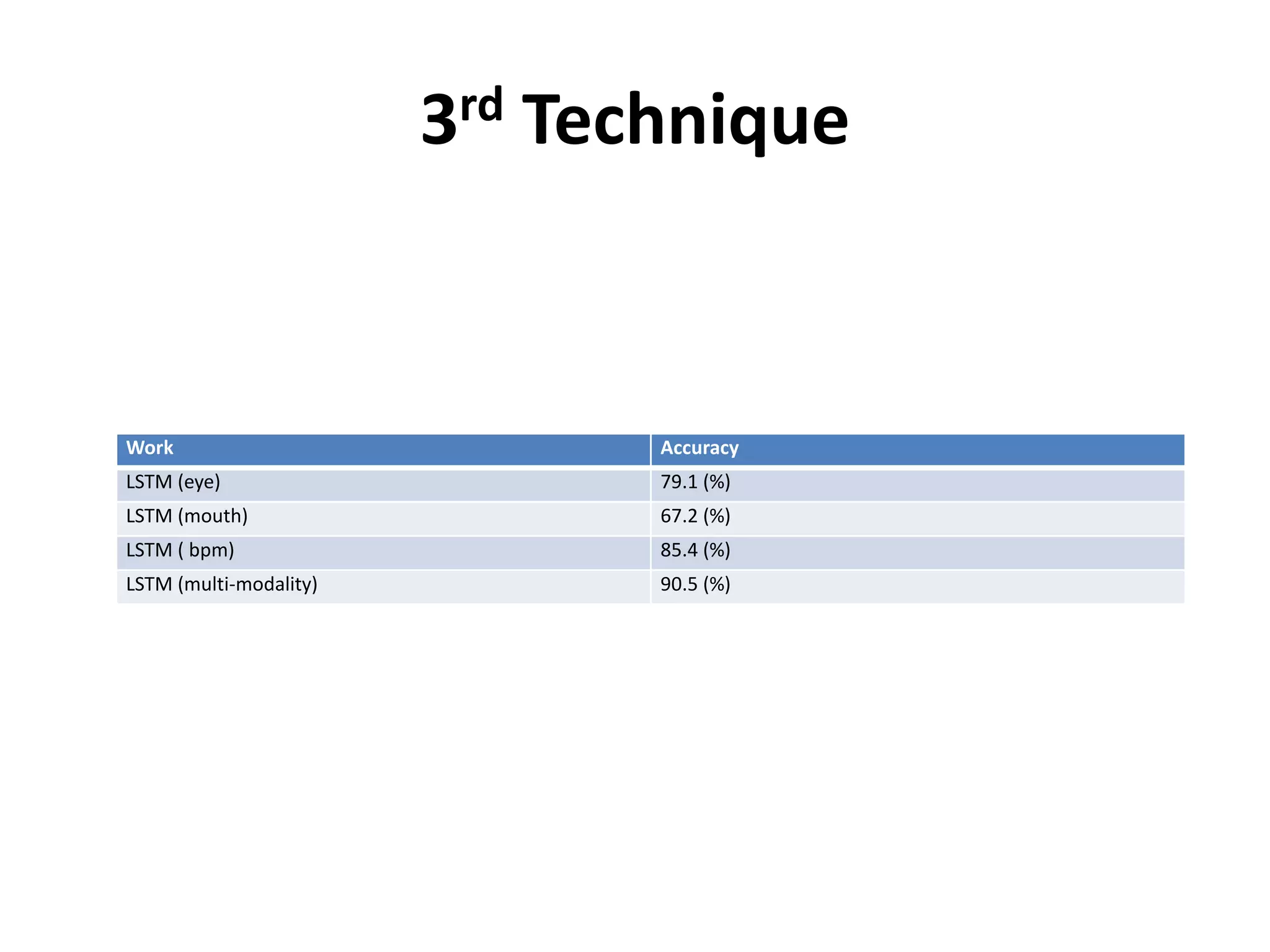
Work Accuracy
LSTM (eye) 79.1 (%)
LSTM (mouth) 67.2 (%)
LSTM ( bpm) 85.4 (%)
LSTM (multi-modality) 90.5 (%)
4th Technique
• The fourth technique detects driver drowsiness
through 3D-deep convolutional neural network
(CNN) .
• This framework consists of four models: Spatio-
temporal representation learning, Scene
condition understanding, Feature fusion,
Drowsiness detection.
• This method is incorporating various driving
conditions i.e: a driving time such as day and
night, a driver’s appearance like wearing glasses
or sun glasses or night glasses.
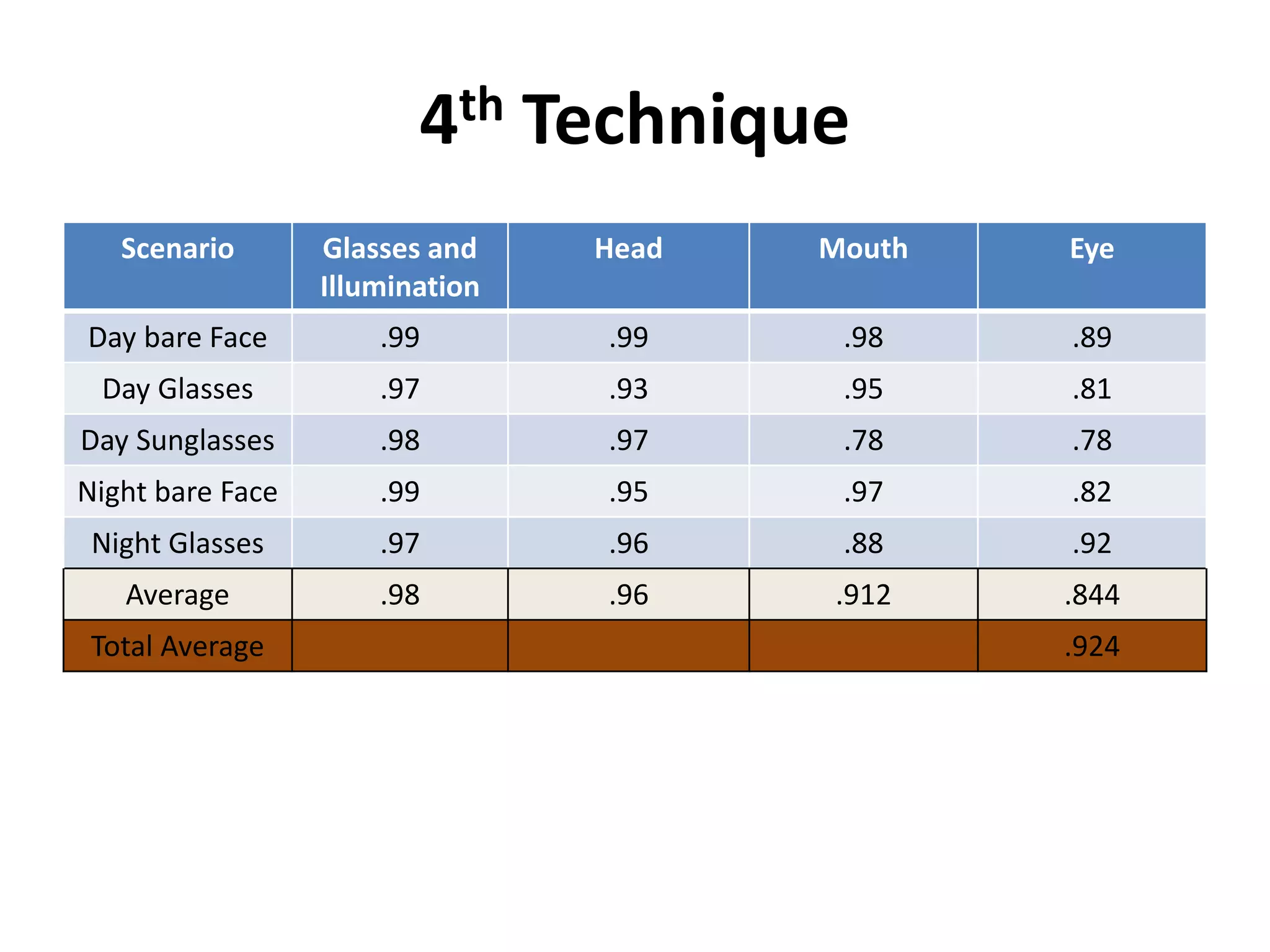
Scenario Glasses and
Illumination
Head Mouth Eye
Day bare Face .99 .99 .98 .89
Day Glasses .97 .93 .95 .81
Day Sunglasses .98 .97 .78 .78
Night bare Face .99 .95 .97 .82
Night Glasses .97 .96 .88 .92
Average .98 .96 .912 .844
Total Average .924
4th Technique
5th Technique
• The fifth technique detects drowsiness using
Multilayer Perceptron Classifier (MLP).
• This framework consists of five steps:
Extracting Videos from NTHU Database,
Extracting Images from Video Frames,
Extracting landmark coordinates from images,
Training the algorithm, Model extraction.
Category Accuracy
With glasses 84.848
Night Without glasses 81.40
Night With glasses 76.152
Without glasses 87.12276
With sunglasses 75.115
All 80.9274
5th Technique
6th Technique
• The sixth technique detects drowsiness using
Filter-Pruned 3D Convolutional Neural Network.
• Drowsiness Detection Dataset (DDD) used in this
model that is collected by Weng et al from
National Tsing Hua university.
• This framework consists of four models for each
video: driver status (drowsy/stillness), eye status
(sleepy/stillness), head status
(nodding/looking/stillness), and mouth status
(yawning/talking/stillness).
6th Technique
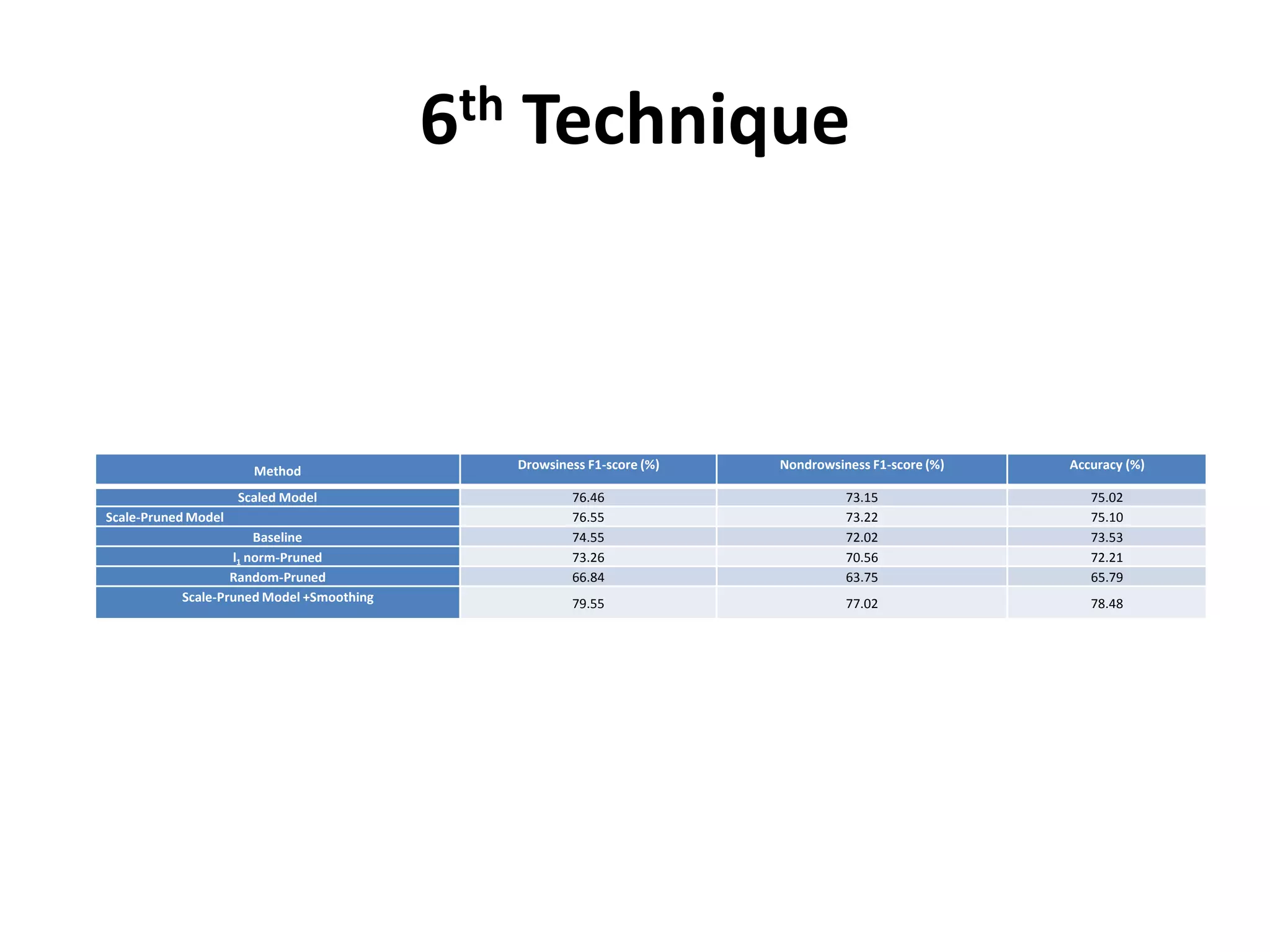
Method Drowsiness F1-score (%) Nondrowsiness F1-score (%) Accuracy (%)
Scaled Model 76.46 73.15 75.02
Scale-Pruned Model 76.55 73.22 75.10
Baseline 74.55 72.02 73.53
l1 norm-Pruned 73.26 70.56 72.21
Random-Pruned 66.84 63.75 65.79
Scale-Pruned Model +Smoothing 79.55 77.02 78.48
CONCUSION
• There are many techniques that are used and can be used for
drowsiness detection among which the most commonly used are
discussed in this paper, which involves behavioral measures,
machine learning techniques, eyelid moments.
• This paper provides the analysis of different techniques, although
many techniques exist but the main purpose of them is the same;
to detect any change in the facial expression of driver to detect any
drowsiness signs.
• The main focus of work is the behavioral measure because they are
non-invasive and do not require a large system to be installed in
vehicle.
• So we concluded from the differences among the performance of
techniques that convolutional neural networks performed better
than the other techniques

Driver Drowsiness Detection Review

  • 1.
    Driver Drowsiness Detection AsaadWaqar Former System Engineer TUOL asadwaqar16@gmail.com +923009183381
  • 2.
    Driver’s Drowsiness • Wehave heard of many accidents that involve drivers lacking focus. Most cases are due to the sleep factor(drowsiness) • Psychological studies have demonstrated that drowsiness can significantly impair productivity and the quality of work outcomes. For example, drowsy driving, usually caused by sleep loss, nights or very long working hours, is reported as one of the main causes of serious accidents. • We can divide the driver’s risky driving as: – drunk driving – distracted driving – drug impaired driving – drowsy driving – unfastened seat belts, and speeding
  • 3.
    Drowsiness & Distraction •To overcome these mentioned problems – driver alcohol detection system, distraction detection system, drowsy detection system and seat belt detection are actively studied. • Besides drowsiness, distraction also plays its part in accidents such as: looking away from the drive way, not mentally active, using mobile while driving, eating etc.
  • 4.
    How to avoidthis problem? • Physiological measures • Behavioral measures • Vehicle-based s
  • 5.
    1. Physiological measures:Electrocardiogram (ECG), electromyogram (EMG), and electroencephalogram (EEG), start to change in earlier stages of drowsiness. However, it is inconvenient to drive a vehicle wearing devices to receive physical signals. 2. Behavioral measures: have relatively high accuracy and do not cause discomfort to a driver when a device for behavioral drowsiness detection is installed on the vehicle. Such as installing a webcam and monitoring through it. Therefore, this tech is actively studied in the automotive industries 3. Vehicle-based: Use embedded sensors to sense the path speed and direction of vehicle. Not applicable in all regions, especially where there are more hurdles and turns. E.g.: In Pakistan.
  • 6.
    1st Technique • Aneural-network-based investigation of eye-related movements for accurate drowsiness estimation • Focuses on drowsiness estimation by eye-related movements. That includes eyelid movements Xel(t) and eyeball movements Xeb(t). • Eye-related movements, e.g., eyelid movements and eye- ball movements are reported to be important and useful for accurate drowsiness estimation by previous studies. The former (el) is usually described by the degree of eye closure, including eyelid droops and blinks; while the latter (eb) often indicates gaze. • CNN-Net and CNN- LSTM-Net, for better drowsiness modeling • The experiments and results have shown, the eyeball movements alone are not an effective enough feature to estimate drowsiness while eyelid movements or joint movements (both) are strongly related to drowsiness status. – CNN-LSTM-Net result for eyelid movements 10s 30s 60s CNN-LSTM 0.74 0.77 0.80
  • 7.
    2nd Technique • Studyon Training Convolutional Neural Network to Detect Distraction and Drowsiness • focuses on proposing a method to detect both distraction and drowsiness using a single convolutional neural network. • uses single convolutional neural network model, Mobile Net, to detect both distraction and drowsiness with eye and mouth. It has less parameter to be trained. • Experiments are performed on three datasets, A, B and C • Dataset A consists of normal and distraction classes. • Dataset B was the first attempt to train model that could detect both distraction and drowsiness. Dataset A Dataset B Dataset C Precision 94.10% 91.26, 85.88% 95.75%
  • 8.
    3rd Technique • Thethird technique involves driver drowsiness detection based on multimodal using fusion of visual-feature and bio-signal. • In this method researchers combine physiological data and visual data to see the effect of drowsiness. • We use a deep learning network consisting of Long Short- Term Memory (LSTM) to gather the driver’s condition. • After extracting visual data through some device like camera, different methods are used on the data to get evaluable results like MTCNN (Multi-task Cascaded Convolutional Networks) to extract feature. • BMP to evaluate each pixel separately. • Reconstruct data and then match it with original one
  • 9.
    3rd Technique Work Accuracy LSTM(eye) 79.1 (%) LSTM (mouth) 67.2 (%) LSTM ( bpm) 85.4 (%) LSTM (multi-modality) 90.5 (%)
  • 10.
    4th Technique • Thefourth technique detects driver drowsiness through 3D-deep convolutional neural network (CNN) . • This framework consists of four models: Spatio- temporal representation learning, Scene condition understanding, Feature fusion, Drowsiness detection. • This method is incorporating various driving conditions i.e: a driving time such as day and night, a driver’s appearance like wearing glasses or sun glasses or night glasses.
  • 11.
    Scenario Glasses and Illumination HeadMouth Eye Day bare Face .99 .99 .98 .89 Day Glasses .97 .93 .95 .81 Day Sunglasses .98 .97 .78 .78 Night bare Face .99 .95 .97 .82 Night Glasses .97 .96 .88 .92 Average .98 .96 .912 .844 Total Average .924 4th Technique
  • 12.
    5th Technique • Thefifth technique detects drowsiness using Multilayer Perceptron Classifier (MLP). • This framework consists of five steps: Extracting Videos from NTHU Database, Extracting Images from Video Frames, Extracting landmark coordinates from images, Training the algorithm, Model extraction.
  • 13.
    Category Accuracy With glasses84.848 Night Without glasses 81.40 Night With glasses 76.152 Without glasses 87.12276 With sunglasses 75.115 All 80.9274 5th Technique
  • 14.
    6th Technique • Thesixth technique detects drowsiness using Filter-Pruned 3D Convolutional Neural Network. • Drowsiness Detection Dataset (DDD) used in this model that is collected by Weng et al from National Tsing Hua university. • This framework consists of four models for each video: driver status (drowsy/stillness), eye status (sleepy/stillness), head status (nodding/looking/stillness), and mouth status (yawning/talking/stillness).
  • 15.
    6th Technique Method DrowsinessF1-score (%) Nondrowsiness F1-score (%) Accuracy (%) Scaled Model 76.46 73.15 75.02 Scale-Pruned Model 76.55 73.22 75.10 Baseline 74.55 72.02 73.53 l1 norm-Pruned 73.26 70.56 72.21 Random-Pruned 66.84 63.75 65.79 Scale-Pruned Model +Smoothing 79.55 77.02 78.48
  • 16.
    CONCUSION • There aremany techniques that are used and can be used for drowsiness detection among which the most commonly used are discussed in this paper, which involves behavioral measures, machine learning techniques, eyelid moments. • This paper provides the analysis of different techniques, although many techniques exist but the main purpose of them is the same; to detect any change in the facial expression of driver to detect any drowsiness signs. • The main focus of work is the behavioral measure because they are non-invasive and do not require a large system to be installed in vehicle. • So we concluded from the differences among the performance of techniques that convolutional neural networks performed better than the other techniques