DROWSINESS DETECTION
- SAURABH NITIN KAWLI
MENTOR : AVANTIKA MA’AM
- LALITKUMAR KANARAMJI CHOUDHARY
MENTOR : KHYATI MA’AM
- Drowsiness of the drivers is one of the key issues for majority of
road accidents.
- Drowsiness threatens the road safety and causes severe
injuries sometimes, resulting in fatality of the victim and
economical losses.
WHAT
IS
DROWSINESS???
APPROACHES TO DETECTING DROWSINESS
• BEHAVIOURAL PARAMETERS-BASED TECHNIQUES
• VEHICULAR PARAMETERS-BASED TECHNIQUES
• PHYSIOLOGICAL PARAMETERS-BASED TECHNIQUES
• DIGITAL IMAGE PROCESSING
• BEHAVIOURAL PARAMETERS-BASED TECHNIQUES
 Measuring the driver’s fatigue without using non-invasive
instruments comes under this category.
 Analysing the behaviour of the driver based on his/her eye
closure ratio, blink frequency, yawning, position of the head
and facial expressions.
• VEHICULAR PARAMETERS-BASED TECHNIQUES
 Measuring the fatigue nature of the driver through vehicle
driving patterns comes under this category.
 These parameters include lane changing patterns, steering
wheel angle, steering wheel grip force, vehicle speed
variability and many more.
• PHYSIOLOGICAL PARAMETERS-BASED TECHNIQUES
 Measuring the drowsiness of the driver based on the
physical conditions of the driver fall under this category.
 Such parameters may be respiration rate, heart-beat rate,
body temperature and many more.
• DIGITAL IMAGE PROCESSING
 The term digital image processing generally refers to
processing of a two- dimensional picture by a digital
computer.
 3 Types :
 Pixel
 Digital Image
 Gray Level
• Parameters for determining the drowsiness
• Eye blink
• Area of the pupils detected at eyes
• Yawning
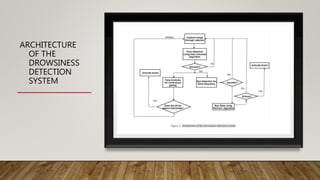
ARCHITECTURE
OF THE
DROWSINESS
DETECTION
SYSTEM
ARCHITECTURE
CONSISTS OF 6
MODULES:
• Face Detection
• Eye Detection
• Face Tracking
• Eye Tracking
• Drowsiness Detection
• Distraction Detection
Screenshots
Screenshots
• Usage Of Drowsiness Detection
Tesla
Self-driving cars
Artificial Intelligence (AI)
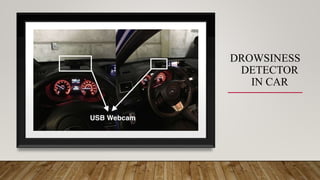
DROWSINESS
DETECTOR
IN CAR
ANY QUESTIONS ???
THANK
YOU..!!!

Drowsiness Detection Presentation

  • 1.
    DROWSINESS DETECTION - SAURABHNITIN KAWLI MENTOR : AVANTIKA MA’AM - LALITKUMAR KANARAMJI CHOUDHARY MENTOR : KHYATI MA’AM
  • 2.
    - Drowsiness ofthe drivers is one of the key issues for majority of road accidents. - Drowsiness threatens the road safety and causes severe injuries sometimes, resulting in fatality of the victim and economical losses. WHAT IS DROWSINESS???
  • 3.
    APPROACHES TO DETECTINGDROWSINESS • BEHAVIOURAL PARAMETERS-BASED TECHNIQUES • VEHICULAR PARAMETERS-BASED TECHNIQUES • PHYSIOLOGICAL PARAMETERS-BASED TECHNIQUES • DIGITAL IMAGE PROCESSING
  • 4.
    • BEHAVIOURAL PARAMETERS-BASEDTECHNIQUES  Measuring the driver’s fatigue without using non-invasive instruments comes under this category.  Analysing the behaviour of the driver based on his/her eye closure ratio, blink frequency, yawning, position of the head and facial expressions.
  • 5.
    • VEHICULAR PARAMETERS-BASEDTECHNIQUES  Measuring the fatigue nature of the driver through vehicle driving patterns comes under this category.  These parameters include lane changing patterns, steering wheel angle, steering wheel grip force, vehicle speed variability and many more.
  • 6.
    • PHYSIOLOGICAL PARAMETERS-BASEDTECHNIQUES  Measuring the drowsiness of the driver based on the physical conditions of the driver fall under this category.  Such parameters may be respiration rate, heart-beat rate, body temperature and many more.
  • 7.
    • DIGITAL IMAGEPROCESSING  The term digital image processing generally refers to processing of a two- dimensional picture by a digital computer.  3 Types :  Pixel  Digital Image  Gray Level
  • 8.
    • Parameters fordetermining the drowsiness • Eye blink • Area of the pupils detected at eyes • Yawning
  • 9.
  • 10.
    ARCHITECTURE CONSISTS OF 6 MODULES: •Face Detection • Eye Detection • Face Tracking • Eye Tracking • Drowsiness Detection • Distraction Detection
  • 11.
  • 12.
  • 13.
    • Usage OfDrowsiness Detection Tesla Self-driving cars Artificial Intelligence (AI)
  • 14.
  • 15.
  • 16.