THE BIONIC
EYE
A RAY OF VISION FOR THE BLIND
P GAYATHRI
N PRAVEENA
P KAUSHIK
MOHAMMAD MUKTAR ALI
PREPARED BY-
ANITS, ECE 1st YEAR
INTRODUCTION
WHAT IS BLINDNESS?
 Blindness is the inability to see anything, even
light. If you are partially blind, you have
limited vision. Complete blindness means that
you cannot see at all and are in total darkness.
 Due to improper treatment people suffering
from are unable to get perfect vision and
undergoing various surgeries which
sometimes further lead to loss of vision.
REASONS FOR BLINDNESS
 Glaucoma refers to four different eye conditions that damage the
optic nerve that carries visual information to your brain.
 Macular degeneration destroys the part of your eye that enables
you to see details. It usually affects older adults.
 Cataracts cause cloudy vision and are more common in older
people.
 A lazy eye can make it difficult to see details and may lead to vision
loss.
 Optic neuritis is inflammation that can cause temporary or
permanent vision loss.
 Retinitis pigmentosa refers to retina damage, but leads to
blindness only in rare cases.
 Tumors that affect the retina or optic nerve can also cause
blindness.
 Derivation of the word “BIONIC”(Bio
+ electrONIC )
 BIONIC EYE, is an experimental
visual device intended to restore
functional vision in those suffering
blindness.
 Bio-electronic eye
 Electronic device which replaces the
functionality of a part or whole of
the eye.
 Bionic eye devices are developed to
restore a sense of vision to people
with retinitis pigmentos and age-
related macular degeneration.
What is
BIONIC
EYE?
Parts of Bionic Eye
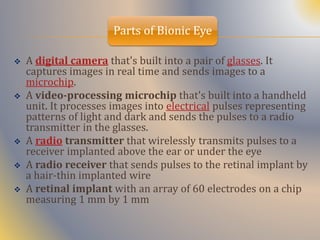
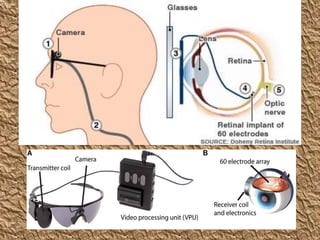
 A digital camera that's built into a pair of glasses. It
captures images in real time and sends images to a
microchip.
 A video-processing microchip that's built into a handheld
unit. It processes images into electrical pulses representing
patterns of light and dark and sends the pulses to a radio
transmitter in the glasses.
 A radio transmitter that wirelessly transmits pulses to a
receiver implanted above the ear or under the eye
 A radio receiver that sends pulses to the retinal implant by
a hair-thin implanted wire
 A retinal implant with an array of 60 electrodes on a chip
measuring 1 mm by 1 mm
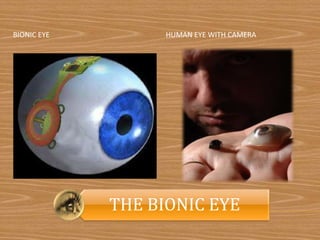
THE BIONIC EYE
BIONIC EYE HUMAN EYE WITH CAMERA
HOW DOES IT WORK?
 The bionic vision system consists of a camera,
attached to a pair of glasses, which transmits
high-frequency radio signals to a microchip
implanted in the eye.
 Electrodes on the implanted chip convert these
signals into electrical impulses to stimulate cells
in the retina that connect to the optic nerve.
 These impulses are then passed down along the
optic nerve to the vision processing centers of the
brain, where they are interpreted as an image.
SOME ONGOING PROJECTS
 Implantable Miniature Telescope
 Artificial Silicon Retina(ASR)
 Harvard /MIT Retinal Implant
 Dobelle eye
 MARC Technology
 Argus
 Holographic Technology
 Virtual Retinal Display(VRD) etc…
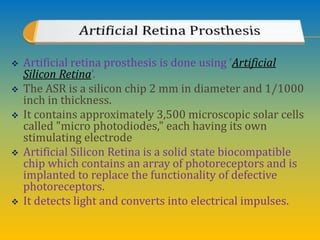
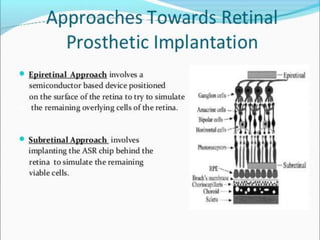
 Artificial retina prosthesis is done using ‘Artificial
Silicon Retina’.
 The ASR is a silicon chip 2 mm in diameter and 1/1000
inch in thickness.
 It contains approximately 3,500 microscopic solar cells
called "micro photodiodes," each having its own
stimulating electrode
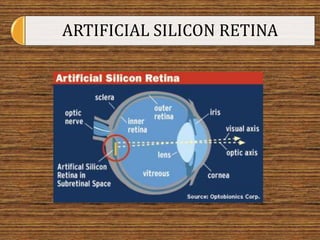
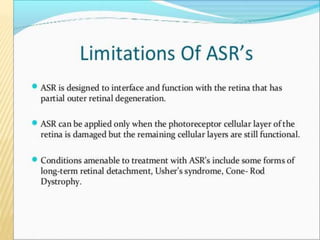
 Artificial Silicon Retina is a solid state biocompatible
chip which contains an array of photoreceptors and is
implanted to replace the functionality of defective
photoreceptors.
 It detects light and converts into electrical impulses.
ARTIFICIAL SILICON RETINA
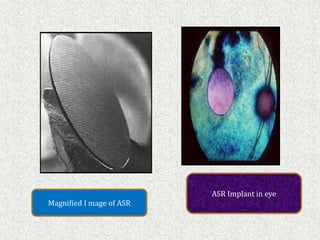
Magnified I mage of ASR
ASR Implant in eye
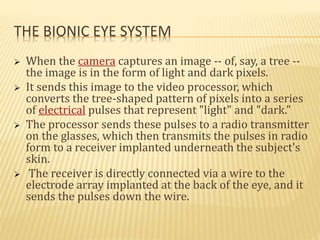
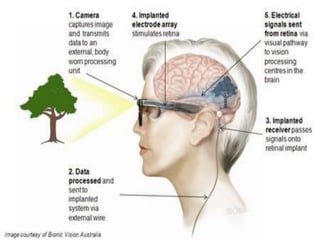
THE BIONIC EYE SYSTEM
 When the camera captures an image -- of, say, a tree --
the image is in the form of light and dark pixels.
 It sends this image to the video processor, which
converts the tree-shaped pattern of pixels into a series
of electrical pulses that represent "light" and "dark."
 The processor sends these pulses to a radio transmitter
on the glasses, which then transmits the pulses in radio
form to a receiver implanted underneath the subject's
skin.
 The receiver is directly connected via a wire to the
electrode array implanted at the back of the eye, and it
sends the pulses down the wire.
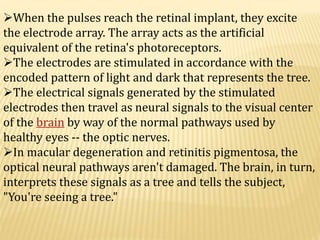
When the pulses reach the retinal implant, they excite
the electrode array. The array acts as the artificial
equivalent of the retina's photoreceptors.
The electrodes are stimulated in accordance with the
encoded pattern of light and dark that represents the tree.
The electrical signals generated by the stimulated
electrodes then travel as neural signals to the visual center
of the brain by way of the normal pathways used by
healthy eyes -- the optic nerves.
In macular degeneration and retinitis pigmentosa, the
optical neural pathways aren't damaged. The brain, in turn,
interprets these signals as a tree and tells the subject,
"You're seeing a tree."
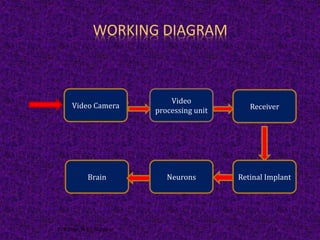
WORKING DIAGRAM
Video Camera
Video
processing unit Receiver
Retinal ImplantNeuronsBrain
ECE Dept. M.I.T. Manipur 14
ARGUS-II DEVICE
 The Argus II Retinal Prosthesis System (“Argus
II”) is the world’s first approved device
intended to restore some functional vision for
people suffering from blindness.
 transmits images from a small, eye-glass-
mounted camera wirelessly to a
microelectrode array implanted on a patient’s
damaged retina.
How
ARGUS
-II
Works?
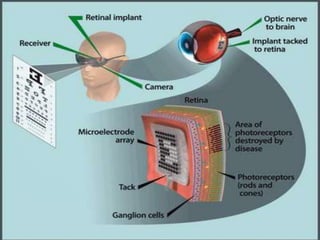
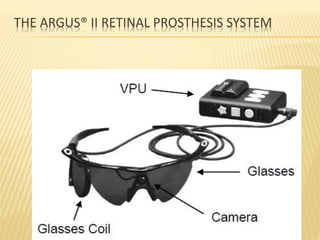
THE ARGUS® II RETINAL PROSTHESIS SYSTEM
WORKING OF ARGUS-II DEVICE………
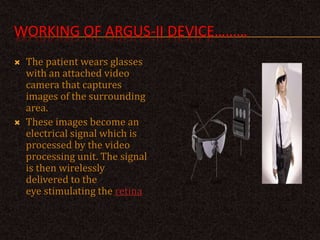
 The patient wears glasses
with an attached video
camera that captures
images of the surrounding
area.
 These images become an
electrical signal which is
processed by the video
processing unit. The signal
is then wirelessly
delivered to the
eye stimulating the retina
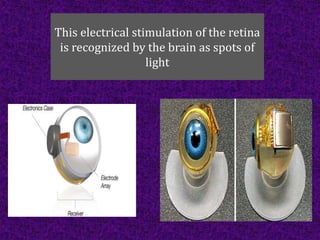
This electrical stimulation of the retina
is recognized by the brain as spots of
light
WHEN IS IT USED?
 The Argus II Retinal Prosthesis System is
intended for patients aged 25 years
 and older with bare or no light perception
vision caused by advanced retinitis
pigmentosa.
RESULT OF THIS SYSTEM
 identify the location or movement of objects
and people;
 recognize large letters, words, or Sentences.
 and helped in other activities of daily life, such
as detecting street curbs and walking on a
sidewalk without stepping off.
ADVANTAGES
 ability to perform visual tasks demonstrated in many
patients
 Upgradable external hardware and software to benefit
from future innovations
 the brain has an amazing ability to adapt to new input
and to improve his or her understanding of what is
being “seen” via an artificial vision system.
 Reduction of stress upon retina
DISADVANTAGES
 The cost of device is too high.
 If a single part of the chip is damaged the total
technique will be meaningless
CONCLUSION
ANY QUESTIONS?
THANK
YOU………

Bionic eye

  • 1.
    THE BIONIC EYE A RAYOF VISION FOR THE BLIND
  • 2.
    P GAYATHRI N PRAVEENA PKAUSHIK MOHAMMAD MUKTAR ALI PREPARED BY- ANITS, ECE 1st YEAR
  • 3.
  • 4.
    WHAT IS BLINDNESS? Blindness is the inability to see anything, even light. If you are partially blind, you have limited vision. Complete blindness means that you cannot see at all and are in total darkness.  Due to improper treatment people suffering from are unable to get perfect vision and undergoing various surgeries which sometimes further lead to loss of vision.

  • 5.
    REASONS FOR BLINDNESS Glaucoma refers to four different eye conditions that damage the optic nerve that carries visual information to your brain.  Macular degeneration destroys the part of your eye that enables you to see details. It usually affects older adults.  Cataracts cause cloudy vision and are more common in older people.  A lazy eye can make it difficult to see details and may lead to vision loss.  Optic neuritis is inflammation that can cause temporary or permanent vision loss.  Retinitis pigmentosa refers to retina damage, but leads to blindness only in rare cases.  Tumors that affect the retina or optic nerve can also cause blindness.
  • 7.
     Derivation ofthe word “BIONIC”(Bio + electrONIC )  BIONIC EYE, is an experimental visual device intended to restore functional vision in those suffering blindness.  Bio-electronic eye  Electronic device which replaces the functionality of a part or whole of the eye.  Bionic eye devices are developed to restore a sense of vision to people with retinitis pigmentos and age- related macular degeneration. What is BIONIC EYE?
  • 8.
    Parts of BionicEye  A digital camera that's built into a pair of glasses. It captures images in real time and sends images to a microchip.  A video-processing microchip that's built into a handheld unit. It processes images into electrical pulses representing patterns of light and dark and sends the pulses to a radio transmitter in the glasses.  A radio transmitter that wirelessly transmits pulses to a receiver implanted above the ear or under the eye  A radio receiver that sends pulses to the retinal implant by a hair-thin implanted wire  A retinal implant with an array of 60 electrodes on a chip measuring 1 mm by 1 mm
  • 9.
    THE BIONIC EYE BIONICEYE HUMAN EYE WITH CAMERA
  • 10.
    HOW DOES ITWORK?  The bionic vision system consists of a camera, attached to a pair of glasses, which transmits high-frequency radio signals to a microchip implanted in the eye.  Electrodes on the implanted chip convert these signals into electrical impulses to stimulate cells in the retina that connect to the optic nerve.  These impulses are then passed down along the optic nerve to the vision processing centers of the brain, where they are interpreted as an image.
  • 11.
    SOME ONGOING PROJECTS Implantable Miniature Telescope  Artificial Silicon Retina(ASR)  Harvard /MIT Retinal Implant  Dobelle eye  MARC Technology  Argus  Holographic Technology  Virtual Retinal Display(VRD) etc…
  • 12.
     Artificial retinaprosthesis is done using ‘Artificial Silicon Retina’.  The ASR is a silicon chip 2 mm in diameter and 1/1000 inch in thickness.  It contains approximately 3,500 microscopic solar cells called "micro photodiodes," each having its own stimulating electrode  Artificial Silicon Retina is a solid state biocompatible chip which contains an array of photoreceptors and is implanted to replace the functionality of defective photoreceptors.  It detects light and converts into electrical impulses.
  • 13.
  • 14.
    Magnified I mageof ASR ASR Implant in eye
  • 17.
    THE BIONIC EYESYSTEM  When the camera captures an image -- of, say, a tree -- the image is in the form of light and dark pixels.  It sends this image to the video processor, which converts the tree-shaped pattern of pixels into a series of electrical pulses that represent "light" and "dark."  The processor sends these pulses to a radio transmitter on the glasses, which then transmits the pulses in radio form to a receiver implanted underneath the subject's skin.  The receiver is directly connected via a wire to the electrode array implanted at the back of the eye, and it sends the pulses down the wire.
  • 18.
    When the pulsesreach the retinal implant, they excite the electrode array. The array acts as the artificial equivalent of the retina's photoreceptors. The electrodes are stimulated in accordance with the encoded pattern of light and dark that represents the tree. The electrical signals generated by the stimulated electrodes then travel as neural signals to the visual center of the brain by way of the normal pathways used by healthy eyes -- the optic nerves. In macular degeneration and retinitis pigmentosa, the optical neural pathways aren't damaged. The brain, in turn, interprets these signals as a tree and tells the subject, "You're seeing a tree."
  • 20.
    WORKING DIAGRAM Video Camera Video processingunit Receiver Retinal ImplantNeuronsBrain ECE Dept. M.I.T. Manipur 14
  • 22.
    ARGUS-II DEVICE  TheArgus II Retinal Prosthesis System (“Argus II”) is the world’s first approved device intended to restore some functional vision for people suffering from blindness.  transmits images from a small, eye-glass- mounted camera wirelessly to a microelectrode array implanted on a patient’s damaged retina.
  • 24.
  • 25.
    THE ARGUS® IIRETINAL PROSTHESIS SYSTEM
  • 26.
    WORKING OF ARGUS-IIDEVICE………  The patient wears glasses with an attached video camera that captures images of the surrounding area.  These images become an electrical signal which is processed by the video processing unit. The signal is then wirelessly delivered to the eye stimulating the retina
  • 27.
    This electrical stimulationof the retina is recognized by the brain as spots of light
  • 28.
    WHEN IS ITUSED?  The Argus II Retinal Prosthesis System is intended for patients aged 25 years  and older with bare or no light perception vision caused by advanced retinitis pigmentosa.
  • 29.
    RESULT OF THISSYSTEM  identify the location or movement of objects and people;  recognize large letters, words, or Sentences.  and helped in other activities of daily life, such as detecting street curbs and walking on a sidewalk without stepping off.
  • 30.
    ADVANTAGES  ability toperform visual tasks demonstrated in many patients  Upgradable external hardware and software to benefit from future innovations  the brain has an amazing ability to adapt to new input and to improve his or her understanding of what is being “seen” via an artificial vision system.  Reduction of stress upon retina
  • 31.
    DISADVANTAGES  The costof device is too high.  If a single part of the chip is damaged the total technique will be meaningless
  • 32.
  • 33.
  • 34.