Muscle Fibers - cellular & molecular nuts & bolts
Motor Units - how is tension developed?
Eye movements - definitions of stimulus & action
Dr. Busatini has an entire course on this subject, so we can
skip pages 143 -152, and 176-185.
VS 112 Ocular Anatomy
I. Just what sort of movements
do your eyes make?
 Those which are you aware of, those that are
voluntary (or at least the initiation of them is
voluntary).
 Reflex eye movements - automatic
adjustment of the eye position to stabilize an
image on the eye.
Eye movements
 Smooth tracking (pursuit)
 Combined head and eye tracking
 Saccades – quick jumps, saccadic eye
movements (< 50 msec) (up to 20°) voluntary
initiation
 Mini saccades (see fixation).
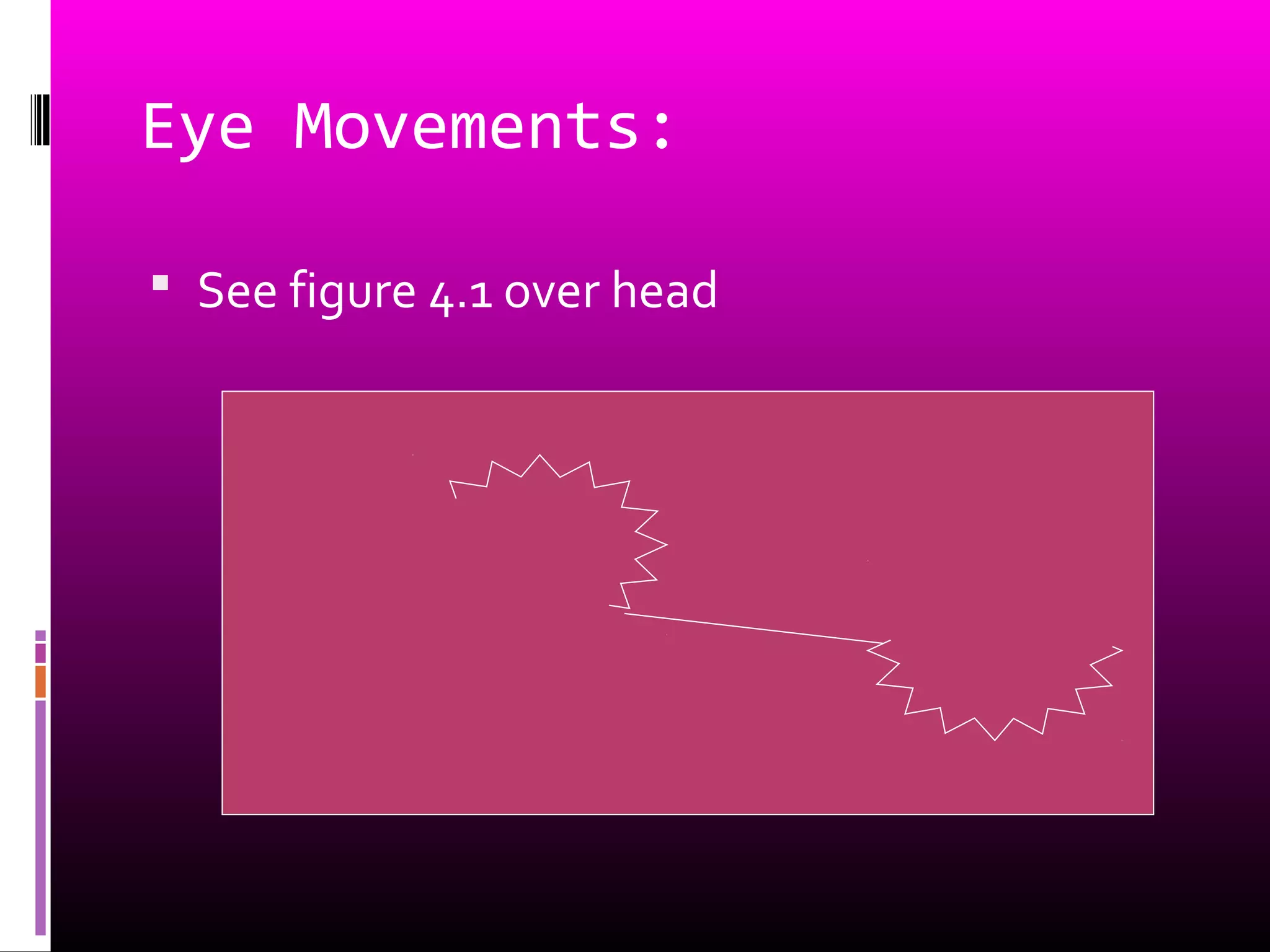
 Fixation – holding a steady gaze (which we
never actually do – see figure 4.1).
Reflex eye movements.
The stimulus can be head/body
movement i) VOR vestibular ocular reflexes – if you
move your head the eyes can maintain fixation
upon the target.
 ii) Optokinetic reflex : stimulus = rapid
motion of the world, such as motion of a stream,
or motion of world outside of the side car window.
 Nystagmus (alternating slow & quick phases of
movement)
Reflex eye movements.
The stimulus can be movement,
motion of an object of interest.
 iii) Smooth pursuit - one object is targeted
and remains clear on the retina the rest of the
visual world is in motion – the standard stimulus
for the optokinetic reflex,(only seen in foveate
animals)
 iv) Fixation - holding a steady gaze on a
target of interest. NOT just a special form of
pursuit.
Fixation – holding a steady
gaze
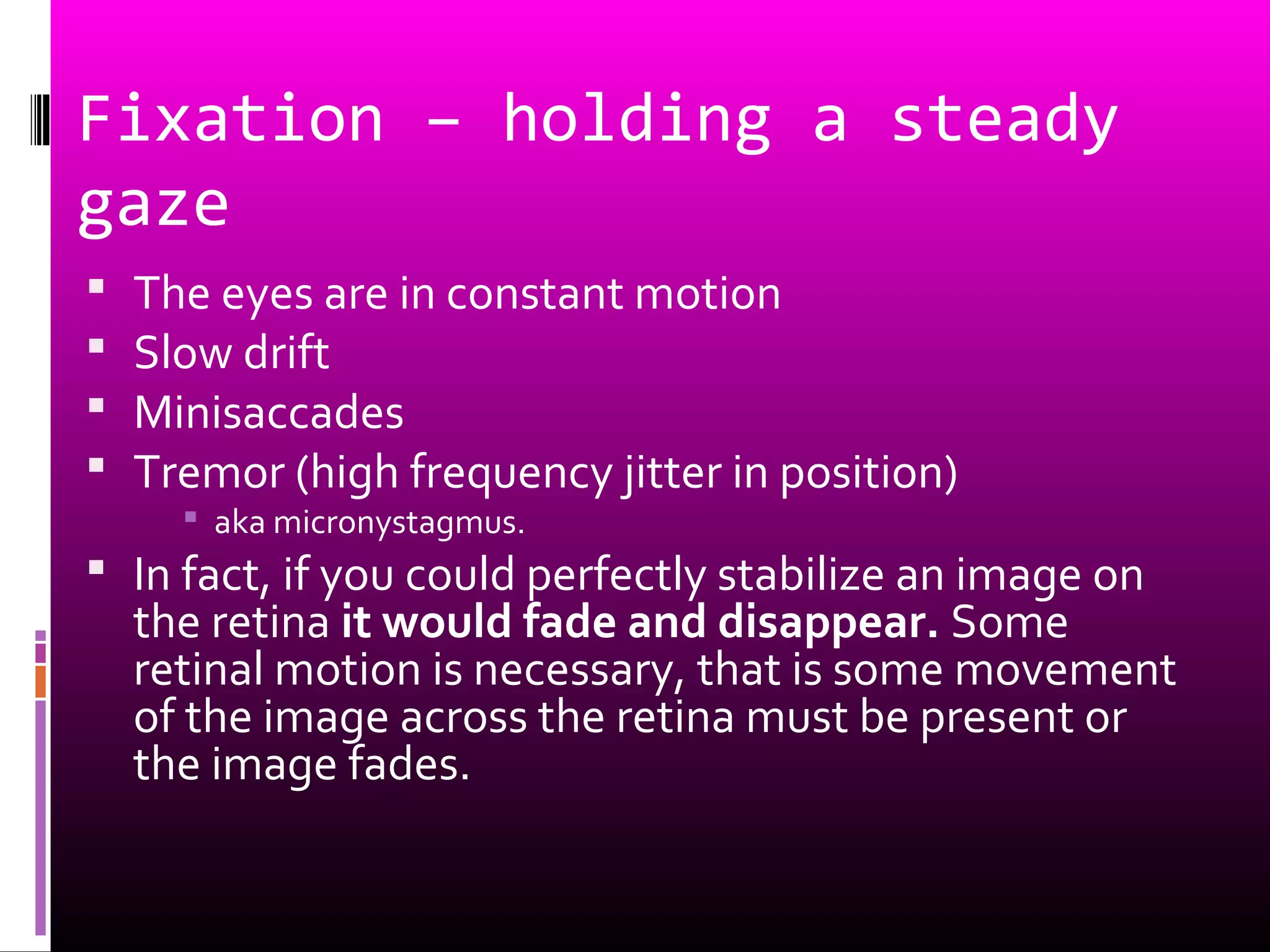
 The eyes are in constant motion
 Slow drift
 Minisaccades
 Tremor (high frequency jitter in position)
 aka micronystagmus.
 In fact, if you could perfectly stabilize an image on
the retina it would fade and disappear. Some
retinal motion is necessary, that is some movement
of the image across the retina must be present or
the image fades.
Eye Movements:
 See figure 4.1 over head
Motion of an Eye
 To describe eye motions we need a set of
defined axes (Fick’s Axes - draw on board)
 X axis : nasal -> temporal
 Y axis: anterior -> posterior
 Z axis: superior -> inferior
 These axes intersect at the center of rotation - a
fixed point, defined as 13.5 mm behind cornea.
Ductions (single eye movements)
 Rotation about the Z axis (Z axis runs vertically
superior to inferior)
 Medial Rotation - adduction toward midline
 Lateral Rotation - abduction away from midline
 Rotation about the X axis (X axis runs horizontally,
from nasal to temporal)
 Upward, elevation (supraduction)
 Downward, depression (infraduction)
Torsion - cyclorotations
 Rotation about the Y axis (Y axis runs
horizontally, from anterior to posterior)
 These are described with respect to a point at 12
o‘clock on the superior limbus
 Intorsion (incyclorotation) rotation nasally
 Extorsion (excyclorotation) rotation of the 12
o’clock position temporally.
 Counteracting head tilt (up to 7-9°)
Version & Vergences
 Some eye movements are paired, that is both
eyes do the same thing. . . . Versions
 Sometimes eyes move in the opposite
directions simultaneously. . . Vergences
Vergences
 Disjunctive eye movements (opposite left- right
movments). Non-yolked motion
 Convergence (simultaneous movement nasally)
 Divergence (simultaneous temporal movement)
 Encyclovergence (intorsion)
 Excyclovergence (extorsion)
Versions (conjugate eye
movement)
 Dextroversion - rightward gaze (demo)
 Levoversion - leftward gaze
 Supraversion - elevation
 Infraversion - depression
 Also up and right, up and left
 Down and right, down and left
 ALL BEHAVIOR IS THAT OF YOLKED EYES
Extraocular Muscles
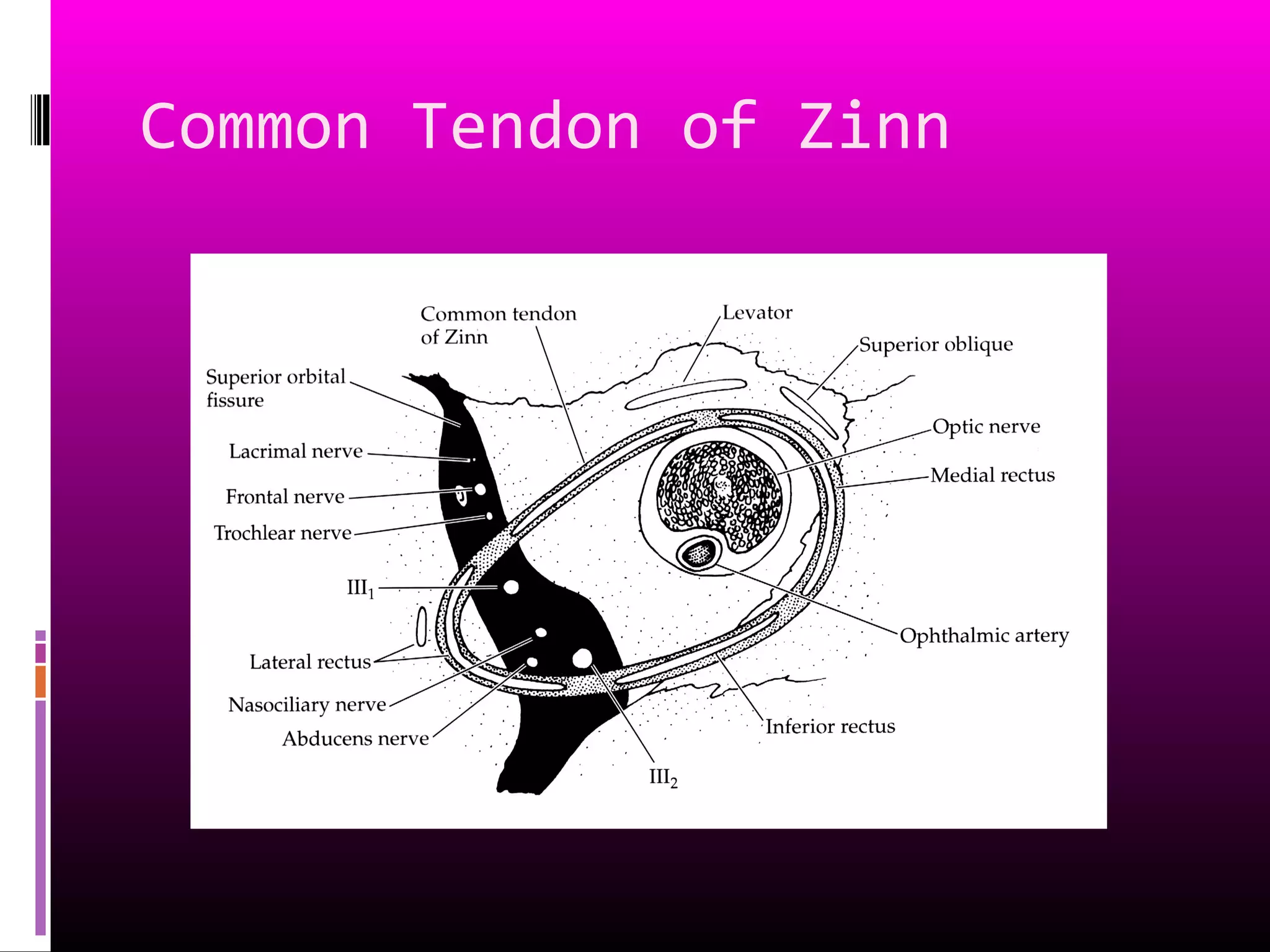
 4 rectus muscles - origin is in the common
tendous ring (annulus of Zinn)
 Oval ring of connective tissue
 Continuous with periorbita
 Anterior to optic foramen
 Medial and lateral rectus attached to both the
upper and lower tendon limbs
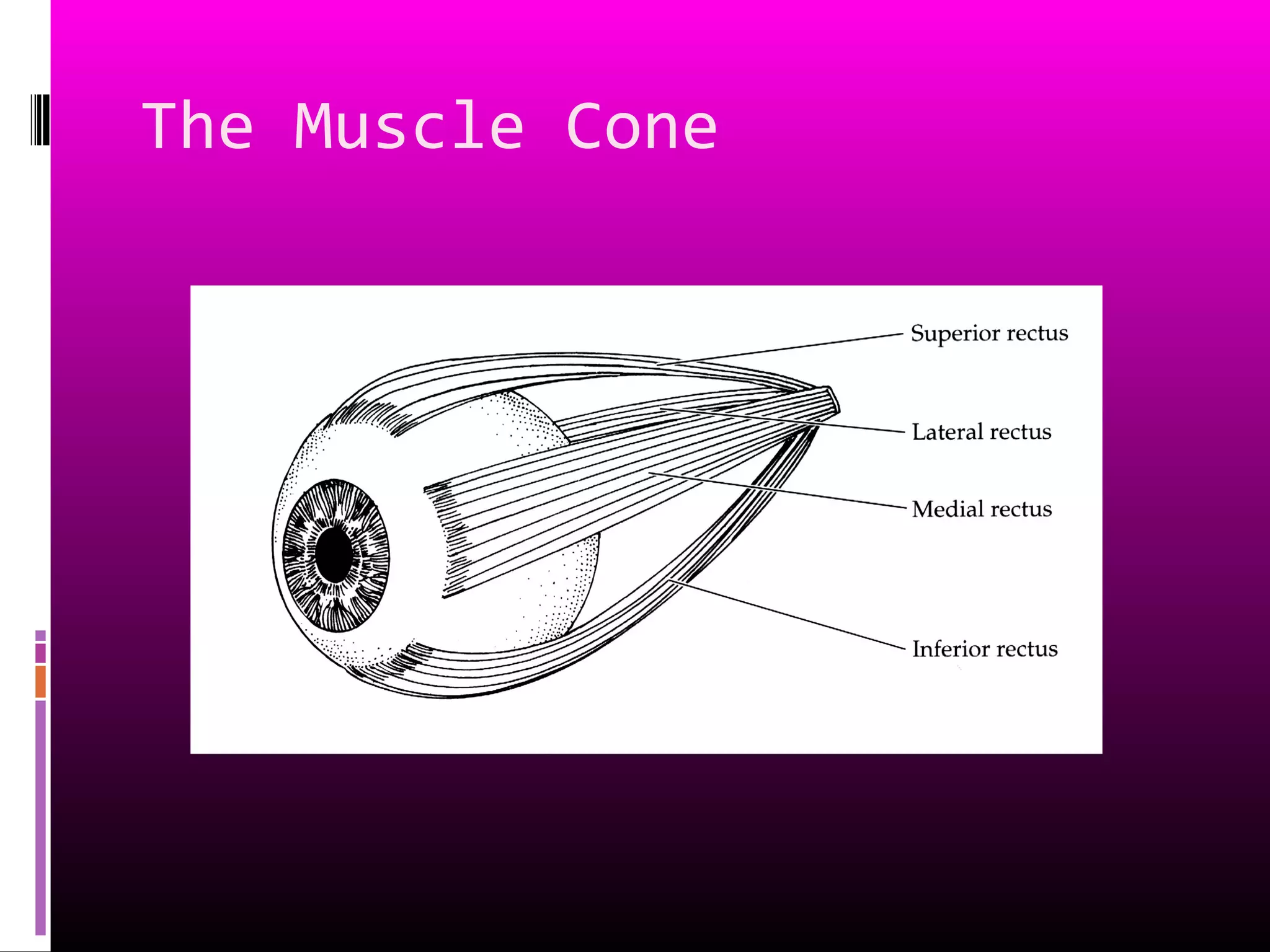
 The muscles traveling from the this tendon ring
to the insertions create muscle cone.
The Muscle Cone
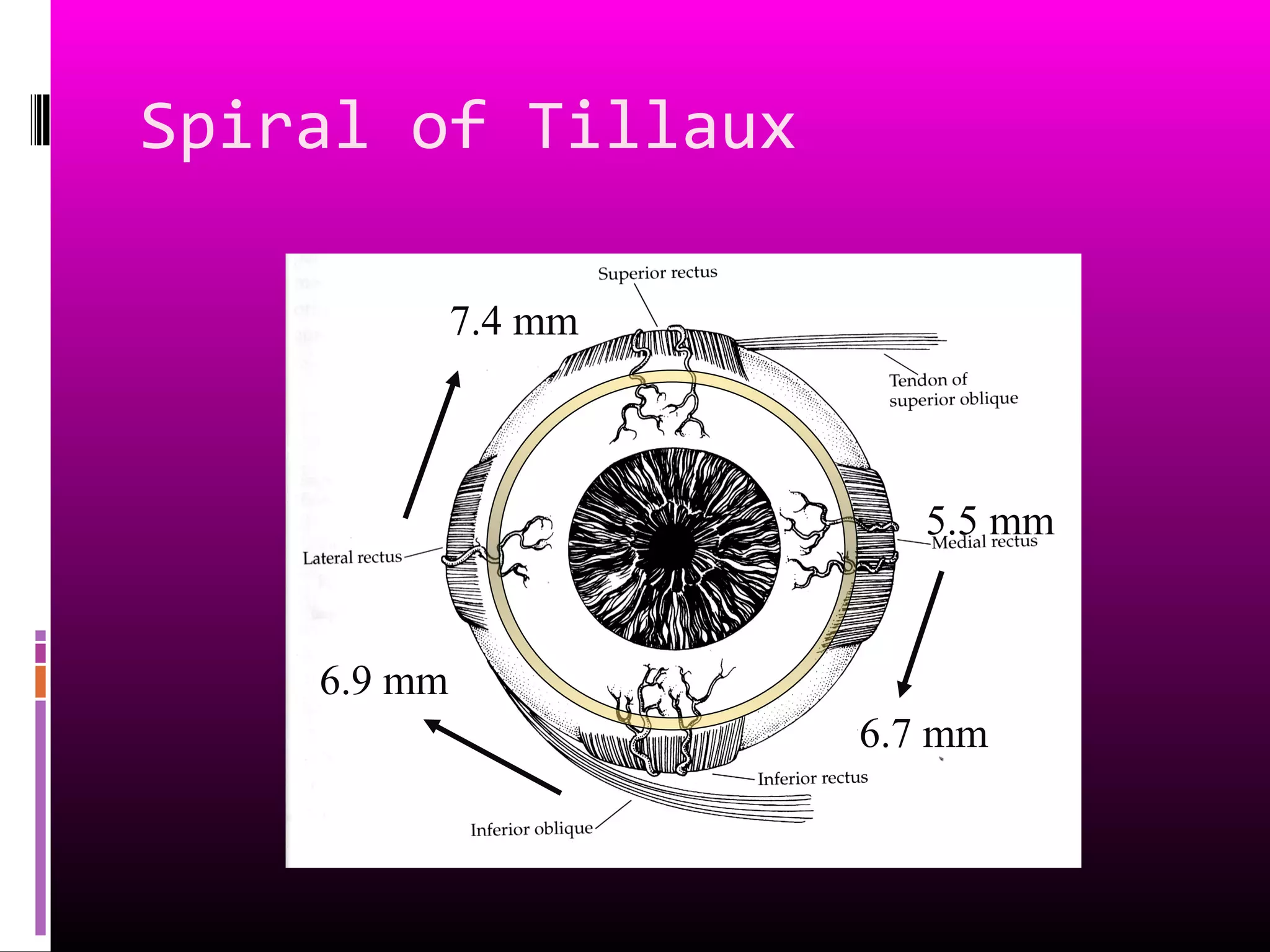
Spiral of Tillaux
 The rectus muscle pass through tenon’s
capsule and insert into the sclera.
 The muscles insert at different distances from
the cornea.
 The insertion pattern is a spiral with the
medial rectus closest to the cornea (5.5 mm)
and the superior rectus the furthest away
from the cornea (7.4 mm).
Common Tendon of Zinn
Medial Rectus
 Originates on both the upper and lower limb
of the common tendous ring and the optic
nerve sheath.
 Inserts along a vertical line 5.5 mm from the
cornea. The horizontal plane of eye bisects
the insertion.
 Fascial expansion from muscle sheath forms
the medial check ligament and attach to
medial wall of orbit.
Medial Rectus cont.
 Innervation is via cranial nerve III, the
oculomotor nerve, and the specific branch
runs along the inside of the muscle cone, on
the lateral surface.
 The superior oblique, ophthalmic artery and
nasociliary nerve all lie above the medial
rectus.
Spiral of Tillaux
5.5 mm
6.7 mm
6.9 mm
7.4 mm
Lateral rectus
 Originates on both the upper and lower limb
of the common tendous ring. . .AND a
process of the greater wing of the sphenoid
bone.
 Inserts parallel to medial rectus 6.9 mm from
the cornea. (Tendon 9.2 mm wide, 8.8 long).
 Fascial expansion from muscle sheath forms
the lateral check ligament and attach to
lateral wall of orbit at Whitnalls tubercle.
Lateral Rectus cont.
 Innervated by the abducens nerve, Cranial n
VI which enters the muscle on the medial
surface.
 The lacrimal artery and nerve run along the
superior border.
 The abducens n., ophthalmic artery and
ciliary ganglion lie medial to the lateral rectus
and between it and the optic nerve.
Superior Rectus
 Originate on superior limb of the tendonous
ring, and optic nerve sheath.
 Muscle passes forward underneath the
levator, but the two sheaths are connected
resulting in coordinated movements.
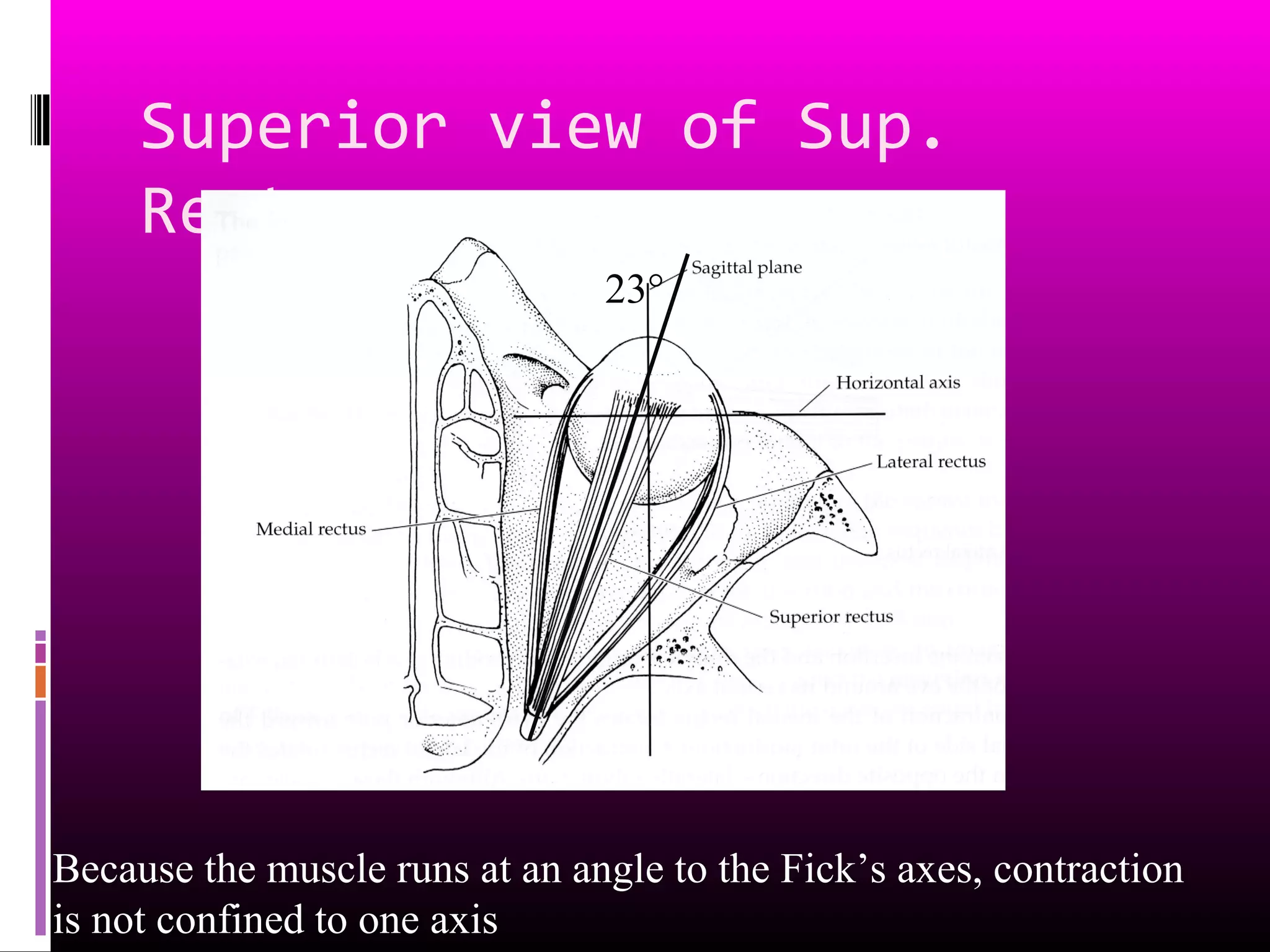
 Insertion 7.4 mm from limbus, and obliquely.
 The angle from the origin to the insertion is
23° beyond the sagital axis. (see overhead)
Superior Rectus cont.
 Frontal nerve runs above the s. rectus & levat.
 The nasociliary nerve and ophthalmic artery
run below.
 The tendon for insertion of the superior
oblique muscle runs below the anterior part
of the superior rectus.
 Innervationis via superior division of CN III,
from the inferior surface; additional branches
make their way to the levator.
Action of Superior Rectus
 Primary action is elevation . . But since the
insertion on the globe is lateral as well as
superior, contraction will produce rotation
about the vertical axis toward midline
 Thus secondary action is adduction
 Finally, because the insertion is oblique,
contraction produces torsion nasally
Intorsion.
 (overhead figure 10-13A)
Superior view of Sup.
Rectus
23°
Because the muscle runs at an angle to the Fick’s axes, contraction
is not confined to one axis
Inferior rectus
 Originates on lower limb of common
tendonous ring.
 Inserts 6.7 mm from limbus, insertion is an arc
 It is parallel to superior rectus, making a 23°
angle beyond the sagittal axis.
 Innervated by inferior division of CN III which
runs above it (within the muscle cone).
 Below is the floor of the orbit and inf. oblique
Inferior Rectus cont.
 Fascial attachments below attached to
inferior lid coordinate depression and lid
opening.
 Fascia below Inf. Rectus and Inf. Oblique
contribute to the suspensory ligament of
lockwood.
 Primary Action downward gaze depression
 2° Adduction, as is the case for sup. Rectus
 Also extorsion due to oblique arc of insertion.
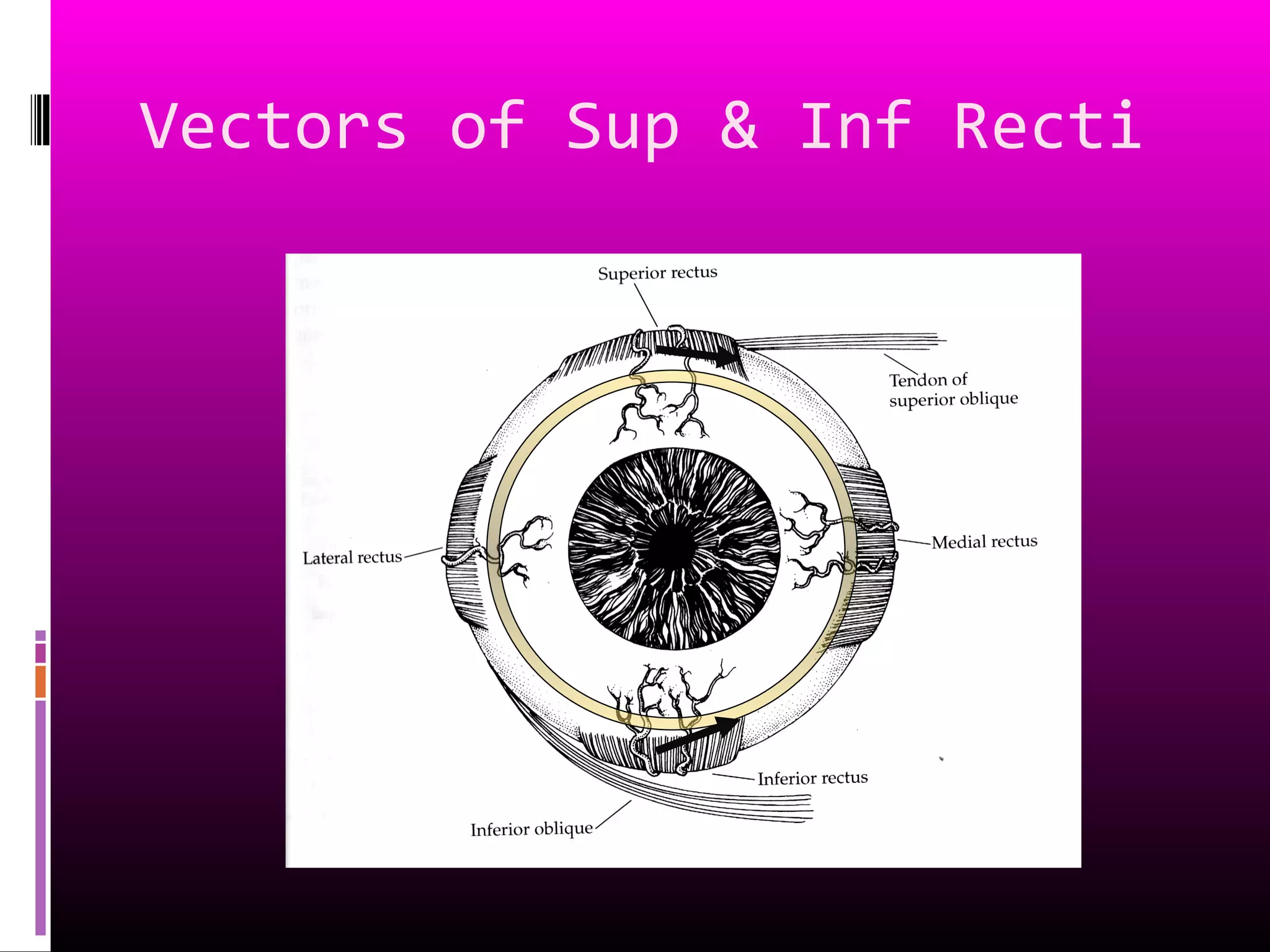
Vectors of Sup & Inf Recti
Superior Oblique
 Anatomical origin is on the lesser wing of the
sphenoid bone. The physiological origin is the
trochlea, a cartilagenous “U” on the superior
medial wall of the orbit.
 Longest thinnest EOM, the muscle ends before
the trochlea, tendon is 2.5 cm, smooth
movement through trochlea.
 Innervation by CN IV, the trochlear nerve
posterior in the orbit.
Action of Sup. Oblique
 Primary action is intorsion _ rotation of 12
o’clock position toward midline.
 Because the insertion of the oblique muscle is
in the lateral, posterior quadrant the
secondary actions are
 Rotating the back half of the globe from lateral to
medial (the anterior pole will move away)
ABDUCTION
 Also depression (posterior superior quadrant of
the globe being pulled upward).
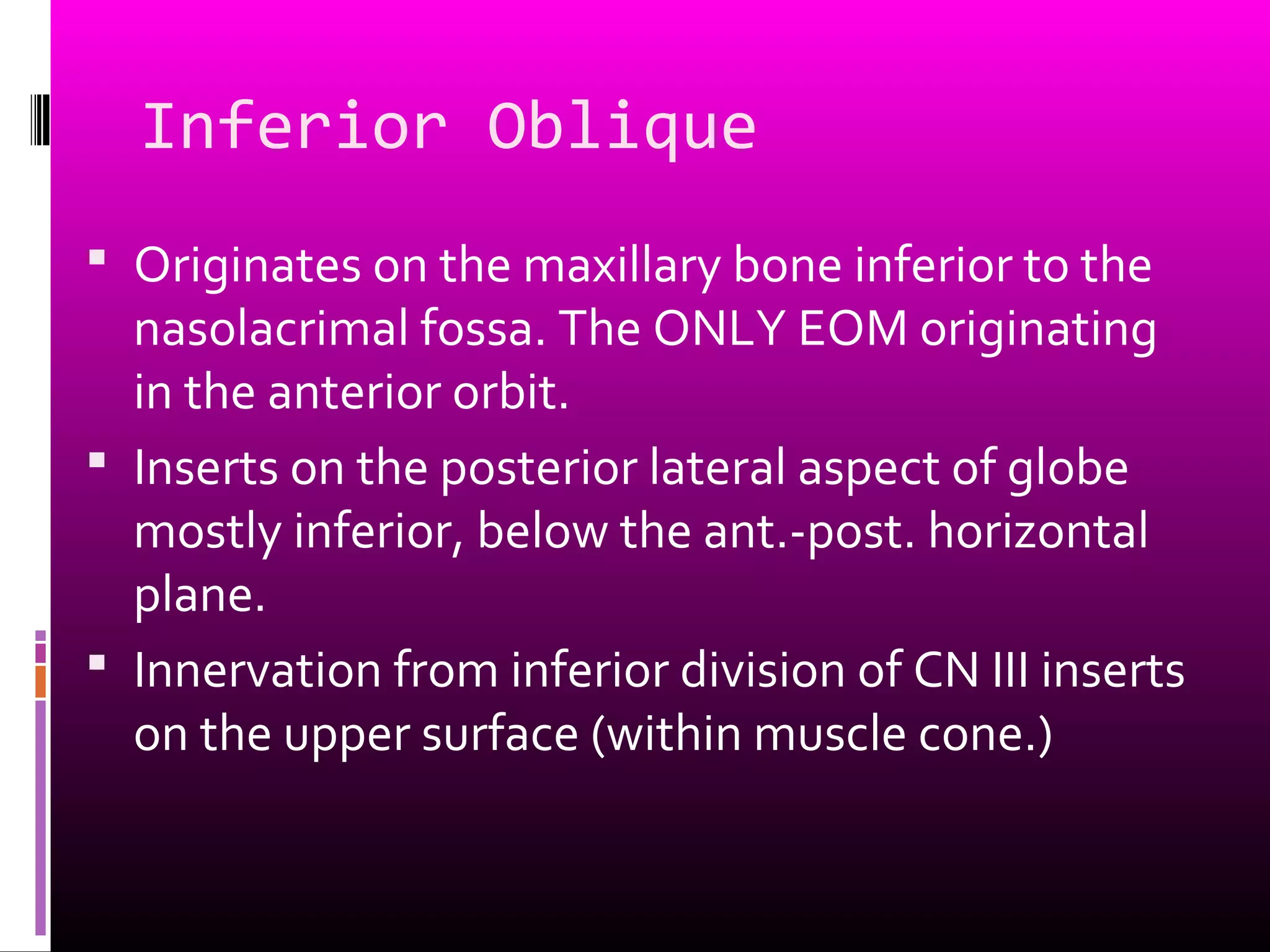
Inferior Oblique
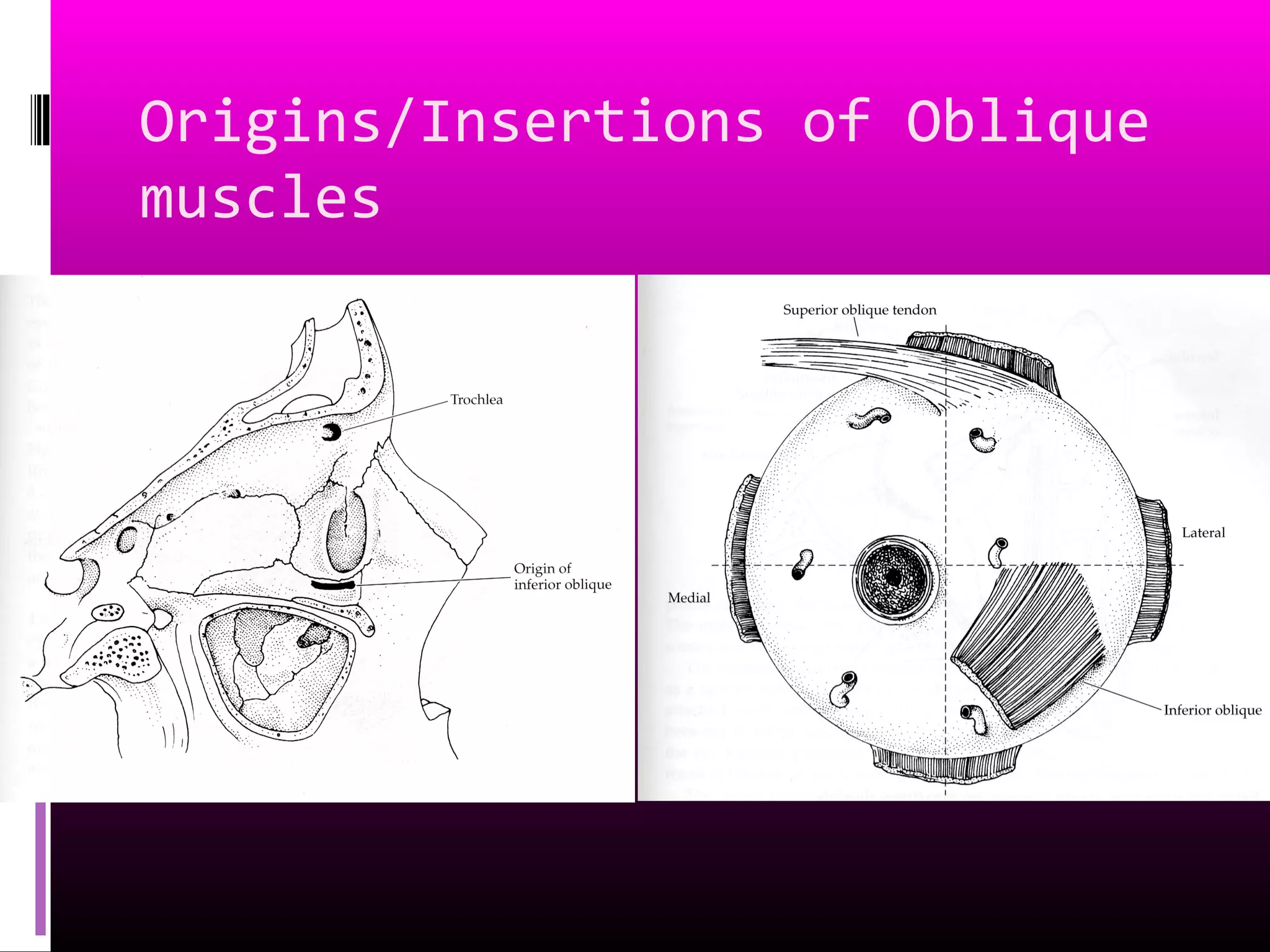
 Originates on the maxillary bone inferior to the
nasolacrimal fossa. The ONLY EOM originating
in the anterior orbit.
 Inserts on the posterior lateral aspect of globe
mostly inferior, below the ant.-post. horizontal
plane.
 Innervation from inferior division of CN III inserts
on the upper surface (within muscle cone.)
Origins/Insertions of Oblique
muscles
Action of Inf. Oblique
 Primary is extorsion
 2° is due to posterior, lateral, inferior
insertion being pulled around, underneath
globe and toward the anterior inferior
insertion medially.
 Rotation about the Z axis will be nasal to
temporal (abduction).
 Rotation about the X axis will be elevation
(see overhead figure 10.14)
And from here it’s
complicated
 There is a balance of tension in the pairs of
muscle to start with. . . .
 Actions of the muscle can and do depend on the
starting position.
 For example elevation of the eye in the straight-
ahead position and lateral position is
accomplished by the sup. rectus.
 But when the eye is medial rotated elevation is
accomplished by the inferior oblique muscle action.
(see fig 10-17 over head).
Defining Muscle groups
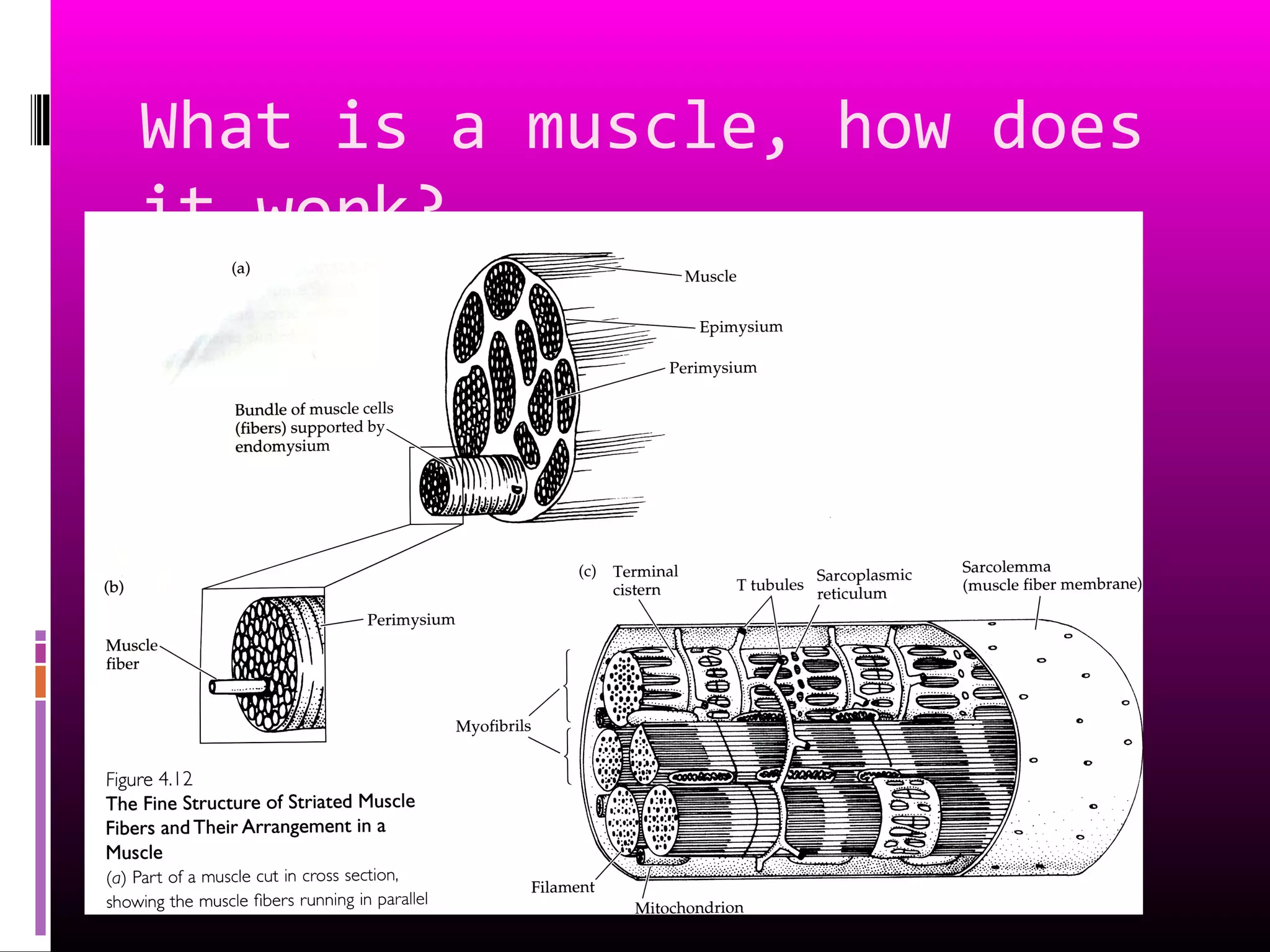
What is a muscle, how does
it work?
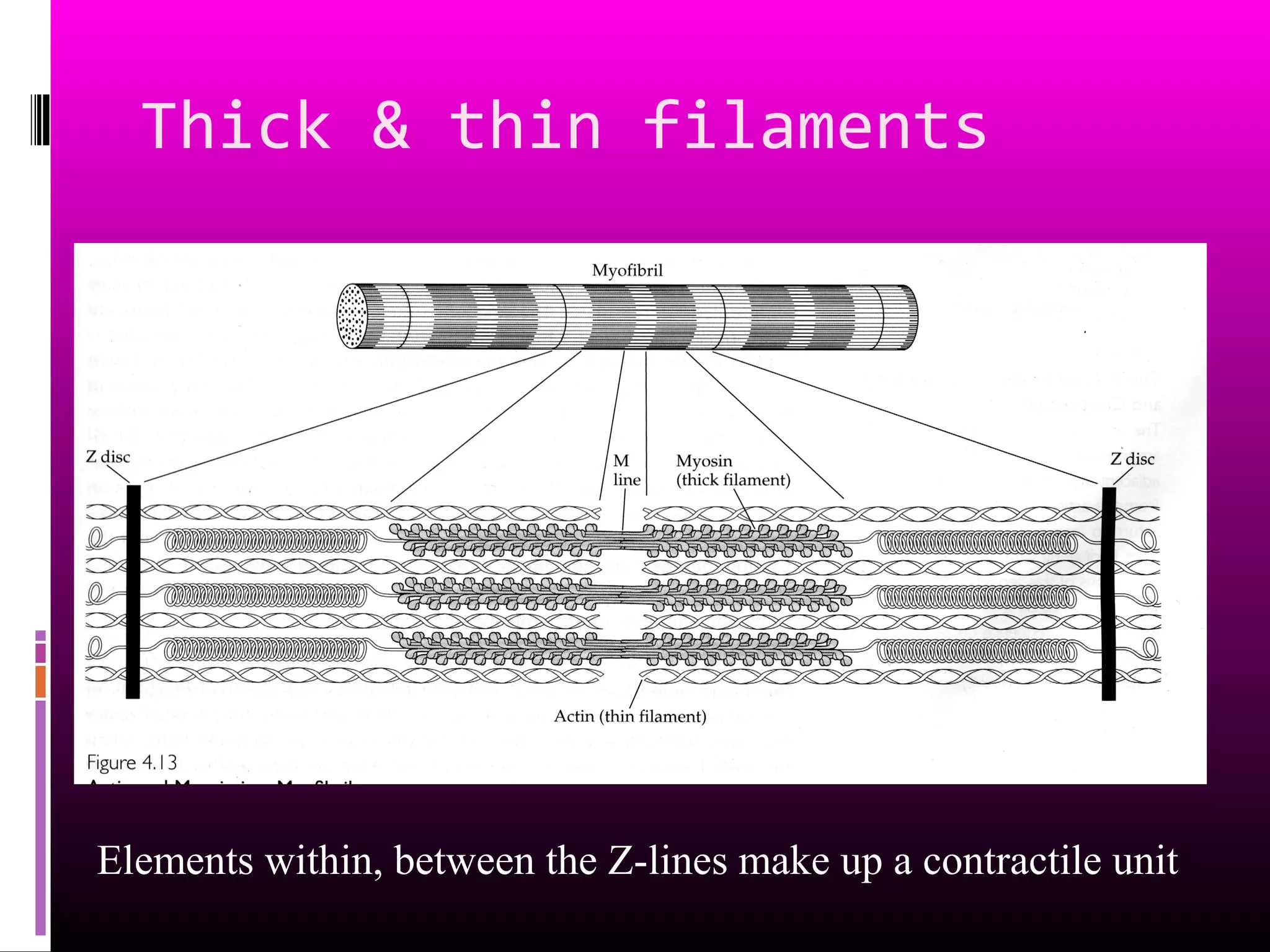
Thick & thin filaments
Elements within, between the Z-lines make up a contractile unit
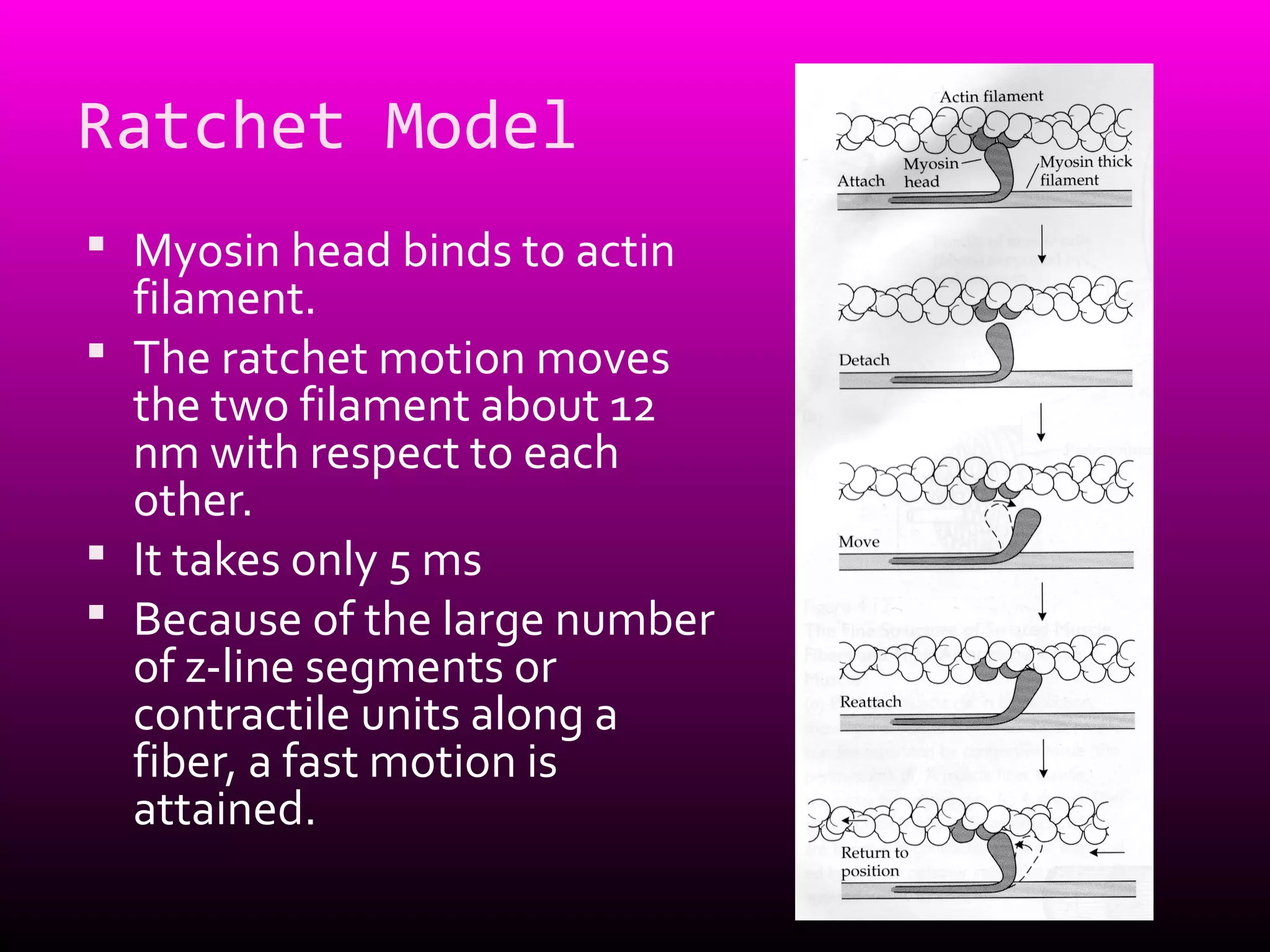
Ratchet Model
 Myosin head binds to actin
filament.
 The ratchet motion moves
the two filament about 12
nm with respect to each
other.
 It takes only 5 ms
 Because of the large number
of z-line segments or
contractile units along a
fiber, a fast motion is
attained.
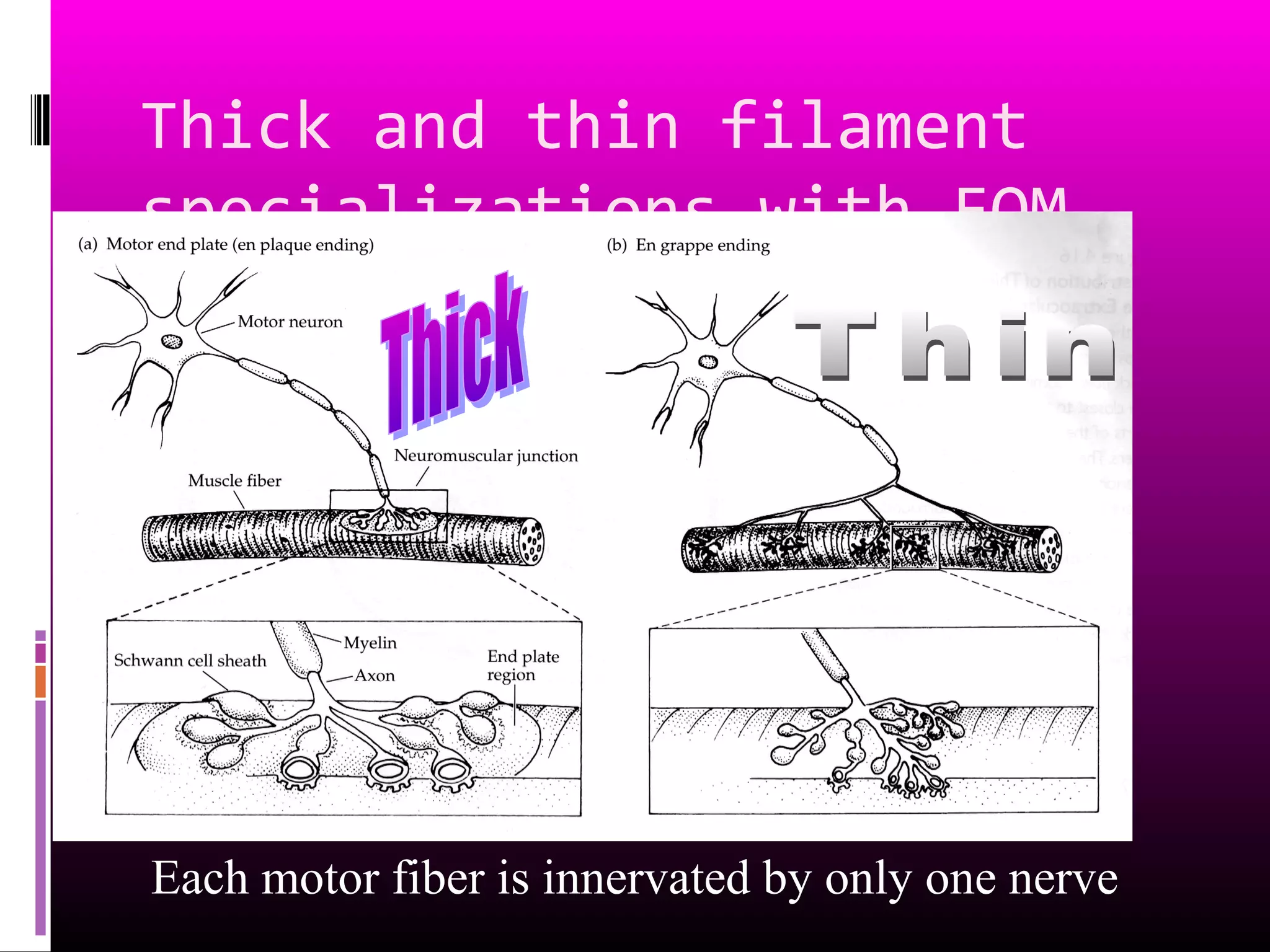
Thick and thin filament
specializations with EOM
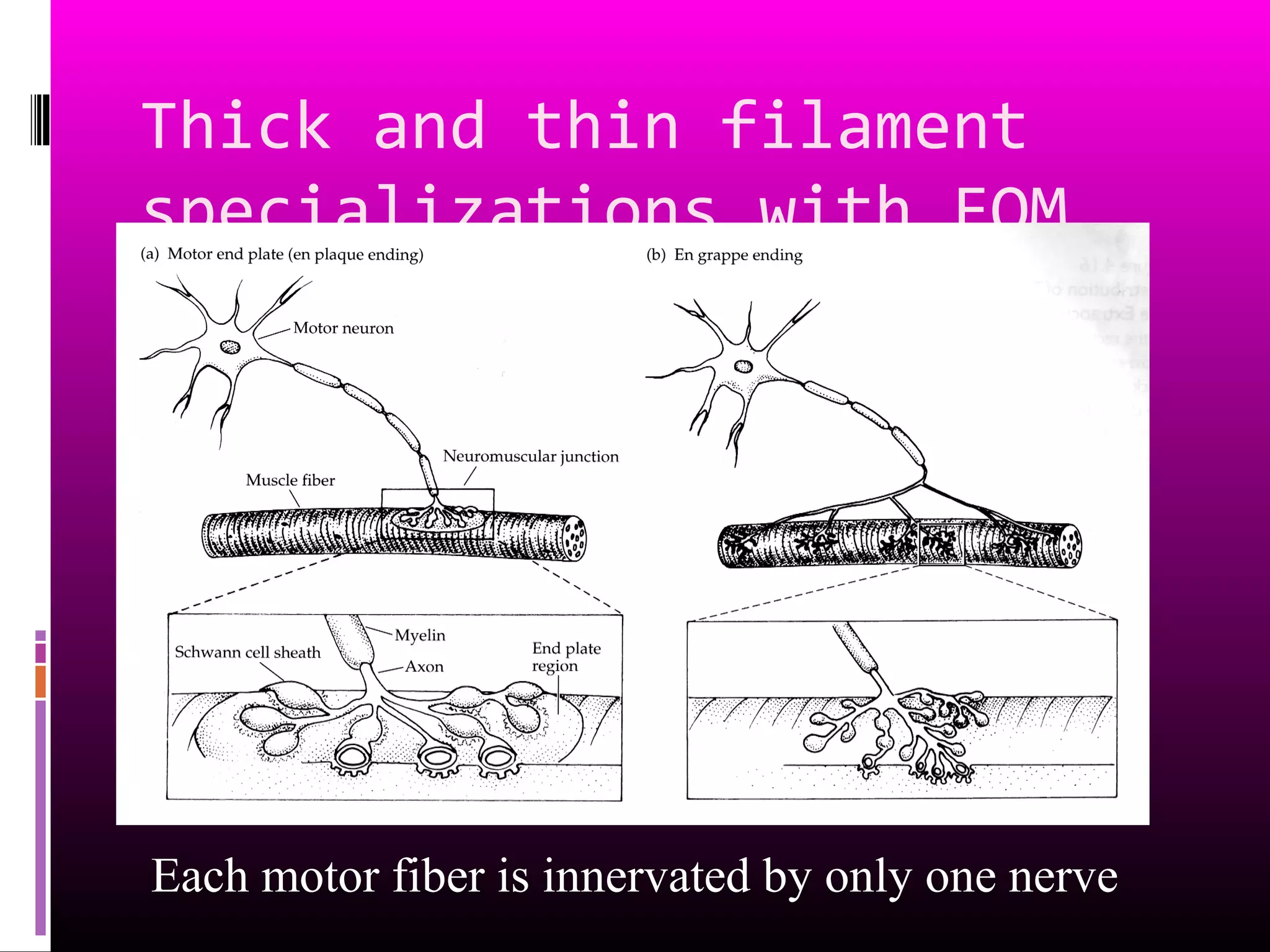
Each motor fiber is innervated by only one nerve
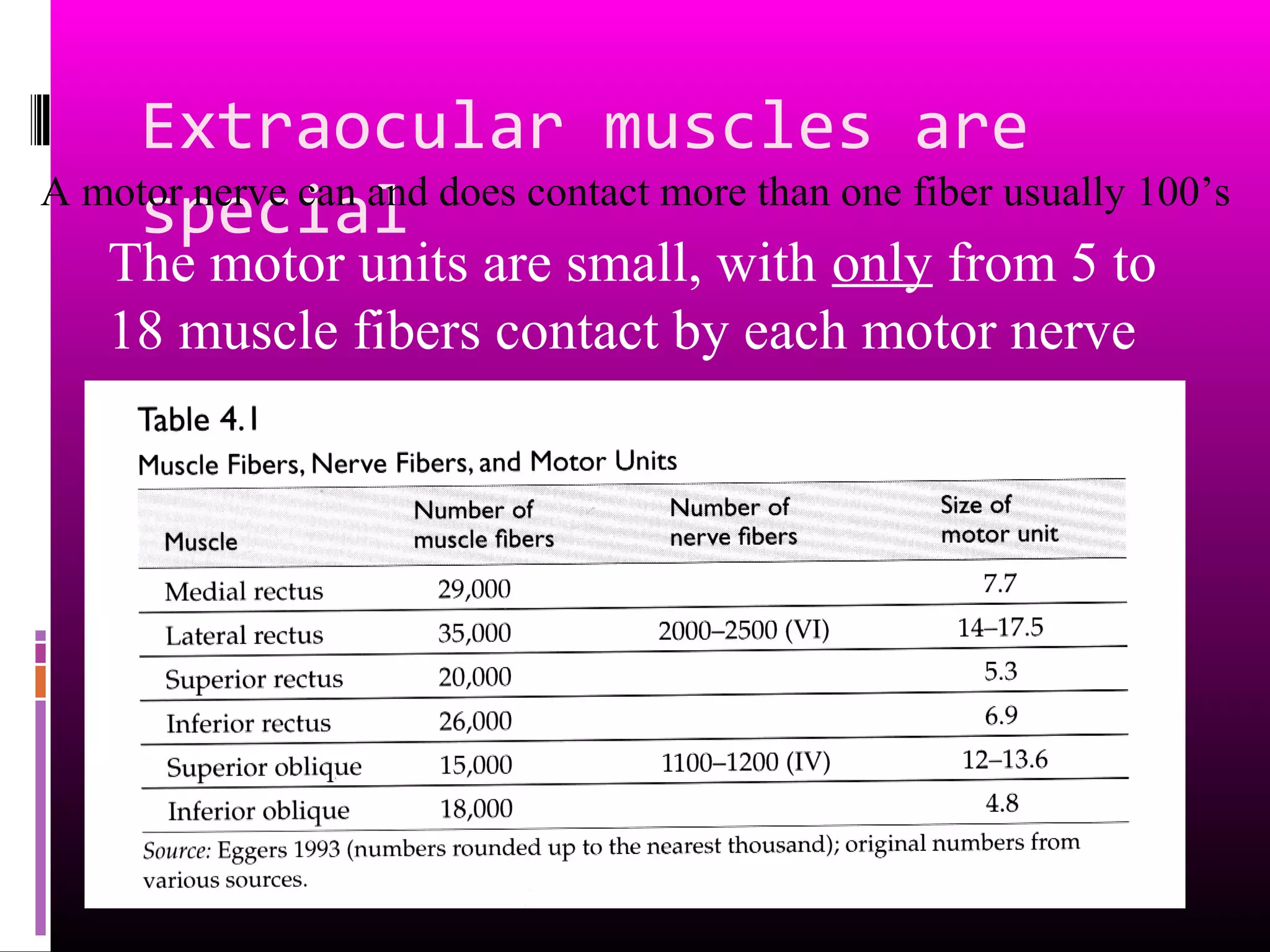
Extraocular muscles are
special
The motor units are small, with only from 5 to
18 muscle fibers contact by each motor nerve
A motor nerve can and does contact more than one fiber usually 100’s
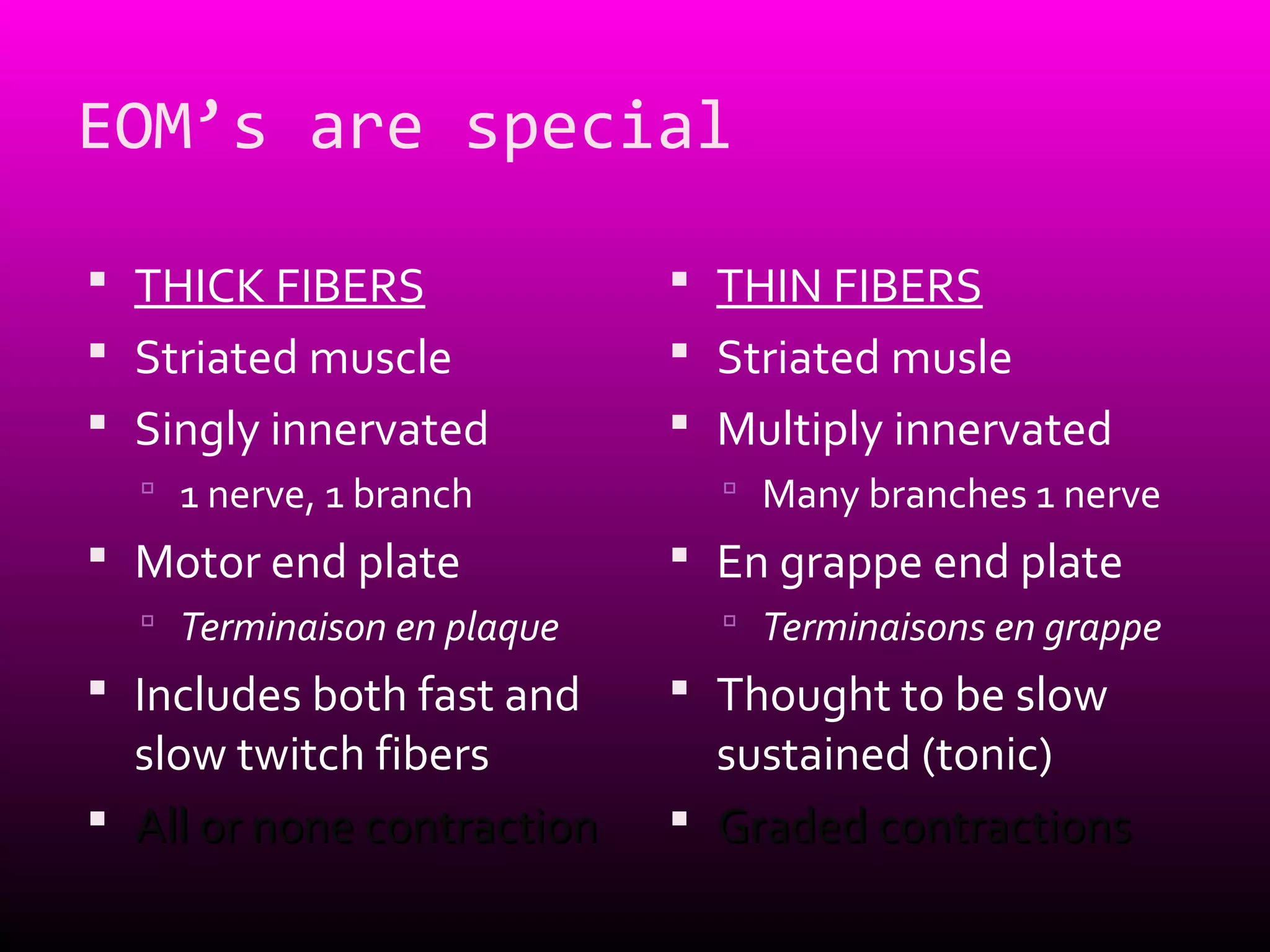
EOM’s are special
 THICK FIBERS
 Striated muscle
 Singly innervated
 1 nerve, 1 branch
 Motor end plate
 Terminaison en plaque
 Includes both fast and
slow twitch fibers
 All or none contractionAll or none contraction
 THIN FIBERS
 Striated musle
 Multiply innervated
 Many branches 1 nerve
 En grappe end plate
 Terminaisons en grappe
 Thought to be slow
sustained (tonic)
 Graded contractionsGraded contractions
Thick and thin filament
specializations with EOM
Each motor fiber is innervated by only one nerve
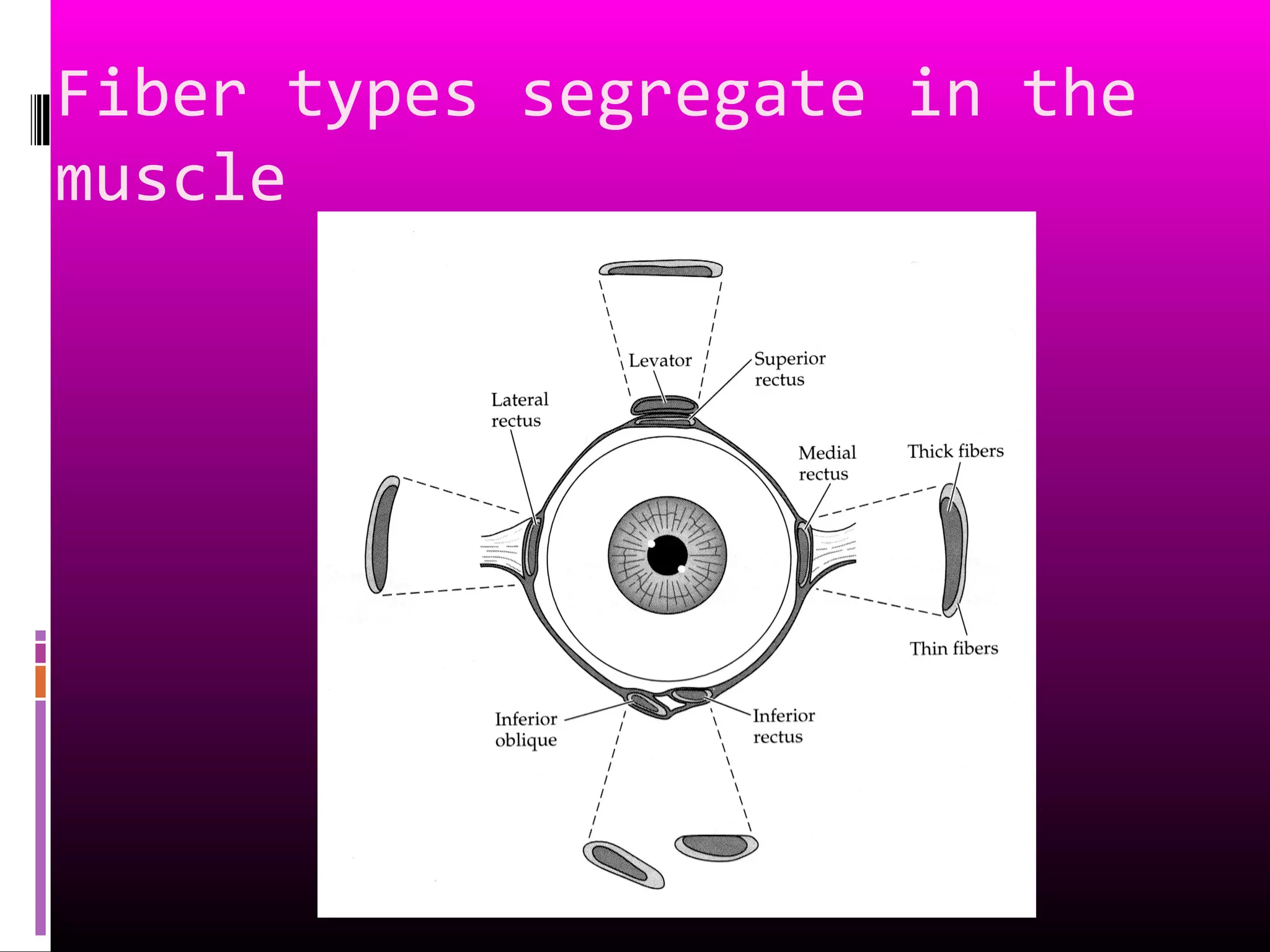
Fiber types segregate in the
muscle
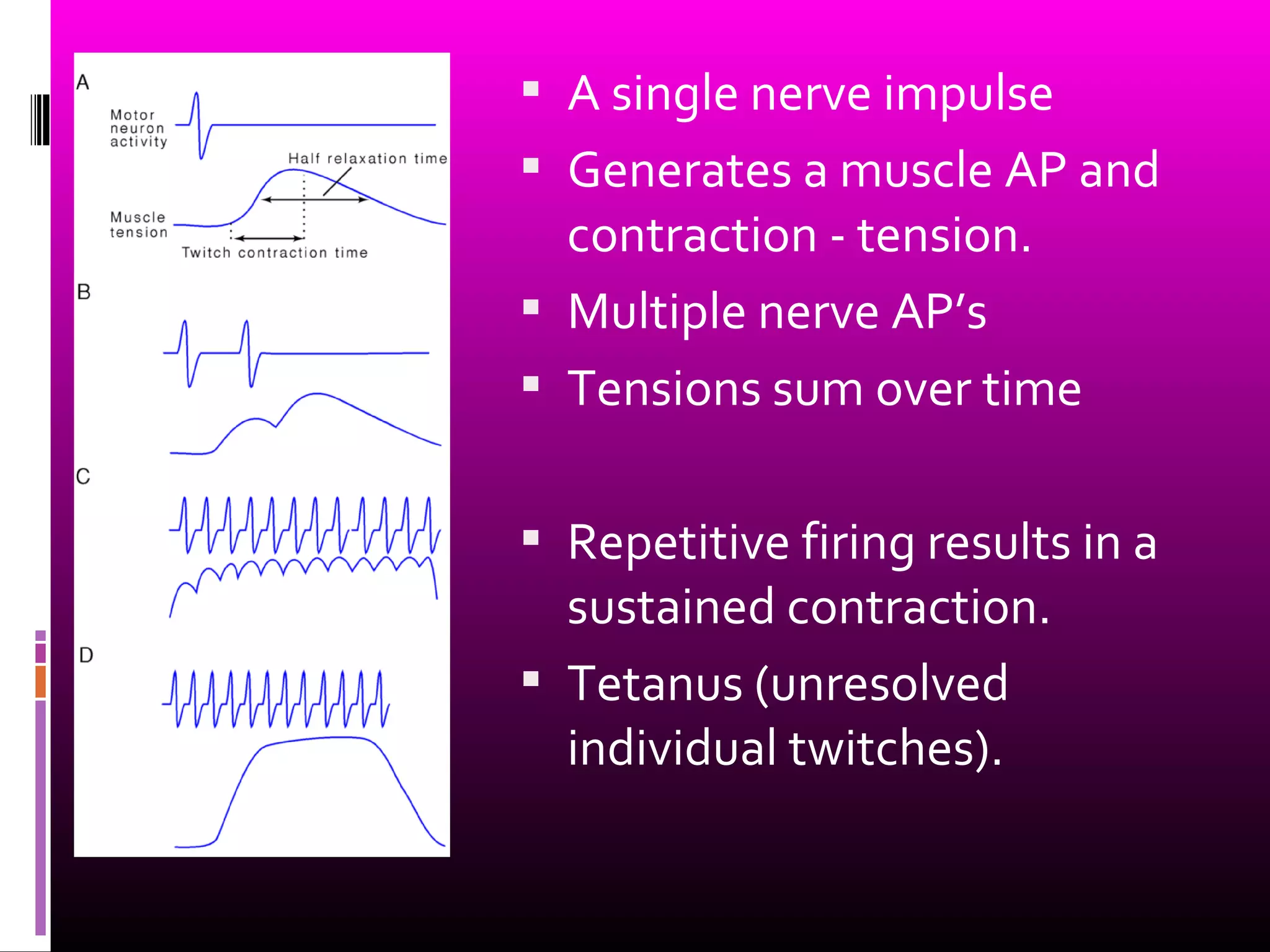
 A single nerve impulse
 Generates a muscle AP and
contraction - tension.
 Multiple nerve AP’s
 Tensions sum over time
 Repetitive firing results in a
sustained contraction.
 Tetanus (unresolved
individual twitches).
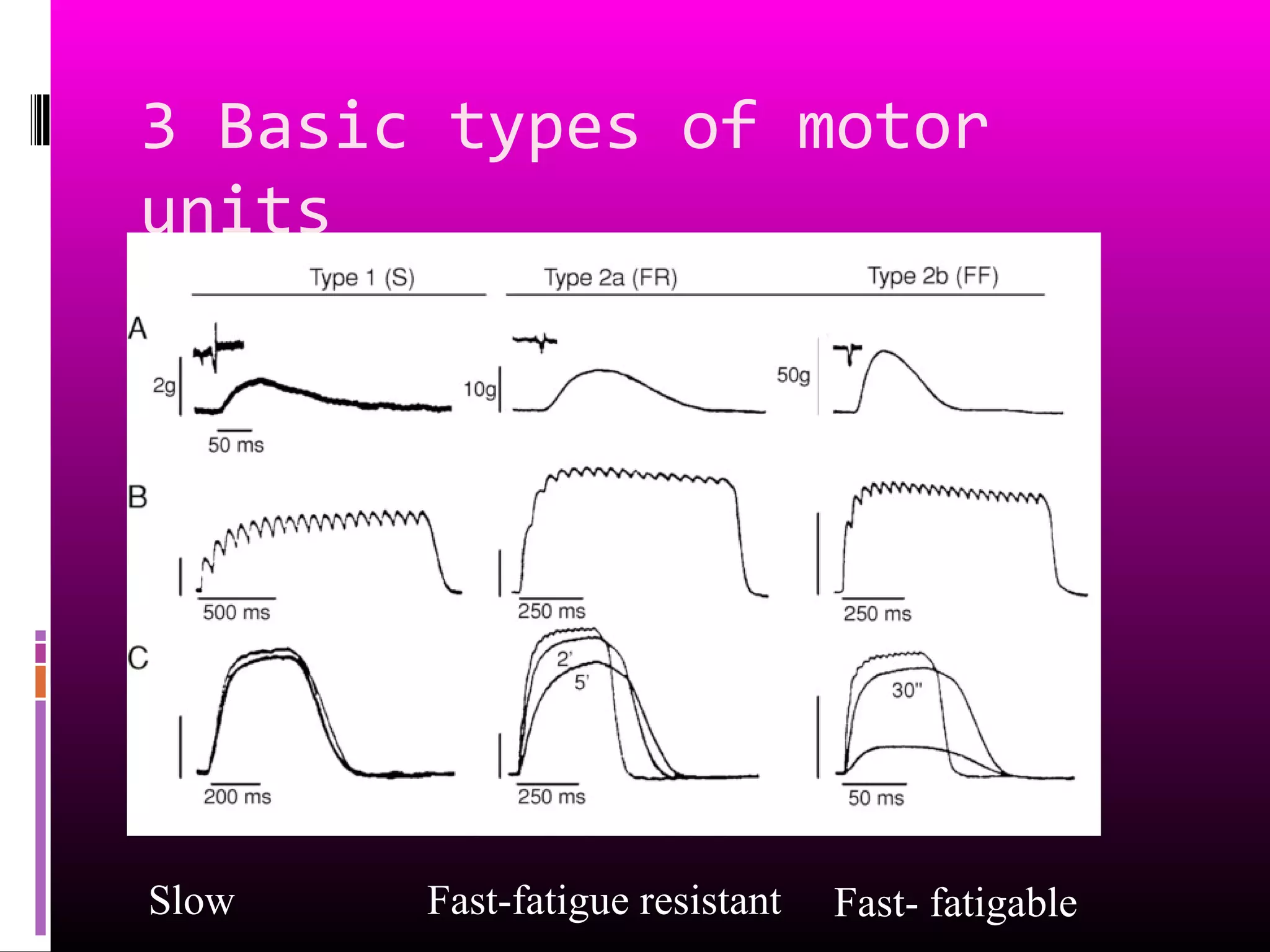
3 Basic types of motor
units
Slow Fast-fatigue resistant Fast- fatigable
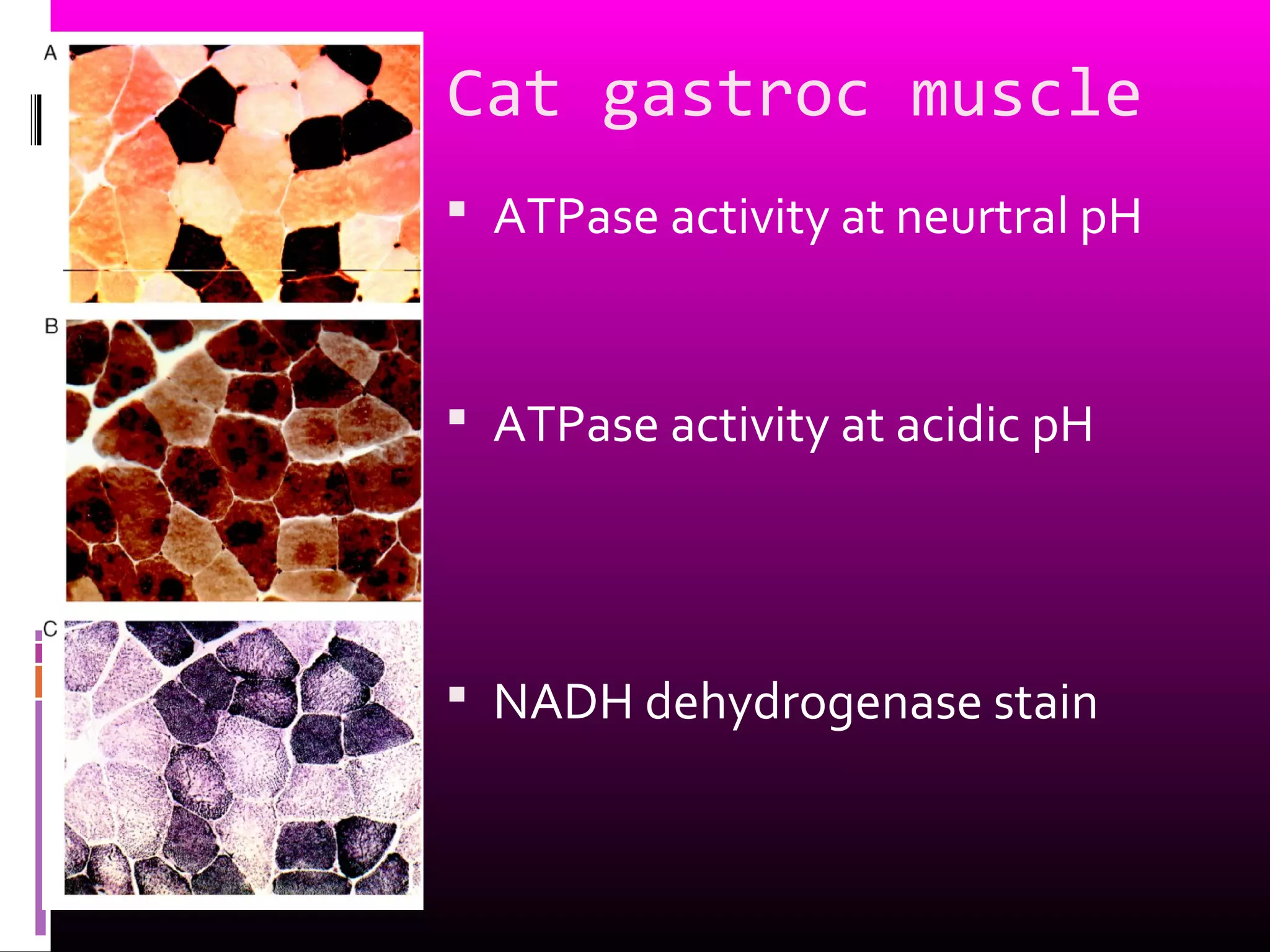
Cat gastroc muscle
 ATPase activity at neurtral pH
 ATPase activity at acidic pH
 NADH dehydrogenase stain
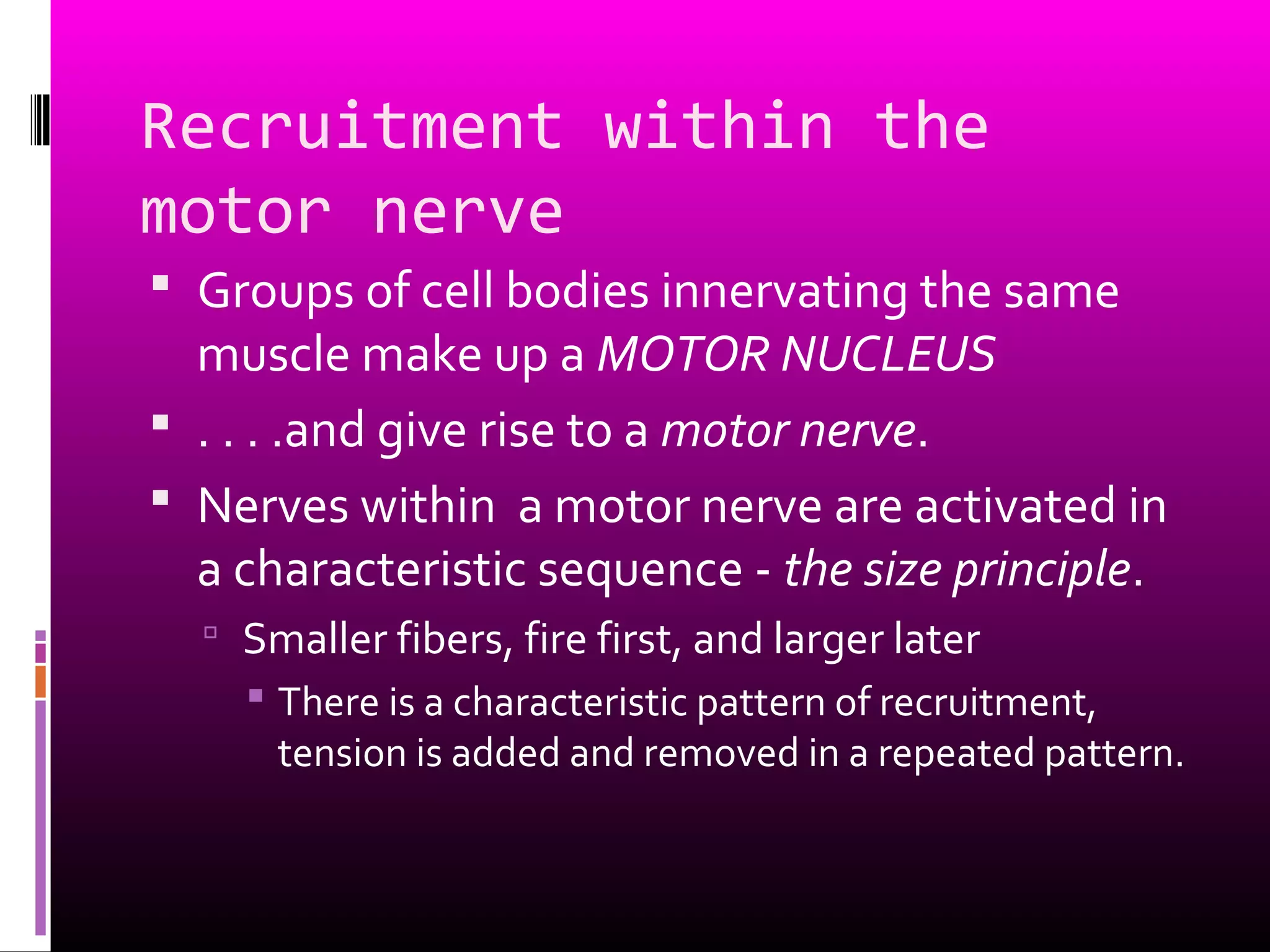
Recruitment within the
motor nerve
 Groups of cell bodies innervating the same
muscle make up a MOTOR NUCLEUS
 . . . .and give rise to a motor nerve.
 Nerves within a motor nerve are activated in
a characteristic sequence - the size principle.
 Smaller fibers, fire first, and larger later
 There is a characteristic pattern of recruitment,
tension is added and removed in a repeated pattern.
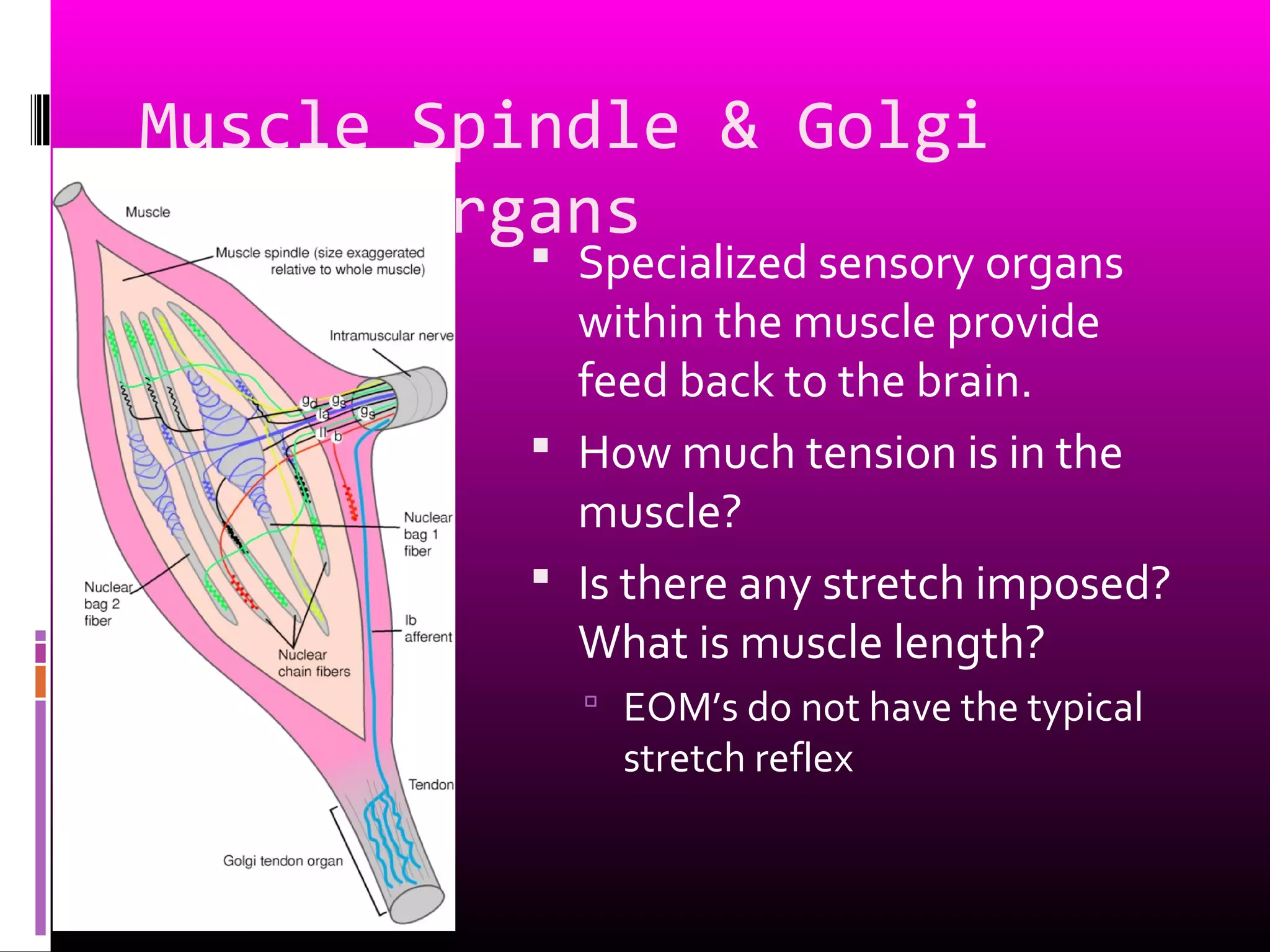
Muscle Spindle & Golgi
Tendon Organs
 Specialized sensory organs
within the muscle provide
feed back to the brain.
 How much tension is in the
muscle?
 Is there any stretch imposed?
What is muscle length?
 EOM’s do not have the typical
stretch reflex

EXTRA OCULAR MUSCLES

  • 2.
    Muscle Fibers -cellular & molecular nuts & bolts Motor Units - how is tension developed? Eye movements - definitions of stimulus & action Dr. Busatini has an entire course on this subject, so we can skip pages 143 -152, and 176-185. VS 112 Ocular Anatomy
  • 3.
    I. Just whatsort of movements do your eyes make?  Those which are you aware of, those that are voluntary (or at least the initiation of them is voluntary).  Reflex eye movements - automatic adjustment of the eye position to stabilize an image on the eye.
  • 4.
    Eye movements  Smoothtracking (pursuit)  Combined head and eye tracking  Saccades – quick jumps, saccadic eye movements (< 50 msec) (up to 20°) voluntary initiation  Mini saccades (see fixation).  Fixation – holding a steady gaze (which we never actually do – see figure 4.1).
  • 5.
    Reflex eye movements. Thestimulus can be head/body movement i) VOR vestibular ocular reflexes – if you move your head the eyes can maintain fixation upon the target.  ii) Optokinetic reflex : stimulus = rapid motion of the world, such as motion of a stream, or motion of world outside of the side car window.  Nystagmus (alternating slow & quick phases of movement)
  • 6.
    Reflex eye movements. Thestimulus can be movement, motion of an object of interest.  iii) Smooth pursuit - one object is targeted and remains clear on the retina the rest of the visual world is in motion – the standard stimulus for the optokinetic reflex,(only seen in foveate animals)  iv) Fixation - holding a steady gaze on a target of interest. NOT just a special form of pursuit.
  • 7.
    Fixation – holdinga steady gaze  The eyes are in constant motion  Slow drift  Minisaccades  Tremor (high frequency jitter in position)  aka micronystagmus.  In fact, if you could perfectly stabilize an image on the retina it would fade and disappear. Some retinal motion is necessary, that is some movement of the image across the retina must be present or the image fades.
  • 8.
    Eye Movements:  Seefigure 4.1 over head
  • 9.
    Motion of anEye  To describe eye motions we need a set of defined axes (Fick’s Axes - draw on board)  X axis : nasal -> temporal  Y axis: anterior -> posterior  Z axis: superior -> inferior  These axes intersect at the center of rotation - a fixed point, defined as 13.5 mm behind cornea.
  • 10.
    Ductions (single eyemovements)  Rotation about the Z axis (Z axis runs vertically superior to inferior)  Medial Rotation - adduction toward midline  Lateral Rotation - abduction away from midline  Rotation about the X axis (X axis runs horizontally, from nasal to temporal)  Upward, elevation (supraduction)  Downward, depression (infraduction)
  • 11.
    Torsion - cyclorotations Rotation about the Y axis (Y axis runs horizontally, from anterior to posterior)  These are described with respect to a point at 12 o‘clock on the superior limbus  Intorsion (incyclorotation) rotation nasally  Extorsion (excyclorotation) rotation of the 12 o’clock position temporally.  Counteracting head tilt (up to 7-9°)
  • 12.
    Version & Vergences Some eye movements are paired, that is both eyes do the same thing. . . . Versions  Sometimes eyes move in the opposite directions simultaneously. . . Vergences
  • 13.
    Vergences  Disjunctive eyemovements (opposite left- right movments). Non-yolked motion  Convergence (simultaneous movement nasally)  Divergence (simultaneous temporal movement)  Encyclovergence (intorsion)  Excyclovergence (extorsion)
  • 14.
    Versions (conjugate eye movement) Dextroversion - rightward gaze (demo)  Levoversion - leftward gaze  Supraversion - elevation  Infraversion - depression  Also up and right, up and left  Down and right, down and left  ALL BEHAVIOR IS THAT OF YOLKED EYES
  • 15.
    Extraocular Muscles  4rectus muscles - origin is in the common tendous ring (annulus of Zinn)  Oval ring of connective tissue  Continuous with periorbita  Anterior to optic foramen  Medial and lateral rectus attached to both the upper and lower tendon limbs  The muscles traveling from the this tendon ring to the insertions create muscle cone.
  • 16.
  • 17.
    Spiral of Tillaux The rectus muscle pass through tenon’s capsule and insert into the sclera.  The muscles insert at different distances from the cornea.  The insertion pattern is a spiral with the medial rectus closest to the cornea (5.5 mm) and the superior rectus the furthest away from the cornea (7.4 mm).
  • 18.
  • 19.
    Medial Rectus  Originateson both the upper and lower limb of the common tendous ring and the optic nerve sheath.  Inserts along a vertical line 5.5 mm from the cornea. The horizontal plane of eye bisects the insertion.  Fascial expansion from muscle sheath forms the medial check ligament and attach to medial wall of orbit.
  • 20.
    Medial Rectus cont. Innervation is via cranial nerve III, the oculomotor nerve, and the specific branch runs along the inside of the muscle cone, on the lateral surface.  The superior oblique, ophthalmic artery and nasociliary nerve all lie above the medial rectus.
  • 21.
    Spiral of Tillaux 5.5mm 6.7 mm 6.9 mm 7.4 mm
  • 22.
    Lateral rectus  Originateson both the upper and lower limb of the common tendous ring. . .AND a process of the greater wing of the sphenoid bone.  Inserts parallel to medial rectus 6.9 mm from the cornea. (Tendon 9.2 mm wide, 8.8 long).  Fascial expansion from muscle sheath forms the lateral check ligament and attach to lateral wall of orbit at Whitnalls tubercle.
  • 23.
    Lateral Rectus cont. Innervated by the abducens nerve, Cranial n VI which enters the muscle on the medial surface.  The lacrimal artery and nerve run along the superior border.  The abducens n., ophthalmic artery and ciliary ganglion lie medial to the lateral rectus and between it and the optic nerve.
  • 24.
    Superior Rectus  Originateon superior limb of the tendonous ring, and optic nerve sheath.  Muscle passes forward underneath the levator, but the two sheaths are connected resulting in coordinated movements.  Insertion 7.4 mm from limbus, and obliquely.  The angle from the origin to the insertion is 23° beyond the sagital axis. (see overhead)
  • 25.
    Superior Rectus cont. Frontal nerve runs above the s. rectus & levat.  The nasociliary nerve and ophthalmic artery run below.  The tendon for insertion of the superior oblique muscle runs below the anterior part of the superior rectus.  Innervationis via superior division of CN III, from the inferior surface; additional branches make their way to the levator.
  • 26.
    Action of SuperiorRectus  Primary action is elevation . . But since the insertion on the globe is lateral as well as superior, contraction will produce rotation about the vertical axis toward midline  Thus secondary action is adduction  Finally, because the insertion is oblique, contraction produces torsion nasally Intorsion.  (overhead figure 10-13A)
  • 27.
    Superior view ofSup. Rectus 23° Because the muscle runs at an angle to the Fick’s axes, contraction is not confined to one axis
  • 28.
    Inferior rectus  Originateson lower limb of common tendonous ring.  Inserts 6.7 mm from limbus, insertion is an arc  It is parallel to superior rectus, making a 23° angle beyond the sagittal axis.  Innervated by inferior division of CN III which runs above it (within the muscle cone).  Below is the floor of the orbit and inf. oblique
  • 29.
    Inferior Rectus cont. Fascial attachments below attached to inferior lid coordinate depression and lid opening.  Fascia below Inf. Rectus and Inf. Oblique contribute to the suspensory ligament of lockwood.  Primary Action downward gaze depression  2° Adduction, as is the case for sup. Rectus  Also extorsion due to oblique arc of insertion.
  • 30.
    Vectors of Sup& Inf Recti
  • 31.
    Superior Oblique  Anatomicalorigin is on the lesser wing of the sphenoid bone. The physiological origin is the trochlea, a cartilagenous “U” on the superior medial wall of the orbit.  Longest thinnest EOM, the muscle ends before the trochlea, tendon is 2.5 cm, smooth movement through trochlea.  Innervation by CN IV, the trochlear nerve posterior in the orbit.
  • 32.
    Action of Sup.Oblique  Primary action is intorsion _ rotation of 12 o’clock position toward midline.  Because the insertion of the oblique muscle is in the lateral, posterior quadrant the secondary actions are  Rotating the back half of the globe from lateral to medial (the anterior pole will move away) ABDUCTION  Also depression (posterior superior quadrant of the globe being pulled upward).
  • 33.
    Inferior Oblique  Originateson the maxillary bone inferior to the nasolacrimal fossa. The ONLY EOM originating in the anterior orbit.  Inserts on the posterior lateral aspect of globe mostly inferior, below the ant.-post. horizontal plane.  Innervation from inferior division of CN III inserts on the upper surface (within muscle cone.)
  • 34.
  • 35.
    Action of Inf.Oblique  Primary is extorsion  2° is due to posterior, lateral, inferior insertion being pulled around, underneath globe and toward the anterior inferior insertion medially.  Rotation about the Z axis will be nasal to temporal (abduction).  Rotation about the X axis will be elevation (see overhead figure 10.14)
  • 36.
    And from hereit’s complicated  There is a balance of tension in the pairs of muscle to start with. . . .  Actions of the muscle can and do depend on the starting position.  For example elevation of the eye in the straight- ahead position and lateral position is accomplished by the sup. rectus.  But when the eye is medial rotated elevation is accomplished by the inferior oblique muscle action. (see fig 10-17 over head).
  • 37.
  • 38.
    What is amuscle, how does it work?
  • 40.
    Thick & thinfilaments Elements within, between the Z-lines make up a contractile unit
  • 41.
    Ratchet Model  Myosinhead binds to actin filament.  The ratchet motion moves the two filament about 12 nm with respect to each other.  It takes only 5 ms  Because of the large number of z-line segments or contractile units along a fiber, a fast motion is attained.
  • 42.
    Thick and thinfilament specializations with EOM Each motor fiber is innervated by only one nerve
  • 43.
    Extraocular muscles are special Themotor units are small, with only from 5 to 18 muscle fibers contact by each motor nerve A motor nerve can and does contact more than one fiber usually 100’s
  • 44.
    EOM’s are special THICK FIBERS  Striated muscle  Singly innervated  1 nerve, 1 branch  Motor end plate  Terminaison en plaque  Includes both fast and slow twitch fibers  All or none contractionAll or none contraction  THIN FIBERS  Striated musle  Multiply innervated  Many branches 1 nerve  En grappe end plate  Terminaisons en grappe  Thought to be slow sustained (tonic)  Graded contractionsGraded contractions
  • 45.
    Thick and thinfilament specializations with EOM Each motor fiber is innervated by only one nerve
  • 46.
    Fiber types segregatein the muscle
  • 47.
     A singlenerve impulse  Generates a muscle AP and contraction - tension.  Multiple nerve AP’s  Tensions sum over time  Repetitive firing results in a sustained contraction.  Tetanus (unresolved individual twitches).
  • 48.
    3 Basic typesof motor units Slow Fast-fatigue resistant Fast- fatigable
  • 49.
    Cat gastroc muscle ATPase activity at neurtral pH  ATPase activity at acidic pH  NADH dehydrogenase stain
  • 50.
    Recruitment within the motornerve  Groups of cell bodies innervating the same muscle make up a MOTOR NUCLEUS  . . . .and give rise to a motor nerve.  Nerves within a motor nerve are activated in a characteristic sequence - the size principle.  Smaller fibers, fire first, and larger later  There is a characteristic pattern of recruitment, tension is added and removed in a repeated pattern.
  • 51.
    Muscle Spindle &Golgi Tendon Organs  Specialized sensory organs within the muscle provide feed back to the brain.  How much tension is in the muscle?  Is there any stretch imposed? What is muscle length?  EOM’s do not have the typical stretch reflex

Editor's Notes

  • #39 Perimysium - coverage of a groups of muscle fibers with connective tissue Coverage of the entire muscle is by another connective tissue sheath the epimysium which merges with tenon’s capsule.
  • #43 EOM have thin fibers with unusual neuromuscular junctions. En Grappe The mean diam is 20 µm, compared to 100 µm in typical skelatal muscles. The range is 10 to 50 µm The distinction between thick and thin is population with overlap and really based on the nerve endings.
  • #52 However there is something known as the oculocardiac reflex. - passive stretching of the EOM can slow, DRASTICALLY SLOW , or STOP!! The heart!!!