

PERSONAL PROTECTIVE
EQUIPMENT
MADE BY : S. Arya Das
FROM : BHARTIMAIYA
COLLEGE OF
OPTOMETRY
1
INTRODUCTION
• NEARLY TWO MILLION PEOPLE ARE
EXPECTED TO RECEIVE DISABLING
WORK-RELATED INJURIES IN YEAR.
INTRODUCTION
• MORE THAN ONE-FOURTH OF
THESE INJURIES WILL INVOLVE THE
HEAD, EYES, HANDS, OR FEET
Personal protective equipment or PPE is
protective equipment used for work-
related occupational health and safety
purposes
Devices used to protect workers from injury
or illness resulting from contact with
chemical , radiological, physical, electrical,
mechanical, or other workplace hazards
4
 PPE is designed to protect the worker’s body
from hazards and injuries such as blunt
impacts, electrical hazards, heat, chemicals,
and infection, etc.
5
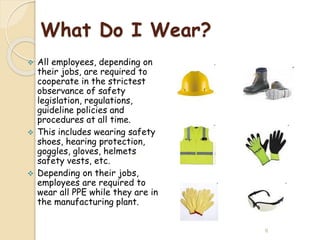
What Do I Wear?
 All employees, depending on
their jobs, are required to
cooperate in the strictest
observance of safety
legislation, regulations,
guideline policies and
procedures at all time.
 This includes wearing safety
shoes, hearing protection,
goggles, gloves, helmets,
safety vests, etc.
 Depending on their jobs,
employees are required to
wear all PPE while they are in
the manufacturing plant.
6
STANDARD FOR PERSONAL
PROTECTIVE EQUIPMENT
•OCCUPATIONAL
HEALTH and
SAFETY
ADMINISTRATION
7
OHSA Standards
OHSA standards requires employer to:
Conduct documented assessment of
workplace hazards
Provide appropriate PPE when required
Provide training
9
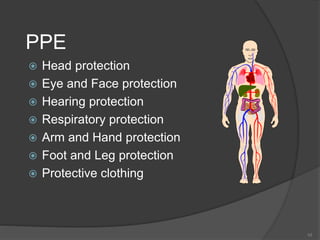
PPE
 Head protection
 Eye and Face protection
 Hearing protection
 Respiratory protection
 Arm and Hand protection
 Foot and Leg protection
 Protective clothing
10
EYE AND FACE ROTECTION
11
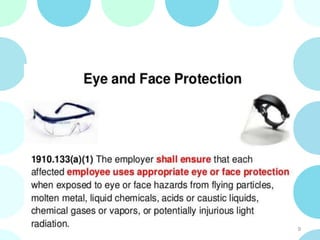
 APPROVED EYE AND FACE PROTECTION
SHALL BE WORN WHEN THERE IS
REASONABLE PROBABILITY THAT AN INJURY
CAN BE PREVENTED OR REDUCED BY
WEARING SUCH EQUIPMENT
When must Eye Protection be
Provided?
 When any of these hazards are present:
• Dust and other flying particles, such as
metal shavings or sawdust
• Corrosive gases, vapors, and liquids
• Molten metal that may splash
• Potentially infectious materials such as
blood or hazardous liquid chemicals that
may splash
• Intense light from welding and lasers
12
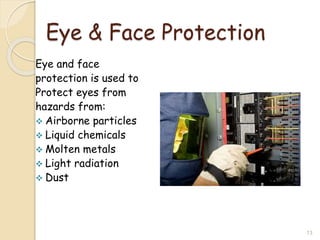
Eye & Face Protection
Eye and face
protection is used to
Protect eyes from
hazards from:
 Airborne particles
 Liquid chemicals
 Molten metals
 Light radiation
 Dust
13
Eye Protection
Criteria for Selection
• Protects against specific hazard(s)
• Comfortable to wear
• Does not restrict vision or movement
• Durable and easy to clean and disinfect
• Does not interfere with the function of
other required PPE
11
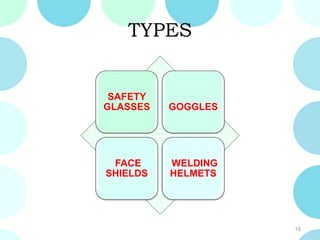
TYPES
SAFETY
GLASSES GOGGLES
FACE
SHIELDS
WELDING
HELMETS
15
SAFETY GOGGLES
• In many working environments it is
possible to simply provide over – goggles ,
particularly to spectacle wearers , but
these should not be seen as a long term
solution as physical and visual comfort will
be limited.
• Safety goggles are most useful to protect
from splashes and / or provide high impact
resistance.
16
Safety Goggles
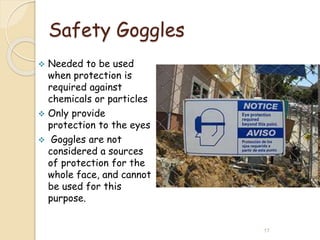
 Needed to be used
when protection is
required against
chemicals or particles
 Only provide
protection to the eyes
 Goggles are not
considered a sources
of protection for the
whole face, and cannot
be used for this
purpose.
17
Safety Goggles - CSA
The Canadian Standards Association (CSA)-
certifies that safety glasses have plastic
polycarbonate lenses.
The manufacturer or supplier logo must be
marked or etched on all approved safety
lenses, frames (front and temple), removable
side shields, and other parts of the glasses,
goggles, or helmets.
Safety frames are stronger than street-wear
frames and are mostly heat resistant.
18
TYPES
19
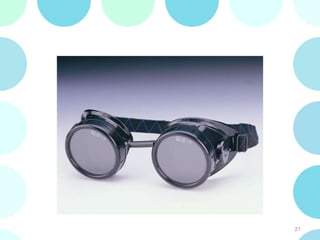
CUP – TYPE GOGGLES
• The elastic headband provides a tight fit to
the face and can provide protection
against molten metal , flying particles ,
dust , etc.
• The housing is generally made of polyvinyl
chloride.
• They sometimes have adjustable nasal
fitting and , if the rims have screws , the
lenses can be replaced or exchanged for
another type of lens , e.g. tinted or impact
resistant. 20
21
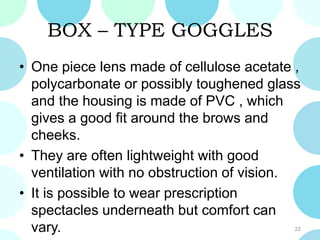
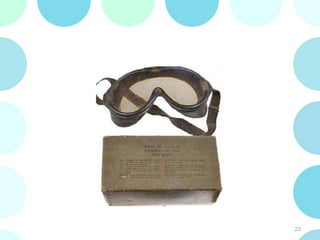
BOX – TYPE GOGGLES
• One piece lens made of cellulose acetate ,
polycarbonate or possibly toughened glass
and the housing is made of PVC , which
gives a good fit around the brows and
cheeks.
• They are often lightweight with good
ventilation with no obstruction of vision.
• It is possible to wear prescription
spectacles underneath but comfort can
vary. 22
23
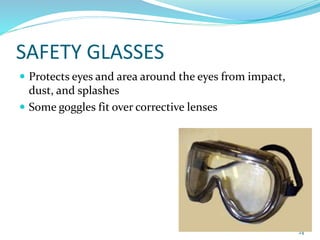
SAFETY GLASSES
 Protects eyes and area around the eyes from impact,
dust, and splashes
 Some goggles fit over corrective lenses
24
SAFETY EYEWEAR
CON’T
• TINTED OR SHADED LENSES MAY BE
NEEDED FOR PROTECTION AGAINST
GLARE
• TINTED OR SHADED LENSES MAY
LIMIT YOUR VISION WHEN MOVING
FROM BRIGHT TO DIM AREAS
• SPECIALLY NUMBERED LENS ARE
PROVIDED FOR PROTECTION OF
RADIANT ENERGY( WELDING ETC.)
25
SAFETY EYEWEAR
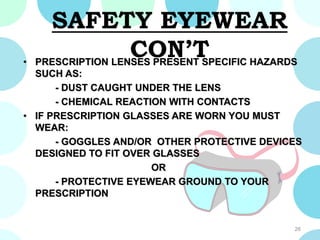
CON’T• PRESCRIPTION LENSES PRESENT SPECIFIC HAZARDS
SUCH AS:
- DUST CAUGHT UNDER THE LENS
- CHEMICAL REACTION WITH CONTACTS
• IF PRESCRIPTION GLASSES ARE WORN YOU MUST
WEAR:
- GOGGLES AND/OR OTHER PROTECTIVE DEVICES
DESIGNED TO FIT OVER GLASSES
OR
- PROTECTIVE EYEWEAR GROUND TO YOUR
PRESCRIPTION
26
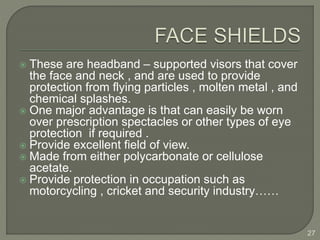
 These are headband – supported visors that cover
the face and neck , and are used to provide
protection from flying particles , molten metal , and
chemical splashes.
 One major advantage is that can easily be worn
over prescription spectacles or other types of eye
protection if required .
 Provide excellent field of view.
 Made from either polycarbonate or cellulose
acetate.
 Provide protection in occupation such as
motorcycling , cricket and security industry……
27
28
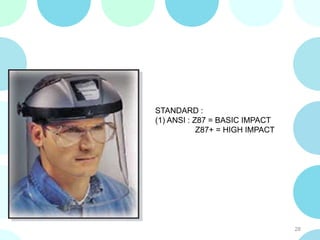
STANDARD :
(1) ANSI : Z87 = BASIC IMPACT
Z87+ = HIGH IMPACT
WELDING SHIELDS
 Constructed of vulcanized fiber or fiberglass and
fitted with a filtered lens, welding shields protect eyes
from burns caused by infrared or intense radiant light;
they also protect both the eyes and face from flying
sparks, metal spatter and slag chips produced during
welding, brazing, soldering and cutting operations.
 OSHA requires filter lenses to have a shade number
appropriate to protect against the specific hazards of
the work being performed in order to protect against
harmful light radiation.
29
SWATI PANARA 30

Personal protective equipment.........arya

  • 1.
    PERSONAL PROTECTIVE EQUIPMENT MADE BY: S. Arya Das FROM : BHARTIMAIYA COLLEGE OF OPTOMETRY 1
  • 2.
    INTRODUCTION • NEARLY TWOMILLION PEOPLE ARE EXPECTED TO RECEIVE DISABLING WORK-RELATED INJURIES IN YEAR.
  • 3.
    INTRODUCTION • MORE THANONE-FOURTH OF THESE INJURIES WILL INVOLVE THE HEAD, EYES, HANDS, OR FEET
  • 4.
    Personal protective equipmentor PPE is protective equipment used for work- related occupational health and safety purposes Devices used to protect workers from injury or illness resulting from contact with chemical , radiological, physical, electrical, mechanical, or other workplace hazards 4
  • 5.
     PPE isdesigned to protect the worker’s body from hazards and injuries such as blunt impacts, electrical hazards, heat, chemicals, and infection, etc. 5
  • 6.
    What Do IWear?  All employees, depending on their jobs, are required to cooperate in the strictest observance of safety legislation, regulations, guideline policies and procedures at all time.  This includes wearing safety shoes, hearing protection, goggles, gloves, helmets, safety vests, etc.  Depending on their jobs, employees are required to wear all PPE while they are in the manufacturing plant. 6
  • 7.
    STANDARD FOR PERSONAL PROTECTIVEEQUIPMENT •OCCUPATIONAL HEALTH and SAFETY ADMINISTRATION 7
  • 8.
    OHSA Standards OHSA standardsrequires employer to: Conduct documented assessment of workplace hazards Provide appropriate PPE when required Provide training
  • 9.
  • 10.
    PPE  Head protection Eye and Face protection  Hearing protection  Respiratory protection  Arm and Hand protection  Foot and Leg protection  Protective clothing 10
  • 11.
    EYE AND FACEROTECTION 11  APPROVED EYE AND FACE PROTECTION SHALL BE WORN WHEN THERE IS REASONABLE PROBABILITY THAT AN INJURY CAN BE PREVENTED OR REDUCED BY WEARING SUCH EQUIPMENT
  • 12.
    When must EyeProtection be Provided?  When any of these hazards are present: • Dust and other flying particles, such as metal shavings or sawdust • Corrosive gases, vapors, and liquids • Molten metal that may splash • Potentially infectious materials such as blood or hazardous liquid chemicals that may splash • Intense light from welding and lasers 12
  • 13.
    Eye & FaceProtection Eye and face protection is used to Protect eyes from hazards from:  Airborne particles  Liquid chemicals  Molten metals  Light radiation  Dust 13
  • 14.
    Eye Protection Criteria forSelection • Protects against specific hazard(s) • Comfortable to wear • Does not restrict vision or movement • Durable and easy to clean and disinfect • Does not interfere with the function of other required PPE 11
  • 15.
  • 16.
    SAFETY GOGGLES • Inmany working environments it is possible to simply provide over – goggles , particularly to spectacle wearers , but these should not be seen as a long term solution as physical and visual comfort will be limited. • Safety goggles are most useful to protect from splashes and / or provide high impact resistance. 16
  • 17.
    Safety Goggles  Neededto be used when protection is required against chemicals or particles  Only provide protection to the eyes  Goggles are not considered a sources of protection for the whole face, and cannot be used for this purpose. 17
  • 18.
    Safety Goggles -CSA The Canadian Standards Association (CSA)- certifies that safety glasses have plastic polycarbonate lenses. The manufacturer or supplier logo must be marked or etched on all approved safety lenses, frames (front and temple), removable side shields, and other parts of the glasses, goggles, or helmets. Safety frames are stronger than street-wear frames and are mostly heat resistant. 18
  • 19.
  • 20.
    CUP – TYPEGOGGLES • The elastic headband provides a tight fit to the face and can provide protection against molten metal , flying particles , dust , etc. • The housing is generally made of polyvinyl chloride. • They sometimes have adjustable nasal fitting and , if the rims have screws , the lenses can be replaced or exchanged for another type of lens , e.g. tinted or impact resistant. 20
  • 21.
  • 22.
    BOX – TYPEGOGGLES • One piece lens made of cellulose acetate , polycarbonate or possibly toughened glass and the housing is made of PVC , which gives a good fit around the brows and cheeks. • They are often lightweight with good ventilation with no obstruction of vision. • It is possible to wear prescription spectacles underneath but comfort can vary. 22
  • 23.
  • 24.
    SAFETY GLASSES  Protectseyes and area around the eyes from impact, dust, and splashes  Some goggles fit over corrective lenses 24
  • 25.
    SAFETY EYEWEAR CON’T • TINTEDOR SHADED LENSES MAY BE NEEDED FOR PROTECTION AGAINST GLARE • TINTED OR SHADED LENSES MAY LIMIT YOUR VISION WHEN MOVING FROM BRIGHT TO DIM AREAS • SPECIALLY NUMBERED LENS ARE PROVIDED FOR PROTECTION OF RADIANT ENERGY( WELDING ETC.) 25
  • 26.
    SAFETY EYEWEAR CON’T• PRESCRIPTIONLENSES PRESENT SPECIFIC HAZARDS SUCH AS: - DUST CAUGHT UNDER THE LENS - CHEMICAL REACTION WITH CONTACTS • IF PRESCRIPTION GLASSES ARE WORN YOU MUST WEAR: - GOGGLES AND/OR OTHER PROTECTIVE DEVICES DESIGNED TO FIT OVER GLASSES OR - PROTECTIVE EYEWEAR GROUND TO YOUR PRESCRIPTION 26
  • 27.
     These areheadband – supported visors that cover the face and neck , and are used to provide protection from flying particles , molten metal , and chemical splashes.  One major advantage is that can easily be worn over prescription spectacles or other types of eye protection if required .  Provide excellent field of view.  Made from either polycarbonate or cellulose acetate.  Provide protection in occupation such as motorcycling , cricket and security industry…… 27
  • 28.
    28 STANDARD : (1) ANSI: Z87 = BASIC IMPACT Z87+ = HIGH IMPACT
  • 29.
    WELDING SHIELDS  Constructedof vulcanized fiber or fiberglass and fitted with a filtered lens, welding shields protect eyes from burns caused by infrared or intense radiant light; they also protect both the eyes and face from flying sparks, metal spatter and slag chips produced during welding, brazing, soldering and cutting operations.  OSHA requires filter lenses to have a shade number appropriate to protect against the specific hazards of the work being performed in order to protect against harmful light radiation. 29
  • 30.