Extra-Ocular Muscles
By/Mohamed Ahmed El –Shafie
Assistant Lecturer in ophthalmology department
KafrELShiekh University
1
ORBITAL MUSCLES
Extrinsic muscles of eyeball.
• Involved in movement of eyeball.
Intrinsic muscles
• Controls shape of lens and size of pupil.
2
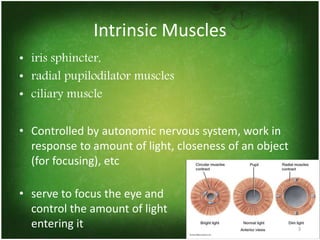
Intrinsic Muscles
• iris sphincter,
• radial pupilodilator muscles
• ciliary muscle
• Controlled by autonomic nervous system, work in
response to amount of light, closeness of an object
(for focusing), etc
• serve to focus the eye and
control the amount of light
entering it 3
vedio
4
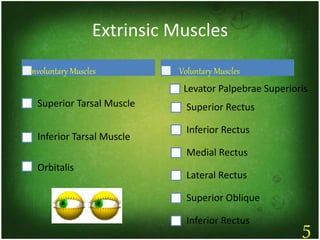
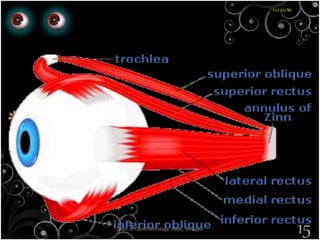
Extrinsic Muscles
Involuntary Muscles
Superior Tarsal Muscle
Inferior Tarsal Muscle
Orbitalis
Voluntary Muscles
Levator Palpebrae Superioris
Superior Rectus
Inferior Rectus
Medial Rectus
Lateral Rectus
Superior Oblique
Inferior Rectus
5
Embryology
• mesodermal origin,
• Perimuscular Connective tissues from neural crest
• development beginning at 3– weeks of gestation.
6
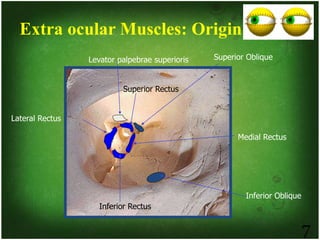
Extra ocular Muscles: Origin
Superior ObliqueLevator palpebrae superioris
Medial Rectus
Lateral Rectus
Superior Rectus
Inferior Rectus
Inferior Oblique
7
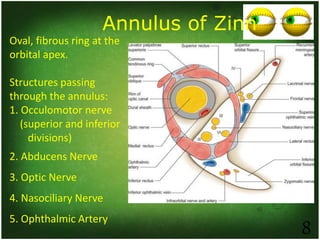
Oval, fibrous ring at the
orbital apex.
Structures passing
through the annulus:
1. Occulomotor nerve
(superior and inferior
divisions)
2. Abducens Nerve
3. Optic Nerve
4. Nasociliary Nerve
5. Ophthalmic Artery
Annulus of Zinn
8
23rd July '15
9
Clinical Significance
 Retrobulbar neuritis
○ Origin of SUPERIOR AND MEDIAL RECTUS are closely attached to the dural
sheath of the optic nerve, which leads to pain during upward & inward
movements of the globe.
 Thyroid orbitopathy
○ Medial & Inf.rectus thicken. especially near the orbital apex - compression of
the optic nerve as it enters the optic canal adjacent to the body of the
sphenoid bone.
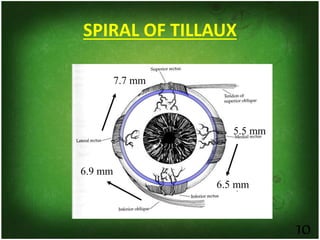
SPIRAL OF TILLAUX
5.5 mm
6.5 mm
6.9 mm
7.7 mm
10
23rd July '15
11
23rdJuly '15
Dept. of Ophthalmology, JNMC, Belagavi
 Medial rectus inserts closest to the limbus and is therefore
susceptible to injury during ant. segment surgery.
 Inadvertent removal of the MR is a well known complication
of Pterygium removal
 The Scleral thickness behind the rectus insertion is the
thinnest, being only 0.3 mm thick -> chances of scleral
perforation while suturing
Clinical Significance
23rd July '15
1
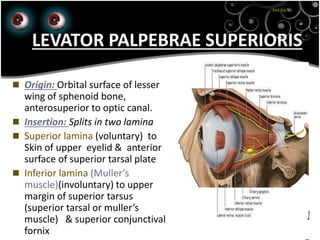
LEVATOR PALPEBRAE SUPERIORIS
 Origin: Orbital surface of lesser
wing of sphenoid bone,
anterosuperior to optic canal.
 Insertion: Splits in two lamina
 Superior lamina (voluntary) to
Skin of upper eyelid & anterior
surface of superior tarsal plate
 Inferior lamina (Muller’s
muscle)(involuntary) to upper
margin of superior tarsus
(superior tarsal or muller’s
muscle) & superior conjunctival
fornix
23rd July '15
1
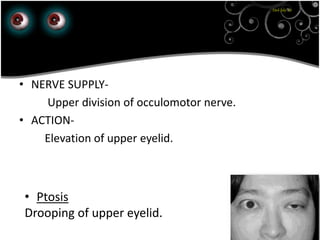
• NERVE SUPPLY-
Upper division of occulomotor nerve.
• ACTION-
Elevation of upper eyelid.
• Ptosis
Drooping of upper eyelid.
VEDIO
23rd July '15 Dept. of Ophthalmology, JNMC, Belagavi 14
23rd July '15
15Dept. of Ophthalmology, JNMC, Belagavi
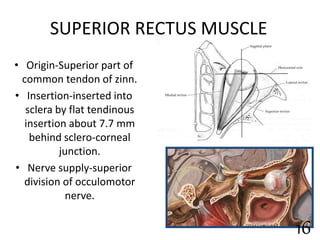
SUPERIOR RECTUS MUSCLE
• Origin-Superior part of
common tendon of zinn.
• Insertion-inserted into
sclera by flat tendinous
insertion about 7.7 mm
behind sclero-corneal
junction.
• Nerve supply-superior
division of occulomotor
nerve.
16
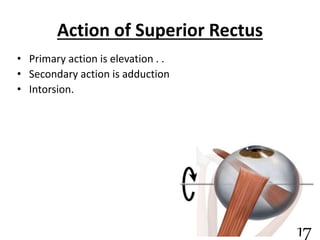
Action of Superior Rectus
• Primary action is elevation . .
• Secondary action is adduction
• Intorsion.
17
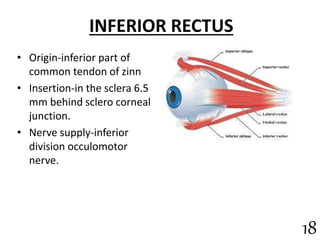
INFERIOR RECTUS
• Origin-inferior part of
common tendon of zinn
• Insertion-in the sclera 6.5
mm behind sclero corneal
junction.
• Nerve supply-inferior
division occulomotor
nerve.
18
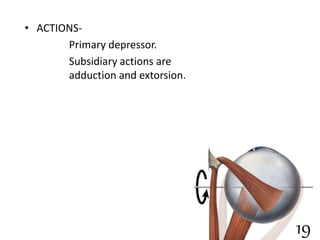
• ACTIONS-
Primary depressor.
Subsidiary actions are
adduction and extorsion.
19
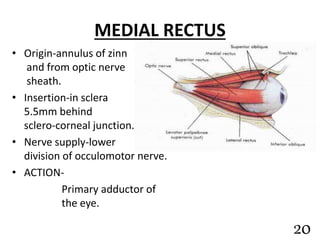
MEDIAL RECTUS
• Origin-annulus of zinn
and from optic nerve
sheath.
• Insertion-in sclera
5.5mm behind
sclero-corneal junction.
• Nerve supply-lower
division of occulomotor nerve.
• ACTION-
Primary adductor of
the eye.
20
LATERAL RECTUS
• Origin-annulus of zinn.
• Insertion-in the sclera 6.9mm behind sclerocorneal
junction.
• Nerve supply-abducens nerve which enters the muscle
on the medial surface.
• ACTION-
Primary abductor of eye.
21
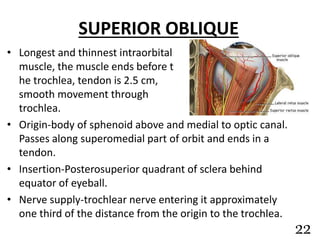
SUPERIOR OBLIQUE
• Longest and thinnest intraorbital
muscle, the muscle ends before t
he trochlea, tendon is 2.5 cm,
smooth movement through
trochlea.
• Origin-body of sphenoid above and medial to optic canal.
Passes along superomedial part of orbit and ends in a
tendon.
• Insertion-Posterosuperior quadrant of sclera behind
equator of eyeball.
• Nerve supply-trochlear nerve entering it approximately
one third of the distance from the origin to the trochlea.
22
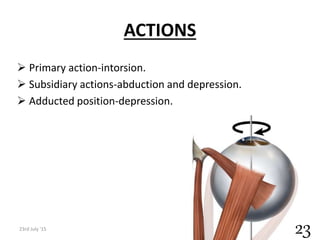
ACTIONS
 Primary action-intorsion.
 Subsidiary actions-abduction and depression.
 Adducted position-depression.
23rd July '15
23
INFERIOR OBLIQUE
• Origin-Anteromedial part of orbital floor lateral to
nasolacrimal groove.
• Insertion-posteroinferior surface of globe near the
macula.
• Nerve supply-inferior division of occulomotor nerve
enters the muscle laterally at the junction of the inferior
oblique and inferior rectus muscles.
23rd July '15
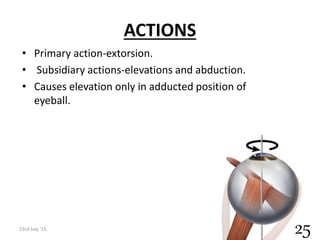
24
ACTIONS
• Primary action-extorsion.
• Subsidiary actions-elevations and abduction.
• Causes elevation only in adducted position of
eyeball.
23rd July '15
25
26
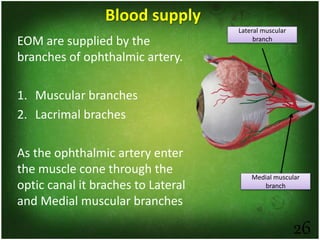
Blood supply
EOM are supplied by the
branches of ophthalmic artery.
1. Muscular branches
2. Lacrimal braches
As the ophthalmic artery enter
the muscle cone through the
optic canal it braches to Lateral
and Medial muscular branches
Medial muscular
branch
Lateral muscular
branch
Dept. of Ophthalmology, JNMC, Belagavi
27
23rdJuly '15
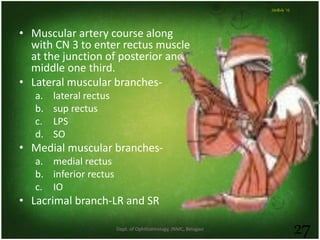
• Muscular artery course along
with CN 3 to enter rectus muscle
at the junction of posterior and
middle one third.
• Lateral muscular branches-
a. lateral rectus
b. sup rectus
c. LPS
d. SO
• Medial muscular branches-
a. medial rectus
b. inferior rectus
c. IO
• Lacrimal branch-LR and SR
Dept. of Ophthalmology, JNMC, Belagavi
28
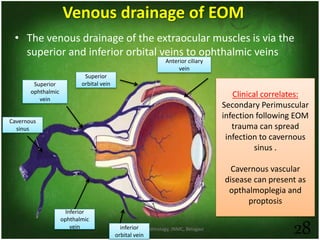
Venous drainage of EOM
• The venous drainage of the extraocular muscles is via the
superior and inferior orbital veins to ophthalmic veins
Anterior ciliary
vein
Cavernous
sinus
Inferior
ophthalmic
vein
Superior
ophthalmic
vein
Superior
orbital vein
inferior
orbital vein
Clinical correlates:
Secondary Perimuscular
infection following EOM
trauma can spread
infection to cavernous
sinus .
Cavernous vascular
disease can present as
opthalmoplegia and
proptosis
23rdJuly '15
Dept. of Ophthalmology, JNMC, Belagavi
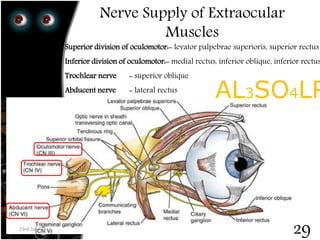
Nerve Supply of Extraocular
Muscles
Superior division of oculomotor:- levator palpebrae superioris, superior rectus
Inferior division of oculomotor:- medial rectus, inferior oblique, inferior rectus
Trochlear nerve - superior oblique
Abducent nerve - lateral rectus
23rd July '15
29
AL3SO4LR
VEDIO
30
23rd July '15
31
Primary position of gaze
• Defined by Scobee
Position of the eyes in binocular vision when,
with the head erect, the object of regard is at
infinity and lies at the intersection of the
sagittal plane of the head and a horizontal
plane passing through the centres of rotation
of the two eyeballs
23rd July '15
32
Secondary position of gaze
• Positions assumed by the eyes while looking
• straight up, (supraversion)
• straight down, (infraversion)
• to the right, (dextroversion)
• and to the left (levoversion)
23rd July '15
33
Tertiary position of gaze
• Positions assumed by the eyes when
combination of vertical and horizontal
movements occur.
• Dextroelevation
• Dextrodepression
• Levoelevation
• levodepression
34
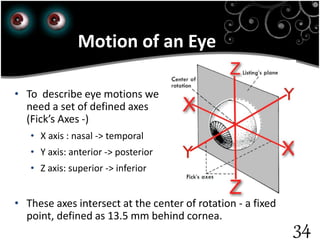
Motion of an Eye
• To describe eye motions we
need a set of defined axes
(Fick’s Axes -)
• X axis : nasal -> temporal
• Y axis: anterior -> posterior
• Z axis: superior -> inferior
• These axes intersect at the center of rotation - a fixed
point, defined as 13.5 mm behind cornea.
35
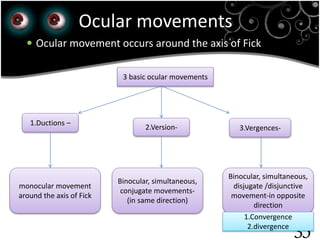
Ocular movements
 Ocular movement occurs around the axis of Fick
3 basic ocular movements
1.Ductions –
2.Version-
monocular movement
around the axis of Fick
Binocular, simultaneous,
conjugate movements-
(in same direction)
Binocular, simultaneous,
disjugate /disjunctive
movement-in opposite
direction
3.Vergences-
1.Convergence
2.divergence
36
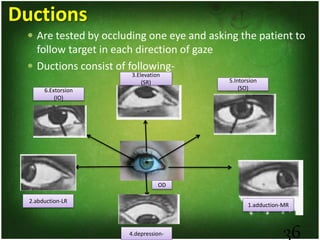
Ductions
 Are tested by occluding one eye and asking the patient to
follow target in each direction of gaze
 Ductions consist of following-
1.adduction-MR
4.depression-
2.abduction-LR
6.Extorsion
(IO)
3.Elevation
(SR) 5.Intorsion
(SO)
OD
Dept. of Ophthalmology, JNMC, Belagavi
37
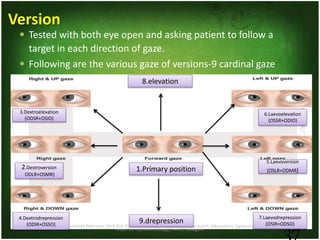
Version
 Tested with both eye open and asking patient to follow a
target in each direction of gaze.
 Following are the various gaze of versions-9 cardinal gaze
3.Dextroelevation
(ODSR+OSIO)
2.Destroversion
ODLR+OSMR)
5.Laevoversion
(OSLR+ODMR)
6.Laevoelevation
(OSSR+ODIO)
7.Laevodrepression
(OSIR+ODSO)9.drepression
8.elevation
1.Primary position
4.Dextrodrepression
(ODIR+OSSO)
VEDIO
38
39
23rd July '15
39
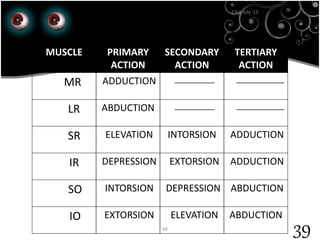
MUSCLE PRIMARY
ACTION
SECONDARY
ACTION
TERTIARY
ACTION
MR ADDUCTION __________ ____________
LR ABDUCTION __________ ____________
SR ELEVATION INTORSION ADDUCTION
IR DEPRESSION EXTORSION ADDUCTION
SO INTORSION DEPRESSION ABDUCTION
IO EXTORSION ELEVATION ABDUCTION
23rd July '15
40
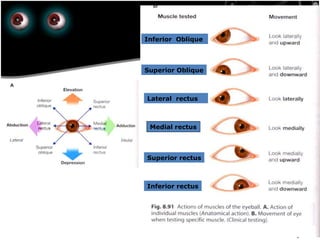
Superior Oblique
Inferior Oblique
Superior rectus
Inferior rectus
Medial rectus
Lateral rectus
23rd July '15
41
Laws of ocular motility
• Agonist
– Any particular EOM producing specific ocular
movement
• Synergists
– Muscles of the same eye that move the eye in the
same direction
23rd July '15
42
• Antagonists
– A pair of muscles in the same eye that move the eye
in opposite directions
• Yoke muscles ( contralateral synergists)
– Pair of muscles, one in each eye , that produce
conjugate ocular movements
43
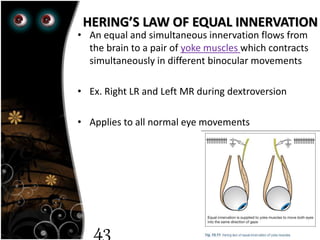
• An equal and simultaneous innervation flows from
the brain to a pair of yoke muscles which contracts
simultaneously in different binocular movements
• Ex. Right LR and Left MR during dextroversion
• Applies to all normal eye movements
HERING’S LAW OF EQUAL INNERVATION
23rd July '15
44
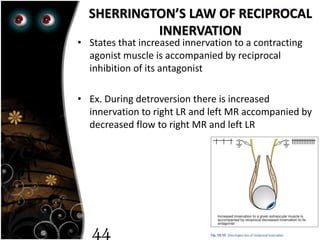
• States that increased innervation to a contracting
agonist muscle is accompanied by reciprocal
inhibition of its antagonist
• Ex. During detroversion there is increased
innervation to right LR and left MR accompanied by
decreased flow to right MR and left LR
SHERRINGTON’S LAW OF RECIPROCAL
INNERVATION
23rd July '15 Dept. of Ophthalmology, JNMC, Belagavi
45
Applied Anatomy
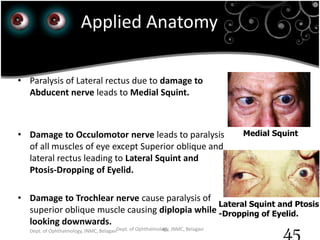
• Abnormal deviation of eyeball is known as Squint
(Strabismus).
• Paralysis of Lateral rectus due to damage to
Abducent nerve leads to Medial Squint.
• Damage to Occulomotor nerve leads to paralysis
of all muscles of eye except Superior oblique and
lateral rectus leading to Lateral Squint and
Ptosis-Dropping of Eyelid.
• Damage to Trochlear nerve cause paralysis of
superior oblique muscle causing diplopia while
looking downwards.
Medial Squint
Lateral Squint and Ptosis
-Dropping of Eyelid.
Dept. of Ophthalmology, JNMC, Belagavi 45
Thankyou

46

EXTRA OCULAR MUSCLES

  • 1.
    Extra-Ocular Muscles By/Mohamed AhmedEl –Shafie Assistant Lecturer in ophthalmology department KafrELShiekh University 1
  • 2.
    ORBITAL MUSCLES Extrinsic musclesof eyeball. • Involved in movement of eyeball. Intrinsic muscles • Controls shape of lens and size of pupil. 2
  • 3.
    Intrinsic Muscles • irissphincter, • radial pupilodilator muscles • ciliary muscle • Controlled by autonomic nervous system, work in response to amount of light, closeness of an object (for focusing), etc • serve to focus the eye and control the amount of light entering it 3
  • 4.
  • 5.
    Extrinsic Muscles Involuntary Muscles SuperiorTarsal Muscle Inferior Tarsal Muscle Orbitalis Voluntary Muscles Levator Palpebrae Superioris Superior Rectus Inferior Rectus Medial Rectus Lateral Rectus Superior Oblique Inferior Rectus 5
  • 6.
    Embryology • mesodermal origin, •Perimuscular Connective tissues from neural crest • development beginning at 3– weeks of gestation. 6
  • 7.
    Extra ocular Muscles:Origin Superior ObliqueLevator palpebrae superioris Medial Rectus Lateral Rectus Superior Rectus Inferior Rectus Inferior Oblique 7
  • 8.
    Oval, fibrous ringat the orbital apex. Structures passing through the annulus: 1. Occulomotor nerve (superior and inferior divisions) 2. Abducens Nerve 3. Optic Nerve 4. Nasociliary Nerve 5. Ophthalmic Artery Annulus of Zinn 8
  • 9.
    23rd July '15 9 ClinicalSignificance  Retrobulbar neuritis ○ Origin of SUPERIOR AND MEDIAL RECTUS are closely attached to the dural sheath of the optic nerve, which leads to pain during upward & inward movements of the globe.  Thyroid orbitopathy ○ Medial & Inf.rectus thicken. especially near the orbital apex - compression of the optic nerve as it enters the optic canal adjacent to the body of the sphenoid bone.
  • 10.
    SPIRAL OF TILLAUX 5.5mm 6.5 mm 6.9 mm 7.7 mm 10
  • 11.
    23rd July '15 11 23rdJuly'15 Dept. of Ophthalmology, JNMC, Belagavi  Medial rectus inserts closest to the limbus and is therefore susceptible to injury during ant. segment surgery.  Inadvertent removal of the MR is a well known complication of Pterygium removal  The Scleral thickness behind the rectus insertion is the thinnest, being only 0.3 mm thick -> chances of scleral perforation while suturing Clinical Significance
  • 12.
    23rd July '15 1 LEVATORPALPEBRAE SUPERIORIS  Origin: Orbital surface of lesser wing of sphenoid bone, anterosuperior to optic canal.  Insertion: Splits in two lamina  Superior lamina (voluntary) to Skin of upper eyelid & anterior surface of superior tarsal plate  Inferior lamina (Muller’s muscle)(involuntary) to upper margin of superior tarsus (superior tarsal or muller’s muscle) & superior conjunctival fornix
  • 13.
    23rd July '15 1 •NERVE SUPPLY- Upper division of occulomotor nerve. • ACTION- Elevation of upper eyelid. • Ptosis Drooping of upper eyelid.
  • 14.
    VEDIO 23rd July '15Dept. of Ophthalmology, JNMC, Belagavi 14
  • 15.
    23rd July '15 15Dept.of Ophthalmology, JNMC, Belagavi
  • 16.
    SUPERIOR RECTUS MUSCLE •Origin-Superior part of common tendon of zinn. • Insertion-inserted into sclera by flat tendinous insertion about 7.7 mm behind sclero-corneal junction. • Nerve supply-superior division of occulomotor nerve. 16
  • 17.
    Action of SuperiorRectus • Primary action is elevation . . • Secondary action is adduction • Intorsion. 17
  • 18.
    INFERIOR RECTUS • Origin-inferiorpart of common tendon of zinn • Insertion-in the sclera 6.5 mm behind sclero corneal junction. • Nerve supply-inferior division occulomotor nerve. 18
  • 19.
    • ACTIONS- Primary depressor. Subsidiaryactions are adduction and extorsion. 19
  • 20.
    MEDIAL RECTUS • Origin-annulusof zinn and from optic nerve sheath. • Insertion-in sclera 5.5mm behind sclero-corneal junction. • Nerve supply-lower division of occulomotor nerve. • ACTION- Primary adductor of the eye. 20
  • 21.
    LATERAL RECTUS • Origin-annulusof zinn. • Insertion-in the sclera 6.9mm behind sclerocorneal junction. • Nerve supply-abducens nerve which enters the muscle on the medial surface. • ACTION- Primary abductor of eye. 21
  • 22.
    SUPERIOR OBLIQUE • Longestand thinnest intraorbital muscle, the muscle ends before t he trochlea, tendon is 2.5 cm, smooth movement through trochlea. • Origin-body of sphenoid above and medial to optic canal. Passes along superomedial part of orbit and ends in a tendon. • Insertion-Posterosuperior quadrant of sclera behind equator of eyeball. • Nerve supply-trochlear nerve entering it approximately one third of the distance from the origin to the trochlea. 22
  • 23.
    ACTIONS  Primary action-intorsion. Subsidiary actions-abduction and depression.  Adducted position-depression. 23rd July '15 23
  • 24.
    INFERIOR OBLIQUE • Origin-Anteromedialpart of orbital floor lateral to nasolacrimal groove. • Insertion-posteroinferior surface of globe near the macula. • Nerve supply-inferior division of occulomotor nerve enters the muscle laterally at the junction of the inferior oblique and inferior rectus muscles. 23rd July '15 24
  • 25.
    ACTIONS • Primary action-extorsion. •Subsidiary actions-elevations and abduction. • Causes elevation only in adducted position of eyeball. 23rd July '15 25
  • 26.
    26 Blood supply EOM aresupplied by the branches of ophthalmic artery. 1. Muscular branches 2. Lacrimal braches As the ophthalmic artery enter the muscle cone through the optic canal it braches to Lateral and Medial muscular branches Medial muscular branch Lateral muscular branch
  • 27.
    Dept. of Ophthalmology,JNMC, Belagavi 27 23rdJuly '15 • Muscular artery course along with CN 3 to enter rectus muscle at the junction of posterior and middle one third. • Lateral muscular branches- a. lateral rectus b. sup rectus c. LPS d. SO • Medial muscular branches- a. medial rectus b. inferior rectus c. IO • Lacrimal branch-LR and SR
  • 28.
    Dept. of Ophthalmology,JNMC, Belagavi 28 Venous drainage of EOM • The venous drainage of the extraocular muscles is via the superior and inferior orbital veins to ophthalmic veins Anterior ciliary vein Cavernous sinus Inferior ophthalmic vein Superior ophthalmic vein Superior orbital vein inferior orbital vein Clinical correlates: Secondary Perimuscular infection following EOM trauma can spread infection to cavernous sinus . Cavernous vascular disease can present as opthalmoplegia and proptosis
  • 29.
    23rdJuly '15 Dept. ofOphthalmology, JNMC, Belagavi Nerve Supply of Extraocular Muscles Superior division of oculomotor:- levator palpebrae superioris, superior rectus Inferior division of oculomotor:- medial rectus, inferior oblique, inferior rectus Trochlear nerve - superior oblique Abducent nerve - lateral rectus 23rd July '15 29 AL3SO4LR
  • 30.
  • 31.
    23rd July '15 31 Primaryposition of gaze • Defined by Scobee Position of the eyes in binocular vision when, with the head erect, the object of regard is at infinity and lies at the intersection of the sagittal plane of the head and a horizontal plane passing through the centres of rotation of the two eyeballs
  • 32.
    23rd July '15 32 Secondaryposition of gaze • Positions assumed by the eyes while looking • straight up, (supraversion) • straight down, (infraversion) • to the right, (dextroversion) • and to the left (levoversion)
  • 33.
    23rd July '15 33 Tertiaryposition of gaze • Positions assumed by the eyes when combination of vertical and horizontal movements occur. • Dextroelevation • Dextrodepression • Levoelevation • levodepression
  • 34.
    34 Motion of anEye • To describe eye motions we need a set of defined axes (Fick’s Axes -) • X axis : nasal -> temporal • Y axis: anterior -> posterior • Z axis: superior -> inferior • These axes intersect at the center of rotation - a fixed point, defined as 13.5 mm behind cornea.
  • 35.
    35 Ocular movements  Ocularmovement occurs around the axis of Fick 3 basic ocular movements 1.Ductions – 2.Version- monocular movement around the axis of Fick Binocular, simultaneous, conjugate movements- (in same direction) Binocular, simultaneous, disjugate /disjunctive movement-in opposite direction 3.Vergences- 1.Convergence 2.divergence
  • 36.
    36 Ductions  Are testedby occluding one eye and asking the patient to follow target in each direction of gaze  Ductions consist of following- 1.adduction-MR 4.depression- 2.abduction-LR 6.Extorsion (IO) 3.Elevation (SR) 5.Intorsion (SO) OD
  • 37.
    Dept. of Ophthalmology,JNMC, Belagavi 37 Version  Tested with both eye open and asking patient to follow a target in each direction of gaze.  Following are the various gaze of versions-9 cardinal gaze 3.Dextroelevation (ODSR+OSIO) 2.Destroversion ODLR+OSMR) 5.Laevoversion (OSLR+ODMR) 6.Laevoelevation (OSSR+ODIO) 7.Laevodrepression (OSIR+ODSO)9.drepression 8.elevation 1.Primary position 4.Dextrodrepression (ODIR+OSSO)
  • 38.
  • 39.
    39 23rd July '15 39 MUSCLEPRIMARY ACTION SECONDARY ACTION TERTIARY ACTION MR ADDUCTION __________ ____________ LR ABDUCTION __________ ____________ SR ELEVATION INTORSION ADDUCTION IR DEPRESSION EXTORSION ADDUCTION SO INTORSION DEPRESSION ABDUCTION IO EXTORSION ELEVATION ABDUCTION
  • 40.
    23rd July '15 40 SuperiorOblique Inferior Oblique Superior rectus Inferior rectus Medial rectus Lateral rectus
  • 41.
    23rd July '15 41 Lawsof ocular motility • Agonist – Any particular EOM producing specific ocular movement • Synergists – Muscles of the same eye that move the eye in the same direction
  • 42.
    23rd July '15 42 •Antagonists – A pair of muscles in the same eye that move the eye in opposite directions • Yoke muscles ( contralateral synergists) – Pair of muscles, one in each eye , that produce conjugate ocular movements
  • 43.
    43 • An equaland simultaneous innervation flows from the brain to a pair of yoke muscles which contracts simultaneously in different binocular movements • Ex. Right LR and Left MR during dextroversion • Applies to all normal eye movements HERING’S LAW OF EQUAL INNERVATION
  • 44.
    23rd July '15 44 •States that increased innervation to a contracting agonist muscle is accompanied by reciprocal inhibition of its antagonist • Ex. During detroversion there is increased innervation to right LR and left MR accompanied by decreased flow to right MR and left LR SHERRINGTON’S LAW OF RECIPROCAL INNERVATION
  • 45.
    23rd July '15Dept. of Ophthalmology, JNMC, Belagavi 45 Applied Anatomy • Abnormal deviation of eyeball is known as Squint (Strabismus). • Paralysis of Lateral rectus due to damage to Abducent nerve leads to Medial Squint. • Damage to Occulomotor nerve leads to paralysis of all muscles of eye except Superior oblique and lateral rectus leading to Lateral Squint and Ptosis-Dropping of Eyelid. • Damage to Trochlear nerve cause paralysis of superior oblique muscle causing diplopia while looking downwards. Medial Squint Lateral Squint and Ptosis -Dropping of Eyelid. Dept. of Ophthalmology, JNMC, Belagavi 45
  • 46.

Editor's Notes

  • #42 Agonist Any particular EOM producing specific ocular movement Ex. Right LR for right eye abduction Synergists Muscles of the same eye that move the eye in the same direction Ex. Right SR and right IO for right eye elevation
  • #43 Antagonists A pair of muscles in the same eye that move the eye in opposite directions Ex. right LR and right MR Yoke muscles ( contralateral synergists) Pair of muscles, one in each eye , that produce conjugate ocular movements Ex. right LR and left MR in dextroversion