
1
By : S. Arya Das
Ty 6th Sem
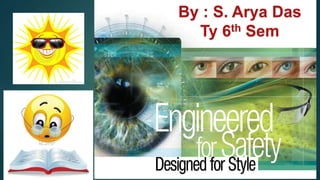
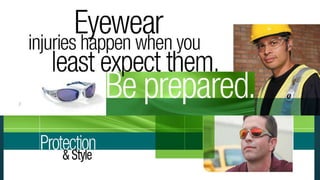
 We believe that health and safety are the priorities in any
working environment, and that greater comfort and
modern styles improve worker compliance with regulatory
requirements for protective eyewear.
 Potential eye hazards can be found in nearly every
industry, more than 40% of injuries occurred among craft
workers, like mechanics, repairers, carpenters and
plumbers.
 Industrial equipment operation.
 The Bureau reported that over a third of the injured workers were
operators, such as assemblers, sanders, and grinding machine
operators. Almost half of these injured workers were employed in
manufacturing.
 What contributes to eye injuries at work? •
 Not wearing eye protection. According to the Bureau of Labor Statistics, nearly three out
of every five workers injured are not wearing eye protection at the time of the accident. •
 Wearing the wrong kind of eye protection for the job. The Bureau of Labor Statistics
also reported that about 40% of the injured workers were wearing some form of eye
protection when the accident occurred. However, these workers were most likely to be
wearing protective eyeglasses with no side shields.
What causes eye injuries?
 70% of accidents resulted from flying or falling objects or
sparks striking the eye. Injured workers estimated that
nearly three- fifths of the objects were smaller than a
pinhead. Contact with chemicals caused one-fifth of the
injuries.
 Maintenance. Eye protection devices must be properly
maintained. Scratched and dirty devices reduce vision,
cause glare and may contribute to accidents. Scratched
or damaged eyewear should be replaced immediately.
Outdoor Occupations, such as:
Constructions,
Road repairing pen-pit mining Agriculture
- summer sunshine being the main
source of heat.
Farmer,
Fisherman,
Mechanics ,
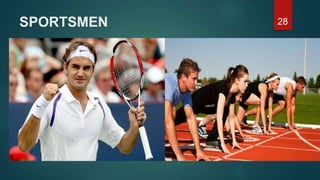
Sportsmen,
Trainer
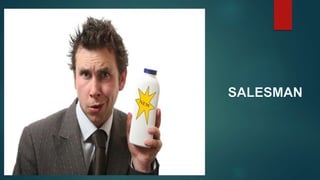
Salesman etc
8
The lens can lose its transparency due to exposure to IR (infrared light)
and UV (ultraviolet light), resulting in loss of vision (cataract).
Burned retina cells are lost forever which causes irreversible loss of
vision.
Industrial hazards for the eyes: ·
Mechanical hazards: dust, shock, solid particles. ·
Thermal hazards: hot liquid, molten splash, flames. ·
Chemical hazards: splashes of acids, solvents. ·
Radiation hazards: ultraviolet, infrared, visible, light, laser. ·
Electrical hazards: direct contact, short-circuit electric arc.
CONSTRUCTIONS
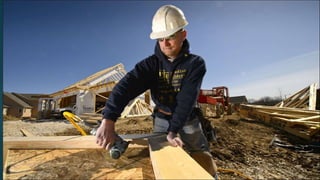
 The construction sector is a complex environment as both the
workplace and the workforce are non-static. Nonetheless, there are
common requirements of Health and Safety legislation and
objectives for occupational disease reduction
 Construction employers should have policies which relate not only
to safety but also occupational health strategy and provision
 Minimum standards are advised for health monitoring /
surveillance for Hand Arm Vibration Syndrome, Noise Induced
Hearing Loss, dermatitis, Respiratory disease (sensitisers,
Silicosis and Chronic Obstructive Pulmonary Disease),
Musculoskeletal problems and Stress.
10
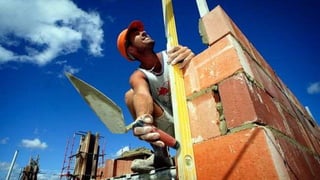
 Construction workers have a high overall mortality rate, independent
of social class, with bricklayers and labourers being recorded as
having the second highest mortality rate
 The protection and promotion of the health of workers by preventing
and controlling occupational diseases and accidents and by
eliminating occupational factors and conditions hazardous to health
and safety at work.
 •The development and promotion of healthy and safe work, work
environments and work organisations.
 •The enablement of workers to conduct socially and economically
productive lives and to contribute positively to sustainable
development.
12
Recommendations for visual acuity
standards for the construction industry.
 It is recommended that the visual acuity standards for safety critical
construction workers are the same as those for the rail standards but
where individuals fail to achieve an aided binocular visual acuity of 6/12 it
should be recognized that they may have other difficulties in the working
environment.
 It is therefore important to determine whether they are capable of
undertaking the required tasks, with or without reasonable adjustments.
 A record of the vision standards achieved should be recorded indicating
“vision satisfactory for safety critical work “ and any advised restrictions.
 It is recommended that the color vision standards for safety
critical construction workers are the same as those for the
rail standards.
 Testing color visions would allow employers to be aware of
any color vn deficiency and a trade test or practical tests
could be used to determine whether in practice this is a
problem, thereafter making any reasonable adjustments. A
record of the color vision standard achieved should be
recorded indicating color vision satisfactory for safety
critical work and any advised restrictions.
15
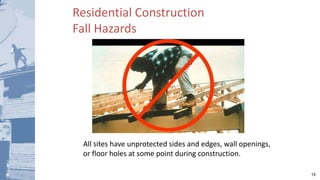
Residential Construction
Fall Hazards
All sites have unprotected sides and edges, wall openings,
or floor holes at some point during construction.
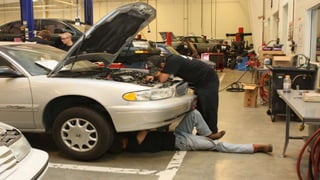
MECHANICS
 Essential Physical Requirements Ability to stand for long periods of
time. Heavy lifting up to 100 lbs. is required in lifting and/or carrying
parts and equipment. Standing, twisting, turning, pushing, pulling,
bending, crawling, crouching, stooping, kneeling and climbing
ladders/scaffolds is required while working in, around, and under
vehicles.
 Ability to manipulate tools and machinery necessary to work on
vehicles such as welding equipment, tire mounter/balancer, hand
tools, drills, saws, and wrenches, truck lifts, steam cleaners, a rotor
turner and other equipment used in the trade. Ability to manipulate
controls necessary to safely drive and operate a motor vehicle to
include foot pedals, steering wheel, etc.
17
 Working Conditions Exposure to road hazards, including
accidents and driving in poor weather conditions. Exposure
to fumes, chemicals, solvents, and other hazardous
materials. Working in a dusty and noisy environment.
Working in extreme heat in a garage without air conditioning.
Working outdoors in all weather conditions while responding
to emergency breakdowns. May be required to work
evenings and weekends as needed to make repairs and
ensure the operation of Hampton City Schools vehicles.
 Ability to visually assess vehicles and their components in
order to identify problems and make repairs.
 Close vision, distance vision, night/dusk vision, color vision,
peripheral vision required in order to visually assess traffic
signs and signals and to ensure that all traffic rules and
regulations are followed.
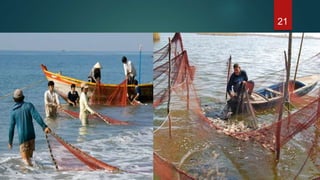
FISHING
 Of all our senses, vision surely ranks as our most important for fishing,
and over the years, many products have been developed to help stack
the odds in our eyes’ favor. Polarized sunglasses allow us to better see
fish beneath the water’s surface — but what about when we’re far
offshore, scanning above the horizon ?
 A marine environment is constantly in motion, and many regular
binoculars simply have too much magnification,”
 The general rule of thumb is that you can use binoculars on boats up to
about a 7x magnification.
21
 Seafarers must be at least 16 years old to undergo
medical examinations. Seafarers who are 16 to 18 years
old must be examined at intervals not exceeding 12
months. Seafarers who have turned 18 must normally
be examined every second year. the eyesight
requirements have become stricter.
 Seafarers with eyesight corrections of 0.5 can
still apply the exemptions from the eyesight
requirements
 Exemptions will still not be granted to
seafarers who are colour-blind and to
seafarers who sign on for the first time in
connection with the eyesight requirement
 PROBLEMS AND HAZARDS
 Glare from water
 There is intensified UV radiation from both overhead and
reflected UV light.
 Glasses that drop form the face or are knocked off will sink
and be lost.
 RECOMMENDED SOLUTIONS
 Use a polarizing lens, which also blocks UV light.
 Use a sunglass lens that cuts out all UV light below 400nm.
Wear a hat with a brim or a visor.
 Use a well fitting frame , possibly one that has cable
temples. Consider using an athletic strap when boating.
Some may use floats that attach to the temples.
23
25 Good binocular vision is very critical. Good binocular vision
improves peripheral awareness which facilitates anticipation and
also developes stereopsis which give the ability to percieve the
depth.
 Color vision is a particular requirement of the rail standard
because of the need to see signals and these are often red and
green colored.
 High degree of eye hand and body co ordination.
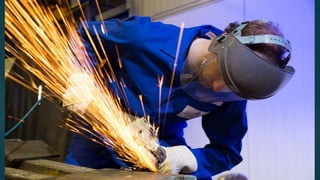
Mechanical hazards: dust, shock, solid particles. ·
Thermal hazards: hot liquid, molten splash, flames. ·
Chemical hazards: splashes of acids, solvents. ·
Radiation hazards: ultraviolet, infrared, visible, light,
laser.
So protective eye wear is needed.
It is dispenser’s responsibility to identify these
individuals n make them aware of their need for eye
protection.
Add UV protection to glasses.
SPORTSMEN 28
Visual standard for jobs  arya

Visual standard for jobs arya

  • 1.
  • 2.
    By : S.Arya Das Ty 6th Sem
  • 3.
     We believethat health and safety are the priorities in any working environment, and that greater comfort and modern styles improve worker compliance with regulatory requirements for protective eyewear.  Potential eye hazards can be found in nearly every industry, more than 40% of injuries occurred among craft workers, like mechanics, repairers, carpenters and plumbers.
  • 4.
     Industrial equipmentoperation.  The Bureau reported that over a third of the injured workers were operators, such as assemblers, sanders, and grinding machine operators. Almost half of these injured workers were employed in manufacturing.  What contributes to eye injuries at work? •  Not wearing eye protection. According to the Bureau of Labor Statistics, nearly three out of every five workers injured are not wearing eye protection at the time of the accident. •  Wearing the wrong kind of eye protection for the job. The Bureau of Labor Statistics also reported that about 40% of the injured workers were wearing some form of eye protection when the accident occurred. However, these workers were most likely to be wearing protective eyeglasses with no side shields.
  • 5.
    What causes eyeinjuries?  70% of accidents resulted from flying or falling objects or sparks striking the eye. Injured workers estimated that nearly three- fifths of the objects were smaller than a pinhead. Contact with chemicals caused one-fifth of the injuries.  Maintenance. Eye protection devices must be properly maintained. Scratched and dirty devices reduce vision, cause glare and may contribute to accidents. Scratched or damaged eyewear should be replaced immediately.
  • 7.
    Outdoor Occupations, suchas: Constructions, Road repairing pen-pit mining Agriculture - summer sunshine being the main source of heat. Farmer, Fisherman, Mechanics , Sportsmen, Trainer Salesman etc
  • 8.
    8 The lens canlose its transparency due to exposure to IR (infrared light) and UV (ultraviolet light), resulting in loss of vision (cataract). Burned retina cells are lost forever which causes irreversible loss of vision. Industrial hazards for the eyes: · Mechanical hazards: dust, shock, solid particles. · Thermal hazards: hot liquid, molten splash, flames. · Chemical hazards: splashes of acids, solvents. · Radiation hazards: ultraviolet, infrared, visible, light, laser. · Electrical hazards: direct contact, short-circuit electric arc.
  • 9.
    CONSTRUCTIONS  The constructionsector is a complex environment as both the workplace and the workforce are non-static. Nonetheless, there are common requirements of Health and Safety legislation and objectives for occupational disease reduction  Construction employers should have policies which relate not only to safety but also occupational health strategy and provision  Minimum standards are advised for health monitoring / surveillance for Hand Arm Vibration Syndrome, Noise Induced Hearing Loss, dermatitis, Respiratory disease (sensitisers, Silicosis and Chronic Obstructive Pulmonary Disease), Musculoskeletal problems and Stress.
  • 10.
  • 11.
     Construction workershave a high overall mortality rate, independent of social class, with bricklayers and labourers being recorded as having the second highest mortality rate  The protection and promotion of the health of workers by preventing and controlling occupational diseases and accidents and by eliminating occupational factors and conditions hazardous to health and safety at work.  •The development and promotion of healthy and safe work, work environments and work organisations.  •The enablement of workers to conduct socially and economically productive lives and to contribute positively to sustainable development.
  • 12.
  • 13.
    Recommendations for visualacuity standards for the construction industry.  It is recommended that the visual acuity standards for safety critical construction workers are the same as those for the rail standards but where individuals fail to achieve an aided binocular visual acuity of 6/12 it should be recognized that they may have other difficulties in the working environment.  It is therefore important to determine whether they are capable of undertaking the required tasks, with or without reasonable adjustments.  A record of the vision standards achieved should be recorded indicating “vision satisfactory for safety critical work “ and any advised restrictions.
  • 14.
     It isrecommended that the color vision standards for safety critical construction workers are the same as those for the rail standards.  Testing color visions would allow employers to be aware of any color vn deficiency and a trade test or practical tests could be used to determine whether in practice this is a problem, thereafter making any reasonable adjustments. A record of the color vision standard achieved should be recorded indicating color vision satisfactory for safety critical work and any advised restrictions.
  • 15.
    15 Residential Construction Fall Hazards Allsites have unprotected sides and edges, wall openings, or floor holes at some point during construction.
  • 16.
    MECHANICS  Essential PhysicalRequirements Ability to stand for long periods of time. Heavy lifting up to 100 lbs. is required in lifting and/or carrying parts and equipment. Standing, twisting, turning, pushing, pulling, bending, crawling, crouching, stooping, kneeling and climbing ladders/scaffolds is required while working in, around, and under vehicles.  Ability to manipulate tools and machinery necessary to work on vehicles such as welding equipment, tire mounter/balancer, hand tools, drills, saws, and wrenches, truck lifts, steam cleaners, a rotor turner and other equipment used in the trade. Ability to manipulate controls necessary to safely drive and operate a motor vehicle to include foot pedals, steering wheel, etc.
  • 17.
  • 18.
     Working ConditionsExposure to road hazards, including accidents and driving in poor weather conditions. Exposure to fumes, chemicals, solvents, and other hazardous materials. Working in a dusty and noisy environment. Working in extreme heat in a garage without air conditioning. Working outdoors in all weather conditions while responding to emergency breakdowns. May be required to work evenings and weekends as needed to make repairs and ensure the operation of Hampton City Schools vehicles.  Ability to visually assess vehicles and their components in order to identify problems and make repairs.  Close vision, distance vision, night/dusk vision, color vision, peripheral vision required in order to visually assess traffic signs and signals and to ensure that all traffic rules and regulations are followed.
  • 20.
    FISHING  Of allour senses, vision surely ranks as our most important for fishing, and over the years, many products have been developed to help stack the odds in our eyes’ favor. Polarized sunglasses allow us to better see fish beneath the water’s surface — but what about when we’re far offshore, scanning above the horizon ?  A marine environment is constantly in motion, and many regular binoculars simply have too much magnification,”  The general rule of thumb is that you can use binoculars on boats up to about a 7x magnification.
  • 21.
  • 22.
     Seafarers mustbe at least 16 years old to undergo medical examinations. Seafarers who are 16 to 18 years old must be examined at intervals not exceeding 12 months. Seafarers who have turned 18 must normally be examined every second year. the eyesight requirements have become stricter.  Seafarers with eyesight corrections of 0.5 can still apply the exemptions from the eyesight requirements  Exemptions will still not be granted to seafarers who are colour-blind and to seafarers who sign on for the first time in connection with the eyesight requirement
  • 23.
     PROBLEMS ANDHAZARDS  Glare from water  There is intensified UV radiation from both overhead and reflected UV light.  Glasses that drop form the face or are knocked off will sink and be lost.  RECOMMENDED SOLUTIONS  Use a polarizing lens, which also blocks UV light.  Use a sunglass lens that cuts out all UV light below 400nm. Wear a hat with a brim or a visor.  Use a well fitting frame , possibly one that has cable temples. Consider using an athletic strap when boating. Some may use floats that attach to the temples. 23
  • 25.
    25 Good binocularvision is very critical. Good binocular vision improves peripheral awareness which facilitates anticipation and also developes stereopsis which give the ability to percieve the depth.  Color vision is a particular requirement of the rail standard because of the need to see signals and these are often red and green colored.  High degree of eye hand and body co ordination.
  • 27.
    Mechanical hazards: dust,shock, solid particles. · Thermal hazards: hot liquid, molten splash, flames. · Chemical hazards: splashes of acids, solvents. · Radiation hazards: ultraviolet, infrared, visible, light, laser. So protective eye wear is needed. It is dispenser’s responsibility to identify these individuals n make them aware of their need for eye protection. Add UV protection to glasses.
  • 28.

Editor's Notes

  • #16 Today, there’s no reason for this worker to work like this …