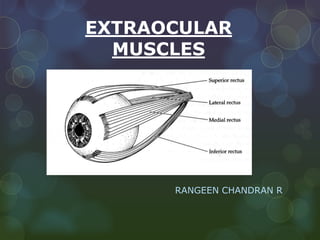
EXTRAOCULAR
  MUSCLES


      RANGEEN CHANDRAN R
ORBITAL MUSCLES


 Extrinsic muscles of eyeball.
      Involved in movement of eyeball.
 Intrinsic muscles
      Controls shape of lens and size of pupil.
Extraocular muscles are special

 The motor units are small, with only from 5 to 18 muscle
  fibers contact by each motor nerve
Motion of an Eye


 To describe eye motions we need a set of defined axes (Fick’s
  Axes - draw on board)
     X axis : nasal -> temporal
     Y axis: anterior -> posterior
     Z axis: superior -> inferior


 These axes intersect at the center of rotation - a fixed point,
  defined as 13.5 mm behind cornea.
AXES OF EYEBALL AND ORBIT
Ductions (single eye movements)


   Rotation about the Z axis (Z axis runs vertically superior to
    inferior)
       Medial Rotation - adduction toward midline
       Lateral Rotation - abduction away from midline


   Rotation about the X axis (X axis runs horizontally, from
    nasal to temporal)
       Upward, elevation (supraduction)
       Downward, depression (infraduction)
Torsion - cyclorotations


    Rotation about the Y axis (Y axis runs horizontally, from anterior
     to posterior)
    These are described with respect to a point at 12 o‘clock on the
     superior limbus
        Intorsion (incyclorotation) rotation nasally


        Extorsion (excyclorotation) rotation of the 12 o’clock position
         temporally.


 Counteracting head tilt (up to 7-9°)
Version & Vergences


 Some eye movements are paired, that is both eyes do
  the same thing. . . . Versions


 Sometimes eyes move in the opposite directions
  simultaneously. . . Vergences
Vergences


 Disjunctive eye movements (opposite left- right
  movments). Non-yolked motion


 Convergence (simultaneous movement nasally)
 Divergence (simultaneous temporal movement)
 Encyclovergence (intorsion)
 Excyclovergence (extorsion)
Versions (conjugate eye
movement)
 Dextroversion - rightward gaze (demo)
 Levoversion - leftward gaze
 Supraversion - elevation
 Infraversion - depression


    Also up and right, up and left
        Down and right, down and left


ALL BEHAVIOR IS THAT OF YOLKED
 EYES
Extraocular muscles


 VOLUNTARY MUSCLES
 INVOLUNTARY MUSCLES
INVOLUNTARY MUSCLES


3 muscles.
 Superior tarsal muscle.
 Inferior tarsal muscle.
 Orbitalis.
VOLUNTARY MUSCLES

7 in number
 Levator palpebrae superioris
 Superior rectus
 Inferior rectus
 Medial rectus
 Lateral rectus
 Superior oblique
 Inferior oblique
LEVATOR PALPEBRAE
SUPERIORIS


 Superior most muscle in
  the orbit.
 Has voluntary and
  involuntary parts.
 Origin-Inferior surface of lesser wing of sphenoid.
 Insertion-
     1.                     Upper lamina-Anterior surface of
          superior tarsus and          skin of upper eyelid.
2.                      Middle lamina-superior margin of
     superior tarsus.
3.                      Lower lamina-Superior conjunctival
     fornix
 NERVE SUPPLY-
           Upper division of occulomotor nerve.
ACTION


 Elevation of upper eyelid.
Ptosis


Drooping of upper eyelid.
 Complete ptosis-injury to occulomotor nerve.
 Partial ptosis-disruption of postganglionic sympathetic
  fibres from superior cervical sympathetic ganglion.
SUPERIOR RECTUS MUSCLE


   Origin-Superior part of common tendon of zinn.
    Insertion-inserted into sclera by flat tendinous
   insertion(10mm broad)about 7.7 mm behind sclero-
                    corneal junction.
 Nerve supply-superior division of occulomotor nerve.
ANNULUS OF ZINN
 Frontal nerve runs above the superior rectus & levator.
 The nasociliary nerve and ophthalmic artery run
  below.
 The tendon for insertion of the superior oblique
  muscle runs below the anterior part of the superior
  rectus.
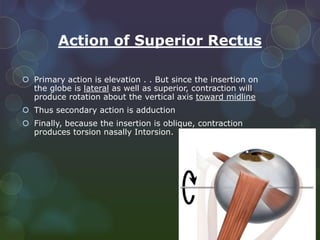
Action of Superior Rectus

 Primary action is elevation . . But since the insertion on
  the globe is lateral as well as superior, contraction will
  produce rotation about the vertical axis toward midline
 Thus secondary action is adduction
 Finally, because the insertion is oblique, contraction
  produces torsion nasally Intorsion.
INFERIOR RECTUS


 Origin-inferior part of common tendon of zinn
 Insertion-in the sclera 6.5 mm behind sclero corneal
  junction.
 Nerve supply-inferior division occulomotor nerve.
 Fascial attachments below attached to inferior lid
  coordinate depression and lid opening.
 Fascia below Inf. Rectus and Inf. Oblique contribute to
  the suspensory ligament of lockwood.
 ACTIONS-
           Primary depressor.
           Subsidiary actions are adduction and extorsion.
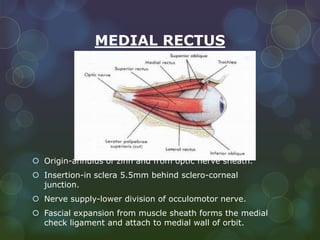
MEDIAL RECTUS


 Origin-annulus of zinn and from optic nerve sheath.
 Insertion-in sclera 5.5mm behind sclero-corneal
  junction.
 Nerve supply-lower division of occulomotor nerve.
 Fascial expansion from muscle sheath forms the medial
  check ligament and attach to medial wall of orbit.
 Innervation is via cranial nerve III, the oculomotor
  nerve, and the specific branch runs along the inside of
  the muscle cone, on the lateral surface.
 The superior oblique, ophthalmic artery and nasociliary
  nerve all lie above the medial rectus.
 ACTION-
             Primary adductor of the eye.
LATERAL RECTUS


 Origin-annulus of zinn.
 Insertion-in the sclera 6.9mm behind sclerocorneal
  junction.
 Nerve supply-abducens nerve which enters the muscle
  on the medial surface.
 The lacrimal artery and nerve run along the superior
  border.
 The abducens nerve, ophthalmic artery and ciliary
  ganglion lie medial to the lateral rectus and between it
  and the optic nerve.
 ACTION-
         Primary abductor of eye.
SPIRAL OF TILLAUX

      7.7
      mm


                5.5
                mm

6.9
mm            6.5
              mm
SUPERIOR OBLIQUE


 Longest and thinnest intraorbital muscle, the muscle
  ends before the trochlea, tendon is 2.5 cm, smooth
  movement through trochlea.


 Origin-body of sphenoid above and medial to optic
  canal.Passes along superomedial part of orbit and ends
  in a tendon.
 Insertion-Posterosuperior quadrant of sclera behind
  equator of eyeball.
 Nerve supply-trochlear nerve entering it approximately
  one third of the distance from the origin to the trochlea.
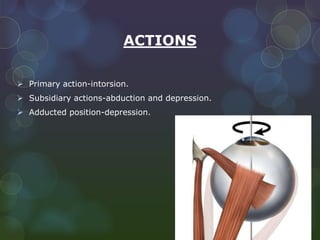
ACTIONS

 Primary action-intorsion.
 Subsidiary actions-abduction and depression.
 Adducted position-depression.
INFERIOR OBLIQUE


 Origin-Anteromedial part of orbital floor lateral to
  nasolacrimal groove.
 Insertion-posteroinferior surface of globe near the
  macula.
 Nerve supply-inferior division of occulomotor nerve
  enters the muscle laterally at the junction of the inferior
  oblique and inferior rectus muscles.
ACTIONS


 Primary action-extorsion.
 Subsidiary actions-elevations and abduction.
 Causes elevation only in adducted position of eyeball.
Origins/Insertions of Oblique
muscles
BLOOD SUPPLY


 Ophthalmic artery.
 Medial muscular branch-inferior rectus,
                   inferior oblique, medial rectus
 Lateral muscular branch-superior rectus
                   superior oblique, lateral rectus.

Extraocular muscles

  • 1.
    EXTRAOCULAR MUSCLES RANGEEN CHANDRAN R
  • 2.
    ORBITAL MUSCLES  Extrinsicmuscles of eyeball.  Involved in movement of eyeball.  Intrinsic muscles  Controls shape of lens and size of pupil.
  • 3.
    Extraocular muscles arespecial  The motor units are small, with only from 5 to 18 muscle fibers contact by each motor nerve
  • 4.
    Motion of anEye  To describe eye motions we need a set of defined axes (Fick’s Axes - draw on board)  X axis : nasal -> temporal  Y axis: anterior -> posterior  Z axis: superior -> inferior  These axes intersect at the center of rotation - a fixed point, defined as 13.5 mm behind cornea.
  • 5.
    AXES OF EYEBALLAND ORBIT
  • 6.
    Ductions (single eyemovements)  Rotation about the Z axis (Z axis runs vertically superior to inferior)  Medial Rotation - adduction toward midline  Lateral Rotation - abduction away from midline  Rotation about the X axis (X axis runs horizontally, from nasal to temporal)  Upward, elevation (supraduction)  Downward, depression (infraduction)
  • 7.
    Torsion - cyclorotations  Rotation about the Y axis (Y axis runs horizontally, from anterior to posterior)  These are described with respect to a point at 12 o‘clock on the superior limbus  Intorsion (incyclorotation) rotation nasally  Extorsion (excyclorotation) rotation of the 12 o’clock position temporally.  Counteracting head tilt (up to 7-9°)
  • 8.
    Version & Vergences Some eye movements are paired, that is both eyes do the same thing. . . . Versions  Sometimes eyes move in the opposite directions simultaneously. . . Vergences
  • 9.
    Vergences  Disjunctive eyemovements (opposite left- right movments). Non-yolked motion  Convergence (simultaneous movement nasally)  Divergence (simultaneous temporal movement)  Encyclovergence (intorsion)  Excyclovergence (extorsion)
  • 10.
    Versions (conjugate eye movement) Dextroversion - rightward gaze (demo)  Levoversion - leftward gaze  Supraversion - elevation  Infraversion - depression  Also up and right, up and left  Down and right, down and left ALL BEHAVIOR IS THAT OF YOLKED EYES
  • 11.
    Extraocular muscles  VOLUNTARYMUSCLES  INVOLUNTARY MUSCLES
  • 12.
    INVOLUNTARY MUSCLES 3 muscles. Superior tarsal muscle.  Inferior tarsal muscle.  Orbitalis.
  • 13.
    VOLUNTARY MUSCLES 7 innumber  Levator palpebrae superioris  Superior rectus  Inferior rectus  Medial rectus  Lateral rectus  Superior oblique  Inferior oblique
  • 15.
    LEVATOR PALPEBRAE SUPERIORIS  Superiormost muscle in the orbit.  Has voluntary and involuntary parts.
  • 16.
     Origin-Inferior surfaceof lesser wing of sphenoid.  Insertion- 1. Upper lamina-Anterior surface of superior tarsus and skin of upper eyelid. 2. Middle lamina-superior margin of superior tarsus. 3. Lower lamina-Superior conjunctival fornix  NERVE SUPPLY- Upper division of occulomotor nerve.
  • 17.
  • 18.
    Ptosis Drooping of uppereyelid.  Complete ptosis-injury to occulomotor nerve.  Partial ptosis-disruption of postganglionic sympathetic fibres from superior cervical sympathetic ganglion.
  • 19.
    SUPERIOR RECTUS MUSCLE  Origin-Superior part of common tendon of zinn.  Insertion-inserted into sclera by flat tendinous insertion(10mm broad)about 7.7 mm behind sclero- corneal junction.  Nerve supply-superior division of occulomotor nerve.
  • 20.
  • 21.
     Frontal nerveruns above the superior rectus & levator.  The nasociliary nerve and ophthalmic artery run below.  The tendon for insertion of the superior oblique muscle runs below the anterior part of the superior rectus.
  • 22.
    Action of SuperiorRectus  Primary action is elevation . . But since the insertion on the globe is lateral as well as superior, contraction will produce rotation about the vertical axis toward midline  Thus secondary action is adduction  Finally, because the insertion is oblique, contraction produces torsion nasally Intorsion.
  • 23.
    INFERIOR RECTUS  Origin-inferiorpart of common tendon of zinn  Insertion-in the sclera 6.5 mm behind sclero corneal junction.  Nerve supply-inferior division occulomotor nerve.
  • 24.
     Fascial attachmentsbelow attached to inferior lid coordinate depression and lid opening.  Fascia below Inf. Rectus and Inf. Oblique contribute to the suspensory ligament of lockwood.  ACTIONS- Primary depressor. Subsidiary actions are adduction and extorsion.
  • 25.
    MEDIAL RECTUS  Origin-annulusof zinn and from optic nerve sheath.  Insertion-in sclera 5.5mm behind sclero-corneal junction.  Nerve supply-lower division of occulomotor nerve.  Fascial expansion from muscle sheath forms the medial check ligament and attach to medial wall of orbit.
  • 26.
     Innervation isvia cranial nerve III, the oculomotor nerve, and the specific branch runs along the inside of the muscle cone, on the lateral surface.  The superior oblique, ophthalmic artery and nasociliary nerve all lie above the medial rectus.  ACTION- Primary adductor of the eye.
  • 27.
    LATERAL RECTUS  Origin-annulusof zinn.  Insertion-in the sclera 6.9mm behind sclerocorneal junction.  Nerve supply-abducens nerve which enters the muscle on the medial surface.
  • 28.
     The lacrimalartery and nerve run along the superior border.  The abducens nerve, ophthalmic artery and ciliary ganglion lie medial to the lateral rectus and between it and the optic nerve.  ACTION- Primary abductor of eye.
  • 29.
    SPIRAL OF TILLAUX 7.7 mm 5.5 mm 6.9 mm 6.5 mm
  • 30.
    SUPERIOR OBLIQUE  Longestand thinnest intraorbital muscle, the muscle ends before the trochlea, tendon is 2.5 cm, smooth movement through trochlea.  Origin-body of sphenoid above and medial to optic canal.Passes along superomedial part of orbit and ends in a tendon.  Insertion-Posterosuperior quadrant of sclera behind equator of eyeball.  Nerve supply-trochlear nerve entering it approximately one third of the distance from the origin to the trochlea.
  • 31.
    ACTIONS  Primary action-intorsion. Subsidiary actions-abduction and depression.  Adducted position-depression.
  • 32.
    INFERIOR OBLIQUE  Origin-Anteromedialpart of orbital floor lateral to nasolacrimal groove.  Insertion-posteroinferior surface of globe near the macula.  Nerve supply-inferior division of occulomotor nerve enters the muscle laterally at the junction of the inferior oblique and inferior rectus muscles.
  • 33.
    ACTIONS  Primary action-extorsion. Subsidiary actions-elevations and abduction.  Causes elevation only in adducted position of eyeball.
  • 34.
  • 35.
    BLOOD SUPPLY  Ophthalmicartery.  Medial muscular branch-inferior rectus, inferior oblique, medial rectus  Lateral muscular branch-superior rectus superior oblique, lateral rectus.