WARMUP
*Have your Vocab Sheets laying out so I can
check them*
What percentage of earth do you think is covered
by water?
EXPLORING THE OCEANS
Earth Science: Book H, Chapter 2
SECTION 1: EARTH’S OCEANS
By the end of this section, you should be able to:
 List

the major divisions of the global ocean.
 Describe the history of Earth’s oceans.
 Identify the properties of ocean water.
 Describe the interactions between the ocean
and the atmosphere.
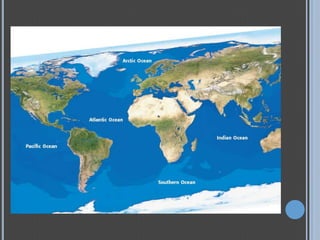
DIVISIONS OF THE GLOBAL OCEAN
 The

largest ocean is the Pacific Ocean.

 The

other oceans, listed from largest to
smallest, are:





the Atlantic Ocean
the Indian Ocean
the Arctic Ocean
the Southern Ocean
HOW DID THE OCEANS FORM?
 About

4.5 billion years ago, there were no
oceans.

 Sometime

before 4 billion years ago, water
vapor in the atmosphere condensed and fell as
rain.
rain filled the deeper levels of Earth’s
surface and the first oceans began to form.

 The

 The

shape of the oceans has changed over
time.


Need Pangaea image here
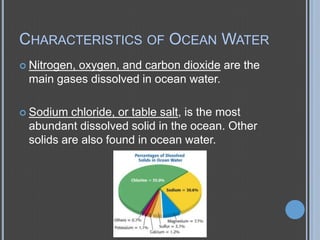
CHARACTERISTICS OF OCEAN WATER
 Nitrogen,

oxygen, and carbon dioxide are the
main gases dissolved in ocean water.

 Sodium

chloride, or table salt, is the most
abundant dissolved solid in the ocean. Other
solids are also found in ocean water.
CHARACTERISTICS OF OCEAN WATER
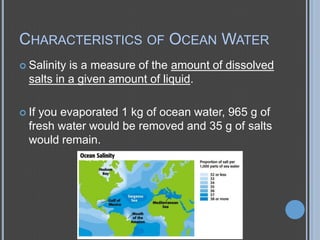
 Salinity

is a measure of the amount of dissolved
salts in a given amount of liquid.

 If

you evaporated 1 kg of ocean water, 965 g of
fresh water would be removed and 35 g of salts
would remain.
CHARACTERISTICS OF OCEAN WATER
 Climate

and water movement affect salinity.

 Coastal

water in cool, humid places has a low

salinity.
 Slow-moving

bodies of water, such as
bays, gulfs, and seas, have higher salinity than
other parts of the ocean do.
CHARACTERISTICS OF OCEAN WATER
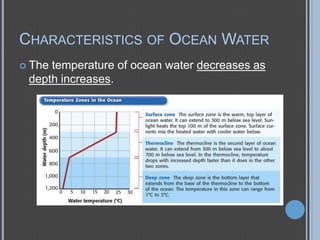
 The

temperature of ocean water decreases as
depth increases.
CHARACTERISTICS OF OCEAN WATER
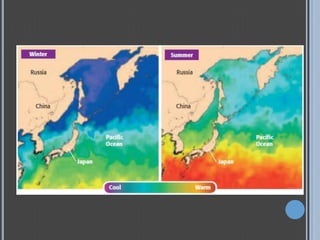
 Surface-zone

temperatures vary with latitude
and the time of year.

 Surface

temperatures range from 1ºC near the
poles to about 24 ºC near the equator.

 The

surface zone is heated more in the
summer.
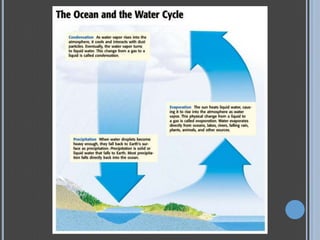
THE OCEAN & THE WATER CYCLE
 The

water cycle is the continuous movement of
water from the ocean to the atmosphere to the
land and back to the ocean.

 The

ocean is an important part of the water
cycle because nearly all of Earth’s water is in
the ocean.
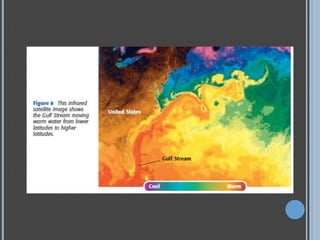
A GLOBAL THERMOSTAT
 The

ocean regulates atmospheric
temperatures.

 The

ocean absorbs and releases thermal
energy much more slowly than dry land does.

 The

circulation of warm water causes some
coastal lands to have warmer climates than
they would have without the currents.
SECTION REVIEW

p.45 #2-6, 8
WARMUP

If you walked off the edge of North America into
the depths of the Atlantic Ocean what would you
see?
SECTION 2: THE OCEAN FLOOR
By the end of this section, you should be able to:
 Describe

technologies for studying the ocean

floor.
 Identify the two major regions of the ocean
floor.
 Classify subdivisions and features of the two
major regions of the ocean floor.
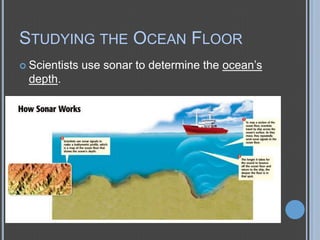
STUDYING THE OCEAN FLOOR
 Scientists

depth.

use sonar to determine the ocean’s
STUDYING THE OCEAN FLOOR
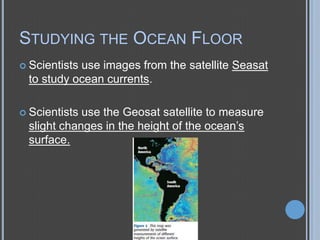
 Scientists

use images from the satellite Seasat
to study ocean currents.

 Scientists

use the Geosat satellite to measure
slight changes in the height of the ocean’s
surface.
REVEALING THE OCEAN FLOOR
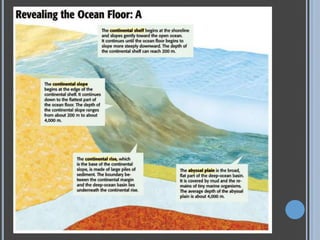
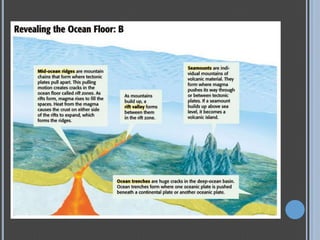
 The

two regions of the ocean floor are the
continental margin and the deep-ocean basin.

 The

continental margin is made of
continental crust and the deep-ocean basin
is made of oceanic crust.
REGIONS OF THE OCEAN FLOOR
 Continental

margin is subdivided into the
continental shelf, continental slope, and
continental rise.

 These

divisions are based on depth and
changes in slope.
REGIONS OF THE OCEAN FLOOR
 The

deep-ocean basin consists of the abyssal
plain, mid-ocean ridges, rift valleys, and ocean
trenches.
of these form near the boundaries of Earth’s
tectonic plates.

 All
REGIONS OF THE OCEAN FLOOR
 On

parts of the deep-ocean basin not near
plate boundaries, there are thousands of
seamounts.

 Seamounts

are submerged volcanic mountains
on the ocean floor.
EXPLORING THE OCEAN
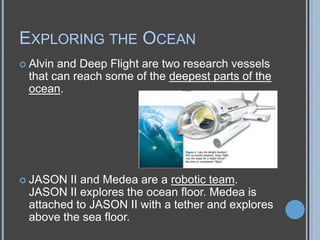
 Alvin

and Deep Flight are two research vessels
that can reach some of the deepest parts of the
ocean.

 JASON

II and Medea are a robotic team.
JASON II explores the ocean floor. Medea is
attached to JASON II with a tether and explores
above the sea floor.
SECTION REVIEW

p.51 #2-7, 11
WARMUP

Imagine you are a marine biologist who must
classify marine life into 3 groups.
What criteria would you use for your classification
system?
SECTION 3: LIFE IN THE OCEAN
By the end of this section, you should be able to:
 Identify

the three groups of marine life.
 Describe the two main ocean environments.
 Identify the ecological zones of the benthic and
pelagic environments.
THREE GROUPS OF MARINE LIFE
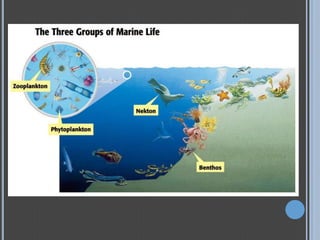
 Organisms

that float or drift freely near the
ocean’s surface are called plankton.

 Organisms

that swim actively in the open ocean
are called nekton.

 Organisms

that live on or in the ocean floor are
called benthos.
THE BENTHIC ENVIRONMENT
 The

benthic environment is the region near the
bottom of a pond, lake, or ocean.

 The

benthic environment is divided into
ecological zones based on where different
types of benthos live.
THE BENTHIC ENVIRONMENT
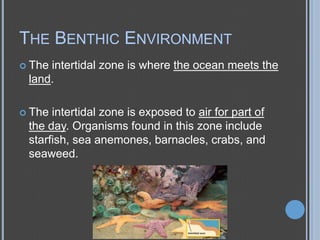
 The

intertidal zone is where the ocean meets the
land.

 The

intertidal zone is exposed to air for part of
the day. Organisms found in this zone include
starfish, sea anemones, barnacles, crabs, and
seaweed.
THE BENTHIC ENVIRONMENT
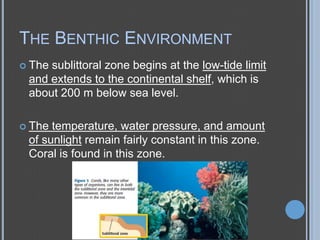
 The

sublittoral zone begins at the low-tide limit
and extends to the continental shelf, which is
about 200 m below sea level.

 The

temperature, water pressure, and amount
of sunlight remain fairly constant in this zone.
Coral is found in this zone.
THE BENTHIC ENVIRONMENT
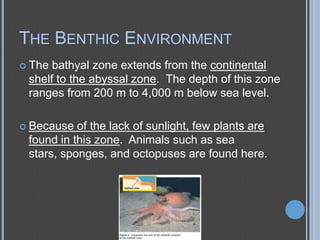
 The

bathyal zone extends from the continental
shelf to the abyssal zone. The depth of this zone
ranges from 200 m to 4,000 m below sea level.

 Because

of the lack of sunlight, few plants are
found in this zone. Animals such as sea
stars, sponges, and octopuses are found here.
THE BENTHIC ENVIRONMENT


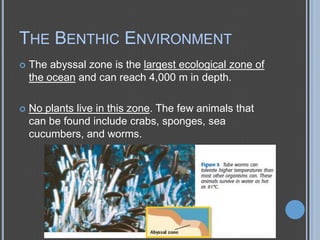
The abyssal zone is the largest ecological zone of
the ocean and can reach 4,000 m in depth.



No plants live in this zone. The few animals that
can be found include crabs, sponges, sea
cucumbers, and worms.
THE BENTHIC ENVIRONMENT
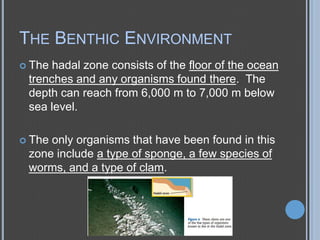
 The

hadal zone consists of the floor of the ocean
trenches and any organisms found there. The
depth can reach from 6,000 m to 7,000 m below
sea level.

 The

only organisms that have been found in this
zone include a type of sponge, a few species of
worms, and a type of clam.
THE PELAGIC ENVIRONMENT
zone near the ocean’s surface and at the
middle depths is called the pelagic
environment.

 The

 The

pelagic environment is above the abyssal
zone and beyond the littoral zone.

 The

two major zones of the pelagic
environment are the neritic zone and the
oceanic zone.
THE PELAGIC ENVIRONMENT
 The

neritic zone is a warm, shallow zone that
covers the continental shelf.

 The

neritic zone contains the largest
concentration of marine life.
THE PELAGIC ENVIRONMENT
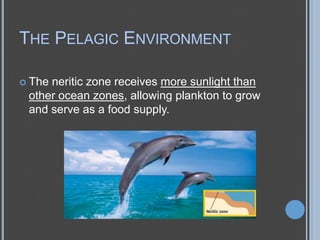
 The

neritic zone receives more sunlight than
other ocean zones, allowing plankton to grow
and serve as a food supply.
THE PELAGIC ENVIRONMENT
 The

oceanic zone includes the volume of water
that covers the entire sea floor except for the
continental shelf.

 The

deeper parts of the oceanic zone have
colder water temperatures and much greater
pressure than the neritic zone.
THE PELAGIC ENVIRONMENT
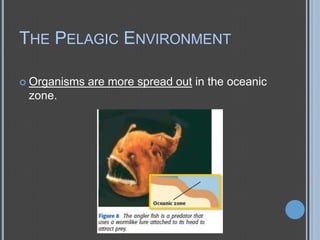
 Organisms

zone.

are more spread out in the oceanic
SECTION REVIEW

p.57 #1-5,7,9
WARMUP
Samantha drove her car to the market to buy a
tuna steak for dinner. When she got home she
poured herself a glass of water, and then fired up
her gas grill to cook the tuna.
What are 3 items or activities mentioned above
that involve ocean resources?
SECTION 4:
RESOURCES FROM THE OCEAN
By the end of this section, you should be able to:
two ways of harvesting the ocean’s living
resources.
 Identify three nonliving resources in the ocean.
 Describe the ocean’s energy resources.
 List
LIVING RESOURCES
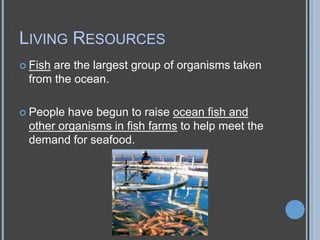
 Fish

are the largest group of organisms taken
from the ocean.

 People

have begun to raise ocean fish and
other organisms in fish farms to help meet the
demand for seafood.
LIVING RESOURCES
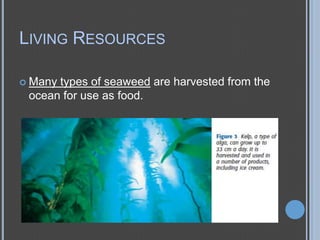
 Many

types of seaweed are harvested from the
ocean for use as food.
NONLIVING RESOURCES
 Oil

and natural gas are used for energy and are
found under layers of impermeable rock.

 Scientists

use seismic equipment to find oil and
natural gas under the ocean floor.
NONLIVING RESOURCES
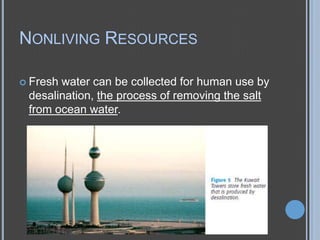
 Fresh

water can be collected for human use by
desalination, the process of removing the salt
from ocean water.
NONLIVING RESOURCES
 Scientists

estimate that 15% of the ocean floor
is covered with mineral-rich nodules.
However, mining them is costly and difficult.

 Nodules

form from dissolved substances in sea
water that stick to solid objects, such as
pebbles.
NONLIVING RESOURCES
 The

constant motion of waves is a
clean, renewable energy resource.

 Researchers

have found certain areas of the
world where wave energy can generate enough
electrical energy to make building power plants
worthwhile.
SECTION REVIEW

p.63 #2-7
WARMUP

How do you contribute to ocean pollution in your
daily lives?
SECTION 5: OCEAN POLLUTION
By the end of this section, you should be able to:
 Explain

the difference between point-source
and nonpoint-source pollution
 Identify three different types of point-source
pollution.
 Describe what is being done to control ocean
pollution.
NONPOINT-SOURCE POLLUTION
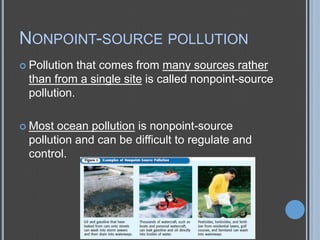
 Pollution

that comes from many sources rather
than from a single site is called nonpoint-source
pollution.

 Most

ocean pollution is nonpoint-source
pollution and can be difficult to regulate and
control.
POINT-SOURCE POLLUTION
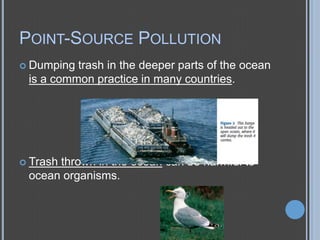
 Dumping

trash in the deeper parts of the ocean
is a common practice in many countries.

 Trash

thrown in the ocean can be harmful to
ocean organisms.
POINT-SOURCE POLLUTION
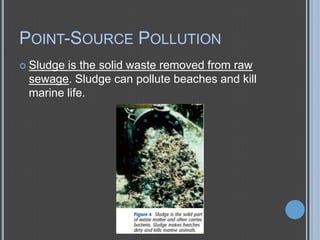
 Sludge

is the solid waste removed from raw
sewage. Sludge can pollute beaches and kill
marine life.
POINT-SOURCE POLLUTION
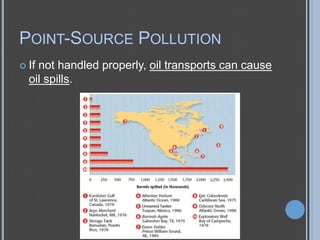
 If

not handled properly, oil transports can cause
oil spills.
POINT-SOURCE POLLUTION
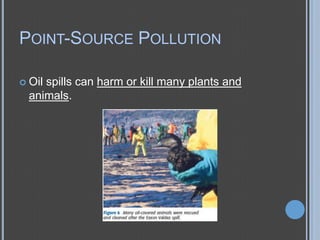
 Oil

spills can harm or kill many plants and
animals.
POINT-SOURCE POLLUTION
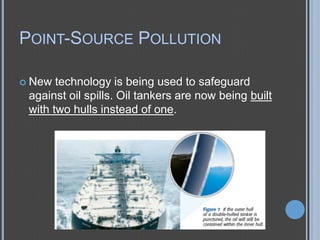
 New

technology is being used to safeguard
against oil spills. Oil tankers are now being built
with two hulls instead of one.
SAVING OUR OCEAN RESOURCES
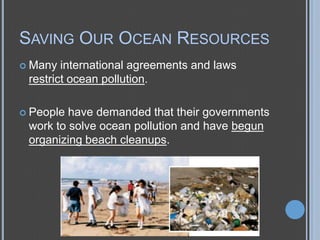
 Many

international agreements and laws
restrict ocean pollution.

 People

have demanded that their governments
work to solve ocean pollution and have begun
organizing beach cleanups.
SAVING OUR OCEAN RESOURCES
 The

U.S. has passed laws to control local
pollution.

 Some

of these laws include the Clean Water
Act and the U.S. Marine
Protection, Research, and Sanctuaries Act.
SECTION REVIEW

p.69 #2-6

Exploring the Oceans

  • 1.
    WARMUP *Have your VocabSheets laying out so I can check them* What percentage of earth do you think is covered by water?
  • 2.
    EXPLORING THE OCEANS EarthScience: Book H, Chapter 2
  • 3.
    SECTION 1: EARTH’SOCEANS By the end of this section, you should be able to:  List the major divisions of the global ocean.  Describe the history of Earth’s oceans.  Identify the properties of ocean water.  Describe the interactions between the ocean and the atmosphere.
  • 4.
    DIVISIONS OF THEGLOBAL OCEAN  The largest ocean is the Pacific Ocean.  The other oceans, listed from largest to smallest, are:     the Atlantic Ocean the Indian Ocean the Arctic Ocean the Southern Ocean
  • 6.
    HOW DID THEOCEANS FORM?  About 4.5 billion years ago, there were no oceans.  Sometime before 4 billion years ago, water vapor in the atmosphere condensed and fell as rain. rain filled the deeper levels of Earth’s surface and the first oceans began to form.  The  The shape of the oceans has changed over time.
  • 7.
  • 8.
    CHARACTERISTICS OF OCEANWATER  Nitrogen, oxygen, and carbon dioxide are the main gases dissolved in ocean water.  Sodium chloride, or table salt, is the most abundant dissolved solid in the ocean. Other solids are also found in ocean water.
  • 9.
    CHARACTERISTICS OF OCEANWATER  Salinity is a measure of the amount of dissolved salts in a given amount of liquid.  If you evaporated 1 kg of ocean water, 965 g of fresh water would be removed and 35 g of salts would remain.
  • 10.
    CHARACTERISTICS OF OCEANWATER  Climate and water movement affect salinity.  Coastal water in cool, humid places has a low salinity.  Slow-moving bodies of water, such as bays, gulfs, and seas, have higher salinity than other parts of the ocean do.
  • 11.
    CHARACTERISTICS OF OCEANWATER  The temperature of ocean water decreases as depth increases.
  • 12.
    CHARACTERISTICS OF OCEANWATER  Surface-zone temperatures vary with latitude and the time of year.  Surface temperatures range from 1ºC near the poles to about 24 ºC near the equator.  The surface zone is heated more in the summer.
  • 14.
    THE OCEAN &THE WATER CYCLE  The water cycle is the continuous movement of water from the ocean to the atmosphere to the land and back to the ocean.  The ocean is an important part of the water cycle because nearly all of Earth’s water is in the ocean.
  • 16.
    A GLOBAL THERMOSTAT The ocean regulates atmospheric temperatures.  The ocean absorbs and releases thermal energy much more slowly than dry land does.  The circulation of warm water causes some coastal lands to have warmer climates than they would have without the currents.
  • 18.
  • 19.
    WARMUP If you walkedoff the edge of North America into the depths of the Atlantic Ocean what would you see?
  • 20.
    SECTION 2: THEOCEAN FLOOR By the end of this section, you should be able to:  Describe technologies for studying the ocean floor.  Identify the two major regions of the ocean floor.  Classify subdivisions and features of the two major regions of the ocean floor.
  • 21.
    STUDYING THE OCEANFLOOR  Scientists depth. use sonar to determine the ocean’s
  • 22.
    STUDYING THE OCEANFLOOR  Scientists use images from the satellite Seasat to study ocean currents.  Scientists use the Geosat satellite to measure slight changes in the height of the ocean’s surface.
  • 23.
    REVEALING THE OCEANFLOOR  The two regions of the ocean floor are the continental margin and the deep-ocean basin.  The continental margin is made of continental crust and the deep-ocean basin is made of oceanic crust.
  • 24.
    REGIONS OF THEOCEAN FLOOR  Continental margin is subdivided into the continental shelf, continental slope, and continental rise.  These divisions are based on depth and changes in slope.
  • 26.
    REGIONS OF THEOCEAN FLOOR  The deep-ocean basin consists of the abyssal plain, mid-ocean ridges, rift valleys, and ocean trenches. of these form near the boundaries of Earth’s tectonic plates.  All
  • 27.
    REGIONS OF THEOCEAN FLOOR  On parts of the deep-ocean basin not near plate boundaries, there are thousands of seamounts.  Seamounts are submerged volcanic mountains on the ocean floor.
  • 29.
    EXPLORING THE OCEAN Alvin and Deep Flight are two research vessels that can reach some of the deepest parts of the ocean.  JASON II and Medea are a robotic team. JASON II explores the ocean floor. Medea is attached to JASON II with a tether and explores above the sea floor.
  • 30.
  • 31.
    WARMUP Imagine you area marine biologist who must classify marine life into 3 groups. What criteria would you use for your classification system?
  • 32.
    SECTION 3: LIFEIN THE OCEAN By the end of this section, you should be able to:  Identify the three groups of marine life.  Describe the two main ocean environments.  Identify the ecological zones of the benthic and pelagic environments.
  • 33.
    THREE GROUPS OFMARINE LIFE  Organisms that float or drift freely near the ocean’s surface are called plankton.  Organisms that swim actively in the open ocean are called nekton.  Organisms that live on or in the ocean floor are called benthos.
  • 35.
    THE BENTHIC ENVIRONMENT The benthic environment is the region near the bottom of a pond, lake, or ocean.  The benthic environment is divided into ecological zones based on where different types of benthos live.
  • 36.
    THE BENTHIC ENVIRONMENT The intertidal zone is where the ocean meets the land.  The intertidal zone is exposed to air for part of the day. Organisms found in this zone include starfish, sea anemones, barnacles, crabs, and seaweed.
  • 37.
    THE BENTHIC ENVIRONMENT The sublittoral zone begins at the low-tide limit and extends to the continental shelf, which is about 200 m below sea level.  The temperature, water pressure, and amount of sunlight remain fairly constant in this zone. Coral is found in this zone.
  • 38.
    THE BENTHIC ENVIRONMENT The bathyal zone extends from the continental shelf to the abyssal zone. The depth of this zone ranges from 200 m to 4,000 m below sea level.  Because of the lack of sunlight, few plants are found in this zone. Animals such as sea stars, sponges, and octopuses are found here.
  • 39.
    THE BENTHIC ENVIRONMENT  Theabyssal zone is the largest ecological zone of the ocean and can reach 4,000 m in depth.  No plants live in this zone. The few animals that can be found include crabs, sponges, sea cucumbers, and worms.
  • 40.
    THE BENTHIC ENVIRONMENT The hadal zone consists of the floor of the ocean trenches and any organisms found there. The depth can reach from 6,000 m to 7,000 m below sea level.  The only organisms that have been found in this zone include a type of sponge, a few species of worms, and a type of clam.
  • 41.
    THE PELAGIC ENVIRONMENT zonenear the ocean’s surface and at the middle depths is called the pelagic environment.  The  The pelagic environment is above the abyssal zone and beyond the littoral zone.  The two major zones of the pelagic environment are the neritic zone and the oceanic zone.
  • 42.
    THE PELAGIC ENVIRONMENT The neritic zone is a warm, shallow zone that covers the continental shelf.  The neritic zone contains the largest concentration of marine life.
  • 43.
    THE PELAGIC ENVIRONMENT The neritic zone receives more sunlight than other ocean zones, allowing plankton to grow and serve as a food supply.
  • 44.
    THE PELAGIC ENVIRONMENT The oceanic zone includes the volume of water that covers the entire sea floor except for the continental shelf.  The deeper parts of the oceanic zone have colder water temperatures and much greater pressure than the neritic zone.
  • 45.
    THE PELAGIC ENVIRONMENT Organisms zone. are more spread out in the oceanic
  • 46.
  • 47.
    WARMUP Samantha drove hercar to the market to buy a tuna steak for dinner. When she got home she poured herself a glass of water, and then fired up her gas grill to cook the tuna. What are 3 items or activities mentioned above that involve ocean resources?
  • 48.
    SECTION 4: RESOURCES FROMTHE OCEAN By the end of this section, you should be able to: two ways of harvesting the ocean’s living resources.  Identify three nonliving resources in the ocean.  Describe the ocean’s energy resources.  List
  • 49.
    LIVING RESOURCES  Fish arethe largest group of organisms taken from the ocean.  People have begun to raise ocean fish and other organisms in fish farms to help meet the demand for seafood.
  • 50.
    LIVING RESOURCES  Many typesof seaweed are harvested from the ocean for use as food.
  • 51.
    NONLIVING RESOURCES  Oil andnatural gas are used for energy and are found under layers of impermeable rock.  Scientists use seismic equipment to find oil and natural gas under the ocean floor.
  • 52.
    NONLIVING RESOURCES  Fresh watercan be collected for human use by desalination, the process of removing the salt from ocean water.
  • 53.
    NONLIVING RESOURCES  Scientists estimatethat 15% of the ocean floor is covered with mineral-rich nodules. However, mining them is costly and difficult.  Nodules form from dissolved substances in sea water that stick to solid objects, such as pebbles.
  • 55.
    NONLIVING RESOURCES  The constantmotion of waves is a clean, renewable energy resource.  Researchers have found certain areas of the world where wave energy can generate enough electrical energy to make building power plants worthwhile.
  • 56.
  • 57.
    WARMUP How do youcontribute to ocean pollution in your daily lives?
  • 58.
    SECTION 5: OCEANPOLLUTION By the end of this section, you should be able to:  Explain the difference between point-source and nonpoint-source pollution  Identify three different types of point-source pollution.  Describe what is being done to control ocean pollution.
  • 59.
    NONPOINT-SOURCE POLLUTION  Pollution thatcomes from many sources rather than from a single site is called nonpoint-source pollution.  Most ocean pollution is nonpoint-source pollution and can be difficult to regulate and control.
  • 60.
    POINT-SOURCE POLLUTION  Dumping trashin the deeper parts of the ocean is a common practice in many countries.  Trash thrown in the ocean can be harmful to ocean organisms.
  • 61.
    POINT-SOURCE POLLUTION  Sludge isthe solid waste removed from raw sewage. Sludge can pollute beaches and kill marine life.
  • 62.
    POINT-SOURCE POLLUTION  If nothandled properly, oil transports can cause oil spills.
  • 63.
    POINT-SOURCE POLLUTION  Oil spillscan harm or kill many plants and animals.
  • 64.
    POINT-SOURCE POLLUTION  New technologyis being used to safeguard against oil spills. Oil tankers are now being built with two hulls instead of one.
  • 65.
    SAVING OUR OCEANRESOURCES  Many international agreements and laws restrict ocean pollution.  People have demanded that their governments work to solve ocean pollution and have begun organizing beach cleanups.
  • 66.
    SAVING OUR OCEANRESOURCES  The U.S. has passed laws to control local pollution.  Some of these laws include the Clean Water Act and the U.S. Marine Protection, Research, and Sanctuaries Act.
  • 67.