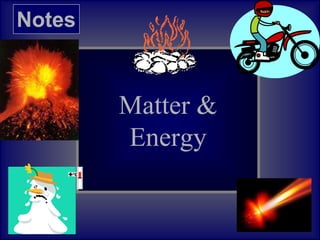
Matter &
Energy
Lesson One
• Agenda
– 1. Bellringer:
• Interactive Notebook Pages 13-15
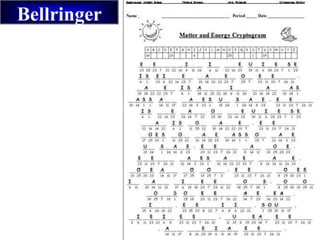
• Matter and Energy Cryptogram
– 2. Homework (Due: Monday 8/26/13)
• Classroom Rules Fable
– 3. Notes/PowerPoint
• Matter and Energy
– 4. Class Work
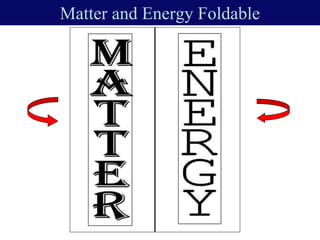
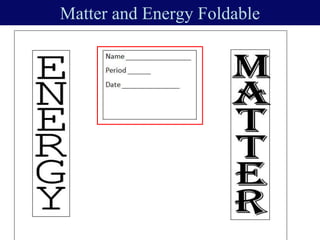
• Matter and Energy Foldable
– 5. Discovery Streaming Videos
• Matter and Energy
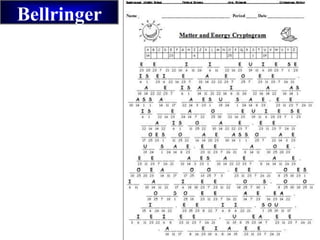
Matter and Energy
Cryptogram
BellRinger
Bellringer
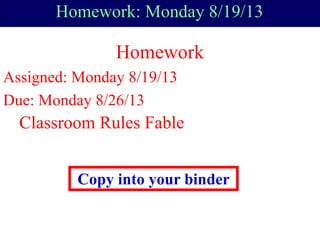
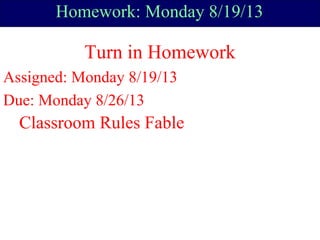
Homework: Monday 8/19/13
Homework
Assigned: Monday 8/19/13
Due: Monday 8/26/13
Classroom Rules Fable
Copy into your binder
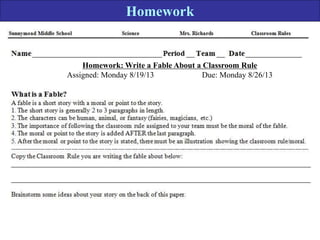
Homework
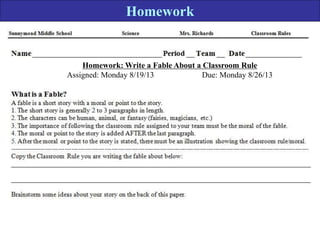
Homework: Write a Fable About a Classroom Rule
Assigned: Monday 8/19/13 Due: Monday 8/26/13
Interactive Science
Notebooks
Class Work
Assignment:
1.Skip page 12
Page 12
Class Work
Assignment:
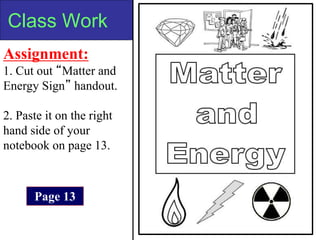
1. Cut out “Matter and
Energy Sign” handout.
2. Paste it on the right
hand side of your
notebook on page 13.
Page 13
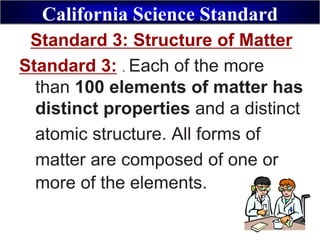
Standard 3: Structure of Matter
Standard 3: . Each of the more
than 100 elements of matter has
distinct properties and a distinct
atomic structure. All forms of
matter are composed of one or
more of the elements.
California Science Standard
Standard 5c: Chemical Reactions
Students know chemical
reactions usually liberate
heat or absorb heat.
Content Objectives
After this lesson you should be able to:
1. Define matter
2. Define energy
3. Describe the universe’s
composition.
Language Objectives
After this lesson I should be able to:
1. Read and listen to a presentation.
2. Write information on a thinking map and graphic
organizer.
3. Write Cornell notes.
4. Participate in whole class and small group discussion.
5. Read and write definitions.
6. Read and answer questions.
7. Read and follow laboratory experiment instructions
Key Questions
What is matter?
What part of the universe
is matter?
Discovery
Streaming
Matter & Energy
Clip
Discovery
Streaming
Matter Intro Clip
Discovery
Streaming
Properties of Matter
Interactive Science
Notebooks
Class Work
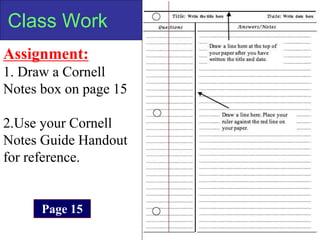
Assignment:
1. Draw a Cornell
Notes box on page 15
2.Use your Cornell
Notes Guide Handout
for reference.
Page 15
Matter and Energy
Foldable
Class Work
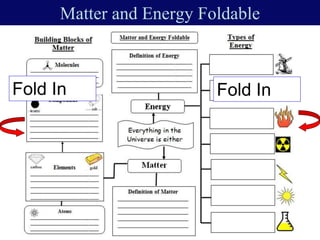
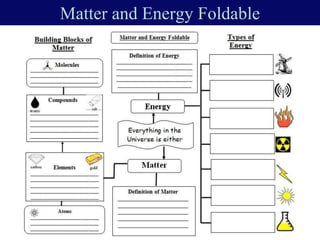
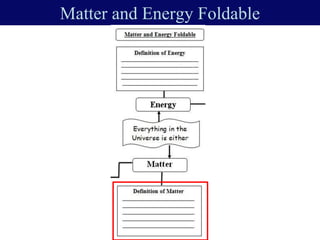
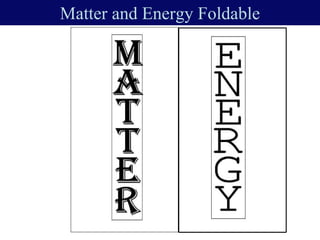
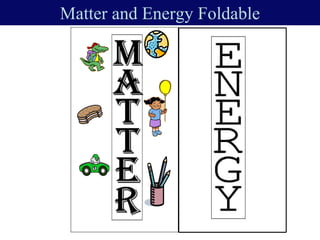
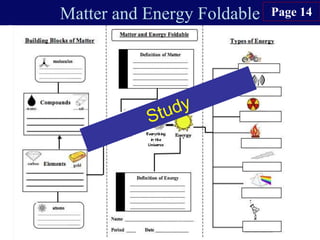
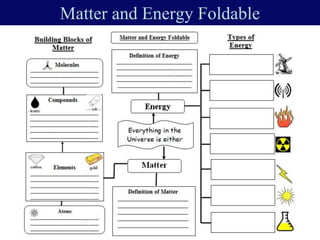
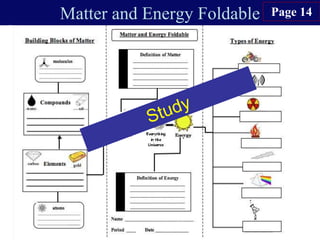
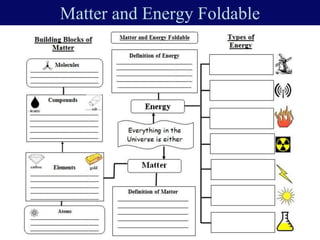
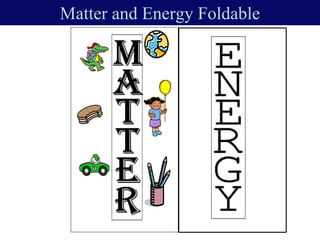
Matter and Energy Foldable
Fold In Fold In
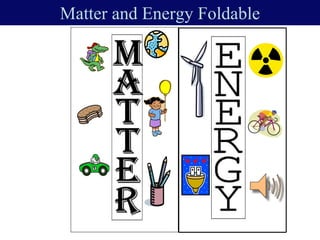
Matter and Energy Foldable
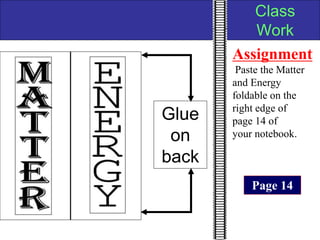
Class
Work
Assignment
Paste the Matter
and Energy
foldable on the
right edge of
page 14 of
your notebook.
Page 14
Glue
on
back
Notes
Matter &
Energy
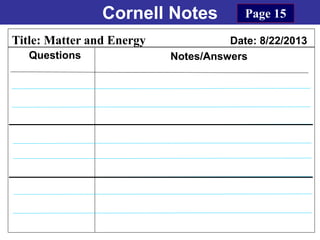
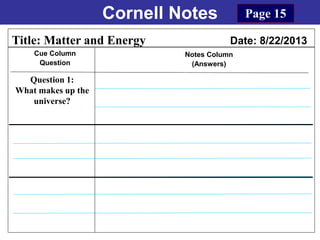
Cornell Notes
Questions Notes/Answers
Title: Matter and Energy Date: 8/22/2013
Page 15
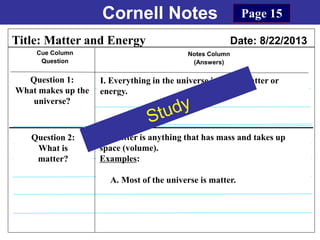
Question 1:
What Makes up
the Universe ?
Cornell Notes
Cue Column
Question
Notes Column
(Answers)
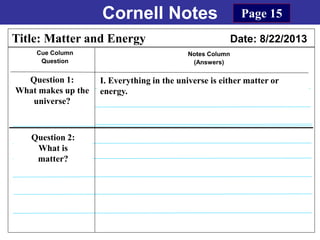
Title: Matter and Energy Date: 8/22/2013
Question 1:
What makes up the
universe?
Page 15
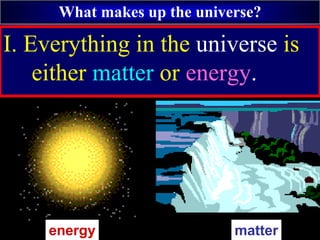
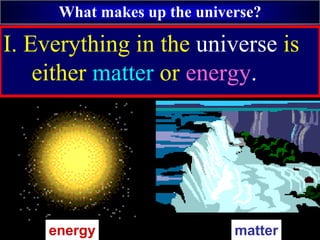
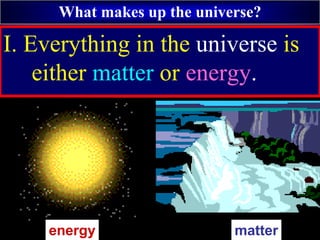
What makes up the universe?
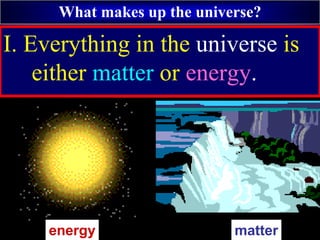
I. Everything in the universe is
either matter or energy.
matter
energy
Cornell Notes
Cue Column
Question
Notes Column
(Answers)
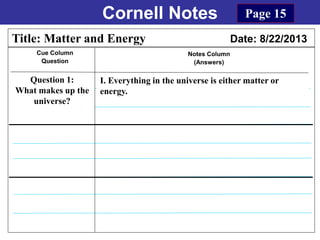
Title: Matter and Energy Date: 8/22/2013
Question 1:
What makes up the
universe?
I. Everything in the universe is either matter or
energy.
Page 15
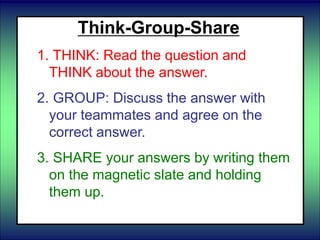
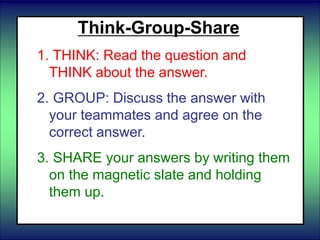
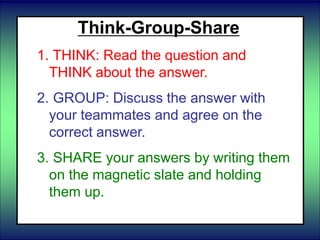
Think-Group-Share
1. THINK: Read the question and
THINK about the answer.
2. GROUP: Discuss the answer with
your teammates and agree on the
correct answer.
3. SHARE your answers by writing them
on the magnetic slate and holding
them up.
Think-Group-Share
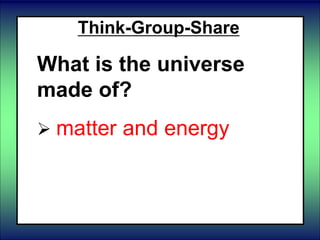
What is the universe
made of?
Think-Group-Share
What is the universe
made of?
 matter and energy
What makes up the universe?
I. Everything in the universe is
either matter or energy.
matter
energy
Question 2:
What is matter?
Cornell Notes
Cue Column
Question
Notes Column
(Answers)
Title: Matter and Energy Date: 8/22/2013
Question 1:
What makes up the
universe?
I. Everything in the universe is either matter or
energy.
Question 2:
What is
matter?
Page 15
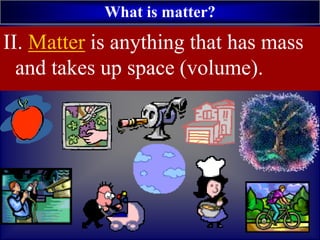
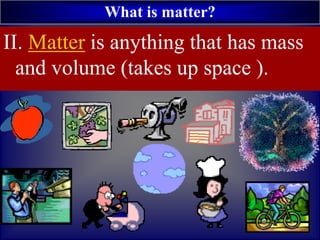
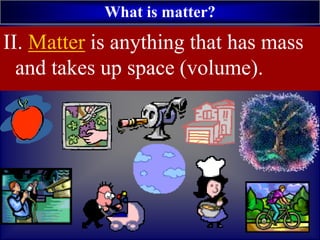
What is matter?
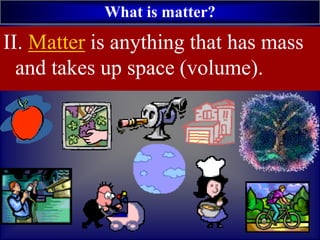
II. Matter is anything that has mass
and takes up space (volume).
Cornell Notes
Cue Column
Question
Notes Column
(Answers)
Title: Matter and Energy Date: 8/22/2013
Question 1:
What makes up the
universe?
I. Everything in the universe is either matter or
energy.
Question 2:
What is
matter?
Page 15
II. Matter is anything that has mass and takes up
space (volume).
Examples:
Matter and Energy
Foldable
Class Work
Matter and Energy Foldable
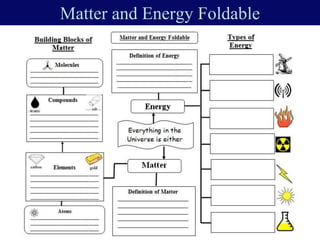
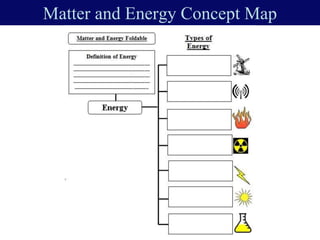
Matter and Energy Concept Map
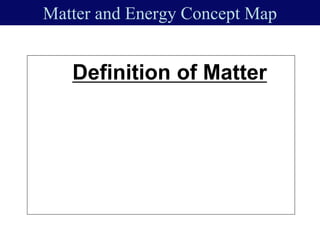
Definition of Matter
Matter and Energy Concept Map
Definition of Matter
Anything that has
mass and volume
(takes up space.)
Think-Group-Share
What is matter?
Think-Group-Share
What is matter?
 Anything that has mass
and volume (takes up space).
What is matter?
II. Matter is anything that has mass
and takes up space (volume).
Notes
Matter &
Energy
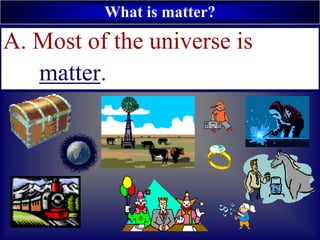
What is matter?
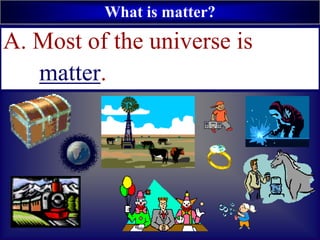
A. Most of the universe is
matter.
Cornell Notes
Cue Column
Question
Notes Column
(Answers)
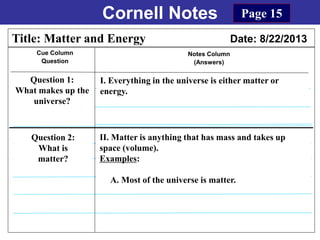
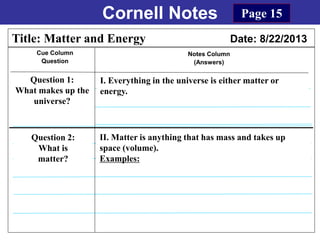
Title: Matter and Energy Date: 8/22/2013
Question 1:
What makes up the
universe?
I. Everything in the universe is either matter or
energy.
Question 2:
What is
matter?
Page 15
II. Matter is anything that has mass and takes up
space (volume).
Examples:
A. Most of the universe is matter.
Think-Group-Share
What is most of the
universe?
Think-Group-Share
What is most of the
universe?
 Most of the universe is
matter.
Matter and Energy
Foldable
Class Work
Matter and Energy Foldable
Matter &
Energy
Lesson Two
• Agenda
– 1. Bellringer:
• Matter and Energy Cryptogram
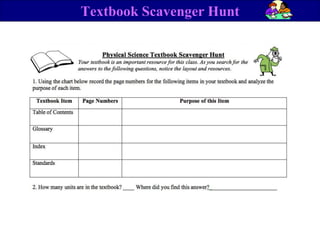
• Textbook Scavenger Hunt
– 2. Homework (Due: Monday 8/26/13)
• Classroom Rules Fable
– 3. Interactive Notebook
• Pages 14 and 15
– 4. Notes/PowerPoint
• Matter and Energy
– 5. Class Work
• Matter and Energy Foldable
– 6. Discovery Streaming/YouTube Videos
Matter and Energy
Cryptogram
BellRinger
Bellringer
Key Question
What are the parts of
my textbook?
Interactive Science
Notebooks
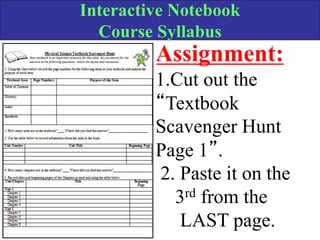
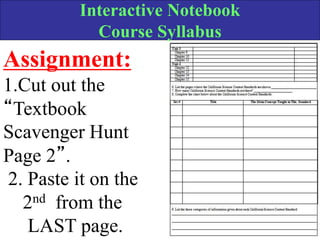
Interactive Notebook
Course Syllabus
Assignment:
1.Cut out the
“Textbook
Scavenger Hunt
Page 1”.
2. Paste it on the
3rd from the
LAST page.
Interactive Notebook
Course Syllabus
Assignment:
1.Cut out the
“Textbook
Scavenger Hunt
Page 2”.
2. Paste it on the
2nd from the
LAST page.
Cooperative Work
Textbook Scavenger
Hunt
BellRinger
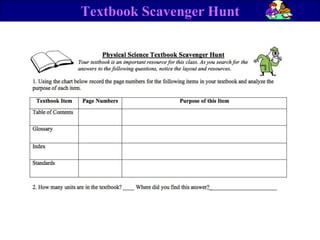
Textbook Scavenger Hunt
Homework: Monday 8/19/13
Homework
Assigned: Monday 8/19/13
Due: Monday 8/26/13
Classroom Rules Fable
Copy into your binder
Homework
Homework: Write a Fable About a Classroom Rule
Assigned: Monday 8/19/13 Due: Monday 8/26/13
Standard 3: Structure of Matter
Standard 3: . Each of the more
than 100 elements of matter has
distinct properties and a distinct
atomic structure. All forms of
matter are composed of one or
more of the elements.
California Science Standard
Standard 5c: Chemical Reactions
Students know chemical
reactions usually liberate
heat or absorb heat.
Content Objectives
After this lesson you should be able to:
1. Define energy
2. Define matter
3. Explain how energy affects matter.
Language Objectives
After this lesson I should be able to:
1. Read and listen to a presentation.
2. Write information on a thinking map and graphic
organizer.
3. Write Cornell notes.
4. Participate in whole class and small group discussion.
5. Read and write definitions.
6. Read and answer questions.
7. Read and follow laboratory experiment instructions
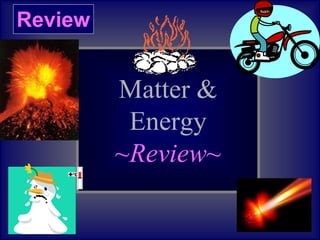
Review
Matter &
Energy
~Review~
Think-Group-Share
Review
• Matter and Energy Cornell Notes
(Page 15)
• Matter and Energy Foldable
(Page 14)
Matter and Energy Foldable Page 14
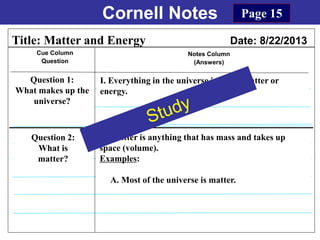
Cornell Notes
Cue Column
Question
Notes Column
(Answers)
Title: Matter and Energy Date: 8/22/2013
Question 1:
What makes up the
universe?
I. Everything in the universe is either matter or
energy.
Question 2:
What is
matter?
Page 15
II. Matter is anything that has mass and takes up
space (volume).
Examples:
A. Most of the universe is matter.
Think-Group-Share
1. THINK: Read the question and
THINK about the answer.
2. GROUP: Discuss the answer with
your teammates and agree on the
correct answer.
3. SHARE your answers by writing them
on the magnetic slate and holding
them up.
Think-Group-Share
What is the universe
made of?
Think-Group-Share
What is the universe
made of?
 matter and energy
What makes up the universe?
I. Everything in the universe is
either matter or energy.
matter
energy
Think-Group-Share
What is matter?
Think-Group-Share
What is matter?
 Anything that has mass
and volume (takes up space).
What is matter?
II. Matter is anything that has mass
and volume (takes up space ).
Think-Group-Share
What is most of the
universe?
Think-Group-Share
What is most of the
universe?
 Most of the universe is
matter.
What is matter?
A. Most of the universe is
matter.
Key Questions
What is energy?
How does energy affect
matter?
Discovery Streaming
Video
What is Energy?
Discovery Streaming
Video
Basics of Physics:
Exploring Energy?
Discovery Streaming
Video
Elements of Physics:
Energy and Power
Discovery Streaming
Video
Getting to Know
Energy
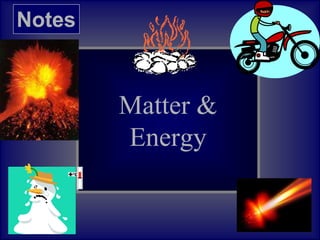
Notes
Matter &
Energy
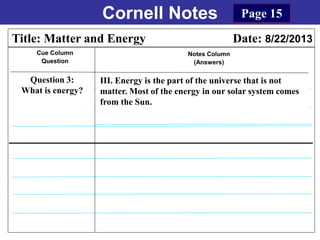
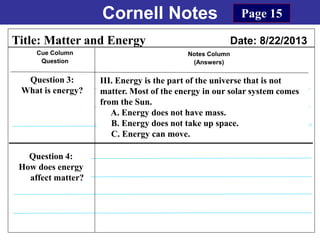
Question 3:
What is energy?
Cornell Notes
Cue Column
Question
Notes Column
(Answers)
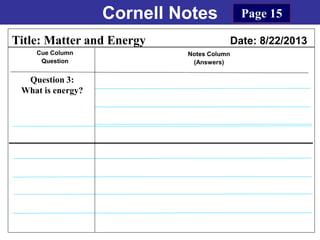
Title: Matter and Energy Date: 8/22/2013
Question 3:
What is energy?
Page 15
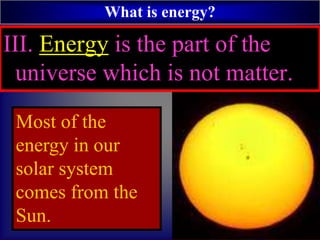
What is energy?
III. Energy is the part of the
universe which is not matter.
Most of the
energy in our
solar system
comes from the
Sun.
Cornell Notes
Cue Column
Question
Notes Column
(Answers)
Title: Matter and Energy Date: 8/22/2013
Question 3:
What is energy?
Page 15
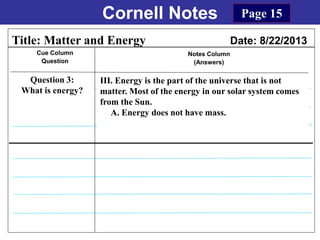
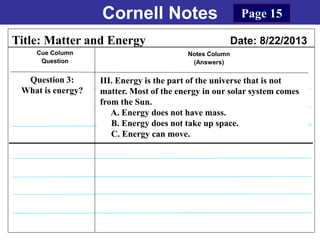
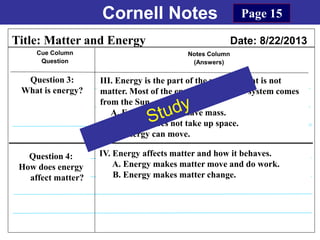
III. Energy is the part of the universe that is not
matter. Most of the energy in our solar system comes
from the Sun.
Think-Group-Share
What is energy?
Think-Group-Share
What is energy?
 The part of the universe
that is not matter.
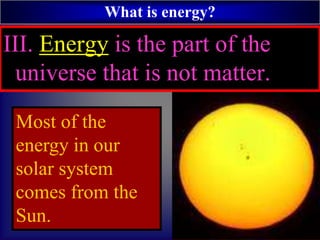
What is energy?
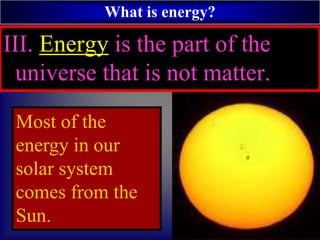
III. Energy is the part of the
universe that is not matter.
Most of the
energy in our
solar system
comes from the
Sun.
Notes
Matter &
Energy
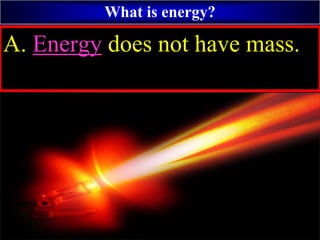
What is energy?
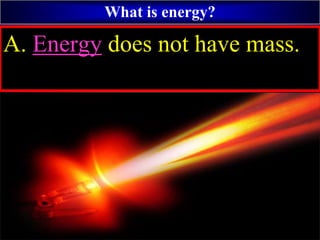
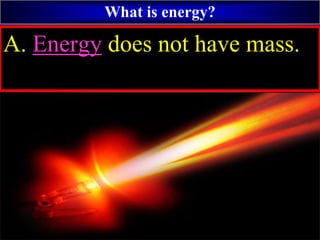
A. Energy does not have mass.
Cornell Notes
Cue Column
Question
Notes Column
(Answers)
Title: Matter and Energy Date: 8/22/2013
Question 3:
What is energy?
Page 15
III. Energy is the part of the universe that is not
matter. Most of the energy in our solar system comes
from the Sun.
A. Energy does not have mass.
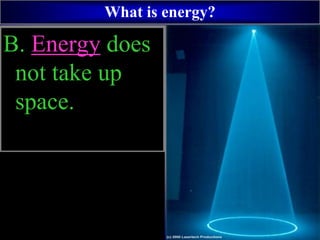
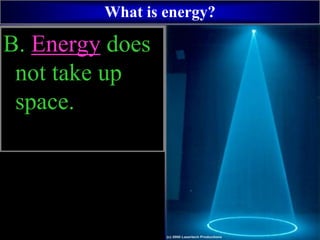
B. Energy does
not take up
space.
What is energy?
Cornell Notes
Cue Column
Question
Notes Column
(Answers)
Title: Matter and Energy Date: 8/22/2013
Question 3:
What is energy?
Page 15
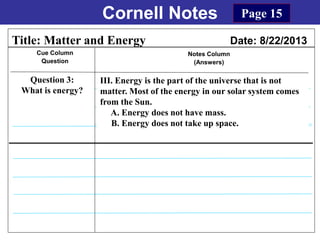
III. Energy is the part of the universe that is not
matter. Most of the energy in our solar system comes
from the Sun.
A. Energy does not have mass.
B. Energy does not take up space.
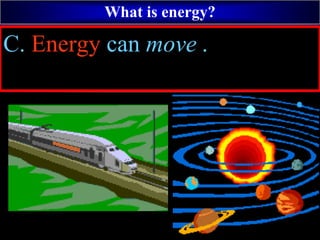
What is energy?
C. Energy can move .
Cornell Notes
Cue Column
Question
Notes Column
(Answers)
Title: Matter and Energy Date: 8/22/2013
Question 3:
What is energy?
Page 15
III. Energy is the part of the universe that is not
matter. Most of the energy in our solar system comes
from the Sun.
A. Energy does not have mass.
B. Energy does not take up space.
C. Energy can move.
Think-Group-Share
Name 2 things energy
does not have.
Think-Group-Share
Name 2 things energy
does not have.
 mass and volume
What is energy?
A. Energy does not have mass.
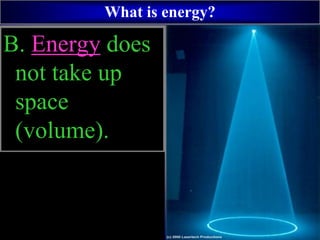
B. Energy does
not take up
space.
What is energy?
Notes
Matter &
Energy
Question 4:
How does
energy affect
matter?
Cornell Notes
Cue Column
Question
Notes Column
(Answers)
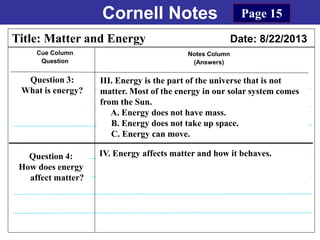
Title: Matter and Energy Date: 8/22/2013
Question 3:
What is energy?
Question 4:
How does energy
affect matter?
Page 15
III. Energy is the part of the universe that is not
matter. Most of the energy in our solar system comes
from the Sun.
A. Energy does not have mass.
B. Energy does not take up space.
C. Energy can move.
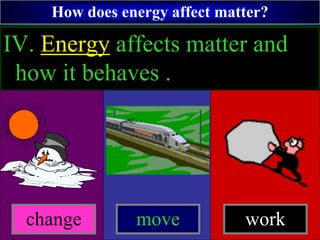
How does energy affect matter?
IV. Energy affects matter and
how it behaves .
change move work
Cornell Notes
Cue Column
Question
Notes Column
(Answers)
Title: Matter and Energy Date: 8/22/2013
Question 3:
What is energy?
Question 4:
How does energy
affect matter?
Page 15
IV. Energy affects matter and how it behaves.
III. Energy is the part of the universe that is not
matter. Most of the energy in our solar system comes
from the Sun.
A. Energy does not have mass.
B. Energy does not take up space.
C. Energy can move.
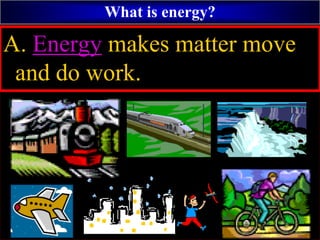
What is energy?
A. Energy makes matter move
and do work.
Cornell Notes
Cue Column
Question
Notes Column
(Answers)
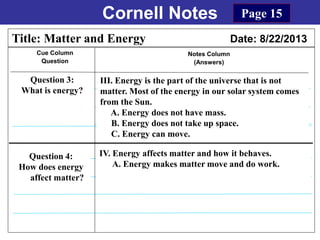
Title: Matter and Energy Date: 8/22/2013
Question 3:
What is energy?
Question 4:
How does energy
affect matter?
Page 15
IV. Energy affects matter and how it behaves.
A. Energy makes matter move and do work.
III. Energy is the part of the universe that is not
matter. Most of the energy in our solar system comes
from the Sun.
A. Energy does not have mass.
B. Energy does not take up space.
C. Energy can move.
What is energy?
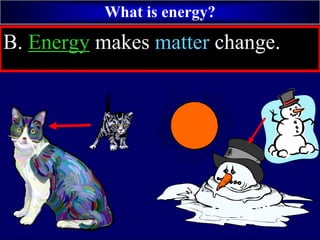
B. Energy makes matter change.
Cornell Notes
Cue Column
Question
Notes Column
(Answers)
Title: Matter and Energy Date: 8/22/2013
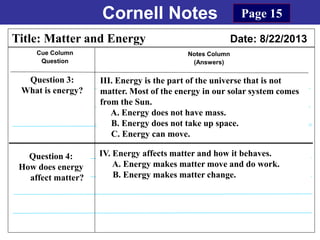
Question 3:
What is energy?
Question 4:
How does energy
affect matter?
Page 15
IV. Energy affects matter and how it behaves.
A. Energy makes matter move and do work.
B. Energy makes matter change.
III. Energy is the part of the universe that is not
matter. Most of the energy in our solar system comes
from the Sun.
A. Energy does not have mass.
B. Energy does not take up space.
C. Energy can move.
Think-Group-Share
Name three things
energy makes matter do.
Think-Group-Share
Name three things
energy makes matter do.
 change
 move
 do work
How does energy affect matter?
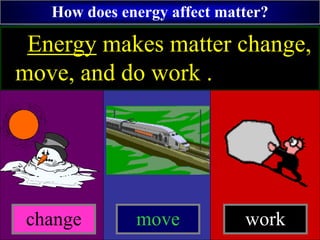
Energy makes matter change,
move, and do work .
change move work
Matter and Energy
Foldable
Class Work
Matter and Energy Foldable
Matter and Energy Concept Map
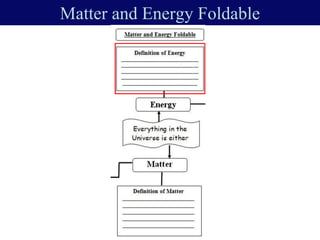
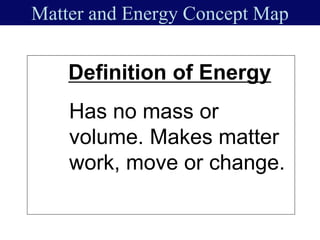
Definition of Energy
Matter and Energy Concept Map
Definition of Energy
Has no mass or
volume. Makes matter
work, move or change.
Matter &
Energy
Lesson Three
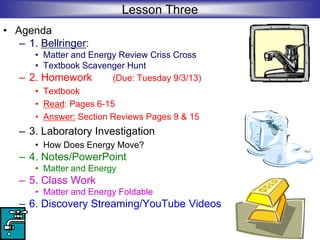
• Agenda
– 1. Bellringer:
• Matter and Energy Review Criss Cross
• Textbook Scavenger Hunt
– 2. Homework (Due: Tuesday 9/3/13)
• Textbook
• Read: Pages 6-15
• Answer: Section Reviews Pages 9 & 15
– 3. Laboratory Investigation
• How Does Energy Move?
– 4. Notes/PowerPoint
• Matter and Energy
– 5. Class Work
• Matter and Energy Foldable
– 6. Discovery Streaming/YouTube Videos
Matter and Energy
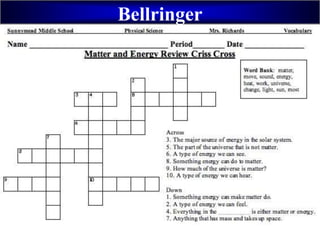
Review Criss Cross
BellRinger
Bellringer
Key Question
What are the parts of
my textbook?
Cooperative Work
Textbook Scavenger
Hunt
BellRinger
Textbook Scavenger Hunt
Homework: Monday 8/19/13
Turn in Homework
Assigned: Monday 8/19/13
Due: Monday 8/26/13
Classroom Rules Fable
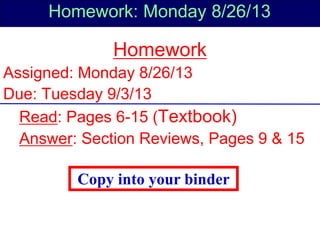
Homework: Monday 8/26/13
Homework
Assigned: Monday 8/26/13
Due: Tuesday 9/3/13
Read: Pages 6-15 (Textbook)
Answer: Section Reviews, Pages 9 & 15
Copy into your binder
Standard 3: Structure of Matter
Standard 3: . Each of the more
than 100 elements of matter has
distinct properties and a distinct
atomic structure. All forms of
matter are composed of one or
more of the elements.
California Science Standard
Standard 5c: Chemical Reactions
Students know chemical
reactions usually liberate
heat or absorb heat.
Content Objectives
After this lesson you should be able to:
1. Define energy
2. Explain how energy affects matter.
3. Identify seven forms of energy.
4. Demonstrate how energy moves.
Language Objectives
After this lesson I should be able to:
1. Read and listen to a presentation.
2. Write information on a thinking map and graphic
organizer.
3. Write Cornell notes.
4. Participate in whole class and small group discussion.
5. Read and write definitions.
6. Read and answer questions.
7. Read and follow laboratory experiment instructions
Key Questions
What is energy?
How does energy affect
matter?
What are common forms
of energy?
Review
Matter &
Energy
~Review~
Think-Group-Share
Review
• Matter and Energy Cornell Notes
(Page 15)
• Matter and Energy Foldable
(Page 14)
Matter and Energy Foldable Page 14
Cornell Notes
Cue Column
Question
Notes Column
(Answers)
Title: Matter and Energy Date: 8/22/2013
Question 1:
What makes up the
universe?
I. Everything in the universe is either matter or
energy.
Question 2:
What is
matter?
Page 15
II. Matter is anything that has mass and takes up
space (volume).
Examples:
A. Most of the universe is matter.
Cornell Notes
Cue Column
Question
Notes Column
(Answers)
Title: Matter and Energy Date: 8/22/2013
Question 3:
What is energy?
Question 4:
How does energy
affect matter?
Page 15
IV. Energy affects matter and how it behaves.
A. Energy makes matter move and do work.
B. Energy makes matter change.
III. Energy is the part of the universe that is not
matter. Most of the energy in our solar system comes
from the Sun.
A. Energy does not have mass.
B. Energy does not take up space.
C. Energy can move.
Think-Group-Share
1. THINK: Read the question and
THINK about the answer.
2. GROUP: Discuss the answer with
your teammates and agree on the
correct answer.
3. SHARE your answers by writing them
on the magnetic slate and holding
them up.
Think-Group-Share
What is the universe
made of?
Think-Group-Share
What is the universe
made of?
 matter and energy
What makes up the universe?
I. Everything in the universe is
either matter or energy.
matter
energy
Think-Group-Share
What is matter?
Think-Group-Share
What is matter?
 Anything that has mass
and volume (takes up space).
What is matter?
II. Matter is anything that has mass
and takes up space (volume).
Think-Group-Share
What is energy?
Think-Group-Share
What is energy?
 The part of the universe
that is not matter.
What is energy?
III. Energy is the part of the
universe that is not matter.
Most of the
energy in our
solar system
comes from the
Sun.
Think-Group-Share
Name 2 things energy
does not have.
Think-Group-Share
Name 2 things energy
does not have.
 mass and volume
What is energy?
A. Energy does not have mass.
B. Energy does
not take up
space
(volume).
What is energy?
Notes
Matter &
Energy
Question 5:
What are
common forms
of energy?
Cornell Notes
Cue Column
Question
Notes Column
(Answers)
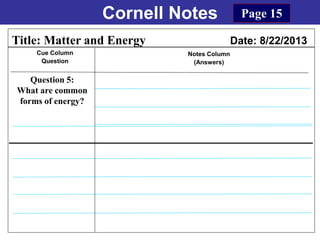
Title: Matter and Energy Date: 8/22/2013
Question 5:
What are common
forms of energy?
Page 15
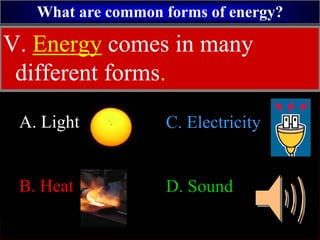
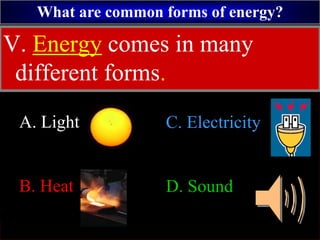
What are common forms of energy?
A. Light
B. Heat
C. Electricity
D. Sound
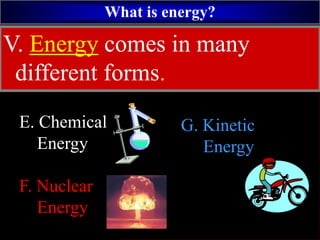
V. Energy comes in many
different forms.
Cornell Notes
Cue Column
Question
Notes Column
(Answers)
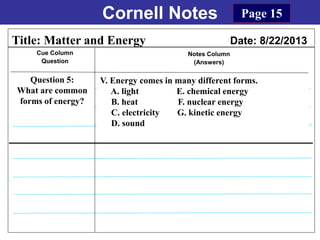
Title: Matter and Energy Date: 8/22/2013
Question 5:
What are common
forms of energy?
Page 15
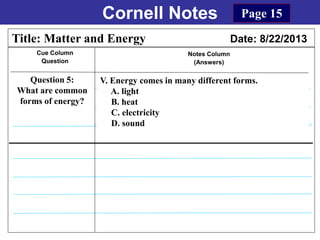
V. Energy comes in many different forms.
A. light
B. heat
C. electricity
D. sound
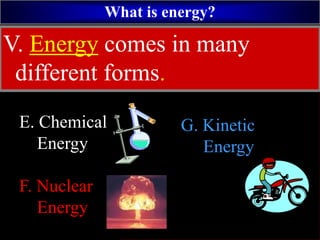
What is energy?
E. Chemical
Energy
F. Nuclear
Energy
G. Kinetic
Energy
F. Energy comes in many
different forms.
V. Energy comes in many
different forms.
Cornell Notes
Cue Column
Question
Notes Column
(Answers)
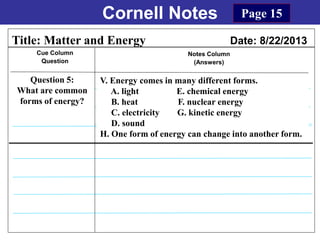
Title: Matter and Energy Date: 8/22/2013
Question 5:
What are common
forms of energy?
Page 15
V. Energy comes in many different forms.
A. light E. chemical energy
B. heat F. nuclear energy
C. electricity G. kinetic energy
D. sound
Think-Group-Share
What are 7 common forms
of energy?
Think-Group-Share
What are 7 common forms
of energy?
kinetic energy sound
chemical energy light
nuclear energy heat
electricity
Notes
Matter &
Energy
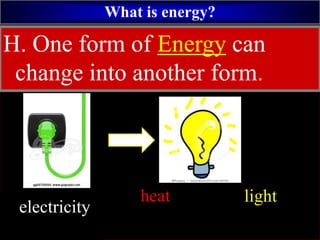
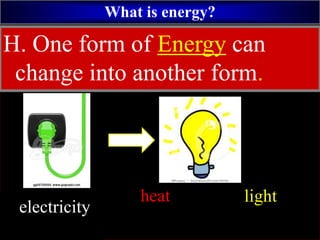
What is energy?
light
F. Energy comes in many
different forms.
H. One form of Energy can
change into another form.
heat
electricity
Cornell Notes
Cue Column
Question
Notes Column
(Answers)
Title: Matter and Energy Date: 8/22/2013
Question 5:
What are common
forms of energy?
Page 15
V. Energy comes in many different forms.
A. light E. chemical energy
B. heat F. nuclear energy
C. electricity G. kinetic energy
D. sound
H. One form of energy can change into another form.
Think-Group-Share
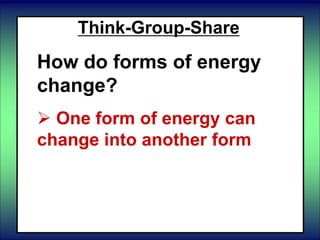
How do forms of energy
change?
Think-Group-Share
How do forms of energy
change?
 One form of energy can
change into another form
Matter and Energy
Foldable
Class Work
Matter and Energy Foldable
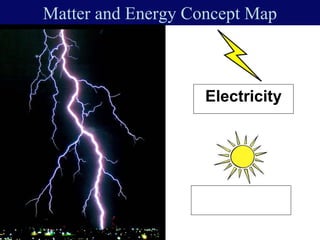
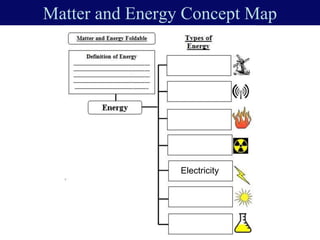
Matter and Energy Concept Map
Electricity
Matter and Energy Concept Map
Electricity
You Tube Video
Electricity: Amazing
Lightning Storm
Strikes 8 Times
You Tube Video
Electricity:
Lightening Storms
Around the World
Discovery Streaming
Electricity:
Mythbusters
Lightning Safety
Analyzing Energy
• Think about this question:
What other forms of energy did
electricity change into?
• Group with your teammates.
Discuss your answer with your
teammates.
• Share with someone else
Share your answer with the class.
How does energy
move?
Laboratory Investigation
Analyzing Energy
• Think about this question:
Why did the energy stick activate
when we held hands
Why did it stop when we let go?
• Group with your teammates.
Discuss your answer with your
teammates.
• Share with someone else
Share your answer with the class.
Notes
Matter &
Energy
Question 5:
What are
common forms
of energy?
What are common forms of energy?
A. Light
B. Heat
C. Electricity
D. Sound
V. Energy comes in many
different forms.
What is energy?
E. Chemical
Energy
F. Nuclear
Energy
G. Kinetic
Energy
F. Energy comes in many
different forms.
V. Energy comes in many
different forms.
What is energy?
light
F. Energy comes in many
different forms.
H. One form of Energy can
change into another form.
heat
electricity
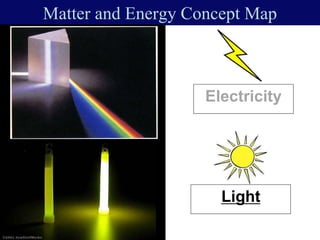
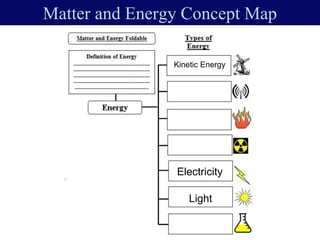
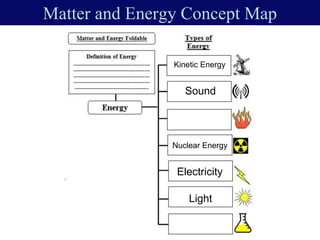
Matter and Energy Concept Map
Light
Electricity
Matter and Energy Concept Map
Electricity
Light
You Tube Video
Light:
Laser Harp Fully
Functional
You Tube Video
Light:
Laser Harp
Malfunction Jeanne
Michel Jarre
Analyzing Energy
• Think about this question:
What other forms of energy did light
change into?
• Group with your teammates.
Discuss your answer with your
teammates.
• Share with someone else
Share your answer with the class.
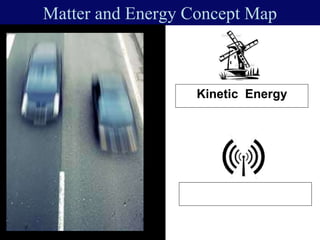
Matter and Energy Concept Map
Kinetic Energy
Matter and Energy Concept Map
Electricity
Light
Kinetic Energy
You Tube Video
Kinetic Energy:
Crazy Windmills
Analyzing Energy
• Think about this question:
What other forms of energy did kinetic
energy change into?
• Group with your teammates.
Discuss your answer with your
teammates.
• Share with someone else
Share your answer with the class.
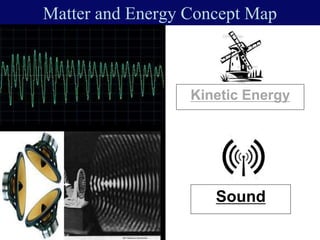
Matter and Energy Concept Map
Kinetic Energy
Sound
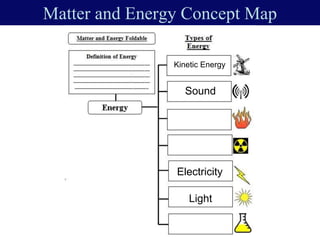
Matter and Energy Concept Map
Electricity
Light
Kinetic Energy
Sound
You Tube Video
Sound:
Doppler Effect Shock
Wave and Sonic Boom
(7:30)
Discovery Streaming
Sound:
Mythbusters
Breaking Glass
YouTube
Sound:
A Mythbusters Glass
Shattering Montage
Analyzing Energy
• Think about this question:
What other forms of energy did sound
change into?
• Group with your teammates.
Discuss your answer with your
teammates.
• Share with someone else
Share your answer with the class.
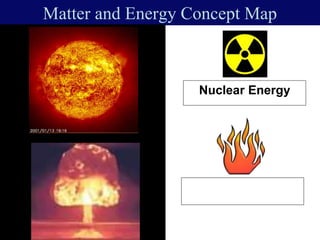
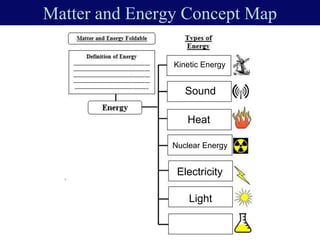
Matter and Energy Concept Map
Nuclear Energy
Matter and Energy Concept Map
Electricity
Light
Kinetic Energy
Sound
Nuclear Energy
You Tube Video
Nuclear Energy:
Nuclear Bomb
Montage
You Tube Video
Nuclear Energy:
Nuclear and
Hydrogen Explosions
You Tube Video
Nuclear Energy:
10 Nuclear
Explosions
Analyzing Energy
• Think about this question:
What other forms of energy did
nuclear energy change into?
• Group with your teammates.
Discuss your answer with your
teammates.
• Share with someone else
Share your answer with the class.
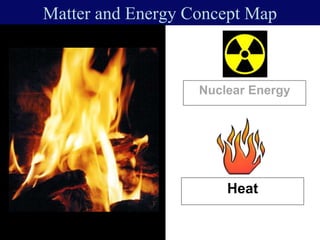
Matter and Energy Concept Map
Nuclear Energy
Heat
Matter and Energy Concept Map
Electricity
Light
Kinetic Energy
Sound
Nuclear Energy
Heat
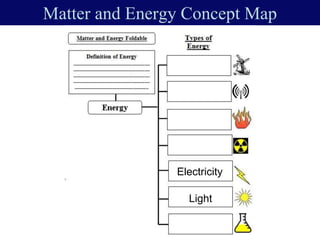
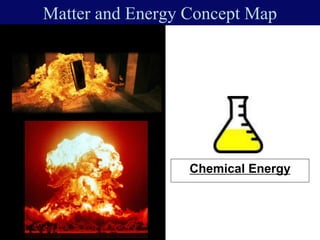
Matter and Energy Concept Map
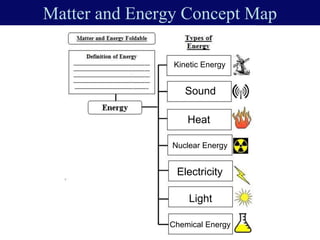
Chemical Energy
Matter and Energy Concept Map
Electricity
Light
Kinetic Energy
Sound
Nuclear Energy
Heat
Chemical Energy
You Tube Video
Chemical Energy:
TLC: Largest Non Nuclear
Explosions
(0:59)
Analyzing Energy
• Think about this question:
What other forms of energy did
nuclear energy change into?
• Group with your teammates.
Discuss your answer with your
teammates.
• Share with someone else
Share your answer with the class.
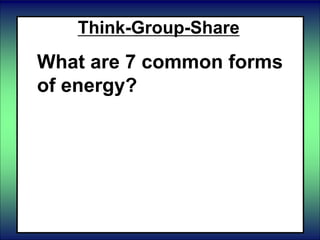
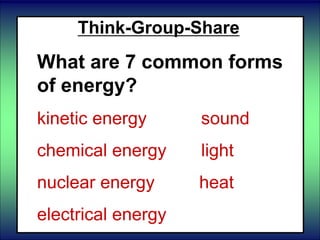
Think-Group-Share
What are 7 common forms
of energy?
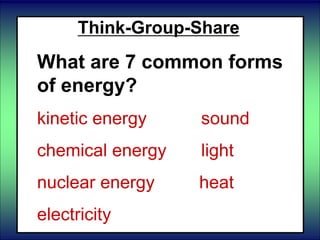
Think-Group-Share
What are 7 common forms
of energy?
kinetic energy sound
chemical energy light
nuclear energy heat
electrical energy
Matter and Energy
Foldable
Class Work
Matter and Energy Foldable
Disney Video
Bill Nye:
Energy
Matter and Energy Introduction Lessons

Matter and Energy Introduction Lessons