By: Mrs. MJ Patterson
5th Grade
Matter and Energy
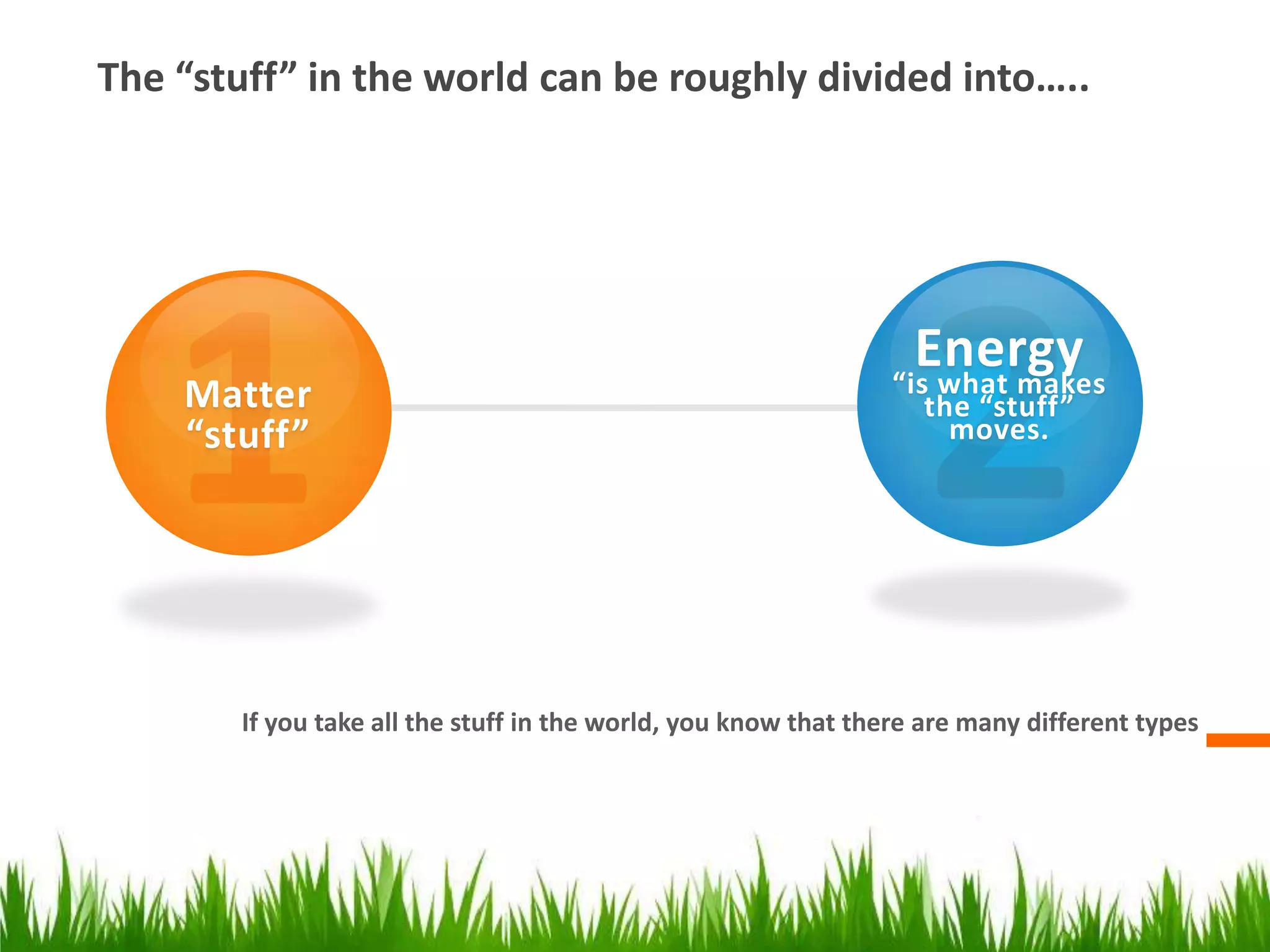
The “stuff” in the world can be roughly divided into…..
If you take all the stuff in the world, you know that there are many different types
Matter
“stuff”
Energy“is what makes
the “stuff”
moves.
Matter “stuff”. Anything
that takes up space and
has mass.
Matter matter everywhere !!!!
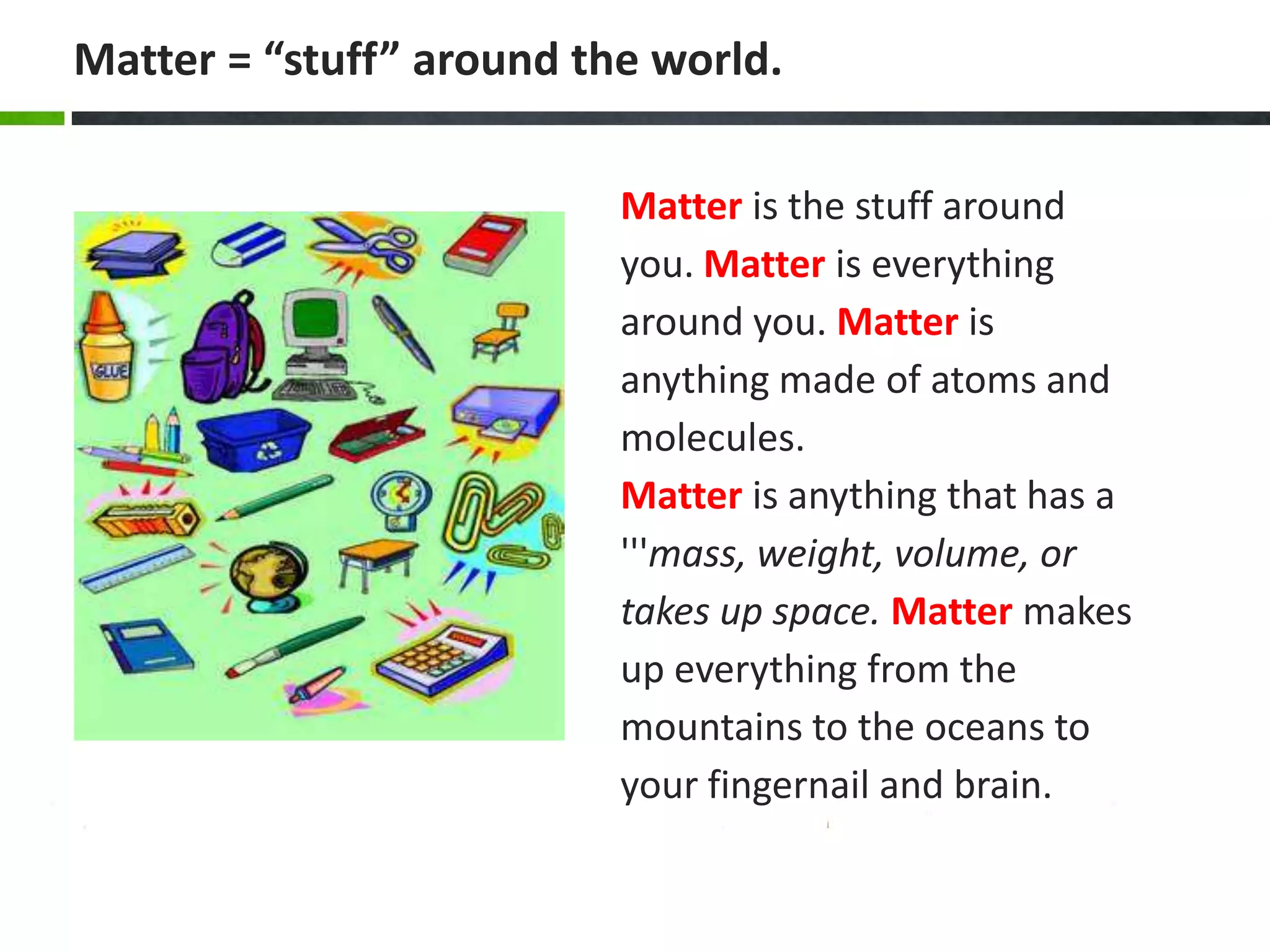
Matter is the stuff around
you. Matter is everything
around you. Matter is
anything made of atoms and
molecules.
Matter is anything that has a
'''mass, weight, volume, or
takes up space. Matter makes
up everything from the
mountains to the oceans to
your fingernail and brain.
Matter = “stuff” around the world.
MATTER MATTER CONCEPT MAP
MATTER
MATTER
SOLID
LIQUID
GAS
COLOR
TEXTURE
ODOR
TASTE
VOLUME
MASS
WEIGHT
SHAPE
SIZETEMPERATURE
MATTER
SOLID
LIQUID
GAS
conductivity
magnetism
solubility
mixture
TEMPERATURE
Boiling pt
Freezing pt
solution
Melting ptdensity
AMOUNT OF MATTER IN AN
OBJECT
MASS DOES NOT CHANGE. MEASURED IN GRAMS
MASS
USES A TRIPLE BEAM BALANCE TO
MEASURE MASS.
MASS DOES NOT CHANGE.
MASS
METRIC UNITS OF MASS: MILLIGRAMS, GRAMS,
KILOGRAM
MASS
WHICH ONE DO YOU THINK HAS MORE MASS?
BASED ON
GRAVITATIONAL PULL ON
AN OBJECT.
WEIGHT CHANGES DEPENDING ON THE GRAVITATIONAL PULL.
METRIC UNITS OF WEIGHT: POUNDS (LB.)
MEASURED IN NEWTONS
(POUNDS).
SPRING
SCALE
MASS VS. WEIGHT
MASS VS. WEIGHT
MATTER
SOLID
LIQUID
GAS
COLOR
TEXTURE
ODOR
TASTE
VOLUME
MASS
WEIGHT
SHAPE
SIZETEMPERATURE
Amount of space occupied
by matter.
METRIC UNITS OF WEIGHT: SOLID (cubic centimeter; cubic inch; etc); LIQUID (milliliters,
liters).
METRIC UNITS OF WEIGHT: SOLID (cubic centimeter; cubic inch; etc); LIQUID (milliliters,
liters).
MATTER
SOLID
LIQUID
GAS
COLOR
TEXTURE
ODOR
TASTE
VOLUME
MASS
WEIGHT
SHAPE
SIZETEMPERATURE
MATTER
SOLID
LIQUID
GAS
conductivity
magnetism
solubility
mixture
TEMPERATURE
Boiling pt
Freezing pt
solution
Melting ptdensity
Electromagnetism
The term "magnetic effect of current" means that "a current flowing in a wire produces
a magnetic field around it".
The magnetic effect of current was discovered by Oersted in 1820. He concluded that a
current flowing in a wire always gives rise to a magnetic field round it. The magnetic
effect of current is called electromagnetism which means that electricity produces
magnetism.
Guiding Question:
How can you create a magnetic characteristic from a
non-magnet material?
Conductivity is the measure of the ease at which
an electric charge or heat can pass through a
material.
Electrical conductivity tells us how well a material
will allow electricity to travel through it. Many
people think of copper wires as something that
has great electrical conductivity.
Thermal Conductors = a material that allows
energy in the form of heat, to be transferred
within the material, without any movement of the
material itself.
Conductors
copper
Conductors
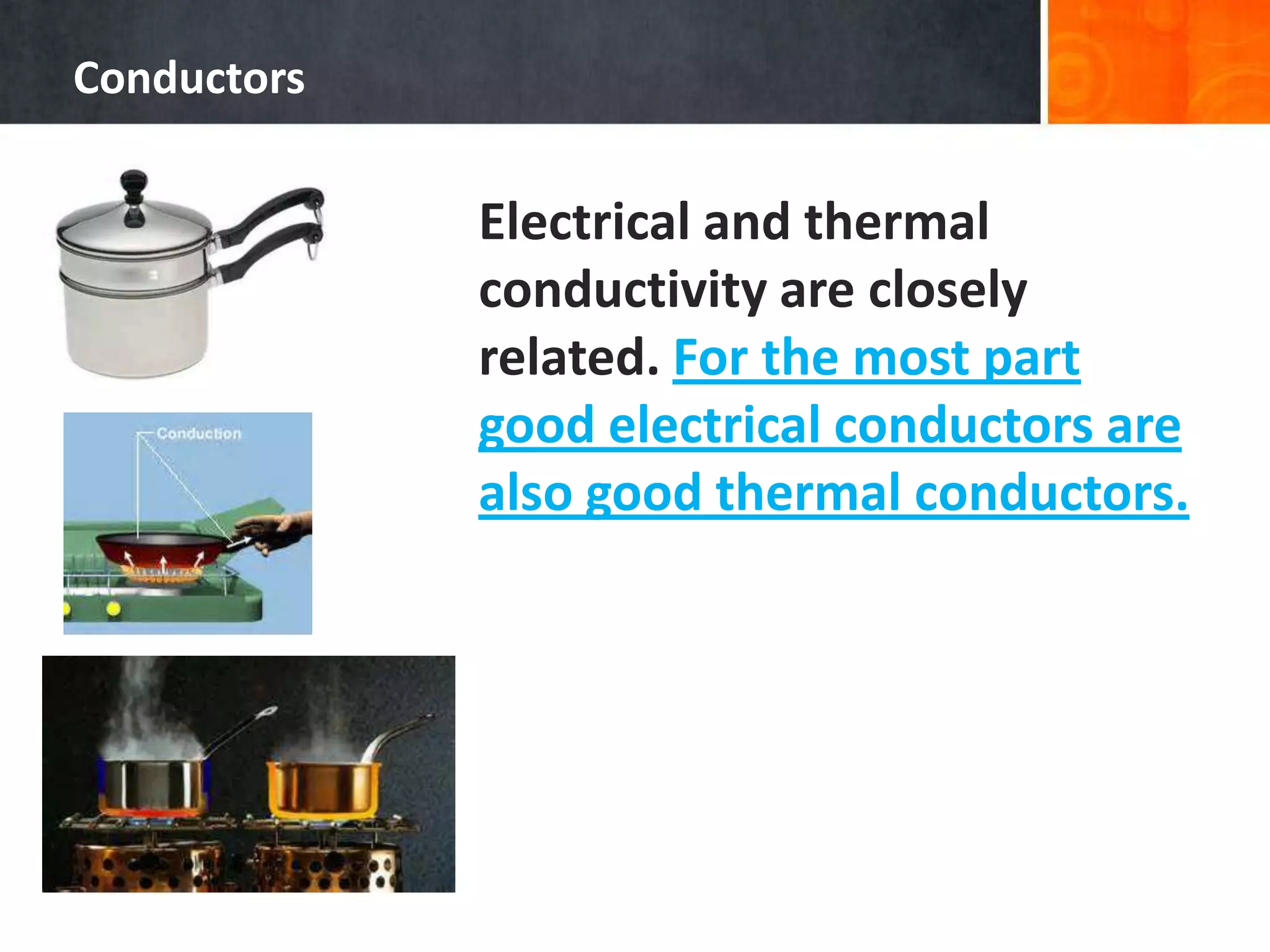
Electrical and thermal
conductivity are closely
related. For the most part
good electrical conductors are
also good thermal conductors.
Conductors
Different Types of Conductors
(1) Metals are traditional conducting materials.
You see them around the house all of the time.
It's a metal wire or one of the metal prongs in
an electric plug. There are a lot of free
electrons in metallic conductors. Free electrons
are electrons that are not being held in atoms,
and so, can move easily. Some of the best
metallic conductors are copper (Cu), silver
(Ag), and gold (Au).
There are some conductors that are not
metals. Carbon is the best example.
A solution such as saltwater has a lot of free ions floating around. Those ions
(charged atoms) can flow easily, and ionic solutions are very good conductors. One
of the reasons you need to get out of the water if there is lightning around, is that
water normally contains dissolved ions, and if lightning hits the liquid (solution), it
might conduct electricity long distances and electrocute you.
Electrical Conductors
Heat Conductors
Heat passes through some materials easily
and these materials are called thermal
conductors.
Heat loves to travel and will travel from a warmer
material to a colder material. The heat will only
travel from hot things to colder things and never
the other way around.
Electrical Insulator
Handling electricity can have very dangerous
consequences, so it is necessary to insulate it
from the surrounding environment. Therefore,
conductors, such as copper wire, are wrapped
in insulating material. Insulating material does
not readily share electrons.
Insulators are nonconductive materials that do
not readily share electrons throughout
themselves. Examples of these are most
plastics and rubber, wood, glass and many
ceramics. In general, many nonmetals are
good insulators. There are always some
exceptions (graphite fibers), so it is safest to
test if a material is a good insulator.
Thermal Insulator
Thermal Insulator Activity
Driving Question:
Which cup can keep the heat longer –
styrofoam, plastic, paper?
MATTER
SOLID
LIQUID
GAS
conductivity
magnetism
solubility
mixture
TEMPERATURE
Boiling pt
Freezing pt
solution
Melting ptdensity
DENSIT
Y
SINK OR FLOAT
The density of a substance
indicates how the particles of a
substance are packed together
within the substance.

The tighter the particles are
packed, the higher the density of
the substance.
Formula:
Mass / volume =
DENSITY
OF
LIQUID
SINK OR FLOAT
Activity 1:
What are some examples of liquid that is more
dense than water?
What are some examples of liquid that is less dense
than water?
Vegetable oil, water (red), dish soap (green), corn
syrup, honey
DENSIT
Y OF
GAS
SINK OR FLOAT
Activity :
Air and helium are both gas. Do they have the same
density?
DENSITY
OF SOLID
SINK OR FLOAT
Activity:
Which material is the most dense?
Popsicle stick; crayon; pasta; paper clip
MATTER
SOLID
LIQUID
GAS
conductivity
magnetism
solubility
mixture
TEMPERATURE
Boiling pt
Freezing pt
solution
Melting ptdensity
You just filled your brain with so much Science concepts. We don’t
want to forget about them. Take the time to look over your notes.
Which one is your favorite?
Review
Have fun!

Matter and energy ppt

Editor's Notes

  • #2 This presentation demonstrates the new capabilities of PowerPoint and it is best viewed in Slide Show. These slides are designed to give you great ideas for the presentations you’ll create in PowerPoint 2011!For more sample templates, click the File menu, and then click New From Template. Under Templates, click Presentations.